INTRODUCTION
Bilingualism or multilingualism is a fairly common phenomenon across the world, with some scholars estimating that about 50% of the world's population understands and speaks two or more languages on a regular basis (Grosjean, Reference Grosjean2010). The bilingual experience is shaped by various factors that lead to marked variations in its expression across individuals. These factors include, for instance, the age and manner in which the languages were acquired, the frequency and regularity with which each of the languages is used, the contexts in which they are used, the general proficiency in each of the languages, and the relative proficiency across different language domains, as well as individual and societal attitudes toward each of the languages (for a review, see Wei, Reference Wei and Wei2000). Thus, while, in general, one can define bilingualism as a phenomenon that involves the ability to use two or more languages, the multidimensionality of the bilingual experience makes operationalizing and consequently measuring bilingualism and bilingual language competence challenging for researchers, educators, and policymakers alike.
Operationalizing bilingualism and measuring the competence of emerging bilinguals—young children who are learning two or more languages simultaneously or sequentially (i.e., at or after age 3)—pose an even greater challenge. Children are not only in the active process of acquiring both languages, but also the developmental pathways and rates of growth for both languages are highly sensitive to the amount and type of input they receive for that language, as well as to various other contextual (e.g., the role of the family and societal attitudes toward the languages), individual (e.g., children's age, personality, and motivation), and language-based (e.g., complexity of linguistic structure) factors (Grosjean, Reference Grosjean2010; Paradis, Genesee, & Crago, Reference Paradis, Genesee and Crago2011). The trajectory and rate of development in each language, in turn, influence two important measures of children's bilingualism: the child's proficiency (i.e., the general linguistic skill level) in each language as well as across both languages, and the dominance (i.e., the relation between languages with regard to skill level and use; Montrul, Reference Montrul, Silva-Corvalán and Treffers-Daller2016). Given the dynamic nature of development, children's linguistic competence in each language and the relation between the languages are continuously changing. Yet, capturing childhood bilingualism is critical not only for researchers examining children's language development, but also for those interested in exploring the relation between bilingualism and other aspects of development.
Research investigating the consequences of bilingualism for other aspects of development has mostly focused on the intersection of bilingualism and cognitive domains, such as abstract reasoning and problem solving, cognitive flexibility, and metalinguistic awareness, as well as attention control and working memory. Most of this work has explored differences between bilingual and monolingual children, with some exceptions (e.g., Chen, Zhou, Uchikoshi, & Bunge, Reference Chen, Zhou, Uchikoshi and Bunge2014; Thomas-Sunesson, Hakuta, & Bialystok, Reference Thomas-Sunesson, Hakuta and Bialystok2016; White & Greenfield, Reference White and Greenfield2017). The comparative approach treats bilingualism as a categorical variable, foregrounding between-group differences at the expense of within-group variations. Although this issue has been addressed recently in various studies (e.g., von Bastian, Souza, & Gade, Reference von Bastian, Souza and Gade2016), this work has mostly been conducted with adult bilinguals. The purpose of this article is to contribute to these recent research efforts by examining individual differences in children's bilingualism and how these variations might play out in the relation to self-regulation, one of the critical skills associated with school success.
EARLY BILINGUALISM AND CHILDREN'S COGNITIVE DEVELOPMENT
The relation between bilingualism and cognitive development has been the subject of much research (for reviews, see Adesope, Lavin, Thompson, & Ungerleider, Reference Adesope, Lavin, Thompson and Ungerleider2010; Bialystok, Reference Bialystok2009; Valian, Reference Valian2015). For half of the 20th century, there was a general consensus that children growing up bilingually faced a general disadvantage in development, and much of the work was centered on identifying the negative effects. Peal and Lambert's (Reference Peal and Lambert1962) seminal work was among the first to demonstrate positive cognitive outcomes for bilingual children, in particular greater cognitive flexibility and superior concept formation, as compared to monolingual children. Subsequent research has centered on investigating whether growing up bilingually confers cognitive benefits on children and, if so, in what cognitive areas. The underlying explanation is that managing and using two languages on a regular basis (i.e., having to choose languages frequently depending on the context, inhibiting one language when using the other, or frequent switching) affords bilingual children with daily experiences that foster the development of key cognitive skills (Bialystok, Reference Bialystok2001, Reference Bialystok2007).
Most of this work has indeed found cognitive advantages for bilingual children living in various countries, having varying socioeconomic backgrounds, and speaking diverse languages (e.g., Bialystok, Reference Bialystok2015; Bialystok, Craik, & Luk, Reference Bialystok, Craik and Luk2012). For instance, bilingual children outperform monolingual children in various areas of metalinguistic awareness, including phonological, word, and syntactic awareness (e.g., Bialystok, Reference Bialystok2001; Chen et al., Reference Chen, Anderson, Li, Hao, Wu and Shu2004; Davidson, Raschke, & Pervez, Reference Davidson, Raschke and Pervez2010). Bilingual children also demonstrate increased ability and flexibility in learning new words, especially in learning new labels for referents for which they already have an associated label (Yoshida, Reference Yoshida2008; Yoshida, Tran, Benitez, & Kuwabara, Reference Yoshida, Tran, Benitez and Kuwabara2011). Bilingualism has also been associated with representational flexibility (Adi-Japha, Berberich-Artzi, & Libnawi, Reference Adi-Japha, Berberich-Artzi and Libnawi2010), as well as with more advanced memory and learning processes, especially during the infant years (Brito & Barr, Reference Brito and Barr2012, Reference Brito and Barr2014). We would be remiss not to acknowledge that there are studies that do not find significant differences between bilingual and monolingual children (e.g., de Bruin, Treccani, & Della Sala, Reference de Bruin, Treccani and Della Sala2015). Yet, in a somewhat recent meta-analysis examining contradictory findings, Adesope et al. (Reference Adesope, Lavin, Thompson and Ungerleider2010) found an overall positive effect of bilingualism on various cognitive areas, including metalinguistic awareness, metacognitive awareness, abstract representation, attention control, and problem solving.
In the last 10 years, research has focused on children's self-regulation, or children's ability to regulate their attention processes and to modulate their emotional and behavioral responses to situational demands (Smith-Donald, Raver, Hayes, & Richardson, Reference Smith-Donald, Raver, Hayes and Richardson2007). The increased interest of both basic and applied child development researchers from across disciplines stems from various key features of self-regulation skills: (a) It has a strong predictive relation to children's academic achievement (Blair & Razza, Reference Blair and Razza2007); (b) it plays a protective role against risk factors associated with low academic success (Sektnan, McClelland, Acock, & Morrison, Reference Sektnan, McClelland, Acock and Morrison2010); and (c) it is malleable—that is, it can be taught and thus is subject to interventions (Barnett et al., Reference Barnett, Jung, Yarosz, Thomas, Hornbeck, Stechuk and Burns2008; Bierman, Nix, Greenberg, Blair, & Domitrovich, Reference Bierman, Nix, Greenberg, Blair and Domitrovich2008; Raver et al., Reference Raver, Carter, McCoy, Roy, Ursache and Friedman2012).
Scholars distinguish between cognitive self-regulation, commonly referred to as executive function (EF), and emotional/behavioral self-regulation, or effortful control (EC; Blair & Razza, Reference Blair and Razza2007; Raver et al., Reference Raver, Carter, McCoy, Roy, Ursache and Friedman2012). EF targets the volitional control of thinking during goal-directed activities, and it includes skills such as attention shifting (i.e., switching focus), working memory (i.e., holding and using information), and inhibitory control (i.e., resisting distraction). The behavioral/emotional component of self-regulation, EC, also involves the inhibition of impulses, but focuses more on automatic emotional reactivity; it includes suppressing an impulsive response in favor of something less salient but more socially desirable, emotion regulation, as well as stress-response control (Blair & Razza, Reference Blair and Razza2007; Ursache, Blair, & Raver, Reference Ursache, Blair and Raver2012).
Scholars have argued that bilingual children's experiences with inhibiting a language on a regular basis, as well the frequent switching between languages, fosters their self-regulation skills (Bialystok, Reference Bialystok2007). For example, studies have shown that bilingual children outperform monolinguals on a variety of EF tasks (e.g., Bialystok & Craik, Reference Bialystok and Craik2010; Carlson & Meltzoff, Reference Carlson and Meltzoff2008), specifically tasks that call for managing conflicting attentional demands, (Carlson & Meltzoff, Reference Carlson and Meltzoff2008; Poulin-Dubois, Blaye, Coutya, & Bialystok, Reference Poulin-Dubois, Blaye, Coutya and Bialystok2011). Yet, this same advantage might not translate to more emotionally charged, EC tasks, including tasks calling for impulse control (Carlson & Meltzoff, Reference Carlson and Meltzoff2008; Martin-Rhee & Bialystok, Reference Martin-Rhee and Bialystok2008) and delay tasks (Poulin-Dubois et al., Reference Poulin-Dubois, Blaye, Coutya and Bialystok2011). Recent work by Sorge, Toplak, and Bialystok (Reference Sorge, Toplak and Bialystok2017) suggests that other cognitive correlates (e.g., ability to focus and pay attention) might moderate the relation between bilingualism and certain EF skills. Moreover, there are studies that show no bilingual advantage, even for more cognitive tasks, such as those tapping into inhibitory and attention control (e.g., Antón et al., Reference Antón, Duñabeitia, Estévez, Hernández, Castillo, Fuentes and Carreiras2014; Hilchey & Klein, Reference Hilchey and Klein2011). As such, there are critics (e.g., Paap, Johnson, & Sawi, Reference Paap, Johnson and Sawi2015) who argue that the conclusions about the bilingual advantage in self-regulation skills are premature.
Arguments against the bilingual advantage in self-regulation include postulations that methodological and measurement issues surrounding the multifaceted nature of self-regulation (Paap, Johnson, & Sawi, Reference Paap, Johnson and Sawi2014; Valian, Reference Valian2015) or even publication preferences toward significant findings (de Bruin et al., Reference de Bruin, Treccani and Della Sala2015; for a counterargument, see Bialystok, Kroll, Green, MacWhinney, & Craik, Reference Bialystok, Kroll, Green, MacWhinney and Craik2015) lead to emphasizing differences that might not exist. In a recent review of the literature on bilingualism and EF skills, Valian (Reference Valian2015, p. 10) concluded that a “concentration on bilingualism, rather than the range of experiences” make it difficult to know what to control for in studies and to identify what about the bilingual experience might lead to increases in self-regulation. While Valian called for a tighter operationalization of EF and an examination of other nonlanguage factors that might foster EF, her conclusion also resonates with Grosjean's (Reference Grosjean1998, p. 131) assertion that conflicting findings can be “lessened, if not avoided, had close attention been paid to methodological and conceptual issues” surrounding the nature of bilingualism. Thus, in order to understand fully the relation between bilingualism and children's self-regulation skills, there is an urgency to move beyond comparative work and examine within-group variability as a way to identify what aspects of the bilingual experience might foster children's self-regulation skills.
CAPTURING EARLY BILINGUALISM IN COGNITIVE DEVELOPMENT RESEARCH
Peal and Lambert's (Reference Peal and Lambert1962) seminal work not only demonstrated positive effects of bilingualism on cognitive skills, but it also highlighted the lack of attention to the operationalizing of bilingualism and thus foreshadowed the importance of accounting for individual differences in bilingual's language skills within and across languages. In their study, Peal and Lambert used a combination of tests (e.g., a measure of rapid naming, a word-detection test, vocabulary scores, and children's self-rating) as a way to screen children for inclusion. Although their work was groundbreaking, they only included children whom they identified as “balanced” bilinguals (i.e., those with high proficiency and comparable scores in both languages) to compare with monolingual children. While their approach provided exactly what was needed at the time, it does limit the overall generalizability of their findings to a certain type of bilingual child, excluding others who have dominance in one language or who might have limited proficiency in both languages.
Research that examines the relation between child self-regulation and bilingualism has tended to use between-subjects designs comparing bilingual to monolingual children. Therefore, rarely do the designs take into account variability in language proficiency, dominance, or both within the bilingual group. To define and identify bilingualism in their samples, researchers generally use one of two approachesFootnote 1 (see Hulstijn, Reference Hulstijn2012). Some researchers use questionnaires to describe the history of development and use across the languages. Reporters are usually parents or primary caregivers, though sometimes they are teachers, depending on the focus of the study. Researchers generally use these data to identify group membership (i.e., bilingual or not) and, in a few studies, to group children based on key characteristics (e.g., language input or age of exposure to the second language, L2) or to quantify the extent to which children hear the first language (L1) in comparison to the L2. Other researchers assess children's skills directly, most frequently through receptive vocabulary tests, such as the Peabody Picture Vocabulary Test (PPVT; Dunn & Dunn, Reference Dunn and Dunn2007). Scores are then used as screeners to decide if children meet inclusion criteria, to describe the participating children, or to group children based on language proficiency or dominance level.
Although a comparative approach serves an important function, it reduces the multidimensionality of bilingualism and thus fails to elucidate what aspects of bilingualism might foster cognitive processes. Recently, researchers have begun to redress the limitations of the comparative approaches by using an individual differences standpoint to identify aspects of the bilingual experience that might enhance EF skills. There have been attempts, for instance, to find ways to quantify bilingualism using various dimensions (e.g., Luk & Bialystok, Reference Luk and Bialystok2013; von Bastian et al., Reference von Bastian, Souza and Gade2016), or to examine within-group variability based on multiple factors, such as balance between languages, age of L2 exposure, use of L1 and L2, or language switching. These studies, largely conducted with adults, have also examined how aspects of bilingualism might be differentially related to EFs (e.g., Luk, de Sa, & Bialystok, Reference Luk, De Sa and Bialystok2011; Soveri, Rodriguez-Fornells, & Laine, Reference Soveri, Rodriguez-Fornells and Laine2011).
The work with children is fairly recent and has captured different aspects of bilingualism, such as language proficiency, language dominance, and degree of bilingualism. Chen et al. (Reference Chen, Zhou, Uchikoshi and Bunge2014), for instance, investigated the relation between children's language proficiency and various self-regulation tasks in a group of Chinese-English bilingual children of immigrant parents. Their results show that a higher degree of combined proficiency or skill level (using a composite score of English and Chinese) was related to improved performance on cognitive flexibility tasks, whereas proficiency in the dominant language was related to EC. Thomas-Sunesson et al. (Reference Thomas-Sunesson, Hakuta and Bialystok2016) measured degree of bilingualism using both balance and proficiency and found that a higher degree of bilingualism (i.e., defined by the authors as high balance and high proficiency) was related to higher levels of EF. In a fairly recent study, White and Greenfield (Reference White and Greenfield2017) used dominance (i.e., relative skill level in each language) to group emergent Spanish-English bilinguals into three categories—English-dominant, Spanish-dominant, and bilingual (i.e., children exhibiting high proficiency in both languages). They found that children classified as bilingual outperformed their English-dominant, but not their Spanish-dominant, counterparts in a composite construct for EF.
In line with these recent efforts, the purpose of this article was to examine within-group variation in bilingualism as a result of home and school experiences and how these variations were related to preschool-aged children's self-regulation skills. In particular, we investigated empirically how four different ways of capturing early bilingualism—(a) proficiency in the home language, (b) proficiency in the language most used in the classroom as reported by teachers, (c) proficiency across both languages, and (d) dominance status—might lead to different results about the relation between bilingualism and children's EF and EC skills. Two main questions were addressed: (a) What are the variations in the bilingualism of Latino preschoolers, and how do different measures of their bilingualism vary in the information they provide? (b) How are these measures related to bilingual children's self-regulation skills?
METHOD
Participants
Participants for this study were recruited at a Spanish-English bilingual preschool center that served children from low-income families. The preschool was located in an urban community with a largely Latino population. As a result, Spanish was the language most frequently heard on the streets, and the environmental print around the neighborhood (e.g., on street signs, at the supermarket) tended to be in both Spanish and English, or in Spanish only. At the time of the study, more than 80% of the children at the partnering preschool were Latino, the great majority of whom were of Mexican heritage. In keeping with the community's values, the school's mission was to have all teachers at the preschool use both English and Spanish throughout their everyday classroom routines. Although the school provided no specific directives to teachers about how to balance language in the classroom, all teachers incorporated Spanish and English for instructional and classroom management purposes, albeit to varying degrees. As such, irrespective of home language(s), all children at the preschool were emergent bilinguals.
As part of a larger study, 174 low-income Latino children (60% girls) were recruited from 12 classrooms at the preschool center; 39% of the children (n = 68) were in their first year of preschool (i.e., 3-year-olds), and the remaining 61% were in their second and final year of preschool (i.e., 4-year-olds). About 68% of the children were first-generation immigrants to the United States, and all children had parents or grandparents who had emigrated from Mexico or countries in Central or South America. Most (88%) of the parents reported being comfortable reading and writing in Spanish, whereas 67% of primary caregivers reported being comfortable reading and writing in English.
Procedure
Children were visited at preschool twice during the final months of the preschool year. During the first visit, children's bilingual language skills were assessed by bilingual research assistants using a combination of parent reports, teacher reports, and two subscales of the Preschool Language Assessment Scale (preLAS 2000, see Duncan & de Ávila, Reference Duncan and de Ávila1998) administered in both Spanish and English.
During a separate visit, four subscales of the Preschool Self-Regulation Assessment (PSRA; Smith-Donald et al., Reference Smith-Donald, Raver, Hayes and Richardson2007) were administered as a direct assessment of two critical components of children's self-regulation skills: EF and EC. In keeping with a culturally sensitive strengths-based approach (see Espinosa & López, Reference Espinosa and López2007), the PSRA was initiated in the child's stronger language (i.e., based on a triangulation of home reports, teacher reports, and preLAS scores). However, assessors were instructed to follow the child's lead and switch languages if the child did so.
Measures
Language Skills
Parents were asked to report on the language(s) spoken (i.e., Spanish, English, or both) in the home, as a measure of language input, and teachers were asked to indicate the language(s) the child used in the classroom (i.e., Spanish, English, or both), as a measure of language use. In addition, two subscales of the preLAS 2000 (Duncan & de Ávila, Reference Duncan and de Ávila1998) were administered to all children as a direct assessment of their bilingualism. This measure was selected because of it had been previously used as a language screener in large-scale national studies (e.g., the Early Childhood Longitudinal Study). In the Simon Says subtest, which assesses children's receptive language skills, the child is asked to follow a set of 10 requested actions. In the Say What You Hear subtest, which assesses children's expressive language skills, the child is asked to repeat 10 oral sentences. Each subtest was administered twice, once in Spanish and once in English, with the order depending on the child's preferred language. Scores on each subtest ranged from 0 to 20, with higher scores representing higher language skills. Scores were then translated into proficiency ratings for each language, with three possible ratings: not proficient (0–22), limited proficiency (23–30), or proficient (31–40).
Self-Regulation
Four subscales of PSRA (Smith-Donald et al., Reference Smith-Donald, Raver, Hayes and Richardson2007) were administered as a direct assessment of children's self-regulation: Balance Beam, Pencil Tap, Toy Sort, and Gift Wrap (for a full description of each task, see Smith-Donald et al., Reference Smith-Donald, Raver, Hayes and Richardson2007). These four subtests were selected to ensure sufficient variability and a lack of ceiling effects over time (Bassett, Denham, Wyatt, & Warren-Khot, Reference Bassett, Denham, Wyatt and Warren-Khot2012). Children's performance on the Balance Beam and Pencil Tap tasks provided an assessment of their EF. Children's performance on the Gift Wrap and Toy Sort tasks provided an assessment of their EC (for a review on the use of these tests, see Raver et al., Reference Raver, Carter, McCoy, Roy, Ursache and Friedman2012).
RESULTS
Capturing Children's Bilingualism
Children's bilingualism was captured in four ways: (a) proficiency in the home language, (b) proficiency in the language most used in the classroom as reported by teachers, (c) children's receptive and expressive language proficiency across both languages, and (d) the dominance status (i.e., the relation between children's language skills across both languages).
Home and Teacher Reports
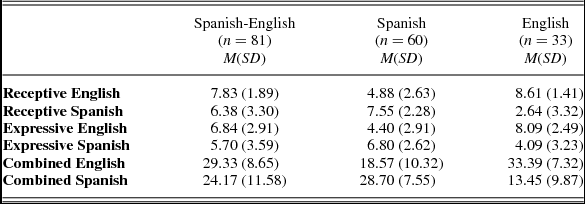
According to parent reports, 47% of children (n = 81) came from families who used both Spanish and English on a regular basis, whereas 35% (n = 60) were from homes in which mostly or only Spanish was spoken, and 19% (n = 33) were from homes in which mostly or only English was spoken. These reports were related to children's receptive and expressive language skills in both languages. Specifically, children who came from English-speaking homes were rated as proficient in English and not proficient in Spanish, and they had significantly higher receptive, t(32) = 9.73, p < .001, and expressive, t(32) = 6.53, p < .001, language scores on the English version of the preLAS as compared to the Spanish version. By contrast, children who came from Spanish-speaking homes were most likely to have been rated as having proficiency or limited proficiency in Spanish and not being proficient in English, demonstrating significantly higher receptive, t(59) = 7.34, p < .001, and expressive, t(59) = 4.90, p < .001, scores on the Spanish version of the preLAS, as compared to the English version. (See Table 1 for means and standard deviations.) Finally, children who came from homes in which they were exposed to both Spanish and English demonstrated limited proficiency in both languages, though their receptive, t(80) = 3.62, p = .001, and expressive, t(80) = 2.51, p < .05, skills were somewhat higher in English than in Spanish.
preLAS Scores by Home Language Reports

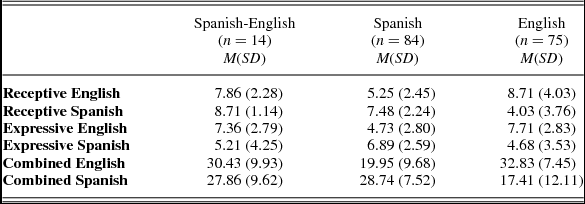
By contrast to the home reports, teachers reported that 8% of the children (n = 14) were bilingual Spanish-English speakers, 48% (n = 84) were Spanish speakers, and 43% were English speakers (n = 75). Children who were categorized by their teachers as English speaking were rated as proficient in English, but not in Spanish, demonstrating significantly higher receptive, t(74) = 10.81, p < .001, and expressive, t(74) = 7.03, p < .001, scores on the English version of the preLAS, as compared to the Spanish version. (See Table 2 for means and standard deviations.) Furthermore, children who were labeled by teachers as Spanish speaking only were ranked as proficient, or having limited proficiency, in Spanish and not proficient in English, and they had significantly higher receptive, t(83) = 8.18, p < .001, and expressive, t(83) = 5.48, p < .001, scores on the Spanish version as compared to the English version of the preLAS. Finally, those few children who were labeled as being Spanish-English bilinguals by their teachers demonstrated limited proficiency in both languages, and there were no significant differences in their receptive and expressive skills across languages.
preLAS Scores by Teacher Language Reports

Results of a chi-square analysis showed significant differences in home and teacher reports, X 2(4) = 96.49, p < .001. Specifically, even though about half of the children (47%) came from Spanish-English bilingual homes, teachers reported that the overwhelming majority of the children (92%) used one language but not both at school. In summary, then, reliance on report-based data provides an accurate, yet limited, index of emergent bilingual children's language skills. The specific information gleaned about the bilingual experience varies based on the informant (i.e., parents vs. teachers), with reports of home language input more likely to over-represent children as “balanced” bilinguals, and teacher reports of language use more likely to reflect skill in stronger language.
Bilingual Language Skills
Scores on each subscale of the preLAS (i.e., receptive and productive) in each language were added to create a composite overall proficiency score similar to conceptual vocabulary scoring (Hoff & Core, Reference Hoff and Core2015; see also Chen et al., Reference Chen, Zhou, Uchikoshi and Bunge2014). On average, children scored a 25.05 (SD = 7.61, range = 7–40), out of a possible 40. These scores differed significantly across groups created from home reports, F(2, 171) = 3.95, p < .05, with children from dual-language homes scoring higher in combined proficiency than children from Spanish-only homes, but not higher than children from English-speaking homes. No between-group differences in proficiency were found in teacher reports of children's language use. There was, however, a trend toward significance F(2, 170) = 2.42, p = .09, such that children reported as using both languages had higher combined language proficiency scores than children who used only one. Taken together, these findings highlight the great variability in the combined language skills (i.e., across both languages) of emergent bilinguals, irrespective of their home language exposure or their preferred language in the classroom, and suggest that directly assessing language skills in both languages provides qualitatively different information regarding their bilingualism than does simply relying on informant reports.
Finally, to determine dominance status, preLAS proficiency ratings (i.e., not proficient, limited proficiency, or proficient) were compared across the two languages, and children were grouped as not balanced (i.e., the child was not proficient in one language but proficient in the other), somewhat balanced (i.e., ratings across languages were one level apart), or balanced (i.e., ratings were the same in both languages). In all, 33% of children (n = 58) were balanced bilinguals, 33% (n = 57) were somewhat balanced, and 34% (n = 59) were not balanced. These groupings were significantly different from those generated by home reports, X 2(4) = 27.45, p < .001, and teacher reports, X 2(4) = 13.08, p = .01. Notably however, results of an ANOVA highlighted that balance status was not related to proficiency scores. This is expected, as children in the balanced group could have limited or high proficiency in both languages.
Putting It All Together
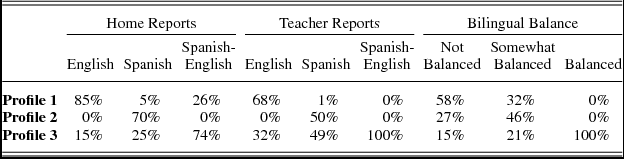
Two-step cluster analysis was run to create profiles of children's bilingualism, using children's receptive and expressive skills in each language, (i.e., as continuous variables), as well as dominance status, home language input, and classroom language use (i.e., as categorical variables). Results showed the presence of three profiles. (See Table 3.)
Percentage of Bilingualism Profiles by Method of Categorization

English-dominant emergent bilinguals
The first profile (n = 52), English-dominant emergent bilinguals, was marked by high receptive (M = 8.87, SD = .97) and expressive (M = 8.46, SD = 1.59) skills in English, but low receptive (M = 2.96, SD = 3.48) and expressive (M = 3.81, SD = 3.19) skills in Spanish. These children were most likely to come from English-dominant homes, and all were classified by their teachers as English-dominant. Not surprisingly, these children were also most likely to have been categorized as not-balanced bilinguals.
Spanish-dominant emergent bilinguals
The second profile (n = 42), Spanish-dominant emergent bilinguals, was marked by average receptive (M = 5.00, SD = 1.96) and expressive (M = 4.38, SD = 2.46) skills in English, and high receptive (M = 8.31, SD = 1.35) and expressive (M = 7.60, SD = 2.19) skills in Spanish. All of these children came from Spanish-dominant homes, and all were classified by their teachers as Spanish-dominant. Finally, these children were also most likely to have been categorized as somewhat-balanced bilinguals.
Balanced emergent bilinguals
The third profile (n = 79), balanced emergent bilinguals, was marked by high-average receptive (M = 6.75, SD = 2.79) and average expressive (M = 5.75, SD = 3.43) skills in English, and high-average receptive (M = 6.95, SD = 2.75) and average expressive (M = 6.15, SD = 3.29) skills in Spanish. These children were most likely to come from Spanish-English bilingual homes and to have been classified by teachers as Spanish-dominant. Moreover, as would be expected, these children were also most likely to have been categorized as balanced bilinguals.
Bilingual Language and Self-Regulation Skills
To address the second research question, analyses focused on the relation between children's proficiency based on home language reports (i.e., their total language score in the language spoken at homeFootnote 2), teacher reports (i.e., their total language score in the language they use most in the classroom), and combined proficiency across the two languages, as well as their dominance status and overall profile, and the two indices of self-regulation skills.
Children's EF (M = .43 SD = .28, range = 0–1) was positively correlated with their proficiency in the language they used most in the classroom (r = .19, p < .05) and their combined proficiency (r = .26, p = .001). After controlling for children's age and the number of people in the home,Footnote 3 however, only combined proficiency was predictive of children's EF (β = .16, p < .05, ∆R 2 = .02). In other words, findings suggested that the greater children's bilingual language proficiency, the more advanced their EF. Children's EC (M = .77, SD = .29, range = 0–1) was positively correlated with proficiency skills based on home language reports (r = .23, p < .05) and combined proficiency (r = .21, p < .01), but after controlling for children's age and gender,Footnote 4 there were no significant predictive relations. However, proficiency based on teacher's reports of children's preferred classroom language was predictive of their EC, even after controlling for children's age and gender (β = .20, p < .05, ∆R 2 = .04). In other words, children with higher language skills in their preferred classroom language demonstrated higher EC.
Analyses conducted with dominance status showed that this variable was significantly related to EC, as well, albeit negatively. In other words, controlling for children's age and gender, children in the not-balanced group demonstrated higher EC, as compared to children in the balanced group (β = .17, p < .05, ∆R 2 = .03). Follow-up analyses showed that this difference was driven by balanced children with low fluency in both languages who had particularly low EC skills, suggesting a possible interplay between proficiency and balance. Finally, comparative analyses using the three profiles created by the cluster analyses showed no differences across the three groups in children's EF or EC.
DISCUSSION
Despite the dynamic and multidimensional nature of childhood bilingualism, research investigating how children's bilingual experience might shape other aspects of development has typically operationalized bilingualism categorically (i.e., bilingual vs. monolingual), at times relying on single informants (e.g., parents or teachers). While this approach is understandable given the scope of the work to date, the lack of consistency in operationalizing bilingualism might be responsible for contradicting findings, given the heterogeneity in bilingual children's experiences and language skills. The present study contributes to the current knowledge base by (a) describing the within-group variation in the nature of the bilingualism of emergent bilingual Latino preschoolers and (b) examining the relation between children's bilingualism and self-regulation skills.
Notably, all children who participated in the current study were emergent bilinguals who lived in the same community (a low-income, predominantly bilingual immigrant community), went to the same bilingual preschool program, were all exposed to Spanish and English (albeit to varying degrees), and were in the process of acquiring both Spanish and English. Interestingly, the majority of children had more developed English skills as compared to Spanish skills, underscoring the societal dominance of English even in Spanish-speaking communities (Place & Hoff, Reference Place and Hoff2011). Notwithstanding these shared language experiences across multiple settings, our results also showed marked within-group variation. Only 14% of the participating children were proficient in both Spanish and English, 50% were proficient in one language but not the other, and 16% did not meet proficiency levels in either language. This variation calls into question research that simply groups children dichotomously as bilingual or monolingual, and it highlights the need to look beyond exposure to language in order to capture the bilingual experience in a meaningful manner.
In the current study, we sought to determine the children's bilingualism by using four methods that are commonly adopted by researchers (i.e., home reports, teacher reports, language skill, and dominance status). We also measured bilingualism as a categorical variable (i.e., groupings based on various aspects of the bilingual experience) and as a continuous variable. Although there were overlaps across the different methods, our results yielded two main conclusions: (a) Categorizations vary based on the approach adopted, and (b) capturing bilingualism as a continuous variable did, in fact, highlight variations within the group.
With regard to the approaches adopted to categorize the children, parental reports of home language input tended to classify a larger number of children as balanced (i.e., having had exposure to both languages at home), which was not necessarily supported by direct assessments of their language skills. By comparison, teachers were more likely to identify the language in which the child was most proficient. Although teachers’ reports were likely a result of the use of both languages in the classroom and the need to distinguish individual children's preferences, the findings also showed that these teachers reported children's general language skill with high levels of accuracy. Thus, the teachers were particularly helpful in providing an index of children's skill level in their stronger language, but in doing so, they underestimated the children's bilingualism. Taken together, these findings underscore the need for future research to rely on multiple key informants, as well as use more in-depth questionnaires of both language input and use across diverse contexts to identify children's bilingual competencies. Although such assessments are generally used in child bilingual language research (see Bedore et al., Reference Bedore, Peña, Summers, Boerger, Resendiz, Greene and Gillam2012), they are not as prevalent in other research areas.
Another method often employed by researchers is to use direct language assessments administered in both languages either as screeners or to describe the language skills of their sample. Unsurprisingly, our findings show that these provide an accurate measure of proficiency in each of the languages, and in turn, of dominance status. Our findings also show that although skill level and dominance are interrelated, they are independent indices, which tap into a different aspect of bilingualism, and they are differentially related to home language input and children's classroom language use. Thus, our results highlight the critical need for researchers to find ways to account for both skill and dominance to capture fully children's bilingual experience.
In the current study, we sought to account for children's full bilingual experience by creating profiles using all indices of bilingualism, language input in the home, language use at school, and language skills across both languages. Our results suggested the presence of three distinct profiles, which we termed English-dominant emergent bilinguals, Spanish-dominant emergent bilinguals, and balanced emergent bilinguals, providing further corroboration of the heterogeneity of this group of emergent bilingual Latino preschoolers. Interestingly, whereas English-dominant emergent bilinguals demonstrated a marked difference in their language skills across both English and Spanish, Spanish-dominant emergent bilinguals tended to show more balance in their proficiency levels across the two languages. In addition, Spanish-dominant emergent bilinguals’ weaker language (i.e., English) was more developed than the weaker language (i.e., Spanish) of their English-dominant counterparts. Given that both groups of children came from the same community and attended the same bilingual preschool, these findings underscore the need to take into account not only language input at home but societal input, as well.
The oversimplification of the bilingual experience, as well as the lack of consensus regarding how to capture bilingualism, might help explain the conflicting findings regarding the existence of a “bilingual advantage” for children's self-regulation skills. For example, comparative research (e.g., Poulin-Dubois et al., Reference Poulin-Dubois, Blaye, Coutya and Bialystok2011) has found that bilingual children show higher EF skills as compared to their monolingual counterparts, but that the groups do not differ insofar as their EC. In the current study, there were large within-group differences in both types of self-regulation, with the emergent bilinguals’ scores for each ranging from 0 to 1 (i.e., the full possible range of scores). In other words, our findings suggest that simply having exposure to two languages is not a sufficient predictor of the bilingual advantage; thus, it is necessary to explore and define what aspects of the bilingualism might result in advanced self-regulation. These findings are corroborated by recent studies showing that higher proficiency coupled with greater balance is significantly related to self-regulation (Chen et al., Reference Chen, Zhou, Uchikoshi and Bunge2014; White & Greenfield, Reference White and Greenfield2017). What our findings add is that the different ways of capturing bilingualism were differentially related to both self-regulation measures, and perhaps more importantly, that the measures capturing this variability were those that defined bilingualism along a continuum rather than categorically.
Specifically, emergent bilingual children's overall proficiency across both languages was predictive of higher EF skills (Blair & Razza, Reference Blair and Razza2007). The finding regarding combined verbal ability predicting EF is not surprising, given Grosjean's (Reference Grosjean2010) assertion that, in terms of their language abilities, bilingual children are not akin to two monolingual children. By contrast, what predicts emergent bilingual children's EC is their language skill in their preferred classroom language. These results corroborate those of Chen et al. (Reference Chen, Zhou, Uchikoshi and Bunge2014), in which they found that combined proficiency was related to EF, whereas proficiency in the dominant language predicted EC. Therefore, it is critical that future research find ways to capture bilingual children's total language skills across both languages, given that the higher the combined language skill, the more likely the bilingual advantage will emerge. Results with regard to EC seem to suggest that a certain level of verbal ability is needed for an advantage in EC to be apparent. Finally, the relative balance across languages also mattered, albeit negatively, such that children with the highest balance had the lowest scores in EC. This result is likely because, unlike past studies, we included children with little or limited proficiency in both languages.
Research on adult and childhood bilingualism has documented the dynamic and multidimensional nature of bilingualism. At the same time, the field of bilingual research has moved from viewing childhood bilingualism as detrimental to appreciating the advantages it affords. To understand fully how the dimensions that comprise bilingualism interact with cognitive processes, it is necessary to move beyond comparative work and examine how factors unique to emergent bilinguals might be related to their self-regulation skills. The current study contributes to the recent efforts by focusing on a heterogeneous group of Latino emerging bilingual preschoolers. Our results demonstrate that the measures used to capture children's bilingual skills privilege different aspects of their bilingual experience. As bilingualism is a multidimensional construct, it is captured best when envisioned along a continuum. The bilingual advantage, in turn, likely falls along a continuum as well.