INTRODUCTION
The reproductive strategies of marine invertebrates are often reflected in patterns of energy allocation to somatic growth, reproduction and maintenance (Lawrence & McClintock, Reference Lawrence, McClintock, David, Guille, Féral and Roux1994). In many asteroid echinoderms, reproduction is cyclic and the organs involved, especially the gonads and the pyloric caeca, change in shape and size according to the stage in the cycle (Lawrence, Reference Lawrence1973). Nutritional reserves in the pyloric caeca sustain gametogenesis (Jangoux, Reference Jangoux, Jangoux and Lawrence1982) and most of the asteroids that possess repeated brooding events make important reproductive investments that minimize the use of energy stored for future reproductive events.
Brooding, common in small asteroids, is often considered a response to limited nutrient availability (Raymond et al., Reference Raymond, Himmelman and Guderley2004). The limited mobility of brooding stars can hinder feeding, leading to the use of somatic reserves (Jangoux, Reference Jangoux, Jangoux and Lawrence1982; Doughty & Shine, Reference Doughty and Shine1997).
The sea star Anasterias minuta Perrier 1875 (Forcipulatida, Asteriidae) inhabits along the Patagonian coast of Argentina, at depths of 0–100 m (Ageitos de Castellanos et al., Reference Ageitos de Castellanos, Cazzaniga and Lopretto1996). Oral-brooding in the family Asteriidae is rare around the world and limited to the genus Leptasterias (Verril, 1866) in temperate to polar waters in the northern hemisphere (Foltz et al., Reference Foltz, Nguyen, Kiger and Mah2008) and to some species in Antarctic and sub-Antarctic regions. However, this behaviour has also been recorded in the south of South America, e.g. in Anasterias minuta (Gil & Zaixso, Reference Gil and Zaixso2007) and Diplasterias brucei (Koehler, 1908) (Kim & Thurber, Reference Kim and Thurber2007), and in the south of Australia, e.g. Smilasterias multipara (O'Loughlin & O'Hara, 1990) (Komatsu et al., Reference Komatsu, O'Loughlin, Bruce, Yoshizawa, Tanaka and Murakami2006). Anasterias minuta is characterized by brooding its offspring in the rocky intertidal between May and October; once developed, the offspring are directly released as juveniles. Major spawning events, evidenced by the presence of eggs in the brood, occur from April to May. Juveniles grow in the oral face of the brooding female, blocking the mouth completely and preventing its feeding during the brooding period (Gil & Zaixso, Reference Gil and Zaixso2007). Females of A. minuta brood the embryos by holding them under their oral face in a external chamber formed by the arched body. Each embryo is connected through a connection cord to an amorphous centre part of the egg mass, containing atrophied eggs or embryos (Gil et al., Reference Gil, Escudero and Zaixso2011). The presence of mucus surrounding the egg mass completes the holding and protecting function.
Only a few studies have focused on the reproduction of A. minuta, described embryo development and shown that spermatogenesis has an annual cycle and oogenesis a biennial cycle (Salvat, Reference Salvat1985; Gil et al., Reference Gil, Escudero and Zaixso2011).
Food consumed by animals is mainly composed of three chemical groups: proteins, lipids and carbohydrates, which are degraded into simpler units and metabolized both for synthesis and energy supply (Schmidt-Nielsen, Reference Schmidt-Nielsen1984). Excess glucose is converted to glycogen (glycogenesis) or to lipids (lipogenesis). During starvation, glucose can be extracted from glycogen (glycogenolysis) to restore the levels of depleted glucose. Fatty acids cannot be converted to carbohydrates because animals do not possess a glyoxylate cycle (Voet & Voet, Reference Voet and Voet1996). Glucose can provide energy in the absence of oxygen and is the main energy source in anaerobic tissues. For most animals, energy required for physiological processes can be completely met using glucose (Schmidt-Nielsen, Reference Schmidt-Nielsen1984). In echinoderms, carbohydrates are considered a source of primary energy for the gonads because they are readily available (Giese, Reference Giese and Boolootian1966). Even in those cases in which fat can provide most of the caloric requirements of the organism, there is always a basal requirement of glucose. Gluconeogenesis is used to convert the metabolic products of other tissues, such as lactate (produced anaerobically) and glycerol (produced mainly by fat tissue) (Mayes, Reference Mayes, Murray, Mayes, Granner and Rodwell1992).
Many studies have shown a positive correlation between oxygen consumption and temperature. As a result, much of the seasonal variation in biological activity has traditionally been related to high environmental temperatures (Brockington & Clarke, Reference Brockington and Clarke2001). Many sessile species display excellent anoxia tolerance; oxygen limitation can arise in several ways, including aerial exposure of intertidal species at low tide. Multiple demands are placed on the metabolism of marine organisms both from the stresses imposed by the external environment (e.g. variation in temperature, oxygen availability, etc.) and from internal physiological drives, including reproduction and growth. Responses to such demands typically involve changes in flux through selected metabolic pathways and this generally translates into changes in the activities of enzymatic pathways as they are the machines that run metabolism (Greenway & Storey, Reference Greenway and Storey1999). Glycolysis provides energy under low oxygen availability or absence of oxygen, and is a main energy source in anaerobic tissues, that cannot be replaced by lipid metabolism.
Given the metabolic characteristics of starving individuals and the absence of feeding in brooding females of A. minuta during brooding (May to October), we hypothesize that carbohydrates are transferred between different organs of females and males during this period and from brooding females to eggs, embryos and juveniles. The purpose of this study was to evaluate whether carbohydrates are transferred in A. minuta and, if so, what is its role in brooding.
MATERIALS AND METHODS
Six specimens of non-brooding females, six specimens of males and six specimens of brooding females were collected monthly from the intertidal of Punta Borja shore (Comodoro Rivadavia city, Chubut Province, Argentina, 45°52′S 67°28′W) from February to December 2002.
Specimens were measured and weighed and the length of the five arms of each specimen measured. Animals were dissected, sex was identified and gonads, pyloric caeca, body wall, eggs, embryos and juveniles were removed. The extracted organs were weighed and preserved at −20°C.
Total soluble and insoluble carbohydrate contents of the gonads, pyloric caeca and body wall of non-brooding females, males and brooding females were determined by the phenol–H2SO4 method using glucose as standard (Dubois et al., Reference Dubois, Gilles, Hamilton, Rebers and Smith1956; Flores et al., Reference Flores, Stortz and Cerezo2000) at 490 nm. Each quantitative analysis was made in triplicate.
An analysis of simple linear regression with inverse prediction was used, where Ŷ = a + b y.x X i was reordered in the following equation: X i = (Y i − a)/b y.x , to determine carbohydrate content by constructing curves with known amounts of glucose (Sokal & Rohlf, Reference Sokal and Rohlf1995). The following pattern was obtained: carbohydrate content = (absorbance − a)/b y.x .
The results were evaluated by three-way factorial analysis of covariance (ANCOVA), using month of collection, organ and sex as factors and arm length as covariate. The amounts of carbohydrates in eggs, embryos and juveniles were evaluated by analysis of multivariate variance (MANOVA). It was determined by test of Wilks’ Lambda, where the variables examined corresponded to the amounts of soluble and insoluble carbohydrates (Zar, Reference Zar1996).
RESULTS
Insoluble carbohydrates in the pyloric caeca, gonads and body wall
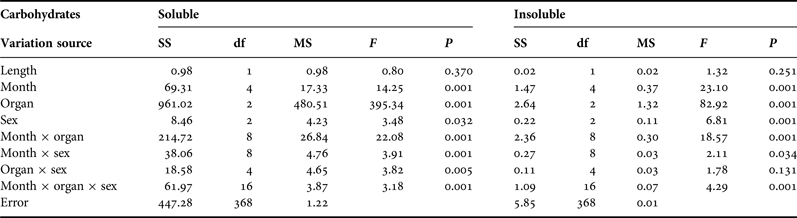
The mass of insoluble carbohydrates of non-brooding females, males and brooding females of A. minuta examined by means of a three-way factorial ANCOVA (where arm length was used as the covariate) from April to September (brooding period), showed a significant interaction (P < 0.05) among the factors month, organ and sex (Table 1). Tukey's test indicated that non-brooding females (Figure 1A) had a significant difference (P < 0.05) in carbohydrate content in the pyloric caeca from April to September and a significant increase in carbohydrate content in the body wall (P < 0.05) from May to September. Males presented a significant increase (Figure 1B) in the carbohydrate content in the pyloric caeca from July to September and constant carbohydrate content in the gonads and body wall during the brooding period. Brooding females (Figure 1C) also showed an increase in carbohydrate content of the pyloric caeca from July to September.
Average mass (95% confidence interval) of insoluble carbohydrates of gonads (gn), pyloric caeca (pc) and body wall (bw) in non-brooding females (A), males (B) and brooding females (C) of Anasterias minuta, adjusted by arm length, throughout the incubation period.

Three-way ANCOVA of soluble and insoluble carbohydrates in non-brooding females, males and brooding females of Anasterias minuta throughout the incubation period.

SS, sum of squares; df, degrees of freedom; MS, means square; F, Fisher's test; P, probability.
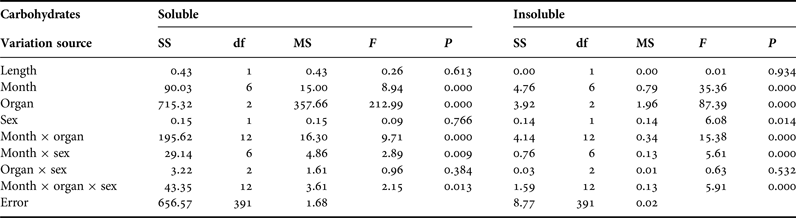
The factorial three-way ANCOVA of insoluble carbohydrate content of non-brooding females and males from February to December showed a significant interaction (P < 0.05) among the factors month, organ and sex (Table 2). Tukey's test indicated that non-brooding females had a significant increase in the carbohydrate content of gonads and pyloric caeca from September to December. The levels of insoluble carbohydrates in the body wall of non-brooding females and males during late spring and summer showed values similar to those during the brooding period (April–September).
Three-way ANCOVA of soluble and insoluble carbohydrates in males and non-brooding females of Anasterias minuta between February and December 2002.

SS, sum of squares; df, degrees of freedom; MS, means square; F, Fisher's test; P, probability.
Soluble carbohydrates in the pyloric caeca, gonads and body wall
The ANCOVA for soluble carbohydrates for non-brooding females, males and brooding females of A. minuta, from April to September (brooding period), showed a significant interaction (P < 0.05) among the factors month, organ and sex (Table 1). Tukey's test showed higher contents of soluble carbohydrates in the pyloric caeca than in gonads and body wall of non-brooding females, males and brooding females. In non-brooding females (Figure 2A), none of the three organs examined showed differences in soluble carbohydrate content during the study period. The soluble carbohydrate content in the pyloric caeca of males was maximum in May and September (Figure 2B), whereas that of brooding females was maximum in May (Figure 2C).
Average mass (95% confidence interval) of soluble carbohydrates of gonads (gn), pyloric caeca (pc) and body wall (bw) in non-brooding females (A), males (B) and brooding females (C) of Anasterias minuta, adjusted by arm length, throughout the incubation period.

The ANCOVA performed for soluble carbohydrates of non-brooding females and males of A. minuta from February to December showed a significant interaction (P < 0.05) among the factors month, organ and sex (Table 2). A significant decrease in the soluble carbohydrate content of the pyloric caeca of non-brooding females was observed from October to December (P < 0.05) and in that of males from February to March (P < 0.05).
Soluble and insoluble carbohydrates in eggs, embryos and juveniles
The MANOVA performed for insoluble and soluble carbohydrates of the egg masses, embryos and juveniles of A. minuta revealed significant differences (F (8, 78) = 4.98, P < 0.05) at least for one of the variables analysed throughout the brooding period (April–September, Figure 3).
Average mass (95% confidence interval) of soluble carbohydrates (SC) and insoluble carbohydrates (IC) in eggs, embryos and juveniles of Anasterias minuta.

Insoluble carbohydrates showed no significant changes (P > 0.05), whereas soluble carbohydrates showed significant changes (P < 0.05). Indeed, soluble carbohydrates of the egg masses, embryos and juveniles of A. minuta showed a maximum in April and another maximum in July. In general, the egg masses, embryos and juveniles had higher levels of soluble carbohydrates than of insoluble carbohydrates.
DISCUSSION
Carbohydrates serve as short-term energy storage (Pearse & Giese, Reference Pearse and Giese1966). Variations in carbohydrate levels should reflect recent energy expenditure and consumption activity. The decrease in carbohydrate levels in gonads, pyloric caeca and body wall of males may reflect glycogen use during gamete release and the formation of spawning aggregations. In contrast, the recovery of carbohydrates may be due to recent feeding activity or to allocation to growth and maintenance during winter (Raymond et al., Reference Raymond, Himmelman and Guderley2004). Glycogen storage implies much more weight than fats; however, its advantage is twofold because it can be a rapid source of fuel for glycolysis and the Krebs cycle and can provide energy under anaerobic conditions (Schmidt-Nielsen, Reference Schmidt-Nielsen1984).
Insoluble carbohydrates in the pyloric caeca, gonads and body wall
The pyloric caeca of sea stars are dynamic storage-transfer organs that constantly process, accumulate and transfer nutrients to other organs (Lawrence, Reference Lawrence, Pandian and Vernberg1987; McClintock et al., Reference McClintock, Watts, Marion and Hopkins1995). Changes in weight of the pyloric caeca reflect complex processes of nutrient uptake, enzyme secretion and deposit of substances (Franz, Reference Franz1986).
The pyloric caeca of brooding females and males of A. minuta presented a similar pattern of insoluble carbohydrate levels during the brooding period, as opposed to those of non-brooding females. This is in agreement with that found for the biochemical content of the pyloric caeca of females and males of Cosmasterias lurida (Philippi, 1858) (Pastor de Ward et al., Reference Pastor de Ward, Rubilar, Díaz de Vivar, González Pisani, Zárate, Kroeck and Morsan2007), Echinaster sp. (Müller & Troschel, 1840) (Scheibling & Lawrence, Reference Scheibling and Lawrence1982) and Sclerasterias mollis (Hutton, 1872) (Barker & Xu, Reference Barker and Xu1991). This pattern indicates stable levels during autumn and an increase from winter to spring, possibly related to the energy expended during the period of gamete release by brooding females and males, as well as to a reduction in consumption rates and an effort in brooding of the offspring during this period. The rapid increase in insoluble carbohydrate levels from winter to spring indicates a recovery of this biochemical component, probably by means of a transfer or transformation (in brooding females and in males). This behaviour has also been observed in other brooding stars, such as L. hexactis (Stimpson, 1862) (Menge, Reference Menge1974) and L. polaris (Müller & Troschel, 1842) (Raymond et al., Reference Raymond, Himmelman and Guderley2004).
Insoluble carbohydrate levels in the pyloric caeca of non-brooding females recovered in autumn and then decreased toward winter, coinciding with the decrease in the consumption rate. Toward the end of spring, however, they showed a second increase, probably related to the accumulation of reserves as an adaptive strategy for the next starvation period.
Non-brooding females, males and brooding females of A. minuta showed no differences in the insoluble carbohydrate content of their gonads throughout the brooding period (April–September). However, non-brooding females exhibited an increasing trend toward the end of spring in gonads (December). This is consistent with an increase in gonad weight and may be related to gametogenesis (Gil & Zaixso, Reference Gil and Zaixso2007) and to the vitellogenic process in female gonads (Salvat, Reference Salvat1985).
Giese (Reference Giese and Boolootian1966) indicated that the body wall of sea stars might act as a storage organ when food availability is reduced.
Insoluble carbohydrate levels in the body wall of brooding females and males remained constant; in contrast, those of non-brooding females exhibited an increase from autumn to spring, probably because they were not involved in reproduction or brooding.
Soluble carbohydrates in the pyloric caeca, gonads and body wall
Soluble carbohydrates in pyloric caeca of non-brooding females, brooding females and males presented higher levels than insoluble carbohydrates and an opposite variation. The evident decrease in soluble carbohydrates in brooding females and males is possibly related to the need for a rapid source of energy to sustain brooding, reduction of consumption rate and requirements of anaerobic tissues.
After the brooding period, the decrease in soluble carbohydrate content in the pyloric caeca of non-brooding females and males may be indirectly related to an event of energy use, such as gametogenesis.
Although non-brooding females, brooding females and males of A. minuta showed a constant content of soluble carbohydrates in gonads from April to September, non-brooding females exhibited a significant decrease from October to March, probably related to the period of rest occurring in these organs; this event was not observed in males.
A similar behaviour has been reported for L. polaris (Raymond et al., Reference Raymond, Himmelman and Guderley2004), whose gonads and pyloric caeca of L. polaris exhibit great variations in the biochemical components. In males, all the biochemical components (lipids, proteins and carbohydrates) of gonads are rapidly reduced after gamete release and then remain stable during winter; a similar, although more marked, pattern is observed in brooding L. polaris.
Soluble carbohydrates exhibited constant levels in the body wall of the three animal groups throughout the study period. In general, the absence of carbohydrate variation in gonads and body wall of A. minuta indicates that these organs do not participate in the transfer of this biochemical component. However, in the pyloric caeca, soluble and insoluble carbohydrates exhibited approximately opposite levels, suggesting that both components are metabolically interrelated and that the pyloric caeca are carbohydrate storage organs that might transfer carbohydrates to the tissues.
In conclusion, the brooding female spawns early in autumn and the eggs block its mouth, impeding feeding; this promotes the mobilization of carbohydrates from the pyloric caeca for the sustainment of metabolic functions, with gluconeogenesis playing a crucial role. Although non-brooding females do not spawn, they are affected by a decreased consumption rate during winter; however, they showed increases in carbohydrates in the different organs in early spring, indicating a consumption that exceeded the metabolic needs. This allowed non-brooding females to increase the reserves for the next brooding period.
Gamete release by males at the beginning of autumn involves a great energy effort. During autumn and winter, males have little activity and the possibilities to obtain food are reduced; therefore, carbohydrates are transferred from the pyloric caeca, with gluconeogenesis playing a crucial role. Both in males and non-brooding females, carbohydrates were related to the accumulation of reserves as an adaptation to the next period of reduced consumption rates or starvation.
Some sea stars show histological evidence of nutrient translocation to brooded juveniles, e.g. Pteraster militaris (O.F. Müller 1776) (Gillespie & McClintock, Reference Gillespie and McClintock2007).
The results obtained in the present study indicate that there is no contribution of carbohydrates from the brooding female to the embryos or juveniles because the carbohydrates necessary for the offspring are supplied by the vitellum.
FINANCIAL SUPPORT
This work was supported by the Universidad Nacional de la Patagonia San Juan Bosco (No. PI 731), Chubut, Argentina.