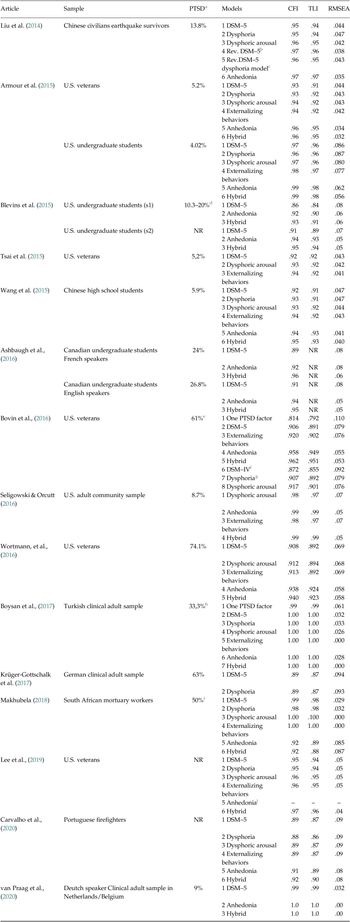
A series of studies have reported the factor structure of Posttraumatic Stress Disorder (PTSD) proposed in the fifth edition of the Diagnostic and Statistical Manual of Mental Disorders (DSM–5). Structural analyzes have been performed using confirmatory factor analysis (CFA) in diverse samples (clinical and non-clinical population, veterans, civilians, high school or undergradate students) in different countries, with a probable PTSD prevalence ranging from 4.2% to 74.1% (Armour et al., Reference Armour, Tsai, Durham, Charak, Biehn, Elhai and Pietrzak2015; Ashbaugh et al., Reference Ashbaugh, Houle-Johnson, Herbert, El-Hage and Brunet2016; Blevins et al., Reference Blevins, Weathers, Davis, Witte and Domino2015; Bovin et al., Reference Bovin, Marx, Weathers, Gallagher, Rodriguez, Schnurr and Keane2016; Boysan et al., Reference Boysan, Ozdemir, Yilmaz, Selvi, Özdemir and Kefeli2017; Carvalho et al., Reference Carvalho, da Motta and Pinto-Gouveia2020; Krüger-Gottschalk et al., Reference Krüger‐Gottschalk, Knaevelsrud, Rau, Dyer, Schäfer, Schellong and Ehring2017; Lee et al., Reference Lee, Bovin, Weathers, Palmieri, Schnurr, Sloan, Keane and Marx2019; Liu et al., Reference Liu, Wang, Cao, Wang, Zhang, Wu, Zhang, Zhao, Fan and Elhai2014; Makhubela, Reference Makhubela2018; Seligowski & Orcutt, Reference Seligowski and Orcutt2016; Tsai et al., Reference Tsai, Harpaz-Rotem, Armour, Southwick, Krystal and Pietrzak2015; van Praag et al., Reference van Praag, Fardzadeh, Covic, Maas and von Steinbüchel2020; Wortmann et al., Reference Wortmann, Jordan, Weathers, Resick, Dondanville, Hall‐Clark, Foa, Young-McCaughan, Yarvis, Hembree, Mintz, Peterson and Litz2016; Wang et al., Reference Wang, Zhang, Armour, Cao, Qing, Zhang, Liu, Zhang, Wu, Zhao and Fan2015) (see Table 1).
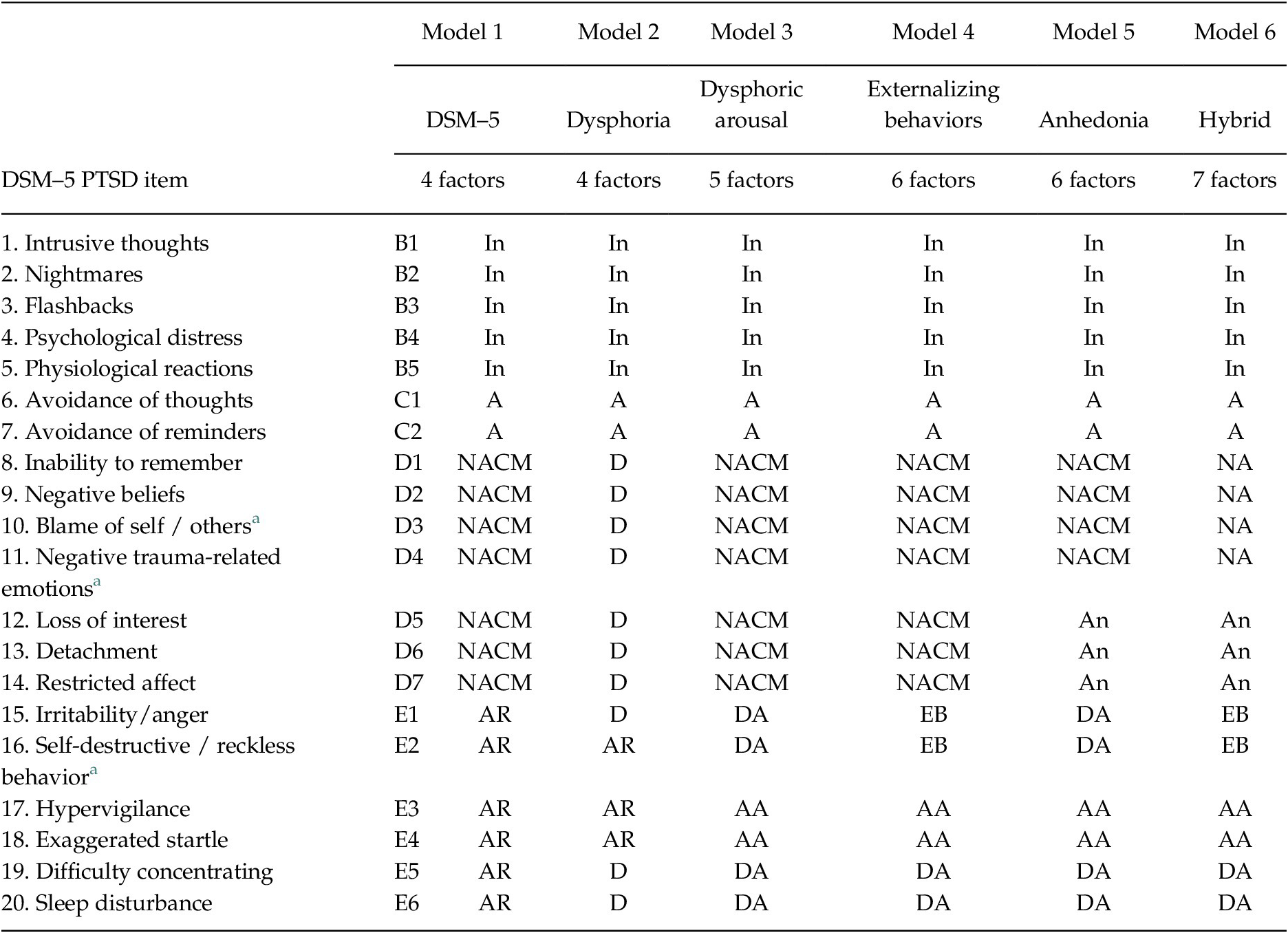
PTSD Models with 20 DSM–5 Symptoms

Note. In = intrusion; A = avoidance; NACM = negative alterations in cognitions and mood; AR = alterations in arousal and reactivity; D = dysphoria; NA = negative affect; An = anhedonia; EB = externalizing behaviors; AA = anxious arousal; DA = dysphoric arousal.
a DSM–5 new symptom.
The results show different alternative models with good fit indices (except the study of Krüger-Gottschalk et al., Reference Krüger‐Gottschalk, Knaevelsrud, Rau, Dyer, Schäfer, Schellong and Ehring2017), high correlations between the factors, and symptoms that belong to different factors in different models without affecting the fit index (see Table 2 and Table 3). These elements could suppose the existence of considerable item cross-loading, the overlap of different factors or even the presence of a general factor that explains the items common source of variance (Marsh et al., Reference Marsh, Morin, Parker and Kaur2014; Morin et al., Reference Morin, Arens and Marsh2015).
PTSD CFA Models Goodness of Fit in Published Studies

Note. CFI, comparative fix index; TLI, Tucker-Lewis index; RMSEA, root mean square error of approximation; NR, non-reported in article.
a Probable PTSD.
b 5-factor revision of the DSM–5 model.
c 5-factor revision of the DSM–5 dysphoria model.
d Estimated PTSD prevalence based on different cut points.
e PTSD base rate using CAPS–5 diagnosis.
f 4-factor model based on DSM–IV structure.
g 4 factor model based on DSM–IV dysphoria model, in this model PCL–5 item 16 is considered in the dysphoric factor.
h Clinical diagnosis.
i Estimated PTSD prevalence based on a cut-point of 33.
j The model failed to converge.
CFA Models Inter-factor Correlationa

Note. NR = non-reported in article.
a Best fit model inter-factor correlation reported.
b Best fit 6-factor Dysphoric arousal model.
c Best fit 7-factor Hybrid model.
d Best fit 6-factor Anhedonia model and 7-factor Hybrid model.
e Best fit 6-factor Externalizing behaviors model.
f Best fit 5-factor Dysphoric arousal model.
g Best fit 4-factor Dysphoria model.
Such assumptions have empirical and theoretical implications for the study of PTSD symptom structure. Empirically, a high correlation among factors could question their empirical separability, and therefore threatens dimensional discriminant validity (Fornell & Larcker, Reference Fornell and Larcker1981). At a theoretical level, if an item is considered to represent a symptom, the supposed item cross-loading goes against the assumption that a symptom can only belong exclusively to a symptomatic group as assumed in the DSM (Atkas et al., Reference Atkas, Walsh and Rybicki2010; Galatzer-Levy & Bryant, Reference Galatzer-Levy and Bryant2013). Or, it could show that a symptom is related to more than one symptomatic cluster as shown by network analysis framework (Armour et al., Reference Armour, Fried, Deserno, Tsai and Pietrzak2017; Bryant et al., Reference Bryant, Creamer, O’Donnell, Forbes, McFarlane, Silove and Hadzi-Pavlovic2016; McNally et al., Reference McNally, Robinaugh, Wu, Wang, Deserno and Borsboon2014). Regarding the method used to model the internal structure of PTSD, it is possible to state that the independent clusters model of confirmatory factor analysis (ICM-CFA), may present certain limitations for modeling complex psychological constructs (Asparouhov & Muthén, Reference Asparouhov and Muthén2009; Morin et al., Reference Morin, Marsh, Nagengast, Hancock and Mueller2013). When there exists empirically (a) a certain overlap between theoretical dimensions and/or (b) indicators with discriminant validity problems, the zero cross-loading specification, assumed by ICM-CFA, may be incorrect. Such inaccuracy can have undesirable consequences, including the artificial inflation of the correlations among the factors (Schmitt & Sass, Reference Schmitt and Sass2011) or specification errors in the measurement model that, under a confirmatory model, lead to a priori rejection of a correct hypothesis. Naturally, errors in model specification entail the risk of a biased interpretation of the results. Moreover, the zero cross-loading that is typical of the ICM-CFA complicates the assessment of the discriminant validity of the symptoms (i.e., verifying the assumption that states that each indicator presents high loading on its primary factor and low loadings on the other factors).
The exploratory structural equation modeling (ESEM) (Asparouhov & Muthén, Reference Asparouhov and Muthén2009) has recently been proposed as a new modeling strategy that overcomes the issues described. In an ESEM model, the cross-loadings are not constrained to zero but are freely estimated allowing to explore the possible cross-loading of items. Furthermore, this technique has the advantages of CFA (e.g., it allows the estimation of the overall rates of comparable fit among the nested models, the detection of local sources of misfit, the possibility of multigroup analysis, etc.) in addition to the flexibility of exploratory factor analysis (Marsh et al., Reference Marsh, Morin, Parker and Kaur2014). In addition, it allows bifactor analysis (bifactor ESEM) to explore the presence of a general factor that explains the common source of the items variance, in the case of considerable correlations between the theoretical factors (Morin et al., Reference Morin, Arens and Marsh2015). Recently ESEM have shown great analytical and adaptive power for the in-depth investigation of complex psychological constructs (Arias et al., Reference Arias, Ponce, Martínez-Molina, Arias and Núñez2016; Morin et al., Reference Morin, Arens and Marsh2015; Marsh et al., Reference Marsh, Nagengast and Morin2013).
We consider that exploring the empirical behavior of the items that represent PTSD symptoms using new modeling strategies allows broadening the understanding of the symptomatic organization of PTSD. Therefore, in order to provide new evidence regarding the factor structure of the DSM–5 PTSD symptoms the present study has the following three objectives:
-
1. To determine the latent optimal structure of the twenty symptoms of PTSD as described in the DSM–5.
-
2. To determine the discriminant validity of both the factors and symptoms by comparing the factorial load estimates and correlations among the factors that were obtained through two estimation methods (the ICM-CFA and ESEM).
-
3. To explore the existence and magnitude of a possible common source of variance for all twenty symptoms of PTSD that would explain the frequent overlap among them as described in the studies where CFA has been used.
Method
Participants and Procedure
The final sample comprised 1,372 undergraduate students from a public university in Chile (468 men) with a mean age of 20.01 years (SD = 1.73) (176 subjects were excluded, 94 cases had missing data, 77 cases did not report traumatic events and 5 people did not report their gender). The participants have been exposed, six years after the study, to an earthquake of great intensity (8.8 on the Richter scale). Following the DSM–5 diagnostic rule for the use of the PCL–5 (Weathers et al., Reference Weathers, Blake, Schnurr, Kaloupek, Marx and Keane2013), the estimated prevalence of “probable” PTSD was 8.2% (women 9.2%; men 6.4%, not significant difference was found, χ2(1) = 3.13, p = .077. The study were approved by the Universidad de Talca Ethics Committee. All participants signed an informed consent.
Measures
The Life Event Checklist for DSM–5 (LEC-5) (Weathers, Blake et al., Reference Weathers, Blake, Schnurr, Kaloupek, Marx and Keane2013) was used to assess the presence of potential traumatic experiences. We included a specific item to report the experiences related to "physical and sexual abuse during childhood" and an item from the original version of LEC “sudden, unexpected death of someone close to you” (Blake et al., Reference Blake, Weathers, Nagy, Kaloupek, Gusman, Charney and Keane1995). The final questionnaire comprised 19 items. In this sample, the most prevalent and disturbing potentially traumatic event to this day were natural disaster (39.4%), sudden, unexpected death of someone close to you (16%) and life-threatening illness or injury (6.6%).
Current PTSD symptoms were assessed by using the PTSD Checklist–5 (PCL–5) (Weathers, Litz, et al., Reference Weathers, Litz, Keane, Palmieri, Marx and Schnurr2013). The PCL–5 is a self-report questionnaire with 20 items using a five-point response scale (from 0 not at all to 4 extremely) that assesses PTSD symptoms in adults over the past month for a specific event. The total score ranged from 0 to 80 points with a higher score implying more severe PTSD. The participants completed this questionnaire with respect to the LEC-5 event deemed most disturbing up to this day. The PCL–5 had high internal consistency (α = .94), high test-retest reliability (r = .82), adequate levels of convergent validity (rs = .74 to .85) and divergent validity (rs = .31 to .60) (Blevins et al., Reference Blevins, Weathers, Davis, Witte and Domino2015). PTSD probability was determined by using the diagnostic criteria proposed in DSM–5 (Blevins et al., Reference Blevins, Weathers, Davis, Witte and Domino2015). The LEC-5 and the PCL–5 items were translated and culturally adapted to Spanish following the recommendation by Brislin (Reference Brislin1970) and Merenda (Reference Merenda2006). First, the questionnaires were translated into Spanish by three independent bilingual speakers Spanish natives, with advanced knowledge about PTSD. Then, a unique Spanish version was created from the three initial translations by a committee formed by the three translators plus an external bilingual PTSD expert. The resulting version was back-translated by a native English bilingual person, expert in the translation of scientific psychology articles blind to the objectives of the study. Then the original version was compared with the back-translation being found that there was concordance between both versions. At the time of the study there was no Spanish version of PCL–5 published. In the present sample, the PCL–5, demonstrate good internal consistency (α = .92 PCL–5 scale, .80 cluster B, .84 cluster C, .82 cluster D and .79 cluster E; split-half reliability coefficient, Spearman-Brown correlation = .868).
Data Analysis
Some general data properties, which are needed to determine the most appropriate analytical approach, were examined. The absence of multivariate normality in all items (Mardia's Test: sig. < .01), and missing data (11.3% of the cases, with a completely random distribution of the missing data; Little's test sig. p > .05) were observed. Given the ordinal nature of the data, the weighted least square with adjusted mean and variance (WLSMV) (Beauducel & Herzberg, Reference Beauducel and Herzberg2006; Rhemtulla et al., Reference Rhemtulla, Brosseau Liard and Savalei2012) approach was used as an estimation method of the factor models.
In all studied models, goodness of fit was determined by using the comparative fit index (CFI), the Tucker-Lewis index (TLI) and the root mean square of approximation (RMSEA). For the CFI and TLI, values above .90 and .95, respectively, indicate an acceptable and adequate fit (Chen, Reference Chen2007, Hu & Bentler, Reference Hu and Bentler1999). In the case of the RMSEA, values below .08 and .05, respectively, indicate an acceptable and appropriate fit (Cheung & Rensvold, Reference Cheung and Rensvold2002). To determine the significance of the fit differences between the nested or equivalent models, Chen (Chen, Reference Chen2007) and Cheung and Resvold's (Cheung & Rensvold, Reference Cheung and Rensvold2002) recommendations were followed. According to these scholars, increases in the CFI and TLI less than .01 and decreases in the RMSEA less than .015 suggest that there are no substantial differences in fit among the compared models. All analyses were performed by using MPlus v 7.3 (Muthén & Muthén, Reference Muthén and Muthén2014).
The following data analytic strategy was adopted. First, six measurement models were estimated via ICM-CFA (see Table 1). Second, and based on the results from the previous step, an ESEM model with a similar configuration to the four-correlated-factor structure proposed by the DSM–5 was estimated. Third, an ESEM bifactor model was estimated to explore the existence of a common source of variance to all PTSD symptoms. To estimate the model-based reliability for each factor the omega index was calculated in the case of the first order models (McDonald, Reference McDonald1999). The omega hierarchical index (Zinbarg et al., Reference Zinbarg, Yovel, Revelle and McDonald2006) and the omega sub-scale were estimated in the case of the bifactor model (Reise, Reference Reise2012). These indexes quantify the degree to which the factor scores accurately reflect the position of the subject in the latent variable (values above .70 are required to ensure the psychometric interpretability of the factor). To estimate the internal consistency of each factor, Cronbach's alpha was used.
Results
Fit of Confirmatory Factor Models
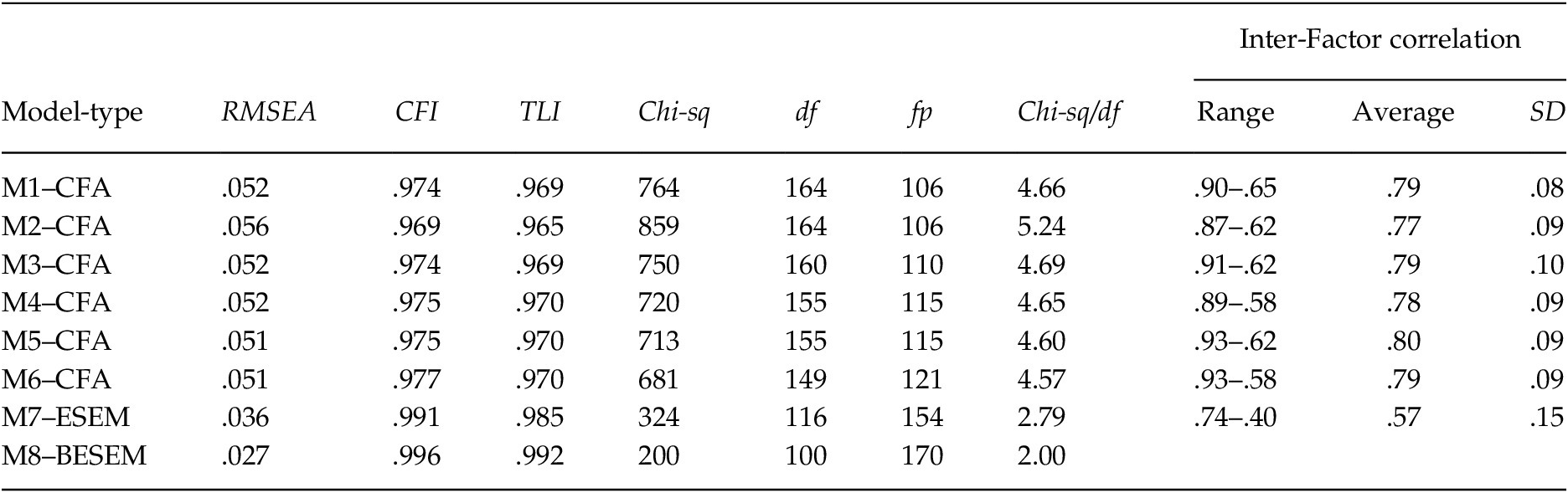
Given that all confirmatory models exceeded the fit threshold that is required to be considered adequate, none of them could be rejected (Table 4). In general, there were slight improvements in less parsimonious models (M4, M5 and M6). However, this improvement was insufficient to make a safe decision on which model best represented empirically the subjects' responses (the largest difference was between M2 and M6: ΔRMSEA = –.005; ΔCFI = .006; ΔTLI = .007). Following the parsimony principle (the number of free parameters estimated in a model), M1 (DSM–5) should be the preferred solution. Table 5 shows the factorial loads, correlations among factors and common variance explained by M1. Factorial loads were generally high (> .70), except for item 8 (D1), whose load was very low (.39). The magnitude of factorial loads indicated an adequate factor convergent validity. However, the correlations among the factors were very high (ranging between .65 and .90). This result clearly questions the discriminant validity, at least for Factors 1, 3 and 4. Very similar results were observed in the other confirmatory models.
Confirmatory Factor Analysis and Exploratory Structural Equation Models Fit Indices

Note. CFA = Confirmatory Factor analysis; ESEM = Exploratory Structural Equation Model; BESEM = Bifactor ESEM; RMSEA = Root Mean Square Error of Approximation; CFI = Comparative Fit Index; TLI = Tucker-Lewis Index; df = Degrees of freedom; fp = free parameters; SD = Standard deviation.
Parameter Estimates for the Confirmatory Factor Analysis and the Exploratory Structural Equation Models

Note. ECV = Explained Common Variance; shaded cells indicate primary (targeted) factor loadings; underlined values indicate significant cross- loadings over .20 in absolute value.
Model Re-specification through Exploratory Structural Equation Modeling (ESEM)
Considering these results, ESEM models were specified with a TARGET oblique rotation. An ESEM-Target model (M7) with load configurations that are equivalent to the M1 model was estimated. Its fit was adequate (Table 4), and the parameters are shown in Table 5. Clear differences were observed between M1 and M7. First, a considerable number (12) of relevant cross-loadings (lambda > .20) was observed. The total cross-loadings explained 17.5% of the common variance that was captured by the model. Additionally, five symptoms were particularly affected by discriminant validity issues. Items D1 (inability to remember) and E6 (sleeping disturbance) presented cross-loadings higher than their primary load and loaded on Criterion C (avoidance) and B (intrusion), respectively. Items B5 (physical reactions), B4 (psychological distress), and E1 (irritable behavior) presented very high cross-loadings (> .30) and moderately low primary loads (around .50).
Analysis of the Sources of Common Variance in PTSD Symptoms: Estimating a Bifactor-ESEM Model
To explore whether the high correlations among the factors were due to the presence of an un-considered higher-order dimension (Canivez, Reference Canivez, Schweizer and DiStefano2015), a bifactor model that uses ESEM with an orthogonal rotation target (M8) was estimated. A bifactor model (Holzinger & Swineford, Reference Holzinger and Swineford1937; Reise, Reference Reise2012) consists of a general factor (G) and specific factors (S). G and S factors are orthogonal to one another (i.e., the correlation between G and S is restricted to zero). This orthogonality helps to isolate the variance that is shared by all items from the associated to specific clusters. Thus, in a bifactor model, each item is simultaneously explained by G and at least by one S factor according to the item content and/or the theoretical criteria. In M8, four specific factors with identical settings to that of M1 (Criteria B to E of the DSM–5) were specified by using an orthogonal rotation target in addition to a general factor (called PTSD) that simultaneously reflected the twenty symptoms of the scale. The correlations among the five factors were fixed at zero to estimate separately the common variance to all symptoms (the general PTSD factor), the specific variance of each diagnostic criterion (B, C, D and E specific factors), and the reliability based on the model for each factor (by using omega hierarchical and omega specific indexes).
The fit of model M8 was not substantially better than the fit of M7 (ΔCFI = .005, ΔTLI = .007, ΔRMSEA = –.009); thus, statistically, both configurations are equivalent despite the lower parsimony of M8. However, the differences between the two models are evident when analyzing factorial loads in detail. First, the common variance that is associated with the total cross-loadings in M8 was 5.2%, which is substantially lower than the 17.5% observed in M7. This finding implies that in the presence of a general factor, the issue regarding item discrimination in the oblique model was considerably reduced. Second, the loadings in the PTSD factor were in all cases higher than all the specific factors (range = .86–.36, M = .70, SD = .11). The general factor of PTSD explained 76.3% of the common variance of all symptoms. In addition, PTSD acquired an omega hierarchical value of .91, whereas the specific factors acquired values that ranged between .08 (Criterion D) and .32 (Criterion C). In a bifactor model, the omega hierarchical value can be understood as the ratio of true variance that is assumed by each factor, once the effect of the other factors is controlled (Zinbarg et al., Reference Zinbarg, Revelle, Yovel and Li2005). The values obtained from the common and omega variances indicate the following:
-
1. The scale reached substantial unidimensionality; consequently, the total scores can be explained largely by the presence of a source of common variance to all items.
-
2. The total scores (not specific ratings by criterion) are the most accurate way to estimate the position of each subject in the evaluated construct, at least in our sample.
-
3. Beyond the general factor, specific factor reliability was low, except for the avoidance factor, which presented a degree of specificity beyond the general factor that was substantially greater than the degree of specificity in the other specific factors.
Discussion
This is the first study combining both CFA and ESEM to assess the internal structure of PTSD symptoms of DSM–5. The CFA models explored were similar to previous studies showing good fit indices, high correlation between their factors, and interchangeability of items between factors in different models (Armour et al., Reference Armour, Tsai, Durham, Charak, Biehn, Elhai and Pietrzak2015; Ashbaugh et al., Reference Ashbaugh, Houle-Johnson, Herbert, El-Hage and Brunet2016; Blevins et al., Reference Blevins, Weathers, Davis, Witte and Domino2015; Bovin et al., Reference Bovin, Marx, Weathers, Gallagher, Rodriguez, Schnurr and Keane2016; Boysan et al., Reference Boysan, Ozdemir, Yilmaz, Selvi, Özdemir and Kefeli2017; Carvalho et al., Reference Carvalho, da Motta and Pinto-Gouveia2020; Lee et al., Reference Lee, Bovin, Weathers, Palmieri, Schnurr, Sloan, Keane and Marx2019; Liu et al., Reference Liu, Wang, Cao, Wang, Zhang, Wu, Zhang, Zhao, Fan and Elhai2014; Makhubela, Reference Makhubela2018; Seligowski, & Orcutt, Reference Seligowski and Orcutt2016; Tsai et al., Reference Tsai, Harpaz-Rotem, Armour, Southwick, Krystal and Pietrzak2015; van Praag et al., Reference van Praag, Fardzadeh, Covic, Maas and von Steinbüchel2020; Wortmann et al., Reference Wortmann, Jordan, Weathers, Resick, Dondanville, Hall‐Clark, Foa, Young-McCaughan, Yarvis, Hembree, Mintz, Peterson and Litz2016; Wang et al., Reference Wang, Zhang, Armour, Cao, Qing, Zhang, Liu, Zhang, Wu, Zhao and Fan2015). Specifically in this Chilean undergraduate sample, the six models tested presented good fit index similar to that reported in a high school student sample in China (Wang et al., Reference Wang, Zhang, Armour, Cao, Qing, Zhang, Liu, Zhang, Wu, Zhao and Fan2015), a U.S. veterans sample (Armour et al., Reference Armour, Tsai, Durham, Charak, Biehn, Elhai and Pietrzak2015), and a clinical sample in Turkey (Boysan et al., Reference Boysan, Ozdemir, Yilmaz, Selvi, Özdemir and Kefeli2017). In relation to studies with Spanish speaking samples, our results are similar to those reported in a study carried out in Spain with an adult clinical sample where the DSM–5 PTSD internal structure was explored using the EGEP–5 questionnaire (Soberón et al., Reference Soberón, Crespo, Gómez-Gutiérrez, Fernández-Lansac and Armour2016). Compared to studies with undergraduate samples, our results show good fit level for all models tested, unlike other studies where the DSM–5 model does not show good fit, and conversely, the Anhedonia and Hybrid models fit the data much better (Armour et al., Reference Armour, Tsai, Durham, Charak, Biehn, Elhai and Pietrzak2015; Ashbaugh et al., Reference Ashbaugh, Houle-Johnson, Herbert, El-Hage and Brunet2016; Blevins et al., Reference Blevins, Weathers, Davis, Witte and Domino2015).
ESEM analysis provided new evidence showing multidimensionality in several items, and a general factor. In the ESEM model (M7) at least five items (D1, inability to remember; E6 sleep disturbances; B5, physical reactions; B4, psychological distress; E1, irritability/anger) fail to comply with the local independence assumption that is required to affirm that its theoretical factor, not other factors, was measured. Therefore, assuming in CFA that these cross-loadings are exactly zero may be a model specification error. The presence of multiple cross-loadings would imply that some of the items can be "interchangeable" across dimensions, which would explain why the fits in the confirmatory models obtained equivalent fits, despite being conceptually and substantively different. A substantial decrease in the correlations among the factors in the ESEM models was observed when estimating the item cross-loadings compared to CFA models. This finding suggests that the high correlations found in the CFA models were probably artificially inflated because of the specification to zero cross-loadings (Schmitt & Sass, Reference Schmitt and Sass2011).
There may be several ways of interpreting the ESEM model (M7) results. First, high cross-loadings may be due to the fallibility of the indicators themselves to properly measure their theoretical factors of reference. This condition may be related to a possible overlap between dimensions (Morin et al., Reference Morin, Arens and Marsh2015). For example, Clusters D (negative alterations in cognition and mood) and E (alteration in arousal and reactivity) could overlap, which is shown by the cross-loadings on the six items already mentioned. Second, the cross-loadings may result from the existence of a non-specified source of common variance in the model (Morin et al., Reference Morin, Arens and Marsh2015; Canivez, Reference Canivez, Schweizer and DiStefano2015). When estimating the bifactor ESEM model, most items presented their maximum load in a PTSD general factor. This general factor took most of the common variance, whereas the specific factors showed poor reliability values based on the model (omega sub-scale). Third, the cross-loadings on some items may result from problems when drafting the reagents; thus, they may associate with a factor other than the primary one. This possibility may be the case in item D1 (inability to remember) that barely loads on the theoretical factor but loads on the intrusion factor (Cluster C), which relates to avoidance behaviors. How this item is drafted may not adequately capture the theoretical symptom (traumatic amnesia) and shows mnemonic problems regarding manifestations of phobic behaviors that involve memories of the traumatic event.
In relation to the PTSD general factor found, mathematical evidence of a strong general factor does not necessarily imply the actual existence of this factor, at least not as a reflection of a common cause for all symptoms (Thorndike, Reference Thorndike1994). On the contrary, the general factor can be interpreted as a summary of the extent to which the symptoms work together as a system of mutual interdependence as is suggested by the networking model approach (Armour et al., Reference Armour, Fried, Deserno, Tsai and Pietrzak2017; Bryant et al., Reference Bryant, Creamer, O’Donnell, Forbes, McFarlane, Silove and Hadzi-Pavlovic2016; McNally et al., Reference McNally, Robinaugh, Wu, Wang, Deserno and Borsboon2014).
Regarding the empirical implications of the CFA implementation, our results are consistent with Morin et al. (Reference Morin, Arens and Marsh2015), who showed that considering that items are caused by a latent variable whose factorial grouping assumes dimensional exclusivity when estimating cross-loadings at zero, it seems not to be the most appropriate way to model complex disorders such as PTSD. In psychology, items' psychometric multidimensionality is a common problem, especially when attempting to measure complex multidimensional constructs whose components may have a degree of overlap (e.g., due to frequent comorbidity among groups of symptoms). Under these circumstances, item psychometric multidimensionality (i.e., its association to sources of variance beyond the primary theoretical factor) implies that a very restrictive model such as CFA cannot adequately represent the actual multidimensionality of the construct. Similarly, this situation may lead to confusion regarding the best model to represent the psychometric theoretical construct of interest, as demonstrated in the present research. Determining symptoms’ discriminative capacity is fundamental to measure their theoretical factors adequately and, consequently, to facilitate an interpretation of the model and of the scores obtained by the subjects in both research and clinical contexts (Morin et al., Reference Morin, Arens and Marsh2015).
In theoretical terms, symptom multidimensionality, which is expressed through cross-loading, questions the idea that each symptom must belong to a single symptomatic cluster with a common base cause (Atkas et al., Reference Atkas, Walsh and Rybicki2010). The results indicate that in the DSM–5 model, only nine symptoms comply with this assumption (B1, 2 and 3; C1 and 2; D5 and 6; and E3 and 4), and the rest present a substantial degree of cross-loadings. This could be interpreted as some symptoms could more clearly represent the core of this disorder, something similar to the idea that guides the PTSD symptoms proposal in ICD–11. It is pointed out that there would be some symptoms that reflect the fear-related reactions that characterize the experience of a traumatic event, leaving aside those more nonspecific symptoms that overlap with other disorders (Brewin et al., Reference Brewin, Cloitre, Hyland, Shevlin, Maercker, Bryant, Humayung, Jones, Kagee, Rousseau, Somasundaram, Suzuki, Wessely, van Ommeren and Reed2017). In the ESEM DSM–5 model, the characteristics of the factor loads of intrusive symptoms (B1, 2 and 3), avoidance (C1 and 2), and alterations in arousal and reactivity (E3 and 4), would go in the direction of ICD–11. However, there are also two symptoms of the cluster negative alterations in cognitions and mood (D5 and 6), that comply with dimensional exclusivity, providing arguments in favor of an “anhedonia” cluster as in the Anhedonia (Liu et al., Reference Liu, Wang, Cao, Wang, Zhang, Wu, Zhang, Zhao, Fan and Elhai2014) and the Hybrid model (Armour et al., Reference Armour, Tsai, Durham, Charak, Biehn, Elhai and Pietrzak2015), which shows the need to continue exploring the symptom structure of PTSD to improve the understanding of this disorder.
The results also provide evidence of reliability and validity that allows the use of the PCL–5 as a symptomatic screening tool for PTSD in Chile in non-clinical undergraduate students’ samples. The Cronbach’s alpha of the subscales is adequate and similar to that of the English version and of the adaptations made in French, German, Portuguese, Turkish and Deuth (α = .75–.94) (Ashbaugh et al., Reference Ashbaugh, Houle-Johnson, Herbert, El-Hage and Brunet2016; Boysan et al., Reference Boysan, Ozdemir, Yilmaz, Selvi, Özdemir and Kefeli2017; Carvalho et al., Reference Carvalho, da Motta and Pinto-Gouveia2020; Krüger-Gottschalk et al., Reference Krüger‐Gottschalk, Knaevelsrud, Rau, Dyer, Schäfer, Schellong and Ehring2017; van Praag et al., Reference van Praag, Fardzadeh, Covic, Maas and von Steinbüchel2020; Wortmann, et al., Reference Wortmann, Jordan, Weathers, Resick, Dondanville, Hall‐Clark, Foa, Young-McCaughan, Yarvis, Hembree, Mintz, Peterson and Litz2016). The internal structure validity agrees with the theoretical structure proposed by the DSM–5 using CFA, similar to the structure reported in studies carried out in other countries (Armour et al., Reference Armour, Tsai, Durham, Charak, Biehn, Elhai and Pietrzak2015; Boysan et al., Reference Boysan, Ozdemir, Yilmaz, Selvi, Özdemir and Kefeli2017; Lee et al., Reference Lee, Bovin, Weathers, Palmieri, Schnurr, Sloan, Keane and Marx2019; Liu et al., Reference Liu, Wang, Cao, Wang, Zhang, Wu, Zhang, Zhao, Fan and Elhai2014; Makhubela, Reference Makhubela2018; Tsai et al., Reference Tsai, Harpaz-Rotem, Armour, Southwick, Krystal and Pietrzak2015; van Praag et al., Reference van Praag, Fardzadeh, Covic, Maas and von Steinbüchel2020; Wang et al., Reference Wang, Zhang, Armour, Cao, Qing, Zhang, Liu, Zhang, Wu, Zhao and Fan2015), and with the use of ESEM.
This study presents limitations that are worth noting. First, this sample includes a population of university students which limits the generalization of the results to other community or clinical samples of adults. The use of a self-report questionnaire does not allow estimating the real prevalence of PTSD. A low prevalence of probable PTSD was reported, however it is higher than the prevalence reported in similar samples of university (Armour et al., Reference Armour, Tsai, Durham, Charak, Biehn, Elhai and Pietrzak2015) and high school students (Wang et al., Reference Wang, Zhang, Armour, Cao, Qing, Zhang, Liu, Zhang, Wu, Zhao and Fan2015), and higher than samples of war veterans (Armour et al., Reference Armour, Tsai, Durham, Charak, Biehn, Elhai and Pietrzak2015; Tsai et al., Reference Tsai, Harpaz-Rotem, Armour, Southwick, Krystal and Pietrzak2015). Finally, it is important to note that in relation to PTSD cross-cultural validity, a series of factors have been described that can be influenced or associated with culture, such as conditional risk of PTSD, the way to process and cope with a traumatic experience, or even the way to respond to an evaluation of PTSD (Lewis-Fernández et al., Reference Lewis-Fernández, Hinton, Marques, Friedman, Keane and Resik2014), that in this study were not assessed. Notwithstanding the foregoing, our results tend to support the transcultural hypothesis of PTSD, but only allows to affirm that the DSM–5 PTSD construct can be measured by using the PCL–5 in an undergraduate sample in Chile. We consider necessary to extend this level of knowledge through studies with clinical and non-clinical samples in our country and the world, incorporating cultural factors such as those already mentioned.
The application of the CFA method to estimate the factor structure of PTSD allowed us to obtain similar results to those reported in the literature. However, the application of ESEM and the Bifactor analysis gave us the opportunity to empirically appreciate that many items do not meet the assumption of dimensional exclusivity, with substantive loads on more than one theoretical factor or even loading on a general factor. We consider that these results do not question the relevance of the PTSD construct, but rather disagree with the theoretical model that underlies the symptomatic organization of this disorder, while demonstrating the need to include new analysis strategies to study the symptomatic structure of PTSD and thus improve the understanding of this disorder.
Access to the data is authorized if requested by the editor or peer reviewers.