Introduction
Silicone rubber (SR) is widely used in several industrial sectors due to their excellent mechanical properties, biocompatibility, chemical resistance to alkalis/acids, and redox reagents. The medical and food sectors employ SR in the manufacturing of implants, medical/diagnostic (devices or components)[ Reference Whitford 1 – Reference Saxon, Barton, Katon, Lakin, Timmermans, Uchida, Keller and Rösch 3 ] as well as molds, containers, processing belts, among others.[ Reference Sidwell and Baughan 4 ] However, as occur with other materials, a prolonged use in an environment rich in nutrients provokes the pollution with organic materials, allowing the bacterial proliferation as a biofilm on these devices.[ Reference O'Toole, Kaplan and Kolter 5 ] Therefore, to provide antimicrobial activity to SR means to increase its value since it is the most important for some applications where the bacterial growth is undesirable,[ Reference Wang, Qin, Lin, Zhu, Zhang, Liu and Van der Bruggen 6 ] and conversely increasing the lifetime of devices is imperative, e.g., to prevent medical complications[ Reference Harding and Reynolds 7 , Reference Arciola, Campoccia, Speziale, Montanaro and Costerton 8 ] and enhance the life of stored products.[ Reference Mérian and Goddard 9 ]
The methods employed to provide antimicrobial activity to SR have been extensive, including the loading of biocides[ Reference Vazquez-Gonzalez, Melendez-Ortiz, Diaz-Gomez, Alvarez-Lorenzo, Concheiro and Bucio 10 ] and antibacterial enzymes.[ Reference Hadjesfandiari, Yu, Mei and Kizhakkedathu 11 ] However, to accomplish this goal, the modification of the matrix with other polymers supplying adequate functional groups was required[ Reference Garcia-Galan, Berenguer-Murcia, Fernandez-Lafuente and Rodrigues 12 ] since otherwise it is almost impossible to achieve this task due to the high hydrophobicity and inadequate functional groups of the matrix.[ Reference Flores-Rojas, Pino-Ramos, López-Saucedo, Concheiro, Alvarez-Lorenzo and Bucio 13 , Reference Mateo, Palomo, Fernandez-Lorente, Guisan and Fernandez-Lafuente 14 ] One of the methods used to modify the SR is by grafting polymerization using chemical[ Reference Feng, Brash and Zhu 15 , Reference Abbasi, Mirzadeh and Katbab 16 ] or energy sources as initiators,[ Reference Flores-Rojas and Bucio 17 ] allowing the grafting of vinyl monomers which can provide thermal[ Reference Valencia-Mora, Zavala-Lagunes and Bucio 18 ] and pH[ Reference Ferraz, Varca, Ruiz, Lopes, Mathor, Lugão and Bucio 19 ] responsiveness, as well as high hydrophilicity and chemical groups that enable subsequent chemical modifications, allowing the covalent immobilization of antimicrobial enzymes such as lysozyme.[ Reference Flores-Rojas, Pino-Ramos, López-Saucedo, Concheiro, Alvarez-Lorenzo and Bucio 13 , Reference Barbosa, Ortiz, Berenguer-Murcia, Torres, Rodrigues and Fernandez-Lafuente 20 ]
Some methods applied to covalent immobilization of enzymes are through chemical reactions such as exchange reactions of thiol-disulfide,[ Reference Neves-Petersen, Snabe, Klitgaard, Duroux and Petersen 21 ] formation of Schiff bases,[ Reference Barbosa, Ortiz, Berenguer-Murcia, Torres, Rodrigues and Fernandez-Lafuente 20 , Reference Chae, In and Kim 22 , Reference Flores-Rojas, López-Saucedo, Bucio and Isoshima 23 ] or by peptide[ Reference Guadarrama-Zempoalteca, Díaz-Gómez, Meléndez-Ortiz, Concheiro, Alvarez-Lorenzo and Bucio 24 ] and diazo bonds,[ Reference Masoom and Townshend 25 ] and even through by alkylation reactions.[ Reference Sheldon 26 ] Where one of the best methods is by the formation of Schiff bases from the chemical groups provided by the matrix or enzyme followed by the reduction of imine groups if the enzyme allowed it. This method offers some advantages since less aggressive conditions are used in the enzyme immobilization, for example, low temperature and water as a medium of reaction, which also allows the control of pH and ionic strength, guaranteeing the integrity of the enzyme.[ Reference Flores-Rojas, Pino-Ramos, López-Saucedo, Concheiro, Alvarez-Lorenzo and Bucio 13 ]
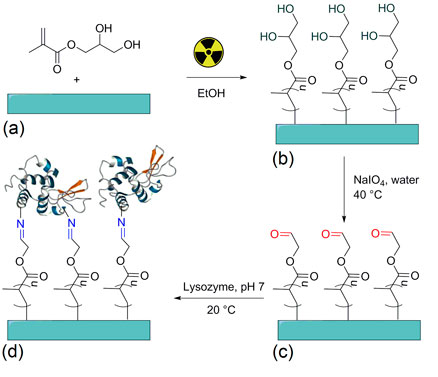
In this paper, we report the lysozyme immobilization in SR modified through grafting performed by γ-rays as initiator; using glycerol methacrylate (GlyMA) to provide adequate functional groups for subsequent derivatization to 2-oxoethyl methacrylate (OxMA) and finally carry out the lysozyme immobilization, also studies were done at different pH values on lysozyme releasing.
Results and discussion
Grafting polymerization
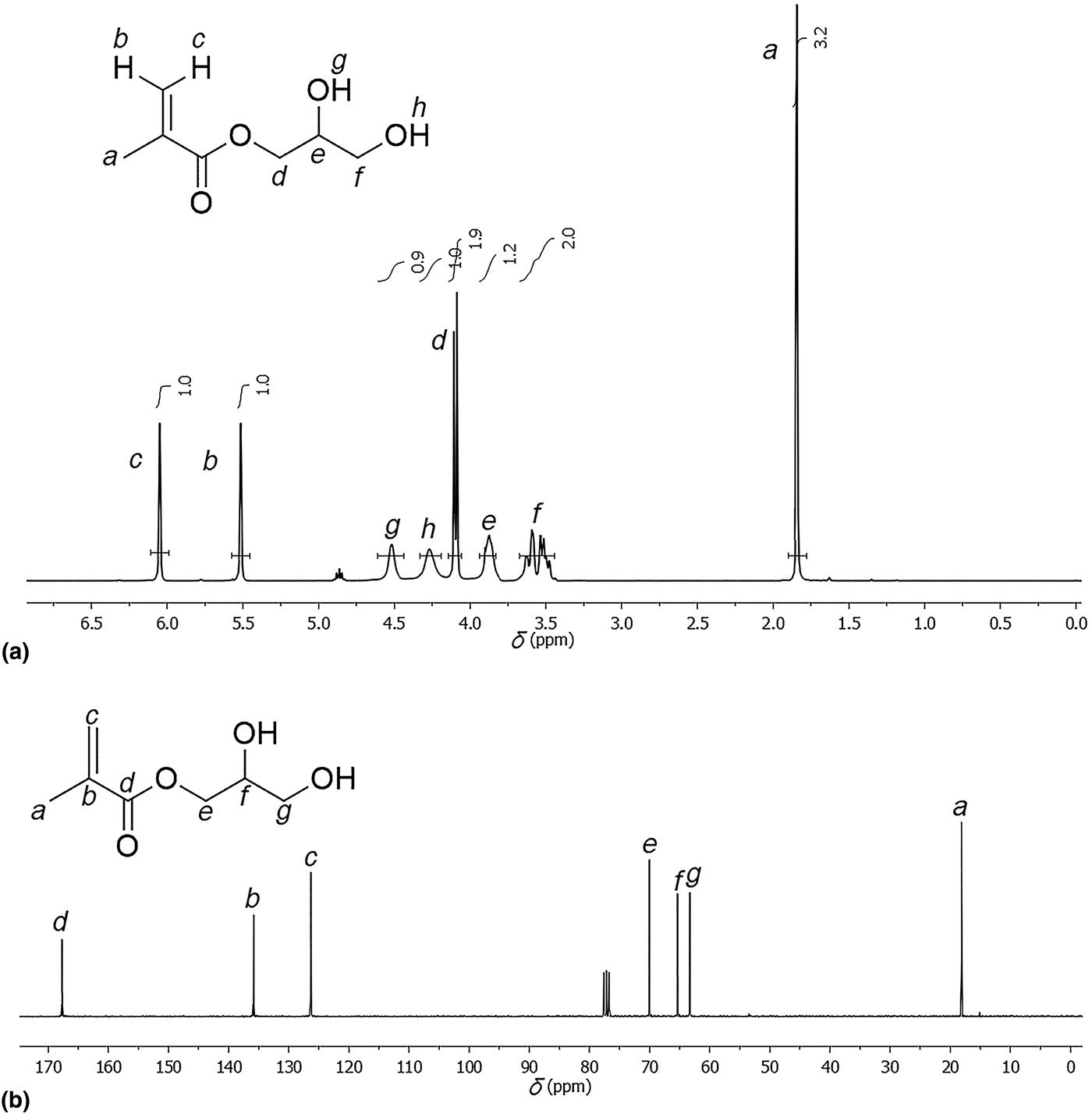
The synthesis of GlyMA was successfully achieved by the opening of epoxide ring of glycidyl methacrylate using water as the medium of reaction and nucleophile under air flow to prevent the monomer polymerization (Fig. 1), and once this is obtained, it was employed in the grating polymerization on SR by means of γ-rays using ethanol.
(a) 1H-RMN spectrum (300 MHz, CDCl3) of glycerol methacrylate. δ H (ppm): 1.84 (s, 3H, −CH3), 3.48–3.63 (m, 2H, −CH2), 3.88–3.90 (m, 1H, −CH), 4.10 (d, 2H, J = 5.4 Hz, −CH2), 4.27 (s, 1H, −OH), 4.52 (s, 1H, −OH), 5.51 (s, 1H, = CH2), 6.05 (s, 1H, = CH2). (b) 13C-RMN spectrum (75 MHz, CDCl3) δ H (ppm): 18.1 (CH3), 63.3 (CH2), 65.3 (CH2), 70.0 (CH2), 126.3 ( = CH2), 135.8 (C ipso ), 167.7 (C ipso ). The FTIR-ATR and mass spectra are in Supplementary Material Figs. S1 and S2.

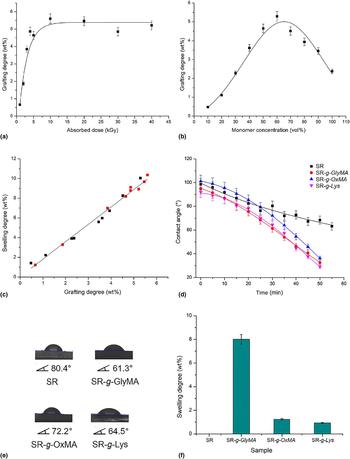
The grafting degree exhibited a dependence on the absorbed dose and monomer concentration with a maximum grafting degree at 5 kGy and 50% vol. of monomer [Figs. 2(a) and 2(b)]. The study showed the possibility of control on the modification degree changing the monomer concentration covering an interval of grafting from 0.5% to 5.6% using an absorbed dose of 5 kGy, while the absorbed dose study offered a low control on this, due to the sensitivity to changes of absorbed dose with a fast increase of the grafting in a range between 1 and 5 kGy, followed by a constant grafting degree from 5 to 40 kGy. The behavior was attributed to the fast polymerization of the monomer caused by the absorbed dose suggesting that after 5 kGy, the monomer was completely consumed by the grafting polymerization and not being able to improve the grafting degree due to the excess of absorbed dose.
Effect of the absorbed doses (a) and monomer concentration in ethanol (b) on the grafting degree, and (c) swelling percentage as a function of grafting degree; red squares belong to absorbed dose series and black squares belong to monomer concentration series. The swelling degree of SR-g-GlyMA was measured after 24 h in water as solvent. (d) Contact angle at different times, (e) photographs of contact angle after 30 min of films in the immobilization process of lysozyme, and (f) swelling percentage of films in the immobilization process of lysozyme using SR-g-GlyMA with 4.9% of grafting.

Hydrophilicity study
The grafting of GlyMA on SR matrix provided high hydrophilicity because of hydroxyl groups from the grating. The hydrophilicity of the new materials was measured by the swelling study and contact angle using water. The series grafted at different absorbed doses indicated that there was no cross-linking of the grafting since the modified films obtained from 10 to 40 kGy had a similar swelling in accordance with their grafting degree [Fig. S3(a)], otherwise the swelling degree would have decreased as the absorbed dose increased; this behavior is in agreement with the protector effect of ethanol preventing the cross-liking of grafting, and this result was also confirmed by the linear behavior showed in both the series (absorbed dose and monomer concentration) [Figs. S3(a) and S3(b)], where the linear behavior of the swelling study in water had an R 2 = 0.98, which indicates that it is possible to control the swelling of the SR sample by the grafting degree [Fig. 2(c)], even though to predict the swelling as a function of absorbed dose, monomer concentration, and grafting degree.
Lysozyme immobilization
The immobilization was achieved using the SR-g-GlyMA with a grafting degree of 4.9% that was previously modified using sodium periodate with 1.3 chemical equivalents to supply formyl groups (SR-g-OxMA), followed by the lysozyme immobilization (SR-g-Lys).
The intermediate film SR-g-GlyMA (with a grafting degree of 4.9%) submitted to immobilization process of lysozyme showed a considerable decrease of swelling degree caused by the change of chemical groups on the film, being this behavior agreed with the chemical modification on the material. However, in both cases of SR-g-OxMA and SR-g-Lys, the contact angle [Figs. 2(d) and 2(e)] and swelling degree [Fig. 2(f)] were not consistent since the contact angle showed high wettability similar to SR-g-GlyMA, but their swelling degree was considerably lower; the behavior was attributed to decrease the capacity of adsorption of water provoked by the less hydrophilicity of the groups and the binding of lysozyme (SR-g-Lys) where the latter also generated a restriction on the swelling of the matrix that could be attributed to the multi-covalent bonds between the enzyme and the chains of the OxMA.
Fourier transform infrared spectroscopy-attenuated total reflectance (FTIR-ATR) analysis
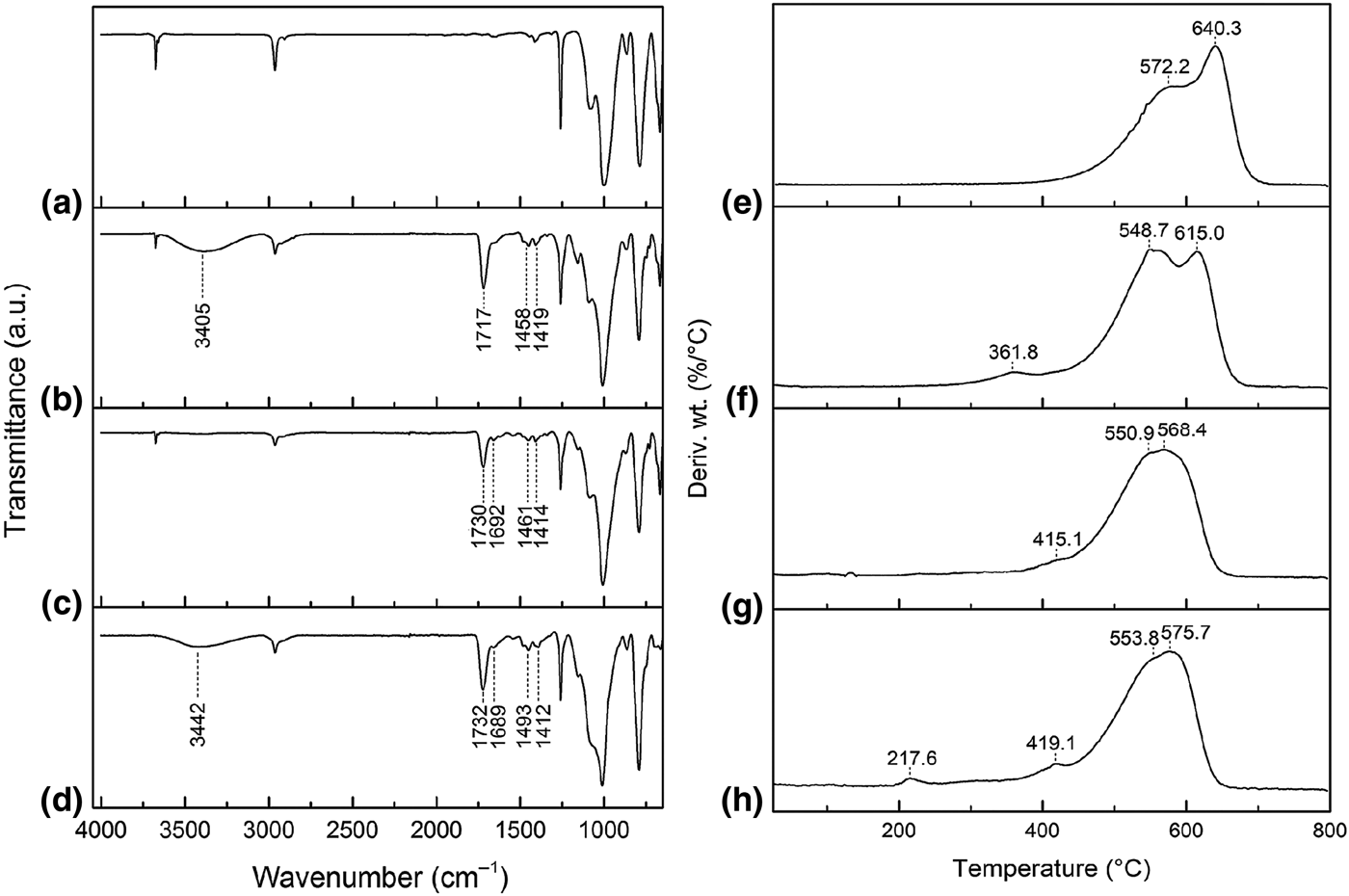
FTIR-ATR analysis provided information about functionalization of SR in the immobilization process. The spectrum of started SR showed strong bands at 1012 and 800 cm−1 corresponding to the Si–O–Si stretching and bending vibrations, respectively [Fig. 3(a)]. SR-g-GlyMA [Fig. 3(b)] exhibited the bands at 1717 and 3405 cm−1 corresponding to ν(C = O) and ν(OH) groups from the grafting (Fig. S4) while in the spectrum of modified sample by the sodium periodate (SR-g-OxMA), [Fig. 3(c)] had a shift of carbonyl band to 1730 cm−1 as well as the absence of the corresponding band to hydroxyl groups (at 3405 cm−1), indicating a successful formation of formyl groups.
FTIR-ATR spectra in the process of lysozyme immobilization with dried films using a sample with 4.9% of grafting; (a) SR, (b) SR-g-GlyMA, (c) SR-g-OxMA, and (d) SR-g-Lys. Weight loss derivate as a function of temperature for the films in the immobilization process of lysozyme under a nitrogen atmosphere using a sample with 4.9% of grafting; (e) SR, (f) SR-g-GlyMA, (g) SR-g-OxMA, and (h) SR-g-Lys.

The spectrum of SR-g-Lys [Fig. 3(d)] evidenced a new band of weak intensity at 1732 and 1689 cm−1, assigned to ν(C=O) of the ester and “amide I” from the immobilized lysozyme. The spectrum also showed the band at 3442 cm−1 assigned to ν as(NH2) and ν(OH), which exhibited an intensity increase of complementary bands at 1493 and 1412 cm−1 corresponding to δ(CO) and δ(CN) from the immobilized lysozyme.
Thermal analysis
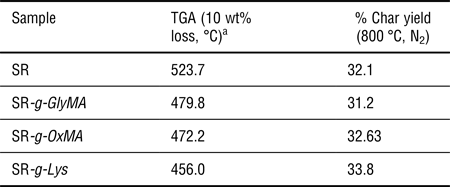
The temperatures at 10% weight loss through the immobilization process of lysozyme showed consistently a decrease of thermal stability in each step of the immobilization where the most considerable change occurred after the grafting polymerization, being the lower temperature for the SR-g-Lys which is accord with the decomposition temperature of lysozyme (Table 1).
Temperatures at 10% weight loss and residue of the sample in the lysozyme immobilization process.

a Measured at 10 °C min−1.
The thermogravimetric analysis (TGA) performed with the pristine SR [Fig. 3(e)] showed two-step decomposition at 572.2 and 640.3 °C. Moreover, the SR-g-GlyMA exhibited one step of decomposition at a lower temperature 361.8 °C, corresponding to the decomposition of the GlyMA grafting [Fig. 3(f)] which had a higher stability temperature in comparison to PGlyMA [Fig. S5(a)], and the next ones to the SR matrix with a temperature of 548.17 and 615.0 °C, while the SR-g-OxMA exhibited a better thermal stability with a first decomposition temperature at 415.1 °C [Fig. 3(g)] which was assigned to the grafting. The SR-g-Lys showed multiple decomposition stages: the first two decompositions at 217.6 and 419.1 °C were attributed to immobilized lysozyme [Fig. S5(b)] and decomposition of the grafting, respectively, followed by the matrix decomposition at 553.5 and 575.7 °C as shown in Fig. 3(h).
Scanning electron microscope (SEM) study
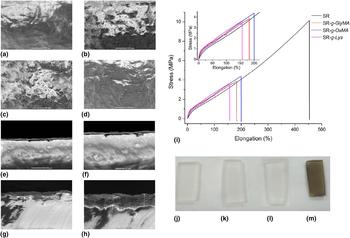
The SEM images showed the changes on surface morphology of the film through the immobilization process of lysozyme showing a homogenous grafting of GlyMA on the surface of SR being this accord with the expected since the grafting is benefited meanly in the amorphous polymer. The images of SR-g-OxMA and SR-g-Lys samples did not exhibit aggregates on the surface of the film, but, they had an increase of their rugosity and fissures (Fig. S6) as the SR was modified [Figs. 4(a)–4(d)] suggesting a more fragile surface. The transversal section images showed that the grafting on the SR was carried out on the surface with a narrow thickness of 24.36 ± 3.75 µm [Figs. 4(e)–4(h)]. Therefore, the subsequent steps of modification (SR-g-OxMA and SR-g-Lys) were carried out just on the surface of the film being this restricted by the grafting.
SEM images of SR samples through immobilization process of lysozyme using SR-g-GlyMA with 4.9% of grafting. (a) SR, (b) SR-g-GlyMA, (c) SR-g-OxMA, (d) SR-g-Lys, (e) and (f) transversal section of SR, and (g) and (h) transversal section of SR-g-GlyMA. (i) Mechanical properties were recorded using dried samples with a grafting degree of 4.9% in each step of immobilization process of lysozyme at 23 °C and a speed of 10 mm min−1. Confirmation of lysozyme immobilized (SR-g-Lys) with a grafting degree of 4.9%, using ammonia solution of silver nitrate as stainer, where the dark brown color indicates a positive presence of lysozyme, (j) SR, (k) SR-g-GlyMA, (l) SR-g-OxMA (modified with 0.5 equivalents of NaIO4), and (m) SR-g-Lys.

Mechanical properties
The study of mechanical properties showed the effects of grafting polymerization and immobilization process of lysozyme [Fig. 4(i) and Table 2], exhibiting the most important change that occurred after the grafting (SR-g-GlyMA) increasing Young's modulus from 3.89 to 40 MPa with a maximum load from 48 to 18 N, and the stress curve also showed the contribution of the GlyMA grafting, which provoked small strains on the curve indicating that the grafting is restricted on the surface of the SR film being this confirmed by the SEM images. The subsequent derivatization to SR-g-OxMA provided a decrease of hardness giving a Young's modulus of 6.06 MPa and increasing the maximum loading from 18 to 21 N; this behavior attributed a weaker interaction between formyl groups compared with hydroxyl group interactions on the SR-g-GlyMA. Finally, the lysozyme immobilization increased the hardness of the matrix with Young's modulus of 11.19 MPa and a maximum load of 16 N.
Resume of mechanical properties of the SR through the immobilization process of lysozyme, with a grafting degree of 4.9%.

Non-specific assay of lysozyme
The presence of lysozyme immobilized on the SR-g-Lys was confirmed by a non-specific assay using ammonia solution of silver nitrate as stainer, which was positive for the presence of lysozyme showing the characteristic dark brown stain [Figs. 4(j)–4(m)]. Moreover, this test indicated that the immobilization was limited on the surface of film since the color was observed just on the surface of the SR-g-Lys sample.
Enzymatic activity
The immobilization of lysozyme was initially carried out with the SR-g-GlyMA (~4.9% of grafting) modified completely by sodium periodate to provide the formyl groups (SR-g-OxMA) and subsequent lysozyme immobilization giving a maximum amount of immobilized lysozyme of 252 ± 8 µg cm−2. However, these films did not exhibit enzymatic activity in Micrococcus lysodeikticus (coccus, Gram-positive) suspension at pH = 7 and 30 °C after 24 h. The failure was attributed to overimmobilization of lysozyme on the matrix. Therefore, half of the chemical equivalents were used with respect to the grafting to form the formyl groups; in this regard, to decrease the overimmobilization, the new material had an immobilization of 115.6 ± 5 µg cm−2, which shows the presence of enzymatic activity.
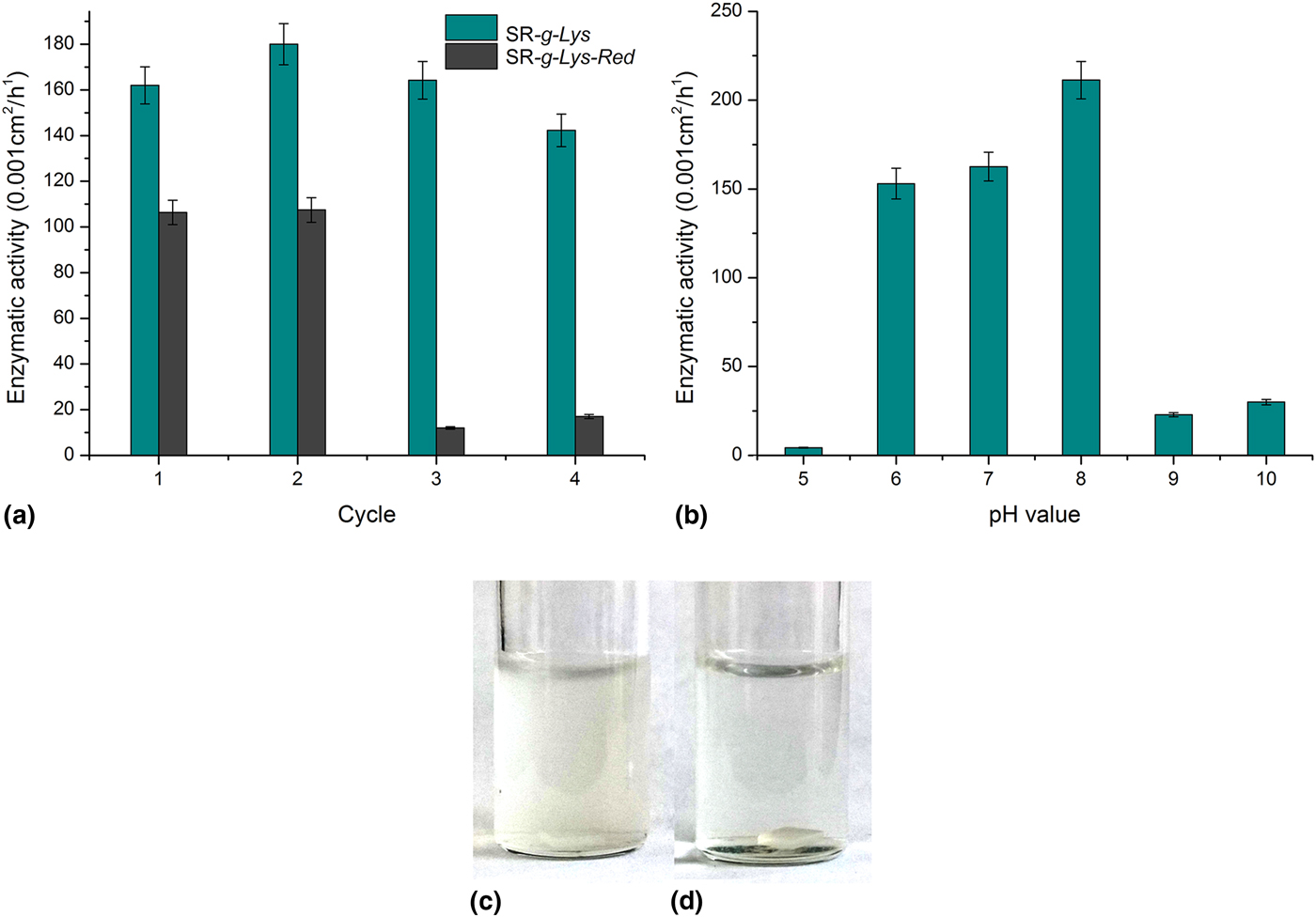
Subsequently, half of the SR-g-Lys was taken from the latter and treated with NaBH3CN to reduce the imine groups formed in the immobilization to generate secondary amines, which are more stable groups (SR-g-Lys-Red), thus obtaining two samples: SR-g-Lys and SR-g-Lys-Red. These two samples were used in the enzymatic activity assays and the results confirmed a better activity in the SR-g-Lys compared with the SR-g-Lys-Red sample [Fig. 5(a)]. The less enzymatic activity (first cycle) on the SR-g-Lys-Red was maybe provoked by a damage of lysozyme in the reduction process. In the next cycle, the enzymatic activity remains slightly constant, which later shows a considerable decrease, and this behavior was not observed on the SR-g-Lys. Despite the decrease of enzymatic activity in the SR-g-Lys-Red sample, in both cases, the behavior was consistent with the immobilization of lysozyme on the films since the enzymatic activity was improving after each cycle.
(a) Reusability of SR-g-Lys and SR-g-Lys-Red (samples synthesized with SR-g-GlyMA with 4.9% of grafting obtained using an absorbed dose of 5 kGy) at pH = 7 [0.01] and 30 °C. The reusability was calculated after 24 h. (b) Enzymatic activity of the SR-g-Lys sample at different pH values. Photographs of Micrococcus lysodeikticus suspension at pH = 7 and 30 °C, (c) 0 h, and (d) 48 h after adding the SR-g-Lys sample.
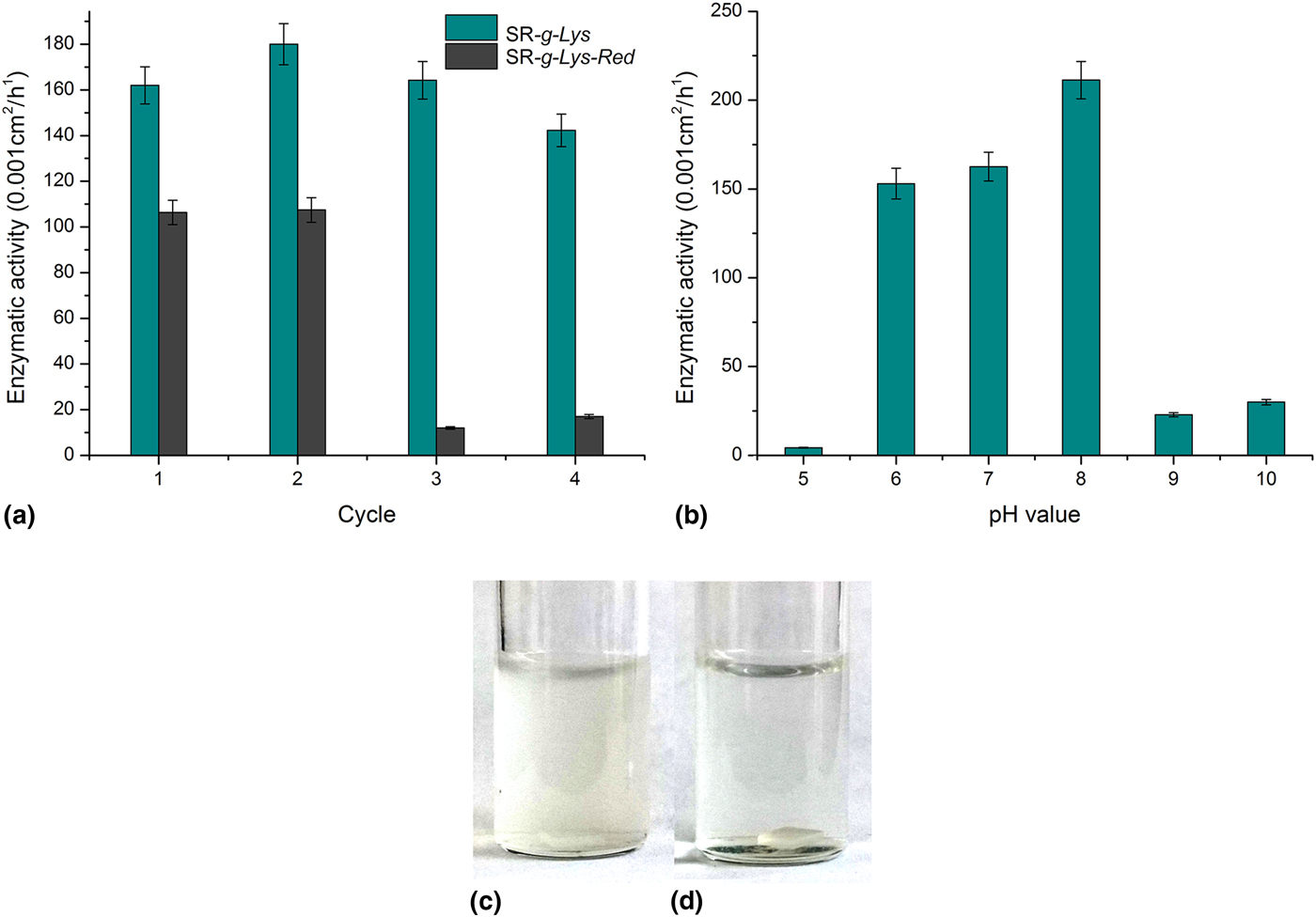
The enzymatic activity at different pH values was performed using the SR-g-Lys sample, which had the best enzymatic activity. The results indicated a narrow interval of enzymatic activity from 6 to 8 with the best activity at pH = 8, showing a low enzymatic activity out of this interval [Fig. 5(b)]; finally, Figs. 5(c) and 5(d) show the photographs of lytic activity in M. lysodeikticus suspension once the lysozyme was immobilized on the matrix.
In the case of SR-g-Lys sample, this was soaked in buffers with different pH values from 5 to 10 and monitored by spectrophotometry, to know the stability of imine groups between the lysozyme and the matrix at these pH values. The results did not show the evidence of lysozyme releasing indicating an excellent stability at acidic and basic pH values (Fig. S7).
Conclusion
The synthesis and grafting of GlyMA were successfully carried out on the SR, showing the grafting degree a dependence on the absorbed dose and the monomer concentration, leading a tailored grafting on the matrix. Moreover, the derivatization of GlyMA to OxMA was achieved with sodium periodate under mild reaction conditions providing this methodology the control on the degree of derivatization, being this an advantage in the immobilization process of lysozyme. The mechanical properties showed the most important change on its properties which was made after the GlyMA grafting, being this also modified by the derivatization and immobilization of lysozyme.
The reduction of imine groups by NaBH3CN decreases the enzymatic activity, presumably provoked by a damage of the enzyme. The effect of overimmobilization of lysozyme on the enzymatic activity was also observed, which provoked a complete impediment of this. In addition, the enzymatic activity study at different pH values showed higher activity in the interval from pH 6 to 8, without evidence of lysozyme releasing as it was indicated in the corresponding studies carried out at different pH values with the non-reduce sample (SR-g-Lys) suggesting a stable lysozyme immobilization.
Supplementary material
The supplementary material for this article can be found at https://doi.org/10.1557/mrc.2018.16
Acknowledgments
This work was supported by Dirección General de Asuntos del Personal Académico, Universidad Nacional Autónoma de México under Grant IN201617 (Mexico). The authors thank B. Leal and M. Cruz from ICN-UNAM as well as E. Hernández-Mecinas and Carlos Flores from IIM-UNAM for their technical assistance.