

The recent literature on economics as a scientific discipline argues that “economists are everywhere” [Markoff and Montecinos Reference Markoff and Montecinos1993; Lebaron Reference Lebaron2000; Reference Lebaron2001; Fourcade Reference Fourcade2009; Heredia Reference Heredia2014; Godechot Reference Godechot2011]. According to this thesis, economics and its sister discipline of business studies have achieved during the last half-century an unrivalled “superiority” in the social sciences and in the academic field as a whole [Fourcade et al. 2015; Khurana 2007; Pfeffer Reference Pfeffer1997]. Especially in the world-leading US scientific field, both disciplines have increased their scientific legitimacy. Economists have “left history behind and turned to paradigmatic fields in the natural sciences” [Fourcade et al. 2015: 92] and could, in terms of scientific reputation, profit from the symbolic value and the high entry costs of mathematical formalisation. Today the scientific renown of the economic sciences is both accepted by the other (social) sciences and claimed by the members of the disciplines themselves. Simultaneously, by exporting academic logic into the corporate and political spheres, the economic sciences would have reinforced their impact in these domains as well. Scholars in the economic sciences have become increasingly important advisers in central administrations, political leaders in governments, central bankers, directors of supra-national organisations and board members of large firms [Markoff and Montecinos Reference Markoff and Montecinos1993; Fourcade Reference Fourcade2006; Cho et al. 2017]. In a nutshell: the economic sciences owe their “superiority” to their simultaneous success in scientific and in extra-academic spheres alike. Scholars in the economic sciences enjoy both a high scientific reputation and participate in the political and private sectors.
In opposition to this narration, theories of scientific power deem such simultaneous power within and outside the scientific sphere as rather unlikely. Bourdieu [Reference Bourdieu1988] argued that scientific reputation (scientific capital) and institutional power (academic and extra-academic capital) are mutually exclusive and can—for reasons of time allocation and habitus—not be maximised simultaneously [Gingras Reference Gingras, Lebaron and Mauger2012; Graf Reference Graf2015]. More recent studies have found that this opposition is also valid within the economic sciences themselves: Lebaron [Reference Lebaron2000] identifies the divide between a “temporal pole” (political and economic power) and a “spiritual pole” (intellectual and scientific power) as key to the understanding of the economic sciences. According to him those economists who occupy powerful positions in politics and business are not admired for their works, their research or their theories. Inversely, those who possess an important intellectual and scientific reputation rarely sit on influential boards and committees in the worlds of business, senior civil service or politics.
The question therefore arises of how these different forms of capital are related to each other in the case of the economic sciences. In order to untangle the interaction between scientific reputation and institutional power, and its role in the rise of the economic sciences, this paper investigates the positions and assets of 487 extraordinary (associate) and ordinary (full) professors of economics and business sciences Footnote 1 at Swiss universities since the 1950s. We study three types of power resources: academic capital (institutional power within the university), scientific reputation, and extra-academic positions in the political and economic spheres. We seek to answer two research questions: a) How has the endowment of these power resources by professors of the economic sciences evolved over the second half of the 20th century? How does this endowment and its historical evolution compare to that of professors of law, social science and the humanities? b) How have these forms of capital evolved relationally to each other: can we observe trade-offs between scientific and institutional forms of power assets [Bourdieu Reference Bourdieu1988] or do these resources mutually reinforce each other? To analyse these questions Switzerland seems to us a particularly suitable case study. The country occupies a middle position in the international hierarchy of science, the weakly professionalised political and administrative spheres are particularly open to the participation of scientific experts, and its very internationalised scientific field allows us to study the influence of international scientific assets.
The article is organised as follows. We first present two opposing views on the importance and power of the economic sciences and then explain what the Swiss case could add to the existing explanations. We then formulate our research questions, provide details of our sample, and explain how we have operationalised the variables. In the result section we shed light on three power dimensions of the economic sciences: institutional academic capital, scientific capital and extra-academic capital. We then discuss specifically the interaction between scientific capital and institutional and extra-academic capitals on the individual level. In the conclusion, we revisit our research questions and discuss the meaning of our results for theories on the power of the economic sciences.
Analytical framework and research questions
The trade-off between scientific and institutional capital
One of the most important studies on scientific and academic power remains Bourdieu’s Homo Academicus [1988]. In this study, Bourdieu focuses on the French academic field of the late 1960s and early 1970s. He argues that this academic field Footnote 2 witnessed an increasing autonomy from the 19th century onwards, and had become structurally homologous to the French field of power Footnote 3 [Bourdieu Reference Bourdieu1988: 37]. According to Bourdieu the French academic field of the time is structured by two fractions with each a specific configuration of capitals [Bourdieu Reference Bourdieu1988: 48]. First, the society pole, which is composed of the temporally dominant and spiritually dominated fraction of professors, close to the external (economic and political) powers of the field and thus dependent on the field of power. They are the principal holders of economic and political capitals (understood as the specific resources linked to the economic and political fields) and the (institutional) academic capital (which allows them to control other positions and their occupants in the field through administrative functions within the university, such as vice chancellor or dean). Professors of law and medicine tend to be part of this fraction [Bourdieu Reference Bourdieu1988: 40, 62, 73]. The second is a temporally dominated and spiritually dominant fraction, the scientific pole. It is principally composed of professors of the faculties of (natural) sciences, major holders of scientific capital. According to Bourdieu, scientific capital is “a symbolic capital of recognition that is primarily, sometimes exclusively, valid within the field: a scientist’s symbolic weight tends to vary with the distinctive value of his contribution and the originality that his competitors-peers recognize in his distinctive contribution” [Bourdieu Reference Bourdieu2004: 55]. According to Bourdieu there is a trade-off between academic and political/economic capital on the one hand and scientific capital on the other. For reasons of time allocation, specialisation and scientific habitus, it is difficult for the representatives of a discipline to cumulate those two major forms of power simultaneously [Graf Reference Graf2015]. Furthermore, Bourdieu asserts that most of the faculties, or the disciplines within these, are more or less close to one of these two poles Footnote 4 .
Lebaron [Reference Lebaron2000], studying economists in a Bourdieusian perspective in France, found this divide between a society pole and a scientific pole to be key also within this discipline. Scholars who are renowned for their ideas, theories and works, with publications in the important American journals or on the national book market are opposed to scholars who have mandates in the corporate world, in economic interest groups or in political parties. Whereas the former seldom cultivate links to business and politics, the latter are endowed with only limited scientific capital. This interpretation, emphasising the struggles and conflicts within the discipline, cuts across the findings of a more recent literature on economics and business studies [Markoff and Montecinos Reference Markoff and Montecinos1993; Fourcade Reference Fourcade2009; Fourcade et al. 2015; Khurana 2007; Honegger et. al. 2007]: all these studies ascertain that scholars of the economic sciences tend to occupy ever more powerful positions, both in scientific and societal terms. Fourcade et al. [2015] for instance show that economics researchers, in particular, have isolated themselves from other social sciences due to a strong shift towards a highly formalized mathematical and statistical approach. This “insularity” also has a hierarchical component: economists hardly ever cite any other social sciences and have colonialized certain segments and themes of political science, law and sociology. This “superiority of economists” is also echoed in the high opinion that economists have of themselves (compared to other social sciences) and in their comparatively low esteem for interdisciplinary collaboration [Fourcade et al. 2015: 93-95]. This domination of economics over other disciplines is concomitant to a strong hierarchy and homogeneity within the discipline: in the US in particular, positions as PhD graduates are allocated through a highly standardised, collectively organised and hierarchized process. Economics publications are also strongly concentrated and hierarchized: the hierarchy between journals is clearly established through widely accepted markers of quality [Frey and Eichenberger Reference Frey and Eichenberger1992]. In Bourdieu’s terms, we could speak of a collective increase of the scientific capital of the economic sciences that is coupled to a clear and visible internal hierarchy of the discipline.
However, Fourcade’s argument goes further than this and challenges the thesis of a cleavage between a scientific pole and a society pole very directly: historically, the economic sciences have not only increased their scientific capital, but they have also managed to get closer to the power of the state. Based on the idea that “economic development and growth can be engineered” [Fourcade Reference Fourcade2006: 162], economists and economic experts have increasingly transformed nation states into “economies”. They have created important economic instruments and institutions, Footnote 5 and have thereby established themselves as the key experts of this new professional arena. This “economization of technocracy” is, according to Fourcade, closely linked to the simultaneous internationalisation of education in the economic sciences, inspired by the dominant American model. By financing educational programs and sending out US economists in the post-war period, the American state and philanthropic foundations not only tried to prevent the spread of communism; they invigorated the economic professions and created and consolidated economic scientific communities at the periphery, particularly in Latin America, Asia and Africa [Fourcade Reference Fourcade2006: 169]. This has two potential consequences for the structuration of the scientific field. First, with the importation of academic and economic logics into the nation state (and its institutions and administrations), scientific knowledge of the economic sciences became technocratic and political in nature. Therefore, the divide between the scientific pole (the scientific reputation) and the society pole (the position in the field of power) might have become smaller in the economic sciences than in other disciplines. As an economic scientist, it is possible to be highly recognized for one’s scientific contribution by one’s peers and to provide expertise to higher administrations or important firms at the very same time. Second, all forms of the power resources of economic scientists have to be considered in relation to their internationality, in particular to their relationship with the most dominant zones of the global field of economics in the US. The scientific reputation of a scholar in the economic sciences is increasingly dependent on the acceptance his contribution enjoys within the American field or at least his propensity to do science according to the standards—as established and canonised by the American top journals.
The Swiss Case
We study the interaction between scientific and institutional capital in the economic sciences on the basis of a specific case study: Switzerland. The Swiss case allows us to vary and deepen the findings on the power of the economic sciences, on the basis of three reasons.
-
1) The recent rise of economists has either been observed from the apex of the hierarchy, i.e. the point of view of US economics [Fourcade et al. 2015] or from the periphery, i.e. the perspective of developing countries [Dezalay and Garth Reference Dezalay and Garth2006]. The focus was often on how challenging new elites in developing countries had to rely on forms of legitimation outside their home countries [Fourcade Reference Fourcade2006: 157]. Within this international hierarchy of scientific fields, Switzerland occupies an intermediate position––one that has not yet been the subject of much scientific interest. Economic scientists in Switzerland never developed a genuinely “Swiss” intellectual tradition, such as regulation theory in France [Lebaron Reference Lebaron2000] or the historical school of economics or ordoliberalism in Germany [Nützenadel 2006]. But in particular within the monetarist school, Swiss economists were already connected relatively early—from the 1960s onwards—to the US field of economics Footnote 6 . In addition, the country became the destination of a large amount of scientific migration from the 1970s onwards, thanks to comparatively good working conditions and an open labour market for scientists. The foreign economics and management professors who migrated to Switzerland include academics with a high international reputation and, at times, close links to the US Footnote 7 . Such a high degree of internationalisation and a clear orientation towards the dominant US field is common to smaller European countries such as Belgium, Denmark, Sweden or Austria—and differs by contrast with France or Italy [Eichenberger et al. 2000; Kalaitzidakis et al. 1999] Footnote 8 . Therefore the Swiss case allows us to examine the relations between scientific reputation and institutional positions in a country that is not at the top of the international hierarchy.
-
2) Compared to both France and the US, Switzerland features other forms of porosity between elite spheres, in particular between the academic field and the field of power. In both France and the US, elites are recruited through a system of elite universities—the Grandes écoles in France and the Ivy League universities in the US. Both countries are characterised by a system of “pantouflage,” in which people change between elite fields at successive stages of their career. Whereas in France changes between the public administration and the large (sometimes state-owned or semi-public) firms are particularly widespread, “pantouflage à la US” also includes changes between academia and the federal administration. In Switzerland, comparable in this respect to Germany, the recruitment of economic and political elites is more decentralised and not organised through elite universities. More important are specific “elite disciplines,” namely law and more recently also the economic sciences [Hartmann Reference Hartmann2007]. When it comes to elite circulation, “pantouflage,” even though also present in Switzerland, is not as central for elite coordination as in France and the US. Decisive is the simultaneous co-presence of elites in different spheres: since the Swiss political field is only weakly professionalized, many members of parliament work in other spheres and are for instance entrepreneurs or professors. In addition, the Swiss system of extra-parliamentary commissions, a specific form of “lay administration,” opens other opportunities for (scientific) experts to be co-present in several elite fields at the same time [Bühlmann et al. 2012; 2013]. Co-presence in several fields rather than pantouflage is therefore typical for elite circulation in Switzerland and potentially also shapes the worldly pole of the scientific field in a specific way.
-
3) The Swiss academic field has undergone a strong “(re)-internationalisation” from the 1950s onward and is currently one of the most international scientific fields in Europe: in 2010 over 50% of university professors possess a foreign citizenship [Goastellec and Pekari Reference Goastellec, Pekari, Teichler and Höhle2013]. France and the German speaking neighbour countries are important pools of recruitment. However, internationalisation is not confined to immigration; stays (of Swiss or foreign scholars) in the US or the UK can also provide the legitimacy necessary to be nominated as professor of economic sciences in Switzerland [Rossier et al. 2015]. Compared to France for instance, the internationality of scientific reputation—and particularly the legitimation provided by the US field of economics—potentially plays a much greater role in (recent) Swiss economic sciences. This importance of international scientific capital is hardly neutral in relation to the society pole of the Swiss scientific field: professors with a foreign origin, an education abroad or a longer career spell in a foreign country might be remoter from the Swiss national field of power than those who have always remained in a local or national space. In order to study these relations between the international and the national scientific reputation, the introduction of a complementary form of capital might be helpful: international or cosmopolitan capital. Cosmopolitan capital can be defined as a form of international cultural or social resources with particular symbolic value. Particularly important are such international exchanges with countries that dominate the scientific international hierarchy—the US in the case of the economic sciences [Bühlmann et al. 2013: 215-216; Wagner Reference Wagner2007; Wagner and Réau Reference Wagner, Réau and Siméant2015].
Research Questions
Based on the specificities of the Swiss scientific field—its position in the international hierarchy, its specific forms of porosity between elite fields, and its strong internationalisation—we ask two research questions.
-
1) Compared to neighbouring disciplines such as law, the humanities or the social sciences, how has the endowment of power resources by professors of the economic sciences evolved in the second half of the 20th century? How do professors of the economic sciences compare with those of other disciplines, when it comes to institutional academic capital, for instance in the form of positions within the university hierarchy? And how does the endowment with scientific capital of professors of the economic sciences compare to the one of professors of law or the social sciences? Have they come closer to the field of power and do they occupy more and more prestigious positions in the administrative, political or economic spheres?
-
2) How have these capitals evolved relationally to each other? Here we aim to identify the specific patterns of repulsion or reinforcement of these different forms of power resources. Can we observe trade-offs or incompatibilities between scientific capital and institutional forms of capital? Or, on the contrary, can we detect a mutual reinforcement of these two types of capital, based on a conversion of scientific reputation into institutional power resources?
These questions will allow us to discuss the meaning of the historical evolution of capital endowment and the relationship between different sorts of capital in the theories of Fourcade and Bourdieu/Lebaron.
Data and research strategy
Sample
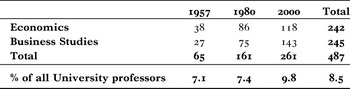
In order to explore these questions, we rely on a prosopographical database containing systematic biographical data on professors of economics and business studies in 1957, 1980 and 2000 in Switzerland. This historical depth allows us to refer to both the French situation of the 1960s and to recent studies of the economic sciences. In particular, the data cover the historical period of the recent scientific internationalisation (which began in the 1960s) and its influence on the structure of the economic sciences. The sample is composed of ordinary (full) and extraordinary (associate) professors of economics and business studies at all 12 Swiss universities at these three dates. The size and composition of the sample is displayed in the following Table 1 Footnote 9 .
Numbers of professors of economics and business studies in 1957, 1980 and 2000

The absolute numbers of professors in the economic sciences significantly increased during the second half of the 20th century, especially for business studies (which overtook economics by 1980). Even though it is important to keep in mind the specificities of the two branches of the economic sciences, they share some common features: they both study the economy (whether within the frame of the state or the firm), they have both emerged institutionally linked, and they have both been taught in the same departments or faculties [Honegger et al. 2007]. We will compare the figures for the economic sciences with those of professors in other disciplines, namely the social sciences, the humanities and the law.
Indicators
To study the endowment of power resources by these professors, we consider three types of assets. These are primarily influenced by Bourdieu’s conceptualisation of different forms of capital. However, they also introduce elements that allow us to understand the historical evolution of the scientific field since the 1960s, in particular when it comes to international or cosmopolitan reputation Footnote 10 :
A first dimension concerns the institutional academic capital of economists. Here we examine the number of courses, chairs, sections and finally autonomous faculties of the economic sciences to be found in the Swiss universities Footnote 11 . We also investigate the (comparative) number of vice chancellors of Swiss universities who have come from the economic sciences over the years. We count the total number of vice chancellors at Swiss universities for periods of 10 years and then calculate the share of economic sciences, law, humanities and social sciences among this group. This is an indicator of the academic recognition the members of this discipline possess, both among peers and politicians, in representing the academic world. But it is also an indicator of the executive power of the discipline within the university.
When it comes to scientific capital, we measure (national forms of) scientific capital by the total amount of money granted between 1976 and 2010 by the most important funding agency, the Swiss National Science Foundation. These funds are measured by the grants obtained by year and by discipline, and by the number of projects funded by year and by discipline Footnote 12 . In addition to this national form of scientific capital we are particularly interested in the international variants of this asset: we measure the number of citations of the ten most cited publications in the Citation Index (Web of Science) for each individual. This index is based on a selection of prestigious journals, mostly in English, and is therefore a good measure of international scientific capital in the field of the economic sciences Footnote 13 . Additionally, we also measure the share of professors who obtained their PhDs abroad and specifically in the US. A doctoral degree earned at a US university can be considered as a cosmopolitan form of scientific capital that can be re-imported to countries such as Switzerland in order to reach top positions within the discipline.
Third, we study the closeness to the field of power by defining economic and political capitals. By economic capital we understand the occupation of ceo or Board positions on one of the 110 most important Swiss companies, or being a member of the executive committee of one of the major economic associations [see also: Bühlmann et al. 2012]. We have taken into account economic and political elite positions of professors in office at the three dates of 1957, 1980 and 2000 over their entire careers Footnote 14 . This indicator shows how many professors of the economic sciences are part of the economic pole of the field of power. We measure political capital by the holding of a mandate in the federal government, the federal parliament, one of the cantonal governments or as a higher civil servant (including in the Swiss National Bank). In addition, we have also taken into account the organizations of scientific administration, in most of which professors participate as representatives of their university or their discipline. We built the variable organization of scientific administration based on the membership in the following institutions: Swiss Council of Science and Innovation (scsi), the Commission for Technology and Innovation, the Swiss National Science Foundation (presidents of the National Research Council and the Foundation Council), and the Board of the Federal Institutes of Technology in Zurich and Lausanne [Benninghoff and Leresche 2003]. Finally, we also measure participation in extra-parliamentary commissions. These are important administrative “lay commissions”, deployed in almost all sectors of the federal administration, mainly composed of “experts” and “stakeholders” external to the civil service [Germann and Frutiger Reference Germann and Frutiger1981].
Institutional Academic Capital
A crucial argument of the recent literature on the power of the economic sciences addresses its institutional autonomy and recognition in the academic field. We examine this institutional recognition of economics and business studies through two dimensions. First, we look at the institutional recognition of the disciplines in terms of courses, chairs, sections and faculties. We are particularly interested in how the economic sciences define their relationship with neighbouring disciplines such as law or the social sciences. Second, we examine a hierarchical component of academic recognition: the likelihood of professors of the economic sciences to become vice chancellors (or presidents) of their universities. For a discipline, being able to send one of its members to such a position is both a symbolic recognition by the entire academic community and a concrete power resource.
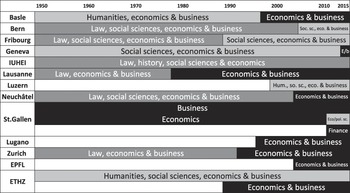
In Switzerland, the economic sciences emerged mainly from within the faculties of law Footnote 15 . Still in the 19th century, economics struggled for institutional and social recognition as a scientific discipline [Jost 1997: 103], and professors of law usually taught the rare courses of political economy. Slowly, the first chairs of economic sciences were created at the law faculties and, by the time of World War II, there was generally one economics and one business studies chair in every university. Slightly later “economics” appeared for the first time in the name of a faculty; in some universities the discipline was given a proper section, and the first “Handelshochschule” in St. Gallen slowly gained in recognition. This process of institutional recognition and autonomisation was paralleled by the progressive introduction of diplomas (and especially doctorates) [Gottraux et al. 2000: 115-116]. But still in the early 1950s there existed only three faculties of economic sciences in Swiss universities: the Faculty of Economics (Volkswirtschaftliche Abteilung) and the Faculty of Business Studies (Betriebswirtschaftliche Abteilung) of the Handelshochschule of St. Gallen, and the Faculty of Economic and Social Sciences (Faculté des sciences économiques et sociales) in Geneva, the first in Europe (created in 1915; see [Charle and Verger Reference Charle and Verger2012: 127]). However, the major period for the formal autonomisation of the economic sciences from law and the other social sciences only began in the 1970s and 1980s. It was between 1980 and 2010 that former economic sections of the faculties of law and economics became independent faculties, and that new faculties of economic sciences were founded: in 1978 at the University of Lausanne, 1992 at the University of Zurich, 1997 at the University of Basel, 2004 at the University of Neuchâtel and 2014 at the University of Geneva. Furthermore, the two Federal Institutes of Technology in Zurich and Lausanne created their sections of economic sciences in 1989 and 2004 respectively. In 2015, with the exception of Fribourg and Berne, every Swiss university had at least one autonomous economics faculty Footnote 16 and professors of economic sciences were rare within the faculties of law, social sciences or humanities. Economic sciences have thus experienced a more or less complete process of institutional autonomisation from other disciplines (Figure 1). Also the share of students who have graduated in economic sciences has progressively grown in the last 40 years, from about 10% of all students in 1980, to about 15% in 2010 (Swiss Federal Office of Statistics).
Faculties of economic sciences in Switzerland 1950-2015
Notes: dark grey = faculties of law; light grey = faculties of humanities and/or social sciences; black = faculties of economic sciences; white = institutions or faculties do not exist yet. The University of Lugano is created in 1996 and the University of Luzern in 1999. In 1989 the Department Management, Technology and Economics is created at the ETHZ. The College of Management of Technology of the EPFL is created in 2004. In St.Gallen, a third economic faculty, the School of Finance, is created in 2011.

This increasing autonomy of the economic sciences, which is explicitly an emancipation from related disciplines, was also accompanied by the greater symbolic recognition and increased influence of professors of economic sciences within the academic field. In order to evaluate this, we examine the representation of professors of economic sciences in one of the most powerful positions within the Swiss university system: the position of vice chancellor (or university president). Vice chancellors are often elected by all the university professors or a representative organ of those professors. Electing a professor from a specific discipline as a vice chancellor therefore corresponds also to a—at least implicit—recognition of his or her discipline. It involves conferring on the representatives of this discipline the credit of being able to represent the university as a whole, both within and outside the academic sphere. What is more, vice chancellors have a certain influence on the governance of the university, and on how science and teaching should be developed at a specific alma mater. In Switzerland, this second aspect of a vice chancellor’s office has become increasingly important in recent years. Universities have become formally more autonomous from the political field, and vice chancellors enjoy more discretional power and extended mandates.
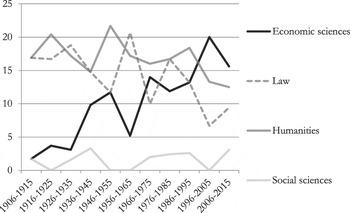
Figure 2 shows that the share of humanities professors who have become vice chancellors remains constantly high throughout the century (between 13% and 22%). So do the proportions of law professors (between 7% and 21%), but with a decreasing slope. By contrast, professors of social sciences are only very rarely represented in the executive management of Swiss universities (between 0% and 3%). Professors of economic sciences show a continuously increasing tendency to become vice chancellors: their share grows from 2% at the beginning of the 20th century to over 20% in the years 1996-2005. This means that the economic sciences have not only become institutionally more autonomous, but that they have also steadily approached the pole of institutional academic power.
Disciplines of vice chancellors of Swiss universities, 1906-2015 (in %)
Notes: The “Swiss elite database”. The total number of mandates of vice chancellors between 1906 and 2015 is N=455 Footnote 17 .

Scientific and international capital
Is this increase in institutional autonomy and academic recognition now accompanied by a rise in the scientific reputation of the economic sciences? To investigate this point, we examine the evolution of the scientific capital of economics and business studies. Scientific capital, as we mentioned, is a symbolic capital of recognition that is valid among peers—within the scientific field or even within the disciplines. Many of the indicators of scientific capital, such as scientific prizes or the number and importance of publications, can therefore not be measured across disciplines. To achieve a first impression of how the economic sciences fare in terms of scientific capital, we study the amount of research funding its professors can attract—calculated as an amount per year and per professor. Because this remains essentially a national measure of scientific capital, we complete it with two more international indicators that allow us to account for the international hierarchy of the economic sciences and the strong internationalisation of the Swiss academic field. We measure the number of citations of professors of economic sciences in the Web of Science Citation Index over the years and we also examine the number of professors holding a doctorate abroad.
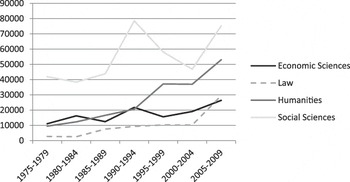
Comparing the disciplines, we see that the economic sciences are not necessarily among the most publicly well-funded disciplines—at least by the Swiss National Science Foundation (SNSF) (Figure 3). Neither can we observe a rise in the amount of funding from 1975 to 2009, which would be superior to that found in law, humanities or social sciences. On the contrary: the amount of funding for the economic sciences is only slightly above that for law, and its slope is much flatter than that of social sciences and humanities, particularly in recent years. However, these results have to be interpreted with caution. Even though all the studied disciplines are part of the same Division I of the snsf (and are evaluated by the same group of experts at the National Research Council) we can presume that the amount of funding allocated to each discipline is not (only) the outcome of a direct competition concerning the scientific value of the projects. More realistically, these differences reflect the result of a political negotiation between different disciplines and the specific promotion policies for certain disciplines by snsf. Several other reasons potentially explain the low level of funding for the economic sciences: until the 1980s a large part of economic research was in fact “theoretical” and did not require funding for the collection of empirical data; or the data was collected by administrations or statistical offices (which was the case until recently, when economic research turned to experiments). We can also make the assumption that professors of economic sciences—more than professors of social sciences or humanities—can rely on private sponsorship of their research and/or private mandates, which do not appear in the statistics of the snsf.
snsf Research Project Funding (chf) allocated to economic sciences, law, humanities and social sciences between 1975 and 2009 (per year, per professor)
Notes: 1975-2009: SNSF, P3 database (http://p3.snf.ch/). Only projects conducted at universities are taken into account. Number of university professors by discipline according to the Swiss statistical office (http://www.bfs.admin.ch/bfs/portal/fr/index/themen/15/06/data/blank/03.html). The unit of reference is Swiss Francs (CHF) per year, per professor.

However, as Switzerland enjoys a rather international scientific field, we have good reason to believe that the scientific capital of the economic sciences in Switzerland is not necessarily consecrated at the national level, but draws its value from its internationality. To capture this international component of the scientific capital of professors of economic sciences we have analysed the number of citations in the Science Citation Index (Web of Science). This citation index is based on a selection of prestigious English-speaking journals. What in another context (for instance in comparisons across disciplines) might be a “bias” is for our purpose a good measure of the prestige of a group of scholars in the international or even American scientific field. The scientific recognition in these fields is in turn a valuable asset that can be reimported to the Swiss academic field.
The results (Figure 4) show very clearly that professors of economic sciences at the Swiss universities are increasingly cited in international journals. In particular in the case of economics, we can speak of an increasing “de-provincialisation” [Baltensperger, Reference Baltensperger2002]: each professor in place in 1957 was only cited 12 times on average; for professors in office in 1980 and 2000 the number of citations rose to 81 and 293. Furthermore, the comparatively less internationally cited professors of business studies became more international: in the year 2000 they were cited 139 times on average in the Web of Science Citation Index. While the citations in this Index provide a relatively clear picture of the increasing international scientific capital of Swiss professors of economic sciences, this indicator cannot be used for comparisons with other disciplines. Disciplines have different sizes and different strategies of publication (choice of journals, traditions of citing other scholars) and it is therefore notoriously problematic to compare them in bibliometric terms.
Average number of citations in the Web of Science Citation Index of Swiss professors of economics and business (1957, 1980, 2000)
Notes: http://webofknowledge.com. N = 65 in 1957, 159 in 1980 and 253 in 2000. In 1980 and 2000, we have removed outliers with a large amount of citations (1 person in 1980 and 4 in 2000) and a corresponding number of professors with no citations.

A complementary indicator that is potentially more meaningful in comparing different disciplines is a doctoral degree abroad. The PhD experience is one of the most formative and symbolically important moments in an individual’s scientific career. We posit that the acquisition of a PhD abroad endows professors with a symbolically highly valued international capital, which they can use in their national scientific field––for example against more regionally oriented competitors for a professorship. This international capital is also a form of scientific capital: from a longer stay or from an education achieved abroad, a scholar also brings with him or her the reputation and the legitimacy of the scientific culture of the country in which he or she stayed. As we have seen, the economic sciences are particularly organised according to a clear international hierarchy, with the US at the top. A doctorate from an American University (and even more from a top US University) procures for its holder a particularly high amount of international scientific capital.
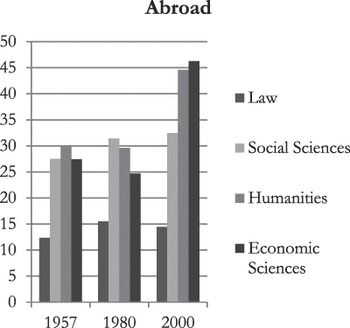
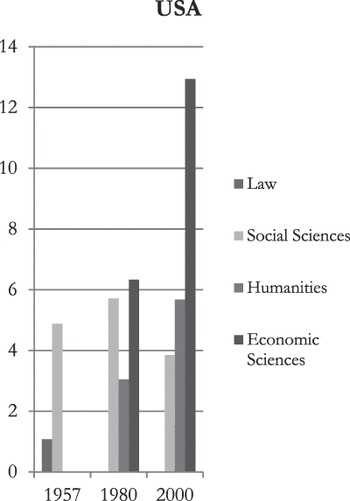
The internationality, and thus the concentration, of cosmopolitan assets almost doubled for professors of economic sciences between 1980 and 2000 Footnote 18 . (Figure 5) In comparison, professors of law were only weakly internationalised during the same period Footnote 19 . In social sciences and in humanities the proportion of professors with a PhD abroad was higher than in the economic sciences in 1957 and 1980. Only in the year 2000 did the economic sciences become the most international discipline studied here, mainly because, as part of the process of conversion, business studies also become increasingly international. However, the real difference between the economic sciences and all the other disciplines appears when we examine the share of professors with a PhD from a US university (Figure 6). While this proportion rose strongly in the economic sciences from 0% in 1957 to 13% in 2000, it remained below 6% for both social sciences and humanities. To sum up: professors of economic sciences thus tend to own more cosmopolitan capital than their counterparts in law, social sciences and humanities. They are particularly endowed with symbolic capital from US universities, which are at the top of the disciplinary hierarchy in the economic sciences.
Share of professors who obtained their PhD abroad (in %)
Notes: The “Swiss elite database”. Professors who obtained a PhD in economic sciences: 62 in 1957, 158 in 1980 and 255 in 2000. Law: 89 in 1957, 161 in 1980 and 187 in 2000. Humanities: 163 in 1957, 162 in 1980 and 139 in 2000. Social sciences: 40 in 1957, 70 in 1980 and 77 in 2000.

Share of professors who obtained their PhD in the US (in %)
Notes: The “Swiss elite database”. Professors who obtained a PhD in economic sciences: 62 in 1957, 158 in 1980 and 255 in 2000. Law: 89 in 1957, 161 in 1980 and 187 in 2000. Humanities: 163 in 1957, 162 in 1980 and 139 in 2000. Social sciences: 40 in 1957, 70 in 1980 and 77 in 2000.

Economic sciences within the Swiss field of power
In a third step we now seek to analyse how this rise in international scientific capital combines with the positioning of professors of economic sciences in the national field of power. According to Bourdieu [Reference Bourdieu1988] the proximity to the field of power can be measured by the mandates and positions held outside the university, for example in academic administrations or in the political or economic spheres. We have seen that as a consequence of the weak professionalization of the Swiss parliament, the simultaneous (and sometimes successive) occupation of positions in different spheres of power is rather common in Switzerland. Professors’ political or economic mandates are therefore an important indicator in examining the proximity of a scientific discipline to the field of power.
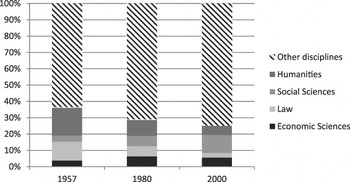
We examine first how professors of economic sciences fare in organizations of national academic administration. In our definition these organizations include institutions such as the Swiss Council of Science and Innovation (SCSI) or the Councils of the Swiss National Science Foundation [Benninghoff and Leresche 2003]. In Figure 7 we show the share of different disciplines in these organizations over time.
Share of professors in organizations of scientific administration according to disciplines
Notes: “The Swiss elite database”.

As in other national contexts, the professors of natural sciences are largely dominant in these national institutions of science administrations [Graf Reference Graf2015]. Within the group of disciplines studied, we can observe that the humanities and law are among the disciplines which lose influence over the period 1957 to 2000. Contrastingly, professors of economic sciences and (particularly in 2000) social sciences become proportionally more important. While the rise of social sciences is due to the sheer numeric increase of this discipline, the inversion of the tendency between law and the economic sciences in the representative bodies of these institutions is a sign of an inversed hierarchy between the two disciplines.
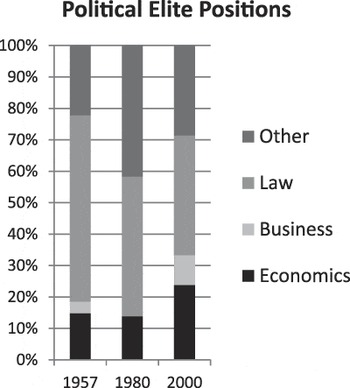
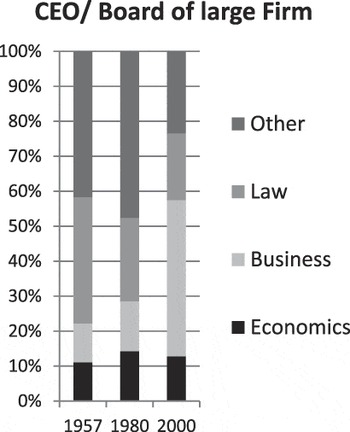
In figures 8 and 9, we display the proportion of professors who occupy a mandate in the economic or political field. Of all Swiss university professors, 35 sat on the board of one of the 110 most important firms in 1957, compared to 63 in 1980 and 47 in 2000. When it comes to political mandates (in the federal government, the federal parliament, a cantonal government or as a higher civil servant) we counted 24 professors in 1957, 33 in 1980 and 20 in 2000. Generally, the absolute number of professors first rises between 1957 and 1980, and then falls again between 1980 and 2000. More interesting is how the relative shares between disciplines changed over the period 1957 to 2000. To investigate this, we compare professors of economic sciences to professors of law and to the (comparatively few) professors of other disciplines occupying such extra-academic positions of power.
Professors in a political elite position or on the board of one of the 110 most important Swiss firms (in %)
Notes: “The Swiss elite database”.

Professors in a political elite position or on the board of one of the 110 most important Swiss firms (in %)
Notes: “The Swiss elite database”.

The most striking result here is the rise in the proportion of professors of economics and business studies among all professors who were board members of large Swiss firms: they increased from 28 % of all professors who occupied such a position in 1980 to 57 % in 2000. The differences between economics and business studies are important: whereas the proportion of economists in top corporate positions remained constant over the years, it was mainly business professors who increased their share. At the same time professors of law experienced the opposite movement: their share on boards of large Swiss firms was clearly highest in 1957, but then steadily decreased until 2000. Within the political field, we can observe a similar—but less spectacular—trend: professors of law who were very dominant within the professors in the political field in 1957 (almost 70 % of all professors) then decreased significantly. Meanwhile the share of professors of economic sciences increased from 1980 onward. At the end of the period, the economic sciences had almost caught up with law (35 % against 40 %).
Based on these indicators of multi-positionality, we cannot observe a clear tendency towards a closer or more distant relationship between the academic field and the field of power in Switzerland. Among the scientific disciplines, however, while other traditional disciplines of power, such as law, seem to increasingly depart from the field of power, we see clearly that professors of economic sciences approach the society pole of the academic field and increase their extra-academic assets.
Scientific and institutional capital: trade-off or mutual reinforcement?
The study of three forms of power resources held by professors of economic sciences indicates that, collectively speaking, the economic sciences fared better than comparable disciplines such as law, humanities or social sciences. Professors of economics have become more autonomous and have increased their academic power. What is more they have also increased their scientific reputation and are much more international (and especially close to the US) than most of the related disciplines. Finally, these professors have also become more influent in extra-academic domains and occupy positions of power both in the business world and in politics. It would appear that professors of economics and business have managed to get closer to both the society pole and to the scientific pole in the Swiss scientific field between 1957 and 2000. The trade-off between both poles does not seem to hold for the economic sciences. It would appear that these professors have been able to retain those different resources concomitantly. Can we conclude from this that the trade-off between scientific capital and academic capital, as evidenced by Lebaron [Reference Lebaron2000] for instance, does not apply to Switzerland? Can we speak of a mutual reinforcement of these forms of capital, by a transformation of the scientific knowledge of the economic sciences into an expert knowledge that allows them to occupy powerful positions outside the academic field (such as ascertained by Fourcade)?
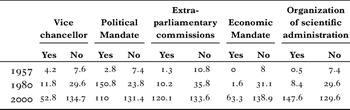
To refine the understanding of this topic, we examine the distribution of scientific and institutional capital at the individual level. When it is problematic to compare indicators of scientific reputation across disciplines, due to its homogenous and hierarchical character, it is relatively easy to measure scientific capital within the discipline of the economic sciences Footnote 20 . For this purpose we added the citation numbers of the ten most cited papers per author in the Social Citation Index of all Swiss professors of economics in the years 1957, 1980 and 2000.
We calculated the mean number of citations over these ten papers and systematically compared the professors who occupied a university mandate, a political mandate, a mandate in an extra-parliamentary commission Footnote 21 , an economic mandate or a mandate in an organization of scientific administration with those who had no such mandate (Table 2). With two exceptions Footnote 22 , the results provide a very clear account: professors who are vice chancellors, who are members of parliament, who sit on the board of a large firm or in the national scientific organizations have systematically less scientific capital. Professors with a large number of citations in the Web of Science Citation Index on the other hand, only rarely participate in extra-scientific areas of power. The most cited professors of economic sciences at Swiss universities—the Austrian micro-economist Ernst Fehr (University of Zurich) or the Swiss behavioural economist Bruno S. Frey (University of Zurich)—have never sat in important institutional positions in the political or economic domain. Inversely, the best known “policy entrepreneurs” among the professors of economic sciences in the 1990s, for instance Silvio Borner (University of Basel) and Heinz Hauser (University of St. Gallen), even though influential on the public and political scene Footnote 23 , rank only in the very modest zones of the Web of Science Citation Index [Mach Reference Mach2002; Streckeisen 2016]. The brothers René Frey and Bruno S. Frey may serve as a good illustration for these two types of economic research profiles among Swiss professors: Bruno S. Frey is cited 3,527 times in the Web of Science Citation index and is one of the leading (inner-disciplinary) critics of the Homo Economicus model. He spearheaded the combination of economic and psychological research based on experimental studies, has a notice in the Who’s Who in Economics, is ranked among the most influential economists in Europe and Switzerland, and holds a doctorate honoris causa from several universities. On the other hand, he was never vice chancellor of his university, never occupied a position in an organisation of scientific administration and has no political, administrative or economic mandates. His brother René, professor at the University of Basel, is completely different: he has only 42 citations in the Citation Index and never appears in the international rankings of influential economists. His publications address local and policy relevant topics such as federalism, environmental and transport issues, or the welfare state. On the other hand he has been vice chancellor of the University of Basel (1996-1998), was (in a rather administrative role) president of National Research Programme 25 on “City and Transport,” and has sat on several extra-parliamentary commissions and on the board of several middle-sized local firms. If it is true, as Fourcade postulates, that economists have “economized technocracy” and thereby increased their influence and their eligibility as experts in the political and administrative domains, we can specify that—in the Swiss case at least—it is not the same economists who innovate scientifically and consult as experts. On the individual level, the trade-off between scientific capital and institutional capital seems to hold—even if, at the collective level, the discipline has historically become better endowed with scientific and institutional capital simultaneously. The collective rise of professors of economic sciences is still due to an internal division of work between scientific professors (with a large number of research projects and a high number of citations) and “institutional professors” (who become vice chancellors and participate actively in the political and economic realms). These groups should not be confounded with the professors of the two sub-disciplines “business studies” and “economics.” Rather they correspond to the distinction between a “spiritual” and a “temporal” fraction which cuts across the sub-disciplinary boundaries [Lebaron Reference Lebaron2000; Reference Lebaron2001].
Average number of citations in the Web of Science Citation Index

Notes: http://webofknowledge.com. N = 65 in 1957, 159 in 1980 and 253 in 2000. In 1980 and 2000, we have removed outliers with a large amount of citations (one person in 1980 and four in 2000) and a corresponding number of professors with no citations.
Conclusion
The aim of this article was to study the rise of professors of economics and business studies in Switzerland in the second half of the 20th century. With this case study we sought to confront and deepen two competing theories of the influence of the economic sciences: the Bourdieu inspired theory of a trade-off between scientific and institutional capital, and the more recent literature on the rising power of the economic sciences. Based on a full sample of 487 extraordinary and ordinary professors of economics and business at Swiss universities we examined the historical development of their endowment with academic, scientific and extra-academic forms of capital, and the relations between these forms of capital.
What are our conclusions for the Swiss case with regard to the two theories on the power of economists? In a certain sense, both theories are right. When we compare the economic sciences with neighbouring disciplines such as law, social sciences and the humanities, we observe a general increase in the power resources of professors of economic sciences. Professors from the economic disciplines have risen in terms of institutional academic capital, (international) scientific capital and extra-academic power resources. It would appear that professors of economic sciences were able to become more legitimate both scientifically and institutionally. Then, when we look at the internal structuration of the field of economists, we see that it is not the same professors of economic sciences personally who occupy top scientific positions and also hold a large amount of institutional capital. On the individual level, the trade-off between scientific and institutional capital ascertained by Bourdieu and Lebaron is still relevant—we can observe and distinguish a more scientific fraction from a more social fraction among the professors of economic sciences.
However, our analysis also exposes some blind spots in both theories and clarifies the direction that future research on this topic should take: the studies based on the French case [Bourdieu Reference Bourdieu1988; Lebaron Reference Lebaron2000] probably underestimated the restructuring impact of international forms of scientific capital on the field of science. The internationalisation of science and the international hierarchisation of scientific fields has brought about new forms of legitimacy of science and, by doing so, potentially shifted traditional constellation and hierarchies between disciplines. Economic sciences, as one of the most internationalised disciplines, has benefited from this shift. A second aspect that Bourdieu struggled to anticipate is the possible changes in the relationship between scientific and extra-academic capital. The concomitant increase of scientific and extra-academic capital among economists also shows that the idea of an opposition between the two types of capital has to be nuanced. An “economization of technocratic knowledge,” such as suggested by Fourcade, can indeed transform the relationship between scientific and technocratic knowledge and thus lead to a restructuration of the scientific field.
While this changing relationship between scientific legitimacy and its technocratic use seems convincing and is confirmed at the level of the discipline in our study, we see also that our knowledge on the exact mechanisms of this transfer from science to politics is still sketchy at the individual level. Do professors of economic science have a rational master plan by which they consciously (or even strategically) distribute work to “scientists” and “technocrats” in order to increase their power as a discipline? Is this more of an implicit “structural coalition” between two groups, which—even though mutually beneficial—has never been planned or discussed together. Or are we rather observing an internal power struggle between two opposing fractions—with the collective power increase being an unintended effect of their conflict? We think that future research on the power of economic scientists should try to include more case studies and shed light on this (still) puzzling relationship between their scientific and extra-academic power.
Acknowledgements
This study was funded by the project of the Swiss National Science Foundation “Academic Elites in Switzerland 1910-2000: between Autonomy and Power” (100017_143202/1). We are grateful to Steven Piguet, Marion Beetschen, Pierre Benz and Thomas David for their help with the data collection. We also would like to thank Martin Benninghoff and Matthieu Leimgruber for reading and commenting an earlier version of this article, as well as the two anonymous reviewers – all remaining weaknesses are ours.