Introduction
Over 90 years of archaeological excavation at the Late Shang (c. 1250–1050 bce) site of Yinxu in Anyang city, Henan Province, China has revealed a rich visual culture, populated with animals, mythical beings and, occasionally, humans (Chang Reference Chang1983, 57). These entities were reproduced across different media, including bronze, ceramic, bone, stone and lacquer, and many of the wild and domesticated animals have correlates in the palaeographic and archaeological records. Although representations of humans are rarely depicted in the material culture of the Late Shang (von Falkenhausen Reference von Falkenhausen2008; Reference von Falkenhausen, Boschung and Queyrel2017), an intimate engagement with the human body is evident in the post-mortem arrangement of the heads and bodies of decapitated individuals who were the victims of large-scale acts of institutionalized ritual violence (Chang Reference Chang1983, 110).
Decapitation as a method of human sacrifice and ritual violence is a cross-cultural phenomenon. Although scholarship has tended to highlight the spectacle of this act, the manipulation and display of human heads and their representation in material culture can also provide valuable insight into ontologies of the body (Harris & Robb Reference Harris and Robb2012) and the visual aesthetics of past groups (Tiesler & Lozada Reference Tiesler and Lozada2018). A critical approach that contextualizes decapitation within a larger matrix of socio-political, ritual and economic practices and beliefs greatly enhances our understanding of ancient societies.
Past research on decapitation at Yinxu has focused on its socio-political functions, with a particular emphasis placed on how elites used violence to establish and maintain their power and authority over allies, enemies and their own population (Campbell Reference Campbell2007; Reference Campbell and Campbell2014; Reference Campbell2018; Chang Reference Chang1983; Shelach Reference Shelach1996), and the social roles, identities, and lived experiences of these victims (Cheung et al. Reference Cheung, Jing, Tang, Weston and Richards2017; Osing Reference Osing2014; Wolin Reference Wolin2018). In this article, I investigate the human head as Late Shang elite visual culture. I argue that the increase in decapitation as a form of ritual sacrifice at Yinxu escalated engagement with human heads in isolation and necessitated the development of a ritually informed process for burying these remains that not only fitted into the existing visual repertoire, but also took into account the potentially dangerous post-mortem agency of these victims. By bringing together osteological remains with material culture, my research challenges the separation of these two records when interpreting the ritual and visual landscape of past peoples.
The Late Shang period
The archaeological and palaeographic record
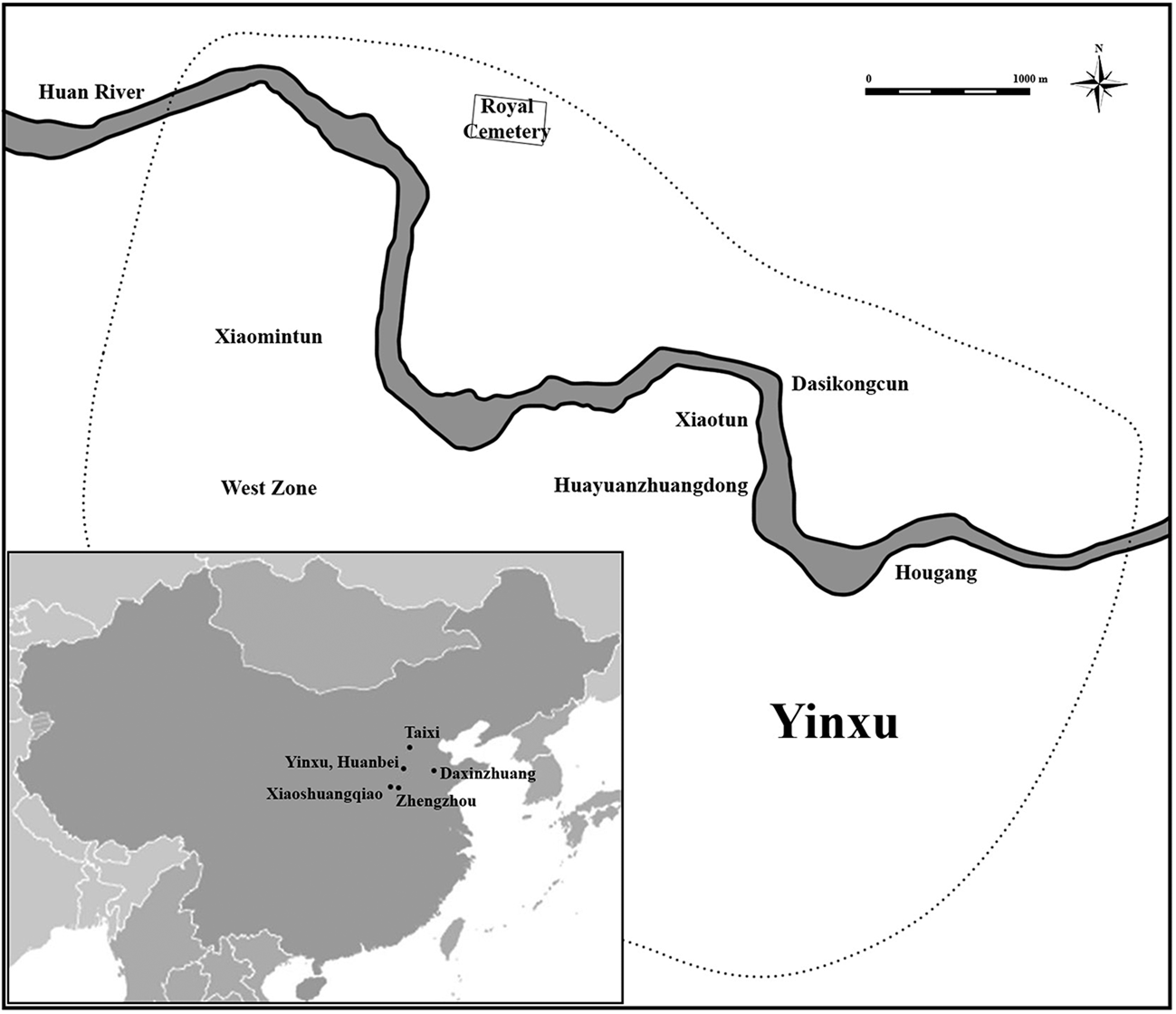
The Late Shang (c. 1250–1050 bce) site of Yinxu 殷墟 is located in the Central Plains region of northern China (Fig. 1).Footnote 1 Excavations at Yinxu since 1928 have revealed a highly stratified urban settlement (IA, CASS 2003). The highest elite lived in structures with rammed-earth foundations in the palace-temple area (Xiaotun 小屯) and the majority of the royal burials were located across the Huan river in the royal cemetery 王陵区, which contained large, ramped tombs and sacrificial deposits (Fig. 1). Neighborhoods, organized along kinship lines, contained domestic areas and cemeteries, and several were associated with specialized craft production (Chang Reference Chang1986; Jing et al. Reference Jing, Tang, Rapp, Stoltman and Underhill2013). Ritual divinations recorded in contemporaneous oracle-bone inscriptions (OBI) 甲骨文 and systematic archaeological excavations in northern China have shown that other polities were interacting with the people of Yinxu through trade, warfare and outposts (Campbell Reference Campbell2009; Chang Reference Chang1986; Fang Reference Fang and Underhill2013; Keightley Reference Keightley2000; Liu & Chen Reference Liu and Chen2012; Shelach-Lavi Reference Shelach-Lavi2015).
Map of select locales at Yinxu and Shang sites. (After Jing et al. Reference Jing, Tang, Rapp, Stoltman and Underhill2013, 344, fig. 17.1.)

Ritual sacrifice during the Late Shang
With its roots in the Neolithic and Early Bronze Age, ancestor veneration was one of the primary tenets of Late Shang ritual practices (Campbell Reference Campbell, Hill and Hageman2016; Keightley Reference Keightley and Lagerwey2004; Liu Reference Liu2000; Nelson Reference Nelson and Bray2003; Underhill Reference Underhill2002; Yao Reference Yao, Tarlow and Stutz2013). The residents of Yinxu were organized around lineages (Campbell Reference Campbell2018; Cao Reference Cao2018; Chang Reference Chang1980; Keightley Reference Keightley1979; Tang Reference Tang2004) and they shared their cultural landscape with animals, gods, nature powers and ancestors (Chang Reference Chang1983; Keightley Reference Keightley1978b; Reference Keightley and Lagerwey2004; Puett Reference Puett2002; Tang Reference Tang, Whitfield and Tao1999). Food (e.g. meat and grain), alcohol, objects and sacrifices of animals and humans were offered to these entities as part of the 60-day ritual calendar, during mortuary events, or to resolve imminent threats, such as warfare.
The topic of human sacrifice in the Late Shang has been studied extensively using palaeographic, archaeological and osteological data (Campbell Reference Campbell2007; Reference Campbell and Campbell2014; Reference Campbell2018; Cheung et al. Reference Cheung, Jing, Tang, Weston and Richards2017; Hu Reference Hu1974; Huang Reference Huang1990; Reference Huang2004; Keightley Reference Keightley2012; Osing Reference Osing2014; Reinhart Reference Reinhart2015; Shelach Reference Shelach1996; Tang & Niu Reference Tang and Niu2013; Tang & Tang Reference Tang and Tang2014; Wang & Kubin Reference Wang and Kubin2007; Wolin Reference Wolin2018). Systematic archaeological excavations at Yinxu have revealed sacrificial deposits associated with architectural foundations or features, within or near burials and in neighbourhood areas. Bioarchaeological research has demonstrated how differences in sacrificial style and post-mortem treatment were influenced by various aspects of a person's social identity, including status, gender, and whether they were local or foreign to Yinxu (Cheung et al. Reference Cheung, Jing, Tang, Weston and Richards2017; Wolin Reference Wolin2018). These deposits contain humans buried whole or dismembered, singly or commingled and with or without animals. Among the different types of sacrifice, the high frequency of decapitation captured in the palaeographic and archaeological record suggests that during the Late Shang this act fulfilled overlapping ritual, socio-political and aesthetic functions.
Decapitation during the Late Shang
Decapitation and agency
Decapitation as a method of human sacrifice and ritual violence is found in complex societies across the globe, including North America (e.g. Fowler et al. Reference Fowler, Rose, Vander Leest and Ahler1999; Thomas et al. Reference Thomas, Buchanan, Wilson and Crane2017), Mesoamerica (e.g. Carrasco Reference Carrasco2000; Dodds Reference Dodds and Carroll2007), the Andes (e.g. Benson & Cook Reference Benson and Cook2001; Klaus & Toyne Reference Klaus and Toyne2016), Europe (e.g. Armit Reference Armit2012; Talalay Reference Talalay2004; Tucker Reference Tucker, Knüsel and Smith2014), the ancient Near East (e.g. Dolce Reference Dolce2017) and Asia (e.g. Jaang et al. Reference Jaang, Sun, Shao and Li2018). The global presence of decapitation around (perimortem) or after (post-mortem) the time of biological death can be at least partially attributed to the unique value that is often placed on the head and face, which not only serve as one of the primary methods for differentiating individual people, but are also understood as ‘the seat of personhood, ancestorhood, or the soul’ in some societies (Bonogofsky Reference Bonogofsky2011, 3).
While decapitation may represent a necessary step in mortuary ritual, the practice is often regarded as a type of violation or veneration (Duncan Reference Duncan, Rakita, Buikstra, Beck and Williams2005). Decapitation as violation may be motivated by the desire to desecrate the remains, obscure the identity of the individual, disrupt the victims’ transition into the afterlife, or to create trophies to be viewed and experienced by human and non-human actors (Geller & Suri Reference Geller and Suri2014, 504; Tung Reference Tung2008; Verano Reference Verano, Silverman and Isbell2008). The heads of ancestors or enemies could also become important symbols of political power and authority, as seen in many regions of the world such as the ancient Andes (Arnold & Hastorf Reference Arnold and Hastorf2016).
In cases of human sacrifice or ritual violence, the treatment of the victims’ bodies after death—ranging from displaying them to leaving them exposed to the elements—was a meaning-laden act that contributed to the restructuring of social relations and power among the living and the dead in the liminal space surrounding their death (Toyne Reference Toyne2015). The living could continue to engage with the biologically, but not socially, dead (Geller Reference Geller2012, 125) through the representation, adornment, manipulation and eventual deposition of body parts (e.g. Bonogofsky Reference Bonogofsky2011; Fowler Reference Fowler, Hamilakis, Pluciennik and Tarlow2002; Tiesler & Lozada Reference Tiesler and Lozada2018). The dead may have also been perceived as actively engaging with the world of the living through post-mortem agency (Dobres & Robb Reference Dobres, Robb, Dobres and Robb2000; Tung Reference Tung2014). Using Geller's (Reference Geller2012) ‘death history’ approach, which focuses on reconstructing post-mortem engagement with the body, this study investigates how decapitated heads were integrated into the larger visual culture at Yinxu during the Late Shang period.
Decapitation in the Shang (c. 1600–1050 bce)
Evidence for decapitation in northern China dates back to the Late Neolithic and Early Bronze Age (Jin Reference Jin2005; Jaang et al. Reference Jaang, Sun, Shao and Li2018), and deposits of heads (ranging from one to around 100) have been uncovered at the Early and Middle Shang (c. 1600–1250 bce) sites of Zhengzhou Shang City 郑州商城 (Henan Wenhuaju 1959; Henan Wenwu 2001), Xiaoshuangqiao 小双桥 (Henan Wenwu 2013), Taixi 台西 (Hebei Wenwu 1985), Huanbei 洹北 (Jing et al. Reference Jing, Tang, Rapp, Stoltman and Underhill2013) and Daxinzhuang 大辛庄 (Shandong University 2008) (Fig. 1). Many of these deposits were the result of rituals surrounding the construction or consecration of structures, activities which Qian (Reference Qian2019, 308) suggests may have promoted social integration. Few large burials have been excavated from the Early and Middle Shang; however, this may change with the continued investigation of sites such as Huanbei (He Reference He2018). Current evidence suggests that while human sacrificial offerings were placed in burials (e.g. Panlongcheng 盘龙城: Zhang Reference Zhang, Steinke and Ching2014, 59), decapitated heads were not a substantial part of this tradition. Almost all of the skulls whose sex could be assessed were identified as male, indicating that decapitation was a form of gender-based violence (see the discussion for a counter-example that pre-dates the Shang period).Footnote 2 Based on these signatures, decapitation during the Early and Middle Shang was likely restricted to intermittent acts of ritual violence.
The increase in the scale of human sacrifice during the Late Shang at Yinxu (c. 1250–1050 bce) is captured in the palaeographic record, which documents over 10,000 human victims (Huang Reference Huang1990, 62). While there is some debate over the interpretation of sacrificial methods in oracle-bone inscriptions (Huang Reference Huang1990; Reference Huang2004; Wang & Kubin Reference Wang and Kubin2007), the character 伐 fa, which depicts a person standing in profile beside a hafted weapon, is frequently read as ‘decapitate’ (Qiu Reference Qiu, Mattos and Norman2000, 190) and is often associated with the qiang 羌 people (for interpretations of this group, refer to Campbell Reference Campbell2018, 206; Chang Reference Chang1980, 249; Cheung et al. Reference Cheung, Jing, Tang, Weston and Richards2017; Hu Reference Hu1974; Huang Reference Huang1990; Reference Huang2004; Shelach Reference Shelach1996, 18; Tang & Niu Reference Tang and Niu2013; Tang & Tang Reference Tang and Tang2014). Archaeological signatures of decapitated human victims unearthed in royal and neighbourhood contexts across Yinxu attest to the importance of these visually captivating events and the extent to which this practice may have been viewed and experienced by various segments of the population. The next three sections provide a brief overview of contexts where signatures of decapitation have been uncovered at Yinxu: in association with architectural features or ditches, in and around tombs, and in circular pits.
Foundations and ditches:
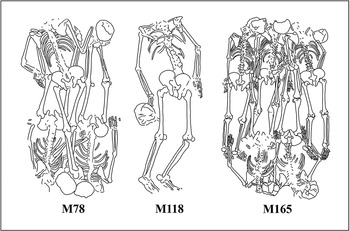
Hundreds of sacrificial pits are associated with the rammed-earth architectural foundations in the Xiaotun 小屯 palace-temple area (Fig. 1) (Chang Reference Chang1980, 95; Du Reference Du2010). Among these remains, almost all of the 393 individuals excavated from 80 pits in the middle section 中组 foundations (Shi Reference Shi1972, 335) were decapitated and their heads were placed within the burials (Fig. 2). These pits were oriented approximately north–south and the majority of the bodies in these multiple burials were prone, a burial style that is also common among the general population, particularly for male individuals (Zhang Reference Zhang2011). Unfortunately, age and sex estimations were not recorded at the time of excavation and the remains are no longer available for further analysis. None of the structures from neighbourhood areas across Yinxu (e.g. Anyang Wenwu 2015; IA, CASS 2007; 2014; 2018) have provided clear evidence of decapitation, suggesting that this practice was restricted to the highest elite. Apart from foundations, a few isolated features with decapitated remains have been identified. This includes the headless bodies of 14 decapitated late adolescent to young adult (青年) males uncovered at Xiaomintun 孝民屯 in a circular ditch (G1) (Yinxu XMT Team 2007, 39). The lack of an overlying structure and absence of heads in this context suggest that this feature may have resulted from different ritual practices than those seen in the royal foundations.
Sacrificial pits in Xiaotun's middle foundations. Not to scale. (After Shi Reference Shi1972, pls 58, 54, 67.)

In and around tombs:
Scholars have noted the symbolic equation of tombs and houses during the Late Shang (Campbell Reference Campbell2018, 221; Chang Reference Chang1964, 47; Cheng Reference Cheng1960, 77), and elite burials contained a wealth of objects, food and drink and human and animal sacrifices, which served to build up the status and position of the recently deceased into ancestors (Keightley Reference Keightley1978b; Reference Keightley and Lagerwey2004; Puett Reference Puett2002). Along with retainers,Footnote 3 decapitated individuals are present within royal tombs and in nearby sacrificial pits. Although heavy looting in the royal cemetery 王陵区 has significantly hindered our understanding of the scale of sacrificial activities associated with the burial process (Li Reference Li1977, 92; Li et al. Reference Li, Yue and He2018), clear patterns in decapitation can be discerned from the thousands of remains uncovered to date.
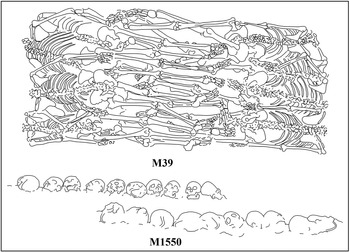
Over 500 skulls were excavated from within the large tombs in the royal cemetery (Guo Reference Guo1951; IA, CASS 1979a; 1987a; Liang & Gao Reference Liang and Gao1962; Reference Liang and Gao1965; Reference Liang and Gao1967; Reference Liang and Gao1968; Reference Liang and Gao1970; Reference Liang and Gao1974; Reference Liang and Gao1976; Reference Liang and Gao1996). While four-ramped tombs such as M1550 (N = 243: Fig. 3) tend to have the greatest number of skulls, these remains are also present in medium-sized burials such as M259 (N = 14), one of which was found inside a bronze yan 甗 steamer (IA, CASS 1987a, 111). All of the skulls whose sex could be estimated belonged to males (Li Reference Li1977, 257; Wolin Reference Wolin2018).
Headless bodies in pits (M39) and heads on ramps (M1550) in the Royal Cemetery. Not to scale. (After Anyang Course & IA, CAS 1977, 23 and Liang & Gao Reference Liang and Gao1976, pl. XIII, respectively.)

Medium and large tombs with evidence of decapitation have also been identified in the palace-temple area and in the neighbourhood areas. In 1976, the unlooted tomb of Fu Hao 妇好 (M5), one of the wives of King Wu Ding, was excavated at Xiaotun (IA, CASS 1980). Although much smaller in scale than the elite tombs in the royal cemetery, the rectangular burial contained human and animal sacrifices, which included two decapitated human heads. Medium and large tombs in the neighbourhood areas also featured decapitated heads, such as M9, a two-ramped tomb at the Hougang 后冈 locale excavated in 1991. All of the skulls (N = 13) belonged to males between 20 and 45 years old at the time of death (IA, CASS 1993, 10). While skulls are common in these larger burials, only M1001 in the royal cemetery contained headless bodies (N = 73), which belonged to adolescents and young adults (Liang & Gao Reference Liang and Gao1962, 37–40).
Thousands of sacrificial pits have been located through coring and excavation in the eastern side of the royal cemetery (Anyang Course & IA, CAS 1977; Li Reference Li1977, 90; Tang & Tang Reference Tang and Tang2014). The majority of these pits were multiple burials of headless bodies, which were positioned prone and lacked grave goods (Fig. 3). Across these contexts, all of the headless individuals whose sex could be estimated were males, with ages ranging from children to adult (IA, CASS 1979b; Wolin Reference Wolin2018). The presence of cervical vertebrae and mandible fragments indicates that the individuals were decapitated and buried around the time of death. While these deposits are relatively orderly, evidence of decapitation has also been uncovered in disorderly contexts in neighbourhood areas.
Circular pits:
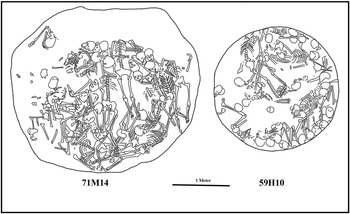
Although rectangular pits predominate in the royal cemetery, circular or irregular features in neighbourhood areas, many of which were repurposed wells or refuse pits, could also contain commingled decapitated human remains (Fig. 4). In 1971, a circular pit (71M14) with the decapitated remains of 31 individuals, including children and adult males, was excavated at Dasikongcun 大司空村 (Anyang Museum 1978). Another circular pit (59HGH10) with the remains of 73 human skeletons was excavated between 1960 and 1977 at the locale of Hougang (IA, CASS 1987b, 270). Whole, dismembered, and decapitated bodies of males and females, infants and adults, were recovered from three separate layers within this pit (IA, CASS 1987b, appendix I, table 3.4). The uniqueness of this context has prompted scholars such as Du (Reference Du2011) to see it as the remains of a massacre, rather than a sacrificial deposit, which is likely to be the case for the Dasikongcun pit as well. While M14 appears to reflect a single event, the presence of three distinct deposits in H10 suggests that this violent act occurred on separate occasions. Distinct clusters of skulls within these pits (Anyang Museum 1978, 72; IA, CASS 1987b, 268) may be the materialized actions of surviving members of the group who were attempting to give the dead a ‘proper’ burial. The extreme departure in demographic composition, body treatment and configuration from those of the royal cemetery and palace-temple area indicates that decapitation was not a monolithic practice at Yinxu.
Dasikong and Hougang (Lower Layer 1) circular pits. (After Anyang Museum 1978, 71 and IA, CASS 1987, 268, respectively.)

Discussion
The aesthetics and spectacle of the decapitated human head
The majority of sacrificial deposits described above follow larger trends in Late Shang ritual beliefs and aesthetics, including principles of symmetry, dualism and directionality, which are also evident in oracle-bone inscriptions, material culture, architectural features and large burials (Allan Reference Allan1991; Chang Reference Chang1964; Reference Chang1983; Keightley Reference Keightley2000). The palace-temple area and royal cemetery were the primary stages for large-scale decapitation events, which would have been dissonant, bloody spectacles (Keightley Reference Keightley and Lagerwey2004, 11) that may have left a lasting impression on anyone experiencing them (Reinhart Reference Reinhart2015). While it is difficult to confirm who would have witnessed these mass sacrifices, the enormous investment of labour that went into creating these mortuary contexts indicates that a large number of elites, ritual practitioners, craft specialists, labourers and others would inevitably have seen the act and/or its aftermath. This is probably true for sacrificial acts performed in the neighbourhood areas, which may have seen even more widespread community involvement. Thus, decapitation events would have linked elite material culture involved in the act (e.g. bronze yue 钺 axes), the decapitated heads themselves and other tangible (e.g. food and drinks: Nelson Reference Nelson and Bray2003) and intangible (e.g. music and dance: Chang Reference Chang1983, 53) components of these rituals (see Reinhart Reference Reinhart2015 for a discussion of the sensory experience of Late Shang violence).
The transformation of the human head through decapitation and display has been explored extensively by scholars working in the ancient Andes (e.g. Tiesler & Lozada Reference Tiesler and Lozada2018; Toyne Reference Toyne2015; Tung Reference Tung2014). Discussing the experience of this process, Tung (Reference Tung2014, 447) writes: ‘This highly tactile engagement with the bodies, treating them as objects to be cut, smashed, defleshed and demuscled would have further reinforced their identity as things, not as persons.’ I propose that decapitation and display of heads at Yinxu resulted in a similar process, transforming the human body into an elite object (Bonogofsky Reference Bonogofsky2011, 4). While the presence of cervical vertebrae indicates that most of these individuals were buried before significant decomposition took place, this does not discount the possibility that some heads were first displayed within mortuary contexts or in other elite settings, as is suggested by the presence of inscribed human skull fragments with the names of enemy leaders (e.g. Heji 38759: Keightley Reference Keightley1978a). These skulls, which were not used for divination, may have been displayed along with other ‘trophies’ from hunting expeditions, an activity which has been associated with warfare, military training and captive-taking (Campbell Reference Campbell and Campbell2014, 99; Fiskesjö Reference Fiskesjö2001, 145–6). These cases indicate that skulls could have been manipulated in a variety of ways, which included transforming them into visual symbols of the elite.
The extreme differences in the post-mortem treatment of decapitated individuals in foundations and mortuary contexts and those in circular pits indicate that not all of the decapitated heads were transformed into elite objects. The material remains of humans in circular pits undoubtedly symbolized the power and authority of those who carried out the act. However, rather than being brought into the larger visual repertoire and aesthetic, disorder prevailed: whole and decapitated, young and old, and male and female bodies were all commingled together.
Decapitation as ritual safeguarding
Post-mortem arrangement of sacrificial victims in the palace-temple area and royal cemetery suggests that they had a vital role to play in constructing the Late Shang landscape of the living and the dead, and their relative relationships. Elaborate mortuary rituals and sacrificial practices have been interpreted as part of a larger programme to ‘make’ the recently deceased elite into powerful ancestors (Campbell Reference Campbell2007; Reference Campbell and Campbell2014; Reference Campbell2018; Keightley Reference Keightley and Lagerwey2004; Puett Reference Puett2002). According to Campbell (Reference Campbell and Campbell2014, 9), within the ‘hierarchy of being’ that existed in the Late Shang, the positions of the social actors could be restructured through ‘a negative dialectic of violence, with kudos passing from defeated to victor’. Building off this premise, I argue that decapitation not only transformed their relative status, as Campbell suggests, but was also a necessary step for reconfiguring the personhood (Fowler Reference Fowler2004; Gillespie Reference Gillespie2001) of the victims, which incapacitated their potentially dangerous post-mortem agency.
Similarities in sacrificial deposits in the royal cemetery and palace temple area include the presence of rectangular pits oriented approximately north–south,Footnote 4 which contained multiple individuals and lacked grave goods. The greatest variation between these contexts is the treatment of the heads and bodies. Notably, in the royal cemetery and neighbourhood mortuary contexts, heads and bodies tend to be spatially separated—even when placed in the same tomb (e.g. M1001)—whereas the heads of the decapitated individuals associated with the palace-temple foundations are almost always placed in the same pit.
Late Shang divinations illustrate the power of non-human actors and ancestors to affect daily life, as well as the sacrifices made to mollify them. Ritual sacrifice, hunting, and warfare have been interpreted as mechanisms for pacifying ancestors and spirits, both within the immediate Shang domain and outside this sphere (Campbell Reference Campbell2007; Reference Campbell2018; Fiskesjö Reference Fiskesjö2001; Keightley Reference Keightley1979; Reference Keightley2000; Puett Reference Puett2002). Keightley (Reference Keightley2000, 76) highlights how divinations about leaving and returning to the settlement indicate that ‘pollution and malign influences from the outside’ were a concern of the king and high elite. If their own ancestors were dangerous enough (Puett Reference Puett2002), it is possible that the spirits of sacrificed individuals could also be potentially harmful if the ritual was not carried out properly. Thus, decapitation would have been both an effective and visually striking method of sacrifice that left no doubt to the viewer (living or ancestral) of the victim's death.
Regarding the transformation of human victims, Campbell (Reference Campbell2018, 202) interprets this process in terms of social capital: ‘the reduction from political agent and enemy, to captive and sacrificial capital, interchangeable with animal offerings’. While the relative social identity and personhood of these individuals was undoubtedly reconfigured across this physically violent process, post-mortem curation of decapitated humans shows that while domesticated animals and humans may have fulfilled the same ritual function at times (see Campbell Reference Campbell2018 for examples), biologically dead humans posed a unique threat to the living that animals did not, which required specific ritual action. Decapitation and dismemberment of the bodies was a purposeful act of desecration that denied them their position as ancestors through the improper treatment of their remains. The further spatial separation of the heads and bodies in the royal cemetery would have ensured that these individuals did not transition into the afterlife, while simultaneously transforming them into elite objects that were meant to be viewed ephemerally by the living and eternally by the dead.
Based on the evidence presented above, I argue that the Late Shang people recognized the head as an important site of social identity and power and thus emphasized it in large burials and in isolated remains (e.g. inscribed skulls). The bodies themselves do not seem to have held such an important status; however, they were not carelessly discarded, suggesting that even the headless body may still have been perceived as dangerous. Specific contexts were considered appropriate for the disposal of bodies, which could extend outside elite areas, as evidenced by the ditch discovered at Xiaomintun. The lack of skulls in these contexts—and the lack of post-cranial remains in large and medium tombs—demonstrate how bodies were viewed as partible (Duncan & Schwartz Reference Duncan, Schwarz, Osterholtz, Baustian and Martin2014; Fowler Reference Fowler, Hamilakis, Pluciennik and Tarlow2002; Geller Reference Geller2012; Strathern Reference Strathern1988): they could be broken down into different elements that, once separated, held divergent meanings and functions.
Heads in Late Shang visual culture
In many cultures where decapitation occurs, there is a simultaneous representation in their art and iconography. This can include scenes leading up to ritual violence, such as the ceramic figurines of war captives uncovered at the Moche site of Huaca de la Luna in Peru (Scher Reference Scher2018), or representations of the act or immediate aftermath. In these depictions, decapitation can be carried out by other humans, as seen in the Tomb of Rameses VI in Egypt (Picardo Reference Picardo2007), or a non-human social actor, such as the ‘Decapitator God’ of the Moche (Cordy-Collins Reference Cordy-Collins, Benson and Cook2001). Finally, the decapitated head may also be depicted in isolation, either representing a generic group of individuals, such as the reproduction of Aztec tzompantli skull racks on the sides of the Templo Mayor in Tenochtitlan (Cháves Balderas Reference Chávez Balderas, Tiesler and Lozada2018), or specific historical figures, such as that of King Teummann depicted in a relief at the ancient Assyrian city of Nineveh (Dolce Reference Dolce2017, 5). Can we identify these motifs in the material culture of the Late Shang, and if so, what was their relationship to the physical remains of decapitated sacrificial victims?
Scholars have noted a scarcity of representations of humans in the Neolithic and Bronze Age, even though they became an integral part of ritual practices in later periods (for examples, refer to Bagley Reference Bagley1990; Kesner Reference Kesner2007; Priewe Reference Priewe and Insoll2017; Shaanxi Provincial Institute of Archaeology 2020; Sichuan Wenwu 1999; Sun Reference Sun2007; von Falkenhausen Reference von Falkenhausen2008; Reference von Falkenhausen, Boschung and Queyrel2017; Yang Reference Yang1988). During the Late Shang period, humans frequently appear in oracle-bone inscriptions; however, these characters would have been both rarely seen and visually constrained by their function within a codified system of writing, and thus probably had little impact on representations in other media. Representations of humans at Yinxu can be classified into two categories: (1) a complete body or (2) simply the head or face.Footnote 5 These two categories are also found among the small number of human representations uncovered at the Early and Middle Shang sites of Zhengzhou (e.g. H1:420: Henan Wenwu 1959, pl. 20) and Gaocheng Taixi (e.g. T13:01: Hebei Wenwu 1985, 60). In order to evaluate the relationship between decapitated heads and representations of heads in the material culture of Yinxu, a brief overview of each category is necessary.
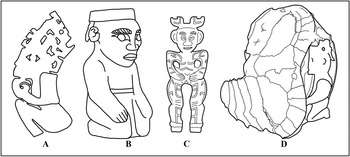
Complete bodies were either rendered three-dimensionally in ceramic, stone, or jade, or they were carved into flat pieces of jade (Fig. 5A). The individuals were typically portrayed as kneelingFootnote 6 or sitting with the knees brought close to the body. The clothing worn by these figures ranges from relatively plain (e.g. M5:376) to covered in intricate designs (e.g. M5:371), and several individuals sport hats or headdresses (Fig. 5B). One notable exception in the visual language of this collection is an erect jade figure uncovered from Fu Hao's tomb (Fig. 5C) that displays a human male on one side and a female on the other (Linduff Reference Linduff, Nelson and Rosen-Ayalon2002).Footnote 7 While the original use of these objects is unknown, a ritual function is suggested by the discovery of a human figurine placed inside a turtle shell (Fig. 5D) that was unearthed in 2004 at the Dasikongcun locale (T0204 M18).Footnote 8 Two ceramic figurines (H77:12, 76) were also found within a sacrificial pit at Liujiazhuang North Locus (IA, CASS 2012).
Representations of complete human bodies at Yinxu. (A) Human jade tablet, M1550 (after Liang & Gao Reference Liang and Gao1976, pl. 43); (B) Stone kneeling figure, M5:376 (after IA, CASS 1980, pl. 23); (C) Jade figurine, M5:373 (after IA, CASS 1980, pl. 25); (D) Jade kneeling figurine in a turtle shell, Dasicongcun M18:14 (after IA, CASS 2014, pl. 85). Not to scale.

The intricacies of some of the figures’ attire suggests that they were probably higher-status individuals. With the exception of M5:373, none of the other representations possess anatomical characteristics that could be used to assess biological sex; however, hairstyle may provide some insight into gender expression. Many of the individuals appear to have hair that is cropped quite close to the head. As they would not have been able to wear hairpins, which tend to be associated with elite women (Linduff Reference Linduff, Nelson and Rosen-Ayalon2002; Wang Reference Wang, Linduff and Sun2004), a tentative interpretation is that many of these images represent men. Based on this survey, only two examples appear to represent captives. Two clay figurines were excavated in Xiaotun (H358) depicting robed individuals with bound hands; however, they were uncovered from a disturbed context, and thus cannot be securely dated to the Late Shang (Li Reference Li1977, 212). Therefore, there is no clear evidence that any of these representations can be directly interpreted as portraying the victims of decapitation.
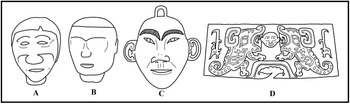
Representations of the face and head of humans were also uncommon at Yinxu (Fig. 6). Small, three-dimensional heads rendered in jade and ceramic tend to have minimal identifying features, with the exception of close-cropped hair. Similarities in form cut across media and contexts, exemplified by a clay head from a small rectangular burial of a 7–8-year-old child in Xiaomintun (IA, CASS 2018, 686) and a jade one from Fu Hao's tomb (Figs 6A & 6B). These examples stand in contrast to the idiosyncratic discovery of a large bronze object (25.4 cm in height) with a naturalistic rendering of a human faceFootnote 9 (Fig. 6C) recovered from a 4-ramped tomb in the royal cemetery (M1400). Human heads were also present as decorations on bronze objects as part of the ‘man-beast motif’ (Fig. 6D), such as a large bronze yue 钺 axe excavated from M5 (IA, CASS 1980).Footnote 10 Chang (Reference Chang1983) has interpreted this motifFootnote 11 and other anthropomorphized beings within the framework of shamanistic communication and transformation, which was achieved through human–animal engagement in the form of sacrifice, divination and decorations such as the taotie 饕餮 (see Keightley Reference Keightley1998 for a critique).
Representations of heads and faces at Yinxu. (A) Clay head, Xiaomintun SM9:1 (after IA, CASS 2018, pl. 309); (B) Jade head, M5:374 (after IA, CASS 1980, pl. 131); (C) Bronze face, M1400:R1116 (after Liang & Gao Reference Liang and Gao1996, pl. 53); (D) Bronze axe, M5:799 (after IA, CASS 1980, 106). Not to scale.

These isolated faces offer a stylistic departure from the decorative motifs and flourishes that characterize much of Late Shang elite visual culture, and instead highlight the features of the face.Footnote 12 Scholars (e.g. Bagley Reference Bagley1990; Kesner Reference Kesner2007; von Falkenhausen Reference von Falkenhausen, Boschung and Queyrel2017) have noted that, contrary to representational practices in other parts of the world, specific historical figures are not depicted in early China, possibly resulting from cultural restrictions or taboos (von Falkenhausen Reference von Falkenhausen, Boschung and Queyrel2017, 379). This anonymity may have allowed them to represent a range of social actors simultaneously, and von Falkenhausen (Reference von Falkenhausen, Boschung and Queyrel2017, 385) has suggested that some of the heads on vessels may have represented sacrificial victims themselves. While it is difficult to prove who was depicted with the current available evidence, if they were sacrificial victims, the representations may have been used specifically to invoke memories of the material remains of decapitated heads when viewed in isolation from the body, as Reinhart (Reference Reinhart2015, 165) has suggested for images of animals on bronzes.
The site of Shimao (c. 2300–1800 cal. bce) in Shaanxi province presents an interesting context where both a large number of human representations and deposits of decapitated heads are present (Jaang et al. Reference Jaang, Sun, Shao and Li2018; Shaanxi Provincial Institute of Archaeology 2020). The walled settlement features stone relief carvings of human heads and bodies, as well as figurines. Notably, caches of decapitated heads associated with architectural features, such as gates, contain more female than male individuals (Chen et al. Reference Chen, Xiong, Shao and Sun2016), differing considerably from the patterns observed at Yinxu and other earlier Shang sites in the Central Plains. Although the relationship between Shimao and these later sites is still unclear, future research may help illuminate why women were the primary targets for decapitation during the former period, but not the latter, and what the specific relationship was between material remains and depictions of humans at Shimao.
The perceived spiritual strength and value of the material presence of decapitated heads at Yinxu may not have necessitated their widespread replication in other media. This research lends further support for Priewe's (Reference Priewe and Insoll2017, 19) suggestion that, in early China, ‘corporeal understandings’ may have emphasized the material remains of humans over artistic representations. By interrogating the osteological and material records together, this research helps us better understand past ontologies of the body and the agency of dead and living human social actors at the Late Shang site of Yinxu.
Conclusion
In this article I have explored how the human head was viewed and experienced within the larger framework of visual culture at Yinxu. As with many other state-level societies, decapitation served several simultaneous socio-political and ritual functions aimed at the reproduction of the social and religious relationships that maintained the state and its elites. The increase in human sacrifice that emerged at Yinxu required the elites to develop a ritually informed process for curating and burying these remains. Post-mortem treatment of decapitated bodies was contingent on the purpose for the decapitation, the social identity of the individuals and, as argued here, their material contribution to the built, visual landscape of the living and the dead. Future research that takes a broader temporal and spatial scope can help address diachronic patterns in decapitation in early China.
Acknowledgements
Research on human representations was carried out at the Institute for the Study of the Ancient World. Research on decapitation was carried out as part of my dissertation (Wolin Reference Wolin2018), which was funded by a Fulbright U.S. Student Research Grant and the Yale University Council on East Asian Studies Dissertation Fellowship. I would like to thank all of my colleagues at the CASS Institute of Archaeology Anyang Archaeological Workstation, Anne Underhill, Zhichun Jing and Richard Burger for their guidance and support during my dissertation research. I am grateful for the comments and advice that Anne Underhill and Roderick Campbell provided on this manuscript, along with feedback from Andrew Womack, Michelle Young, Natasha Osing and others. Thank you to Lothar von Falkenhausen and Qingzhu Wang for bringing several readings and sources to my attention and to Colin Theys for his assistance making figures. Finally, I would like to extend my thanks to the editor and two anonymous reviewers for their feedback and suggestions for improving this article.