Since 2003, coalition forces in Iraq have engaged in conflict with a variety of opposition groups. The set and characteristics of these groups continue to change over time as the violence ebbs and flows. During the early stages of the war, the primary opposition consisted of ex-Baathist Iraqi military forces. Over the next several years, combatants fragmented and many new groups emerged. Hafez identifies up to fifty-six Sunni groups that were involved in insurgent attacks between 2003 and 2006, for example.Footnote 1 A fragmented Shia insurgency also developed in Iraq, further expanding the set of actors involved in the war. The recent conflict in the Darfur region of the Sudan likewise involves a changing roster of combatants. The Sudanese Liberation Army (SLA) fragmented into two separate groups and the number of combatants proliferated over the course of several years. During the first Chechen war (1994–96), otherwise unfriendly Chechen clans first united to oppose the Russian invasion, but over time the opposition fragmented into many groups. Similar changes to the set and characteristics of actors occurred in many other conflicts in contexts as diverse as Colombia, Burundi and Afghanistan.Footnote 2 This raises the question of how such processes of change occur and affect the dynamics and outcomes of wars.
Both the theoretical and empirical literatures on war dynamics capture only a limited conception of change. Current theoretical models of war dynamics tend to follow the suggestions of FearonFootnote 3 by focusing either on the presence of incomplete information,Footnote 4 or the existence of commitment problemsFootnote 5 associated with negotiated agreements. Over the past decade, formal-theoretic bargaining models of war offer prominent theoretical innovations in the study of war. Yet, one of the principle features of existing models is the inclusion of only two fixed actors that, during the course of conflict, change only in their capabilities and beliefs. Although formal models of war were developed primarily to explain interstate wars,Footnote 6 scholars apply both the assumptions and insights extensively to civil warsFootnote 7 or, at least, suggest that they apply.Footnote 8 Yet, arguably, these models require crucial adjustments to capture the fundamental dynamics of civil wars.
There also exists a non-trivial disjuncture between theoretical models of war dynamics and the empirical dynamics of civil wars. Some empirical literatures discuss specific cases of complexity that arise during the course of civil conflicts, including war expansion through third party state interventionFootnote 9 or changes in rebel groups during civil war,Footnote 10 but in understandably limited ways. Other processes of change, such as the fragmentation of combatants, are scarcely noticed, even in the empirical literature. And yet, such changes appear to be the rule rather than the exception. Kalyvas writes: ‘civil wars are not binary conflicts but complex and ambiguous processes that foster an apparently massive, though variable, mix of identities and actions … Put otherwise, the widely observed ambiguity is fundamental rather than incidental to civil wars, a matter of structure rather than noise.’Footnote 11
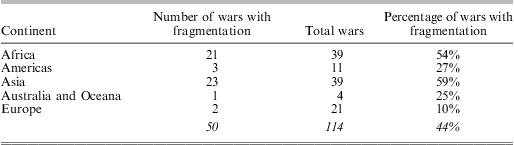
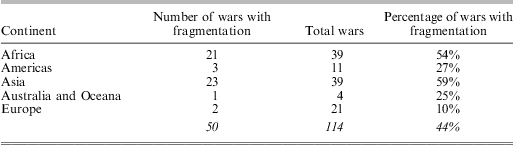
Empirically, recent civil wars suggest that the complexity is indeed fundamental – changes in the set and characteristics of actors appear pivotal in case after case. Although many types of change are important, we have focused this article on how the fragmentation of combatants affects the duration and outcomes of civil wars. As a first step, we considered how frequently combatants fragment, by coding the number of wars in the Uppsala Conflict Database in which at least one group fragmented.Footnote 12 Based on a conservative coding of the wars, fifty out of 114 (roughly 44 per cent) experienced fragmentation. Table 1 gives descriptive statistics of wars with fragmentation across regions; fragmentation occurred in many of the highest profile wars, such as Rwanda, Northern Ireland, Democratic Republic of the Congo, Iraq, Sudan, India, Sri Lanka, Colombia, Algeria and Peru, to name a few. In a number of the wars, fragmentation occurred more than once. In this initial empirical inquiry, wherever possible, we identified the timing of the fragmentation by the quarter of the war in which it occurred. Based on the available data, 33 per cent of the fragmentations occurred during the first quarter of the war, 12 per cent in the second quarter, 14 per cent in the third quarter, and 41 per cent in the fourth quarter. Empirically, fragmentation dynamics are not easy to capture with a high level of precision, but these broad observations suggest that fragmentation occurs frequently and it tends to cluster at the beginning and end of wars.
Descriptive Statistics on Fragmentation in Civil Wars
Because fragmentation is difficult to consider conceptually and empirically, we argue that the causes and consequences of fragmentation can be better understood by conceptualizing war as an evolutionary system.Footnote 13 Conceptualized as such, war is a process whereby combatants learn on an individual basis, but are also subject to evolutionary processes similar to natural selection, which result in changes to the set and characteristics of the actors. We utilize computational modelling, which is well suited to incorporating evolutionary processes in multi-agent situations.Footnote 14 De Marchi notes that:
‘war is often non-dyadic, and models that assume dyadic conflicts cannot be expected to have anything general to say about non dyadic conflicts … N-player games are difficult, in most circumstances, for game theory to encode; thus, formal modelers often make the choice of making analogies to the multi-actor case from a two-player game’.Footnote 15
Considering the ways that actors change during war, computational modelling is a suitable approach to address these multi-actor scenarios. The computational model of war in this article builds on the structure and insights of existing formal models but, in an attempt to model more directly the complexities of the war, we treat agents as adaptive, boundedly rational actors subject to uncertainties arising from the process of war.
We proceed with a discussion of processes of change during war. We then develop a baseline model of war incorporating elements of what Powell refers to as ‘informational problems’,Footnote 16 and consider whether our results are generally consistent with the theoretical expectations of the formal literature, despite beginning with some different assumptions. Next, we incorporate an evolutionary selection process that can lead to the fragmentation of actors and analyse how it influences the duration and outcome of wars. We find that fragmentation does not simply occur as a matter of course; but it happens enough to alter the course and outcomes of wars in distinct ways.
Among other findings, one key result emerges from our analysis that runs contrary to much conventional wisdom in the civil war literature. Some prominent research on civil wars suggests that the dynamics between moderates and extremists, often induced by fragmentation, make wars more difficult to resolve.Footnote 17 Further, others have suggested that the number of actors involved in a war only complicates the ability of combatants to reach an end to the war.Footnote 18 The opening example appears to support others’ arguments: the rise of the fragmented Shia insurgency appears to have complicated the dynamics of the Iraq war.
And yet, under many circumstances, our model suggests that fragmentation may lead to shorter wars that end in negotiated agreement. The logic underlying the connection between fragmentation and the dynamics of war is that fragmentation substantially weakens the resulting combatants who split, which creates conditions conducive for more immediate co-operation. While we are cautious to apply the theoretical results directly to a broader set of empirical cases, these findings suggest a potential explanation for the clustering of instances of fragmentation in the final stages of wars that we found in the preliminary empirical examination above.
Civil War Dynamics and Outcomes
Scholars of civil (and interstate) wars devote much of their effort to the conditions under which wars begin. While there has been interest over time in the dynamics and outcomes of wars,Footnote 19 far less attention has been given to war resolution. Formal models of war dynamics are largely responsible for a shift in emphasis towards the entire process of war and demonstrate the importance of learning.Footnote 20 Although formal models of war dynamics emphasizing information problems were primarily developed as explanations for interstate war, they have been applied to civil wars almost without alteration.Footnote 21
Learning during Civil War
Clausewitz discusses the ambiguity facing combatants attempting to obtain reliable estimates of an opponent's troops and strategies; he famously refers to this as the ‘fog’ (uncertainty) of war.Footnote 22 More recently, others raise Clausewitz's ideas about ambiguity in justifying the difficulties of learning during war and the consequent difficulties of prosecuting the war.Footnote 23
From the perspective of the current war literature, combatants learn about their opponent(s) during war, and utilize these changing expectations to inform their choices as they attempt to maximize their individual utility.Footnote 24 In this framework, learning is motivated by a desire to choose the ‘best’ strategy – one that maximizes individual goals. Some scholars have modelled the problem of fog in war by assuming that the outcomes of key events, or the actions of other combatants, provide important information.Footnote 25
Following Fearon, who argues that war often results because of incomplete information about the distribution of capabilities, models of war dynamics generally assume that the outcomes of battles, and in some cases actions during negotiations, reveal information to the actors about the distribution of capabilities.Footnote 26 The information generated by these events helps clear the ‘fog’ that Clausewitz spoke of, so that the combatants understand whether they should settle by negotiating an agreement or continue to pursue a military victory.Footnote 27 That is, as the actual distribution of capabilities becomes evident to the different parties, each side can agree on its relative share of a negotiated agreement.
One of the key results from the formal literature is that actor beliefs about the distribution of capabilities ‘converge’,Footnote 28 and as a result, actors decide to co-operate with each other by negotiating an agreement. It is difficult to verify empirically whether the convergence mechanism leads to more negotiated agreements, but the frequency of negotiated agreements generally matches the empirical record in that interstate wars have been far more likely to end by negotiated agreement than military victory.Footnote 29 In the post-Cold War era, even civil wars have been far more prone to end in negotiated settlement than in military victory.Footnote 30 And rationalist explanations of civil wars suggest that, like interstate wars, learning can play a key role in the resolution of war.Footnote 31
Other important questions remain, nonetheless. Are civil wars fundamentally different from interstate wars? Kalyvas and others suggest that significantly greater ambiguity exists in civil wars.Footnote 32 What happens, for example, when more than two actors battle against each other? Cunningham contends that the more actors there are in a war, the longer that war is likely to last.Footnote 33 The more actors there are, arguably the more complicated the information problems that occur during the warFootnote 34 and, consequently, the more difficult it is to end it. Nominally weaker actors, furthermore, might create uncertainty through the use of extremist violence that potentially spoils steps towards peace.Footnote 35 Thus, the current literature implies that learning may be complicated as the roster of combatants changes shape during the war, causing wars to last longer.
Like evolutionary processes, changes to the set and characteristics of actors during war result from more than just the outcome of a battle or a negotiation attempt, and are more than the direct product of individual agency. One could argue that actors change by choice in order to improve the prospects for victory on the battlefield or to get a better deal at the negotiation table. And yet, not all changes in actors necessarily lead to a greater likelihood of success during war. In the Sudan, the government's new strength, through a coalition with one of the previous Sudanese Liberation Movement (SLM) factions, following the May 2006 Darfur peace agreement, allowed it to be more successful. At the same time, the other SLM faction and the Justice and Equality Movement (JEM) became much weaker and began to fall apart as various segments of the once unified groups split into smaller fragments.
From Formal Models to Empirical Tests
Over a decade ago, a group of prominent scholars published a collection of essays calling for studies to examine ‘war and conflict as a dynamic, evolving, malleable, and complex phenomenon’.Footnote 36 Likewise, James and Goetze organized a collection of work addressing the connections between evolutionary theory and ethnic conflict on the basis that standard approaches to studying war might not be adequate.Footnote 37 More recently, others have argued for connecting different phases of war together to understand the interdependencies of the component parts.Footnote 38 The formal literature on war attempts to address complexities of war and connect different stages of conflict within a single framework, but in understandably limited ways.
With only a few exceptions, empirical tests of the formal literature are almost non-existent.Footnote 39 To be sure, a number of quantitative scholars attempt to push forward a disaggregated study of conflict behaviour, but we contend that the vast majority assume away many of the complexities of war.Footnote 40 Quantitative research captures certain complexities of war, such as the involvement of multiple actors, better than existing formal work, but also in understandably limited ways.Footnote 41 Quantitative research on interstate war mostly uses the dyad as the unit of analysis,Footnote 42 but this approach does not address multilateral processes adequately.Footnote 43
In civil war research, the country year has been the primary unit of analysis in most studies.Footnote 44 Some argue that different research designs should be employed in order to account adequately for multilateral and more complex processes. For example, others explore the role of dyadic interactions,Footnote 45 or third-party involvement in civil wars,Footnote 46 that are not dependent on the dyadic framework. But even these studies are limited in the set of actors considered and a two-actor framework to which they are confined. Even in the civil war studies that account for more than two actors,Footnote 47 there is an important distinction between including a variable for more actors in a regression model and accounting for how the actors change and the effects of these changes. Indeed, our contention in this article is that the process of fragmentation is intrinsically useful to consider as a way of capturing some of the complexity of civil wars.Footnote 48
Complexity in Civil War
Clearly both the formal and empirical literatures contribute to our understanding of the dynamics of civil war. And yet there is a substantial disconnect between the formal and empirical literatures, as well as between either literature and the phenomenon of civil war itself. Empirically, for example, actors are forced to adjust expectations and change strategies based on processes that are not only outside the combatants’ control, but arguably external to the interactions and decisions of existing combatants. Such a process might include the intervention of outside parties (as in the 1999 intervention of the North Atlantic Treaty Organization (NATO) into Kosovo), forcing combatants to respond to changing circumstances.
One of the contributions of our project is to incorporate fragmentation, which occurs in many civil wars, and offer a more diverse set of expectations regarding the outcome and duration of wars. We contend that these processes of change are fundamental, not tangential, to the process of civil war and should be better included in theoretical models and empirical analyses. Among the many possibilities, we suggest that fragmentation receives only cursory attention in the civil war literature. Unfortunately, changes such as fragmentation are difficult to capture using extant modelling approaches. Therefore, we have attempted to model fragmentation dynamics using computational techniques.
A Model of Civil War With Fragmentation
We have constructed a computational model of civil war that incorporates assumptions found in the current formal modelling literature, such as bargaining and learning, along with assumptions from the agent-based modelling literature, such as notions of adaptive, boundedly rational agents. Given the complexities inherent in civil wars, we have attempted to construct the model to capture key elements that ‘generate results that directly map to the empirical referent’ (fragmentation) rather than confining the assumptions to the bounds of a mathematical model.Footnote 49 Particularly, we have allowed the actors themselves to change over time by fragmenting and, consequently, for more than two actors who interact adaptively, rather than fully rationally.Footnote 50 The model allows us to vary a greater number of parameters to explore the consequences of these changes on the outcomes of interest.Footnote 51 Scholars increasingly use computational models of war and violence to account for the number and heterogeneity of actors and to explore a greater repertoire of actor strategies and outcomes.Footnote 52
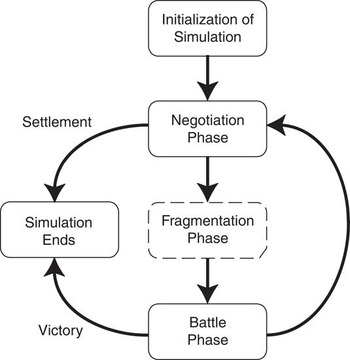
We begin by assuming that agents are involved in a dispute over the distribution of some issue, such as how to share power in a government or how to address a territorial claim on a state's border. Each simulation begins with the initialization phase in which two agents are created and assigned characteristics such as capabilities and beliefs. After the initialization phase, the agents enter into the ‘main interaction loop’ consisting of alternating rounds of negotiations and battles, similar to the alternating battles and negotiations convention found in the game-theoretic literature.Footnote 53 The ‘negotiation phase’ can end in two possible outcomes. Either agents agree to a settlement, at which point the simulation ends, or the agents do not agree and the simulation continues. In the baseline model, the agents proceed immediately to the ‘battle phase’, the outcome being determined by the distribution of capabilities and a random draw, which is another common feature of game-theoretic models we cite. Following battles, agents alternate between negotiations and battles until either a negotiated agreement obtains or one side achieves a military victory.
In the extended model with fragmentation, a ‘selection’ phase can occur between the negotiation and battle stages, during which fragmentation may take place. In this article, we primarily consider the fragmentation of existing actors. The baseline and extended models are summarized in Figure 1, where the dotted line (box) surrounding the ‘Fragmentation Phase’ indicates that this part of the simulation only occurs in the extended model. The following section formalizes the model.Footnote 54
Overview of the computational model

The Baseline Model
Two agents, i and j, are involved in a dispute over Π, which represents terms of a settlement such as control over the institutions of government, means of coercion, territory or some other benefits. Agent utility is strictly increasing over Π, meaning that both i and j wish to obtain the entire Π. During the initialization phase, i and j are created and assigned initial attributes. The capability of each agent is determined through a random draw from a uniform distribution in uκ∈[0, δ], where δ represents the maximum amount of capability, κ, an agent can possess at the outset.Footnote 55ρ denotes the capability ratio for agents such that  $ {{\rho }_i}\, = \,\frac{{{{\kappa }_i}}}{{\mathop{\rSigma} \kappa }} $. Assume first complete information, in which i knows its own capability as well as j’s.
At the beginning of the negotiation phase, the strongest agent, i (assume κi > κj), makes an offer πj to j, which represents some division of Π. Agent i offers πi based on its belief about the distribution of capabilities. Under complete information, agents have accurate beliefs and therefore i offers itself  $ {{\pi }_i}\, = \,{{\rho }_i}^{ \times } \rPi $ and offers agent j
 $ {{\pi }_j}\, = \,{{\rho }_j}^{\times} \rPi \, = \,1{\rm{ - }}{{\pi }_i} $. πi and πj represent the shares of Π expected by both agents and, accordingly, both i and j accept, and the simulation ends immediately with an agreement.
Rationalist studies of war have long accepted the idea that capabilities are uncertain, leading to a variety of models incorporating ‘private information’Footnote 56 and ‘asymmetric information’Footnote 57 assumptions. Thus, we now assume that each agent knows its own capabilities, but has beliefs about the capabilities of all others and must learn during war.Footnote 58
Given the complexities of civil war, we assume that agents have extremely limited ability to forecast the likely course of the war and, therefore, in a general sense are boundedly rational and frequently use inductive reasoning over time to make decisions.Footnote 59 Lane and Maxfield discuss the complex ‘foresight horizon’ facing actors in wars such as Bosnia.Footnote 60 They suggest that Bosnian diplomats in early 1995 had to wrestle with whether Croats were friends or foes, decide whether the UN Security forces would support them, and predict which new actors might join the war, and only through experience could they make their choices.Footnote 61 Comparing rational choice and adaptive computational models, furthermore, Laver argues that:
‘the key distinction … is that hyperrational agents make choices by looking forward strategically, continuously solving and resolving in real time the dense system of equations in the high-end rational choice literature … In contrast, adaptive agents look backward and learn from the past, developing simple rules of thumb that condition future behavior on the recent history of the system’.Footnote 62
We assume agents have minimal ability to understand the future course of the war and that they learn adaptively, rather than rationally. While political scientists commonly use Bayes’ Rule for belief updating, it is clear that there are a very large number of possible learning models from which to choose.Footnote 63 Given our interest in modelling war as a complex system with boundedly rational agents, we opt to use a simple heuristic-based learning model that captures one of the simplest ways agents might update beliefs. Specifically, we adapt a framework in Smith and Stam in which beliefs are based on the mean of the beta distribution, which has two free parameters, α and β.Footnote 64 Using α and β, each agent calculates an estimated ratio between itself and another agent, such that agent i’s belief about j is  $ {{\dot{\rho }}_{i,j}}\, = \,{{{{\alpha }_{i,j}}} \mathord{\left/ {\vphantom {{{{\alpha }_{i,j}}} {{{\alpha }_{i,j}}\, + \,{{\beta }_{i,j}}}}} \right. \kern-\nulldelimiterspace} ({{{\alpha }_{i,j}}\, + \,{{\beta }_{i,j}}}}) $. Initially, the parameters αi ,j and βi ,j are derived from κi and κj. Under complete information,
 $ {{{{\kappa }_i}} \mathord{\left/ {\vphantom {{{{\kappa }_i}} {\mathop{\sum} \kappa }}} \right. \kern-\nulldelimiterspace} {\mathop{\rSigma} \kappa }}\, = \,{{{{\alpha }_{i,j}}} \mathord{\left/ {\vphantom {{{{\alpha }_{i,j}}} {{{\alpha }_{i,j}}\, + \,{{\beta }_{i,j}}}}} \right. \kern-\nulldelimiterspace} ({{{\alpha }_{i,j}}\, + \,{{\beta }_{i,j}}}}) $. Under incomplete information, ι denotes the maximum amount that βi ,j can vary from κj such that:
 $${{\beta }_{i,j}}\, = \,{{\kappa }_j}\, + \,(({{\kappa }_j}\,\times \,\iota )\,\times \,(1{\rm{ - }}({{u}_v}\,\times \,2)),$$
where uv∈U[0,1] (i.e., a random draw from a uniform distribution on the unit interval).Footnote 65
Now, i’s offer to itself is  $ {{\pi }_i}\, = \,{{\dot{\rho }}_i} $ and i‘s offer to j is
 $ {{\pi }_j} = 1{\rm{ - }}{{\dot{\rho }}_i}\, = \,1{\rm{ - }}({{{{\alpha }_{i,j}}}}/({{{{\alpha }_{i,j}}\, + \,{{\beta }_{i,j}}}})) $. Note that i's offer to j is based entirely off of i's belief, which is derived from the pairwise parameters αi ,j and βi ,j. It is possible for i to make an offer that j will not accept, because i’s belief of j’s capability (
 $ 1{\rm{ - }}{{\dot{\rho }}_{i,j}} $) may be lower than j's belief. Similar to Fearon, only one agent, in our case agent i, is able to make offers to other agents.Footnote 66 If an agent is offered a portion of Π that is greater than or equal to what it believes it deservesFootnote 67, then it accepts the offer (i.e., for i if
 $ {{\pi }_i}\geq {{\dot{\rho }}_i} $).
What if the offer is less than  $ \dot{\rho } $? Because actors could be willing to accept offers that are similar to their beliefs, but not quite commensurate, a parameter, ε, determines a ‘sensitivity’ range, similar to Rosen's ‘willingness to suffer’ logic,Footnote 68 in which actors might accept sub-optimal solutions in order to avoid continued interaction, a process similar to ‘satisficing’.Footnote 69 This follows a substantial literature in agent-based modelling that incorporates boundedly rational agents who satisfice, rather than optimize.Footnote 70 If the difference between an agent's belief about its capability ratio and the offer is less than ε (i.e., for i if
 $ {{\dot{\rho }}_i}{\rm{ - }}{{\pi }_i}\, \less \lt \,{\epsilon} $), then it accepts the offer. Actors know that, if they reject a negotiation offer, a return to war will be unavoidable. For example, if one agent believes it controls 75 per cent of the capability distribution, but is offered only 50 per cent of Π and ε = 0.1, then the agent rejects the offer because the offer is too low (i.e., 0.75−0.5 = 0.25 > 0.1). If both agents accept the offer, then a negotiated agreement is reached, and the simulation ends.
Agents update beliefs about capabilities during the negotiation phase based on whether an actor accepts an offer, which is observed by all other agents.Footnote 71 If j rejects an offer, then i concludes that it is underestimating j’s capability, and as a result adds χ to β.Footnote 72 Negotiations end in one of two ways: both i and j accept the offer, at which point the simulation ends; j rejects i's offer and the simulation proceeds to the battle phase (see Figure 1).
With only two agents, the battle phase consists of a single battle between i and j. The outcome of the battle is determined by a random draw, ub∈U [0,1], which is compared to the distribution of capabilities. If ub ≤ ρi, then i wins the battle and one unit is added to i's capability ( $ {{\kappa }_{i,t\, + \,1}}\, = \,{{\kappa }_{i,t}}\, + \,1 $) and one unit is subtracted from j's capability (
 $ {{\kappa }_{j,t\, + \,1}}\, = \,{{\kappa }_{j,t}}{\rm{ - }}1 $). If ub > ρi, then agent j wins and capabilities change similarly.
Each agent also updates its beliefs based on the outcome of the battle. If an agent wins a battle, then it adds ω to α, and thus believes it is stronger than originally thought. If the agent loses the battle, then it adds ω to β, and thus believes it is weaker than originally thought. To illustrate, if i has α = 1 and β = 1, then  $ {{\dot{\rho }}_i}\, = \,{1 \mathord{\left/ {\vphantom {1 2}} \right. \kern-\nulldelimiterspace} 2} $. If i wins a battle, then it adds ω to α and its resulting belief about j is
 $ {{\dot{\rho }}_i}\, = \,({{1\, + \,\omega } \mathord){\left/ ({\vphantom {{1\, + \,\omega } {2\, + \,\omega }}} \right. \kern-\nulldelimiterspace} {2\, + \,\omega }}) $, which is higher than its previous belief. While not a complicated belief setup, this captures a simple heuristic-based learning process that offers some indication to the combatants of how strong they are.
If an agent's capability reaches or drops below 0, then it is defeated and ceases to participate further, and the simulation ends in victory for the remaining agent. In this case, the surviving agent wins all of Π. If both agents survive the battle phase, the simulation returns to the negotiation phase, and the main interaction loop begins again (see Figure 1).
Baseline results
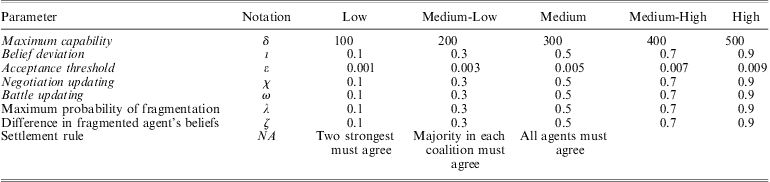
We conduct initial analysis of the model with key parameters set at five different values that capture the range for each parameter. The parameters varied are the maximum amount of capability that an agent may initially possess (δ), the maximum percentage initial belief parameters may deviate from agent capabilities (ι), the threshold agents use to accept offers (ε), the amount agents update beliefs in negotiations (χ), and the amount agents update beliefs in battles (ω). Table 2 details the five ‘experiments’ conducted for the baseline parameter sweeps, each set at five different values (ranging from low to high).Footnote 73
Values for Parameter Sweeps
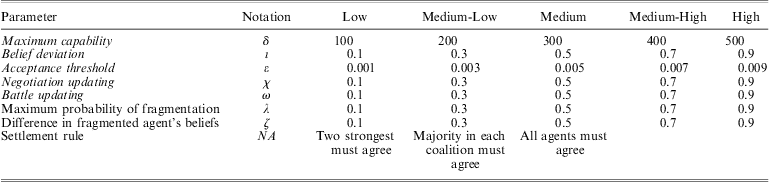
Notes: The parameters listed in italics are the parameters that are varied in the Baseline experiments. All other parameters are varied in the experiments after the probability for fragmentation is added.
Due to the stochastic elements in the model, each experiment consists of 1,000 runs with the same parameter configuration, and the results for the 1,000 runs are summarized for comparison with other experiments. This prevents any single run from overly influencing the conclusions from an experiment. In most cases, the parameters are bounded by 0 and 1 and we sweep most of the range. In a couple of cases (acceptance threshold and, later, mutation probability), the high and low values capture a wide range of parameter values. To measure duration in an experiment, we average the number of rounds it takes for runs to end in settlement or victory.
We initially examine whether parameter changes lead to results generally consistent with the existing formal literature. We are not suggesting that these experiments are directly comparable to existing formal models. We find that these baseline experiments are consistent with results from existing models. Simulations are more likely to end in settlement rather than victory across a wide range of parameter settings.Footnote 74 Furthermore, the effects of deviations in initial beliefs and the amount of learning during battle and negotiations coincide with expectations regarding the convergence of beliefs during wartime.Footnote 75
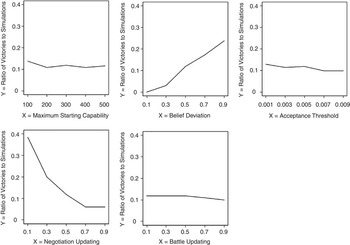
Figure 2 illustrates the results of these parameter changes (x-axis) on the ratio of victories to simulations (y-axis).Footnote 76 The figure shows that most of the simulations end in settlement.Footnote 77 There appears to be little association between the maximum possible starting capability of states and the ratio of simulations that end in victory. As the range of possible initial beliefs increases, so does the percentage of runs ending in victory. The more divergent beliefs, the longer belief convergence takes, which allows more opportunity for victory to take place in the interim.Footnote 78 As the acceptance threshold increases the range of acceptable settlement offers increases and thus the percentage of victories decreases. The amount of updating during battles and negotiations also has an impact on the percentage of victories in the experiments. As the amount an agent can update beliefs during negotiation increases, the percentage of victories decreases, which is also consistent with the notion of convergence: the more agents learn about their opponent, the quicker beliefs converge and settlement takes place.Footnote 79 There also appears to be a slight negative relationship between battle updating and victories, although not nearly as strong as with negotiation updating.
Baseline model outcome plots
Notes: The labels along the x-axis represent parameter values in the experiments. For each graph, all other baseline parameters are set at their middle values.

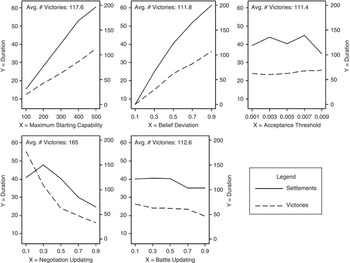
Figure 3 illustrates changes in average duration for runs ending in victory or settlement.Footnote 80 Two of the parameters, maximum initial capability and initial belief differences, increase the duration of all simulations regardless of outcome. Higher initial capabilities increase the duration of victories, as it takes more battles to deplete the capability of an agent completely. Similarly, larger belief deviations, holding capability size constant, increase the duration of simulations ending in both settlement and victory.
Baseline model duration plots – changes in average duration for runs ending in victory or settlement Notes: The labels along the x-axis represent parameter values in the experiments. The y-axis on the left is for simulations ending in settlement, as indicated by the solid lines. The y-axis on the right is for simulations ending in victory, as indicated by the dashed lines. For each graph, all other baseline parameters are set at their middle values.

As the acceptance threshold increases, there appears to be no relationship to the duration until settlement. The parameters determining the amount learned during negotiations and battles generally fit our expectations regarding the convergence of beliefs. As the amount learned increases, beliefs should converge in a shorter span of time, and settlements be reached sooner. Indeed, as the amount learned during negotiation increases, settlements and victories occur more quickly in all but the 0.1–0.3 range. Increasing amounts of battle updating also decrease the duration of simulations ending in victory. The duration of simulations ending in settlement is decreasing only in the range 0.5–0.9, which runs contrary to the expectation that any increase at all in the updating of beliefs will lead to shorter durations of simulations ending in either settlement or victory.
Model with Fragmentation
We now add the possibility of fragmentation to the baseline by including another ‘phase’ in between negotiations and battles (see Figure 1). If negotiations fail, agents can be ‘selected’ based on their fitness to undergo fragmentation into two derivative actors, where weaker actors are more likely to fragment than stronger actors. The logic underlying fragmentation is that various forces can cause actors to split. Often this occurs when combatants reach an internal impasse about whether to continue fighting or to negotiate a peace agreement. Whereas combatants would be stronger if they remained together, which would be more optimal from the perspective of fighting, internal bargaining breakdowns nonetheless occur and combatants fall apart. Fragmentation increases the overall number of agents involved in the war by one, but with two caveats: (1) only one agent can fragment in each phase (even though most of the time agents do not fragment); and (2) the total number of agents cannot exceed ten at any given time.Footnote 81
Fragmentation
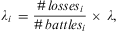
Agents are selected for fragmentation based on their fitness with respect to other agents. Fitness is determined based on the ratio of an agent's losses to the number of battles fought, such that the probability of fragmentation for agent i (hereafter λi) is represented by:
 $${{\lambda }_i}\, = \,\frac{{\# \,losse{{s}_i}}}{{\# \,battle{{s}_i}}}\,\times \,\lambda, $$
where λ represents the maximum probability that an agent will fragment. An agent that has never participated in battle has a λi = 0, meaning that it cannot fragment. The greater the proportion of losses, the more likely an actor will fragment, if selected. In Liberia in 1989–90, for example, government forces faced extremely strong resistance from Charles Taylor and the National Patriotic Front of Liberia (NPFL) and the government very quickly lost much of Liberia. Almost immediately, Liberian government forces fragmented into a number of armed bandit organizations that were loosely referred to as the Armed Forces of Liberia.Footnote 82 Once λi is determined, i fragments only when a random draw from a uniform distribution, uλ∈[0,1], is less than the fragmentation parameter (i.e.,  $ {{\dot{\lambda }}_i}\, \gt \,{{u}_\lambda } $).
After fragmentation takes place, more than two agents can be involved in the dispute over Π simultaneously. We organize agents into one of two coalitions, where a coalition may be comprised of one or more agents. Following fragmentation, the new agent remains in the same coalition as the original, fragmented agent, but these two agents are subsequently treated as two separate agents. The previous agent retains its battle history, which is used in subsequent rounds to determine fragmentation, as in Equation 2. While groups that split might end up fighting each other, such as with the SLM in Sudan, most groups continue to co-operate with each other against their previous enemy following fragmentation. The many additional fragmentations that occurred following the Darfur peace agreement, in which new combatants co-operated with others from whom they just fragmented,Footnote 83 better represent fragmentation dynamics in most civil wars.Footnote 84
New capabilities and beliefs are generated for the newly created agent, as well as the agent that underwent fragmentation. We assume that the newly formed agent, f, and the existing agent, i, both possess a portion of the composite parent's capability. We randomly draw a number (uc), which determines each agent's capability share: κi = uc × κi and κf = (1−uc) × κf. We generate new beliefs, α and β, for the new agent identical to the procedure in the initialization phase, with the exception that ζ, represents the maximum percentage the new belief differs from the original:Footnote 85
 $${{\beta }_f}\, = \,{{\kappa }_i}\, + \,(({{\kappa }_i}\,\times \,\zeta )\,\times \,(1{\rm{ - }}(2\,\times \,{{u}_c}))).$$
As an example of how fragmentation dynamics may split weaker actors, and thus create loose coalitions, consider the war in Chad, which began shortly after independence from France in 1960. People in the Northern region organized in the mid-1960s and eventually formed the Chad Liberation Front (Frolinat). But the roster of combatants was not limited to Frolinat and the Chadian government. Between 1971 and 1973, Frolinat fractured into a number of separate groups. Arnold suggests that ‘it was part of the nature of Frolinat to splinter into rival factions’.Footnote 86 According to Brogan, Frolinat itself was ‘a loose coalition of exiled and rebel groups’, which ‘had two armies in the field: the Forces Armées du Nord (FAN) and the First Liberation Army’.Footnote 87
Negotiations and battles after fragmentation
We now extend the belief framework to allow more than two agents to form beliefs about their capability ratio relative to all other agents. The belief of one agent, f, regarding the ratio of its capability in relation to another agent, j, is still formed by  $ {{\dot{\rho }}_{f,j}}\, = \,{{{{\alpha }_{f,j}}} \mathord{\left/ {\vphantom {{{{\alpha }_{f,j}}} {{{\alpha }_{f,j}}\, + \,{{\beta }_{f,j}}}}} \right. \kern-\nulldelimiterspace} ({{{\alpha }_{f,j}}\, + \,{{\beta }_{f,j}}}}) $. f now has a pairwise belief about each of the other agents, however. For example, if two other agents, i and j, exist, then there are now two separate beliefs:
 $ {{\dot{\rho }}_{f,i}}\, = \,{{{{\alpha }_{f,i}}} \mathord{\left/ {\vphantom {{{{\alpha }_{f,i}}} {{{\alpha }_{f,i}}\, + \,\mathop{\sum} {{\beta }_f}}}} \right. \kern-\nulldelimiterspace} ({{{\alpha }_{f,i}}\, + \,\mathop{\rSigma} {{\beta }_f}}}) $ and
 ${{\dot{\rho }}_{f,j}}\, = \,{{{{\alpha }_{f,j}}} \mathord{\left/ {\vphantom {{{{\alpha }_{f,j}}} {{{\alpha }_{f,j}}\, + \,\mathop{\sum} {{\beta }_f}}}} \right. \kern-\nulldelimiterspace} ({{{\alpha }_{f,j}}\, + \,\mathop{\rSigma} {{\beta }_f}}})$ that are weighted by summing together each of f's β s towards all other agents in the denominator. Each agent thus forms an overall belief of its capability ratio,
 $ {{\bar{\rho }}_f} $, in relation to all other agents with the following equation:
 $${{\bar{\rho }}_f}\, = \,\frac{{\mathop{\sum} {{{\dot{\rho }}}_f}}}{{n{\rm{ - }}1}}.$$
During negotiations, the strongest agent, assume i, offers all the other agents a split of Π equal to i's beliefs about every other agent's share of the distribution of capabilities ( $ {{\dot{\rho }}_{i,j}},\,{{\dot{\rho }}_{i,k}},\, \ldots, {{\dot{\rho }}_{i,n}} $). The offerer uses its belief about other agents and its known capability about itself to estimate the capability of each of the other agents
 $ (\dot{\kappa }) $. For example, i estimates j's capability with:
 $ {{\dot{\kappa }}_j}\, = \,({{{{\kappa }_i}} \mathord{\left/{{{{\dot{\rho }}}_{i,j}}}}){\rm{ - }}{{\kappa }_i} $. The agent making the offer then calculates the portion of Π by finding a proposed capability ratio for the other agent, such that for agent j above,
 $ {{\pi }_j}\, = \,{{{{{\dot{\kappa }}}_j}} \mathord{\left/ {\vphantom {{{{{\dot{\kappa }}}_j}} {\mathop{\sum} \dot{\kappa }}}} \right. \kern-\nulldelimiterspace} {\mathop{\rSigma} \dot{\kappa }}} $. An agent accepts or rejects the offer by comparing the offer to its belief about its own share of the overall capability distribution,
 $ {{\bar{\rho }}_f} $. It is possible that only some of the agents accept the offer, which requires considering settlement rules. We consider three: the strongest agent in each coalition must accept the offer for the simulation to end in settlement; a majority of agents in each coalition must accept the offer for a settlement to occur; and all of the agents in each of the coalitions must accept. In the results section, we only report the results for the last settlement rule in which all agents in each coalition accept their respective offers and are thus all-inclusive.Footnote 88
During the battle phase, agents fight pairwise battles against agents from the other coalition.Footnote 89 One agent from each coalition is randomly selected from its respective coalition to participate in the battle. They fight the battle and update their beliefs as in the baseline model. For example, if agents i and j are selected from the opposing coalitions to battle, and i wins (based on the comparison of the distribution of capabilities to a random draw), then agent i adds one to its capability (κi) while agent j subtracts one from its capability (κj).Footnote 90 Once an agent fights a battle on behalf of its coalition, it does not fight another battle during that battle phase; furthermore, only one battle takes place in each battle phase. If all of the agents in a coalition are defeated, then the other coalition wins and divides Π amongst themselves according to their capabilities. But, if at least one agent from each coalition survives, then the agents return to the cycle of negotiations, possible fragmentation, and battles until either settlement or victory.
Results with fragmentation
We now turn to an examination of the experiments that include the possibility of agent fragmentation. We vary the maximum probability of fragmentation (λ) to understand how the results change for different acceptance thresholds and maximum capability levels.Footnote 91 We then varied the maximum percentage (ζ) that a fragmented agent's belief parameter β may vary. These parameters vary as listed in Table 2.Footnote 92
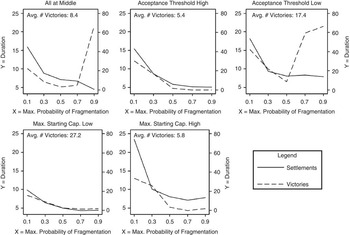
We present the results with the settlement rule requiring all agents to accept (hereafter referred to as ‘consensus’); we note when there is inconsistency between these results and other settlement rules.Footnote 93 We begin by exploring the differences among runs with fragmentation and then compare the new results with the baseline results (see above). To summarize, there are three key results that emerge from our analysis: (1) incorporating fragmentation and belief differences changes the results compared to the baseline substantially; (2) as the probability of fragmentation increases, the duration of runs ending in settlement decreases; and (3) the more that beliefs vary following fragmentation, the longer the duration until both settlement and victory, where the results for settlements are more conclusive than for victories.
The most striking results of our analysis are due to fragmentation. Figure 4 illustrates these findings across low and high values for the acceptance threshold and low and high values of the maximum initial capability. One of the key results in these figures is that, as the maximum probability of fragmentation increases, the duration of simulations ending in settlement decreases. The relationship between the maximum probability of fragmentation and victory is similar to settlements, but we note that the relationship is less consistent due to the small number of victories.
The relationship between the maximum probability of fragmentation and duration Notes: The y-axis on the left is for simulations ending in settlement, as indicated by the solid lines. The y-axis on the right is for simulations ending in victory, as indicated by the dashed lines.

One might expect that as fragmentation increases, a negotiated agreement becomes more difficult due to the fluid negotiation context and because the number of viewpoints that must be considered increases. Cunningham, for instance, argues that civil war duration increases as more actors are involved.Footnote 94 But there is arguably an important difference between a context in which multiple combatants exist and a process of fragmentation that occurs because of the context of the war and that, in turn, has important feedback effects on the war. An examination of individual simulation runs in our model indicates that a number of wars end in settlement immediately or soon after fragmentation takes place, because sudden changes to the actors create incentives for co-operation. Examples, such as the Democratic Republic of the Congo, demonstrate that parties fragmented numerous times in the late 1990s arguably resulting in new configurations of actors more conducive to joint co-operation, following which peace agreements were signed in 1999 and 2001. In the late 1990s in Egypt, a major split in the opposition also led to a cessation of violence shortly thereafter. In Bangladesh, to add another example, in the late 1980s, many splinter factions accepted general amnesties offered by the government and ceased fighting.Footnote 95
Empirically, it appears that in many cases, groups fragment because some members of the group believe they can obtain more by fighting, whereas others believe they need to reach a settlement. Once fragmentation occurs, members of the original faction can press forward with the peace process, and members of the newly fragmented group become too small to affect the peace process. During the Good Friday peace process in Northern Ireland, the Loyalist Volunteer Force (LVF) split from the Ulster Volunteer Force (UVF) over an internal dispute about whether to co-operate with the peace process. The UVF wanted to co-operate and indeed more fully co-operated once the LVF left.
In a number of civil wars, furthermore, including the recent wars in Sudan, Chad, Djibouti and India, increased intergroup co-operation followed fragmentation. In Djibouti and one of the Indian conflicts, for example, splits occurred because the stronger party following fragmentation co-operated, and weaker splinter groups eventually realized that they could not gain enough support to win. That fragmentation could result in negotiated settlement also fits with a dynamic identified by Crenshaw in the context of terrorism.Footnote 96 She contends that if groups split, those continuing to fight might lose support much quicker resulting in a quicker resolution to the conflict.
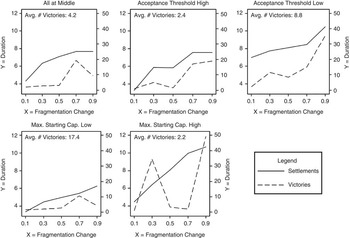
The amount that a newly fragmented agent's beliefs differ from the true capability ratio also leads to relatively consistent results, as illustrated in Figure 5. First, as the maximum variation in the beliefs of newly fragmented agents increases, the duration of each run ending in settlement increases. This is consistent with Ward's finding that as expectations about resource distributions diverge, settlements become more difficult to reach in a timely manner.Footnote 97 The relationship between belief difference and duration until victory is also generally increasing, but again less consistently due to the small number of victories.
The relationship between the maximum change in beliefs resulting from fragmentation and duration Notes: The y-axis on the left is for simulations ending in settlement, as indicated by the solid lines. The y-axis on the right is for simulations ending in victory, as indicated by the dashed lines.

What do we make of the results across Figures 4 and 5? An increase in the probability of fragmentation decreases the duration of simulations ending in settlement, but an increase in the amount that a newly fragmented agent's beliefs deviate increases the duration of simulations ending in settlement. Fragmentation often results in new beliefs that are conducive to settlement. But when beliefs deviate substantially from the true ratios, even a few agents with extreme beliefs can prevent an agreement from occurring because their beliefs will take a long time to converge.Footnote 98 This may account for the fragmentation of agents in civil wars producing such varied effects.
Intuition suggests that more complex wars will last longer and will be more difficult to end with settlement. Our model suggests that this is not necessarily the case. One might expect that settlement between parties would be more difficult when the number of parties is allowed to vary through a mechanism such as fragmentation. In many cases, however, we find that settlements occur more quickly when the possibility exists for the set of combatants to grow through fragmentation. Furthermore, victories tend to occur more quickly when the war is more complex, as well, perhaps, reflecting a divide and conquer dynamic. These results collectively suggest that paying closer attention to complexity in civil wars is important.
Little attention has been devoted to processes of change, such as fragmentation, in the civil war literature, but our results have implications for the application of theoretical models to empirical cases. Powell argues that ‘informational explanations and the models underlying them … often provide a poor account of prolonged conflict, and they give a bizarre reading of the history of some cases’.Footnote 99 Our modelling results show variation in the duration of wars; they suggest that fragmentation and the variable beliefs of actors offer insight into how long wars last as well as how they end. We contend that further work along these lines will provide a more accurate representation and better predictions about the process of war in contexts as diverse as the Democratic Republic of the Congo, Chechnya, Liberia, El Salvador, Rwanda and India, all of which experienced fragmentation of actors. Indeed, our initial empirical inquiry reported in the introduction suggests that fragmentation often immediately precedes civil war termination.
Conclusion
In diverse contexts throughout the world, wars are complex phenomena. Whereas most formal models address the information scarcity and commitment problems facing combatants, we examine a third factor – fragmentation. We began by creating a computational model drawing on the assumptions and structures posited in the literature on bargaining during war, but supplementing them with key assumptions in the agent-based modelling literature. We found that we could recover behaviour broadly similar to existing models, suggesting that our model is specified reasonably. For example, the baseline model with incomplete information suggests that increasing the potential difference between an agent's beliefs and the ‘true’ values of capabilities decreases the number of negotiated settlements relative to victories and increases the duration of wars ending in either negotiated settlement or victory.Footnote 100
We then extended the basic model by allowing for the fragmentation of actors. Some of the results of allowing fragmentation are intuitive; other results are unexpected. Our purpose is not to argue that complicated models create complicated dynamics. In fact, our results suggest the opposite: the duration and outcome of wars are not necessarily more complex when fragmentation occurs. Most notably, incorporating fragmentation does not somehow automatically increase the duration of wars and does not mean that such wars will always end in victory. In many circumstances, fragmentation led to shorter wars ending in negotiated settlement, a result that does not square well with the civil war literature on spoiling and extremist behaviour. It appears that this occurs because, when actors fragment, new actors are not necessarily more committed to war. In fact, actors might fragment and new actors might form, precisely because factions desire to settle the war more quickly. Alternatively, when actors fragment, the result is that it becomes difficult for any one party to defeat all of the other parties. Under these circumstances, otherwise unco-operative factions realize that negotiating an agreement might be the only way out of a long and protracted war. Another key result emerging from the analysis is that as the beliefs of actors about capability distribution diverge following fragmentation, the duration until settlement increases, a finding consistent with other research incorporating boundedly rational agents.Footnote 101
Our argument and analysis indicate that fundamental processes of change are inadequately addressed in current studies of civil war dynamics and outcomes. In this article, we primarily address theoretical concerns, although we included a number of anecdotal examples to demonstrate the plausibility of the model's assumptions and results. The model clearly could be extended in multiple ways in the future, such as including multiple issues or issue indivisibility. Or the idea of fragmentation could be extended to other contexts such as changes in groups that use terrorism. But given that fragmentation had strong effects in this initial computational model, and because fragmentation occurs in almost half of all civil wars, both scholars and policy makers would benefit from better understanding its role.