Implications
Nine mitochondrial DNA (mtDNA) markers (m.7998C>T, m.8158C>T, m.8297T>C, m.9111T>C, m.9230G>A, m.11859A>G, m.13955T>C, m.14719A>G, m.16933T>C) may be useful for tracing Iberian or Duroc maternal origin. Mitochondrial transmission through a limited number of lineages causes a large dispersion of mtDNA haplotype frequencies among different crossbreeding schemes. Therefore, maternal Iberian origin required for Iberian pork labeling could be traced for pigs from some schemes, but would not be possible for others. We have also verified three mtDNA markers for European wild boars (m.7188G>A, m.9224T>C, m.15823A>G), but detection of additional markers is required to provide valid genetic tests to distinguish mislabeling of wild boar products.
Introduction
Genetic traceability is based on the identification of both animals and their products through the study of DNA. The use of DNA techniques provides different levels of identification: (i) individual traceability to ensure food safety; and (ii) traceability of individuals to their source breed or species to detect possible labeling adulteration (Dalvit et al., Reference Dalvit, De Marchi and Cassandro2007). Breed names of domestic animals are increasingly being used as brand names for marketing expensive meat (such as the American Standard Turkey) and milk (as Parmigiano Reggiano cheese, linked to the Reggiana breed) products from local breeds. In this sense, DNA tests for breed authentication have become essential tools to protect these products in the market of fraudulent labeling and to improve the profitability of local breeds (Gandini and Oldenbroek, Reference Gandini and Oldenbroek2007). Breed identification methods based on combinations of genetic markers have been developed recently to detect label falsification of meat from cattle breeds as Chianina (Ciampolini et al., Reference Ciampolini, Cetica, Ciani, Mazzanti, Fosilla, Marrón, biagetti, Sebastián, Papa, Filippini, Cianci and Presciuttini2006) or Japanese Black (Watanabe et al., Reference Watanabe, Hirano, Takano, Mizoguchi, Sugimoto and Tasakuga2008). Falsification of game meat and game-meat products is also common, and several DNA tests for discriminating between game and related domestic species have been reported (Wolf et al., Reference Wolf, Rentsch and Hübner1999; Pfeiffer et al., Reference Pfeiffer, Burger and Brenig2004).
The Iberian pig breed is the source of highly priced meat and dry-cured products with excellent sensory properties (López-Bote, Reference López-Bote1998). In this production, Spanish regulation of ‘Iberian’ labeling only admits progenies from Iberian sows. Moreover, a differentiated labeling is required for meat and dry-cured products depending if they are from purebred Iberian or from Duroc × Iberian crossbred animals. Although genetic tests based on a combination of coat color genes and other nuclear genetic markers can be used to differentiate purebred from crossbred animals (Fernández et al., Reference Fernández, Fabuel, Alves, Rodriguez, Silió and Óvilo2004), the mandatory Iberian maternal origin requires the development of mtDNA breed markers. The mtDNA, due to its maternal inheritance and high number of copies per cell, is an adequate target to search maternal breed diagnostic markers of live animals and their transformed meat products.
Meat and dry-cured products from wild boar also command a higher price compared to other pig meats because of their sensory and nutritional quality. Crossbred wild boars may proceed from controlled farrowings of domestic sows or from accidental mating of female wild boar. The distinction between fraudulent or unintentional mislabeling of wild boar products requires the accurate differentiation of their domestic or wild maternal origin. Previous studies have been focused for distinguishing between meats from wild boar, domestic pig and wild boar × domestic pig crosses liable to be marketed as derived from purebred wild boars (Naya et al., Reference Naya, Horiuchi, Ishiguro and Shinagawa2003; Fajardo et al., Reference Fajardo, González, Martín, Rojas, Hernández, García and Martín2008). However, their results did not provide a useful genetic test to determine the maternal origin.
In the present study, we investigate the complete porcine mtDNA to identify markers useful to trace Iberian, Duroc and wild boar maternal lineages.
Material and methods
Complete mtDNA has been studied following three complementary strategies: near-complete mtDNA sequencing, minisatellite analysis and European and Asian Cytochrome B (CytB) haplotypes (Giuffra et al., Reference Giuffra, Kijas, Amarger, Carlbörg, Jeon and Andersson2000) genotyping.
Animals
The near-complete mtDNA sequence was determined in 14 animals including: (a) six Iberian pigs (IB1 to IB6) from the Torbiscal line, which is a valuable genetic resource for tracing back the mtDNA variation in Iberian pigs, due to its composite origin from the most important Spanish and Portuguese strains (Alves et al., Reference Alves, Óvilo, Rodríguez and Silió2003; Fabuel et al., Reference Fabuel, Barragán, Silió, Rodríguez and Toro2004); (b) two Duroc pigs of different genetic origin: one Duroc-Jersey from an American line imported to Spain in 1962 (D1) and one Duroc from a line selected in Spain since 15 years ago (D2); (c) six European wild boars hunted in three different Spanish regions: southern (WB1), northern (WB2, WB3) and central (WB4 to WB6). The six Iberian pigs have been used in a previous association study on meat quality traits (Fernández et al., Reference Fernández, Alves, Fernández, De Pedro, López-García, Óvilo, Rodriguez and Silió2008). Additional Duroc samples were used for partial sequencing of COI, ATPase6, NADH2 and NADH3 mitochondrial genes.
Once potential diagnosis markers were identified, verification of the most informative markers (those that covered a greatest number of maternal lineages) was carried out on a larger number of samples. We also take into account the feasibility of the selected markers to be genotyped by pyrosequencing. The 326 samples analyzed comprised: 96 Iberian pigs from 10 breeding nuclei registered in the Herd Book and representative of the present breed genetic diversity, 125 Duroc pigs from 18 different breeding nuclei and 73 wild boars hunted in different locations of Spain. Samples of 16 Large White pigs (Gene+ Ibérica, Aranguren, Navarra, Spain) and 16 Landrace pigs (Nova Genética S.A., Lleida, Spain) were also genotyped for potential wild boar markers.
mtDNA sequencing and genotyping
Total DNA was extracted from blood, using a conventional phenol-chloroform precipitation protocol. The sequencing of near-complete mtDNA was carried out in 34 overlapping amplicons according to the procedure described by Fernández et al. (Reference Fernández, Alves, Fernández, De Pedro, López-García, Óvilo, Rodriguez and Silió2008). Sequences obtained were edited, compiled and aligned with Mega4.0 (Tamura et al., Reference Tamura, Dudley, Nei and Kumar2007).
Seventeen pyrosequencing protocols were implemented using PSQ Assay Design 1.0.6 (Biotage AB, Uppsala, Sweden) in order to genotype 18 potential markers identified in the present study (Table S1). All the PCR reactions were performed in a 25-μl final volume containing standard PCR buffer (75 mM Tris-HCl pH 9.0, 50 mM KCl, 20 mM (NH4)2SO4), 200 μM dNTPs, 0.5 U Tth polymerase (Biotools, Madrid, Spain), 90 ng of DNA, 0.5 μM of each primer and 2.0 mM MgCl2 concentration. Amplification conditions were 94°C for 5 min, followed by 35 cycles of 94°C (30 s), the specific annealing temperature (Table S1) (30 s) and 72°C (45 s), with a final extension step of 10 min at 72°C. PCR reactions were performed on a PTC-100 thermocycler (MJ Research, Watertown, EMA). The pyrosequencing reactions and genotype determination were carried out in a PSQ-HS96 device (Pyrosequencing AB, Uppsala, Sweden) using the specific pyrosequencing primers.
Minisatellite DNA analysis
The total length of displacement loop region (D-loop) region depends on the variable number of tandemly repeated sequences, which is the minisatellite TACACGTGCG. Its analysis cannot be done by sequencing due to the high number of repetitions of this motif. Therefore, in order to evaluate the usefulness of the repetition number as diagnosis marker, we designed a pair of primers (Table S1), which allowed the amplification of this region. Amplified products were analyzed by capillary electrophoresis and fluorescent detection in an ABI 3730 (Applied Biosystems, Warrington, UK). Initially, the D-loop minisatellite analysis was carried out employing the same 14 samples that were used for the sequencing experiment. In a second stage, 14 additional Iberian samples from four different matrilineal lineages were also included in order to confirm inheritance pattern. All the reactions were carried out twice as technical replicates.
Cyt B haplotypes genotyping
European and Asian Cyt B haplotypes described by Giuffra et al. (Reference Giuffra, Kijas, Amarger, Carlbörg, Jeon and Andersson2000), correspond to the substitutions m.15038T>C, m.15040G>A, m.15043C>T and m.15047G>A. These haplotypes have been frequently used to perform phylogenetic studies and to dissect genetic relationships between porcine breeds and populations. We have designed a pyrosequencing protocol (Table S1) to genotype these haplotypes in both Duroc (n = 125) and Iberian (n = 96) samples.
Results
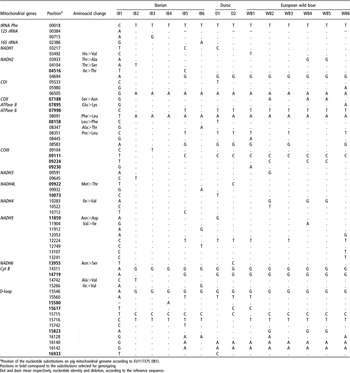
Complete mtDNA sequences, excluding the tandem repeats present in the D-loop region, were successfully determined for the 14 animals: six Iberian pigs, two Duroc pigs and six European wild boars (GenBank accession numbers: EU117375, FJ236991, FJ236992, FJ236993, FJ236994, FJ236995, FJ236996, FJ236997, FJ236998, FJ236999, FJ237000, FJ237001, FJ237002 and FJ237003). According to the sequences of Cyt B gene all the samples correspond to European E1 type mtDNA (Giuffra et al., Reference Giuffra, Kijas, Amarger, Carlbörg, Jeon and Andersson2000). The comparison of these sequences revealed a total number of 57 substitutions and two Indels (Table 1). One single substitution was found in a tRNA-Phe, one substitution and one Indel in 12s rRNA, one substitution in 16S rRNA, 43 substitutions in protein-coding genes and 11 substitutions and one Indel in D-loop. Seventeen out of the 43 protein-coding gene substitutions were non-synonymous (Table 1).
Summary of all nucleotide substitutions among the six Iberian, two Duroc and six European wild boars mtDNA genomes

aPosition of the nucleotide substitutions on pig mitochondrial genome according to EU117375 (IB1).
Positions in bold correspond to the substitutions selected for genotyping.
Dot and dash mean respectively, nucleotide identity and deletion, according to the reference sequence.
Potential Iberian breed markers
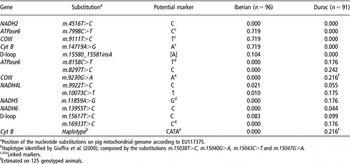
Sequencing results showed 32 potential Iberian breed markers that were absent in Duroc samples (Table 1). Five of the six Iberian samples (IB1 to IB4 and IB6) shared a string of nine potential markers: substitutions at positions m.4694, m.7998, m.8583, m.9111, m.12224, m.14719, m.15560, m.16140 and m.16142. The samples IB5 and IB6 shared another potential marker at m.16128. Some nucleotide substitutions were present only in one of the Iberian samples: seven substitutions in IB1 (positions m.18, m.6505, m.8091, m.14311, m.15546, m.15715 and m.15716), six substitutions in IB6 (at m.2386, m.8347, m.9932, m.11912, m.12749 and m.15.226), three substitutions in the sample IB2 (at m.4104, m.9645 and m.14742), three substitutions in IB5 (at m.4516, m.10712 and m.15742), two substitutions in IB3 (at m.715 and m.9104), and one insertion was exclusively found in IB4 (at m.15580). Six of the quoted substitutions (at m.12224, m.15560, m.15742, m.16128, m.16140 and m.16142) could be discarded as Iberian markers because they were present in some of the previously reported Duroc mtDNA sequences (GenBank accession numbers: AF486858, AY232875, AY232879 and AY337045). We selected five potential markers to be validated as Iberian breed markers and estimated their frequencies in a higher number of Iberian (n = 96) and Duroc (n = 91) samples. The substitutions m.7998C>T, m.9111T>C and m.14719A>G were selected because they were present in five of the six sequenced Iberian samples. The substitution m.4516T>C was selected because it was present in the remaining Iberian sample (IB5). Finally, m.15580_15581insA was selected because it was previously detected in several Iberian pig populations (Alves et al., Reference Alves, Óvilo, Rodríguez and Silió2003). Genotyping results showed that m.7998C, m.9111T and m.14719A nucleotides were linked in the Iberian pigs with an allelic frequency of 0.719 and absent in Duroc (Table 2). The m.4516C marker was not detected among the genotyped animals. The m.15580_15581insA insertion was detected in Iberian pigs with a frequency of 0.104 in some of the animals carrying the diagnosis markers m.7998C, m.9111T and m.14719A (Table 2).
Frequency of potential diagnosis markers for breed identification determined in Iberian and Duroc populations

aPosition of the nucleotide substitutions on pig mitochondrial genome according to EU117375.
bHaplotype identified by Giuffra et al. (Reference Giuffra, Kijas, Amarger, Carlbörg, Jeon and Andersson2000); composed by the substitutions m.15038T>C, m.15040G>A, m.15043C>T and m.15047G>A.
c,d,eLinked markers.
fEstimated on 125 genotyped animals.
Potential Duroc breed markers
The comparison of Duroc and Iberian mtDNA sequences revealed 10 potential Duroc markers. Eight out of them were detected at positions m.5533, m.8158, m.9922, m.10073, m.11859, m.13955, m.15617 and m.16933 (Table 1) and the remaining two potential Duroc markers were found at positions m.8297 and m.9230, in the additional Duroc mtDNA samples partially sequenced. Nine of the 10 substitutions, m.8158C>T, m.8297T>C, m.9230G>A, m.9922T>C, m.10073C>T, m.11859A>G, m.13955T>C, m.15617T>C and m.16933T>C, were genotyped in both sets of Iberian and Duroc samples to confirm their validity as breed markers and to estimate their frequencies. The m.5533C>T substitution was genotyped by sequencing in a subset of six Duroc samples, but it was not detected among them, and therefore it was not genotyped in a higher number of samples. Genotyping results of the nine substitutions (Table 2) allowed us to discard three of these potential Duroc markers because m.9922C, m.10073T and m.15617C nucleotides were detected in Iberian samples. The remaining six potential Duroc markers presented low frequencies ranging from 0.044 to 0.242, and three of them (m.8158T, m.11859G and m.16933C) appeared linked in Duroc pigs.
Moreover, we genotyped 125 Duroc and 96 Iberian samples for the Cyt B European and Asian haplotypes (Giuffra et al., Reference Giuffra, Kijas, Amarger, Carlbörg, Jeon and Andersson2000). All the genotyped Iberian pigs presented exclusively the European E1 haplotype, whereas Duroc pigs presented both European E1 and Asian A1 haplotypes. Asian A1 haplotype and m.9230A nucleotide appeared linked in Duroc pigs (Table 2).
Potential European wild boar markers
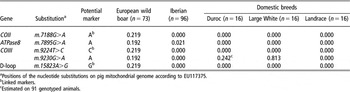
Sixteen nucleotide substitutions exclusive for European wild boar were identified when comparing with Iberian and Duroc mtDNA sequences (Table 1). Five of these potential wild boar markers (positions m.7188, m7895, m.9224, m.9230 and m.15823) were selected to be genotyped in a higher number of samples of wild boars (n = 76), Iberian (n = 96) and Duroc (n = 16) pigs as well as in samples of Large White (n = 16) and Landrace (n = 16) domestic pigs. Genotyping results showed that m.7188A, m.9224C and m.15823G appeared linked in wild boars, and absent in the 144 analyzed domestic pig samples (Table 3). Substitutions m.7895A and m.9230A were discarded as wild boar markers because they were also detected in some of the analyzed domestic breeds (Iberian, and Duroc and Large White, respectively).
Frequency of potential diagnosis markers determined in European wild boar, Iberian, Duroc, Large White and Landrace populations

aPositions of the nucleotide substitutions on pig mitochondrial genome according to EU117375.
bLinked markers.
cEstimated on 91 genotyped animals.
Minisatellite polymorphism
The designed protocol for the analysis of the tandemly repeated sequence allowed the detection of amplified peaks that ranged from 230 to 520 bp. Generally each sample presented numerous peaks from which three or four were higher than the rest. Highest peaks had a minimum size of 380 bp and a maximum of 500 bp; these sizes would correspond to a number of minisatellite repeats between 18 and 30, suggesting heteroplasmy. Smallest peaks would likely correspond to PCR artifacts known as slipped-strand mispairing. Overlapping fragment size ranges were observed for the three studied pig populations making not possible to identify a minisatellite diagnostic pattern. We observed a complete repeatability between the technical replicates but when individuals from the same maternal lineage were compared, the amplified pattern did not match exactly.
Discussion
The main objective of this study was to detect diagnostic mtDNA markers useful for Iberian and wild boar maternal origin validation. The search of Iberian or Duroc exclusive genetic markers valuable for breed discrimination is hampered by the close genetic relationship between both breeds. It is well-documented that Red Iberian pigs imported from Spain and Portugal contributed, together with other breeds, to the origin of Duroc-Jersey, the first name of the Duroc breed in USA (Jones, Reference Jones1998). However, previous studies have reported some nuclear genes with Duroc exclusive alleles never found in the Iberian breed (Fernández et al., Reference Fernández, Fabuel, Alves, Rodriguez, Silió and Óvilo2004; Carrodeguas et al., Reference Carrodeguas, Burgos, Moreno, Sánchez, Ventanas, Tarrafeta, Barcelona, López, Oria and López-Buesa2005). Moreover, in the present paper, some mitochondrial markers specific for either Iberian or Duroc pigs have been detected and verified.
Potential Iberian markers exploration was based on sequenced mtDNA samples from the composite Torbiscal line. Three mtDNA samples (IB4 to IB6) represent mitochondrial types of the Black Hairless variety from La Serena, and each one of the other samples represents one different Iberian variety, namely Blond Alentejano (IB1), Black Hairless from the Guadiana Valley (IB2) and Portuguese Red (IB3) (Alves et al., Reference Alves, Óvilo, Rodríguez and Silió2003; Fabuel et al., Reference Fabuel, Barragán, Silió, Rodríguez and Toro2004). Five potential Iberian markers detected by examination of the eight near-complete Iberian and Duroc mtDNA sequences were genotyped in two sample sets representing multiple breeding nuclei of both pig breeds. The nucleotide m.4516C was not found in any of the 96 genotyped Iberian pigs despite its presence in one mtDNA sequence (IB5) traceable to one of the Black Hairless varieties. The three nucleotides in genes ATPAse6 (m.7998C), COIII (m.9111T) and CytB (m.14719A) appeared exclusively and completely linked in Iberian pigs. Being redundant the informativity of these nucleotide substitutions, each one of them provides a genetic test to confirm the maternal Iberian origin of about 72% of the crossbred progenies from Iberian dams. Finally, m.15580_15581insA was found in 10 of the 96 genotyped Iberian pigs but these 10 animals also carry the diagnosis markers m.7998C, m.9111T and m.14719A. Therefore, this genotyped insertion does not contribute to increase the total Iberian marker informativity.
The verifiable proportion of the maternal Iberian origin of crossbred animals could increase if other potential Iberian markers could be validated as diagnostic markers. Moreover, our results indicate a large dispersion of marker’s frequencies among different crossbreeding schemes. This is a consequence of mtDNA transmission through a limited number of maternal lineages in each breeding scheme. Hence, maternal Iberian origin could be easily traced for pigs from some crossbreeding schemes where there is a high diagnostic marker frequency, but it would not be possible for some others where no diagnostic marker is present.
The six new Duroc mtDNA markers, identified in the present study, are useful to identify crossbred Iberian pigs of Duroc maternal origin and their products. The combined informativity of all these markers might allow identifying almost a 50% of Duroc mtDNA. Again, the frequency and therefore the usefulness of the detected Duroc markers, is specific for each breeding nucleus. For example, there is one specific nucleus where the frequency of m.9230A Duroc marker was close to fixation, whilst in other sampled Duroc nuclei this nucleotide was absent. The differential success rate for identifying Iberian or Duroc diagnostic markers might be due to the reduced number of complete or partially sequenced Duroc mtDNA samples. In fact, when we added the published European-type Duroc sequence (GenBank accession number: AF486858) to the sequence comparison for the phylogenetic analyses, we could detect five new potential Duroc markers (m.817C>T, m.3134A>T, m.9263C>T, m.10787T>C, m.15759C>T).
It is known that introgression of Chinese pig breeds affected most of the major European standard breeds as Large White, Landrace, German or Belgian Pietrain (Giuffra et al., Reference Giuffra, Kijas, Amarger, Carlbörg, Jeon and Andersson2000) but local Spanish breeds such as the Iberian pig display only European mtDNA types (Clop et al., Reference Clop, Amills, Noguera, Fernández, Capote, Ramón, Nelly, Kijas, Andersson and Sánchez2004). Results from the present study provided evidence of a maternal contribution of Chinese breeds to an American breed, such as Duroc. CytB Asian haplotype appeared in the analyzed Duroc pigs with a frequency of 0.216, however no Asian haplotypes were detected in a large sample of Iberian pigs.
The genetic traceability of wild boar products is an unsolved task that requires further studies. The differentiation between meats from European wild boar, domestic pig and wild boar × domestic pig crosses is not completely feasible. The alleles of the melanocortin 1 receptor (MC1R) gene have been reported as useful markers for distinguishing among these meats (Fajardo et al., Reference Fajardo, González, Martín, Rojas, Hernández, García and Martín2008). However, MC1R*1 allele is not the only one present in Spanish wild boars. MC1R*3, MC1R*6 and MC1R*7 alleles had also been detected although at low frequencies (Fernández, Reference Fernández2003; Fernández et al., Reference Fernández, Fabuel, Alves, Rodriguez, Silió and Óvilo2004). Introgression of MC1R domestic pig alleles may occur in other European regions where wild boars coexist with domestic pigs reared in open-air systems.
Three previous attempts of differentiating wild boar and domestic pig meats based on mtDNA D-loop fragments were scarcely successful. Montiel-Sosa et al. (Reference Montiel-Sosa, Ruiz-Pesini, Montoya, Roncalés, López-Pérez and Pérez-Martos2000) reported a deletion at position 15879 in wild boar mtDNA compared to domestic pig mtDNA. However, the reported Indel has not been observed in further investigations (Kim et al., Reference Kim, Lee, Li, Zhang, Lee, Gongora and Moran2002; Alves et al., Reference Alves, Óvilo, Rodríguez and Silió2003). By sequencing, Naya et al. (Reference Naya, Horiuchi, Ishiguro and Shinagawa2003) were able to distinguish D-loop haplotypes of Japanese wild boar from those of other Asian and European domestic pigs, but no single nucleotide substitutions were detected as useful diagnostic markers. Recently, Fajardo et al. (Reference Fajardo, González, Martín, Rojas, Hernández, García and Martín2008) failed in identifying any D-loop nucleotide substitution useful to discriminate European wild and domestic pigs. Although in the present study we found three linked wild boar mtDNA markers, they showed great frequency dispersion among the sampled territories, as they only appeared in some samples from Asturias (Northwestern Spain) and Toledo (Central Spain), and were absent in wild pigs hunted in other regions. Besides, these markers should be further validated in a higher number of domestic pig samples.
The minisatellite genotyping results showed important technical difficulties besides of heteroplasmy. Heteroplasmic repeated sequences in the porcine D-loop region were described by Ghivizzani et al. (Reference Ghivizzani, Mackay, Madsen, Laipis and Hauswirth1993). Finally, the overlapping copy number ranges observed in the present study nullify using this polymorphism as diagnostic marker. Genetic tests to validate maternal origin should be based on nucleotide changes located in other mtDNA regions.
Although additional marker validation and new identification are required to achieve totally useful genetics tests, the results of the present study are valuable to resolve problems of Iberian and wild boar maternal origin determination.
Acknowledgements
We acknowledge the technical assistance of Nines López-García and the valuable help obtained from the following persons and institutions in obtaining samples: Elena Diéguez, AECERIBER; Miguel Delibes, Estación Biológica de Doñana-CSIC; Christian Gortázar, Instituto de Recursos Cinegéticos-CSIC and Joan Altarriba. We also acknowledge useful comments from Beatriz Villanueva. This research was funded by INIA RZ03-010 grant.