Introduction
People's attitudes and beliefs about the elderly and the process of ageing are heavily influenced by the portrayal of older people in the mass media. The effects of such mass media messages appear to be manifold and affect all generations: younger people's expectations about their own old age as well as older people's self-image appear to mirror typical media representations. Likewise, media effects on the communicative behaviour patterns in intergenerational contact as well as on the social activities of the elderly were established by early research in the field (Filipp and Mayer, Reference Filipp and Mayer1999).
More recently, a wide range of studies demonstrated that one's beliefs about older people and ageing, which develop at least partly in response to exposure to mass media content, will in turn have a profound influence on the process of ageing in the individual holding those beliefs. In particular, negative beliefs about ageing appear to affect elderly people's health conditions as well as their cognitive performance. Older people who hold pessimistic views about ageing (e.g. those who tend to agree with statements such as ‘everything will get worse as I become older’), do less to maintain or improve their health (Levy and Myers, Reference Levy and Myers2004), more commonly develop cardiovascular disease (Levy et al., Reference Levy, Zonderman, Slade and Ferrucci2009) and have lower life expectancy (Kotter-Grühn et al., Reference Kotter-Grühn, Kleinspehn-Ammerlahn, Gerstorf and Smith2009). Stewart et al. (Reference Stewart, Chipperfield, Perry and Weiner2012) studied a group of 105 elderly people suffering from severe chronic diseases and found that mortality over a two-year period was significantly higher in the group who attributed their health condition to old age as opposed to some other factor such as an unhealthy lifestyle, poor medical care, genetics or bad luck. A line of studies also uniformly indicates that the activation of negative stereotypes has a detrimental effect on older people's memory performance (Levy, Reference Levy1996; Hess et al., Reference Hess, Auman, Colcombe and Rahhal2003, Reference Hess, Hinson and Statham2004). Additionally, this adverse effect appears to be stronger in those who agree with the content of the stereotype (i.e. with the view that memory performance inevitably declines with old age; O'Brien and Hummert, Reference O'Brien and Hummert2006).
Levy (Reference Levy2003) argues that stereotypical beliefs are typically internalised during childhood and become even more ingrained during adulthood through repeated reinforcement. In old age, when being old becomes part of one's identity, these beliefs begin to operate as self-fulfilling prophecies: older people tend to behave and perform in ways that match their own beliefs about their age group. Levy's theoretical position thus suggests a very direct link between the valence of the stereotype and its effect: positive beliefs contribute to better physical and cognitive condition, while negative beliefs lead to deterioration in the corresponding domains.
If such self-stereotyping were the only psychological process in operation, the implications for mass media would be simple and clear-cut: producers, editors and marketing agencies should be advised to design highly positive portrayals of elderly people, thereby alleviating the adverse effects caused by widespread, and often unfounded, negative beliefs. Research, however, indicates that the general trends reviewed by Levy (Reference Levy2003) are not without exception. Fung et al. (Reference Fung, Li, Zhang, Sit, Cheng and Isaacowitz2015), for instance, obtained evidence that extremely positive, unrealistic portrayals of elderly people – such as the depiction of an older person engaging in a highly challenging physical activity with apparent ease – may ‘backfire’ and have a detrimental effect on memory performance, in sharp contrast to realistic positive portrayals, which have been found to enhance memory functioning. The authors also found that the calming effect of positive portrayals on the parasympathetic neural system (as indicated by a measure of cardiovascular reactivity) could not be reproduced using extremely positive portrayals as stimuli. These results suggest that depicting elderly people in an unrealistically positive light may be counterproductive, and therefore media practitioners should be cautioned against such practices. One may argue, however, that such extremely positive portrayals are already confined to specific types of media content, such as advertising, and are less commonly used in entertainment, and even less frequently in the news media. Therefore, while the potentially harmful effects of extremely positive representations should not be neglected, the importance of this particular risk factor should not be overrated when assessing the total impact of mass media messages on the viewer's behaviour.
Another pattern of research findings which complicates the relationship between portrayal valence and its effect is provided by studies that have shown that negative portrayals which do not match the viewer's self-image may actually have positive effects. In one study, elderly participants were exposed to a text summarising some extremely negative views allegedly held by teenagers about older people (Pinquart, Reference Pinquart2002). Contrary to the general pattern of findings regarding cognitive abilities, this treatment resulted in an improvement in the participants’ self-image. Pinquart suggests that this finding can be explained by positing that older people do not automatically integrate all information about their age group in their self-image; instead, information perceived as incompatible with one's self-image will be treated as a standard of comparison. This account is in line with social comparison theory, originally formulated by Festinger (Reference Festinger1954). In a recent review and meta-analysis on six decades of social comparison research, Gerber et al. (Reference Gerber, Wheeler and Suls2018) conclude that people tend to seek opportunities to compare themselves upward, i.e. to people who are better off in some respect than themselves. This tendency prevails despite the fact that the result of such comparisons is typically a self-deflating contrast: learning that we are not as good as another person has a negative impact on our self-evaluation. When, however, people compare themselves downward (i.e. to someone who is worse off than themselves, which people rarely choose to do), the result will be positive: their self-evaluation will increase, or their threatened self-esteem will be restored. Wills’ (Reference Wills1981) downward comparison theory, which has received considerable empirical support since its original formulation, therefore predicts that even extremely negative media portrayals of elderly people may have a positive impact, especially on viewers who are facing some problems associated with old age and whose self-esteem is threatened as a result.
To sum up, the available literature suggests that mass media messages about elderly people have a profound effect on media consumers’ views about ageing, and such internalised views will in turn influence people's health, physical condition, cognitive performance and self-esteem when they begin to regard themselves as old. For this reason, a distinct line of mass media research has been focusing on revealing trends in the representation of older people in the media, in general, and on television, in particular.
Such studies have consistently shown that in comparison to their continuously increasing proportion in the population, older people are severely under-represented on television. This tendency appears to hold for a wide range of different programmes, including films, chat shows and advertisements (Vasil and Wass, Reference Vasil and Wass1993; Robinson et al., Reference Robinson, Skill, Turner, Nussbaum and Coupland2004; Stern and Mastro, Reference Stern and Mastro2004; Zhang et al., Reference Zhang, Harwood, Williams, Ylänne-McEwen, Wadleigh and Thimm2006). The gap between actual population proportion and media appearance is especially wide in the group of elderly people above the age of 80 (sometimes labelled as ‘old(est) old’ people as opposed to the ‘young old’ group, between 60 and 80 years of age; Gerbner et al., Reference Gerbner, Gross, Signorielli and Morgan1980; Elliot, Reference Elliott1984).
In line with earlier studies, Kessler et al. (Reference Kessler, Rakoczy and Staundinger2004) also found that the over-60 age group (comprising 22% of the population of Germany in 2002) were seriously under-represented in television series, with only 8.5 per cent of the main characters falling in this category. Even within this group of elderly characters, only 37 per cent were women and 63 per cent were men. This proportion of the genders revealed a considerable over-representation of men, compared to the population statistics of the time, which showed a 3:2 ratio of women to men. The authors speculate that the overall under-representation of the older generation may be at least partly due to intentional decisions: producers and script writers may assume that viewers – including elderly viewers – do not enjoy watching depictions of older people and ageing because such images draw attention to problems associated with their own present condition or inevitable future. We agree with the plausibility of this explanation, adding that such decisions may be often unconscious and driven by the principles of narrative development. While the portrayal of problems and conflicts is a common element in fiction and entertainment, contemporary Western audiences tend to require such conflicts to be resolved. What makes the problems of ageing (such a deteriorating health) a special case is that often no realistic resolution can be achieved and inserted in the story line. Therefore, depicting old age may be a challenge the script writers ‘shy away from’, rather than a ‘bad recipe’ that they deliberately avoid. We believe that this alternative explanation is also supported by the authors’ additional finding that problems related to ageing tend to be severely under-represented in television series: older characters are typically rich, pursue financially and physically demanding hobbies, enjoy good health, and are part of a large, well-functioning social network consisting of family, friends, colleagues and other acquaintances. The authors note that such an overly positive portrayal of old age simply contradicts gerontological evidence.
It should also be noted that a similar tendency towards a generally positive portrayal of older people in television series had been detected over a decade earlier in the United States of America (USA). Examining the title sequences of six series featuring elderly characters, Bell (Reference Bell1992) found that the prevailing attributes associated with old people were activity, good health, high socio-economic status, power and sexiness, in sharp contrast with the previous decades’ tendencies to portray old people as silly, strange or amusing.
In addition to television series, the portrayal of older people in television advertisements has also received considerable attention from mass media researchers. Studies have repeatedly shown that older people are heavily under-represented in commercials just as in television series (Stern and Mastro, Reference Stern and Mastro2004; Zhang et al., Reference Zhang, Harwood, Williams, Ylänne-McEwen, Wadleigh and Thimm2006), and it has been proposed that underlying reasons for their disproportionately low presence could be similar in both content types. Kessler et al. (Reference Kessler, Schwender and Bowen2010), for instance, suggest that because of widespread negative attitudes towards old age, advertisers expect that older people on the screen may trigger a depressing emotional experience, reminding viewers of their own ageing, physical decline and even death, and they naturally do not want their target audience to associate such negative concepts with their product. Also, completely in line with television series, older people in television advertisements tend to be portrayed in a positive manner that does not match reality as shown by gerontological evidence. First, television commercials appear to exaggerate the employment rates of elderly people: Kessler et al. (Reference Kessler, Schwender and Bowen2010) found that in German television advertisements, older people are portrayed as employed just as frequently as younger characters. Second, television advertisements tend to represent older people as highly adventurous, intellectually curious, aesthetically sensitive, and attracted to variety and novelty. This is again in sharp contrast with a robust finding in personality psychology indicating the openness to experience – a personality trait reflecting an individual's active seeking of new information – begins to decrease after the age of 60 (Roberts et al., Reference Roberts, Walton and Viechtbauer2006). Finally, older people are most often shown as socially engaged and interacting with family members, friends and colleagues, which does not correspond to gerontological evidence that a significant proportion of older people feel isolated and lonely.
Miller et al. (Reference Miller, Leyell and Mazacheck2004) conducted a quantitative content analysis on a sample of 1,662 television advertisements aired in the USA over a period of five decades (1950–2000). In line with the results of Kessler et al. (Reference Kessler, Schwender and Bowen2010), they found that while elderly characters were featured in only 4.75 per cent of the advertisements, portrayals consistent with negative stereotypes were rather infrequent in all periods. The analysis, however, revealed some interesting temporal trends in the proportions of specific types of positive portrayal. For instance, while representations consistent with the ‘adventurous golden ager’ stereotype increased over this 50-year period, the ‘perfect grandparent’ appeared less and less often in advertisements.
It is interesting to note that most research on the portrayal of older people on television has focused on series and commercials, i.e. two types of fictional media content. Kessler et al. (Reference Kessler, Rakoczy and Staundinger2004) argue that such characters often function as role models for the viewers and as standards of social comparison. Prime-time television series and advertisements also have high viewership, and therefore such character portrayals can be assumed to affect a broad cross-section of a society rather than a limited target audience. It is undeniable that fiction can mirror important characteristics of a society's value structure and conventional beliefs. Still, given the above reasoning, it is somewhat surprising that the portrayal of older people on television news programmes has received little attention so far. News programmes have high viewer rates comparable to television series and advertisement blocks. Furthermore, while television viewers are normally aware of the fact that characters in advertisements and series are fictional, news programmes are typically perceived as – by and large accurate – representations of social reality. The personality features, the behaviours, the problems, as well as the opinions of characters in television series and commercials are often exaggerated for the purposes of entertainment or marketing to the extent that the viewers become aware that the portrayal is untypical or even unrealistic. By contrast, when a news story reports on the views, problems or activities of elderly people, viewers will more readily interpret such messages as real, and therefore such content will be even more likely to become internalised and subsequently function as criteria for social comparison. Admittedly, television viewers do not assume a direct correspondence between news content and reality: knowledge of selective news reporting as well as the possibility of unethical editorial practices is a function of the individual's level of media literacy. Nevertheless, we argue that it is still reasonable to assume that a typical viewer presupposes a far closer match between television news and reality than between television series (or advertisements) and reality.
Most of the studies that explored the representation of older people in news reporting have analysed messages in print media (Gibb and Holroyd, Reference Gibb and Holroyd1996; Wilinska and Cedersund, Reference Wilinska and Cedersund2010; Sedick and Roos, Reference Sedick and Roos2011; Kessler and Schwender, Reference Kessler and Schwender2012; Koskinen et al., Reference Koskinen, Salminen and Leino-Kilpi2014). Those rare studies which focused on the portrayal of older people in news programmes appear to provide some empirical support for our claim that the representation of this age group may be considerably different on the news than in other types of programme. Jürgens (Reference Jürgens1994), for instance, found that the news typically portrays elderly people in passive roles, such as suffering from illnesses or victims of crimes. By contrast, the same study revealed a far more varied pattern of representation in soap operas.
Socialisation is a highly complex process affected by a large number of factors, and in modern societies the media representations of social groups – such as ethnic minorities, social classes, age groups or the genders – do have a significant impact on the norms and values internalised by new generations (Bandura, Reference Bandura, Bryant and Oliver2009). The vast majority of studies on representing social groups focus on a single grouping variable at a time and are typically driven by the need to explore and understand negative stereotypes associated with certain groups (such as racism, ageism or sexism). However, as Prieler et al. (Reference Prieler, Kohlbacher, Hagiwara and Arima2011) point out, few studies focus on intersections of such categories, which may be of interest in their own right. In particular, the scarcity of studies on the gender representation of older people is especially striking, considering that an ageing society has become a common feature of most industrialised countries.
There is some evidence from early studies on television series that elderly women and men tend to be depicted in different roles and as possessing different characteristics. Through the content analysis of 13 daytime serials, Cassata et al. (Reference Cassata, Anderson and Skill1980) found that about 80 per cent of older characters with a high social status and a managerial or professional occupation were men, while middle- and lower-class occupations were dominated by women. Similarly, the analysis of Kessler et al. (Reference Kessler, Rakoczy and Staundinger2004) of the socio-economical, health-related and psychological resources accessible to elderly characters in a sample of German television series revealed that male characters tended to have higher social status, higher education level and more prestigious occupations, had more formal (rather than informal) contacts and received more social support than women.
It must be noted, however, that these findings were based on very small samples of elderly characters (N = 58, Cassata et al., Reference Cassata, Anderson and Skill1980; N = 30, Kessler et al., Reference Kessler, Rakoczy and Staundinger2004), and therefore the authors did not conduct statistical tests to establish whether the results can be generalised to television series (in the given culture at the given time) in general. To the best of our knowledge, the only large-sample content analysis comparing the media representation of older men and women was conducted on a sample of 1,220 Japanese television advertisements, 306 of which contained older people (Prieler et al., Reference Prieler, Kohlbacher, Hagiwara and Arima2011). This study, however, had a very narrow focus exploring gender differences in terms of three key variables: role (major/minor), setting (inside/outside) and product category. Therefore, it seems reasonable to ask (a) whether the results suggesting gender differences in terms of status and social functioning can be corroborated through the analysis of a larger sample; (b) whether similar tendencies can be detected in contemporary mass media practices; and (c) whether these tendencies carry over to other types of television programmes, such as the evening news.
The purpose of the present study is to provide a comprehensive analysis of the portrayal of elderly men and women in Hungarian evening news programmes. The design of our study encompasses a far broader range of aspects than most studies in the field. Instead of focusing on a specific group of attributes of representation, our approach is exploratory in nature: we employ a coding scheme that covers all major aspects of portrayal, including contextual attributes, appearance, behaviours and communication, as well as a range of common stereotypes revealed by a previous study (Kovács et al., Reference Kovács, Aczél and Bokor2018). The research questions our study aims to answer are as follows:
(1) Are there any aspects in terms of which the portrayal of elderly men and women on television news programmes significantly differ?
(2) If yes, which aspects of representation show the most striking differences?
Method
In order to determine the range of significant differences (if any) in the portrayal of elderly men versus elderly women in Hungarian television news programmes, we applied the method of quantitative content analysis. The unit of analysis was an elderly individual who appeared on the news, the independent variable was the gender of the person and the dependent variables were a range of characteristics covering various aspects of portrayal and context.
Sample
Our research was limited to four Hungarian television channels with high viewership: we digitally recorded the evening news programmes broadcast throughout April 2017 by m1, RTL Klub, TV2 and ATV. Sixteen days from this pool were then randomly selected for the analysis, which amounted to a total of 49 hours of audio-visual content. The main coding was carried out by four research assistants who were asked to identify all elderly people portrayed as individuals. The instructions specified that a person is represented as an individual (a) if he/she expresses his/her views or opinions; (b) if there is at least one shot in which he/she can be seen with no more than two other people; or (c) if he/she is evidently in focus or in the foreground with no more than two other people, even though other people are visible in the background. The coders were instructed to ignore elderly people who were shown as part of a group consisting of three or more people, for instance, when the camera probed the audience at a public event. A person was to be classified as elderly if his/her age exceeded 60 years based on the coder's perception or other available information. Coders were presented with a selection of images of 60-year-old men and women for reference and comparison but were urged to consider additional cues (other than physical appearance) in the content of the news story when making an estimate of a person's age. For instance, all people interviewed as exemplars of groups such as pensioners or residents of senior living centres were to be included in the sample regardless of their looks. In the case of politicians, celebrities and other public figures, coders were instructed to find out the exact date of birth whenever in doubt. Following these instructions, the coders identified 754 elderly people (547 men and 207 women) portrayed as individuals and recorded all relevant data about each of them using an online coding form.
Variables
Because the purpose of the present study was to obtain a comprehensive view of gender differences in the portrayal of elderly people, a fairly detailed coding scheme was applied, consisting of 115 qualitative variables. The variables belong to the following, more general categories: (a) the topic of the news story in the context of which the elderly person appears; (b) the valence of the news story (positive, neutral or negative); (c) demographic characteristics; (d) role; (e) appearance; (f) facial gestures; (g) place and time; (h) manner of speaking; (i) activities; (j) personality attributes; and (k) stereotypical attributes. A full list of the variables along with their possible values (categories) is provided in Table A1 in the online supplementary material.
The list of stereotypical attributes was compiled on the basis of the results of a previous survey (Kovács et al., Reference Kovács, Aczél and Bokor2018). Hilton and Von Hippel (Reference Hilton and Von Hippel1996) defined stereotypes as commonly shared beliefs about a social group. In line with this classic definition, the purpose of Kovács et al. (Reference Kovács, Aczél and Bokor2018) was to identify a set of widespread beliefs about elderly people. The authors used a questionnaire consisting of 20 open questions which probed respondents’ beliefs about older people's typical appearance, activities, conversation topics, fears, joys, interests, goals, and so on. Recurring sense units were identified using an open coding scheme, and sense units that were mentioned by at least 10 per cent of the respondents were classified as stereotypes. The items included in the last section of the coding form used in the present study are identical to those previously identified by Kovács et al. (Reference Kovács, Aczél and Bokor2018), with the following exceptions: some stereotypes – e.g. wearing glasses, being overweight, spending time at home or at retail outlets – were already included in previous sections of the coding form and were therefore not repeated in this final section. Other stereotypes revealed in Kovács et al. (Reference Kovács, Aczél and Bokor2018) were directly related to one of the genders: e.g. elderly men wearing shirts and carrying walking sticks or elderly women having short hair and pulling roller shopping bags. Since it is not meaningful to test gender differences on such gender-specific stereotypes, such sense units were excluded from the present study.
Measures and reliability
The coding form contained detailed instructions with every variable about the conditions under which each category must be chosen and how to deal with ambiguous cases. Although such instructions are traditionally provided in a separate manual called the code book (Neuendorf, Reference Neuendorf2002), with an online form – where copying costs are a non-issue – we felt it more natural to incorporate the instructions in the coding form itself. A definite advantage of this approach is that the coders do not need to keep switching their attention between the manual and the form but find all necessary information in one place. The online form also contained a text box which the coders could use to send remarks back to the research team and provide descriptions of cases which raised further issues about the coding process or which they felt uncertain about.
The measurement procedure took place in three distinct cycles. Initial coder training was followed by a pilot phase in which each coder watched and coded four news programmes broadcast on a randomly selected day. After receiving detailed feedback from the coders, minor changes were applied to the coding form. These included expanding the original range of categories for some variables. Specifically, travel, holidays, shopping/prices, sports and weather were added as possible topics for the news story, church and pharmacy were added as possible locations, and the role of demonstrator was also included at this stage. In addition, the instructions were clarified by specifying that if a person appears multiple times in a given news story, it counts as a single appearance and therefore a single coding form must be completed. Data obtained in the piloting phase were subsequently edited to reflect these changes.
In the second phase, 12 more dates were randomly selected and assigned to the coders, who coded all the evening news programmes broadcast on those days. Coders reported that – despite the considerable length of the instrument – after gaining initial practice, it took no longer than about 10 minutes to code a single person.
Finally, in the third phase, the random sub-sample of 120 elderly people was drawn from the full data-set and re-coded by a pool of co-coders (different from those responsible for the main coding). Cohen's kappa was used as a measure of inter-observer reliability. For 30 of the 115 variables, Cohen's kappa could not be calculated due to lack of variability in the choices recorded by either the main coder or the co-coder (or both): in other words, the variable turned out to be a constant in the sub-sample for at least one of the coders. Fifty-five of the remaining 85 variables yielded kappa rates in the range of 0.4 to 1, indicating acceptable to perfect agreement. The value of Cohen's kappa was below 0.4 for the remaining 30 variables, indicating poor reliability (Fleiss, Reference Fleiss1981), and therefore these variables were excluded from further analyses. Detailed reliability statistics are provided in Table A1 in the online supplementary material.
Statistical procedures
All analyses sought evidence for relationships between a person's gender and other characteristics of their portrayal. Because all variables were qualitative in nature, all procedures were based on two-way contingency tables. For two-by-two tables, the observed significance level (p-value) was obtained through Fisher's Exact Test, as this procedure provides accurate results even under extreme distributions when the chi-square approximation may provide unreliable estimates (Mehta and Patel, Reference Mehta and Patel2012). For large tables, the standard chi-square procedure was followed, with the exception of tables in which one or more expected cell counts were below 1 or over 20 per cent of the expected cell counts were below 5 (Agresti, Reference Agresti2002: 396). In such cases, Monte Carlo analyses were conducted (based on 10,000 samples) to obtain interval estimates – specifically, 99 per cent confidence intervals (CI) – for the observed level of significance (Mehta and Patel, Reference Mehta and Patel2012).
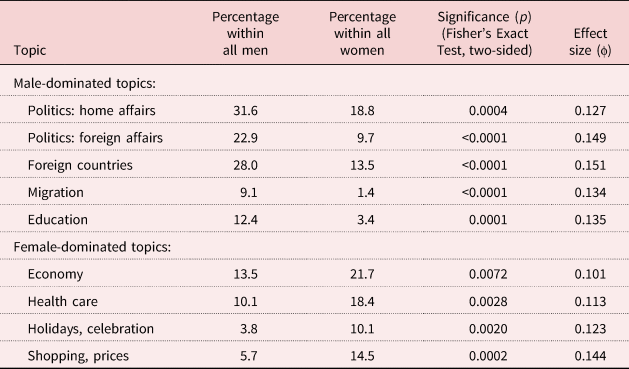
In order to identify significant differences between the portrayal of the genders, a large number of statistical tests had to be run, which is associated with an inflated familywise error rate and thus an increased risk of making at least one Type I error (i.e. erroneously concluding that there is evidence for a difference when in fact no difference exists). To deal with this potential threat, we decided to conduct all analyses at a conservative significance level of α = 0.01, instead of the more conventional 0.05 level. Although with 54 tests this still results in a familywise error rate of 0.419, we speculated that using the Bonferroni correction to fix the familywise error rate at 0.05 and conducting all analyses at a significance level of 0.05/54 ≈ 0.0009 would result in an undesirable loss of power. Therefore, our decision – as all decisions about the level of significance – reflects a reasonable compromise between the conflicting requirements for low rates of Type I and Type II errors at a given sample size. While our choice of α = 0.01 was made prior to the analysis, it is worth noting at this point that nearly all significant differences reported in this paper would also pass the more stringent criterion calculated with the Bonferroni approach, the only exceptions being three female-dominated topics listed in Table 1 and the finding that women mention illness significantly more often than men do (see Table 6).
Significant associations between gender and news story topic

Results
Our analysis revealed a range of aspects in which the representation of elderly men and elderly women significantly differ in Hungarian news programmes. Our presentation of the results below is limited to those variables in terms of which a significant difference (at the p < 0.01 level) was found between the genders, and our discussion is comprehensive in that respect. This means that variables which are not mentioned explicitly in this section did not exhibit a significant gender difference (or were excluded from the analysis in the first place for not meeting the reliability criteria).
Table 1 presents a set of significant associations between the gender of the person and the topic of the new story in which he or she appears. The percentage figures in the table are to be interpreted as conditional probabilities of the form P(topici|genderj). For instance, if we randomly select a person from our sample and we learn that the person is male, there is a 31.6 per cent probability that the news story which he appeared in was related to home affairs. If, however, the person is female, the corresponding probability drops to 18.8 per cent. In other words, it is about 1.68 more likely that an elderly person is presented within a news story related to domestic politics if the person is a man rather than a woman. Our analysis therefore provides evidence that men are more likely than women to appear in the context of stories related to politics, foreign countries, migration and education, whereas women are more likely than men to appear in stories concerning the economy, health care, holidays/celebration and shopping/prices.
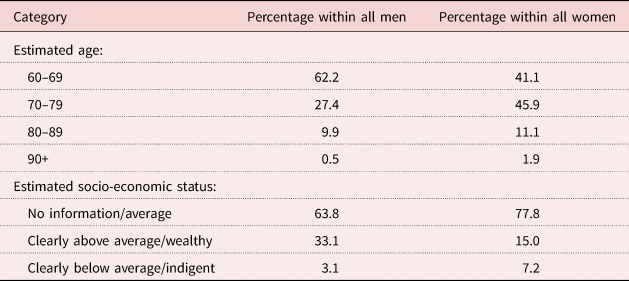
We also detected significant relationships between gender and two other demographic variables, namely the perceived/estimated age of the person (χ2(3) = 30.947, p < 0.0001, Cramer's V = 0.203) and the perceived/estimated socio-economic status (χ2(2) = 27.921, p < 0.0001, Cramer's V = 0.192). As shown in Table 2, men were more commonly perceived by the coders as being in their sixties, while women were more commonly judged to be in their seventies or older. Also, men were more than twice as likely than women to be seen as wealthy, and women were more than twice as likely than men to be perceived as indigent.
Significant associations between gender and other demographic variables

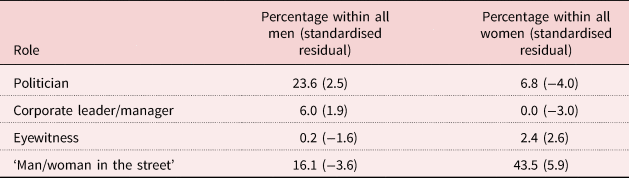
Our analysis also revealed imbalances between the genders when elderly people represent particular roles. Because the people in our sample were assigned to 29 different role categories, the resulting 29-by-2 contingency table was rather sparse, with 28 (48.3%) cells having expected frequencies below 5, and therefore unfit for standard chi-square analysis. However, a Monte Carlo analysis based on 10,000 samples yielded a 99 per cent CI for the p-value of Fisher's Exact Test with an upper bound of 0.0005 (Cramer's V = 0.427), suggesting a highly significant relationship. In order to determine which particular roles contribute to this significant relationship, we calculated standardised residuals as described by Sheskin (Reference Sheskin2004: 525–527). Table 3 contains all rows of the original contingency table in which the absolute value of a standardised residual exceeded 2.58, indicating a significant difference between the expected and the observed cell count at the p < 0.01 level (assuming that the standardised residual follows the standard normal distribution). The results indicate that elderly men appear far more commonly as politicians or corporate leaders/managers, while elderly women are more likely to appear as eyewitnesses and as ‘women in the street’. It is also interesting to note that this latter role accounted for nearly half of all female appearances.
Significant imbalances between the genders in terms of the role elderly people represent

The role of an expert was operationalised as a separate variable, as it may overlap with many other roles: a doctor, a lawyer, a headmaster, etc. may in addition be represented as a person providing expert opinion. Our analysis revealed a significant relationship between gender and the role of an expert as well, with men nearly three times more often appearing as experts than women (the conditional probabilities are 37.3 and 13.0%, respectively; two-tailed Fisher's Exact Test p < 0.0001, ϕ = 0.235).
The vast majority of significant differences in appearance are trivial and are mentioned here solely in the interest of completeness. Most of these differences stem directly from either biological differences between the two sexes (e.g. men more commonly having facial hair and being bald) or conventional cultural differences between the genders (e.g. women more commonly wearing earrings, necklaces and make-up, or elderly men more commonly having completely grey – i.e. undyed – hair). In addition, however, we also found a significant difference in terms of clothing (χ2(4) = 60.844, p < 0.0001, Cramer's V = 0.287). As shown in Table 4, it was over twice as likely for a man to be perceived as wearing elegant clothes, whereas women more commonly appeared in casual clothing (the table is confined to categories in which the standardised residual analysis confirmed a significant difference at the p < 0.01 level).
Significant differences between the genders in terms of clothing

Our analysis of facial gestures associated with particular emotions clearly indicates that such non-verbal signals could not be reliably coded with an instrument based on coders’ perceptions. Of the nine emotional states included on our coding form, only joy passed the reliability criterion of κ > 0.4. Still, no significant difference was found between the genders in terms of how often joy was expressed through facial gestures.
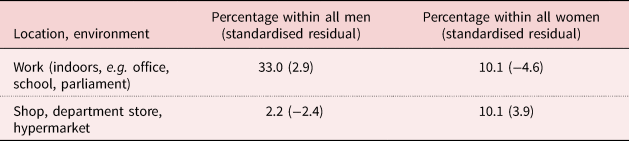
There were, however, significant differences in the locations and environments in which the two genders tend to appear (two-tailed Fisher's Exact Test, upper bound of 99% CI for p = 0.0005, Cramer's V = 0.377). In particular, standardised residual analysis revealed that elderly men are over three times more commonly shown at work, while elderly women are portrayed nearly five times more often than men in retail outlets (see Table 5).
Significant differences between the genders in terms of physical environment

We also found a significant difference between the activities that the two genders perform (χ2(7) = 46.103, p < 0.0001, Cramer's V = 0.247). Specifically, and completely in line with our findings concerning the physical environment, elderly women are shown while shopping nearly five times more frequently than men. The conditional probabilities and the standardised residuals are 10.6 per cent (4.1) and 2.2 per cent (−2.6), respectively.
The genders also differed significantly in terms of their perceived personality (χ2(2) = 20.445, p < 0.0001, Cramer's V = 0.165): according to our coders’ judgements, 35.7 per cent of the women created the impression of being ‘nice, friendly and well-meaning’ personalities, as opposed to a corresponding 20.8 per cent rate for men (standardised residuals were 3.1 and −1.9, respectively).
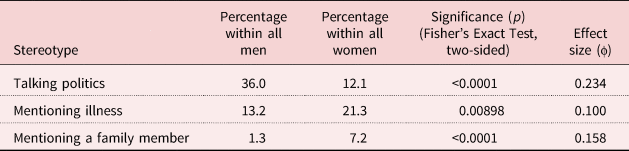
Finally, our analysis shows that it is somewhat challenging to detect the presence or absence of stereotypical attributes in a reliable manner using a standard content analysis coding procedure. The majority of stereotypical attributes (26 in a total 46 attributes) were so infrequent that reliability could not be measured, and only nine of the remaining 20 attributes revealed an acceptable (moderate) level of agreement between the coders. The genders differed in terms of three of these attributes. As can be seen in Table 6, while neither gender appears to be portrayed more stereotypically than the other, different stereotypes appear to be prominent in men and women: elderly men talk more often about political issues, while women mention illnesses and family members more frequently.
Significant associations between gender and the presence of old-age stereotypes

Discussion
In summary, our analysis indicates that elderly men tend to be portrayed more positively than elderly women in many respects. Men appear more often in connection with topics related to power, control and knowledge (such as politics, migration, education as well as their own field of expertise), they look younger, they have higher socio-economic status and greater responsibilities, wear more elegant clothes and work actively (i.e. produce value rather than just spend money in retail outlets). The aspects in terms of which women are portrayed in a more positive manner are generally soft and affective in nature: older women on the news talk more about health care and illnesses (often in the context of helping people), they talk more about their families and holidays, and in general they appear to be friendlier than men. In other words, the pattern of results we obtained provides strong support for the persistence of the traditional stereotypes of ‘powerful men’ and ‘caring women’ (Kessler et al., Reference Kessler, Rakoczy and Staundinger2004).
With this study being a descriptive content analysis in the narrow sense, it is not our purpose to check these findings against the social reality of present-day Hungary. While official statistics about employment and income are available, to check the extent to which each of these gender imbalances are misrepresentations of reality, we would first need to gather data and reliable estimates on how often elderly men and women talk about different topics, how often they wear elegant versus casual clothes, how much time they spend in different environments, and so on; a monumental project far beyond the scope of the present study. For lack of such bases of comparison, it is not possible to tell which of the gender effects reflect real differences in our society and which can be considered as distorted depictions of social reality. Nevertheless, we can safely conclude that in evening news programmes in Hungary, elderly men and women are represented differently in all the respects listed above.
In general, therefore, it is difficult to estimate the extent to which these differences are rooted in social reality and the extent to which they represent conscious or unconscious editorial bias. In some of the cases, however, it is evident that news editors are faced with a challenge stemming from conflicting ideals of accurate versus equal representation of the genders. For instance, the proportion of female members of the Hungarian parliament has been steadily around 10 per cent since the first democratic elections ending communist rule, in 1990 (Koncz, Reference Koncz2014). With such an uneven split between the genders in politics, it is natural to see different proportions of politicians within the two gender groups. In fact, the gender ratio in news programmes (see Table 3) is considerably less extreme that the actual ratio of male to female seats in the parliament, suggesting that female politicians are in fact somewhat over-represented on the news relative the proportion of female members of parliament. Thus, it appears that in this case news editors achieved a compromise somewhere in between the ethical ideals of representing reality (i.e. the true proportions of genders in politics) and equality (i.e. equal screen time for both genders).
In some other cases, however, it is highly unlikely that the gender effects revealed by our analysis reflect real differences. For instance, it can be safely assumed that television reporters have access to male and female pedestrians in approximately equal numbers (even in the elderly age group) when interviewing the ‘man/woman in the street’, and that men and women witness crimes and accidents equally often. Reporters and/or editors, however, appear to show a clear preference for females in these roles. The underlying reasons for this bias may be complex and manifold. On the one hand, elderly women may exhibit more willingness than men to contribute to news programmes, and on the other, journalists may wish to capitalise on women's stereotypically superior verbal skills (a claim which has received some – albeit mixed – empirical support; for a review, see Kimura, Reference Kimura1999). Future interview studies conducted with journalists involved in the editorial process could greatly enhance our understanding of the motives behind such tendencies.
How may all the gender differences revealed by our results affect the viewers, who may consciously or unconsciously perceive them? Viewing an elderly person on the news contextualised in a specific manner may trigger a set of psychological processes simultaneously, and which of these processes becomes dominant depends on factors other than the nature of the content itself. One important factor is whether the viewer regards himself or herself as belonging to the same group as the person shown on the screen. An elderly viewer may perceive an older person on the screen as ‘one of us, seniors’, whereas a younger viewer may categorise the same person as ‘one of them’. However, even a younger viewer may interpret the depicted person as an example of what he or she may become in the future, especially if the gender of the person on the screen matches the gender of the viewer. For this reason, a possible advantage of more positive representations is that both younger and older viewers may interpret them as role models: successful examples demonstrating that it is in fact possible to be healthy, active, knowledgeable and affluent in one's later years. Such role models can motivate the individual to make plans for their old age and take specific steps, such as adopting a healthy lifestyle or ensuring future financial security. As Kessler et al. (Reference Kessler, Rakoczy and Staundinger2004) note, such positive portrayals may also alleviate younger viewers’ worries over getting old by providing counter-evidence to some of the most common negative stereotypes about ageing. Considered from this perspective, it is unfortunate that younger and older women see fewer such examples of their own gender than men do.
On the other hand, research also indicates that it is not only positive portrayals that can have positive effects on the viewer. For instance, Pinquart (Reference Pinquart2002) found that when elderly people were explicitly reminded of a series of negative stereotypes about ageing (such as the deterioration of eyesight, hearing, physical strength, motor skills and mental abilities), the participants’ self-image actually improved as a result. Pinquart suggests that such a seemingly paradoxical effect can be accounted for by assuming that older people do not integrate such negative stereotypes in their self-concept, but rather treat such information as a standard of comparison. In line with Pinquart's findings, a line of social psychological research indicates that downward social comparisons – i.e. seeing others who are in worse conditions than ourselves – contribute positively to people's sense of wellbeing (Gerber et al., Reference Gerber, Wheeler and Suls2018), and this principle remains operative in old age (Heidrich and Ryff, Reference Heidrich and Ryff1993).
More recent research found evidence for the other side of the same coin: extremely positive, unrealistic portrayals of old people will adversely affect the viewer's perception of ageing and cognitive performance (Fung et al., Reference Fung, Li, Zhang, Sit, Cheng and Isaacowitz2015). What is more, Kessler et al. (Reference Kessler, Schwender and Bowen2010) argue that it is not only absurdly unrealistic positive portrayals that may have negative effects, but even less-conspicuous positive distortions of reality can bring undesirable consequences. For instance, disproportionate depictions of carefree, healthy and socially active elderly people may lead younger media consumers to develop an idealistic concept of old age, leaving them unprepared to deal with real problems inherently associated with ageing. Also, younger adults with naively positive beliefs about ageing may react negatively to older people who do not match the idealised views that they have formed on the basis of media experience.
Therefore, both positive and negative portrayals may have positive or negative effects on the viewer, primarily depending on whether the viewer integrates the information in his or her self-concept or contrasts it with his or her own situation and condition, thereby distancing the information from the self. Which of these psychological processes will be ultimately triggered appears to depend on the current content of the self-image. For instance, a classic study by Mares and Cantor (Reference Mares and Cantor1992) revealed that non-lonely elderly participants felt better after viewing a positive portrayal of an elderly person (the result of integration and assimilation), while lonely participants felt better after viewing a negative portrayal (the result of downward comparison and contrast). Taking such psychological tendencies into account, it follows that news editing practices in which elderly men are more commonly represented as active, powerful and wealthy than women will typically benefit male viewers with a positive self-image and abundant resources (providing them with models they can integrate), as well as female viewers with a negative self-image and scarce resources (providing them with examples for downward comparison). Such a pattern in media content may do a disservice especially to elderly men who suffer from financial difficulties, poor health and loneliness, as the news may create a misrepresentation of reality in which all or most men of their age are still healthy, active and well-to-do. A vast body of research on social comparison suggests that such upward comparisons will lead to further decrements in self-evaluation in male viewers who already have low self-esteem (Gerber et al., Reference Gerber, Wheeler and Suls2018). At the same time, it must be noted that such media effects may be considerably muted – or even removed – by the viewer's direct experience with elderly relatives, friends, colleagues, neighbours or other acquaintances who are worse off than themselves. Such comparison targets can mitigate the effects of mass media because in social comparisons people attach more weight to local information than to distant information (Zell and Alicke, Reference Zell and Alicke2013). In general, as regards the overall effect on the viewer, the valence of the portrayal appears to interact with the viewer's condition, self-concept, as well as other experiences with his or her immediate social context. Therefore, it is perhaps best to conclude (in line with Mares and Cantor, Reference Mares and Cantor1992) that viewers as a diverse group will benefit most from a balanced and varied – rather than one-sided – portrayal of old age.
The tendencies revealed in this paper are likely to be culture specific. In other words, while these differences in the representation of elderly men and women definitely hold in Hungarian television news programmes, in other cultural contexts some of these gender effects may prove to be considerably diminished (or even non-existent), and other differences may appear, or show as even more prominent than is suggested by our results. Therefore, it would be important to conduct similar analyses in other regions of the world to explore fully the strengths of the interactions between the cultural context and gender differences in media representations.
Another logical extension of the present study would be to widen the scope of the analysis to other age groups. While it may appear plausible that some of the gender effects shown by our analysis – such as the significantly higher proportion of male experts – are largely due to the remnants of a male-dominated past, empirical support for this interpretation could only be provided by a comparable study that would show that these imbalances disappear (or become substantially reduced) when the analysis is conducted on the portrayal of a younger generation. Presently available research on the representation of genders in the news media, however, suggests that forming such an optimistic hypothesis is unwarranted, or at least premature. The most recent report of the Global Media Monitoring Project (Macharia, Reference Macharia2015) yielded results highly similar to ours: women (of all ages) are rarely represented in news stories related to topics such as politics, government or economics, and when they provide their opinion, they are far more frequently portrayed in the role of an ‘ordinary citizen’ than an expert with specialist knowledge. Similarly, through the analysis of Portuguese television news programmes, Lobo and Cabecinhas (Reference Lobo and Cabecinhas2018) found that men's portrayals are more commonly associated with power, productivity and work, whereas women's representations typically focus on the social roles they fulfil in their private lives. Such results indicate that the imbalances revealed in the present paper are by no means confined to elderly people, although some aspects of gender asymmetry may be more pronounced in the representation of this age group. Further research is needed to explore the presence and nature of such potential age-by-gender interactions.
Supplementary material
The supplementary material for this article can be found at https://doi.org/10.1017/S0144686X20000227.
Acknowledgements
We owe special thanks to Márton Rétvári for recording the audio-visual material for this study, as well as to our main coders Dorka Dengyel, Nikolett Karamusko, Hanna Szabó and Krisztina Szabó, and co-coders Dorina Hulzebos, Anikó Kristóf and Tímea Ondok, for their precise work and contributions to the development of our coding scheme.
Financial support
The authors have received no financial support for this research project and have no commercial, legal or professional relationships with other organisations which could have influenced the research reported in this paper.
Ethical standards
The study is a descriptive analysis of media content and did not involve human participants. Therefore, ethical issues regarding the rights and welfare of participants did not arise. The article does not contain copyrighted or previously unpublished material for which the owner's permission would be required.