


In the modern world, political protest and regime change have often advanced in waves (Hale Reference Hale2013; Kurzman Reference Kurzman1998). Progress toward liberty in one country inspires citizens in other countries to push for similar changes. As cases ranging from the “Springtime of Peoples” in 1848 to the “Arab Spring” of 2011 show, these tsunamis of protest were propelled by the demonstration and contagion effects emanating from the overthrow of French Citizen King Louis Philippe in February 1848 and of Tunisian dictator Zine El Abidine Ben Ali in January 2011, respectively. But despite their amazing advance, many of these rebellions ended up bringing little lasting progress and soon fell to elite efforts to turn the clock back; established rulers and their supporters frequently managed to squash protest or restore the status quo once mass demonstrations died down. Therefore, advances tended to be followed by reversals, which spread in waves as well (Gunitsky Reference Gunitsky2014; Huntington Reference Huntington1991, 15–21).
Do these reactionary riptides mirror the initial upsurge of contention or do their features diverge, given the different protagonists? Because social science has traditionally neglected counterrevolution (Mayer Reference Mayer1971, 35–6), these questions have remained unanswered, especially for historical cases. The recent outpouring of writings on authoritarian rule has begun to fill this gap (e.g., Ambrosio Reference Ambrosio2009; Brownlee, Masoud, and Reynolds Reference Brownlee, Masoud and Reynolds2015, chaps. 4, 5; Koesel and Bunce Reference Koesel and Bunce2013), but has focused on contemporary events, especially the “color revolutions” in the post-Communist world during the early 2000s and the Arab Spring (wider coverage: Gunitsky Reference Gunitsky2014, 16–25). Through an in-depth analysis of counterrevolution after the March uprising of 1848, especially in Prussia, this article tries to broaden this emerging line of research and thus uncover more generalizable findings.
Interestingly, in 1848 as on other occasions, counterrevolution advanced differently than revolution. Whereas contention swept across a whole continent like a raging torrent,Footnote 1 the rollback occurred through a long trickle of suppression, taking hold first here, then there (Sperber Reference Sperber1994, chap. 5). Rather than squashing protest in a dramatic counterwave, reactionaries restored “order” in specific countries at different times, as Table 1 shows. Similarly divergent patterns unfolded in 1830, when a quick sequence of contentious advances triggered by the July revolution in Paris was followed by more staggered, differentiated repression and rollback (Church Reference Church1983). And while the Russian Revolution and WWI unleashed a crisp, concentrated wave of democratization in 1918/19, often pushed by bottom-up mass mobilization, the reverse wave of authoritarianism and fascism with its fundamentally counterrevolutionary impetus advanced slowly over the course of the 1920s and 1930s (Gunitsky Reference Gunitsky2014, 5, 10; Huntington Reference Huntington1991, 17–8). Furthermore, post-Communist countries led by Russia continue to harden their efforts to combat the “color revolutionary” impulses of the early 2000s, and the counterrevolutionary moves prompted by the Arab Spring keep gathering steam years later, as the penultimate section below discusses.
Revolution and Counterrevolution: Divergent Patterns

Sources: Sperber (Reference Sperber1994); Dowe, Haupt, et al. (2001); Engehausen (Reference Engehausen2007).
These variegated experiences across history suggest that 1848 was not unique: Counterrevolution seems to lack the tight temporal clustering of revolution. This difference is surprising because reversals can take inspiration from a similarly stunning precedent as the contentious wildfire. In 1848, the violent crushing of the June uprising in Paris sent shockwaves across Europe and encouraged conservative sectors in many polities to move in the same direction (Price Reference Price, Dowe and Haupt2001, 37–9). But reactionaries did not strike immediately; instead, they waited for a good opportunity to open up in each specific polity. Why do events of similar magnitude and salience, occurring on the same prominent stage, have such a divergent impact? Why does a striking outbreak of contention unleash a sudden, wide-ranging riptide, whereas its tragic defeat produces a much slower groundswell that sequentially ripples from polity to polity?
This question is of relevance to diffusion studies, which have in recent years flourished in the social sciences (overview: Solingen Reference Solingen2012). After scholars from various disciplines have documented that demonstration and contagion effects propel change in many areas of politics and policy, attention is turning to the characteristics and causes of these wavelike patterns. What factors and mechanisms drive replication efforts? Why does diffusion spread with varying speed and bring differential degrees of success? By comparing the patterns of counterrevolution with revolution, the present article contributes to this cutting edge of diffusion studies.
The contrast between a contentious tsunami and its gradual, differentiated rollback is especially puzzling in light of recent investigations of the 1848 revolutions that attribute the rash of rebellion to widespread misjudgments and overreactions (Hale Reference Hale2013, 335–9; Weyland Reference Weyland2014, chap. 4). Ample historical sources show that both oppositional sectors and defenders of the status quo overestimated the significance of the French monarch's ouster and jumped to the conclusion that similar challenges could be successful in a wide variety of other polities. This overgeneralization from the Parisian precedent induced discontented groupings across Europe to rush into protests and uprisings, while paralyzing rulers and preventing them from taking effective countermeasures.
If actors of all political stripes—both revolutionaries and reactionaries—initially shared these facile inferences and proceeded in a rash and unthinking fashion during the upswing of revolution, why did the same reactionaries then act so differently during the downswing and promote counterrevolution in a methodical and systematic fashion? Why did the noteworthy victory of counterrevolution in Paris in June not set in motion a similar riptide as the overthrow of Louis Philippe in February had done? Cognitive psychology, which provides the theoretical microfoundation of the above-mentioned arguments (Weyland Reference Weyland2014, chap. 2), highlights inferential mechanisms that are imprinted in people's cognitive architecture (Kahneman Reference Kahneman2011) and may have deep roots in evolutionary prehistory (McDermott, Fowler, and Smirnov Reference McDermott, Fowler and Smirnov2008). Given these uniform bases, why the difference in political behavior: Why did the same political circles, especially defenders of the status quo (ante), respond to equally dramatic events in such different ways?
Rich historical documentation shows indeed that reactionaries across Europe, who had been thrown off course by the Citizen King's eviction and who had blundered when facing the tidal wave of revolution, pursued their interests in a much more deliberate, systematic, and calculated fashion when planning and executing counterrevolution. While they took encouragement from the squashing of the June revolt in Paris, they did not immediately rush into emulation efforts, but prudently awaited a propitious chance for combating the upheaval in their own polity. For this purpose, they paid much closer attention to the domestic power constellation than they had done in March, when the rebellious precedent of Paris had swept a variety of actors off their feet. Conservative groupings now based their moves on changes in the internal political conjuncture, which held the greatest objective relevance for their reactionary goals. In pursuing counterrevolution, the same actors thus displayed a political rationality that was much less tightly bounded than during the outbreak of contention (see in general Gunitsky Reference Gunitsky2014, 19–20).
To explain this noteworthy difference, the article proposes an argument about learning that rests on political experience and decision-making procedure. As the seminal scholar of bounded rationality, Herbert Simon, emphasized, cognitive limitations are—despite their firm roots—not fixed and immutable, but can be mitigated through individual expertise and collective organization (Bendor Reference Bendor2010, chaps. 2, 3, 7; Jones Reference Jones2001, 23, 82, 131; March and Simon Reference March and Simon1993; Simon Reference Simon1976). Whereas common people face tight bounds of rationality, preparation and practice can loosen these constraints. Experience allows for better performance and more rational behavior. Similarly, procedural mechanisms can compensate for cognitive limitations and reduce the repercussions of biases and distortions. The organizational division of labor favors specialization, while debate and deliberation permit different actors to crosscheck their perceptions and judgments and correct the worst mistakes. Experienced actors who vet each other's views can thus learn and move closer toward rational decision-making.
The historical record suggests that reactionary sectors came to benefit from both of these mitigating factors. While they had been overwhelmed by the eruption of contention in early 1848 and had resorted heavily to cognitive shortcuts in the midst of this confusion, in subsequent months they gained greater clarity about the changed political landscape. Helped by long-established albeit informal procedures of discussion and deliberation, these experienced political operators learned from earlier mistakes, designed a fairly coherent plan for outmaneuvering their adversaries, and enacted this program in a savvy way, taking advantage of opportunities and avoiding risks. Whereas the revolutionaries, captivated by the French precedent and misguided by cognitive shortcuts, had rushed forward precipitously, their enemies encircled them in the cautious and prudent fashion counseled by more rational calculations. Consequently, the final checkmate happened at different times in different places, rather than sweeping across the continent in a few short weeks, as the tsunami of contention had done. Counterrevolution advanced very differently than revolution.
The article substantiates this argument through an in-depth study of authoritarian reversal in 1848 and offers evidence of its broader applicability in a comparative discussion toward the end. The in-depth investigation pays special attention to Prussia, one of the two great powers caught up in the upheaval. For analytical reasons, it makes sense to examine a site of fairly independent decision-making, immune from unwanted foreign interference. By contrast, many other rulers in Germany, Italy, and the rest of Europe depended on external support;Footnote 2 thus, counterrevolution was not their autonomous decision.
Feasibility considerations also justify focusing on Berlin. Given Prussia's importance, amazingly rich source material is available, which allows for reconstructing the perceptions and calculations, discussions, and decision-making among revolutionaries and conservatives. 1848 was such a momentous experience that the most diverse participants and observers left testimony: rebellious students (Boerner Reference Boerner1920; Schurz Reference Schurz1998), Bildungsbürger (bourgeois of education: Fontane 1920; Lewald Reference Lewald and Schaefer1969), liberal aristocrats (Varnhagen Reference Varnhagen1862), and true reactionaries such as Bismarck (Reference Bismarck1898), who devoted a whole chapter of his autobiography to the revolution.
Whereas these memoirs were written for the public and may carry “spin,” there are many even more candid and instructive sources: The private diaries and letters by central decision-makers, including King Friedrich Wilhelm IV, his family, ministers, and kitchen cabinet, the secretive camarilla (see especially E. L. Gerlach Reference Gerlach1903, Reference Gerlach and Diwald1970; L. Gerlach Reference Gerlach1891; Haenchen Reference Haenchen1930; Radowitz Reference Radowitz and Möring1922; Wilhelm IV Reference Berner1906), shine bright light on internal processes that are largely hidden in contemporary authoritarian regimes. History offers great opportunities because the passing of time has opened up the archives. By contrast, who could access equivalent material from Vladimir Putin or Hosni Mubarak? Scholars who intend to reconstruct decision-making inside nondemocracies could benefit greatly from looking back at historical cases and take advantage of a wealth of authentic documents, as democratization studies have recently done with an important “historical turn” (Capoccia and Ziblatt Reference Capoccia and Ziblatt2010).
During the last decade, qualitative research has made substantial methodological progress by clarifying the types of tests that process tracing employs (e.g., Beach and Pedersen Reference Beach and Pedersen2013, chaps. 6, 7). Yet while “hoop tests” establish only preconditions and “smoking gun tests” mostly unearth circumstantial evidence (Bennett Reference Bennett, Brady and Collier2010), the diaries and letters used in this study provide more conclusive proof, which—in the detective analogy employed by Collier (Reference Collier2011)—comes close to “confessions.”
After all, private diaries, letters, and notes were not written for a broader audience and were published only posthumously.Footnote 3 These strikingly frank documents reveal the unvarnished perceptions and calculations, thoughts, and plans of leading actors and elucidate the debates and deliberations among them. They open up the “black box” of decision-making and demonstrate the elaborate preparation and careful execution of counterrevolution in 1848. Researchers can examine how systematically crucial actors designed their plans, vetted their strategies and tactics, responded to challenges, sought to enlist support, tried to outmaneuver competitors and adversaries, and cunningly outfoxed their enemies.Footnote 4 In their authentic directness and candor, evidenced by many intimate, embarrassing, or potentially self-damaging statements,Footnote 5 these documents seem less subject to the problems that can plague the sources often used in qualitative research, such as the self-serving “spin” of personal interviews (Beach and Pedersen Reference Beach and Pedersen2013, 134–6). Moreover, these posthumously published sources are generally accessible and allow for replicable inferences. The present study therefore stands on unusual empirical foundations.
THE 1848 REVOLUTIONS: A TSUNAMI PROPELLED BY COGNITIVE SHORTCUTS
As a baseline for elucidating the special features of counterrevolution, this section examines the amazing spread of revolution in spring 1848. This contentious riptide is remarkable for its stunning speed and fairly indiscriminate reach: It affected polities of very different socioeconomic and political characteristics. Prudent rational calculations would have produced a differentiated, targeted pattern of protest, depending on the specific opportunities and constraints prevailing in different polities. But challengers threw rational caution to the wind and eagerly rushed into dangerous defiance against powerful, repressive rulers—a very risky undertaking. This striking surge of contention reflected cognitive heuristics that can entail significant deviations from standard rationality (Hale Reference Hale2013, 334–6; Weyland Reference Weyland2014, chap. 4).
Both opponents and defenders of the established order drew rash, facile inferences from the eviction of French King Louis Philippe by mass protests.Footnote 6 Overestimating the significance of the Parisian precedent and the similarities to the internal situation in their own polities, discontented sectors “jumped to the conclusion” that they could replicate this feat. This facile judgment multiplied the perceived chances of success and thus triggered an outburst of contention.Footnote 7 As many people across Europe leapt to the surprisingly firm belief that they could wrest concessions from their rulers as well, spontaneous crowds gathered and forcefully demanded change. This boldness, which often drew a repressive response, diverged clearly from rational interest calculations, which would have counseled caution: After all, many polities actually differed from the forerunner France in important respects. The farther one moved to the East, the more inchoate was civil society; and the greater the repressive capacities of the state. It was therefore not conventionally rational that all across Europe, including the great powers of Prussia and Austria and the backward Danubian principalities of Moldova and Walachia, many citizens dared to defy their long-established rulers (Weyland Reference Weyland2014, chap. 4).
These rash decisions were shaped by cognitive shortcuts with which oppositional groupings drew inferences from the French precedent. The availability heuristic (Kahneman Reference Kahneman2011, chaps. 12, 13) induced people to pay overwhelming attention to the striking, vivid events in Paris, while discounting other information of equal objective importance, namely the quiescence maintained in many other polities. Then the representativeness heuristic (Kahneman Reference Kahneman2011, chaps. 10, 14–16) led people to overestimate the similarities between France and the situation inside their own polities. They came to assess domestic conditions through the lens of the protests in Paris and “automatically” concluded that a similar success was feasible at home.Footnote 8 They suddenly saw their own regime as precarious and fragile and confidently expected oppositionists to engage in forceful contention, just as France's rebellious crowds had done. These rash inferences, which imprudently discounted the clear differences between politically advanced France and less developed Central and Eastern Europe, spurred an urge to emulate Louis Philippe's ouster and confront the rulers of a wide variety of other polities as well.
Interestingly, ample evidence shows that these inferential shortcuts did not only shape the perceptions and calculations of oppositionists, but of supporters and officials of the incumbent regimes as well. For instance, Berlin's military commander was captivated by the Parisian events and immediately feared their replication (Prittwitz Reference Prittwitz and Heinrich1854, 1, 13–4, 16–7, 44–5, 150). Even the mastermind of Europe's restoration era, Klemens von Metternich, exclaimed right after learning about Louis Philippe's overthrow, “Oh well, it's all over!” (quoted in Häusler Reference Häusler1979, 133). The Prussian court, not known for faintheartedness, was similarly perplexed, depressed, and stricken with profound fear after the Parisian uprising, as a well-connected aristocrat emphasized (Varnhagen Reference Varnhagen1862, vol. 4, 211–3, 252–5, 261, 274, 296, 314). As General Prittwitz (Reference Prittwitz and Heinrich1854, 16) highlighted, the government was “surprised and paralyzed.” One leading conservative wrote, “I foresee very bleak prospects. . .it is as if everybody was losing their wits” (den Kopf verlieren, E. L. Gerlach Reference Gerlach1903, vol. 1, 507, 509; Hohenlohe-Ingelfingen Reference Hohenlohe-Ingelfingen1897, 51). A Prussian diplomat perceived “among the enemies a tenfold increase in physical and political force, in our camp the discouragement of the governments, the collapse of their authority and legitimacy” (Radowitz Reference Radowitz and Möring1922, 9). The letters that Prussian King Friedrich Wilhelm IV received from various European princes prove this widespread consternation and profound anxiety (in Haenchen Reference Haenchen1930, 24–5, 27–9, 34, 37, 43, 47).
The unexpected outbreak of revolt after decades of quiescence plunged government officials and their advisers into an abyss of confusion and disarray.Footnote 9 Their orderly world cracked wide open; political hierarchy suddenly faced a fundamental challenge; deep uncertainty engulfed the future. The shock was so intense that it literally made grown men cry—in public—especially archconservatives like Prince Wilhelm, the king's brother, and Otto von Bismarck (Bismarck Reference Bismarck1898, 31–2, 38–9). Because “in Prussia one had hitherto known revolutions only from the reports of others, but had not experienced them oneself,” government officials faced the storm “like complete novices” (Prittwitz Reference Prittwitz and Heinrich1854, 264; see also E. L. Gerlach Reference Gerlach1903, vol. 1, 519; L. Gerlach Reference Gerlach1891, 137). Therefore, they relied heavily on the availability and representativeness heuristics.Footnote 10
Defenders of the status quo also based their inferences and beliefs on the dramatic event of Louis Philippe's overthrow. Like protesters, they attached disproportionate importance to this striking precedent and jumped to the conclusion that similar rebellions could easily erupt at home and endanger their own rule. After initial attempts to suppress rising contention failed, they therefore switched to belated concessions (Prittwitz Reference Prittwitz and Heinrich1854, 95–7); and when that tactical turnaround also proved ineffective, they hastily capitulated to the swelling crowds besieging their palaces (Hachtmann Reference Hachtmann1997, chap. II.1-2; Hohenlohe-Ingelfingen Reference Hohenlohe-Ingelfingen1897, 31, 50).
These vacillations and the meek final response, which Prussia's king soon regretted as “the biggest mistake of my life or at least of my government” (letter in Radowitz Reference Radowitz and Möring1922, 69), reflected the “sense of defeatism” gripping the court in Berlin after the Parisian news sank in (L. Gerlach Reference Gerlach1891, 127; also 130–1). Similarly, the Austrian government was “deeply depressed and practically at wit's end. . .. [The advancing protest wave] was totally paralyzing all resistance by those in charge of maintaining law and order.” Many had the “feeling as if any fight against the advancing ruination was futile, as if the final outcome. . .[was] unavoidable” (Radowitz Reference Radowitz and Möring1922, 12–4; similar 18, 26, 31).
Princes’ sudden weakness arose from deep concern that the Parisian outcome would repeat itself with the toppling of their dynasties and declaration of republics. Friedrich Wilhelm IV feared that the approaching revolution would become “the grave of the monarchy in Prussia and in Germany.”Footnote 11 When mass protest was gathering steam in Berlin, his brother Wilhelm wondered: “What will all this lead to?. . . [The arming of the citizenry, a core rebel demand] and the free press will in short time transform Germany into a republic” (Wilhelm I Reference Berner1906, 172).
In fact, however, domestic discontent focused on government ministers and the brutal security forces,Footnote 12 but largely exempted the king himself (Hachtmann Reference Hachtmann1997, 183–4; Wolff Reference Wolff1849, 196). In Central and Eastern Europe, demonstrators did not challenge monarchy as such; instead, they sought more moderate changes such as constitutional safeguards and greater citizen participation (e.g., Varnhagen Reference Varnhagen1862, vol. 4, 224). Considering these limited goals, princes’ fear was exaggerated; it arose not from the demands they actually faced, but from the scary Parisian precedent of monarchy's overthrow, whose replication they expected. Like the contentious masses, the authorities also overestimated the similarity of the domestic conjuncture with the dramatic events in France. The representativeness heuristic held them in thrall and made their beliefs diverge from fully rational calculations.
Moreover, the improvised expedients with which governments responded to the tidal wave of demonstrations emerged from a haphazard, chaotic decision-making process. As a variety of demand-making groupings, official and self-appointed advisers, and rival court factions desperately sought influence, a cacophony of voices stormed in on Friedrich Wilhelm IV.Footnote 13 A minor Prussian official from Westphalia, for instance, managed to get access to the monarch and helped persuade him to give in to popular pressures (Prittwitz Reference Prittwitz and Heinrich1854, 227–30). Similarly, poet Ludwig Rellstab, who represented nobody but himself (Rellstab Reference Rellstab1849, 48–9), maneuvered his way into the royal chamber and offered frank advice in a lengthy conversation (Rellstab Reference Rellstab1849, 61–76; Wolff Reference Wolff1849, 202–7). Thus, an accidental welter of counselors besieged the king, who was overtired (Bismarck Reference Bismarck1898, 44; Varnhagen Reference Varnhagen1862, vol. 4, 284) and therefore especially prone to problematic inferences (cf. Kahneman Reference Kahneman2011, chaps. 2, 3).
In this fluid situation, the very locus of decision-making became unmoored. Above all, it remained unclear who actually issued the decisive order to withdraw the troops after the terrible night of barricade fighting on March 18–19. The interior minister invoked royal authority, but Friedrich Wilhelm IV denied authorship. Did this turning point emerge from a misunderstanding, a deliberate misrepresentation, or a bold arrogation of power?Footnote 14 Like the king's brother Wilhelm (Wilhelm I Reference Berner1906, 174–6), who pushed for stern repression (Varnhagen Reference Varnhagen1862, vol. 4, 283, 298, 330), Berlin's military commander confronted the interior minister and submitted only reluctantly to his assertion of hierarchy (Prittwitz Reference Prittwitz and Heinrich1854, 287–92, 310), “blue-red from rage” and allegedly muttering grave insults (Bismarck Reference Bismarck1898, 29–31). Thus, uncertainty and chaos gave rise to choices that were deeply shaped by problematic inferential shortcuts, rather than a minimally systematic processing of the relevant information.
In sum, governing officials based their decisions on similarly flimsy information, distorted perceptions, and rash judgments as the crowds of protesters. During the uprising, revolutionaries and conservatives shared very similar views about the situation they were facing and the developments that were likely to unfold. Both sides of the barricades overgeneralized from the French precedent, believed that incumbent rulers all over Europe stood on precarious footing, and expected determined challenges to hold high probabilities of success. This noteworthy commonality of views shows that these perceptions resulted neither from wishful thinking by discontented sectors nor from deliberate fear-mongering by conservatives, such as the “military party” of Prince Wilhelm. Instead, these shared views and probability assessments betray the operation of cognitive heuristics that people of all persuasions commonly and automatically use, particularly under high uncertainty, time pressure, and other impairments of the decision-making process (George Reference George1980, 37, 47–9; Kahneman Reference Kahneman2011, chaps. 2, 3; Payne, Bettman, and Johnson Reference Payne, Bettman and Johnson1993, 37–40).
In turn, these inferential shortcuts are crucial for explaining the enormous impact of the French precedent and the remarkably tight clustering of the contentious wave it set in motion. As cognitive heuristics induced people across Europe to draw facile conclusions from the Citizen King's ouster, emulation efforts unfolded with amazing speed in a wide range of political settings. Deviations from standard rationality therefore propelled the tsunami of revolution in 1848 (Weyland Reference Weyland2014, chap. 4).
THE SEQUENTIAL IMPOSITION OF COUNTERREVOLUTION
Counterrevolution, however, advanced very differently from revolution. Reactionaries moved in a gradual sequence of targeted, differentiated steps, not a crisp, dramatic wave. While the upswing of contention was quick and steep, the downswing occurred more slowly and less uniformly; it reached some polities much later than others. The rollback began in Prague (Valentin Reference Kurzman1998, 78–81; Varnhagen Reference Varnhagen1862, vol. 5, 82, 88, 106) and Paris in June 1848, then affected Vienna in October, spread to Berlin in November, and took hold in the German and Italian middle states at different moments during 1849 (Price Reference Price, Dowe and Haupt2001, 36–41).
This staggered timing is noteworthy because counterrevolution got under way after a stunning precedent that was as vivid and dramatic as the trigger of the revolutionary tsunami, namely the violent suppression of the June uprising in Paris. This crackdown at the very site of the original revolution cost thousands of lives on both sides of the barricades. The restoration of “law and order” in France ushered in the reverse wave that then rippled across Europe during the subsequent year (Sperber Reference Sperber1994, 197–203). As a Prussian aristocrat with close connections to court circles, Karl August Varnhagen, commented in December 1848, “The stifling of our revolution and all the reversal is only a product of the setback that happened in France. . .. Cavaignac [the general who squashed the Parisian uprising] is a tool of reaction” (Varnhagen Reference Varnhagen1862, vol. 5, 325–6, 334). But whereas after France's contentious precedent in February 1848, revolution spread with tremendous speed and indiscriminately engulfed a great variety of polities, after France's repressive precedent in June 1848, counterrevolution advanced at a much slower pace and more selectively, polity by polity, depending on domestic circumstances.
Thus, internal factors, especially the constellation of power, played a much more important role in counterrevolution than in revolution. Whereas in early 1848, the French precedent had “overwhelmed” domestic actors and made them disregard internal considerations, now a similarly dramatic event had much less force. Rather than being swept off their feet again and rushing into emulation efforts, reactionary forces assessed the circumstances in their own polity, waited for a good opportunity to strike, and in the meantime undertook preparations to guarantee eventual success.
The weaker demonstration and contagion effects are evident in the lower frequency of references to Cavaignac's victory in the rich source material. Whereas both opponents and defenders of the existing regimes, elite and mass actors, had amply emphasized the stunning impact and enormous significance of the French king's eviction (Weyland Reference Weyland2014, chap. 4), the crushing of the June uprising was mentioned much more rarely and briefly, even by reactionaries, who had incentives to emphasize this precedent (e.g., Hohenlohe-Ingelfingen Reference Hohenlohe-Ingelfingen1897, 15–7 vs. 86). A leader of Friedrich Wilhelm IV's camarilla, Leopold von Gerlach, for instance, does not comment on the Parisian crackdown in his extensive diary (L. Gerlach Reference Gerlach1891, 169–73). But according to his brother Ernst Ludwig, another archconservative, it was right after these events that Leopold began to promote counterrevolution in Prussia and started searching for a prime minister who would be willing “to Cavaignac the sovereign people” (E. L. Gerlach Reference Gerlach1903, vol. 1, 538; see also Varnhagen Reference Varnhagen1862, vol. 5, 106). Notably, counterrevolutionaries did not initiate replication right away, but waited until the power constellation turned more propitious. They took encouragement from the rollback in Paris (Hachtmann Reference Hachtmann1997, 555, 654–5, 661; Varnhagen Reference Varnhagen1862, vol. 5, 88, 95–6, 103, 106), but refrained from imitating it precipitously.
LEARNING FROM THE MOST RELEVANT PRECEDENT
Different from revolution, it was not the first striking instance of counterrevolution that exerted the strongest effect by stimulating immediate emulation efforts. Rather than all being drawn to the same “model,” conservatives across Europe learned selectively: They took their primary inspiration and guidance from different rollbacks. Reactionaries in Berlin were much less impressed by the Parisian crackdown than the later crushing of revolution in Vienna, which occurred in a more similar context. Due to a number of important parallels between Austria and Prussia, the lessons from the Danube commanded higher objective relevance and greater applicability on the Spree.
After all, both in the Habsburg and Hohenzollern realms, semiabsolutist monarchs had preserved their throne, whereas the Parisian uprising had overthrown a constitutional monarchy and instituted a republic. The two German rulers had kept their militaries largely intact, whereas General Cavaignac had to draw on newly recruited fighting forces. Civil society in Austria and Prussia was less developed, liberal, and experienced with revolution than in France (Lewald Reference Lewald and Schaefer1969, 70–1, 75–8), which had for the third time ousted a king in 1848. Most importantly, the Austrian emperor and Prussian king had more reactionary goals than the French authorities: They fully sought to reverse the revolutionary advances and restore autocratic supremacy (see Friedrich Wilhelm IV in Haenchen Reference Haenchen1930, 175–7; see also E. L. Gerlach Reference Gerlach1903, 511–8; Reference Gerlach and Diwald1970, 574–7, 588–92). By contrast, the new government in Paris, a product of the revolution, merely defended the fledgling republic from radical challenges. Thus, the project of Prussian conservatives resembled the Austrian counterrevolution much more than the French crackdown. For intendedly rational actors, the Viennese precedent was therefore a more relevant, useful source of learning.
Accordingly, Prussia's court circles paid far greater attention to the Austrian events (Hachtmann Reference Hachtmann1997, 731–40).Footnote 15 Whereas all eyes had fixated on France during the upsurge of revolution, the equally dramatic and important suppression of the June uprising, which ushered in the advance of counterrevolution all over Europe, attracted less interest and exerted a more indirect effect. Cavaignac's triumph steeled the resolve of Austrian reactionaries, yet their Prussian brethren then took much more inspiration from the Viennese variant than the Parisian original (Valentin Reference Valentin1998, 276). The Prussian king and his advisers followed the crisis on the Danube closely.Footnote 16 As regards an old government minister, “the events in Vienna stir him up as if they happened here [in Berlin]” (Varnhagen Reference Varnhagen1862, vol. 5, 228). As a former prime minister's brother reported, “the Viennese events keep all minds here on edge” and “were and are of great importance for us;” after the subjugation of Vienna, he expected the restoration of “lasting tranquility in Austria” to “affect Prussia beneficially as well” (Otto Camphausen in Fenske Reference Fenske1996, 179, 187–8).
Prussia's conservatives adjusted their own counterrevolutionary moves to the twists and turns with which repression unfolded in Germany's other great power. When the Austrian emperor faced a renewed challenge in October 1848 (Valentin Reference Valentin1998, 198–202), reactionaries in Berlin held back; while appalled by the renewed outburst of violence in Vienna (Haenchen Reference Haenchen1930, 209), the Prussian king did not dare to crack down immediately. A well-connected Berlin aristocrat commented: “Here everything is on hold in expectancy of the turn of events there; court and people feel that their cause hangs in the balance there” (Varnhagen Reference Varnhagen1862, vol. 5, 239–40).
Yet right after the Austrian capital had been shelled into submission, the same source remarked: “The news from Vienna give the [Prussian] court courage, it is moving to action” (Varnhagen Reference Varnhagen1862, vol. 5, 260). As a Saxon diplomat in the Austrian capital correctly predicted, “Above all, Berliners will not be spared the harsh lesson that Vienna just received” (Vitzthum Reference Vitzthum1886, 186). Other German princes forcefully encouraged Friedrich Wilhelm IV to replicate the subjugation of Vienna. For instance, the king of Hannover urged his Prussian nephew in brutal language to impose a state of siege and “make an example and a real example” by court-martialing rebellious leaders and students “without mercy” (letter in Haenchen Reference Haenchen1930, 232–7). In fact, Prussian archconservatives highlighted how the ostentatious execution of National Constituent Assembly deputy Robert Blum, who had joined the renewed fighting on the Danube, furthered their own goals (E. L. Gerlach Reference Gerlach and Diwald1970, 601, 608). Consequently, soon after the Viennese events, Friedrich Wilhelm IV had a massive military force occupy Berlin as well (cf. Haenchen Reference Haenchen1930, 227–30).
Thus, status-quo-oriented sectors now responded to external stimuli more selectively. Vivid events no longer pushed aside considerations of relevance, as during the “Springtime of the Peoples.” Instead, the defenders of the old order focused on a specific foreign experience that had important objective parallels to their own circumstances. Counterrevolutionaries now engaged in more active, targeted lesson-drawing, rather than being swept up by external demonstration and contagion effects, as during the outbreak of mass contention in early 1848.
THE PREVALENCE OF DOMESTIC CONSIDERATIONS IN THE IMPOSITION OF COUNTERREVOLUTION
Because rulers and their aides pursued their restoration projects in a fairly deliberate and rational fashion, domestic opportunities and constraints weighed much more heavily in their calculations and decisions than external stimuli. This renewed focus on internal circumstances reflected a substantial move toward more rational decision-making compared to the outbreak of revolution. Due to cognitive shortcuts, the overthrow of Louis Philippe had “carried away” both challengers and defenders of the established order and had stimulated precipitated emulation efforts across Europe with little regard for domestic opportunity structures. Yet after conservative sectors in Central and Eastern Europe recovered from this sudden shock and again made systematic use of their political experience and deliberative mechanisms, they came to concentrate primarily on internal factors and conjunctures. They continued to pay attention to foreign developments, but only in a supplementary fashion (Hachtmann Reference Hachtmann1997, 715). External events helped to inform their choices and actions, but no longer overrode domestic assessments and calculations.
This recalibration of attention constituted another step toward greater political rationality. After all, in autonomous polities where the risk of forceful external intervention is low, as in mighty Prussia, the domestic constellation of power is the decisive factor that actors seeking regime change need to consider. Whether they can achieve their goals depends primarily on the balance of influence between their supporters and adversaries. To use any opening skillfully, they need a thorough understanding of the internal political opportunity structure. Certainly, foreign influences can affect the domestic distribution of power, but they operate indirectly; internal conditions prevail among the proximate causes of regime change.
Counterrevolutionaries approximated this goal-oriented, calculating approach by tailoring their plans to domestic opportunities. The basic precondition for their efforts at reversing revolutionary gains was that the Prussian military had escaped the crowd uprising relatively unscathed. While sealing an embarrassing defeat (cf. Prittwitz Reference Prittwitz and Heinrich1854, 292–3, 311; Varnhagen Reference Varnhagen1862, vol. 4, 319, 349), provoking internal discontent and open saber-rattling,Footnote 17 and inducing numerous officers to resign (Varnhagen Reference Varnhagen1862, vol. 4, 334), the sudden order to withdraw the troops from the firestorm of rebellion on March 19 managed to prevent mass desertions (Prittwitz Reference Prittwitz and Heinrich1854, 350; Varnhagen Reference Varnhagen1862, vol. 4, 305, 326–7, 347) and kept large parts of the army intact. Although military discipline suffered in subsequent months (Hohenlohe-Ingelfingen Reference Hohenlohe-Ingelfingen1897, 73–4) and concerns over “fraternization” with protesters persisted (Varnhagen Reference Varnhagen1862, vol. 5, 241–2), the king and his loyal generals succeeded in gradually tightening hierarchical command.Footnote 18
Thus, the surprisingly easy victory of revolutionaries in mid-March had the paradoxical effect of allowing the monarch to retain control over the main instrument of coercion. While far from sufficient for guaranteeing “successful” counterrevolution, this power base gave conservative sectors the necessary means for plotting a comeback, as they understood clearly. As one of the king's leading aides confided in his diary in late March already, “I conceived of the possibility of restoring the king's coercive authority (der königlichen Gewalt) via the army” (L. Gerlach Reference Gerlach1891, 150).
From early on, the king and his conservative advisers resented the liberal constraints that the temporarily successful revolutionaries had imposed on monarchs.Footnote 19 But reactionaries regarded an immediate counterattack as infeasible (see letters in Hassel Reference Hassel1905, 576–92). Instead, his confidants urged Friedrich Wilhelm IV to wait for the proper moment to pursue his reactionary goals. Their Machiavellian minds believed that another spasm of unrest would provide a justification for restoring “order” by resurrecting full autocracy.Footnote 20 But this backlash could only succeed once support for the revolution among upstanding citizens and liberal elite circles had faded; otherwise it risked provoking strong resistance (cf. Varnhagen Reference Varnhagen1862, vol. 5, 104).
Therefore, reactionaries did not make their big move after the Zeughaussturm of June 1848, when popular sectors stormed the military's arms depot in downtown Berlin and stole rifles and ammunition. While the king and his camarilla wanted to use this new transgression as a pretext for cracking down,Footnote 21 the liberal cabinet appointed after the March uprising blocked this initiative. The monarch did not yet dare to dismiss his ministers and renege on his liberal and constitutionalist promises in this still-volatile situation, as Friedrich Wilhelm IV explained to young reactionary Otto von Bismarck in a remarkably frank and tense conversation (Bismarck Reference Bismarck1898, 43–5). At that time, the king “still had the greatest fear,” as a well-connected aristocrat reported.Footnote 22 This cautious approach, the subject of considerable internal debate (L. Gerlach Reference Gerlach1891, 171–2; Radowitz Reference Radowitz and Möring1922, 48–51), shows how carefully the enemies of revolution calculated their chances (see also E. L. Gerlach Reference Gerlach1903, vol. 2, 1, 33). When in doubt, they avoided unnecessary risks, as rational prudence would demand.
Interestingly, in assessing the domestic power constellation, reactionaries were not so much concerned with mass mobilization. They trusted that military force could crush any new uprising, as their master plan for counterrevolution stressed (E. L. Gerlach Reference Gerlach1903, vol. 2, 516). After all, they were convinced that the army could have suppressed the revolution in March already! For them, the main problem lay with liberal currents among upstanding citizens (the Bürgertum) and elites, which influenced even some court factions. These upper-middle sectors—“the real center of gravity in the contemporary era” (Radowitz Reference Radowitz and Möring1922, 57)—embraced or endorsed the restrictions on royal autocracy that Friedrich Wilhelm IV had conceded or promised in March. Renewed outbreaks of popular contention could actually help drive these important sectors into the arms of counterrevolutionaries (Radowitz Reference Radowitz and Möring1922, 48, 57–8, 64).
Through their innumerable personal and professional connections,Footnote 23 conservatives constantly gauged the political views and preferences of this upper crust. Specifically, they tried to ascertain whether the chance for executing their reactionary project had arrived. The decisive operational indicator was whether they could convince enough prominent heavyweights to join a ministerial cabinet that would enact determined counterrevolution.Footnote 24 Thus, in a hierarchical society with a strong, coercion-wielding state, reactionaries’ careful evaluations of the domestic opportunity structure were distinctly top-heavy, focused on middle and elite sectors more than the popular masses. In Svolik's (Reference Svolik2012, chap. 1) terms, the problem of authoritarian power-sharing weighed more heavily on their minds than the problem of authoritarian control.
Consequently, counterrevolutionaries sought to restore the king's authority primarily by combating the limitations proposed by Prussia's surprisingly independent-minded constituent assembly. Because reactionaries’ first priority was unrestricted command over the military,Footnote 25 “the interference of the assembly in military affairs” was the turning point that prompted the king to combat the revolution head-on.Footnote 26 In fact, Friedrich Wilhelm IV worried that in case he did not defend the armed forces against the assembly, hardliners would push him off the throne and install his martial brother, the army's favorite (L. Gerlach Reference Gerlach1891, 193; Varnhagen Reference Varnhagen1862, vol. 5, 231, 238). After all, Prussia's weak and indecisive ruler had deeply offended the military with the withdrawal order of March 19 and had already been the target of coup machinations at that time.Footnote 27
Reactionaries also fought against the assembly's efforts to limit the king's institutional attributions. They rejected ministerial responsibility to parliament; the monarch wanted to appoint and control the cabinet alone.Footnote 28 Moreover, the king denied popular sovereignty and insisted that his rule originated from “the grace of God;” the assembly's attempt to delete this formula enraged him.Footnote 29 These escalating conflicts with the constituent assembly induced the monarch to enact the restoration plan prepared by his camarilla;Footnote 30 sporadic crowd contention served merely as a pretext for repressive moves.
After sufficient military force became available,Footnote 31 the king appointed a new prime minister in September 1848 and tasked him with confronting the assembly (L. Gerlach Reference Gerlach1891, 196, 199, 202–3). That official, however, shied away from open conflict and sought a compromise with the parliamentary majority.Footnote 32 While the balance of hard power favored counterrevolution, the political success of a direct attack was not yet assured. After all, Friedrich Wilhelm IV had in March promised to cooperate with the assembly and work toward a liberal constitution, which would inevitably restrict his attributions (L. Gerlach Reference Gerlach1891, 180). Betrayal of these pledges could risk provoking a backlash against reactionary moves among influential middle and upper sectors (cf. Haenchen Reference Haenchen1930, 175).
Nevertheless, the king and his aides tried hard to find replacements for the ministerial cabinet.Footnote 33 But who had the determination and courage to push the reactionary program forward? The dramatic flare-up of revolution in Vienna in October rekindled worries in Berlin; an “unconstitutional” coup could reignite the flames of contention (L. Gerlach Reference Gerlach1891, 212–6; Hachtmann Reference Hachtmann1997, 740). Thus, while domestic circumstances weighed foremost on reactionaries’ minds, select external events that seemed to hold particular relevance did influence their calculations. After all, there were important similarities between the two German great powers, as discussed in the preceding section. Thus, it made rational sense for Prussian politicians to pay attention to the Austrian case.
Accordingly, the violent suppression of the Viennese uprising then gave the Prussian king and his aides the confidence to make their decisive move as well (E. L. Gerlach Reference Gerlach1903, vol. 2, 23, 30). As an aristocrat with ample access to court circles reported, “the people in Potsdam [the king and his aides] are getting cocky because of the news from Austria. . .. The Kamarilla in Potsdam now regards everything [= the realization of its full plan] as possible, it reinforces its activities to the utmost” (Varnhagen Reference Varnhagen1862, vol. 5, 245; similar 260). Reassured by the Austrian crackdown, Prussian conservatives began to carry out their counterrevolutionary program. In particular, they emulated the Austrian emperor's marginalization of his constituent assembly by forcefully transferring it from the capital, where it benefited from strong popular support, to a provincial town, where it was isolated and easier to tame (E. L. Gerlach Reference Gerlach1903, vol. 2, 23).
Following the Austrian recipe (Varnhagen Reference Varnhagen1862, vol. 5, 270) and executing their own “so long-prepared coup” (E. L. Gerlach Reference Gerlach1903, vol. 2, 25), Prussian reactionaries reined in the obstreperous assembly with military force and moved it away from Berlin. By separating liberal reformers from rebellious crowds, they further divided the uneasy alliance that had suddenly coalesced after the Parisian precedent and sustained the March uprising, but that had frayed in the meantime.Footnote 34 When the emasculated assembly quarreled on how to operate in this predicament, the king closed it down and imposed a constitution by decree (“octroy”).Footnote 35 To compensate for this autocratic process and give the new charter some legitimacy among the Bürgertum and elites, Friedrich Wilhelm IV promulgated surprisingly liberal rules.Footnote 36 At that time, the Prussian court still feared a backlash to the reassertion of autocracy, as even the king's hardnosed brother Wilhelm confided.Footnote 37 Out of rational prudence, the king and his cabinet therefore sought to appease moderate liberals and disarm critics of his counterrevolutionary turn.Footnote 38 As his tough but pragmatic prime minister told the monarch (letter in Haenchen Reference Haenchen1930, 238), he could further tighten the charter in the future.
The king himself wrote in a December 1848 memo that “time, namely very well-used time, was required for overcoming a revolution. . .in a solid way” (in Haenchen Reference Haenchen1930, 274; see also E. L. Gerlach Reference Gerlach and Diwald1970, 605–6). Accordingly, in mid-1849, when reaction had taken firm hold in Prussia and the remaining embers of revolution were about to be extinguished in the rest of Germany, Friedrich Wilhelm IV took another reactionary step by imposing a highly unequal, elitist election system (Radowitz Reference Radowitz and Möring1922, 97). Finally, in January 1850 he had the new, pliant legislature remove some of the liberal features from the charter. This calculated, deepening retrenchment ushered in stifling political stagnation during the 1850s.
Thus, the defenders of the old order enacted the rollback in a sequence of calibrated steps that reversed many revolutionary advances, one after the other. While the tsunami of contention had caught them off guard in the spring of 1848, they soon recovered their bearings. From fall 1848 onward, conservative sectors managed to proceed in a careful, systematic fashion and reclaimed lost ground.
COUNTERREVOLUTIONARIES’ WIDER BOUNDS OF RATIONALITY
What gave rulers and their leading advisers the capacity to pursue counterrevolution in a more deliberate, rational fashion than they had shown in responding to the initial upsurge of revolution (see in general Gunitsky Reference Gunitsky2014, 19–20)? How and why did reactionaries in late 1848 keep inferential shortcuts in check and limit their distortionary repercussions, which had contributed to their ineffectual actions during the “Springtime of the Peoples”? As mentioned above, the theoretical literature does not postulate uniformity, but highlights that the bounds of rationality can vary in tightness (Bendor Reference Bendor2010; March and Simon Reference March and Simon1993; Simon Reference Simon1976). These differences in the limitations on rationality arise primarily from two factors, namely individual expertise and collective organization.
First, well-trained individuals with extensive experience can outperform novices (Bendor Reference Bendor2010, 36–44; Payne, Bettman, and Johnson Reference Payne, Bettman and Johnson1993, 3, 35–6, 199–201, 206–7). Through learning, they have acquired better capabilities for information processing. If they flexibly employ case-based knowledge and practical reason—rather than abstract theoretical models—and thus act as “foxes” rather than “hedgehogs” in Tetlock's (Reference Tetlock2005, chap. 3) terminology, they can do relatively well. Experienced political actors who face short-term opportunities and challengesFootnote 39 are especially likely to achieve results that are closer to full rationality (without ever reaching this standard, however).
Second, collective organization can compensate for the deficiencies of individuals. The division of labor promotes specialization, which fosters expertise. Moreover, institutional mechanisms of discussion and deliberation allow for the double-checking of problematic perceptions and inferences, which can weed out distortions and clarify the situation (Bendor Reference Bendor2010, 28–9, 163–9; George Reference George1980, 84–5, 96, 157–9, 193–4, 209–15; Jones Reference Jones2001, 23, 82, 131). Consequently, aggregate decisions emerging from an initial diversity of viewpoints are often much closer to the mark than individual conjectures and estimates (Page Reference Page2007).
Both factors contributed to the savvy way in which the authorities enacted counterrevolution. First, ruling officials and their aides had much greater political experience than oppositional circles. Obviously, the king had been groomed from early on to occupy the throne. Moreover, he appointed ministers with long careers in public administration, the diplomatic service, or the military. This was true even after the mass contention of early 1848 forced the monarch to include reformists in his cabinet: He chose Liberals who had a track record as moderate opponents during the 1830s and 1840s, not the new, inexperienced, and very fluid leadership that arose from scratch with the crowd protests. Furthermore, the king continued to surround himself with personal advisers who were longstanding political operatives and who had for years belonged to his kitchen cabinet.
All of these actors had a thorough understanding of internal elite alignments and power constellations in the higher ranks of society and inside the state, including the military. They also knew many of the liberal reformers who now used the new bodies created by the revolution, especially the constituent assembly, to push for enshrining institutional change. While reactionaries had little knowledge of democrats and popular sectors (rarely mentioned in their diaries, e.g., E. L. Gerlach (Reference Gerlach1903) and L. Gerlach (Reference Gerlach1891)), some conservatives had a sophisticated grasp of political affinities and divisions among their adversaries. One of the king's most trusted aides, Josef von Radowitz, for instance, discussed the relations among liberals, democrats, and socialists in perceptive memos (reprinted in Hassel Reference Hassel1905, 572–4, 576–8, 586–9). In sum, defenders of the status quo had enormous political experience and skill, especially in wielding the instruments of power and coercion.
By contrast, challengers had little inside knowledge of the power structure, and radical leaders were newcomers who lacked political experience. Intransigent liberals and democratic sectors had been outsiders during the restoration era (1815–48). Leaders of the popular sectors had risen quickly “out of nowhere” during the March upheaval, and many soon faded away again. They were often young, came from lower socioeconomic backgrounds, and had not enjoyed advanced education. Therefore, they could neither draw on nor accumulate political experience and could not match reactionaries in their understanding of the power structure.
As regards organization, state institutions helped reactionaries widen their bounds of political rationality. Although the hierarchical authority of the king limited internal debate, the ministerial cabinet had a good deal of independence, especially after the March revolt, which had forced the monarch to dismiss his old handpicked ministers and appoint a more liberal cast that could placate the protesters. The new cabinet faced a difficult task mediating between political forces that pulled in very different directions: the constituent assembly was elaborating a liberal, reformist charter; popular sectors agitated for more profound change; and the king and his kitchen cabinet intended to restore the old order. These disagreements brought innumerable discussions and debates, both inside and among these different institutions, which elucidated the prevailing constellation of power (ample documentation in Friedrich Wilhelm IV Reference Berner1906 and Haenchen Reference Haenchen1930).
Most decisive for the advance of counterrevolution was the circle around the king, especially his relatives and personal advisers. The latter belonged to an informal organization, the notorious camarilla. This kitchen cabinet of longstanding aides, which had begun to resume its secretive meetings right after the March uprising (L. Gerlach Reference Gerlach1891: 150; see also E. L. Gerlach Reference Gerlach and Diwald1970, 570, 594, 607–8), engaged in constant frank and open debates about pressing political issues.Footnote 40 While the king sought to project unassailable authority in public, behind closed doors he was far from enforcing conformity and allowed for surprisingly strong and direct criticism. In fact, he often solicited candid assessments and independent advice from his confidants (e.g., letters in Radowitz Reference Radowitz and Möring1922, 43, and Hassel Reference Hassel1905, 583–5), who embraced divergent viewpoints, offered conflicting counsel, and frequently “pushed” the monarch directly.Footnote 41
The king intentionally drew on aides of different persuasions (cf. George Reference George1980, 157–9, 209–15), ranging from true reactionaries to reform-conservatives (see, e.g., E. L. Gerlach Reference Gerlach and Diwald1970, 600–2, 608–9). Even hardliners like the brothers Gerlach disagreed among each other; Ernst Ludwig was significantly more diehard than Leopold (e.g., E. L. Gerlach Reference Gerlach and Diwald1970, 568). In his “fanaticism” (Bismarck Reference Bismarck1898, 46), he complained that his brother should not “paralyze” his efforts (E. L. Gerlach Reference Gerlach1903, vol. 1, 527; see also vol. 2, 34).
Moreover, there was an informal division of labor among the king's advisers. Ernst Ludwig von Gerlach was the main thinker, who designed the master plan for counterrevolution (E. L. Gerlach Reference Gerlach1903, vol. 1, 542–3; vol. 2, 1, 511–8). His brother Leopold was the principal operator who prepared its execution, especially by recruiting ministers who were willing to help restore autocracy (L. Gerlach Reference Gerlach1891, 211–6, 221–31). General von Prittwitz and the king's brother Wilhelm represented the viewpoints and interests of the military, which Friedrich Wilhelm IV had antagonized with his troop withdrawal on March 19. And while Ernst Ludwig von Gerlach was a strong Protestant, Josef von Radowitz was Catholic and therefore had good access to Austrian court circles, serving as the main conduit to Germany's other great power (Radowitz Reference Radowitz and Möring1922, 6–43, 100–3). Thus, this longstanding group of advisers approximated some of the specialization that helps formal organizations achieve more rational information processing and decision-making.
This kitchen cabinet engaged in innumerable debates and conversations, often based on memos, which prompted written or oral comments. These procedures guaranteed thorough and systematic deliberations, which considered divergent viewpoints (see, e.g., L. Gerlach Reference Gerlach1891, 253), promoted mutual criticism, and thus allowed for learning. In making the final decision, the monarch drew on a good deal of information processing and preparation (cf. E. L. Gerlach Reference Gerlach1903, vol. 2, 25). Thus, this planning center of counterrevolution, which persistently pressed the monarch in fall 1848 to carry out his reactionary inclinations,Footnote 42 operated with fairly wide bounds of rationality.
The king's epistolary and personal exchanges with other princes, both inside Germany and beyond, contributed to this discussion of ideas and vetting of perceptions, inferences, and judgments. Because many correspondents were family members, diplomatic etiquette and power differentials did not preclude frank comments. For instance, King Ernst August of small Hannover kept giving his nephew Friedrich Wilhelm IV. “a hard time” about the “excessive” concessions that the ruler of this European great power had made to his rebellious citizens (letters reprinted in Haenchen Reference Haenchen1930, 70–3, 109–10, 233–4). With similar candor, other minor potentates pressured their mighty colleague to combat revolution in Berlin, because the precedent of Prussia would facilitate their own counterrevolutionary projects (in Haenchen Reference Haenchen1930, 56, 242–3, 288–9). The monarch in turn explained his behavior and consulted with his sister, Russia's Tsarina, in amazingly frank letters (Haenchen Reference Haenchen1930, 81–3, 92–5, 112–5, 126–9, 164–6, 173–4, 209–11, 268–9). These constant debates inside the family fostered the calibration of judgments.
In sum, political experience and frequent collective discussions allowed reactionary circles to mitigate the impact of inferential shortcuts and loosen their bounds of political rationality.
THE LIMITED ROLE OF ALTERNATIVE FACTORS
The preceding argument about counterrevolutionaries’ emergence from tight cognitive limitations provides a more comprehensive and persuasive account of the reactionary reversal in 1848 than other theories and is crucial for complementing the important factors highlighted by those approaches. To explain the fate of revolution and counterrevolution, the literature has emphasized variables related to material power capabilities, organization for collective action, institutional framework, and cultural mindset and shared mental models.
A plausible explanation for the success of counterrevolution points to the realities of hard power and the differential capacity of revolutionaries and reactionaries to marshal coercion and apply it effectively. Status-quo defenders’ advantage seems particularly pronounced where a ruler survives the initial uprising and keeps most of his military intact, as in Prussia in 1848. Yet this “realist” argument is not fully convincing: While the contentious masses lacked the direct command over the armed forces that the king retained, this coercive superiority had strikingly failed to protect the monarch from the upsurge of revolution in the first place! Soldiers and their hardware did not guarantee the outcomes that status-quo defenders wanted. While material power capabilities are certainly a necessary condition for counterrevolution, they are far from sufficient.
An organizational argument emphasizes the unorganized, leaderless nature of crowd protest, which is impossible to sustain for long (cf. Olson Reference Olson1965). As mass mobilization predictably faded and challengers retreated back into private life (Hirschman Reference Hirschman1982), victory was bound to fall into the lap of reactionaries. Due to the typical “cycle of contention” (Tarrow Reference Tarrow2011, chap. 10), conservatives could simply “sit out” the protesters, based on their strongholds inside the state.
This organizational account of protest's downswing usefully elucidates a factor facilitating the rollback. But by stressing the weakening of revolutionaries, it underestimates the agency of counterrevolutionaries and its importance for the eventual outcome. The reversals in 1848 did not directly arise from the exhaustion of revolution, but from conservatives’ active efforts to restore “order.” Reactionaries, in fact, did not fear renewed protests, but were convinced that they could crush them with force (E. L. Gerlach Reference Gerlach1903, vol. 2, 516). Indeed, they saw flare-ups of contention as an opportune justification for imposing counterrevolution.Footnote 43 As soon as they could find ministers willing to employ repression (E. L. Gerlach Reference Gerlach1903, vol. 2, 1–3, 6–9, 15–9, 23, 25) and could count on acquiescence and support from elite circles and citizens (the Bürgertum), they combated the revolution head-on. The King preempted any renewed uprising by having the military forcibly subdue the citizen militia and systematically confiscate arms from popular neighborhoods.
An institutional version of this argument stresses reactionaries’ fine-tuned capacity to marshal power and coercion. With their command over police and military, the king and his advisers could apply force at any point in a targeted way and thus promote their machinations successfully. By contrast, for lack of organization the contentious crowds could rely only on street protest, a blunt instrument for pressing their demands that could not be mobilized at will, over and over again, as reformist sectors recognized (Varnhagen Reference Varnhagen1862, vol. 5, 104).
This institutional advantage helps us to understand the eventual success of counterrevolution. Above all, control over readily available means of coercion allowed status quo defenders to proceed systematically according to a consistent plan, which foresaw a sequence of steps toward a comprehensive rollback.
But this argument cannot explain the differential success with which elites wielded this powerful instrument. How did they manage to use it skillfully in imposing counterrevolution after they had charted a haphazard, failure-prone course when confronting revolution? In March, reactionaries had initially overshot by employing excessive repression; then they made an unexpected turnaround and withdrew the “undefeated” troops. In fact, the harshness with which the military had attacked protesters in the beginning had backfired and fanned the flames of rebellion, provoking a dangerous escalation that turned peaceful demonstrations into violent barricade fighting (Hachtmann Reference Hachtmann1997, 157–72, 183–7). Thus, during the upswing of contention, the authorities had used their main instruments of “law and order” in counterproductive ways: They had helped bring about the uprising that they had desperately tried to prevent.
As these initial failures show, institutional command over power and coercion was a necessary condition for the effective rollback, but by no means sufficient. What mattered greatly was the adroitness with which the government wielded its main weapon. During the confusion stimulated by the overthrow of Louis Philippe in France, rulers and their aides relied heavily on cognitive shortcuts and had great difficulty responding effectively. By employing an illogical mixture of brutal repression and ample concessions, the authorities antagonized all sides and soon had to abandon coercion and temporarily capitulate to spiraling mass protest.
Once the initial confusion had passed, however, and reactionaries had some time to digest the changes and grasp the new realities, they managed to loosen their bounds of rationality and engage in learning, as my core argument claims. As counterrevolutionaries gained an ever better sense of the new constellation of political forces, they came to use their institutional instruments of coercion with increasing aptitude. They took advantage of opportune conjunctures to pursue the retrograde plans that they had carefully prepared. In sum, learning was crucial in allowing reactionaries to wield their main means of power with growing success.
That counterrevolutionaries managed to loosen their bounds of rationality also casts doubt on a culturalist, ideational approach, which predicts “continuity” in actor dispositions (Eckstein Reference Eckstein1988, 790–3). According to this framework, “path dependence in ideas and ideologies” (Denzau and North Reference Denzau and North1994, 27) means that conservatives may be stuck in outdated patterns of thought and action. Old-timers may find it difficult to deal with a suddenly politicized, mobilized mass public. Their rigidity could set them up for failure, as it had befallen their mastermind, Klemens von Metternich, right at the outbreak of revolution.
But contrary to these continuity claims, conservative elites proved surprisingly flexible and quickly managed to learn (Dipper Reference Dipper1998, 412–4). They soon realized that the eruption of mass contention had transformed the parameters of politics and that even “reactionaries” had to adapt, as the Prussian king's brother Wilhelm, a notorious hardliner, admonished a rigid general (Wilhelm I Reference Berner1906, 192). Consequently, the initial efforts by diehards to depose the irresolute king in a military coup,Footnote 44 and the monarch's own later temptations to restore autocracy through an open “dictatorship” did not find sufficient support (King's letters reprinted in Haenchen Reference Haenchen1930, 114, 116, and in Radowitz Reference Radowitz and Möring1922, 56). The Camarilla recognized that such a frontal attack against the revolution was not politically viable; with rational prudence, they advised against premature adventures (L. Gerlach Reference Gerlach1891, 152; Hohenlohe-Ingelfingen Reference Hohenlohe-Ingelfingen1897, 68; Radowitz Reference Radowitz and Möring1922, 48–51, 56–9).
Reactionaries understood that they had to adopt new ways to pursue their old goals—and they did so with considerable skill. Stodgy insiders who had avoided the limelight (E. L. Gerlach Reference Gerlach1903, vol. 1, 541) and exerted “invisible” influence at the court now noticed the heightened importance of public opinion. Therefore, they founded a newspaper to propagate their views and gain broader backing.Footnote 45 The new press organ systematically tried to pry away support from revolutionaries. For this purpose, it appealed not only to traditional themes of patriotism (see Friedrich Wilhelm IV Reference Berner1906, 52) and “law and order,” but also invoked some social concerns raised by the revolution.Footnote 46
With this savvy move, reactionaries sought to estrange the popular masses from the moderate liberals whom the revolution had given important institutional positions in the ministerial cabinet and the constituent assembly: Poorer sectors, the foot soldiers of the revolution, had pressing material needs, cared little about abstract constitutional debates, and often saw free-market liberalism as a threat to their livelihood. They preferred a strong state that could provide paternalistic protection against depredations by nascent entrepreneurs. Of course, reactionaries were eager to resurrect such a strong state to promote autocratic restoration. As this cunning effort shows (which foreshadowed later conservative tactics such as Bismarck's top-down creation of a welfare state), counterrevolutionaries were skillful in twisting revolutionary themes toward their own goals and splitting the erstwhile phalanx of challengers (Gall Reference Gall1983, 80–3). Rather than being tied down by rigid ideology and repeating old mistakes, they aptly adjusted to new circumstances.
In sum, alternative approaches do not offer fully persuasive explanations. But they highlight factors that are necessary for effective counterrevolution—and that therefore serve as scope conditions for my argument. Above all, conservative sectors must have command over coercion, particularly military force. Revolutionaries can secure their victory only by quickly destroying the military, as Castro did in Cuba; they expose themselves to a backlash when they (have to) leave the armed forces intact, as in Chile under Salvador Allende. Moreover, counterrevolutionaries have much greater chances of success when they face unorganized protesters (usually as part of a wave of contention: Weyland Reference Weyland2014); a well-organized vanguard party, such as Lenin's Bolshevists, is harder to defeat. Finally, pragmatic conservatives, especially “foxes” à la Tetlock (Reference Tetlock2005, chap. 3), are more likely to make a comeback than traditional monarchs unused to challenges, such as Louis XVI in 1789, or rulers of rigid ideological regimes, such as Portugal's Catholic corporatism in 1974. The important factors emphasized by other theories thus help establish the scope conditions for my argument.
COMPARATIVE PERSPECTIVES
Considering these scope conditions, my historical findings seem to have broader applicability, even in other regions during the contemporary era—a “most different systems” design. Indeed, a sequence very similar to 1848 played out in the Arab world in 2011: A tsunami of mass contention as precipitous and indiscriminate as in 1848 was soon followed by a variety of counterrevolutionary efforts that advanced slowly and selectively, in line with domestic opportunities and conjunctures. As both qualitative and statistical analyses suggest, the initial riptide of protest was propelled by the cognitive shortcuts that fueled the wildfire of 1848 (Bamert Reference Bamert2013; Weyland Reference Weyland2012). But this amazing wave soon suffered a rollback, which proceeded in more systematic and “rational” ways (Barany Reference Barany2011; Brownlee, Masoud, and Reynolds Reference Brownlee, Masoud and Reynolds2015, chaps. 4, 5).
Depending on internal conditions and external support, counterrevolution got under way sooner or later. Bahrain's rulers drew on Saudi assistance and quickly repressed their opponents.Footnote 47 Syria's dictator used religious and ethnic cleavages to fight back and maneuvered shrewdly in the resulting civil war, which devastated his country, but enabled him to stay in power. Yemen's chieftain eventually acquiesced to stepping down, but managed to retain strong influence, with which he has tried to plot a comeback. Even in Tunisia, where democratizing change has gone the farthest, the winners of the 2014 elections were an unholy alliance of reformers and leftovers from the old regime, who may well try to engineer a restoration. Thus, as in 1848, reactionary elites in the contemporary Arab world engaged in learning (Heydemann and Leenders Reference Heydemann and Leenders2011), calibrated their counterrevolutionary efforts to the domestic and international political situation (Stacher Reference Stacher2015), and proceeded selectively in clever ways.
The Arab case with special parallels to Prussia in 1848 is Egypt. In the 2011 uprising, the military—for decades the real power behind the throne—was initially “caught off guard” (Stacher Reference Stacher2015, 267) and in the presidential contest of 2012 temporarily lost its longstanding tutelage to an elected government of Islamists. But when the new civilian president sought to strengthen his precarious position by concentrating power, the armed forces helped spur “liberal” protests, which allowed them to reclaim control with a 2013 coup. General Abdel Fattah al-Sisi then ruthlessly outmaneuvered his secular allies and took advantage of the widespread civil disobedience organized by the Muslim Brotherhood to crush this powerful organization (Stacher Reference Stacher2015, 267–9). By now he has imposed an autocracy strikingly similar to the status quo ante. Considering the goals of the military's predominant hardline faction and its sense of superiority over civilians, this skillfully executed restoration project reflects a great deal of rational design and implementation (cf. Ashour Reference Ashour2015, 17–22). As in 1848, counterrevolutionaries emerged from initial perplexity and recovered their capacity to proceed systematically—and successfully.
Similarly, after overcoming their initial shock and confusion (Horvath Reference Horvath2013, 5, 31–2; Petrov and Ryabov Reference Petrov, Ryabov, Åslund and McFaul2006, 158), established rulers combated the “color revolutions” rippling through the post-Communist world in the early 2000s by employing “elite learning” (Beissinger 2007, 269–73). Because these autocrats benefited from the accumulation of experience in this more slowly unfolding wave of post-electoral regime contention (Weyland Reference Weyland2014, 240–1), they managed to elaborate a set of savvy strategies and “successfully” rolled back beginning protests in their own countries, cemented their authoritarian rule, and prevented the anti-incumbent riptide from spreading further. Most importantly, Russia's Vladimir Putin, who initially stumbled badly with his clumsy interference in Ukraine's Orange Revolution (Horvath Reference Horvath2013, 22–35; Petrov and Ryabov Reference Petrov, Ryabov, Åslund and McFaul2006), soon established a support network for other nondemocratic leaders in post-Soviet countries and enlisted skillful tactics—including armed confrontation—to undermine new presidents who had emerged from color revolutions, such as Georgia's Mikheil Saakashvili and Ukraine's Viktor Yushchenko (and recently Petro Poroshenko) (Ambrosio Reference Ambrosio2009, chaps. 6–8). Moreover, Putin thoroughly cemented his domestic hegemony by obstructing opposition mobilization and organization, intimidating independent news media, and building up government-controlled support movements (Ambrosio Reference Ambrosio2009, chaps. 4, 5; Horvath Reference Horvath2013, chaps. 4–7). Thus, learning from color revolutions, Putin systematically precluded a spillover to Russia.
These “most different cases” suggest that the present study has uncovered a more general pattern. Once established elites who face a surprising outbreak of mass contention recover their bearings, they manage to broaden their bounds of rationality, adapt to the new situation, carefully draw up a plan of counterrevolution, and advance their reactionary project with considerable skill.
CONCLUSION
The last decade has seen an outpouring of studies on authoritarian rule, especially its institutional characteristics and its durability after the third wave of democratization. This important literature has examined how incumbent autocrats seek to cement their domination and respond to external challenges, which can emerge from international efforts at democracy promotion, cross-national waves of revolution, or upheaval among their own citizens. Recent studies emphasize that nondemocratic leaders often learn from each other or cooperate to confront these threats (e.g., Ambrosio Reference Ambrosio2009; Brownlee, Masoud, and Reynolds Reference Brownlee, Masoud and Reynolds2015, chaps. 4, 5; Koesel and Bunce Reference Koesel and Bunce2013). But direct evidence of these interactions, especially of the underlying perceptions and calculations, is very sparse (Tolstrup Reference Tolstrup2015). Autocracy's closed nature makes it exceedingly difficult to unearth valid and reliable information on its internal decision-making.
History can offer relief. A treasure trove of primary sources on 1848 allow for an in-depth investigation of the restoration of authoritarian stability, a topic at the forefront of contemporary research interests (e.g., Svolik Reference Svolik2012). Strikingly, reaction advanced more slowly and selectively than the initial wave of mass contention. Whereas revolution swept across large parts of Europe like a tsunami, counterrevolution unfolded as a trickle, imposed in different polities at different times.
To explain this distinctive pattern, which helped to make reaction more “successful” than crowd protest, the article advanced a learning argument. Whereas mass rebellions were fueled by heavy reliance on cognitive shortcuts and the resulting rush to action, which temporarily “overwhelmed” defenders of the status quo, the counterrevolutionary rollback arose from more careful calculations and deliberate plans, which conservative forces executed systematically after recovering from their initial perplexity. Louis Philippe's downfall in February 1848 stunned political actors of all persuasions, induced discontented forces across the continent to undertake precipitous emulation efforts in March, and left status-quo defenders at a loss about how to respond effectively. At that time, automatic resort to inferential heuristics led both progressives and reactionaries to proceed with tightly bounded rationality.
But conservative sectors soon overcame their bewilderment and gradually figured out the transformed political landscape. Their ample experience helped them adjust their strategies and tactics to the new opportunities and constraints; and their well-established practices of frank discussion and constant consultation entailed mutual vetting and fairly thorough scrutiny. These mechanisms allowed reactionaries to resume much better information processing than they had managed to conduct during the chaotic upsurge of contention. Consequently, as the waves of revolution were calming, reactionaries regained their capacity for skillful response. They gradually moved to drain the floodwaters and rebuild institutional and coercive dikes to protect rulers and restore their authority. Reaction thus unfolded very differently than revolution—more slowly and more “successfully.”
My historical study complements more general findings in political science, especially on the causes of state repression. A burgeoning statistical literature, inspired by the seminal contribution of Poe and Tate (Reference Poe and Tate1994, 866), has consistently documented democracy as a restraint on repression, and civil conflict as a stimulus.Footnote 48 Indeed, in 1848 popular contention prompted governmental crackdowns. Yet reactionary sectors went beyond direct responses to challenges and pursued farther-reaching goals: They planned to use renewed outbursts as a pretext for promoting autocratic restoration. Thus, while repression is conditioned by regime type, it can also serve to impose regime change, including the reversal of temporary liberal advances.
Like recent contributions (Danneman and Ritter Reference Danneman and Ritter2014; Ritter and Conrad Reference Ritter and Conrad2016), my study also helps fill a lacuna in the repression literature by drawing attention to diffusion effects: Many governments respond to foreign contention with preventive repression at home. Yet when preemption fails and protests do erupt, governments are confused whether to intensify repression, or concede (Ritter and Conrad Reference Ritter and Conrad2016, 87–88, 91, 95–96) just as in March 1848! Perhaps my cognitive-psychological argument can help explain this perplexity. Moreover, my investigation adds another dimension to the diffusionist turn in the repression literature: It documents that besides dissent and civil conflict, repression also exerts demonstration effects, especially across similar political regimes (vs. Danneman and Ritter Reference Danneman and Ritter2014, 271–2). In these ways, my study enriches the more nuanced findings that the repression literature, after its longstanding focus on macro-variables, has recently established (Ritter and Conrad Reference Ritter and Conrad2016, 96–97).
Most fundamentally, this article with its learning argument sheds light on the variable bounds of rationality and their important political impact (cf. Bendor Reference Bendor2010; Jones Reference Jones2001). While cognitive shortcuts are innate mechanisms of human thinking, their limitations and distortions can be mitigated by individual efforts, which give rise to experience and expertise, and by collective procedures, especially formal organizations and informal procedures for debate and deliberation. Human rationality will never reach the perfection postulated by ideal-typical models of rational choice; as Immanuel Kant stressed, our minds are carved out of crooked timber. But through individual and collective mechanisms, people can try to reduce the distortions and biases arising from our cognitive architecture.
Of course, the benefit of moving toward greater rationality need not favor causes that are morally good. Because rationality is instrumental, it can also help reactionaries achieve their unsavory goals. Yet to understand actual outcomes, scholars cannot only examine progressive causes, but the “dark side” as well. Unfortunately, historical developments do not always conform to our normative principles. As Ziblatt (Reference Ziblatt2006, 313) emphasizes, “regime change even in the important European historical cases so often held up as the paradigmatic models of successful ‘transitions’ to democracy were messier and more ambiguous than typically thought.” In fact, the long and winding road toward democracy included temporary reversals, such as the counterrevolutions of 1848.
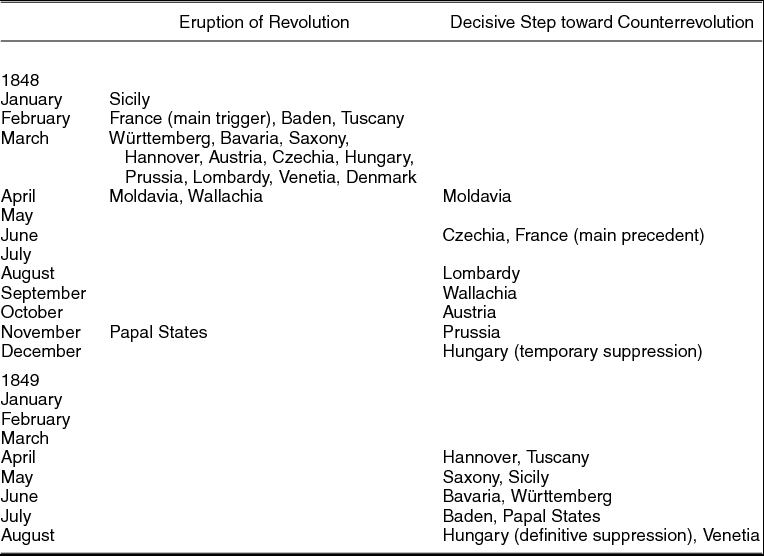



Comments
No Comments have been published for this article.