

There is relatively little published literature in psychology focusing on the Caribbean, let alone Grenada. This fact gave impetus for the first Caribbean Regional Conference of Psychology, which convened in November 2011. The conference provided an opportunity for Caribbean psychologists to contribute to the development of a regionally meaningful psychological science and practice, to collaborate with psychologists from outside the region, and to share their work with colleagues from around the world.
Grenada is a small Caribbean country of 344 km2 (or 133 mi2) at the southern-most tip of the windward island chain in the West Indies (CIA World Factbook, 2013). Its population is slightly more than 100,000, includes Black, European, Arawak/Carib Amerindian, and mixed ethnicities, and is mainly Catholic and Protestant (CIA World Factbook, 2013; Steele, Reference Steele2003). Grenada was discovered by Christopher Columbus, settled by the French, colonised by Great Britain, and currently belongs to the British Commonwealth and to the Caribbean Community (CARICOM) and Organisation of Eastern Caribbean States (CIA World Factbook, 2013; Steele, Reference Steele2003).
Grenada has witnessed political and economic upheaval since gaining independence in 1974. In the late 1970s political tension between the government and opposition escalated to civil unrest and, ultimately, to a series of coups that installed increasingly hardline Marxist regimes. In 1983 the United States and six Caribbean nations launched Operation Urgent Fury, a military incursion that restored Grenada's pre-revolutionary constitution and parliamentary democracy. However, the 2000‒2 Truth and Reconciliation Commission uncovered lingering resentment among Grenadians about this turbulent period in their country's history as well as concern that many injustices of the time have gone unaddressed (Seaga, Reference Seaga2009).
Like other Caribbean countries, a large number of Grenadians have emigrated to countries with healthier economies and better job prospects, especially after the widespread, severe damage caused by two successive hurricanes. These ex-patriate Grenadians remit large sums to support family members on the island (CIA World Factbook, 2013; Steele, Reference Steele2003). In 2004, Hurricane Ivan damaged or destroyed 90% of the buildings in Grenada, followed one year later by Hurricane Emily, which caused another 110 million dollars of damage to a devastated economy (CIA World Factbook, 2013). That economy is currently burdened by unserviceable foreign debt and an unemployment rate above 25% (CIA World Factbook, 2013; World Bank, 2013), and is struggling to emerge from the global economic meltdown of 2008. Grenada's economy revolves around tourism (81.9% of GDP), textiles (12.6% of GDP), and agriculture (5.4% of GDP) (CIA World Factbook, 2013; World Bank, 2013). Grenada's GDP is $1.47 billion, which is 198 worldwide; its GDP per capita is $14,100, which ranks it 92 worldwide (CIA World Factbook, 2013; World Bank, 2013). As an economically developing country, Grenada faces many challenges that impact individuals, families, communities and the nation as a whole. At the structural level there are inequalities tied to disparities in education and income, whereas at the psychosocial level substance misuse and crime are growing concerns (Grenadian Psychological Association, 2012).
Each country appears to have a distinctive ambiance that influences how its citizens collectively feel about and respond to national conditions and events (de Rivera, Reference de Rivera1992; de Rivera, Kurrien & Olsen, Reference de Rivera, Kurrien and Olsen2007). This ambiance has been termed national emotional climate. National emotional climate may be defined as a pervasive pattern of beliefs about how angry, fearful, hopeless, secure and trusting most people feel that reflects shared experiences of the economic, political and social realities of a country (de Rivera, Reference de Rivera1992; de Rivera & Yurtsever, Reference de Rivera and Yurtsever2010). National emotional climate can be objectively measured and correlated with the personally held political views of citizens, such as the desire to emigrate in response to hopeless conditions and, particularly in times of crises, confidence in non-violent protest against injustice and willingness to surrender freedom to preserve stability. To our knowledge, no studies of the national emotional climate of a Caribbean country have been conducted. Given the political and economic history of Grenada and its current difficulties, we believed that such a study would shed light on Grenada's collectively held beliefs and their connection to the personal political inclinations of individual Grenadian citizens.
The purpose of this study was threefold. First, we wanted to delineate the national emotional climate of Grenada. Second, we wanted to examine the relationship between Grenada's national emotional climate to three personally held political views: desire to emigrate, confidence in non-violent protest, and willingness to surrender freedom. The relationship between these variables has been established in previous cross-national research (de Rivera & Yurtsever, Reference de Rivera and Yurtsever2010). Third, we wanted to compare Grenada's national emotional climate to that of selected countries adjoining the Caribbean for which archival data was conveniently available, namely Colombia, Costa Rica and the United States.
Method
Design and Analyses
The design of the study was strictly correlational. Pearson product-moment correlation coefficients were calculated for the five national emotional climate scale scores and ratings for the three items on personal political views, as well as with age and ratings of current happiness, overall happiness and social desirability. Chi-square tests were used to evaluate differences in scores on the five national emotional climate scales based on gender and socioeconomic status. Separate stepwise regression analyses were performed with ratings for each political view as a distinct criterion and the five national emotional climate scale scores as predictors. Our aim was to discern the unique contribution of each dimension of national emotional climate to a particular political view held by individual Grenadians. Finally, raw score means for the five national emotional climate scales for Grenadians and archival national emotional climate scale score means for Colombian, Costa Rican and US samples were standardised to permit a qualitative cross-national comparison of national emotional climate. Noteworthy differences between country samples on standardised national emotional climate scale score means were operationalised as more than one-half of a standard score difference (i.e., a z-score difference above 0.5).
Participants
One hundred and fifty-nine of the 212 (75%) Grenadians who gave written consent to participate completed the hard copy questionnaire accurately and fully, and constituted the final sample. Forty-eight participants were men (30.2%) and 111 were women (69.8%), ranging in age from 18‒47 years (M = 20.9, SD = 5.6). Seventeen (10.7%) participants self-identified as lower class, 27 (17%) as lower-middle class, 93 (58.5%) as middle class, 16 (10.1%) as upper-middle class, and 6 (3.8%) upper class. Although inclusive of all socioeconomic strata, the sample appeared more affluent than the general population of Grenada.
Measures
National emotional climate
National emotional climate was measured by 24 items that required respondents to consider how people (i.e., Grenadians) in general feel about the following five components of emotional climate (de Rivera & Yurtsever, Reference de Rivera and Yurtsever2010): Anger at Government (four items), Fear (three items), Hopeless-Insecurity (four items), Security (four items), and Social Trust (five items). These five scales represent the underlying dimensions of national emotional climate that were derived from an exploratory factor analysis of 1,699 participants from 10 countries, and have been used in previous research on national emotional climate (de Rivera & Yurtsever, Reference de Rivera and Yurtsever2010) and cultures of peace (de Rivera et al., Reference de Rivera, Kurrien and Olsen2007). Adhering to the five-factor structure of national emotional climate permitted us to make cross-national comparisons of national emotional climate, which was our third research objective.
Items require participants to rate on a 7-point Likert scale (1 = no, 7 = absolutely) how citizens in general feel about the current situation in their country, as opposed to how participants personally feel. Eight affect-laden terms were each used in three items, which provided a range of contexts in which these words lent meaning (e.g., ‘Are many people angry at the amount of corruption in the government?’). Anger at Government is an index of frustration and hostility toward elected leaders and their policies (Grenadian α = 0.728). Fear measures anxiety about gathering, publishing, and speaking out in public (Grenadian α = 0.602). Hopeless-Insecurity refers to despair and uncertainty about current and future conditions (Grenadian α = 0.602), whereas Security emphasises confidence and optimism in the country (Grenadian α = 0.644). Social Trust focuses on interpersonal respect and group cooperation on civic goals (Grenadian α = 0.649). The internal consistency reliabilities of the five scales of national emotional climate were adequate based on our volunteer sample, and were somewhat lower than those reported by de Rivera and Yurtsever (Reference de Rivera and Yurtsever2010).
Political Views
We measured three personally held politically views using a 7-point Likert scale (1 = no, 7 = absolutely). Desire to emigrate was assessed by the item, ‘Is this country so hopeless that people want to leave?’ Confidence in non-violent protest was tapped by the item, ‘How confident are people that nonviolent methods (such as voting, peaceful protests, strikes that do not destroy property) can increase justice in this society?’ Willingness to surrender freedom was gauged by the item, ‘Are you willing to give up some freedom so that a strong leader can make things better?’ Each of these items has been used in prior research as an index of politically related personal beliefs (de Rivera et al., Reference de Rivera and Yurtsever2010). We dispersed the three items on political views among the 24 items that comprised the measure of national emotional climate.
Control variables
To determine whether responses to the five scales of national emotional climate and three items on personal political views were confounded, we administered two mood-related items and one item on social desirability (de Rivera et al., Reference de Rivera and Yurtsever2010). One of the mood-related items inquired about participants’ current level of happiness, whereas the other asked about their level of overall life happiness. The social desirability item probed how pressured participants feel in responding as others want. Mood and social desirability items required participants to provide a rating with a 7-point Likert scale (1 = no, 7 = absolutely). We embedded the three items on mood and social desirability, along with two categorical items that inquired about gender and socioeconomic status and one open-ended item on age, among the 24 items that measured national emotional climate.
Procedure
Grenadians from most of the country's six parishes were recruited by snowball sampling, beginning with undergraduate volunteers at St George's University in Grenada. A majority of participants were undergraduates in their 20s, complemented by a few volunteer family members, friends and neighbours who were not affiliated with St George's University. All participants consented in writing to complete a 33-item paper-and-pencil questionnaire that consisted of the 24 items on national emotional climate, three items on personal political views, two items on mood, one item on social desirability, one item on gender, one item on socioeconomic status, and one item on age. Once completed, questionnaires were returned to or collected by the second author. Participants were told that the results of the study would be posted on the website of the first author, where they could also find a debriefing statement.
Results
The five national emotional climate scale scores and ratings for the three items on personal views were not significantly correlated with age, gender, socioeconomic status, ratings of current and overall happiness, and ratings of social desirability. We concluded that the data on national emotional climate and personal political views were not moderated by demographic variables nor confounded by mood or social desirability. Therefore, we proceeded by statistically analysing the raw scores for the pooled sample of Grenadians.
Grenadian data analyses
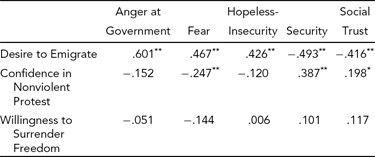
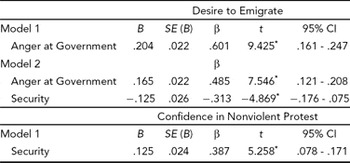
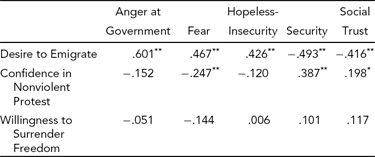
Pearson product-moment correlations between national emotional climate scale scores and ratings for the items on personal political views are presented in Table 1. Significant stepwise regression analyses of national emotional climate scale scores on ratings of each political view appear in Table 2. Desire to emigrate was correlated (ps < 0.005) positively with Anger at Government, r(157) = 0.601, Fear, r(157) = 0.467, and Hopeless-Insecurity, r(157) = 0.426, and negatively correlated with Security, r(157) = -0.493, and Social Trust, r(157) = -0.416. A stepwise multiple regression indicated that Anger at Government and Security predicted the desire to emigrate, R2 = 0.446, F(2, 156) = 62.688, p < 0.005, f 2 = 0.805; ΔR 2 = 0.361, F(1, 157) = 88.825, p < 0.005, f 2 = 0.565 and ΔR 2 = 0.084, F(1, 156) = 23.705, p < 0.005, f 2 = 0.092, respectively.
Correlations between national emotional climate and political views
Note. Degrees of freedom = 157
*p < .01, two-tailed. **p < .005, two-tailed.
Significant stepwise regressions predicting political views from national emotional climate

Note. Degrees of freedom = 157
*p < .005, two-tailed.
Confidence in non-violent protest was correlated positively with Security, r(157) = 0.387, p < 0.005, and Social Trust, r(157) = 0.198, p = 0.012, and negatively correlated with Fear, r(157) = -0.246, p < 0.005. Security predicted confidence in nonviolent protest, R 2 = 0.150, F(1, 157) = 27.644 p < 0.005, f 2 = 0.176.
None of the national emotional climate scale scores was correlated significantly with willingness to surrender freedom, nor did any of these scale scores predict willingness to surrender freedom.
Cross-national data analysis
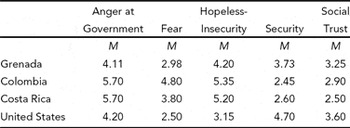
Mean national emotional climate scale scores for the Grenadian sample and for samples drawn from three other countries adjoining the Caribbean appear in Table 3. National emotional climate data for Colombia (N = 155), Costa Rica (N = 127), and the United States (N = 188) were gathered in previous research (de Rivera et al., Reference de Rivera and Yurtsever2010). Much like our Grenadian sample, participants from these countries were principally middle-class university students in their 20s, although a small proportion of them were drawn from the community at large.
Country means for national emotional climate scales

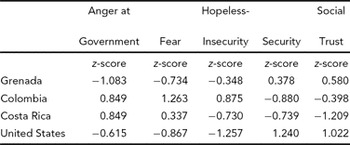
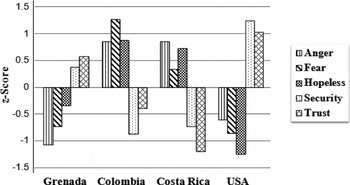
Raw score means for the five national emotional climate scales for Grenadian, Colombian, Costa Rican and US samples were then standardised. The standardised national emotional climate scale means for these four national samples are presented in Table 4 and depicted graphically in Figure 1. The overall pattern of z-scores reveal a more positive national emotional climate for Grenadians and Americans in contrast to a more negative national emotional climate for Colombians and Costa Ricans; in fact, the pattern of standardised national emotional climate scale means for Grenadians and Americans is nearly parallel. Grenadians appear to experience more security and social trust, but less anger at government, fear and hopeless-insecurity than Colombians and Costa Ricans. Compared to the US sample, Grenadians reported more hopeless-insecurity and less security.
Standardized country means for national emotional climate scales

z-score differences in national social climate scale means for four country samples

Discussion
In reflecting on their fellow citizens’ predominant experience of the economy, politics and society, Grenadian participants identified widespread moderate frustration with government leaders and policies coupled with mixed feelings of resignation and optimism about current and future conditions affecting the country. They reported little pervasive apprehension about public discourse and a broad-based tendency to respect and expect cooperation from their fellow citizens. Grenadians did not manifest a pattern of collectively held beliefs that would likely occasion personal intentions to leave the country or to abandon peaceful methods of working toward social change.
These findings come as no surprise. As in many Caribbean countries, Grenada has already witnessed a large number of young people depart the island. With more than 100,000 people residing in Grenada, estimates are that at least that number of Grenadians have emigrated elsewhere in the Caribbean and at least that number again have settled in first-world countries (CIA World Factbook, 2013; Steele, Reference Steele2003). The economy has been shackled with debt from rebuilding the island in the wake of hurricanes Ivan and Emily nearly a decade ago and has shown vulnerability since then to episodic regional and global economic declines. However, Grenada has viable tourism, manufacturing and agriculture sectors that have potential for growth and job creation. Politically, Grenada has enjoyed an unbroken period free of political violence since 1983 (Seaga, Reference Seaga2009). The country is sufficiently stable to have recently commuted the sentences of several members of the ‘Grenada 17’ who were convicted of the 1983 coup that overthrew and murdered then Prime Minister Maurice Bishop. Early in 2013, Grenadians participated in a contentious national election in which the National Democratic Congress was resoundingly defeated due to widespread dissatisfaction with the party's leaders in failing to chart a course for economic recovery and to demonstrate political inclusiveness and transparency in its approach to governance (Caribbean News Now, 2013a).
Notwithstanding these mixed economic and political realities, Grenadian citizens, whether at home or in the Grenadian diaspora, appeared highly engaged in the life of their country, with electoral observation missions from the Organisation of American States and CARICOM reporting 85% total voter turnout and both the campaign and election conducted peacefully (Caribbean News Now, 2013b). Thus, there is impressionistic historical and contemporary evidence to support our finding of an association between the collective beliefs about Grenada and the political views of individual Grenadians: while moderate frustration toward government leaders and policies may lead some Grenadians to contemplate leaving the island, when paired with cautious optimism about the Grenada's future, may modulate anger at government, offer an incentive for citizens to stay put, and increase engagement in lawful political change. This possibility underscores the need for sophisticated research designs to disentangle the complex interaction between multiple dimensions of national emotional climate and personal political beliefs both in Grenada and elsewhere.
The national emotional climate of Grenada is generally more positive than that of Colombia and Costa Rica, but somewhat less favourable than that of the United States. Economic development has been tentatively linked to a positive national emotional climate (de Rivera, Reference de Rivera1992; de Rivera & Yurtsever, Reference de Rivera and Yurtsever2010). However, this interpretation cannot account for the differences in national emotional climate observed between Grenada and both Colombia and Costa Rica, all of which share developing country status and are upper-middle income countries (CIA World Factbook, 2013; World Bank, 2013). Nor does it explain the similarity in national emotional climate between Grenada and the United States, which is a high-income country (CIA World Factbook, 2013; World Bank, 2013). Likewise, demographic homogeneity and the cultural dimension of individual-collectivism fall short of clarifying the similarities and differences in national emotional climate between Grenada and selected countries that adjoin the Caribbean. While it is reasonable to assert that Grenada, Colombia and Costa Rica are more demographically homogeneous and culturally collectivistic than the United States, the country means for national emotional climate scale scores do not adhere to this pattern.
An alternative consideration in making sense of our findings may lie in how the cultural milieu of the four countries covary; Grenada and the United States share an Anglo-centric culture whereas Colombian and Costa Rican culture is primarily Latin. Whether these two cultures contribute to various dimensions of national emotional climate and how they mediate the similarities and differences between the four countries sampled are topics worthy of future research. Furthermore, our findings for Grenada departed markedly from those of the 10 countries that de Rivera and Yurtsever (Reference de Rivera and Yurtsever2010) compared. In their study, desire to emigrate was predicted by all national emotional climate scales except for social trust, confidence in nonviolent protest by social trust and willingness to surrender freedom by fear and social trust. Thus, we hereby offer a tentative hypothesis that national emotional climate, which reflects a set of interwoven collective beliefs born of shared economic, political and social experiences, may be influenced by more enduring and foundational normative systems (de Rivera, Reference de Rivera1992). The work of Ronald Ingelhart and Wayne Baker as well as that of Michael Harris Bond seem highly germane here. Ingelhart and Baker (Reference Ingelhart and Baker2000) extracted two bipolar dimensions from their World Values Survey, namely authority (i.e., traditional – secular/rational) and values (i.e., survival – self-expression). These dimensions can be crossed to locate countries in a four-celled matrix with which to understand how culture can influence how countries response to economic and political challenges. Similarly, Bond et al. (Reference Bond, Leung, Au, Tong, de Carrasquel, Murakami and Lewis2004) identified two social axioms, or culture-level beliefs that act as recipes for living, which can be transformed into a four-fold typology: dynamic externality (i.e., conservative social hierarchies) and societal cynicism (i.e., widespread mistrust of social systems). This typology also offers an attractive conceptual framework for better understanding the observed cross-national variation in national emotional climate. Obviously, further research is needed to identify, measure and conceptually integrate cultural and other group-level variables, about which relatively little is known (Griffith, Reference Griffith2001), that contribute to Grenada's national emotional climate per se and in relation to its neighbours.
Future regional investigations of national emotional climate and personal political views should gather data on and compare larger, more representative samples from Grenada and other understudied Caribbean countries. In addition, these studies should establish the cross-national equivalence of measures of national emotional climate and personal political views at both the item and factor level.