Introduction
Social relation is one of the most important determinants of successful ageing (von Faber et al. Reference von Faber, Bootsma-van der Wiel, van Exel, Gussekloo, Lagaay, van Dongen, Knook, van der Geest and Westendorp2001). Considering heterotypic social relations among older adults (Fiori, Antonucci and Cortina Reference Fiori, Antonucci and Cortina2006), social network typology research has focused on patterned variations among older adults. These variations are based on discernible network types derived from a range of social relation variables (Gerstorf, Smith and Baltes Reference Gerstorf, Smith and Baltes2006). Studies using social network typology have demonstrated that older adults in networks with a broader array of social relations report better health and psychological wellbeing than those in more isolated network types (Cheng et al. Reference Cheng, Lee, Chan, Leung and Lee2009; Fiori, Antonucci and Akiyama Reference Fiori, Antonucci and Akiyama2008; Fiori, Antonucci and Cortina Reference Fiori, Antonucci and Cortina2006; Fiori, Smith and Antonucci Reference Fiori, Smith and Antonucci2007; Litwin Reference Litwin2001; Litwin and Shiovitz-Ezra Reference Litwin and Shiovitz-Ezra2011; Wenger Reference Wenger1997). While this is an important finding with potentially far-reaching and long-term implications, little longitudinal evidence is available.
Compared to the accumulating knowledge of the cross-sectional association between network types and health and wellbeing, little research has been conducted on the changes in social networks over time, or the effects of these changes on the physical and psychological wellbeing of older adults. In addition, while the American and European samples have been examined rigorously, social network typology research should also include diverse, especially non-Western, social and cultural contexts. This broader focus will support better understanding of the generalisability or cultural-specificity of the linkages between social network types and wellbeing in old age. To address these issues, the present study investigates changes in social network types among older adults in South Korea using two waves of nationally representative panel data. We examine if and to what extent changes in social network types influence the subjective health and psychological wellbeing of older South Koreans.
Pattern-centred social network types
A number of studies have demonstrated that social relations significantly influenced the health and wellbeing of older adults (Ingersoll-Dayton, Morgan and Antonucci Reference Ingersoll-Dayton, Morgan and Antonucci1997; Newsom et al. Reference Newsom, Nishishiba, Morgan and Rook2003). However, other studies have provided inconsistent results (Hanson et al. Reference Hanson, Isacsson, Janzon and Lindell1989; Lund et al. Reference Lund, Modvig, Due and Holstein2000). It is likely that these emerged because many previous studies have focused on a few selected aspects of individuals’ social relations and have used a variable-centred approach (Fiori and Jager Reference Fiori and Jager2012). The variable-centred approach aims to understand how a specific type of social relations affects health and wellbeing after artificially controlling for other types of social relations. These studies tend to focus on structural (e.g. contact frequency with family or friends; Due et al. Reference Due, Holstein, Lund, Modvig and Avlund1999) or functional (e.g. exchange social support; Brown et al. Reference Brown, Nesse, Vinokur and Smith2003) social relations in isolation from one another. Analysis of such functions provides little insight about the actual configuration of social relations in old age.
Considering the limitation of this variable-centred approach, some researchers recently have recommended identifying social network typologies using a pattern-centred approach. This approach has the advantage of allowing scholars to assess the social relations of individuals in a more comprehensive manner (Fiori, Smith and Antonucci Reference Fiori, Smith and Antonucci2007). In contrast to the prevalent variable-centred approach, this pattern-centred approach elucidates a variety of aspects of heterotypic adaptations among older adults (Fiori, Smith and Antonucci Reference Fiori, Smith and Antonucci2007). Social network typology distinguishes among individuals based on network constellations rather than specific characteristics of social relations (Cheng et al. Reference Cheng, Lee, Chan, Leung and Lee2009).
Previous studies in social network typology have examined the association between social network types and physical and/or psycho-social wellbeing. Analyses of cross-sectional survey data from community-residing older adults in diverse societies such as Hong Kong, Israel, Japan, Wales and the United States of America have identified four relatively robust social network types based on type and size of social relations, and frequency of contact: Diverse, Friend-focused, Family-focused and Restricted (Cheng et al. Reference Cheng, Lee, Chan, Leung and Lee2009; Fiori, Antonucci and Akiyama Reference Fiori, Antonucci and Akiyama2008; Fiori, Antonucci and Cortina Reference Fiori, Antonucci and Cortina2006; Fiori and Jager Reference Fiori and Jager2012; Fiori, Smith and Antonucci Reference Fiori, Smith and Antonucci2007; Litwin Reference Litwin2001, 2011; Litwin and Shiovitz-Ezra Reference Litwin and Shiovitz-Ezra2011; Scharf and Wenger Reference Scharf and Wenger1995; Wenger Reference Wenger1996, 1997). The general pattern of findings suggests that social networks with a wider range of ties, such as the Diverse and Friend-focused networks, were associated with positive health and wellbeing outcomes (Fiori, Smith and Antonucci Reference Fiori, Smith and Antonucci2007). In particular, the Diverse network has been shown to be the most protective of physical and psycho-social health. In contrast, findings indicate that the Restricted social network group, that with the most limited ties, was associated with the poorest health outcomes.
Theoretical perspective: Convoy Model of Social Relations
The Convoy Model of Social Relations (Antonucci Reference Antonucci, Birren and Schaie2001) provides a modern theoretical perspective of social ageing and the lifespan development of social relations (Wahl and Lang Reference Wahl, Lang, Wahl, Scheidt, Windley and Schaie2004). We used the Convoy Model to guide the present longitudinal examination of social network types and the effects of these network types on the health and wellbeing of older adults. This theory conceptualises close social relations as a convoy that surrounds and protects individuals throughout the lifecourse (Antonucci Reference Antonucci, Birren and Schaie2001). A convoy represents various resources that provide support to individuals. Convoys have been shown to significantly influence an individual's health and psychological wellbeing (Fiori, Antonucci and Cortina Reference Fiori, Antonucci and Cortina2006). Because the composition and quality of an individual's social network is shaped by a variety of personal and situational factors (Fiori and Jager Reference Fiori and Jager2012), social convoys are not static entities, but rather multilayered dynamic systems. In this respect, the social network of an individual is expected to change over time. This change may affect his or her health and psychological wellbeing.
Longitudinal research would further strengthen social network typology research by investigating how individuals’ social network types develop over time. Currently, limited knowledge exists about transitions in social network types. Most previous studies of variable- and pattern-centred social networks were cross-sectional. Change and stability in older adults’ social relations were often assumed from the cross-sectional findings. These studies have shown that the oldest-old were over-represented in the Restricted network type (Litwin Reference Litwin2001; Litwin and Landau Reference Litwin and Landau2000; Park, Smith and Dunkle Reference Park, Smith and Dunkle2013). However, it is not clear whether older people are more likely to have restricted networks as they age, or if they are more likely to have always been members of restricted networks (i.e. whether they exhibit a cohort effect). In addition, because most social network typology research has used cross-sectional data-sets to analyse the associations between social network types and health outcomes, the direction of influence between social network and health outcomes cannot be ascertained. It is conceivable that the increased physical and mental health challenges often associated with older age influence changes in social network type membership. A longitudinal investigation would address this question.
Expanding the Convoy Model to additional cultures
Most prior studies of social network types have focused on older adults in Western societies (Fiori, Antonucci and Cortina Reference Fiori, Antonucci and Cortina2006; Melkas and Jylhä Reference Melkas, Jylhä and Litwin1996; Stone and Rosenthal Reference Stone, Rosenthal and Litwin1996; Wenger Reference Wenger1991, 1996). Recent social network typology research has expanded to Eastern societies, among them Hong Kong (Cheng et al. Reference Cheng, Lee, Chan, Leung and Lee2009), Japan (Fiori, Antonucci and Akiyama Reference Fiori, Antonucci and Akiyama2008) and South Korea (Park, Smith and Dunkle Reference Park, Smith and Dunkle2013). The growing body of evidence from these studies suggests that cultural variations may exist not only between Western and Eastern societies, but also among Asian countries. Previous studies showed that while older adults in Western countries are more likely to be in diverse or friend-focused social networks, those in Asian countries tend to have family-focused social relations (Cheng et al. Reference Cheng, Lee, Chan, Leung and Lee2009; Fiori, Antonucci and Akiyama Reference Fiori, Antonucci and Akiyama2008; Fiori, Antonucci and Cortina Reference Fiori, Antonucci and Cortina2006; Fiori and Jager Reference Fiori and Jager2012). Although the family-focused type has been found to be a prevalent and important social network among older adults in Asian countries such as Hong Kong and Japan (Cheng et al. Reference Cheng, Lee, Chan, Leung and Lee2009; Fiori, Antonucci and Akiyama Reference Fiori, Antonucci and Akiyama2008), Park, Smith and Dunkle (Reference Park, Smith and Dunkle2013) identified a couple-focused network type instead of a family type among older Koreans. These emerging differences among Asian countries caution against taking a binary approach when studying Western and Eastern cultures.
The social and cultural context of South Korea provides another unique opportunity to investigate older adults’ social relations and the effects of relationships on health and psychological wellbeing. As with other Asian countries, South Korea had a long tradition of cultivating strong intergenerational ties that are based on filial piety. However, during the second half of the twentieth century, it experienced rapid social and cultural transitions influenced by its industrialisation and westernisation. In particular, social norms concerning family obligations shifted rapidly (Lee et al. Reference Lee, Chung, Yeom, Oh, Yoo and Lee2010), resulting in an increase in single- or couple-only households among older adults (Lee Reference Lee2010). The majority of middle-aged and older Koreans now report believing that caring for older adult family members is not a child's responsibility; that older parents should prepare for old age themselves; and that they should expect more assistance or support from public services than from family (Lee Reference Lee2008; Lee et al. Reference Lee, Chung, Yeom, Oh, Yoo and Lee2010). Cultural differences between Western and Eastern societies have often been classified as a contrast between independence/individualism versus interdependence/collectivism (Hofstede Reference Hofstede2001; Triandis Reference Triandis2001). However, interdependence/collectivism may no longer be an accurate representation of intergenerational relationships in South Korea.
The present study
The present study examines if and to what extent older adults’ social networks change over time and investigates to what extent any changes in older adults’ network types affect their subjective health and psychological wellbeing. To that end, we assessed network types at two points in time: 2006 and 2008. We then assessed patterns of change in network types over two years, and finally examined the effects of change on subjective health and psychological wellbeing. Because previous studies found that older cohorts were over-represented in the restricted network type (Litwin Reference Litwin2001; Park, Smith and Dunkle Reference Park, Smith and Dunkle2013), we hypothesised that (a) older adults’ social network types would shift towards a more restricted type over time. In line with results from previous studies demonstrating the negative effects of restricted networks on health and psychological wellbeing, we hypothesised that (b) older adults who remained members of the restricted social network type would be more likely to report poorer self-rated health, higher levels of depressive symptoms and lower levels of life satisfaction than those who were never part of the restricted network type, those who transferred from restricted to non-restricted network types and/or those who became part of the restricted network type.
Method
Data and sample
This study used the 2006 and 2008 data from the Korean Longitudinal Study of Aging (KLoSA), a nationally representative study of South Koreans aged 45 and older. To investigate social network types among older adults, this study restricted its sample to respondents over age 65 at baseline (2006) who currently resided within a community and who completed surveys of both waves in 2006 and 2008 (N = 3,501; mean age = 72.8, standard deviation = 6.12, range 65–105 years).
Measures
Dependent variables
This study examined three measures of health and wellbeing: self-rated health, depressive symptoms and life satisfaction. Self-rated health was assessed by asking, ‘Overall, how would you describe the state of your health these days?’, and was measured on a five-point scale (1 = very good, 2 = good, 3 = fair, 4 = poor and 5 = very poor). Depressive symptoms were assessed using the Center for Epidemiological Studies Depression ten-item scale (CES-D 10; Radloff Reference Radloff1977), using a four-point scaled response format for each item ranging from 0 to 3 (0 = very rarely, 1 = sometimes, 2 = often and 3 = almost always). To calculate the CES-D 10 score, the two positively phrased items were reverse coded, and the ten items were then summed. The internal consistency score was 0.82. Life satisfaction refers to self-reported life satisfaction. Respondents were asked, ‘Compared with others your age, how satisfied are you with your quality of life?’ Life satisfaction was measured as a continuous variable ranging between 0 and 100 where greater values indicated higher life satisfaction. All dependent variables were from Wave 2 and were controlled for self-rated health, depressive symptoms and life satisfaction at Wave 1.
Independent variables
Changes in social network types were the primary independent variables in this study. These were established using a two-step procedure. First, network types were derived based on five social network characteristic variables reported in the social support literature: current marital status, family size, contact with children, contact with friends and social activities (Lubben et al. Reference Lubben, Blozik, Gillmann, Iliffe, Kruse, Beck and Stuck2006; Wenger Reference Wenger1991). Second, changes in social network types between the two waves were categorised into four groups based on stability or change in network membership relative to the restricted network. The four groups were: Remain Restricted, Became Restricted, Became Non-restricted and Remain Non-restricted.
Current marital status was coded as 0 (not married) or 1 (married). Respondents who lived with their spouses or partners were considered married, and those who were divorced, separated, widowed or never married were categorised as ‘not married’. For family size, a simple count was used. Contact with children was derived from two classes of contact types: face-to-face contact and email or phone contact. These were coded on a five-point scale ranging from 1 (rarely) to 4 (almost every day) to 5 (currently live with). Frequency measures (i.e. face-to-face and email/phone contact) were requested for up to ten children, and the average score of these two frequencies was used. Contact with friends was derived by assessing frequency of contact with close friends and frequency of attendance at alumni meetings. Both were measured on a four-point scale ranging from 1 (rarely) to 4 (every day). The average score of both frequencies was used. For social activities, four types of group activities were included. These were attendance at religious services, a social club within a senior centre, regular sports or cultural clubs, and political organisations such as a political party or civic organisation. All activities were measured on a four-point scale ranging from 1 (rarely) to 4 (every day), and the average score of all the activities was used.
Covariates
Socio-demographic attributes and health conditions from the baseline survey were controlled for in the analyses. Age was measured as a continuous variable. Gender was measured as male or female, and education was measured by the number of years of formal schooling. The total of a couple's income was derived by combining the annual income of husband and wife, reported in millions of Korean won. Home-ownership was indicated by coding homeowner as 1 and non-homeowner as 0. Urbanicity was assessed as either urban (population greater than 50,000) or rural (population less than 50,000). Functional status was assessed based on 17 activities of daily living and instrumental activities of daily living. These include: bathing, dressing, eating, transferring from bed to chair and back, voluntarily controlling urinary and faecal discharge, using the toilet, walking, light housework, preparing meals, taking medications, shopping for groceries or clothes, using the telephone and managing money (Won et al. Reference Won, Yang, Rho, Kim, Lee, Yoon, Cho, Shin, Cho and Oh2002). Cognitive impairment was measured using 19 items from the Korean Mini-Mental State Examination with the total score ranging from 0 to 30 (Kang, Na and Han Reference Kang, Na and Han1997). A reversed score was used for analyses so that high scores represented higher levels of cognitive impairment.
Data analysis
We used Latent Class Analysis (LCA) to categorise individuals into groups where the individuals within a group were similar to one another and different from individuals in other groups (McCutcheon Reference McCutcheon, Hagenarrs and McCutcheon2002). Compared to a clustering analysis such as a k-means analysis, which most existing network typology research has used (Cheng et al. Reference Cheng, Lee, Chan, Leung and Lee2009; Fiori, Antonucci and Akiyama Reference Fiori, Antonucci and Akiyama2008; Fiori, Antonucci and Cortina Reference Fiori, Antonucci and Cortina2006; Litwin Reference Litwin2001; Litwin and Shiovitz-Ezra Reference Litwin and Shiovitz-Ezra2011; Park, Smith and Dunkle Reference Park, Smith and Dunkle2013), LCA deals effectively with measurement error (Fiori and Jager Reference Fiori and Jager2012; Yamaguchi Reference Yamaguchi2000). It estimates network types by classifying a person into a certain category. In order to decide on an optimal classification of network types, four criteria of model fits were used: Akaike Information Criterion (AIC), Bayesian Information Criterion (BIC), Entropy's score and Vuong-Lo-Mendell-Rubin (VLMR) (Geiser Reference Geiser2013). The stability of each model was examined by using different sets of starting values based on a local maximum iteration process. Selection of smallest AIC and BIC scores were used as criteria for goodness of fit. High Entropy's score was selected to measure how well the classes can be distinguished. The VLMR test was used to assess whether the right number of classes was chosen.
After discernible network types in each year were derived, four types of network changes were created. These focused particularly on status with respect to the restricted network: Remain Restricted, Became Restricted, Became Non-restricted and Remain Non-restricted. Bivariate analyses were then conducted between every background variable and the four network change types. Here we examined differences across the groups’ socio-demographic attributes and health conditions. We further examined how changes in the network types of the older adults affected their subjective health and psychological wellbeing. To that end, a series of multivariate regressions (i.e. ordered logit regressions for self-rated health, and ordinary least squares regressions for depressive symptoms and life satisfaction) were employed to control for background variables at the baseline. Variables included age, gender, education, income, home-ownership, living location (urban versus rural), and physical and mental health conditions such as self-rated health status, depressive symptoms, life satisfaction, functional limitation and cognitive impairment.
We tried to address the potential reciprocal associations between social networks and health/psychological wellbeing (i.e. deterioration in health may limit social relations of older adults) in two ways. First, by using longitudinal data with two time-points, this study analysed the influence of changes in social networks between 2006 (time 1) and 2008 (time 2) on self-rated health, depressive symptoms and life satisfaction in 2008 (time 2). In addition, we controlled for lagged variables of self-rated health, depressive symptoms and life satisfaction in the analyses. Also, all covariates were taken from time 1. We believe that this research design allows more clear causality between social network changes (independent variables) and health/psychological wellbeing (dependent variables). Second, we examined the effects of changes in social network type on health and psychological wellbeing in a sample restricted to subjects who were relatively physically and psychologically healthy at the baseline (Lawlor et al. Reference Lawlor, Hart, Hole and Smith2006; Zheng et al. Reference Zheng, McLerran, Rolland, Zhang, Inoue, Matsuo and Potter2011). In this sensitivity analysis, we selected the sample who had good self-rated health (i.e. very good or good; 20% of the total sample) and a high level of life satisfaction (i.e. life satisfaction score greater than 80; 23% of the total sample) at the baseline. For depressive symptoms, a cut-off score of 10 was used. According to Andersen (Reference Andersen1994), the score of 10 or higher for CES-10 indicates the presence of significant depressive symptoms.
Although KLoSA includes a relatively small number of missing values, multiple imputations were used to ensure that samples in this study reflect all the eligible respondents (Schafer Reference Schafer1999).
Results
Social network types
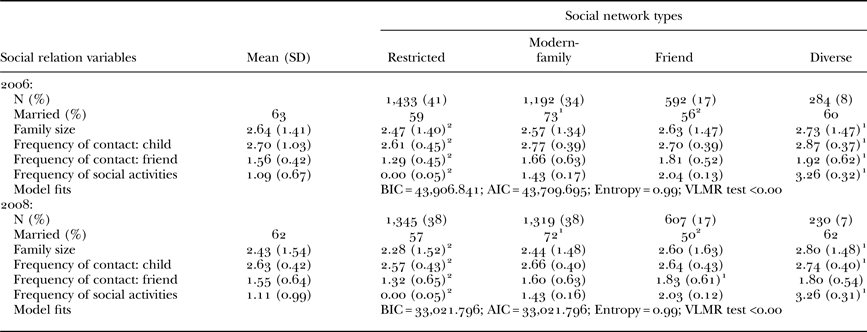
All four criteria of model fits (i.e. AIC, BIC, Entropy's score and LVMR) from the LCA indicated that the four-class solution is the most optimal classification of network types for our sample. Each cluster type was named after assessing the distribution of criterion variables across the four clusters. Table 1 presents profiles for the total sample and for each of the four network types in 2006 and 2008: Restricted, Modern-family, Friend and Diverse.
Group means and proportions for five social relations variables by network type in 2006 and 2008

Notes: N = 3,501. SD: standard deviation. AIC: Akaike Information Criterion. BIC: Bayesian Information Criterion. VLMR: Vuong-Lo-Mendell-Rubin. 1. Highest percentage or mean value. 2. Lowest percentage or mean value.
The Restricted network was the most prevalent (41% in 2006, 38% in 2008) social network type among Korean older adults. Individuals in this network demonstrated the most limited social ties compared to individuals from the other three types of social networks. This group was characterised by the lowest proportion of married individuals, smallest family size, least frequent contacts with children or friends, and lowest attendance at social activities within respective communities. The Modern-family network (34% in 2006, 38% in 2008) was the second-most prevalent social network type. The characteristics of this group were similar to family-focused network types found in previous studies (e.g. Fiori, Antonucci and Cortina Reference Fiori, Antonucci and Cortina2006); it included individuals who were likely to be married and who maintained closer relationships with children than friends. Involvement in social activities was minimal. However, the family size of older Koreans in this network was not significantly larger than other networks. The Friend network (17% in 2006 and 2008) was distinguished by the lowest scores in marital status and highest scores in contact frequency with friends and social activities. The Diverse network was the least frequent network type (8% in 2006, 7% in 2008) and included individuals who were distinguished by high scores on all four social relation criteria. The Restricted and Diverse networks contrasted with each other in all social relations criteria except marital status.
Changes in social network types over time
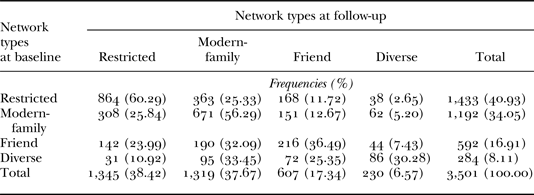
Table 2 shows the changes in network types between the baseline and the follow-up surveys among older adults in South Korea. Although the distribution of the four network types in each year was very similar, this study found dynamic transitions across different social network types over time. Only half the respondents remained in the same social network type over the two waves of the study. The Friend and Diverse network types were observed to be more dynamic than the Restricted and Modern-family network types: only one-third of individuals in these groups remained in the same network types. Despite dynamic shifts in other social network types, the Restricted network type was relatively stable. More than 60 per cent of respondents remained in the Restricted network over the two waves. Of the four network types identified in this study, the Restricted type was characterised by the most isolated social network. The Diverse type was characterised by the broadest range of social relations, followed by the Friend type. We found that the change in social network type was not always in the direction of the Restricted type. However, the proportions of respondents who moved to this more isolated network type were much larger than those who moved to broader network types. For example, among elders in the Modern-family type at the baseline survey, 26 per cent shifted to the Restricted type at the follow-up, while 18 per cent of them changed to the Friend (13%) or Diverse (5%) type. Also, among respondents in the Friend type at baseline, 56 per cent moved into the Restricted (24%) or Modern-family (32%) type. However, only 7 per cent of these respondents belonged to the Diverse type at follow-up. In the Restricted group, which was the most isolated type of social network, 60 per cent remained in the Restricted group, and only about 40 per cent moved into a broader network type. On the other hand, among those in the Diverse group, the largest proportion (approximately 70%) moved to other social network types (i.e. social network types with narrower social relations), and only 30 per cent were remained in this group.
Changes in network types between baseline and follow-up

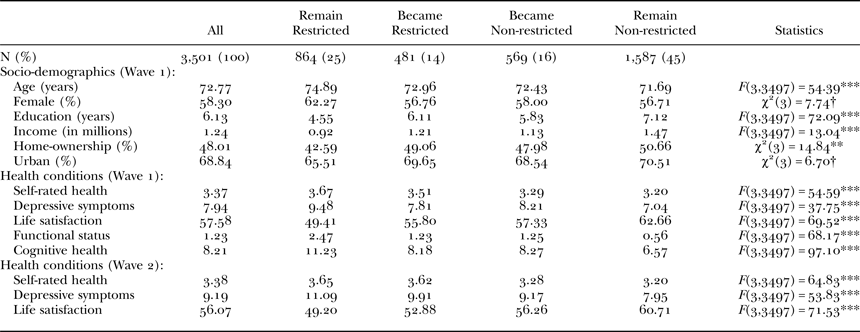
For the following analyses, the four types of social networks were re-categorised into two groups: Restricted (including Restricted type only) and Non-restricted (including Modern-family, Friend and Diverse). Next, the four network change types (Remain Restricted, Remain Non-restricted, Became Restricted and Became Non-restricted) were identified based on whether or not respondents transitioned between the Restricted and Non-restricted groups across the two waves. A quarter of respondents remained in the Restricted network over time (Remain Restricted) and 45 per cent were not embedded in the Restricted network in either 2006 or 2008 (Remain Non-restricted). Within the sample, 14 per cent of older adults changed their social network type from Non-restricted to Restricted (Became Restricted) and 16 per cent transitioned out of the Restricted over the study period (Became Non-restricted).
A series of bivariate analyses (i.e. analysis of variance and chi-square tests) between the social network types and all socio-demographic and health variables showed that all individuals’ attributes varied significantly across the types of network change (Table 3). In particular, these analyses demonstrated that characteristics of those in the Remain Restricted group contrast significantly and consistently with those in the Remain Non-restricted group. Analysis of variance shows that age differed by network type. Members in the Remain Restricted group were the oldest and those in the Remain Non-restricted group were the youngest. The Remain Restricted group contained the largest proportion of women and the Remain Non-restricted group included the smallest number of women. The Remain Restricted group had the lowest levels of education, whereas the Remain Non-restricted group had the highest levels. A similar pattern was found for income level, home-ownership and urban residency.
Characteristics of sample and network type differences by key variables

Significance levels: † p < 0.10, ** p < 0.01, *** p < 0.001.
For health conditions and psychological wellbeing, analyses of variance also showed that all dimensions differed significantly by the type of network changes (p < 0.001). A clear pattern was found in all outcome variables. Older adults in the Remain Non-restricted group showed the most positive health and psychological wellbeing at baseline regarding self-rated health, depressive symptoms, life satisfaction, functional status and cognitive health. On the other hand, those in the Remain Restricted group had the poorest health and psychological wellbeing outcomes. These preliminary findings were investigated further through multivariate analyses.
Multivariate analyses
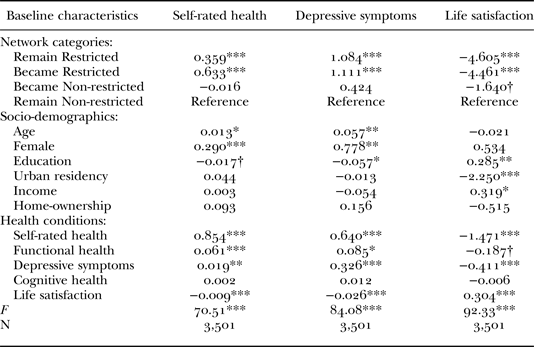
Table 4 presents the regression results from the models for self-rated health, depressive symptoms and life satisfaction. The first column shows the regression coefficients from the ordered logit model for self-rated health. Compared with those who Remained in the Non-restricted network group, individuals whose social network types Remained or Became Restricted during the study period reported poorer health. However, respondents whose social network types Remained Non-restricted did not statistically differ on self-rated health from those who Became Non-restricted. Post-estimation tests were performed to permit further comparisons between other categories (i.e. Remain Restricted versus Became Restricted, Remain Restricted versus Became Non-restricted, and Became Restricted versus Became Non-restricted). Post-estimation tests indicate that older adults who Became Restricted rated their health condition poorer compared to people in all other types of network changes. Moreover, individuals in the Remain Restricted group had poorer self-rated health than those in the Became Non-restricted group (results not shown).
Multivariate analyses on subjective wellbeing at follow-up by network types changes

Note: The coefficients for self-rated health are from an ordered logit model. All other coefficients are from ordinary least squares regressions. All the analyses were conducted with multiple imputed data-sets.
Significance levels: † p < 0.10, * p < 0.05, ** p < 0.01, *** p < 0.001.
The second column presents the regression coefficients for depressive symptoms. Similar to results for self-rated health, the Remain Restricted or Became Restricted was associated with poorer depressive symptoms at the follow-up survey compared to the Remain Non-restricted. Post-estimation tests suggest that older adults in the two restricted groups, the Remain Restricted and Became Restricted groups, had more depressive symptoms than those in the Became Non-restricted group. No difference was found between the Remain Non-restricted and the Became Non-restricted (results not shown).
Finally, the results from the regression model for life satisfaction are presented in the last column. The results indicate a pattern similar to the previous findings regarding self-rated health and depressive symptoms. The Remain or Became Restricted group showed lower life satisfaction than the Remain Non-restricted group. A trend (p < 0.10) in the results suggests that the life satisfaction of people who were in the Became Non-restricted type was lower than life satisfaction of those who were in the Remain Non-restricted group. Post-estimation tests demonstrated that people in the Remain Non-restricted group tended to show the highest levels of life satisfaction compared to those in all other social network change groups, followed by people in the Became Non-restricted. There was no significant difference in life satisfaction between the Remain Restricted and Became Restricted groups (results not shown).
We conducted sensitivity analyses with a relatively healthy sample to examine possible reverse causation. In these sub-groups, any associations between social network changes and health and wellbeing could not be due to poor health and wellbeing at the baseline. The magnitude and pattern of associations were identical to those in the whole sample (data not shown).
Discussion
Drawing from the Convoy Model of Social Relations, this study investigated the changes in and stability of social network types, as well as their associations with health and wellbeing among older adults in South Korea. As the first longitudinal study of social network changes, this study not only adds to the limited body of literature on longitudinal network typology, but it also expands our knowledge of social network types among older adults into diverse social and cultural contexts.
From the sample of older adults in South Korea, four discernible types of social networks were identified and consistently derived in both waves of the study: Restricted, Modern-family, Friend and Diverse. These four types of social networks have been found to be robust types of social network typology across multiple samples, countries and cultures (Cheng et al. Reference Cheng, Lee, Chan, Leung and Lee2009; Fiori, Antonucci and Akiyama Reference Fiori, Antonucci and Akiyama2008; Fiori, Antonucci and Cortina Reference Fiori, Antonucci and Cortina2006; Litwin Reference Litwin2001; Litwin and Shiovitz-Ezra Reference Litwin and Shiovitz-Ezra2011). This study confirms that social network typology studies are generally able to derive the same major types in different societies, at various time-points, with diverse social relation profile variables. Continued confirmation of network type as a valid construct will enhance its applicability as an assessment tool for relevant social service programmes in the field of ageing.
Despite general similarities in social network types, social and cultural variations do exist in the distribution of social network types among older adults. Direct comparisons between results from the present study and from previous studies on social network types are not available since each study used a slightly different research design (e.g. k-means clustering versus LCA) and social relations variables for network typology. However, our results contrasted sharply with the data found in other countries. This study showed that the Restricted group, the most isolated and vulnerable type of social network, was shown to be the most prevalent social network type in both waves of the study (41 and 38%, respectively). Moreover, more than half of the study sample was included in the Restricted type either in 2006 or 2008, suggesting that this is an especially vulnerable and large group in South Korea. In contrast, the Diverse network was shown to be the least prevalent network type in both waves of the study (8 and 7%, respectively), followed by the Friend network (17% in both 2006 and 2008). In contrast to our results, the Restricted social network type comprised less than a quarter of the sample in previous studies investigating social network types among older populations (Cheng et al. Reference Cheng, Lee, Chan, Leung and Lee2009; Fiori, Antonucci and Akiyama Reference Fiori, Antonucci and Akiyama2008; Fiori, Antonucci and Cortina Reference Fiori, Antonucci and Cortina2006; Fiori and Jager Reference Fiori and Jager2012; Litwin Reference Litwin2001, 2011). Also, in previous studies, the Diverse or Friend network type was found to be the most prevalent social network type, particularly in Western countries (Fiori, Antonucci and Cortina Reference Fiori, Antonucci and Cortina2006; Litwin Reference Litwin2001, 2011; Litwin and Shiovitz-Ezra Reference Litwin and Shiovitz-Ezra2011). In Japan and Hong Kong, Asian countries that place higher value on family relations, the most prevalent social network type among elders was the Family type (Cheng et al. Reference Cheng, Lee, Chan, Leung and Lee2009; Fiori, Antonucci and Akiyama Reference Fiori, Antonucci and Akiyama2008).
This strikingly high prevalence of the Restricted type of social network among older Koreans may be caused by rapid social and cultural changes. In Asian societies, including South Korea, family was traditionally considered the most important source of old-age support, and it was based on the strong norm of filial obligation (Sung Reference Sung2001). In this filial obligation context, family-focused social relations were more valued or normative than such social relations as friends and social activities (Koyano et al. Reference Koyano, Hashimoto, Fukawa, Shibata and Gunji1994). In fact, several social network studies of Korean elders did not find a distinctive type of Friend network (Cheon Reference Cheon2010; Park et al. Reference Park, Jang, Lee, Ko, Haley and Chiriboga2015). While the older generation still tends to value family relationships more and to have limited social relations outside the family, ‘familism’ has been weakening among the younger generation (Park et al. Reference Park, Phua, McNally and Sun2005). As a result, in recent years, more older Koreans tend to be in the Restricted network and to have limited social relations inside and outside the family.
Another interesting finding is the profile of the Modern-family type. This social network type was characterised by a high likelihood of being married and having frequent contact with children, but the family size of this network type was not large compared to that of other network types. This result reflects current transitions in intergenerational relationships in South Korea, particularly changes in older Koreans’ living arrangements. Older parents in South Korea traditionally lived with their adult children, but in recent years they have come to prefer living separately from their adult children due to value and lifestyle differences between the generations (Lee Reference Lee2010). As a result, the number of households consisting of only older adults has increased sharply in South Korea. While family support for older parents in South Korea traditionally depended on the extended family (Sung Reference Sung2001), the profile of the Modern-family type identified in this study shows that co-residence or large family is not always associated with family support.
Research question 1: changes in network types over time
The first research question examined changes in social network types among older adults. Based on earlier findings, it was hypothesised that older peoples’ networks would become more isolated over time. Consistent with the Convoy Model of Social Relations that suggests dynamic changes in the composition of an individual's social network, older Koreans’ social networks were not static even over a two-year period. Although findings showed that the change was not always in the direction of belonging to or becoming members of the Restricted type, the proportion of respondents who moved to more isolated network types was much higher than those who moved to broader network types. Since this is an observation based on two-wave data with a two-year gap, it may be hasty to conclude that older Koreans are more likely to move to restricted networks as they age. Additional research is needed to closely examine this particular group of older adults to determine who moves and why they change networks. Also, an investigation over a longer period of time would more clearly illuminate patterns of change in social network types with age.
Despite dynamic transitions in the social network types among older Koreans, the Restricted type of social network is the most stable over time compared to all other network types. Thus, a particular group of older adults can be clearly identified in the Restricted type of network. More than 60 per cent of older adults in the Restricted network at baseline remained within the same network at the follow-up. Participants in this Remain Restricted group were typically female, older, lower socio-economic status and in poorer health than those in the other networks. Thus, we suggest that formal social services should target this group for additional attention and support.
Research question 2: network change and health
The second research question investigated the extent to which changes in network types affects the subjective health and psychological wellbeing of older adults. Considering that a social convoy is a dynamic concept throughout an individual's life course (Antonucci Reference Antonucci, Birren and Schaie2001), the development and disruption of a social convoy can significantly influence health and wellbeing. The results of this present study, together with longitudinal observations on social network types, confirm the important role of social convoys in an individual's life. As hypothesised, the Remain Restricted group was associated with worse health and psychological wellbeing outcomes over time. However, longitudinal observations on changes in network types indicate that the Became Restricted group showed the poorest outcomes in subjective health and psychological wellbeing among older Koreans, even after controlling for baseline health and wellbeing. These results indicate that entering a restricted social network strongly negatively affects all aspects of subjective wellbeing, and that disruption of a social convoy can lead to poor health outcomes.
As expected, respondents in the Remain Non-restricted group were least likely to have problems in subjective health and depressive symptoms and more likely to have higher levels of life satisfaction. The results regarding the Became Non-restricted group were noteworthy. Health and psychological wellbeing among those in the Became Non-restricted group were found not to be significantly different from those of the Remain Non-restricted group. Even if older adults once categorised into the Restricted type of social network demonstrated that departing from the isolated social network can positively influence subjective health and psychological wellbeing. This positive influence of transition from a Restricted to Non-restricted network confirms the protective role of social convoys when facing life's challenges.
A few limitations of this study should be noted. The first is related to the criteria used to identify the social relations variables. Despite limitations in the cross-sectional designs of prior studies, other social network typology research has advanced the extent to which both the structural features and the function and quality of social relations are included in the assessment of network typologies. These advances provide a multi-dimensional approach to network assessment (Fiori, Smith and Antonucci Reference Fiori, Smith and Antonucci2007). Future efforts should include more refined criterion variables of functional and quality network assessments in longitudinal research. This would further develop social network typology research. An enhanced network typology research method would improve social network type construction, serve as a basis for risk assessment and offer a means for determining intervention efficacy (Litwin Reference Litwin2011).
Another area of concern is related to the stability of self-rated health and psychological wellbeing. As pointed out by Smith et al. (Reference Smith, Borchelt, Maier and Jopp2001), researchers are inconsistent in their recommendations regarding how stability can and should be examined. Some researchers believe that older adults maintain positive self-rated health and wellbeing in old age while others suggest that it declines. Since some dimensions of self-rated health and wellbeing may be more susceptible to change (Smith et al. Reference Smith, Borchelt, Maier and Jopp2001), network typology research should explicitly address this open question. Although the present study employs longitudinal data, it has not examined whether older adults’ self-rated health and wellbeing change in conjunction with changes in their social network types. The joint examination of these changes in social network types and in self-rated health and wellbeing will contribute to a more detailed perspective on changes in network types.
Despite these limitations, the current study contributes to social typology literature by expanding the Convoy theory of social support to additional culture, employing a pattern-centred approach and using longitudinal data. The study identified cultural-specific social network types among older Koreans. However, it still confirmed that social network types can be consistently derived over time, thereby serving as a meaningful construct when examining their association with self-rated health and psychological wellbeing – major indicators of successful ageing. The patterns of changes in social network type found in this study contribute to understanding of dynamics of social convoy in later life and their implications for health and wellbeing.
Network typology can be a promising and practical tool to identify at-risk elderly better. Furthermore, our findings suggest that, to support successful ageing, social services should provide older people with opportunities to transition into less-restricted social networks in addition to developing programmes aimed at preventing and avoiding social isolation. For future research, a continued effort is needed to enhance the applicability of network types as a meaningful cross-cultural construct. It should further investigate how change and stability of social network types influence an individual's health and wellbeing over a longer period time.
Acknowledgements
This research was supported by the Academy of Korean Studies (KSPS) Grant funded by the Korean Government (MOE; AKS-2011-BAA-2102). BoRin Kim contributed to the conceptualisation of the study, conducted statistical analyses and wrote the manuscript. Sojung Park contributed the initial conceptualisation, conducted Latent Class Analysis and co-wrote the manuscript. Toni C. Antonucci contributed to the review of the theoretical and analytic approach.