As described by Professor David Hiley, the Moosburger Graduale (München, Universitätsbibliothek, CIM 100 [olim 2o Cod. ms. 156]) ‘nimmt somit einen Ehrenplatz in der Geschichte der geistlichen lateinischen Lieder ein’ (takes therefore a place of honour in the history of sacred Latin song).Footnote 1 This study represents a step towards the fulfilment of the wish expressed by both Franz Stein and Walter Lipphardt for a more complete picture of the songs from the Moosburger Graduale.Footnote 2 It builds upon the previous studies of these songs by Hans Spanke, Franz Stein and David Hiley, but is focused primarily on aspects of musical style in the five songs attributed in the manuscript to ‘Johannes Decanus’.Footnote 3 Through a comparison of these five works by a single composer within the context of the other songs in the manuscript, it will be possible to demonstrate the different melodic styles available to the fourteenth-century monophonic song writer, and how these different styles reflect clear distinctions of musical genre.
Very little is known about the life of the man identified in the gradual as ‘Johannes Decanus’, whose full name was Johannes de Perchausen.Footnote 4 The earliest mention of Johannes de Perchausen appears to be a document dated 28 January 1357 that records his gift to the Collegiate Church of St Castulus of two musical manuscripts: a ‘bonum et integrum Gradwale’ (a good and complete gradual), which is most likely the Moosburger Graduale, and the winter portion of the antiphonary (most likely München, Bayerische Staatsbibliothek, Clm 9468). Two years later, in a ‘Liber Reddituum prediorum’ (book of incomes from estates) from 1359, he is said to have written the book when he was the ‘cellarius’ (cellarer) of St Castulus.Footnote 5 By the end of this same year (29 November 1359), Johannes is first mentioned as a dean of the Moosburg church, probably following the death of his predecessor, Diepold von Hohenpeunt († 4.X.1359). Within three years, on 15 August 1362, his death was recorded in the church's necrology.Footnote 6
Stein's dating of the Moosburger Graduale to the period 1354–60 is based initially on the illuminated initial on f. 2r, in which, underneath a representation of God, there are portraits of Johannes de Perchausen and two of his brothers, Octo de Wartenberg and Johannes de Geyerstal, with a rubric that these three men copied the one manuscript just as God is three in one:

Since Johannes de Geyerstal died on 12 October 1354 and Octo de Wartenberg died on 13 October 1356, it is likely that work on the manuscript was in progress even before 1354. The conclusion of significant work on the gradual is indicated by a comment on f. 260v, that Ernestus, a scribe from Landshut, had finished his work: ‘Anno domini Millesimo ccco. Sexagesimo scriptus est iste liber per manum Ernesti scriptoris de Landshuta’ (In the year of the Lord 1360 this book was written by the hand of Ernest, a scribe from Landshut).
The complex question of who were the actual scribes of the Moosburger Graduale is extensively discussed by Hiley, who notes that it is very difficult to isolate different text and music hands in this source.Footnote 7 He proposes that Ernestus de Landshuta was most likely the text scribe (though this may only apply to the music added at the end of the manuscript, fols. 230v–260v) and that Johannes de Perchausen was responsible for the music. It is clear in the gradual proper, which was possibly prepared in its entirety by the three persons mentioned on the first folio – Johannes de Perchausen, Johannes de Geyerstal and Octo de Wartenberg – that the text was written first, since there are a number of places where no notation was added to the previously ruled staves.Footnote 8 Next, when the notation was added onto the previously ruled staves, some corrections were made to the texts.Footnote 9 Finally, it appears that the music scribe (or scribes) was also the same person (or persons) who provided the coloured initials, since three B flats, similar to all the other B flats in both parts of the manuscript, were added in colour.Footnote 10 Furthermore, in my opinion, it seems unlikely that Johannes himself would have added the marginal attributions ‘Johannes Decanus’ if he was the main scribe of the song collection at the end of the manuscript, since he appears to have more consistently used the cognomen ‘de Perchausen’, as in the preface and other archival documents.
The collection of songs (‘cantiones’) and other additions (‘adiunctis’; most likely the Benedicamus songs and other tropes) was annexed (f. 230v: ‘annectere’) to the main corpus of the manuscript, beginning with what were blank folios towards the end of fascicle 29.Footnote 11 These additions begin with a preface by Johannes de Perchausen, written in the first person (f. 230v).
Alma mater ecclesia. Nam decet domum domini sanctitudo, et decet, ut cuius in pace factus est locus eius cultus sit cum debita veneracione pacificus. In concilio Lugudenensi ut habetur Sexto libro decretalium, de emunitatibus ecclesiarum et cimiteriorum, prohibuit, in ecclesiis fieri canciones et publica parlamenta. Ne igitur propter scolarium Episcopum cum quo in multis ecclesiis a iuniori clero ad specialem laudem et decorem natalis domini solet tripudiari, secularia parlamenta, nec non strepitus, clamorque, et cachitus mundanarum Cancionum in nostro choro invalescant. Ex quibus sacerdos in altari divina celebrans frequentius abstrahitur, disciplina choralis confunditur, necnon popularis devotio in risum et lasciviam provocatur.
Ego Iohannes cognomine de Perchausen, Decanus ecclesie Mosburgensis, antequam in decanum essem assumptus, primus in ecclesia Mosburgensi usualem cantum in musicam transferens. Et cum subsidio dilectorum patrum, dominorum, et Confratrum meorum, domini Iohannis de Geyrstal, et domini Octonis de Wartenberch, canonicorum ecclesie Mospurgsensi felicis recordacionis, eciam primus in hac ecclesia libros musicales conscribens, et conscriptus huic ecclesie largiens pro conservacione et augmento divini cultus.
Infra scriptas canciones, olim ab antiquiis eciam in maioribus ecclesiis cum scolarium Episcopo decantatas, paucis modernis, eciam aliquibus propriis, quas olim, cum Rector fuissem Scolarium, pro laude nativitatis domini et beate virginis composui, adiunctis, cepi in unum scriptum colligere, et presenti libro annectere, pro speciali reverencia infancie salvatoris, ut sibi tempore sue nativitatis, hiis cancionibus a novellis clericulis, quasi ex ore infancium et lactencium, laus et ympnizans devocio, postposita vulgarium lascivia, possit tam decenter quam reverenter exhiberi.
(Oh gracious mother church! ‘For holiness befits the house of the Lord; and it is fitting that He whose abode has been established in peace should be worshipped in peace and with due reverence’.Footnote 12 In the council of Lyon, as is held in the Sixth Book of the Decretals concerning the defences of churches and cemeteries, it forbids songs and public colloquies to be performed in churches.Footnote 13 Therefore, on account of the schoolboys' bishop (since [the feast] is accustomed in many churches to be danced to the particular praise and beauty of the birth of the Lord by him, a younger clerk), let not worldly colloquies, as well as the din and clamour, and laughter of the worldly songs, prevail in our choir. On account of which [colloquies and songs], the priest celebrating at the divine altar is quite frequently distracted, the discipline of the chant is disturbed, as well as the devotion of the people stirred into laughter and lasciviousness.
I, John, with the surname de Perchausen, a dean of the Moosburg church, before I was raised into the deanship, [was] the first in the Moosburg church translating the usual chant into musical notation. And with the assistance of my beloved fathers, lords, and brothers, Lord John de Geyrstal and Lord Octo de Wartenwerch, in the blessed recollection of the canons of the Moosburg church, also the first in this church writing musical books, and, having been written, donating them to this church for the conservation and augmentation of the divine worship.
The following songs, formerly often sung from antiquity also in major churches with the schoolboys' bishop, along with a few modern [songs] and also with some of my own [songs], which formerly, when I had been the rector of the schoolboys, I composed for the praise of the Lord's Nativity and of the Blessed Virgin, with additions, I began to assemble into one document and to annex this to the present book, for the special reverence of the infant Saviour, so that in the time of His Nativity, with these songs by the new little clerks, as if from the mouth of infants and suckling children, praise and devotion by singing hymns to Him would be able to be displayed both decently and reverently, neglecting the lasciviousness of the common people.)
In this preface, Johannes refers to the traditional election of a ‘schoolboys’ bishop' or ‘boy bishop’, a practice especially associated with Holy Innocents' Day (28 December), during which the ‘boy bishop’ may have even participated more actively in the liturgy, as well as leading the more celebratory activities of song and dance.Footnote 14 Johannes states in this preface that dancing was a common custom in churches, and that it was also part of the life for the boys at Moosburg can be seen in the rubric to Johannes's song, Mos florentis venustatis (f. 231v): ‘Cum itur extra ecclesiam ad Choream’ (When he [the boy bishop] goes outside the church to the carole).Footnote 15
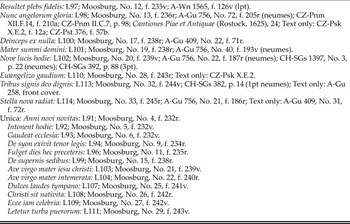
Johannes's preface clearly delineates three repertoires of songs in this collection, and these are listed in Tables 1–3: the ‘antique’ songs are those with concordances in older manuscripts from the twelfth and thirteenth centuries; the ‘modern’ songs are those either with concordances only from the fourteenth century or the unica in the manuscript; and lastly there are ‘some of my own [songs]’ assigned to ‘Johannes Decanus’ (all unique to this source), ‘with additions’ (possibly the Benedicamus songs and other tropes).Footnote 16 The other point made by the preface is that his own songs were written when Johannes was ‘Rector … Scolarium’ (rector of the schoolboys) and responsible for the boys who sang much of the chant at the church, a position he probably held before achieving higher office (before 1359?) in the chapter.Footnote 17
‘The following songs, often formerly sung from antiquity’Footnote 18

‘A few modern [songs]’

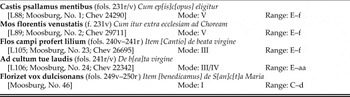
The five works ascribed to ‘Johannes Decanus’ in the Moosburger Graduale are listed in Table 3. The first four are traditionally numbered among the cantiones, while the fifth work is among the poetic Benedicamus tropes. The two basic points that can be discovered through an examination of these works are, first, that Johannes had a very clear sense of different melodic styles for different types of songs and, second, that Johannes's melodic writing is very different in three of the five songs, not only from the style of chant but also from earlier Latin song traditions.
Cantiones by Johannes DecanusFootnote 19

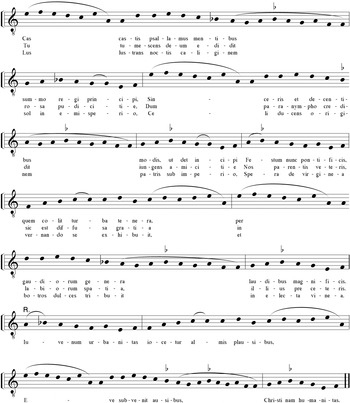
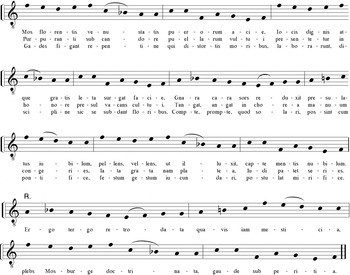
A comparison of the first two songs by Johannes from the Graduale (Appendix, numbers 1 and 2) will provide examples of these distinctions. Both songs are based on mode V with a final on F, frequently notated b flat, and have identical ranges (E–f). Both melodies are built from the permutations and combinations of a few short melodic phrases and also have refrains.Footnote 20 A cursory examination, however, demonstrates their very different melodic styles. While Castis psallamus is perhaps not ‘rhapsodic’ as understood by Christopher Page in his definition of the ‘High Style’, it clearly does not have the ‘conspicuous and short-range patterns’ of Mos florentis venustatis that delineate the basic characteristics of a dance song in Page's ‘Low Style’.Footnote 21
While both songs have refrains, a clear characteristic of dance songs but only rarely used in songs of the ‘High Style’, the extensive repeating melismas of Castis psallamus contrast with the direct syllabic style of Mos florentis. I would argue that Johannes de Perchausen was consciously imitating the ‘rhapsodic’ melodic character of the ‘High Style’ in Castis psallamus with his use of melismas, which resemble the even more elaborate melismas found in the tenth fascicle of ‘F’.Footnote 22 This style would have been particularly appropriate for a song that was sung when the boy bishop was elected. In contrast, the clear melodic phrases of Mos florentis are particularly appropriate for the boy bishop's dance outside the church.
The well-articulated tonal direction of most chant melodies is often a basic characteristic of many Latin songs from the twelfth century on, with the primary difference being the distinct formal structures of the melodies based on the poetic patterns of the songs' lyrics. Mos florentis is a typical example of the characteristic tonal organisation often found in many earlier Latin songs, though the indication of a B-quadratum in the manuscript (found at the end of the second staff in the Appendix, number 2) indicates a movement in the melody to the recitation tone of mode V, c.Footnote 23 The signs for both the B-rotundum and the B-quadratum are probably later additions not only in this song but also throughout the main body of the Graduale, but, as noted above, they were in all probability added at about the same time as the coloured initials and are most likely fourteenth-century additions. The modal usage of the Moosburger Gradual is somewhat eccentric and will be the subject of a more detailed future study, but frequently it appears that Johannes (if he was the corrector for the manuscript) would indicate every instance of a B-rotundum in a single line of chant. This contrasts with a more typical medieval usage in which a chromatic inflection would often remain in force through to the end of the musical line or phrase. It seems probable that even without the indications for the B-quadratum in this song, the fact that there were no indications on these pitches for B-rotundum would imply that they were meant to be sung as ‘leading tones’, and that they were added because the boys were singing them as B flats.
The melodic prototypes for the clear tonal direction of Mos florentis can be seen when it is compared with one of the ‘ancient’ songs copied in the Graduale, Gregis pastor Titirus, which is found as a two-voice versus in the late twelfth/early thirteenth-century Aquitanian manuscript now in the British Library (London, British Library, add. 36 881, f. 13v) and in the Moosburger Graduale as another song ‘ad choream’ (Example 1). In this example, however, it is also evident from the many differences between the two versions that the melody in the Moosburger Graduale, especially the three-fold repetition in the refrain of the melodic movement from G to F, clearly emphasises the final, F.Footnote 24 Similar melodic changes can also be found in two other older songs: Verbum patris humanatur (O8) and In natali summi regis (P25).Footnote 25 As in the case of Gregis pastor Titirus, some of the alterations in all three of these songs may be due to their transformation from polyphonic originals into monophonic songs.
A comparison of the melodies for Gregis pastor Titirus.

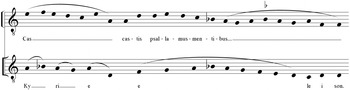
The tonal clarity of Mos florentis is distinctly different from the tonal ambiguity of Castis psallamus. Stein posited one similarity between Castis psallamus and typical chant style. While he correctly noted that ‘Die Melodie im F-Modus zeigt deutlich die Abwendung vom traditionellen Choralschaffen’ (‘The melody in F-mode shows clearly the turning away from traditional chant creations’), I would nuance his characterisation that the opening of Castis psallamus is a ‘noch klar chorale(s) Initium’ (‘still clear chant opening’) similar to Kyrie XI (Example 2).Footnote 26
The opening of Castis psallamus compared with Kyrie XI.

The opening melisma of Johannes's song is clearly a transposed version of the beginning of Kyrie XI, but it functions quite differently as a melody. Where the chant keeps clearly within the bounds of its mode, there is little in the melodic opening of Castis psallamus that would indicate a Mode V melody. Indeed, the falling fifth at the end of the opening melisma instead characterises a mode on A, as the falling fifth in Kyrie XI indicates a mode on D, and not a mode on F, which is evident in the second part of this opening phrase.
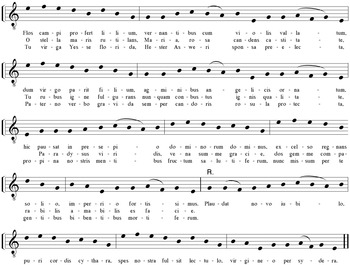
Similar melodic contrasts can be observed in the next two songs ascribed to ‘Johannes Decanus’ in the manuscript: Flos campi profert lilium (fols. 240v–241r) and Ad cultum tue laudis (fols. 241r/v) (Appendix, numbers 3 and 4), both of which are apparently cantiones ‘de beata virgine’. Flos campi has the clear syllabic style and tonal direction of Mos florentis, and the short melismas occur only at the ends of phrases, so that this is another example of a chorea, or dance song. The use of mode III is atypical of earlier Latin songs but had become increasingly common by the fourteenth century.Footnote 27
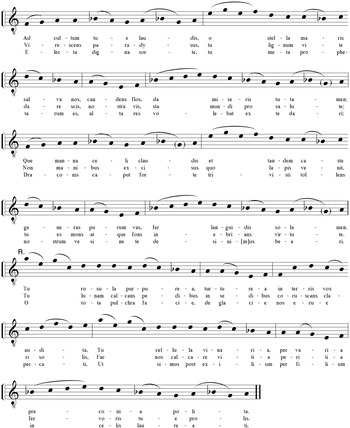
Ad cultum tue laudis is in many respects similar to Castis psallamus: though its frequent melismas are at most only four notes long, they are significant recurring melodic motives, often delineating the beginnings of structurally important musical phrases. The song is a transposed Mode IV and perhaps provides evidence that Johannes was thinking in terms of modes since there are no indications of a B-rotundum to ameliorate the frequent b flat to e natural melodic phrases and the addition of an e flat would then alter the perfect fifth of the descent from e natural to a that ends each of these phrases. The form of this song is different from the other three songs by Johannes discussed so far. In Castis psallamus, Mos florentis and Flos campi, the refrain melodies repeat the final melodic phrases of the verse; however, the refrain in Ad cultum begins with an new melodic phrase at the highest pitch of the entire melody. Again, this is a melody that mimics the ‘rhapsodic’ phrases of the ‘High Style’ and is most likely not a traditional chorea.Footnote 28
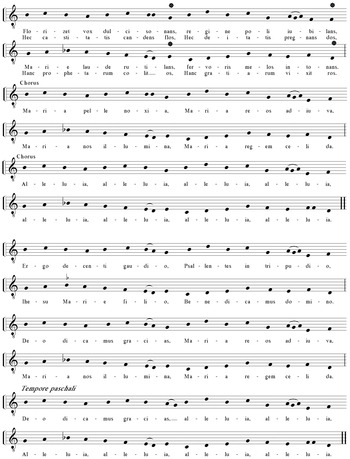
What is apparently the last of the compositions ascribed to ‘Johannes Decanus’ that he may have considered his own, Florizet vox dulcisonans (f. 249v) (Appendix, number 5), is prefaced with the rubric ‘Item de sancta Maria’, which refers to the short previous work, Benedicamus in laude ihesu, whose rubic is ‘De beata virgine Maria benedicamus’. It seems unlikely that Florizet vox dulcisonans was thought of as a ‘song’, since none of the Benedicamus settings is termed a cancio in the manuscript. The copy of this particular work also raises some questions in that the music and text copied on f. 249v is incomplete even though the medieval foliation (CCL-CCLI) is not broken. The last syllable of ‘adiuva’ (at the end of line 3 in the transcription) and the pitch indicated by the custos are not copied at the top of f. 250r. Perhaps the rubric ‘Chorus’ and the incomplete text ‘Maria pelle vitia, maria reos adiu[va]’ on the bottom line of f. 249v were a cue for a slightly altered refrain. The incomplete ‘Alleluia’ refrain at the top of f. 250r may perhaps be another cue to the complete version of this refrain on f. 249v. It would seem that either there was an egregious scribal omission or that due to the repetitive melody, which consists only of two constantly repeating phrases, it was unnecessary to repeat the entire refrain melodies. The simple syllabic style of this song and its clear structure again mark it as a chorea in style, if not in actual function.
The last significant stylistic feature of these five compositions by ‘Johannes Decanus’ is that while two songs (Mos florentis and Flos campi) are each obviously centred in their respective modal frameworks, three of the songs are what might best be termed as ‘wayward melodies’. By the adjective ‘wayward’ is meant that in the construction of each melodic phrase, Johannes has implied a different modal framework. For example, in Florizet vox dulcisonans, the first phrase, ending on g, would not be out of place in a Mode VII/VIII chant or song except that it would be unusual to begin a Mode VII/VIII song on the pitch b.Footnote 29 The second phrase, ending on F, would not be out of place in the context of a pure mode V melody, with B natural, excepting perhaps the falling fourth (c to G) five syllables from its end. The pitch b in this phrase would seem to have to remain as b natural due to the tertian outline at the beginning of this phrase and the ascending melodic motion to c on the first syllable of ‘poli’. The third phrase of the same melody, ending on E, clearly introduces a B-rotundum on the third pitch at the beginning of a melodic tritone descent to the final pitch of the phrase, which would be unusual in a Mode III melody. It is perhaps only the final phrase that ends on D which seems to be modally stable. The tetrachordal descent of the final pitches in each of these four phrases (G–F– E–D, marked with asterisks in the transcription, Appendix, number 5) is not unknown in earlier medieval song but is quite unusual in the repertoire of this manuscript. One well-known example occurs in Bernart de Ventadorn's Can vei la lauzeta, though only in two of its primary sources, and also in the Latin contrafactum by Philip the Chancellor, Quisquis cordis et oculi (K52).Footnote 30 The difference I find between this earlier work and Florizet vox dulcisonans is that the melodic patterns in each of the four final phrases of Bernart's song stay within traditional modal expectations; for example, in v.6, which ends on F, manuscript W even adds a B-rotundum to syllable 4 as part of the melodic descent to the final pitch. Even in this context, Johannes's song seems wayward.
Castis psallamus is wayward in a different manner. On a superficial level, the use of descending and ascending fifths, along with ascending fourths and sevenths, helps to diffuse any sense of clear tonal direction. The opening melisma is particularly striking, especially if a falling fifth is statistically more likely to occur if it were moving to the final (for example, as in Kyrie XI). Yet, to begin a melody on e, end the melisma with the falling fifth (e–a), but continue with a descent to the final F is particularly unusual. In the case of this song, the waywardness may have an additional significance to be mentioned below.
Finally, Ad cultum tue laudis is distinct in a number of ways. In contrast to all the other four compositions, whose ranges only include an octave plus a second, this work is similar to some later chants in that it actually combines authentic and plagal ranges, in this case an octave plus a fourth. It is also one of two songs in the Moosburger repertoire that use a B flat to indicate a transposed mode III or IV, the other being Ewangelizo gaudium (f. 243r; L110, Chev 5583), which, however, has a much smaller tessitura. For a work whose final is a, the opening three phrases are unusual, in that the phrases are quite similar to Castis psallamus, whose final is F, and also frequently used the fifth, A–e. These three phrases also use the chain of thirds – F–a–c – which also helps establish a tonal centre of F. However, the fourth phrase (at the end of the second line) eventually establishes the final a. This same tonally ambiguous progression is then repeated. The refrain, beginning at the upper limit of the authentic mode (aa), confirms the final a in three ways: through the octave descent from aa to a in its first phrase, in its middle section (with the melodic cadence to ee on the second line from the bottom), and through the final three phrases, which end with a repetition of the cadential fourth phrase from the verse.
The waywardness of these three compositions indicates that Johannes de Perchausen, as Stein had intimated, was moving away from the tonal and melodic norms of cantus planus, and was composing melodies within the traditional genres of monophonic song which reflected the new melodic possibilities which were becoming current in the fourteenth century.Footnote 31 One example of this type of meandering (though, as in the case of Johannes, with clear tonal purpose) is Guillaume de Machaut's virelai Comment qu'a moy (Example 3 ).Footnote 32 In the final measures of the verse, whose goal is the pitch d, some performers shift between c sharp and c natural, perhaps implied by Machaut's explicit chromatic alteration of the penultimate c sharp in this section.Footnote 33
From Machaut, Comment qu'a moy.

An even clearer example might be the refrain of He! dame de valour (Example 4), in which the shifting between f sharp and f natural is clearly indicated.Footnote 34
From Machaut, He! dame de valour.

By providing these examples, I am not suggesting Johannes was influenced by Machaut. What I believe these five songs share with Machaut and other fourteenth-century monophonic song is a much more varied repertoire of melodic gestures and the use of chromatic signs to indicate significant changes in melodic direction that might be important either for individual melodic phrases or for the tonal direction of a whole song.Footnote 35 I believe Johannes's more conservative outlook, rooted deeply in the liturgical song he taught his students, is indicated by his use of only B-rotundum and B-quadratum.
While some of the other twenty-nine ‘antique’ and ‘modern’ songs from the Moosburger Graduale have a few of these unusual melodic elements discussed above, none meander quite as much as those by Johannes. Just as some of the songs were designed to teach the Moosburg scholars proper grammar by demonstrating the correctly changing declension of a single word in different stanzas (such as Dies ista colitur [f. 236v]), it would seem that these songs by the former ‘Rector scholarium’ were designed to teach his charges advanced skills in singing untraditional ‘modern’ melodies. Perhaps this was also the point and humour in beginning Castis psallamus with a direct quotation from Kyrie XI and then continuing in an entirely different melodic direction. This might have been the rector's own musical joke to honour the installation of the boy bishop.
Appendix
Johannes de Perchausen, Castis psallamus mentibus (f. 231r/v)
Cum ep[is]c[opus] eligitur
[L88; Chev 24290] Mode: V Range: E–f

Johannes de Perchausen, Mos florentis venustatis (f. 231v)
Cum itur extra ecclesiam ad Choream.
[L89; Chev 29711] Mode: V Range: E–f

Johannes de Perchausen, Flos campi profert lilium (ff. 240v–241r)
Item [Cantio] de beata virgine.
[L105; Chev 26695] Mode: III Range: E–f

Johannes de Perchausen, Ad cultum tue laudis (f. 241r/v)Footnote 36
De b[ea]ta virgine.
[L106; Chev 22342] Mode: III/IV Range: E–aa

Florizet vox dulcisonans (ff. 249v–250r)
Item [benedicamus] de S[an]c[t]a Maria