INTRODUCTION
The broadnose seven-gill shark Notorynchus cepedianus inhabits exclusively coastal and shelf waters worldwide (Last & Stevens, Reference Last and Stevens1994; Compagno et al., Reference Compagno, Dando and Fowler2006). Off California (USA) and southern Africa (Ebert, Reference Ebert1989, Reference Ebert1991a, Reference Ebertb, Reference Ebert2002) females mature at larger total lengths (TL) than males with biennial reproductive cycle and one of the highest fecundity among elasmobranchs (Ebert, Reference Ebert1989). Due to its restricted limited inshore depth-range distribution in temperate waters, N. cepedianus is exposed to intensive inshore fisheries over most of its range and could be impelled to local extinction. But lack of fisheries data elsewhere makes it impossible to determine whether this pattern of depletion occurs throughout its range and the IUCN Sharks Specialist Group Red List Assessments set its conservation status as Data Deficient (IUCN, 2007).
In Argentina several studies about the taxonomy and distribution of the species have been carried out by Lahille (Reference Lahille1928), Guzman & Campodónico (Reference Guzmán and Campodónico1976), Menni et al. (Reference Menni, Ringuelet and Arámburu1984), and Menni & Garcia (Reference Menni and García1985). Recently, Lucífora et al. (Reference Lucifora, Menni and Escalante2005) studied the reproductive biology, abundance and feeding habits of the broadnose seven-gill shark in Bahía Anegada (40°36′S 62°08′W), in Buenos Aires province, Argentina. Monthly variation in abundance was found and the presence of neonates and juveniles was common in the study area. Male and female sizes at maturity were 170 and 224 cm total length (TL) respectively, featuring a similar size at maturity of other studied regions. These authors pointed out that Bahía Anegada could be an important area for conservation of the seven-gill shark in the south-west Atlantic given the high abundance of juveniles and sub-adults.
Notorynchus cepedianus also has commercial value as a non-target catch in bottom trawling and gill-net fisheries in Buenos Aires province (Chiaramonte, Reference Chiaramonte1998). In Patagonia, the species is mainly caught by anglers and recreational fishermen (Cochia et al., Reference Cochia, Bovcon, Barreiro, Mirenda and Caille2006; Cedrola et al., Reference Cedrola, Caille and Chiaramonte2007), but in the coastal trawl fisheries it was recorded as a low frequency by-catch (Van der Molen et al., Reference Van der Molen, Caille and González1998).
Protected areas of Ría Deseado (47°47′S 65°49′W) and Península de San Julián (49°17′S, 67°42′W) are placed in the north coast of Santa Cruz province, in southern Patagonia (Figure 1). Both areas concentrate a high diversity of seabird and migratory shorebirds together with several species of cartilaginous fish and marine mammals. Ría Deseado and Bahía de San Julián act as nursery and breeding areas for several species (Gandini & Frere, Reference Gandini and Frere1998; Chiaramonte & Pettovello, Reference Chiaramonte and Pettovello2000; Bastida & Rodríguez, Reference Bastida and Rodríguez2003; Wilson et al., Reference Wilson, Scolaro, Gremillet, Kierspel, Laurenti, Upton, Gallelli, Quintana, Frere, Muller, Thor and Zimmer2005).
Natural Reserves of Patagonia where Notorynchus cepedianus are caught by anglers: BA, Bahía Anegada; PD, Puerto Deseado; SJ, Península de San Julián.

The aim of this research is to investigate the population structure of N. cepedianus in southern Patagonia, Argentina. Moreover, we discuss the possibility that Ría Deseado and Bahía de San Julián operate as secondary nursery areas for N. cepedianus.
MATERIALS AND METHODS
Shark recreational fisheries occur in Ría Deseado (RD) and Bahía and Península de San Julián (SJ) every year between early November and late March. Sharks are caught from the coast (in both locations) and small boats < 7 m long (only in Ría Deseado), with rod and reel. For 40 years now, broadnose seven-gill shark fishing competitions have taken place in both locations. Samples for this study were taken from tournament editions as well as from the recreational fishery during the fishing seasons 2004–2005, 2005–2006 and 2006–2007. Sex, size and weight of sharks caught were registered. Total length (TL) was recorded to the nearest millimetre, from the tip of the snout to the tip of the upper lobe of the caudal peduncle at natural position, and weight (W) to the nearest gram. Differences in mean TL between areas were tested by t-test (Zar, Reference Zar1996). Total length–weight (TL-W) curves were calculated for males and females. Differences in the slopes of the TL–W relationship between the sampled areas (RD and SJ) for each sex were tested with a two-tailed Student's t-test for the slopes of log transformed data (Zar, Reference Zar1996). To test for sexual differences in this relationship, the same test was carried out pooling the data from both locations for each sex. Sex ratios for each locality were tested by χ2-test. In each parametric test, normality was tested by a Kolmogorov–Smirnov test and the homogeneity of variance by Levene test (Zar, Reference Zar1996).
RESULTS
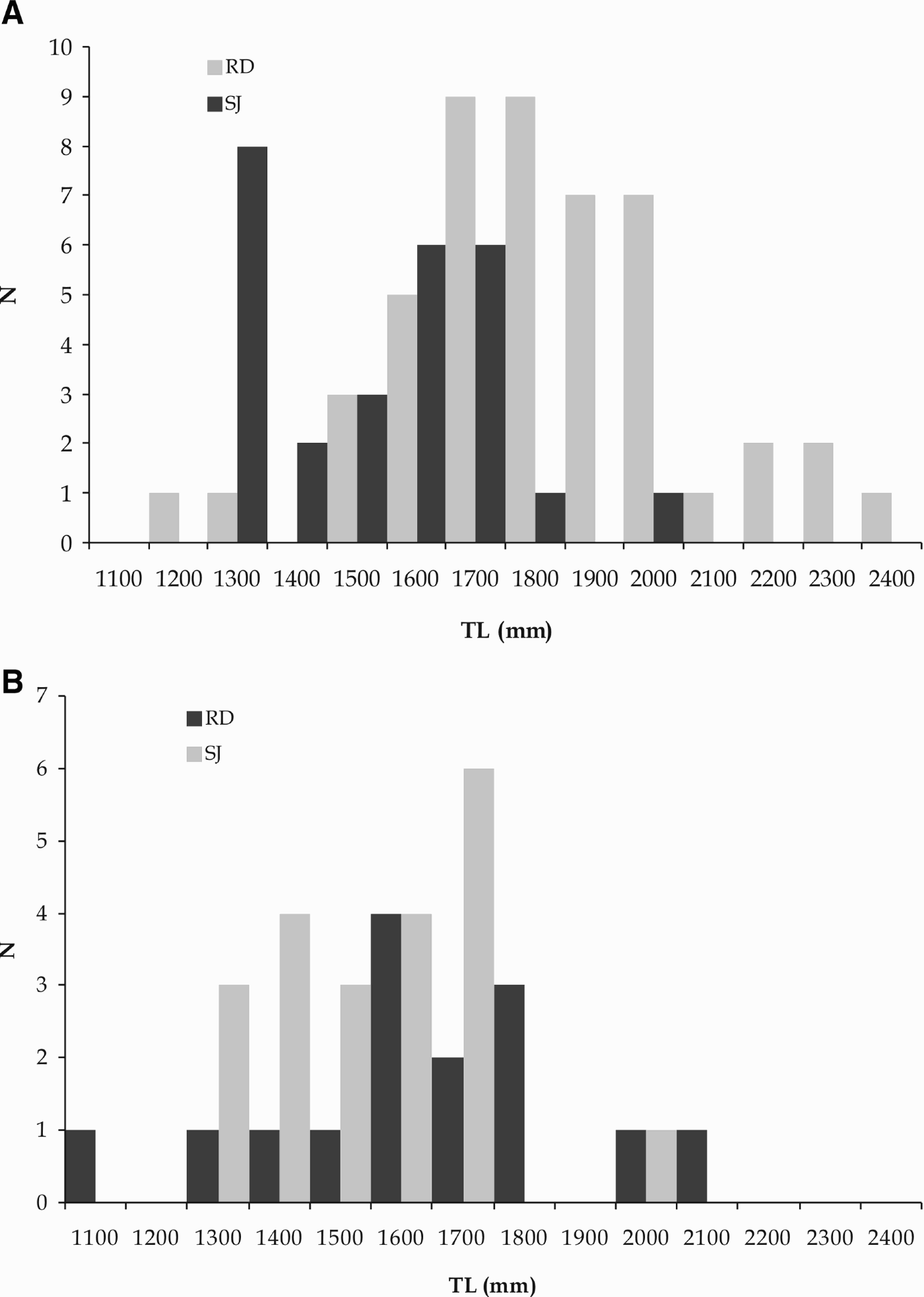
A total of 111 broadnose seven-gill shark specimens (75 females and 36 males) were caught, 63 in RD and 48 in SJ. Juvenile females dominated the catches in both areas during the 4-year period (96.73% of the total female catch). In RD the females of the broadnose seven-gill sharks were larger than in SJ (t = 5.389, df = 73, P < 0.01; Figure 2A). Mean TL in RD was 1781 mm (SD = 245.08; range 1150–2320 mm TL) and the heaviest female weight 70 kg. In SJ the mean TL was 1484 mm (SD = 196.10; range 1210 – 2000 mm TL) and the heaviest female weighed 36.9 kg. Juvenile males also dominated the catches of males in both areas during the 4-year period (86.11% of the total male catch). No differences between localities were detected in the case of males for the TL (t = 1.520, df = 34, P > 0.05; Figure 2B). The mean TL in RD was 1616 mm (SD = 245.83; range 1100–2050 mm TL) and the heaviest male weighed 40 kg. In SJ the mean TL was 1508 mm (SD = 184.26; range 1250–2000 mm TL) and the heaviest male weighed 32.5 kg.
Size–frequency distribution of Notorcynchus cepedianus in Ría Deseado (RD) and Península de San Julián (SJ). A, females; B, males.

No significant differences were detected between the slopes of the logTL–logW relationship for TL–W relationship between localities for males (t =−0.265, df = 32, P > 0.05) and females (t = 0.214, df = 71, P > 0.05). Thus, for the comparison between sexes we pooled the data from both localities. The TL–W relationships are shown in Figure 3. The TL–W relationships are W (g) = 2.77E–06 TL (mm) 3.0634 for females and W (g) = 1.05E–05 LT (mm) 2.8858 for males. No significant differences were found between the slopes of the logTL–logW relationship of males and females (t = 1.058, df = 107, P > 0.05).
TL–W relationship for Notorynchus cepedianus in southern Patagonia. A, females; B, males.

In RD the sex ratio (female:male) was 3.2:1, which results significantly different from 1:1 (χ2 = 8.64; P > 0.05). However, in SJ the sex ratio was 1.3:1 but these differences were not statistically significant to 1:1 (χ2 = 0.5; P > 0.05). Catches by number of Notorynchus cepedianus exhibit its maximum in December and January in both locations.
DISCUSSION
Seasonal abundance of Notorynchus cepedianus in southern Patagonia shows a peak during early summer (December to January). In Bahía Anegada (40°32′S), Lucifora et al. (Reference Lucifora, Menni and Escalante2005) found the highest abundance during late summer and early autumn, which could reflect a south to north migratory movement. This peak corresponds with the arrival of the narrownose smooth hound shark, Mustelus schmitti, to RD. This shark is one of the preys of N. cepedianus in the area (Chiaramonte & Pettovello, Reference Chiaramonte and Pettovello2000). Lucífora et al. (Reference Lucifora, Menni and Escalante2005) obtained a similar result and observed that M. schmitti is the main dietary item in the size-class 100–170 cm of TL for N. cepedinus in northern Patagonia, which is the dominant size-class in our study samples (Figures 2 & 3). The RD and SJ bays are also feeding and nursery areas for Comerson's dolphin, Cephalorhynchus commersonii, and the South American sea lion, Otaria flavescens, both N. cepedianus preys (Bastida & Rodríguez, Reference Bastida and Rodríguez2003; Crespi et al., Reference Crespi-Abril, García, Crespo and Coscarella2003; Lucífora et al., Reference Lucifora, Menni and Escalante2005).
The size–frequency distribution for N. cepedianus in RD and SJ showed a bias on behalf of juveniles, with a dominance of females. Ebert (Reference Ebert2002) found segregation by sex and life history stages in the populations of California and South Africa. Adolescent males are rare in nursery areas, whereas juvenile females of comparable size tend to remain there. Dietary changes associated with the size of N. cepedianus may, in part, explain how food resources within a given area are partitioned to minimize competition between conspecifics at different life history stages. Within the species, reduced competition between adults and sub-adults would increase survivorship for the latter during the critical early stages of life (Ebert, Reference Ebert2002). According to our findings and Ebert's (2002) conclusions, the dominance of juvenile females of N. cepedianus in RD and SJ indicate that these protected areas operate as secondary nursery areas for the species as defined by Bass (Reference Bass, Hodgson and Mathewson1978), and become the southernmost nursery areas known for the species in the south-western Atlantic.
ACKNOWLEDGEMENTS
The authors wish to thank all the anglers who helped and collaborated with the project, especially to Club de Pesca Piedra Toba from Puerto Deseado, and Club de Pesca Deportiva de San Julián from Puerto San Julián.