Introduction
Among youth, it is well-documented that risky sexual behaviours correspond to a high rate of unintended pregnancies and the spread of sexually transmitted infections (STIs) (Meekers & Klein, Reference Meekers and Klein2002; Hearst & Chen, Reference Hearst and Chen2004; Finer & Henshaw, Reference Finer and Henshaw2006). The condom is the most common method of self-protection, and it is the only method that reduces exposure to STIs as well as providing contraception (Cates & Steiner, Reference Cates and Steiner2002; Shlay et al., 2004; Abma et al., Reference Abma, Martinez and Copen2010). Condom use at sexual debut is connected to the likelihood of subsequent condom use throughout adolescence and early adulthood (Miller et al., Reference Miller, Levin, Whitaker and Xu1998; Shafii et al., Reference Shafii, Stovel, Davis and Holmes2004). The consistent use of condoms is essential for the prevention of unintended pregnancies and most viral and non-viral STIs (Manlove et al., Reference Manlove, Ryan and Franzetta2003). Hence, self-protection behaviour at sexual debut has long-term implications for well-being, since it appears to be a habit-forming behaviour (Shafii et al., Reference Shafii, Stovel, Davis and Holmes2004). Following this logic, it is possible that social differences in condom use at sexual debut are a proxy for high-risk behaviours (unsafe sex) throughout adolescence and early adulthood.
The interest in the sexual and reproductive behaviour of youth is well-motivated because STIs are a global public health problem and the social consequences of early childbirth associate with low socioeconomic status for women and their children (Eggleston, Reference Eggleston1998; Gerbase et al., Reference Gerbase, Rowley and Mertens1998). As Juarez & LeGrand observe (Reference Juarez and LeGrand2005), early sexual relations are predisposed to risky behaviours for several reasons. The primary reasons are related to insufficient knowledge about self-protection and a failure to plan against unsafe sex. Besides less knowledge, younger people also have less personal regard for the consequences of unsafe sex because of their faulty perceptions of ‘invulnerability’ to risk. This is an important observation considering that condom use corresponds to perceptions of risk (Meekers & Klein, Reference Meekers and Klein2002). For these reasons, it is reasonable to define youth (people aged 15–24 years) as a high-risk group for unintended pregnancies and STIs.
In China, little is understood about the sexual behaviour of youth, except that the age of sexual debut is declining and the prevalence of premarital sex is increasing (see World Health Organization, 2005, for a review). This lack of knowledge is troubling given that China is facing a sharp rise in STIs, and that younger people are among the most vulnerable population, along with female sex workers, injection drug users and migrant workers (Song & Ji, Reference Song and Ji2010; Chen et al., Reference Chen, Peeling, Yin and Mabey2011; Zou et al., Reference Zou, Xue, Wang and Lu2012). Our knowledge of condom use among Chinese youth is incomplete, and almost nothing is known about their risk-taking behaviours (unprotected intercourse) at sexual debut (Wang & Davidson, Reference Wang and Davidson2006, is an exception). Moreover, there are few studies from other countries that examine the prevalence of condom use at sexual debut and its social and demographic correlates (e.g. Eggleston, Reference Eggleston1998; Manning et al., Reference Manning, Longmore and Giordano2000; Shafii et al., Reference Shafii, Stovel and Holmes2007). While numerous studies focus on condom use among Chinese sex workers (e.g. Lau et al., Reference Lau, Zhang, Zhang, Wang, Cheng and Zhang2007; Chen et al., Reference Chen, Schilling, Wei, Cai, Zhou and Shan2007; Wang et al., Reference Wang, Li, McGuire, Kamali, Fang and Stanton2009), there is a paucity of research on the self-protection behaviours of youth.
Three sets of factors appear to be germane to condom use at sexual debut among Chinese youth. First, age and gender represent the key demographic indicators. Evidence from other developing countries demonstrates that age is a crucial indicator of risky sexual behaviours (Eggleston, Reference Eggleston1998; Blum & Mmari, Reference Blum and Mmari2005). The consistent finding is that condom use increases with age and that early sexual debut increases the risk of having unsafe sex. This is largely because age is related to knowledge about self-protection and efficacy planning for safer sexual intercourse (Juarez & LeGrand, Reference Juarez and LeGrand2005). As Eggleston (Reference Eggleston1998) observes, the relationship between gender and condom use at sexual debut is less clear-cut. However, the general finding is that young males report higher levels of condom use than females, and that females also encounter greater barriers to condom use (Blum & Mmari, Reference Blum and Mmari2005).
Second, socioeconomic status could also have effects on self-protection behaviours at sexual debut. Research on sub-Saharan African adolescents demonstrates that poverty decreases the timing of sexual debut (early onset) and that the poor are less likely than their wealthier peers to use condoms (Madise et al., Reference Madise, Zulu and Ciera2007). This research suggests that, through its influence on sexual behaviours, poverty is a mechanism for the transmission of STIs. Several other studies show that educational attainment is a predictor of condom use and high-risk behaviour (Blum & Mmari, Reference Blum and Mmari2005; Juarez & Martin, Reference Juarez and Martin2006). For example, Karim and co-authors (Reference Karim, Magnani, Morgan and Bond2003) demonstrate that females from Ghana with a secondary education or higher are four times more likely than their lesser educated peers to use a condom at sexual debut. The effect of education on condom use could correspond to knowledge about STIs, which can sensitize people about the risks of unsafe sex. In China, youth with low levels of education also have less knowledge about their sexual and reproductive health, which could influence their perceived risks and decision-making about condom use (Wang et al., Reference Wang, Lou, Gao and Tu2001).
Thirdly, there is a growing emphasis on the relationship context of condom use. Though it is often modelled as an individual-level behaviour, Manning et al. (Reference Manning, Longmore and Giordano2000) point out that decisions about condom use usually happen at the couple level, which means that self-protection behaviour requires co-operation (especially for females) between sexual partners. Relationship context refers to factors such as the relationship type, the age gap between the couple and discussion of self-protection. Previous studies demonstrate that condom use is higher among couples in committed or long-term relationships than it is among those in less-serious relationships or casual sexual encounters (Eggleston, Reference Eggleston1998; Manning et al., Reference Manning, Longmore and Giordano2000). This difference could relate to differences across relationships in the level of discussion and planning for safer sex, which are important factors of condom use (Stone & Ingham, Reference Stone and Ingham2002; Manlove et al., Reference Manlove, Ryan and Franzetta2003). In addition, whether the sexual debut is consensual or non-consensual is also a crucial indicator of condom use (Manlove et al., Reference Manlove, Ikramullah and Terry-Humen2008).
This study uses data from the National Youth Reproductive Health Survey (NYRHS) to examine the sexual behaviour of unmarried Chinese youth (ages 15–24). The NYRHS is the first nationally representative sample of the reproductive and sexual well-being of Chinese youth. The study has two major objectives relating to the self-protection and contraceptive behaviour among Chinese youth. Given the lack of national data, there is very little research on this topic, and the existing studies are based on convenience, regional or clinical samples, which do not offer generalizable empirical findings. The primary objective is to illustrate the relationship between age at sexual debut and condom use and also the socioeconomic and demographic differences in condom use at sexual debut. The secondary objective is to examine the social circumstances of sexual debut (e.g. planned versus unplanned sexual debut, coerced or consensual sex) and whether these associate with condom use at debut. The study estimates separate models for males and females given that the determinants of condom use and circumstances of sexual debut could be gender-specific.
The Chinese Context
In China, premarital sex was uncommon before the 1970s because of cultural norms, which stressed the reproductive function of sexual intercourse (Parish et al., Reference Parish, Laumann and Mojola2007). With the opening up and economic reforms in the 1980s, the social regulation of sexual behaviour has ebbed, and the younger generations have adopted more liberal attitudes about premarital sex and the purpose of sexual relations (Yu, Reference Yu2010). Though marriage remains an important context of sexual debut, it is clear that sexual relations have become untethered from marriage and procreation. The majority of unmarried youth are willing to have premarital sex and 22% have experienced it, which is a major change in sexual behaviours from previous generations (Zheng et al., Reference Zheng, Chen and Gao2010). Chinese youth are sexually active while unmarried for longer periods than ever before (Wang & Davidson, Reference Wang and Davidson2006). With this increase, a growing proportion of youth are engaging in sexual behaviour that places them at high risk of unintended pregnancies and STIs.
Among all age groups, STIs have re-surfaced as a public health problem. Before the 1950s, STIs such as syphilis and gonorrhoea were common (Chen et al., Reference Chen, Gong, Liang and Zheng2000). The prevalence of STIs was greatly reduced by the mid-1960s through a multi-pronged public health programme, including eliminating the commercial sex trade, providing better access to screening and treatment, and informational campaigns aimed at prevention. With the liberalization of sexual behaviour, much of these gains have been lost, and STIs are spreading rapidly from high-risk subgroups (e.g. female sex workers) to the general population (Chen et al., Reference Chen, Peeling, Yin and Mabey2011). Between 1989 and 1998, the incidence of STIs (excluding HIV/AIDS) increased 4.2 times for females and 3.8 times for males, with non-marital sexual relations being the primary source of infection (Chen et al., Reference Chen, Gong, Liang and Zheng2000). The Chinese population has also become vulnerable to the transmission of HIV/AIDS among heterosexuals (Beyrer, Reference Beyrer2003). The spread of STIs reflects an urgent need for behavioural interventions, particularly for high-risk groups (Chen et al., Reference Chen, Peeling, Yin and Mabey2011).
Much research has focused on female sex workers, injection drug users and rural migrants. However, Chinese youth, who account for 13% of the population (161 million persons), are the largest high-risk group, and their sexual behaviours have wide-reaching and long-term implications. Despite the paucity of research, it has become increasingly clear that younger people are indeed a vulnerable group. About half of STI cases between 1995 and 1998 occurred in people aged 29 or younger, which is a disproportionately high incidence (Chen et al., Reference Chen, Gong, Liang and Zheng2000). Among sexually active unmarried females, 23% have had unintended pregnancies, of which 91% were terminated through induced abortion (Zheng et al., Reference Zheng, Chen and Gao2010). These trends reflect a lack of self-protection and contraception among Chinese youth. Nationally representative figures are unavailable, but findings from regional studies and surveys of college students suggest that about half of sexually active youth use condoms, and far fewer use them at sexual debut (Song & Ji, Reference Song and Ji2010; Yu, Reference Yu2010).
Previous studies demonstrate that Chinese youth are ill-prepared for avoiding unsafe sex (Wang et al., Reference Wang, Hertog, Meier, Lou and Gao2005; Wang & Davidson, Reference Wang and Davidson2006). Their risky behaviours parallel a widespread lack of knowledge about sexual and reproductive health. This knowledge is especially deficient among those aged 12–18 years (World Health Organization, 2005). Within this age group, less than half can identify major STIs such as syphilis and gonorrhoea, and many have a limited understanding of the transmission paths of HIV/AIDS. Moreover, just less than half cannot identify a method of contraception. Though this knowledge increases with age, it is still low among college students. The rural population and migrant youth have among the least amount of knowledge, with some unaware of the relationship between sexual intercourse and pregnancy. In large part, this lack of knowledge stems from an absence of comprehensive sex education in schools and a reluctance among parents to discuss these issues with their children (Zhang et al., Reference Zhang, Li and Shah2007). Despite changing sexual behaviours, the older generations still consider sexual relations a taboo topic. This has left the younger generation ill-informed and consequently at high risk of unsafe sexual behaviours.
Data and Methods
Data source
The empirical analysis is based on data from the National Youth Reproductive Health Survey (NYRHS). The NYRHS was a collaboration of Peking University, the National Working Committee on Children and Women under the State Council, and the United Nations Population Fund. The survey was conducted by Peking University from October to November 2009. The data were collected through face-to-face interviews and a supplemental self-directed (anonymous) paper questionnaire for questions on sensitive topics, such as sexual debut and condom use. The target population was unmarried youth aged 15–24 from all mainland provinces, autonomous regions and municipalities, excluding those living in Tibet, which has less than 0.2% of China's total population (National Bureau of Statistics China, 2011). The NYRHS used a multistage sampling design, dividing the country into seven geographic regions and then into 40 administrative regions. Within each region, the target population was divided into three groups: in-school youth, out-of-school youth and youth living in collective (company) dwellings. A total of 22,228 unmarried youth completed the survey with a response rate of 75.1% (see Zheng et al., Reference Zheng, Chen and Gao2010). For further details about the survey design and sampling procedure, see Peking University (2010).
Variables
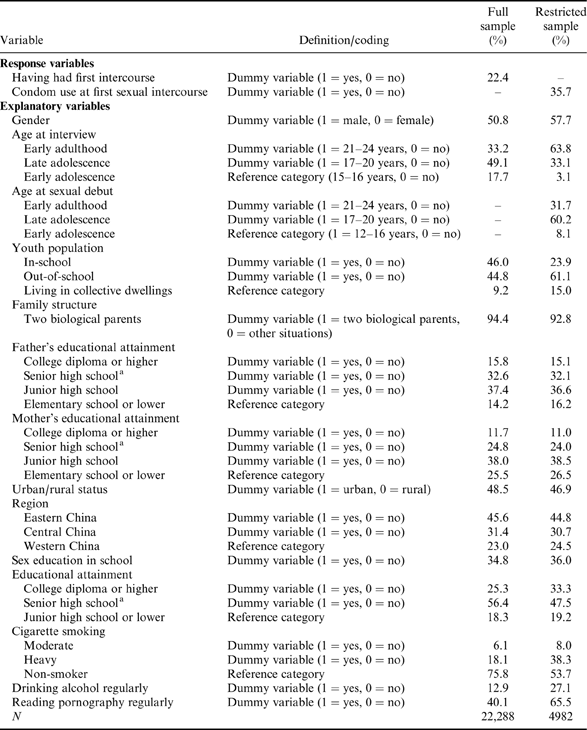
This study examines condom use at sexual debut and the circumstances of sexual debut and how these influence condom use. In the NYRHS, the respondents were asked: ‘How old were you (in years) when you had sexual intercourse for the first time?’ People tend to remember their age at sexual debut accurately and report it honestly (e.g. Siegel et al., Reference Siegel, Aten and Roghmann1998). Table 1 shows that 22.4% of the study sample had had their sexual debut at the time of the survey. Among those who reported a sexual debut (restricted sample), the survey asked whether a condom was used at this time (1=yes). About 36% of Chinese youth used a condom at sexual debut. For the analysis on the circumstances of sexual debut, the study sample is restricted to respondents who experienced their sexual debut with their current or most recent partner. In the NYRHS, the respondents were asked whether their sexual debut was with their current or most recent partner (1=yes). The respondents who reported a sexual debut with a former partner were not asked about the circumstances of sexual debut.
Variable definitions and descriptive statistics for variables used in the analysis, Chinese unmarried youth aged 15–24

a This category includes both senior high school and technical school, which are designed for students who have finished their junior high school in China.
Weighted percentages, unweighted N.
The analysis estimates gender-specific models and considers the effects of several covariates on condom use at sexual debut. This includes age at the interview and age at sexual debut. Age at the interview is measured as a three-level categorical variable: early adulthood (21–24 years), late adolescence (17–20 years) and early adolescence (15–16 years). The ‘early adolescence’ category is the reference group. Age at sexual debut is measured using a similar three-level categorical variable. Table 1 shows that 31.7% of the respondents reported having their sexual debut in early adulthood, 60.2% in late adolescence and 8.1% in early adolescence. The definitions and descriptive statistics for these and all other selected variables are presented in Table 1.
Condom use at sexual debut could associate with risk-taking behaviour in general. Other risk-taking behaviours such as alcohol use, tobacco use and substance abuse are correlates of sexual risk-taking among youth (Luster & Small, Reference Luster and Small1994; Tapert et al., Reference Tapert, Aarons, Sadlar and Brown2001; Parkes et al., Reference Parkes, Wight, Henderson and Hart2007). The analysis considers the effects of several other risky behaviours. This includes cigarette smoking, alcohol consumption and reading/viewing pornography. The latter is an important risk factor in the Chinese context because 70% of Chinese youth acquire information about sex from pornography (Zhang et al., Reference Zhang, Stanton, Li, Mao, Sun and Kaljee2004). This suggests that the lack of condom use that is commonplace in pornography could influence youths' perception of risk. Cigarette smoking is measured as moderate/light smoker (1–10 cigarettes per day), heavy smoker (10+ cigarettes per day) and non-smoker (reference group). Drinking alcohol was measured using responses to the question: ‘Thinking about the previous month, have you ever drunk alcohol regularly?’ Respondents who answered ‘yes’ were coded as 1 and those who answered ‘no’ were coded as 0. Viewing or reading pornography was measured from the question: ‘Have you ever viewed or read pornographic websites, audio/video products, or pornographic books?’ Respondents who answered ‘regularly’ were coded as 1 and respondents who answered ‘occasionally’ or ‘never’ were coded as 0.
The analysis considers several other social and demographic variables. It includes a three-level categorical variable for in-school youth, out-of school youth and youth living in collective dwellings (reference group), another three-level categorical variable of the respondent's educational attainment (junior high school or lower, senior high school, and college diploma or higher), a dummy variable indicating whether she/he received formal sex education (1=yes) in school and one for whether the respondent is from an intact household (married biological parents) (1=yes) or an alternative family. Paternal and maternal education is measured as a four-level categorical variable: elementary school or lower (reference group), junior high school, senior high school, and college diploma or higher. Previous studies show that family structure and parental education are more important predictors of the sexual behaviour of adolescents than other family-related predictors, such as household income (Morris, Reference Morris1992; Cooksey et al., Reference Cooksey, Rindfuss and Guilkey1996). The analysis also measures urban/rural status (hukou). In China, a person's urban/rural status corresponds to their access to public resources (e.g. education, health care) and mobility (Liu, Reference Liu2005). Research from other countries demonstrates that condom use among youth is lower in rural than in urban areas (e.g. Meekers & Calvès, Reference Meekers and Calvès1999). A variable for region is included (Eastern, Central and Western China) because regional imbalances in socioeconomic development could influence condom use behaviours and perceptions of risk.
In addition, the study considers factors capturing the context of sexual debut. These factors include: age gap with first sexual partner (1=yes if the gap is 3 or more years); whether the respondent planned her/his sexual debut (1=yes); the circumstances of sexual debut (forced/coerced, coaxed into/persuaded, and consensual intercourse); whether the respondent discussed contraception with their partner before her/his sexual debut (1=yes); and the type of relationship with their first sexual partner (engaged, serious relationship leading to marriage, semi-serious and causal).
Statistical method
Contraceptive behaviour at sexual debut is the result of two sequential decisions: the first decision is whether to have sexual intercourse and the second decision is whether to use a condom (or contraception) at this time (Brauner-Otto & Axinn, Reference Brauner-Otto and Axinn2010). The probability of condom use at sexual debut is, therefore, a conditional probability. In this analysis, the probability of condom use at sexual debut is observed for a restricted sample, i.e. people who have had their sexual debut. If the decision to have sexual intercourse is correlated with condom use, then the regression estimates in the models of condom use at sexual debut could be biased, because these estimates are based on a non-random sample (Greene, Reference Greene2012). This implies that the decision to begin having sex could associate with other risky behaviours, including not using condoms during sexual intercourse. To address this issue, the analysis estimates two-stage probit models (Heckman, Reference Heckman1979). The first stage estimates the effects of the selected explanatory variables on the decision to have sexual intercourse for the full sample (selection equation) and the second stage estimates the effects of the selected variables on condom use at sexual debut for the restricted sample (outcome equation). The analyses use robust standard errors to account for cluster effects in the sample design.
Results
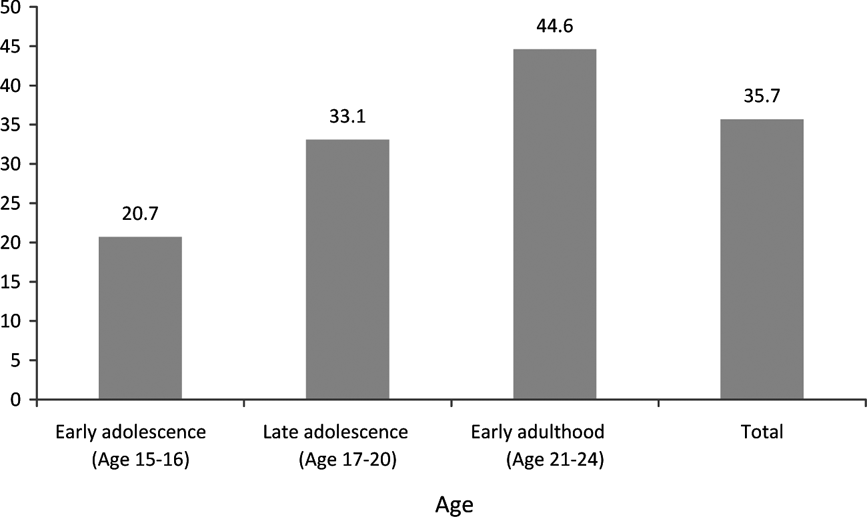
The main objective of this study is to examine social differences in condom use at sexual debut (CSD) among Chinese youth. Figure 1 presents the overall rate of CSD for Chinese youth aged 15–24 years and breaks this down according to age group. The bivariate results demonstrate that about one-third (35.7%) of Chinese youth used a condom at their sexual debut. The rate of CSD increases from early adolescence to early adulthood. The rate of CSD is 20.7% for Chinese youth aged 15–16 years, 33.1% for those aged 17–20 and 44.6% for those aged 21–24.
Chinese youth's condom use at sexual debut by age group.
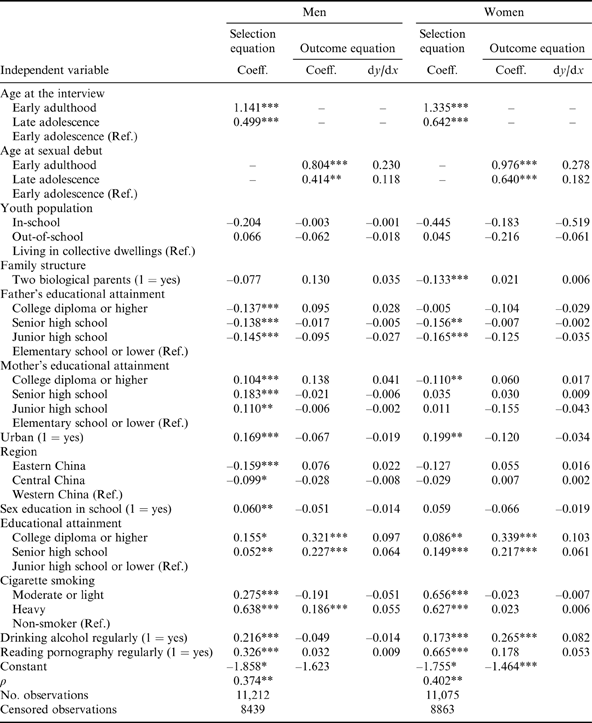
Table 2 presents the results of the estimated parameters of the selection models and the outcome models. As discussed above, the selection models examine the relationship between the selected explanatory variables within the full sample and the outcome models examine the relationship between these variables and condom use at sexual debut within the restricted sample. The table presents separate models for males and females. The significant ρ indicates that the selection and outcome equations are related, demonstrating the need to adjust for sample selection bias, as has been done (see the bottom of the table). The selection model presents the risk factors of sexual debut among male and female youth. The results indicate that age has strong effects on sexual debut, with older age associating with a higher likelihood of being sexually experienced. Factors that decrease the likelihood of sexual debut include coming from an intact family, rural status, coming from a more developed region, lower level of education and engaging in risky behaviours (i.e. drinking, smoking and reading pornography).
Estimated parameters of Heckman's selection model (with robust SE) of condom use at sexual debut among Chinese unmarried youth aged 15–24
***p<0.001; **p<0.01; *p<0.05.
In gender-specific models, Table 2 presents the effects of the selected variables on the likelihood of using a condom at sexual debut. To facilitate the interpretation of the parameter estimates, marginal effects of the explanatory variables (dy/dx) are also presented in the table. The analysis demonstrates that age at sexual debut has a positive effect on CSD for males and females, after controlling for the effects of all other covariates. The findings indicate that CSD increases with age. The conditional probability of CSD is 23% higher among males and 28% higher among females who experienced this event in early adulthood compared with those who experienced it in early adolescence. The probability of CSD is 12% higher among males and 18% higher among females who experienced this event in late adolescence. The influence of sex education is non-significant, but this is probably because sex education in schools is basic and does not provide sufficient information about STIs and methods of self-protection (Zhang et al., Reference Zhang, Li and Shah2007). The educational attainment of youth has significant effects. In comparison with youth with junior high school education or less, males and females with a college diploma have around a 10% higher probability of CSD. For those with a senior high school education, the probability of CSD is about 6% higher for both male and females. For males, the probability of CSD is 6% higher among heavy smokers in comparison with non-smokers. Smoking has a non-significant effect on CSD among females. Drinking alcohol regularly increases the probability of CSD among females, but has a non-significant effect for males.
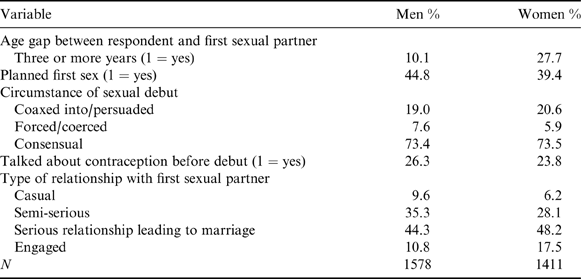
Table 3 presents the descriptive statistics of the circumstances of sexual debut for the respondents who experienced this event with their current partner. About 10% of males and 28% of females had an age gap of three or more years with their partner at sexual debut. About 45% of males and 39% of females planned their sexual debut. Among males, 19% reported that their sexual debut involved them coaxing or persuading their partner into sex or being themselves coaxed into it. About 8% of males reported forcing or coercing their partner into sexual debut or being forced into it themselves. The remainder (73.4%) reported that their sexual debut was consensual. About 21% of females reported being coaxed (or coaxing their partner) into sexual debut and 6% reported being forced (or forcing their partner) into it. The rest (74%) reported that their sexual debut was consensual. About 26% of males and 24% of females discussed contraception with their partner before their sexual debut. Table 3 shows that most Chinese youth were either in a serious relationship or engaged at sexual debut, and few experienced this event in causal encounters.
Circumstances of sexual debut, Chinese unmarried youth aged 15–24
Weighted percentages, unweighted N.
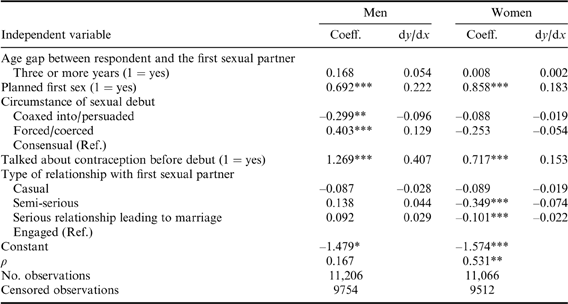
Table 4 demonstrates how the selected variables for relationship context influence the likelihood of CSD. The age gap between partners has non-significant effects on CSD for both males and females. Planned sex increases the probability of CSD by 22% for males and 18% for females. The analysis considers the circumstances of sexual debut, which compares the effects of being (a) forced/coerced into sexual debut and (b) coaxed into sexual debut with consensual sexual debuts. For males and females, the category ‘forced/coerced into sexual debut’ includes whether the respondent forced/coerced her/his partner into sexual debut or were forced/coerced into sexual debut themselves. Of course, whether a person forced a partner or were themselves forced into sexual debut are distinct circumstances. These were combined into a single category because of small cell counts. For males, being forced into sexual debut was a rare event and few females forced their partner into it. For the most part, these categories represent male behaviour (i.e. coaxing or coercing female partners into sexual debut) and this is how we interpret the findings. The category ‘coaxed into’ sexual debut also combines whether the respondent coaxed her/his partner or was coaxed into it themselves. For males, a sexual debut that involves force or coercion increases the likelihood (13%) of CSD at sexual debut in comparison with sexual debuts that are consensual. In contrast, when males coax or persuade their partners into sex, they are 10% less likely to use a condom at sexual debut. The circumstances of sexual debut have non-significant effects on CSD for females. For males and females, discussing contraception with their partners increases the probability of CSD, by 41% and 15%, respectively. For females, being in a semi-serious or serious relationship (leading to marriage) decreases the likelihood of CSD in comparison with their engaged counterparts, but relationship type has non-significant effects for males.
Estimated parameters of Heckman's selection model (with robust SE) of the condom use on the circumstances of sexual debut among Chinese unmarried youth aged 15–24
Selection equations are not shown (but are available from the authors). Models control for all independent variable shown in Table 1.
***p<0.001; **p<0.01; *p<0.05.
Discussion and Conclusion
The purpose of this study was to examine condom use at sexual debut among Chinese youth. As discussed above, little is known about this topic, which is a concern because sexual activity has increased among youth and STIs have re-emerged across China since the 1980s. Coupled with a lack of knowledge about their sexual and reproductive health, the sexual behaviour of Chinese youth is a ‘hidden’ public health problem. Chinese youth are a large sub-group (161 million persons) that is at risk of STIs and unintended pregnancies. Given that condom use is habit-forming, understanding the determinants of CSD is essential for identifying high-risk youths.
Using nationally representative data, this study examined how social and demographic factors influence CSD. The findings generally confirm the patterns of condom use in other developing countries and demonstrate that Chinese youth are a high-risk group. The overall rate of CSD is under 36%, which shows that almost two-thirds of Chinese youth are practising unsafe sex at sexual debut. This rate of CSD is low in comparison with youth in other countries. For example, 61% of US youth use a condom at sexual debut (Shafii et al., Reference Shafii, Stovel and Holmes2007). Since people under age 29 account for a disproportionate number of STIs (Chen et al., Reference Chen, Gong, Liang and Zheng2000), there is an urgent need to implement behavioural interventions for Chinese youth.
For the most part, this study's selected social and demographic variables have similar effects for males and females. Of these variables, only age and educational attainment have significant effects on CSD. The results demonstrate that age is an especially important predictor of CSD. This finding is consistent with studies from other developing countries that observe that condom use increases with age (see Blum & Mmari, Reference Blum and Mmari2005). The finding about the relationship between age and CSD implies that early sexual debut associates with risky sexual behaviour. It is not clear why this is the case. However, previous research suggests that youth are less knowledgeable about self-protection and also lack the skills to plan against unsafe sex (Juarez & LeGrand, Reference Juarez and LeGrand2005). It is also possible that younger people lack good access to condoms or simply are less cautious than older people when it comes to their sexual behaviour.
As prior research indicates, condom use is a couple-level decision (e.g. Manning et al., Reference Manning, Longmore and Giordano2000). Moving beyond individual-level models of condom use, our analysis considered how relationship context influences CSD. The results from these models confirm that relationship context is important. The key findings are that planning sexual debut and discussion of contraception between the couple have strong effects on the self-protecting behaviour of youth. This suggests that youth who are better prepared for their sexual encounters are more likely than others to plan against unsafe sex. Moreover, the type of relationship also influences CSD (for females only), and engaged youth appear to have an increased likelihood of CSD.
This study has several data limitations. First, the dataset focused on unmarried youth. The sexual behaviours of married youth before and after marriage are not observed in this study. Second, the study is limited in that the questions about the relationship context of sexual debut were only asked of people who experienced this event with their current partner. Only about 60% of the restricted sample were still with the person they had their sexual debut with. To some extent, it is possible that the factors that associated with the respondent no longer being with their first sex partner (e.g. it being a casual relationship) could influence CSD. Hence, the effects of relationship context need to be interpreted with some caution. Finally, the dataset lacks concrete information about the respondent's level of knowledge about self-protection and access to it, which is necessary for sorting out whether risk behaviours represent a lack of knowledge, barriers to access or carelessness.
The results suggest that it is necessary to begin providing Chinese youth with a comprehensive sex education at the beginning of high school and perhaps even distribute condoms to them. This comprehensive education should emphasize the risks of unsafe sex and provide concrete information about self-protection. The main challenge to implementing such a programme is public resistance. Until the 1980s, premarital sex was uncommon and the main purpose of sex was considered to be procreation (Parish et al., Reference Parish, Laumann and Mojola2007). Policy-makers and school officials are reluctant to implement comprehensive sex education programmes out of concern that these will be perceived as promoting immoral behaviours (Wang et al., Reference Wang, Hertog, Meier, Lou and Gao2005). The taboos against discussing sexual and reproductive health represent a danger to the well-being of youth.
Acknowledgments
The authors gratefully acknowledge financial support from a Social Sciences and Humanities Research Council (SSHRC) grant, China's National ‘973’ project on Population and Health (No. 2007CB5119001) and a China Scholarship Council grant (No. 2010601193).