Introduction
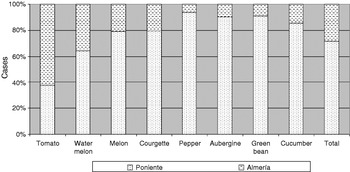
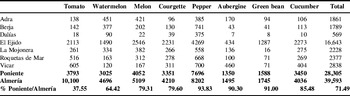
The Poniente region of Almería is known worldwide for its specialty production crops. The eight main crops that form its agricultural tradition (pepper, melon, tomato, courgette, cucumber, watermelon, green bean and aubergine) occupy an area of 28,305 ha1 in ten municipalities (El Ejido, Vícar, Roquetas de Mar, La Mojonera, Adra, Berja, Dalías, Felix, Enix and Darrícal) (Fig. 1). This horticultural area is 56.77% of the 49,786 ha of irrigated, vegetable crops of the province of Almería and 71.49% of the 39,593 ha occupied by the eight main crops mentioned previously. The cultivated area growing the eight main horticultural crops and subject to biological control amounts to 9813 ha2 in the province of Almería, with 85.83% of the area (7882 ha)3 included in the ten municipalities of Poniente (Table 1).
Vegetable area cultivated in greenhouses.

Cultivated area of the main vegetables in the province of Almería.

The Poniente region is also known for sheep and goat production. Of the total 4.41 million sheep and goats in Andalusia, 12.43% are located on livestock farms in the province of Almería4. These data are particularly important with respect to goats, because, of the total 1.13 million goats in Andalusia, 20.74% or 234,600 are in the province of Almería4.
Therefore, a huge amount of biomass is produced in the vegetable greenhouses, estimated at 800,000 t of fresh vegetable material per yearReference Moyano López5 or 1.10 million tReference Camacho Ferre6. According to the latest statistical data of the Delegación Provincial de Agricultura y Pesca de Almería (Provincial Government Office of Agriculture and Fish of Almería), and comparing the average data from the past two seasons, as well as consultations with agricultural technicians from the sector, the production of vegetable wastes coming from greenhouses in the province of Almería can be estimated at 1.95 million t, including 1.36 million t produced in the Poniente region of Almería. This biomass causes major environmental problems because it is usually accompanied by other wastes produced in greenhouses or inherent to such production, including raffia, containers and packaging, cover and padding plastic, wood and metal. These wastes, generated on farms where protected crops are grown, cause major deterioration in the quality of life of the adjoining environment. Solutions have been proposed for these problems, and include, among others, composting of vegetable subproducts from greenhouses (VSG) by aerobic biological decomposition under controlled conditions, using them as fuel to replace fossil fuels in cement plants through incineration, fueling energy generation plants through combustion of resources, and using them in overheated vapor or gasificationReference Camacho Ferre6 plants. The management of containers and container wastes seems more or less controlled by the deposit and return system, but management of biomass seems more complex, not only because of the technology to be applied but also because of the need for storage that prevents entry of animals and reduces the risk of deterioration. The use of this biomass as a subproduct in livestock feed might partially solve the problem, provided storage of this food can be properly managed. The main obstacle we find is the brief period of time in which it must be used by livestock before deteriorating, but such a problem can be solved with the use of a proper preservation method, such as silageReference Moyano López5, or with appropriate management.
The population is uneasy regarding consumption of these VSG by sheep and goats, because of rising concerns about possible biomagnification of supposed wastes of phytosanitary products in the brush or fruit coming from vegetable greenhouses. For this reason, it must be proved that the maximum levels of wastes in these subproducts are within the acceptable limits set by European legislation. All citizens should be informed about stockmen not opting for food dangerous to the livestock's health, because the use of dangerous feed would negatively affect their own economy in the medium or long term, although it supposes an economic profit in the short term. Furthermore, the use of VSG could help keep farms that, in other ways, would disappear over the medium or long term, because, on the one hand, of the owner's age (in some cases they are very close to retirement age), and, on the other, of the constant and progressive increase in prices of fodder and forage used to feed livestock. Finally, it must be stated that the evolution of biological control in the province of Almería contributes in a spectacular way to the confidence of stockmen in the use of this biomass as a subproduct of animal feed. It is enough to see that the area has grown from 130 ha (mainly of tomato and pepper) in the 2005/06 season to more than 9000 ha in the 2007/08 season and more than 17,000 ha in the 2008/093 season.
Materials and Methods
In the Poniente region of Almería, in its ten municipalities (Adra, Berja, Dalías, Darrícal, El Ejido, Enix, Felix, La Mojonera, Roquetas de Mar and Vícar), there are 344 sheep and goat herds, with a census of 36,815 sheep and 25,840 goat for a total of 62,655 animals7. From census totals, 58,532 animals (34,457 sheep and 24,075 goat) do not correspond with fattening animals7. Fattening livestock do not use VSG; therefore, they were removed from the population under study.
Relevant veterinary services were consulted, along with data from the Delegación Provincial de Agricultura de Almería (Provincial Government Office of Agriculture of Almería), and it can be stated that there are some sheep and goat farms where feeding is extensive, and others are included in farms with temporary pastures used in transhumance; therefore, it seemed logical to also remove such livestock and farms from the population under study.
Likewise, it seemed reasonable to conduct a study of livestock with a census big enough to consume a significant quantity of VSG. We estimate the limit for such census at 50 animals; in this way, we eliminated all the sheep and goat herds of less than 50 animals, because we consider them not representative of the object of our research.
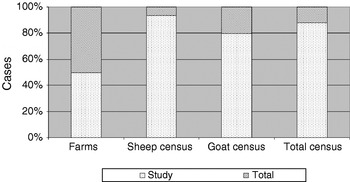
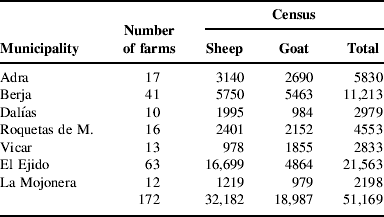
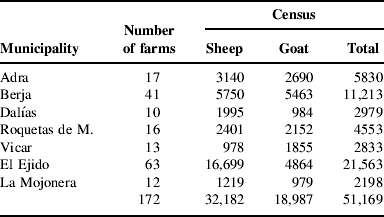
In this way, we obtained a final population of 172 farms with 32,182 sheep and 18,987 goats for a total of 51,169 animals, as shown in Table 2. Therefore, the initial population of our work was reduced to 50% of total herds (172 of the 344 initial ones) and 81.67% of the initial census of animals (51,169 sheep and goats from the initial 62,655). From this final census object of study, 62.89% were sheep (87.41% of the initial population) and 37.11% were goats (73.48% of the initial population) (Fig. 2).
Percentages of farms, sheep and goats included in study.

Farms raising sheep and goats in the Poniente region of Almería7.
The cultivated area of vegetables in the province of Almería amounts to 49,786 ha, of which 57.34% (28,547 hectares) is cultivated in the Poniente region of Almería1. The eight main horticultural crops are pepper, melon, tomato, courgette, cucumber, watermelon, green bean and aubergine. The cultivated area subject to biological control of the eight main crops in the province of Almería comprises 9183 ha, of which 7882 (85.83%) are cultivated in the Poniente3 region.
The data regarding area cultivated in the ten municipalities of the Poniente region of Almería, in terms of the eight main horticultural crops, appear in Table 1. The great importance of pepper crops (93.83%), green beans (91.00%), aubergines (90.30%) and cucumbers (85.48%) must be taken into account in the total area cultivated in the province. From these ten municipalities, we eliminated the municipalities of Darrícal, Enix and Felix because they are not representative.
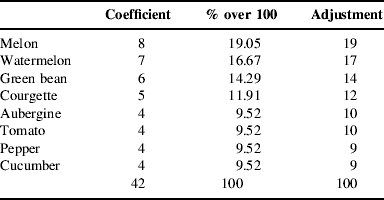
At this point, we have a list of horticultural crops that can apparently be used for feeding sheep and goats. However, not all these crops have the same handling requirements, the same nutritive composition, or the same moisture content. Therefore, we applied a confidence coefficient reflecting the availability of the crop within the municipality where the farm is located, its nutritive content, its handling and management, and the amount of raffia or residual plastics left after harvest. In this sense, the most available and cleanest crop is melon, followed by watermelon, green beans and courgettes. Therefore, we created a weight scale where we assigned the highest weight, 8 to melon, 7 to watermelon, 6 to green bean and 5 to courgette. As the other four crops have a similar weight, we assigned a weight of 4 to each of them. We then transformed this total weight to a scale of 100 to obtain a coefficient referring to the highest confidence of the stockmen in one or another horticultural subproduct, to be called the confidence coefficient (Table 3).
Confidence coefficients.
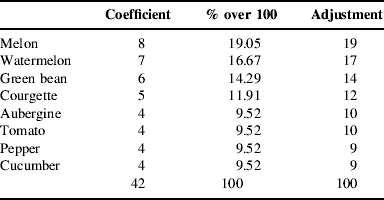
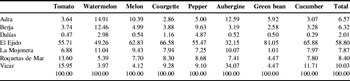
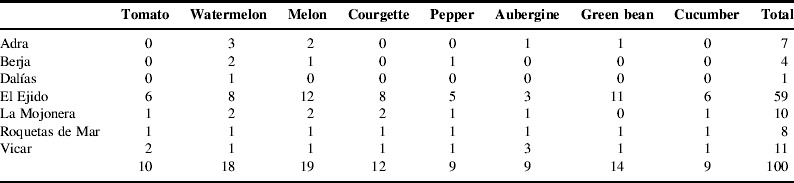
The confidence coefficient can be applied to either the area of the subproduct with respect to the total subproduct in the region (Tables 1 and 4) or to the area of subproduct within each municipality with respect to the total area of each municipality. We chose the first option to make the work more representative. Thus, Table 4 shows the confidence coefficient for each subproduct with respect to the total corresponding subproduct and distribution in municipalities.
Importance in percentage of the use of each subproduct in terms of confidence coefficient.

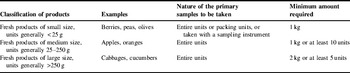
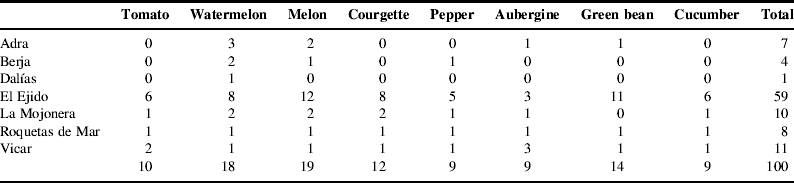
Once the importance of each subproduct was known in terms of confidence coefficients for sheep and goat feeding, a protocol for taking samples was designed to determine whether undesirable substances for animal feed were observed in the VSG. Therefore, it was decided to take samples of crops found on farms and used as livestock feed. Data included the types of vegetable subproduct found (whether brush or fruit), where they were physically found on the farm (in a warehouse or scattered on the plot), whether they had residues of plastic, raffia, or containers and packing, the traceability of such VSG (if they came from a greenhouse, the farmer's own or a fruit and vegetable handling center, a treatment center, or a spill of unknown origin) and the estimated amount in cubic meters, and for this purpose, a visit book was made. Once the action protocol was designed, it was decided to take 100 samples depending on the importance of each subproduct in terms of confidence coefficient for livestock feed, brush, fruit, or both, for each farm visited, with the purpose of analyzing multiple wastes in the Laboratory of Production and Animal Health of Córdoba, part of the Regional Ministry of Agriculture and Fish (Consejería de Agricultura y Pesca) of the Andalusian Regional Government, and in the Laboratory of Production and Vegetable Health of La Mojonera (Almería), also part of the Regional Ministry of Agriculture and Fish (Consejería de Agricultura y Pesca) of the Andalusian Regional Government. The purpose of these analyses was to detect the presence of residual phytosanitary products, forbidden and not forbidden, and to determine whether they exceeded the maximum limit on wastes established in accordance with regulations. Sampling was done completely at random, including the selection of farms, taking as a starting point the official legislation applicable to the sampling methods for the control of pesticide wastes in products of vegetable and animal origin8, 9 (PNT-04MA22 and PNT-04MA30—Method Validation and quality control procedures for pesticide residues analysis in food and feed. Document No. SANCO/2007/3 131.31/October/2007. Supersedes Document No. SANCO/10232/2006). Products of vegetable origin, a description of primary samples, and the minimum size of laboratory samples appear in Table 5. The minimum sample amounts varied depending on whether brush or fruit was being sampled. In this sense, for brush, 200 g samples were taken in a closed bag. Samples had two labels. Bags were labeled with one specifying the code of the farm, owner of the farm, location of the farm and number of the sample. In the case of fruit samples, if they were large (melons, watermelons, aubergine, cucumbers and courgettes), five fruits or 2 kg of weight was taken; if they were small (tomatoes, peppers and green beans), ten fruits or 1 kg of weight was taken, with samples put in bags similar to those used for brush. The second label was added to the sample sheet to unambiguously identify the sample.
Nature of samples to be taken8.

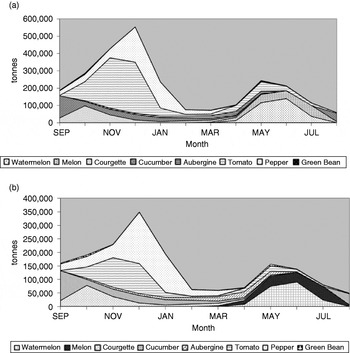
Once the protocol for taking samples was developed, a visit schedule was prepared and the places to be visited were mapped. For this, the approximate dates of generation of subproducts were taken into account in the different municipalities during the year (shown in Fig. 3a and b), along with the importance of each subproduct in terms of confidence coefficient for sheep and goat feeding. The visit schedule is shown in Table 6.
(a) Production of vegetable wastes by greenhouses in the province of Almería by months. (b) Production of vegetable wastes by greenhouses in the Poniente region by months.

Visit schedule % for subproduct and municipality.
Results and Discussion
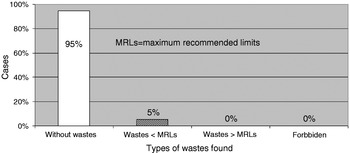
Of the 39 samples sent to the Laboratory of Production and Animal Health of Córdoba, 37 (94.87%) appeared free of wastes of undesirable substances in animal feed (Fig. 4). The other two samples, from brush, showed wastes of undesirable substances over the maximum limit of allowed wastes, but this does not imply that within an appropriate safety period, even those two samples could not be used for animal feed. It must be highlighted that undesirable substances never appeared in fruit. We grouped the results of the samples sent to the Laboratory of Production and Animal Health of La Mojonera (Almería) into two parts, fruit and brush. Further, we considered them separately in order to better represent the different types of analyses carried out. The differences in feed composition are due to fruit and brush coexisting for a period of time on the farm, waiting for consumption by livestock. In addition, compulsory legal measures against disease in horticultural crops10 state that once the crop has terminated, when the plants are pulled up, greenhouses will be closed and stay closed until plants are completely dry, treatments applied against vector insects, and vegetable waste properly removed, and abandonment of the crops is totally forbidden. Wastes of phytosanitary products undesirable for animal feed appeared only in brush, but a logical explanation can be given. From the results obtained, those results less than 0.05 part per million have been eliminated because they appeared only in brush and may have been caused by derived products (endosulfan), by metabolic transformations (carbendazime), or even by compulsory treatment of the greenhouse harvest waste, before being considered as VSG, as mentioned.
Types and amounts of wastes and undesirable substances found in VSG.

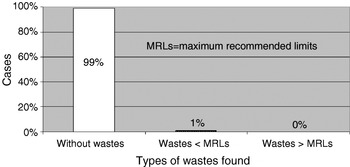
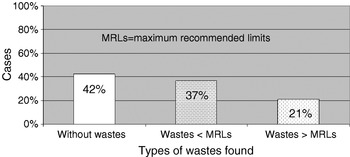
Of the 90 samples of fruit sent to the Laboratory of Production and Vegetable Health of La Mojonera, 89 were free of undesirable substances for animal feed, and no samples contained forbidden substances (Fig. 5). Of the 109 samples of brush sent to the laboratory, 45 (42.2%) were free of undesirable substances, 40 showed wastes of phytosanitary products above the maximum limits allowed in human feed but not for animal feed (they were free of them) (Fig. 6). With a proper safety period, they could be used for feeding herds. Finally, 23 samples showed forbidden substances (not undesirable) for animal feed, mostly due to soil treatment (endosulfan), to active substances that were recently forbidden (malathion and procimidone), or to the compulsory treatment of vegetable waste.
Types and amounts of wastes and undesirable substances found in fruit.

Types and amounts of wastes and undesirable substances found in brush.

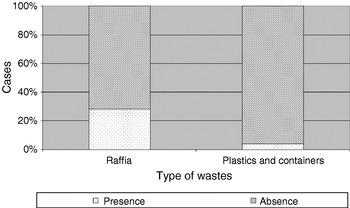
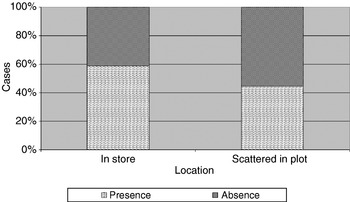
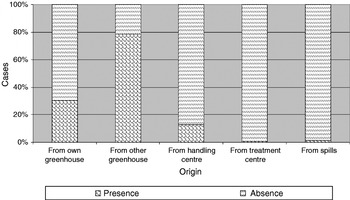
In the 86 visits made, 178 samples were taken, controlling a total of 288 subproducts, of brush as well as fruit. In particular, a total of 194 subproducts from brush and 94 from fruit were controlled. In the 288 subproducts, raffia was found in 28% (Fig. 7), especially in tomato, courgette, green bean and pepper, appearing in very small amounts in melon and watermelon; however, the presence of plastics on the farm, as well as containers and parts of containers, was practically 0% (Fig. 7). The presence of plastics or containers makes livestock feeding more difficult; therefore, stockmen try everything possible to remove them when they find them among vegetable subproducts. In 44% of cases, the VSG were scattered in the plot constituting the farm or in other plots located in surrounding areas where stockmen scattered brush or fruit to feed livestock (Fig. 8). The problem with scattering fruits in unfenced plots is that insects such as flies and mosquitoes proliferate, in addition to rodents, and keeping the animals in the vicinity can be difficult. Therefore, it is not recommended that fruits be used for livestock feed if the plot is not cleaned immediately after the herds have eaten. In 77% of cases, the VSG came from greenhouses other than those owned by the stockmen, and comprised mainly melon and watermelon crops, as shown in Fig. 9.
Types of packing wastes found on farms.

Location of VSG on farms.

Origin of VSG on farms.

The results of this study support the use of these VSG in sheep and goat feeds; however, planning in this sector is not occurring nationwide, unlike the situation in other sectors, such as that of pigs, where the traceability system for pig manure is well developed, and pig manure is authorized for use as an organic fertilizer11. Legislation does not exist in our sector of study. There are no rules regulating the characteristics of sheep and goat farms with respect to their infrastructure or to maximum numbers that a farm can accommodate. In the pig sector, there are legal limitations that protect pigs; for example, fattening pigs between 20 and 100 kg of live weight require at least 0.65 m2 of space per animal. This means that farms are never smaller than allowed and that accommodations for herds can be perfectly structured, including places for their daily exercise, places for feeding, growing, breeding, etc.
In the case of sheep raised for meat, only practical hygiene guidelines are in place12–14. These guidelines suggest the following European Community15 and national16 recommendations for fodder hygiene. Since sheep are ruminants, they require long fiber for proper digestion in their rumen, and such fiber may be provided by the brush in VSG. The guidelines also state that they eat the most appetizing food first, usually the food with the highest energetic concentration; therefore, this aspect should be taken into account when portions are shared. Likewise, it is also recommended that farmers keep a record of all necessary data pertaining to control of the fodders entering the farm, including date of entry, provider, delivery note, type of fodder, prescription number in the case of medical fodder, and the animals to which such fodder is given. It also seems reasonable to keep a traceability record of VSG, registering stockmen of origin, date of entry, vegetable species, approximate kg or volume, provision of multi-waste analysis proving that no wastes of phytosanitary products are included or that the existing wastes do not exceed the maximum recommended limits (MRLs). A model traceability log is shown in Table 7.
Model of traceability log for VSG.

With respect to storage, the guidelines of the Spanish Ministry of the Environment and Rural and Marine Affairs state that feed for livestock must be stored in conditions of low humidity and proper hygiene. There are cases where the VSG are transported from a greenhouse or even from a horticultural center to the farm, where, with no type of traceability control, they are spilled on the plot, and many times such a plot does not belong to the stockman. In this case, neighbors usually make formal complaints about insects, bad odor, putrefaction and the waste traditionally known by stockmen as churre (dirty grease) that can cause problems with percolation and contamination of subterranean aquifers. At other times, brush is stored far from the soil and thus free of humidity; however, it could be covered with plastic to protect it from the open air. The effect of excess humidity is usually the presence of fungus and mold, decomposition and odor.
The problem of separation of raffias can be easily solved in two ways. One is by use of a mechanism placed on the front of the tractor that would lift the brush and separate out a large portion of raffia. The second way is by using natural biodegradable raffia, an alternative to polypropylene that creates totally organic waste without affecting the production of crops, even in the case of long-cycleReference Bernal, Días, Toresano and Camacho17 crops.
Finally, it must be stated that Andalusian regulations pertaining to farms18 affirm that all farms must use means of production that guarantee keeping the farm at a proper hygienic and healthy level and that allow effective cleaning, disinfection and elimination of insects and rodents. Animal welfare regulations in force19 must be observed. Animals must be kept in an enclosed and delimited area, so farms that use VSG are normally enclosed, but they use bordering plots to scatter the feed (fruit and brush) so that when the herds go out to exercise, they eat at the same time. This practice is normal in the Poniente region of Almería, and it is the object of many complaints by individuals. The problem can be easily solved if the correct hygiene, animal welfare and food provisions are observed, and if the plots on which such food is scattered are enclosed, preventing access from the outside, and all remaining feed is removed after the livestock have finished eating.
Conclusions
In view of the results, we conclude that brush and fruit VGS from the eight main crops grown in the vegetable greenhouses of the Poniente region of Almería is a potential feed stock for sheep and goat herds in the region. Precautions must be taken to avoid the use of brush VGS that contains higher than permissible levels of phytosanitary products, or levels of packaging waste that would endanger the health of the livestock. Considering the high prices of raw materials that compose the fodders and concentrates used in sheep and goat feed, VGS provides a viable, low-cost substitute or supplemental source of nutrition for sheep and goats in the Poniente region of Almería.