Introduction
A central focus of epidemiological research on post-stroke affective disorders has been the development of so-called PSD. This outcome has indeed a prominent status within stroke survivors as it can be observed in more than one-third of this population (Hellmann-Regen et al., Reference Hellmann-Regen2013). It is also a crucial factor that may impede the therapeutic process, and increases the risk of later mortality (Robinson, Reference Robinson2003). In contrast, PSA has only recently gained attention (Tang et al., Reference Tang, Lau, Mok, Ungvari and Wong2013; Ayerbe et al., Reference Ayerbe, Ayis, Crichton, Wolfe and Rudd2014; Lambiase et al., Reference Lambiase, Kubzansky and Thurston2014). This is most probably due to the low prevalence reported in early population-based studies on PSA (House et al., Reference House, Dennis, Mogridge, Warlow, Hawton and Jones1991). This kept with epidemiological results from the general adult population, suggesting that anxiety is uncommon among older adults (Campbell Burton et al., Reference Campbell Burton, Murray, Holmes, Astin, Greenwood and Knapp2013).
A major drawback of many studies has been the isolated investigation of PSD and PSA. Despite the fact that their high comorbidity has already been reported (Kessler et al., Reference Kessler, DuPont, Berglund and Wittchen1999; Campbell Burton et al., Reference Campbell Burton, Murray, Holmes, Astin, Greenwood and Knapp2013; Ayerbe et al., Reference Ayerbe, Ayis, Wolfe and Rudd2013b), only few studies are examining them in combination (Barker-Collo, Reference Barker-Collo2007; Fiedorowicz et al., Reference Fiedorowicz, He and Merikangas2011; Lincoln et al., Reference Lincoln2013; Ayerbe et al., Reference Ayerbe, Ayis, Crichton, Wolfe and Rudd2013a). A further limitation of most studies on PSD and PSA is the privileged use of rating scales. Regarding the usability of depression and anxiety rating scales in neurologic patients, it has been clearly demonstrated that these are rather sensitive to distress rather than specific for identifying depressive and anxiety disorders (Schramke et al., Reference Schramke, Stowe, Ratcliff, Goldstein and Condray1998). More recently, Ayerbe et al., also strengthen that PSD validated scales led to diagnoses which could not be confirmed with criteria based on the Diagnostic and Statistical Manual of Mental Disorders (DSM) (Ayerbe et al., Reference Ayerbe, Ayis, Rudd, Heuschmann and Wolfe2011). In contrast, only few studies used more time-consuming Structured Clinical Interview from the DSM (First et al., Reference First, Spitzer, Gibbon and Williams1996) which would not only enabled to investigate precisely PSD and PSA, but also to encompass both within the same tool (Byers et al., Reference Byers, Yaffe, Covinsky, Friedman and Bruce2010).
There is also a lack of evidence regarding the predictability of post-stroke affective disorders based on their respective lifetime prevalence. Various approaches concurred to the conclusion that pre-stroke depression is a predictor of PSD (Caeiro et al., Reference Caeiro, Ferro, Santos and Figueira2006; Ayerbe et al., Reference Ayerbe, Ayis, Rudd, Heuschmann and Wolfe2011). Similarly, few studies described that approximately one-third of patients with PSA had a history of mood or anxiety disorders (Burvill et al., Reference Burvill, Johnson, Jamrozik, Anderson, Stewart-Wynne and Chakera1995; Leppavuori et al., Reference Leppavuori, Pohjasvaara, Vataja, Kaste and Erkinjuntti2003). However, either the measure of the lifetime affective disorder remained unclear or the diagnoses depicts only a specific subtype of patients, e.g. only pharmacologically treated pre-stroke depression (Caeiro et al., Reference Caeiro, Ferro, Santos and Figueira2006) or solely generalized anxiety disorders (GAD) (Leppavuori et al., Reference Leppavuori, Pohjasvaara, Vataja, Kaste and Erkinjuntti2003). Consequently, to our knowledge, no study clearly identified lifetime affective disorders as a predictor for PSD or PSA.
In sum, the present investigation has a double focus: on the one hand on affective disorders at post-stroke and on the other hand on their predictors within the affective history of stroke patients. The implications are twofold. On a clinical level, the adjustment of diagnostic procedures moving from focus on depression to a larger view including anxiety disorders. On a theoretical level, shedding light on the discussion about the taxonomy of affective disorders, more precisely the specificity of post-stroke affective disorders compared to non-stroke related affective disorders.
Methods
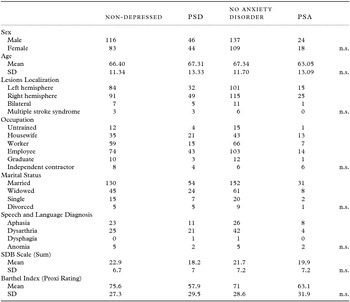
289 patients included in the present study were recruited in three German rehabilitation facilities in the area of Lower-Saxony (Natruper Holz Clinic, Osnabrück; Osterbach Clinic, Bad Oeynhausen, Westfälich Clinic for Psychiatry, Psychotherapy and Neurology, Lengerich). Recent results from the German Health Interview and Examination Survey for Adults reported similar stroke prevalence with prevalence estimates from other international studies (Busch et al., Reference Busch, Schienkiewitz, Nowossadeck and Gößwald2013). The present investigation complies with the following locally appointed ethics committees: of the Osnabrück University and the three rehabilitation facilities. The present research protocol also complies with the Declaration of Helsinki. The main criteria for admission in a German rehabilitation clinic are the following: no need for intensive medical treatment, no artificial respiration, no intensive treatment of the body injuries, no heightened intracranial pressure. For more details, see Schönle, (Reference Schönle1996) and Christensen and Uzzell (Reference Christensen and Uzzell2000). Patients were recruited and assessed shortly after admission (median: 6 weeks after Stroke, Q1, 25% = 4 weeks, Q3, 75% = 9 weeks) with a diagnosis of either acute cerebral infarction or intracerebral hemorrhage. Informed consent was obtained for all patients. Beyond clinical diagnosis of stroke, patients were included if following criteria were fulfilled: a documentation of the presence of the neurological symptoms exceeding 24 hours, a precise documentation of the lesion, physical capacity of the patient to attend our facilities, capability to undergo a structured interview as an evaluation of affective disorders in German. Consequently, patients with severe communication impairment were excluded from the study. Only a small portion of patients had a diagnosis of Aphasia (11.8%). Disability was relatively restricted (mean sum of the SDB: 21.4/28 (Schlaganfalldatenbank of the Niederösterreichischen Landeskrankenhauses Klosterneuburg; (Brainin, Reference Brainin1989); mean proxy Barthel Index (69.9%). The original cohort included 331 patients, from which 289 (87.3%) were kept for the final analyses. This subset of 42 patients (12.7%) were excluded from the final analysis either because of incomplete demographic information (occupation, marital status, n = 37, 11.2%), and/or incomplete diagnostic information (clinical interview and/or speech and language diagnostic, SDB scale n = 40, 12.1%). The final cohort of 289 patients comprehends no missing data. Further information about the final cohort is presented in Table 1.
Demographic and diagnostical characteristics of the 289 stroke patients who were assessed for mood and anxiety disorders.

Note. PSD: “Post-Stroke Depression. ” PSA: “Post-Stroke Anxiety.” SD: “Standard Deviation.” SDB Scale: Schlaganfalldatenbank of the Niederösterreichischen Landeskrankenhauses Klosterneuburg.
The evaluation of post-stroke affective disorders including mood disorder as well as anxiety disorders was based on a semi-structured clinical interview (Structured Clinical Interview), German version, from the DSM (First et al., Reference First, Spitzer, Gibbon and Williams1996). For further analysis, which will be reported in a companion paper, we also used two rating scales focusing on the depression: a proxy rating (CDS) specifically developed for brain-damaged patients and a self-rating (SDS). Results including the analyses of these two scales will be reported elsewhere.
The following SCID-I sections were explored: major depression, panic disorder without agoraphobia, panic disorder with agoraphobia, agoraphobia without panic disorder, social phobia, specific phobia, obsessive compulsive disorder (OCD), and GAD. We voluntarily kept on this DSM-IV-based categorization, and did not exclude OCD from anxiety disorders as suggested in DSM-5, in order to enable comparisons with previous studies. We undertook two main adaptations of the SCID-I interview: the presence of a cerebrovascular disease was not considered as an exclusion criterion and the time criteria (for depression and for the GAD) were adapted with the statement “since stroke” and “before stroke.” This enabled us to investigate two prevalence measures: the period preceding stroke, which was our measure of the lifetime prevalence and the period following stroke, as a measure of the post-stroke prevalence. Prevalence rates were determined by frequency measures of each mood and anxiety disorders listed above. Three clinical psychologists were specifically trained to conduct these interviews and were continually supervised by the first author (H.S.).
Statistical analysis
First, we focused on the report of prevalence rate (post-stroke and lifetime) of each mood and anxiety disorder. In the next step, we related these results to a larger database-result recently obtained for older adults of the European population (Wittchen et al., Reference Wittchen2011). Therefore, we computed, via bootstrapping, the confidence interval based on 1000 bootstrap sample, (CI of 99%) for our population in order to determine whether the prevalence of the European population falls into this confidence interval or not (Elfron and Tibshirani, Reference Elfron and Tibshirani1986). Second, we analyzed the covariations between mood and anxiety prevalence at post-stroke and then for the lifetime period by means of Spearman-ρ bivariate correlations. Third, we carried out a first logistic regression analysis to examine whether single PSA disorders represent meaningful predictors for PSD. Finally, a second logistic regression enabled us to examine which lifetime mood and anxiety disorders predict the occurrence of a PSD or a PSA. Statistical tests were two-tailed with p ≤ 0.05 defining statistical significance.
Results
Prevalence of depression and anxiety disorders
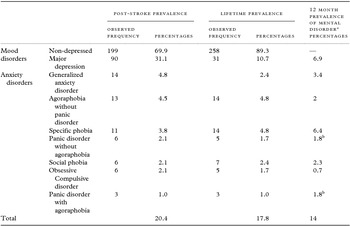
As shown in Table 2, one can observe the prominent status of PSD. The overall frequency of major depression at post-stroke was 31.1%. In order to strengthen this observation, we compared our result with those obtained for older adults in a recent European Study (Wittchen et al., Reference Wittchen2011) on. Interestingly, the post-stroke major depression prevalence of the present population was significantly higher than the prevalence rate of the European population (6.9%, CI = 24.6–38.2). In contrast, the present lifetime major depression prevalence (10.7%) did not significantly differ from the prevalence rate of European population on older adults (6.9%, CI = 6–15.4).
Post-stroke and lifetime prevalence of mood and anxiety disorders of the 289 stroke patients investigated in the present study. These results were contrasted to the results reported from a large European Study on mental disorders

a“12 month prevalence of mental disorder” were quoted from European Data of Wittchen, et al. (Reference Wittchen2011).
bPanic disorder.
When pooling all anxiety disorders, we obtained a post-stroke prevalence rate of 20.4%. We obtained the following ranked distribution from the most frequent to the less frequent anxiety disorders at post-stroke: GAD (4.8%), agoraphobia without panic disorder (4.5%), specific phobia (3.8%), panic disorder without agoraphobia (2.1%), social phobia (2.1%), OCD (2.1%), panic disorder with agoraphobia (1%). Remarkably, contrasting with the mood-disorder results, no comparison between the present prevalence rate and the prevalence rates from the European population reached significance (i.e. neither at post-stroke period nor at lifetime period).
Correlations between depression and anxiety disorders
We found a significant correlation between PSD prevalence and PSA disorder prevalence (Spearman-ρ = 0210, p < 0.001, N = 289). Similarly, lifetime depression prevalence and lifetime anxiety disorder prevalence correlated significantly (Spearman-ρ = 0145, p < 0.05, N = 289). The difference between these two correlations did not reach statistical significance (Z = 0.80, p = 0.425; based on Meng et al., (Reference Meng, Rosenthal and Rubin1992)).
More specifically, when examining the correlation between PSD and individual PSA disorders, GAD solely reached significance (Spearman-ρ = 0161, p = 0.006, N = 289). Similarly, when looking at the correlation-matrix of lifetime depression and individual lifetime anxiety disorders, three significant correlations emerged between lifetime depression and lifetime agoraphobia without panic disorder (Spearman-ρ = 0187, p = 0.001, N = 289); lifetime social phobia (Spearman-ρ = 0168, p = 0.004); lifetime OCD (Spearman-ρ = 0126, p = 0.033, N = 289).
Predictor analysis of post-stroke mood and anxiety disorders
A first logistic regression was carried out with frequency of PSD as the dependent variable and the individual PSA disorders as predictor variables. As shown in Table 3(A), only GAD reached significance. Further analyses of the odds ratio showed a significantly enhanced risk of 4.3 (CI = 1.4–13.26) to develop a PSD when having a GAD.
Logistic regressions results of PSD (A) and PSA (B) as dependent variables. Odds Ratio is presented for significant predictor variables. (A) logistic regression with frequency of PSD as the dependent variable and the following predictor variables: post-stroke panic disorder without agoraphobia, post-stroke panic disorder with agoraphobia, post-stroke agoraphobia without panic disorder, post-stroke social phobia, post-stroke specific phobia, post-stroke OCD, and post-stroke GAD. (B) logistic regression with frequency of PSA as the dependent variable and the following predictor variables: lifetime major depression, lifetime panic disorder without agoraphobia, lifetime panic disorder with agoraphobia, lifetime agoraphobia without panic disorder, lifetime social phobia, lifetime specific phobia, lifetime OCD, and lifetime GAD

Note: R 2 = 0.180 (Cox & Snell), 0.321 (Nagelkerke). Model χ2 (8) = 56.662, p < 0.0001.*p = 0.006; **p = 0.001; *** p = 0.04.
A further logistic regression analysis was carried out with frequency of PSD as the dependent variable and the following predictor variables: lifetime depression, and each lifetime anxiety disorder. No predictor variable reached significance. The same procedure was applied with frequency of PSA as the dependent variable. Interestingly, the following three variables reached significance: lifetime agoraphobia without panic disorder, lifetime specific phobia, and lifetime OCD (as shown in Table 3B)). The further analyses of the respective odds ratio showed the following significantly enhanced risk: a 6.8 (CI = 2.25–20.55) enhanced risk to develop a PSA when having a history of agoraphobia without panic disorder, a 18.8 (CI = 5.5–63.56) higher risk to develop a PSA when having a history of specific phobia, a 25.7 (CI = 2.8–236.92) heightened risk to develop a PSA when having a history of OCD.
Discussion
The present work focused on prevalence of PSD and PSA for a cohort of 289 patients in the early six weeks following stroke, in German rehabilitation clinics. We complemented these data by investigating the lifetime prevalence of mood and anxiety disorders. Based on these results, further analyses focused on the comorbidity between PSD and PSA, as well as predictors of PSD and PSA within affective history of the patients.
As demonstrated, the recent meta-analytical analyses of Ayerbe et al. (Reference Ayerbe, Ayis, Wolfe and Rudd2013b), it seems that studies which assessed more than 200 patients in rehabilitation setting are quite rare (from 43 PSD studies, 22 studies were in rehabilitation setting, of which nine studies assessed more than 200 patients). The present PSD prevalence of 31.1% is in line with Ayerbe's et al. recent meta-analytical analyses (29%, CI = 25–32) (Ayerbe et al., Reference Ayerbe, Ayis, Wolfe and Rudd2013b). For the same population of patients, we reported a PSA prevalence of 20.4%, which also corroborates a recent meta-analytical evaluation reporting an overall frequency of 18.3% (Campbell Burton et al., Reference Campbell Burton, Murray, Holmes, Astin, Greenwood and Knapp2013).
Further analyses of PSD enabled us to reinforce the specificity of this diagnosis compared to non-stroke-related depression. First, we were able to compare our prevalence results with the prevalence obtained from an European Study (Wittchen et al., Reference Wittchen2011) on affective disorders in “non-stroke” elderly population. The present PSD prevalence was significantly higher compared to this population. In contrast, the present lifetime depression prevalence did not significantly differ from the European Study prevalence. Second, we found that the lifetime depression is not a meaningful predictor for the emergence of PSD. Third, the gender asymmetry (a ratio of female: male of 2:3) reported for the “non-stroke” European population (Wittchen et al., Reference Wittchen2011) is not present in the present post-stroke population. These three results rather underpin recent considerations that PSD “is mostly associated with the experience and consequences of the stroke itself” (Ayerbe et al., Reference Ayerbe, Ayis, Wolfe and Rudd2013b).
A different picture emerged when comparing PSA prevalence with the prevalence of anxiety disorders of the European study (Wittchen et al., Reference Wittchen2011). We could confirm the previously reported similarity between these two populations (House et al., Reference House, Dennis, Mogridge, Warlow, Hawton and Jones1991; Burvill et al., Reference Burvill, Johnson, Jamrozik, Anderson, Stewart-Wynne and Chakera1995). As in the “non-stroke” population, GAD appeared to be the most frequent anxiety disorder at post-stroke (Campbell Burton et al., Reference Campbell Burton, Murray, Holmes, Astin, Greenwood and Knapp2013). Thereby, this increase in GAD prevalence between lifetime and post-stroke seems rather due to age than a consequence of stroke itself. In addition, specific lifetime anxiety disorders (agoraphobia without panic disorder, specific phobia, and OCD) are significant predictors of PSA, which is in line with previous reports (Burvill et al., Reference Burvill, Johnson, Jamrozik, Anderson, Stewart-Wynne and Chakera1995; Leppavuori et al., Reference Leppavuori, Pohjasvaara, Vataja, Kaste and Erkinjuntti2003). One possible conclusion of these stronger links between lifetime anxiety and PSA could be that the diagnosis of PSA is lesser stroke-related than the picture of PSD we depicted above. However, further studies are needed to strengthen this conclusion and to specify the link between pre-stroke and post-stroke affective disorders. In other words, to differentiate between new onset, relapse, and continuation of a pre-stroke depression and anxiety disorders.
Regarding the comorbidity between mood and anxiety disorders, two aspects should be put forward. First, compared to the very heterogeneous percentages reported in previous studies (Campbell Burton et al., Reference Campbell Burton, Murray, Holmes, Astin, Greenwood and Knapp2013), we were able to report clear correlations between mood and anxiety disorders at post-stroke and in the lifetime period. More specifically, PSD came along more frequently with post-stroke GAD. In contrast, the lifetime period appeared more complex. Lifetime depression covaried with three different types of anxiety disorders (lifetime agoraphobia without panic disorder, lifetime social phobia, and lifetime OCD).
Nevertheless, one main limitation of the present results should be taken into account when considering their generalizability. As validated scales did not lead to the same diagnoses as DSM-IV-based criteria (Ayerbe et al., Reference Ayerbe, Ayis, Rudd, Heuschmann and Wolfe2011), we applied the time-consuming Structured Clinical Interview (First et al., Reference First, Spitzer, Gibbon and Williams1996). An emerging limitation is the restricted scope of post-stroke patients who can be assessed based on this tool. The present cohort was communicatively and physically able to undertake such an interview. However, one could anticipate that investigating patients with more severe stroke-related physical disabilities and/or more pronounced speech and language disorders could modify the presently reported picture of mood and anxiety disorders. However, the factor “disability” as a predictor for PSD remain to our knowledge a topic of debate (Ayerbe et al., Reference Ayerbe, Ayis, Wolfe and Rudd2013b).
Implications of the present results are twofold: (1) for the clinical practice, diagnostic procedure in stroke patients should encompass depression and anxiety disorders, which will also impact on therapy planning. (2) Regarding the conceptualization of post-stroke affective disorders, PSD seems to be clearly stroke-related and thereby less foreseeable than PSA.
Conflict of interest
None.
Description of the author's roles
H. Schöttke formulated the research question, design the study, supervised the data collection and data analyses. He also assisted with writing the article. C.-M Giabbiconi assisted in formulating the research question, analyzed the data, and wrote the paper.
Acknowledgments
We would like to thank all patients and families who took part in the present study. We also thank the three rehabilitation facilities that enabled the investigation, as well as the psychologists who actively participated in the data collection.
The present work was supported by the Osnabrück University (Position of the first Author, HS). However, it played no role in the design, execution, analyses, interpretation of the data, and writing of the study.