In all chaos there is a cosmos, in all disorder a secret order.
Carl JungFootnote 1
Introduction
Smells are everywhere, but they are elusive, evanescent, and often neglected. This article explores this ‘lower’ sense and the roles it played in the historical process of what is usually termed ‘modernization’ in China. I argue that smell constituted a hidden site where the dynamics of power relations between, broadly speaking, China and the West were played out. Smell also opened up a window to showcase modernity's power and ambivalence. Two examples of observations made by Westerners offer a glimpse of how these dynamics worked.
Paul Claudel (1868–1955), the French consul in China between 1895 and 1909, kept in his memory various ‘exotic’ odours found in the old town of Shanghai: the smell of incense that filled a cave, ‘an odor of earth’ from a temple, ‘an odor of burning chestnuts’, and ‘a heavy perfume, powerful, stagnant, strong as the beat of a gong’ from an opium den.Footnote 2 Everything that he smelled, saw, and heard made up ‘an artless disorder’, and to him ‘the fascination of all the past’.Footnote 3 Leaving this ‘city of other days’, passing through a double gate filled with stench, chaos, and darkness, he saw that ‘the electric lights of the Concession shine’.Footnote 4 His essay ends with this imagery of the lights of the foreign settlement, established by the British, American, and French in the mid-nineteenth century and governed by these Western powers until the early 1940s.Footnote 5 Apparently, these ‘electric lights’ symbolized the modernity and civilization of the West, towards which Claudel seemed to have had mixed feelings.
Thomas Hodgson Liddell (1860–1925), a British painter who travelled in China in 1907, however, provides an observation from a different perspective:Footnote 6
Within a few hundred yards of these modern buildings, constructed according to all the latest ideas of civilisation, we are at once carried back to the conditions prevailing in the Middle Ages in our own country. Plunging into a low, dark, and evil-smelling tunnel, or passage, through the wall, we see the old gates fitted with immense wooden bars for closing them at night. Beggars are everywhere, cripples with grotesque and unusual deformities, and other sufferers. The air is filled with the loud cries of the small huckster announcing the nature of his wares. Quaint little shops line the narrow passages, whose greasy pavement exhales the rich, close, and altogether peculiar odour so familiar to all old residents in the Celestial Empire. (Emphases mine.)
In contrast to Claudel's perspective, Liddell's gaze moved from the foreign settlement across the gate to the Chinese city, and his sensory perception was different too: the Chinese city was foul-smelling, loud, and grotesque—in other words, uncivilized (see Figure 1). While Liddell's perspective is more typical of the colonial stance, emphasizing the advantages of modernity and civilization brought to China by the West, Claudel's feeling demonstrates modernity's ambivalence—nostalgia for the past in this case. Smell played a part in bringing forth these different feelings and attitudes. This article will take a close look at how colonial governance regulated the smellscapesFootnote 7 of Shanghai and produced diverse reactions and effects. Zygmunt Bauman has argued that while modernity is about ‘the production of order’, ‘more ambivalence was the ultimate product of modern, fragmented, drives to order’.Footnote 8 While regulating the modern smellscapes of the foreign settlements in Shanghai was mainly about introducing a new kind of order, odours by nature tend to transcend boundaries and become a site to manifest modernity's ambivalence.
The native city of Shanghai in 1907 painted by Thomas Hodgson Liddell. Source: Liddell, China, Its Marvel and Mystery, p. 36.

The first part of this article looks at how China smelled to the Western nose against the historical background of the rising consciousness of smell, sanitation, and civility in Europe which began in the eighteenth century. The second part examines the ways in which the British administration applied the olfactory norms of the modern West with the aim of taming the Chinese stench. I will study both discourses and practices of deodorization based on a wide array of historical data, ranging from official documents and conference minutes to travel writings and newspaper reports. The final part provides a case study of ordure treatment in order to show how ambivalence arose in this ‘modern’ smellscape and why.
China stank
The area where the foreign settlements and all the splendours of urban culture were to emerge was still quite rural in the early 1840s. To the earliest Western observers, the land was by no means prepossessing, as it was dotted with ‘cemeteries, natural marshes, rice fields and wetlands’.Footnote 9 New homes had to be built on this ‘waste land’. In 1846, the earliest foreign residents of Shanghai—mainly merchants, missionaries, and diplomats, numbering over 100—organized a Committee of Roads and Jetties to be responsible for construction. The grounds were raised, dwellings were built, and several modern institutions soon emerged: a public park, a racecourse, a hospital, and so on.Footnote 10 Among numerous efforts made to turn this area into a vanguard of modernity,Footnote 11 sanitation and deodorization were high on the colonizers’ agenda. In order to better understand their strenuous efforts to purify the environment, we shall first take a glimpse at how China smelled to Westerners.
To the Western nose, China stank. Charles Alexander Gordon (1821–1899), a British Army medical officer, found in the air of the old city of Shanghai in December 1860 ‘the same filthy stenches that had made themselves unpleasantly familiar’.Footnote 12 In the middle of an expedition on the east coast of China, his nose had experienced ‘a fetid odour of the most sickening nature’ in Hong Kong; ‘the effluvia’ of Canton that were ‘purely and thoroughly Chinese; ‘the odour of decomposition’ as he walked through extensive burial grounds in Tianjin; and ‘the pungent odour of the garlic and onion’, also in Tianjin, which made ‘an extremely unpleasant impression upon our olfactories’.Footnote 13 Walking in the walled city of Shanghai, his nostrils had to endure the smells emitting from the ‘dirty streets’, ‘narrow, filthy canals’, and ‘a wretched shed’ where ‘lay dead bodies of people’.Footnote 14 A walk in the countryside around the city was ‘in one respect, not agreeable’, either. The source of offence stemmed from manure, which was not only ‘extremely objectionable to our ideas’ but ‘equally offensive to our olfactories’.Footnote 15
William Lockhart (1811–1896), a medical missionary who arrived in Shanghai in the mid-1840s, described in more detail the unpleasant smell of the city and its consequences for health. He paid more attention to the sewerage, which he considered ‘of the most imperfect kind’.Footnote 16 The drains, he further noted, were ‘no better than a continuous cesspool, where filth of all varieties is allowed to accumulate and pollute the air’.Footnote 17 Furthermore, he associated stench with disease and cited as an example an epidemic of petechial fever that struck Shanghai in 1849. Located in the lower Yangtze delta, the area of Shanghai abounded with intersecting water-courses and canals. The tide rose freely in all the trunk canals, but was prevented from flowing through the branches as they were obstructed or blocked up by filth. In the spring of 1849, the magistrate ordered a thorough cleansing of the whole range of canals. In doing this, however, the mud from the canals was displaced to the bank, occasioning a stench ‘almost intolerable’.Footnote 18 The appearance at this time of a virulent form of low typhus, or petechial fever, as Lockhart called it, ‘could not be wondered at’.Footnote 19
Although these medical missionaries and officers were highly confident of their medical knowledge concerning the close relationship between filth and epidemic, they noticed with great surprise that the Chinese inhabitants, generally speaking, enjoyed ‘a good share of bodily vigour, and in many instances attain a ripe old age’.Footnote 20 Lockhart speculated that the Chinese perhaps had different bodily sensibility. He observed that ‘the nasal organs of the Chinese seem wanting in sensitiveness’ because ‘while the foreigner is almost prostrated by the offensive odours which assail him on every side in a Chinese city, the natives care little for them either at home or abroad’.Footnote 21 Although the Chinese were able to live ‘among so much filth in the canals, streets, and in their own houses’, several Europeans had to leave Shanghai on account of their failing health.Footnote 22
Such foreign accounts of the malodorous environment in China were abundant, and such discourses on the detrimental effect of stench and filth on health were also widespread.Footnote 23 This echoed an overarching narrative of hygiene, deodorization, and civilization developing in eighteenth- and nineteenth-century Europe. ‘The diminution of the olfactory stimuli’, as Freud suggested in Civilization and its Discontents (1930), was a necessary part of ‘the fateful process of civilization’.Footnote 24 In other words, filth and stench signify otherness and the past in this progressive narrative. French historian Alain Corbin has meticulously traced the historical course of what he has termed the ‘olfactory revolution’ in France.Footnote 25 The initial drive seems to be linked to Enlightenment philosophy and science. Sensualism, based on the thought of John Locke (1632–1704), was sweeping European intellectual circles from the early eighteenth century on. The senses increasingly became ‘analytical tools, sensitive gauges for the degree of pleasantness or unpleasantness of the physical environment’.Footnote 26 At the same time, contemporary theories of chemistry and medicine stressed the importance of air, which heightened an awareness of the importance of the sense of smell. Through ‘a social education in hygiene, which emerged at the same time as the leap forward in chemistry (1760–1769)’, these philosophical notions and scientific directions were transformed into public discourses.Footnote 27 It was in this context that a profound fear of noxious odours and vapours arose. Several foul-smelling sources were identified as extremely hazardous; these included excrement, corpses and carcasses, and stagnant water. Therefore, cesspools, dunghills, burial grounds, slaughter-houses, marshes, and swamps became the targets of on-going public hygiene campaigns. And various deodorizing solutions appeared, including paving, draining, and ventilation. At the end of the eighteenth century, as Corbin observed, the increased degree of cleanliness dramatically lowered the thresholds of olfactory tolerance among the masses, ‘who made a direct connection between odors and death’.Footnote 28
Similar fears and comparable responses also occurred in industrializing Britain. The 1830s and 1840s saw the rise of a public health movement. In 1842, the famous sanitary reformer Edwin Chadwick (1800–1890) published his Report on the Sanitary Condition of the Labouring Population, ‘a foundational text of modern public health’.Footnote 29 An age of sanitary improvement followed, lasting until the First World War. Its central tenet was the filth theory of disease, especially miasma theory. Miasma, a pathogenic emanation dispersed in the atmosphere, was considered to be the origin of various epidemic diseases. It usually arises from stagnant water, decomposed matter, and similar environments, and it is identifiable by its foul smell.Footnote 30 This movement was a reaction to what may be termed the ‘sanitary crisis’ that had been striking industrializing and urbanizing towns and cities since the early nineteenth century. For example, a Manchester physician wrote in 1827: ‘The offensive vapours of a thousand manufacturers, odours arising from the preparation of food, from animal bodies in health and disease, from offal, and from common sewers—are dissolved or suspended in the air’.Footnote 31 Contemporary accounts about dirt, undrained streets, accumulating dunghills, and stagnating garbage from slaughter-houses were abundant. It is understandable, therefore, that for Chadwick the most important targets on his list for sanitary reform were ‘cesspools, piles of filth, puddles, and stagnant drains, the producers of the supposed miasm’.Footnote 32
Deodorizing China
The preoccupation of the Western colonizers with deodorizing the foreign settlement in China emerged in this context. Their efforts and the discursive responses of the Chinese agents shaped what Ruth Rogaski has termed ‘hygienic modernity’, a working translation for weisheng in its modern form.Footnote 33 This part examines one important component of the concept of ‘hygienic modernity’: the smell of weisheng. It focuses on the British Settlement—as well as the International Settlement after 1863, an amalgamation of the British and American settlements—and provides a preliminary look at the initial efforts of the foreign administrations to deodorize the environment. The Shanghai foreign settlements have attracted growing scholarly interests in recent decades, and scholarship on this topic has shed light on many details about the relationships between foreign powers, the nature of the Municipal Council, and the ethos of the administrations at many levels.Footnote 34 This study does not intend to provide an overarching historical investigation of the Shanghai International Settlement; rather, it attempts to examine the neglected aspect that is odour management.
The early foreign residents’ fears of filth, stench, and disease were similar to those arising in their home countries. Precautionary measures and remedies were comparable too. In the first edition of the ‘Shanghai Land Regulations’ (1845), the guiding rules for the foreign administration in Shanghai, there is a brief reference in Article 18 to the proscription of ‘the heaping up of filth, running out of gutters on the roads’ in order to ‘afford lasting peace and comfort to the mercantile community’.Footnote 35 Revised versions of the Land Regulations, in 1854 and 1869, contain more details regarding public hygiene. Of the 42 articles that comprised the by-laws in the 1869 edition, nine concern the management of sewers and drains, and another nine concern the cleaning of streets, stagnant pools, waste, and excrement.Footnote 36 These concerns were consistent with the focus on sanitary reforms in Europe as outlined above. Deodorization was one of the general goals of these laws, and some measures were specifically aimed at preventing foul smells. For example, Article VI of the by-laws states that all sewers and drains shall be provided with ‘proper traps or other coverings or means of ventilation, so as to prevent stench’.Footnote 37 Article XXVI, regarding ‘conveyance of offensive matter’, stipulates that every person who uses ‘any utensil or pail or any cart or carriage not having a covering proper for preventing the escape of . . . the stench’ shall be liable to ‘a penalty or fine not exceeding ten dollars’.Footnote 38
Meanwhile, an administrative system was in the making.Footnote 39 The matter of ‘abating the nuisances’ was initially under the charge of the Municipal Police Force.Footnote 40 In December 1860, the Municipal Council, the central administration of the Settlement established in 1854, created the post of inspector of roads and appointed a former police inspector, Mr Waters, to be the first to take up this post and to take charge of cleansing the streets and related matters.Footnote 41 In September 1861, James Carlyle, a veteran, was appointed as the first inspector of nuisances. He was joined by the inspector of roads in order to cope with the growing tasks of maintaining both the cleanliness and order of the Settlement after the intensity of the Taipei Rebellion that struck Shanghai at the time.Footnote 42 In 1871, the Council created the post of health officer, and appointed the British physician Edward Henderson (1841?–1913). He was responsible for ‘forcible removal of noxious accumulations’, ‘the purification of unwholesome buildings, drains, and cesspools’, and other hygienic measures.Footnote 43 In 1898 the Public Health Department was established, which marked a new era of public health administration in the Settlement.Footnote 44
Thanks to the publication of the minutes of the Municipal Council's board meetings and the availability of its annual reports and other archival materials, we can get a close look at how this system was implemented to deodorize the Settlement. The following analyses are not a comprehensive study of the whole century of the Settlement's existence. Rather, I focus primarily on the earliest decades following the establishment of the Municipal Council in order to understand the initial measures and rationales of the foreign administrations in building the Settlement based on their olfactory and sanitary standards.Footnote 45 Their initial efforts mainly focused on four aspects.
Cleaning the streets
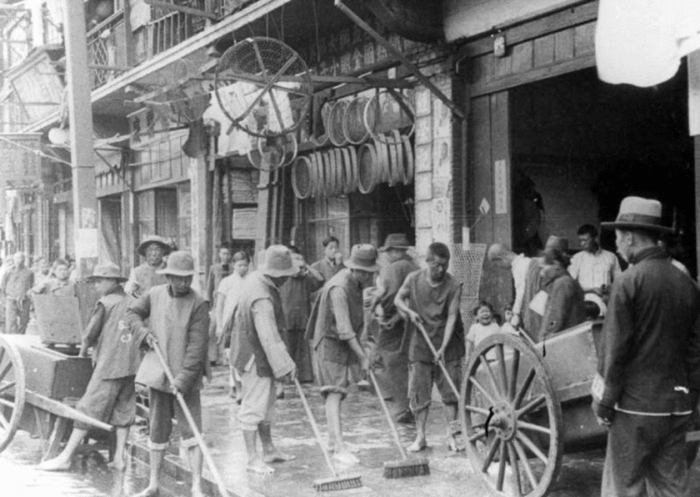
Sweeping the streets was certainly a basic method of removing stench. As early as 1856, in one meeting of the Council, member G. Gray reported that Mr Dallas had been entrusted to remit £50 to London in order to buy ‘two water baths for watering the roads’.Footnote 46 This determination reflects the mentality of the earliest British colonizers—that purification would take place by means of their own ‘technique’. The by-laws of the 1869 Land Regulations contain two articles about cleaning the streets, one concerning the public streets (article XVIII) and the other the areas in the front, side or rear of private premises (XXV). To clean the public streets in 1861, for instance, 50 cleaners were at work each day.Footnote 47 In the 1870s the Council had at its disposal nearly 100 cleaners, six carriages, and several wheelbarrows. The main streets of the Settlement were cleaned twice a day (see Figure 2).Footnote 48
Cleaning the pavement in Shanghai circa 1920. Source: The Virtual Shanghai Project, http://www.virtualshanghai.net/Photos/Images?ID=142, [accessed 26 October 2015].
In practice, however, conflicts abounded. In 1868 a British official wrote on the sanitary state of the Settlement in The North-China Herald, the leading English-language newspaper in Shanghai. He complained that the effort to overcome the ‘prejudice among the Chinese’ was as difficult as the work of ‘rough cleansing’ the streets.Footnote 49 Among 12 reports of ‘illegal’ garbage disposal by the inspector of nuisances in 1861–1863, only two cases were concerned with foreign companies and all the rest with Chinese individuals.Footnote 50 British officers emphasized repeatedly that the Chinese were ‘in the habit of depositing garbage and their filthy matters in the public streets in front of their residence’ (emphasis mine).Footnote 51 Therefore, the general secretary of the Council ordered ‘Chinese chops printed and pasted in the inside of each Chinese door, holding them responsible for the cleanliness of the streets in the vicinity of their dwellings’.Footnote 52 Although these records include no explicit references to the Chinese residents’ indifference to the stench of ‘filthy matters’, these descriptions imply as much and it was clearly the colonial officers who were regulating the smellscape of the area.
But it seems that Chinese ‘prejudice’ and ‘habit’ were not easy to overcome. Two decades later, at a Council meeting held on 19 March 1886, the inspector of nuisances reported that a notice concerning refuse disposal published in daily newspapers had produced no good results, and therefore a notice would be posted in Chinese in all the main streets in the Settlement. Its purpose was to direct the attention of ‘the native residents’ to the police regulations ‘prohibiting garbage or refuse of any kind being placed on the streets after 9 a.m., and warning that in the future no garbage will be allowed to be deposed . . . after they have been cleaned’ (emphases mine).Footnote 53 The core of the problem lay in the particular time slots designated for the collection of garbage, which were hard for the Chinese to strictly adhere to. The inspector reported in the same meeting that ‘the alleyways are swept once a day, and have always a dirty appearance, as most of the garbage is put on them after they have been cleaned’.Footnote 54 These constant tensions arising out of different ‘habits’ and understanding illustrate the rebellious character of modernity. This aspect will be discussed in more detail later.
Discipline, naturally, went hand in hand with punishment. Records of punishment for improper garbage disposal abound in the minutes. For example, 13 Chinese were brought up on bail in August 1862 because of placing rubbish on a public street ‘in contradiction of the printed notices’, and they were ‘warned against a repetition of the offence’.Footnote 55 At the meeting of 14 January 1863, it was reported that several Chinese people were brought to the Council and received a warning due to garbage being thrown in the wrong place, and told that if they committed the same offence they would be liable to a penalty.Footnote 56 On 11 March 1863, Council members decided that two of the five Chinese who disposed of garbage improperly would be sent to the British consul and would be required to fill a ditch as punishment.Footnote 57 This punishment was ‘innovative’ and practically helpful because removing ditches and similar depressions were another keen focus of the Council.
Ditches, stagnant pools, ponds, and swamps
As discussed above, cesspools, ponds, and swamps were the objects of an obsessive fear expressed by French urban dwellers in the early modern period. Putrid miasmas likely to be exuded from stagnant water were deemed deadly. Colonial administrators in Shanghai shared this anxiety and always paid close attention to open ditches, waste lands, and stagnant pools, which were numerous in this area. The by-laws of the Land Regulations stipulated in Article XXVII: ‘No person shall suffer any offensive waste or stagnant water’ to remain in any cellar or other place or within any waste land, and the Council may ‘drain and cleanse out any stagnant pools, ditches, or ponds of water, and abate any such nuisances’.Footnote 58 Therefore, it is understandable that the British officials came up with the ingenious idea of filling ditches as punishment for those who disposed of rubbish improperly. At the same time, more active steps were taken to remove such nuisances. Between 1854 and 1863, over 20 cases dealing with stagnant pools and ditches were discussed at the Council meetings.Footnote 59 For example, in December 1856 the Council gave an order to fill in a depression which was always full of ‘filthy stagnant water’, and the project cost $70 (silver dollars).Footnote 60 At the meeting of 26 June 1861, it was decided ‘to employ some coolies to cleanse out the open ditches on the Maloo (that is, Nanjing Road)’.Footnote 61
Such efforts continued throughout the ensuing decades. At the Council meeting of 19 March 1886, the inspector of nuisances reported on two parcels of waste land in the Settlement, which he described as ‘dangerous swamps, and fever producing centres’.Footnote 62 For one lot, he recommended that ‘the owners should be told to have the land raised and drained before the hot weather sets in’. For another lot, which had been ‘extensively used for latrine purposes by the natives’, he suggested that the Council construct ‘a large native latrine’ in order to ‘mitigate the nuisance’. The inspector also reported on several stagnant ponds and ditches in Hongkew (Hongkou), and recommended that they should either be filled in with earth or provided with steps to make them tidal, but that first a surveyor's report on these troublesome ditches should be commissioned.
According to this logic, stagnant water was the source of stench and should always be made tidal. At the meeting of 4 March 1878, the Council discussed a letter from the secretary of the French Shanghai Council and an attached report from Dr Galle, the French doctor serving the Council. Dr Galle suggested in his report demolishing the dam between the Yangking Creek (see Figure 3) and Defense Creek because the waste from slaughter-houses nearby accumulated there, emanating fetid smells, which were injurious to public health. Once the dam was removed, the flow of water would prevent the accumulation of waste and thus diminish the stench.Footnote 63 In addition to the removal of stinking water, constructing a modern sewage and drainage system was vital to the maintenance of a deodorizing environment.
Yangking Creek (Yangjing bang) circa 1907. Source: The Virtual Shanghai Project, http://www.virtualshanghai.net/Photos/Images?ID=25206, [accessed 26 October 2015].
Sewers and drains
At the same meeting on 26 June 1861, a decision was made (together with the one about cleaning out the open ditches on Nanjing Road) which involved signing a contract to construct sewers and drains in the same district.Footnote 64 Sewerage treatment and drainage were at the centre of sanitary engineering, a new branch of knowledge and practice which developed at the intersection of public health and urban planning in the mid-nineteenth century in the West. A book published in 1880 on sanitary engineering by the North Carolina Board of Health in the United States opens with this statement: ‘Death rates [are] lowered by sanitary works.’Footnote 65 China, however, was seen as lagging far behind on this matter. As mentioned above, Lockhart was struck by the ‘imperfect’ sewerage of the old city of Shanghai and observed: ‘Their cities being undrained, are always in a most filthy state.’Footnote 66 Building sewers and drains was therefore at the top of the agenda of the earliest colonial administrators in Shanghai. Records of their discussions on this issue are numerous in the minutes of the Council meetings.Footnote 67 On 2 April 1855, for example, the Council decided to distribute a notice to landowners to raise questions about ‘the location of drains in the different properties in the settlement’ in order to make ‘a plan of the lines of sewage for general convenience’.Footnote 68 The Council's annual report of 1859 points out: ‘A complete and uniform system of drainage is a growing want; many of the roads are at present altogether without drains.’Footnote 69 At the Council meeting of 21 April 1861, the newly appointed inspector of roads submitted a plan about existing drains, and the Council asked him to investigate the cost of constructing a large sewerage system.Footnote 70
The Municipal Council's annual finance report from April 1863 to March 1864 shows that the expenditure for drainage construction (35,290 taels) was the second highest of all items, roughly equivalent to the total cost of constructing roads, buildings, bridges and jetties, and all repairs (32,599 taels).Footnote 71 The by-laws of the 1869 Land Regulations contained meticulous details on this matter. According to these articles, the entire control and management of all public sewers and drains in the Settlement were the responsibility of the Council. The Council had the power to build, clean, and improve all the sewers and drains. Every person who used the public sewers and drains had to pay the council a sum not exceeding $100. Such sewers should connect to and empty themselves into the river or to the most convenient site for collection and sale for agricultural or other purposes. In no case was such construction to ‘became a nuisance’.Footnote 72 All these stipulations and measures demonstrate that the colonial administration placed much importance on the issue of sewerage and drainage. A real fear of stench and disease was behind these policies. A related issue was the treatment of excreta.
Nightsoil collection, public latrines, and urinals
Using human excrement as fertilizer was common in China. As Robert Alexander Jamieson, medical officer of the Customs, observed in 1871, the marshy lands in Hongkew, where an inchoate American settlement arose, were dosed with liquid nightsoil that was ‘preserved in vats until it has attained a stage of maturation’.Footnote 73 Thus, this district, which was construed ‘malarious’, was also malodorous. The economic value and unpleasant smell of nightsoil were constantly at odds in colonial policies and administration. Colonial officials did not prohibit the collection and sale of nightsoil, but measures were taken to diminish the stench. One measure, as Article XXVI of the by-laws of the Land Regulations stipulates, was that the Council could ‘fix the hours within which only it shall be lawful to empty privies or remove offensive matter’.Footnote 74 Another measure was to equip manure carts or pails with coverings.
Rules and laws on paper notwithstanding, Western residents’ complaints of the offensive emanation from faeces never ceased throughout almost the entire century of the Settlement's existence. For example, a resident of the French Concession complained about the stench from nightsoil boats in the Yangking Creek in 1876.Footnote 75 Removal of nightsoil was still on the Council's agenda at the meeting held on 19 March 1886. The Council instructed the police that ‘all coolies carrying night soil along the streets of the Settlement in buckets which are not provided with proper covers, are to be arrested and taken to the Mixed Court’.Footnote 76 As late as 1938, only three years before the end of the Settlement, The North-China Herald published a series of readers’ letters discussing this issue (to be discussed in the next section).
A related issue was public latrines and urinals. At the Council meeting of 16 April 1862, H. S. Grew, a Council member, submitted a plan for the construction of the first public latrine, and the Council selected a site near Nanjing Road in the Settlement.Footnote 77 Construction started in September 1862 and was completed in December of the same year.Footnote 78 More public latrines appeared after 1863.Footnote 79 But these new facilities did not satisfactorily purify the air in the Settlement. In a letter written to the British consul in Shanghai, dated 12 May 1881 and published in The North China Herald, R. W. Little, chairman of the Municipal Council, explained that latrines had become ‘a serious nuisance to the neighbourhood’ because of ‘the disinclination of the Chinese to make proper use of them, preferring . . . to relieve themselves outside instead of inside the latrine’.Footnote 80 His report was perhaps based on several cases brought up for discussion at Council meetings. For example, on 1 September 1873, the inspector of nuisances reported that the alley near the Hope Brother's Clock Store (Hengdali) on Nanjing Road stank heavily because Chinese passers-by generally used it as a public urinal.Footnote 81 Nine years later this filthy state was unchanged and the inspector of nuisances proposed that the only way to get rid of the stench effectively was to employ a guard or to seal off the entrance of the alley.Footnote 82
This issue might have been the result of a Chinese ‘habit’: for Chinese men urinating outside was commonplace.Footnote 83 Westerners in China constantly expressed their dissatisfaction about this issue. The Council meeting of 4 September 1863 discussed a letter from C. Dawson who complained about the Chinese drivers of the Shanghai Cart Company urinating at the side of the road, and the Council agreed to write to the manager of the Company.Footnote 84 Half a year earlier, the inspector of nuisances had brought before the Council four Chinese men who had relieved themselves in public streets.Footnote 85 Foreign administrators made a lot of effort to ban such behaviour by means of punishment. For the Chinese this was a ‘novel thing’ (xinxian shi), and even became a unique feature of the foreign settlement in the popular mind. In a novel written in 1902 by Wu Jianren (1866–1910), Wang Wei’er, a native of Shandong Province who arrived in Shanghai for the first time, was completely confused about why the police arrested him when he relieved himself in the street.Footnote 86 What did all these ‘odd’ rules and the character of the deodorizing city mean for Wang Wei’er and his compatriots? How did their habits and practices affect the colonial endeavour to bring ‘order’ and ‘modernity’ to China? The next section will explore these questions by taking a closer look at the irritating issue of ordure and its uncontrollable odour.
Order and ordure
Despite the various problems and difficulties that persisted, the efforts of foreign administrators to introduce a new sanitary/olfactory order reaped fruit. In an article published in The North-China Herald on 27 October 1868, its foreign author (most probably a colonial official) proudly announced that the foreign settlement had become ‘a model of purity compared to the native city’.Footnote 87 The roads now presented ‘a hard convex surface, instead of a series of muddy ponds’, drains ran under the roads and streets, and numerous ponds had been ‘conquered’. The smellscape was improved too: ‘the Consular Mud flat no longer reeks in the sun at low water; nor does the Yang-king-pang now imply a vast receptacle for filth and garbage’. When speaking of the Chinese city, his tone was arrogant. He thought that the ‘coarsest sailor in the harbor could point out nuisances enough in the Chinese city to employ the energies of its rulers for years to come’. Only when these had been removed, he continued, might they hope that the Chinese would ‘receive with favour further instructions in sanitary science’. In the meantime, foreigners could ‘best teach them by our example’. This is typical of the colonial discourse which was closely interlinked with the notions of modernity and its ideology, including ‘purity’, the spirit of ‘conquering’, and the pursuit of order.
It is worth noting that Chinese elites freely acknowledged the positive impact of foreign administration on the environment.Footnote 88 For example, an article in Shenbao on 20 July 1872 compares the difference between the foreign settlement and the Chinese city. While the streets in the foreign settlement were tidy and passers-by did not need to hold their noses, the old city was not short of ‘fetid smell and muddy roads’.Footnote 89 At the end of the article the writer asked if his Chinese compatriots who ‘kept up with latest thoughts’ (da shiwu zhe) would agree with him. Li Weiqing, a local scholar-gentry, compiled a textbook about Shanghai's local history and geography in 1907. He also wrote that the foreign settlement was ‘extremely clean like a paradise’, making a sharp contrast to the Chinese city where ‘the canal surrounding the city wall stank and privies and latrines were everywhere’.Footnote 90 In this sense, the position of the Chinese elites was not too different from that of the foreign colonizers. By embracing the values of hygiene and order, Chinese elites also wanted to partake in global modernity. However, modernity had/has ambivalence. Ambivalence was by no means a necessary element of the blueprint of the modern/colonial reconstruction. But history has never developed seamlessly according to any particular model; ambivalence arose beyond the rational calculation of modernity's architects. The stench of filth and ordure was a site in which modernity's disobedient character was manifest.
Mine Kiyoshi, a member of the famous Japanese expedition to Shanghai in 1862 (known as the Sen-zai-maru expedition), observed that ordure and filth accumulated in the streets of the Chinese city, and ‘mud buried my feet, offensive smells assailed my nostrils, and the state of filth is hard to describe’. This made a stark contrast to the ‘wide’ and ‘clean’ streets in the foreign settlement.Footnote 91 But Mine's much-cited diary also contains an analysis of the probable reason for the filthy environment of the Chinese city, and this has been neglected in most studies citing this source.Footnote 92 When Mine asked local residents why their streets were so dirty, they answered: ‘It used not to be like that. But since the British came and commerce thrived, the streets have become more and more filthy.’ The reason was that many local people were busy as silk workers and therefore they had less time to give to agriculture. If filth and excrement were still being transported to the countryside to be used as manure, as had previously been the case, the streets would not have been so dirty.Footnote 93
One may argue that this explanation from the local residents might be an excuse for their carelessness about sanitation, but it is true that filth and ordure were valuable in the Chinese agricultural tradition, as mentioned above. The collection and sale of nightsoil had long been a lucrative business in China, and there was a saying: ‘Treasure nightsoil as if it were gold’.Footnote 94 Missionary doctor Lockhart also noticed the double advantages of deporting ordure to the country for agricultural purposes; otherwise, he commented, ‘the health of the city would be seriously deteriorated’.Footnote 95 John Barrow (1764–1848), a member of Lord Macartney's embassy to China in 1793, left a graphic account of the customs of collecting manure in Beijing:
. . .no kind of filth or nastiness creating offensive smells is thrown out into the streets, a piece of cleanliness that perhaps may be attributed rather to the scarcity and value of manure, than to the exertions of the police officers. Each family has a large earthen jar, into which is carefully collected every thing that may be used as manure; when the jar is full, there is no difficulty of converting its contents into money, or of exchanging them for vegetables. The fame[d] small boxed carts with one wheel, which supply the city with vegetables, invariably return to the gardens with a load of this liquid manure. Between the palace of Yuen-min-yuen and Pe-kin, I have met many hundreds of these carts. They are generally dragged by one person, and pushed on by another; and they leave upon the road an odour that continues without intermission for many miles. Thus, though the city is cleared of its filth, it seldom loses its fragrance. In fact, a constant disgusting odour remains in and about all the houses the whole day long, from the fermentation of the heterogeneous mixtures kept above ground, which in our great cities are carried off in drains.Footnote 96
Barrow's account provides precious early observations about manure collection in China and also reveals his ambivalent attitude towards this Chinese custom. On the one hand, he held a positive opinion of its function of keeping the streets clean and exchanging waste for vegetables or money, which was economic. On the other hand, however, his detailed record of disgusting odours shows his abhorrence and a related feeling of arrogance, especially when he compares Beijing with ‘our great cities’ where sewage was ‘carried off in drains’. Many foreigners who went to China after Barrow shared this ambivalence. For example, George Smith, an agent sent by the Church Missionary Society in England to China in 1844–1846, wrote that roaming in the countryside in China, instead of ‘the inhalations of the pure country air’, the rice fields and gardens gave forth ‘most offensive odours’ caused by the manure. But he admitted: ‘It is by a system of manure and irrigation that the poorest soils are forced, year after year, to produce two annual crops, sustaining an amount of population which few other countries could, in their present state, support.’Footnote 97
If ambivalence is modernity's enemy, it is an enemy that is hard to conquer. Seeing nightsoil's high market value, the colonial administration of the International Settlement compromised with the malodorous. At the Municipal Council's board meeting of 7 June 1865, the Finance, Rate and Appeal Committee of the Council brought up this issue in its report: ‘Sewage and night soil are sought after by Chinese, used by them in all their cultivation. They are seen coming miles to fetch it. Might it not therefore be assumed to have a considerable yearly value?’Footnote 98 The report of the Public Works Committee discussed in the board meeting of 5 September 1865 shows that the Committee signed a new contract with a Chinese ‘for the amount of $505 (silver dollars) per month, payable to the Municipal Council monthly’.Footnote 99 According to the Municipal Council's annual reports, sale of nightsoil brought annual revenue between 3,000 and 4,000 taels in the late 1890s.Footnote 100 These records show that this malodorous matter created profits for the colonial government, even though measures were taken to get rid of the stench of manure carts, such as fixing the hours of collection, providing coverings, and meting out punishment, as discussed above.
However, the imposition of rules did not always bring the expected results. A report of 26 October 1872 published in Shenbao provides a vivid example of how a zone of ambivalence emerged in specific historical circumstances. The report, entitled ‘Coverings must be equipped to transport manure’, opens with a statement about the Municipal Council's stipulation on the conveyance of nightsoil, and explains that the purpose is to ‘abate stench during the daytime, which may cause disease’.Footnote 101 But local manure transporters seldom took these stipulations seriously, either ignoring the fixed hours or the coverings. The foreign police, whose interventions had little effect, sent transgressors to the Mixed Court, where foreigners and Chinese cooperated to deal with civil and criminal cases in the Settlement. The Chinese judge, Mr Zhang, deemed it ‘a trifling matter’, for which ‘a substantial penalty seemed inappropriate’. After a couple of days in custody, they were released. The reporter praised the judge's method as ‘a good balance between obeying the law and respecting the customs’.Footnote 102 Mr Zhang's attitude suggests that in Chinese opinion the unpleasant smell was not sufficient to become a legitimate accusation. Stench was hard to govern and was a subject of tension throughout the period of the foreign settlements’ existence.
As late as September 1938, The North-China Herald published a series of letters written by five foreign residents of Shanghai complaining that the ordure carts passing through the French Concession's central district in busy morning hours emanated ‘nauseous gases . . . wafted on the breeze and into the protesting nostrils and lungs of other people’.Footnote 103 One of the writers described a scene he witnessed: three ordure carts were bunched together and an impatient tram driver clanged his bell as the passengers in various cars held their noses.Footnote 104 This was a subject which ‘one just doesn't talk about’, as Mr Stinky wrote. Interestingly all writers of these letters employed smell-related words or images to ridicule this daily olfactory unpleasantness. One referred to these carts as ‘honey carts’, a term used widely for a long time,Footnote 105 while another described the traffic of these carts as ‘tripping their fragrant way’.Footnote 106 They signed their letter ‘Stinky’, ‘Eau de Cologne’, etc. Mr Stinky came up with this ‘remedy’:
Of course, I could drench a handkerchief with perfume and apply same to my sensitive nose, but this presents two difficulties. It would work while I’m on my way to the office, but what about it when I got there? I. . .can't type or file with one hand. The other objection is this. Would the French authorities pay for the perfume? If so, I think I’d choose a big bottle of Lentheric's “Shanghai.” He has the wrong idea there, though, as the source of his inspiration could never have been the immediate vicinity of Rue du Consulat at 8.30 in the morning.
Mr Stinky had a good sense of humour. The industrially manufactured fragrance that was named ‘Shanghai’ was but a product of fantasy in an Orientalist vein; it had nothing to do with the olfactory reality of Shanghai, where modernity failed to reign over its smellscape because of such unruly phenomena as ordure. From Mr Stinky's references to his office work of typing and filing and his familiarity with perfume brands, we can see that he had a modern consciousness about class and racial differences that separated him (as well as his fellow foreign white-collar workers) with his ‘sensitive nose’ from those Chinese transporters of ‘honey carts’. Another letter shows another familiar association of deodorization with enlightenment. The writer, ‘A sufferer’, deemed this situation ‘a disgrace to the F.M.C. (French Municipal Council) Health Department’.Footnote 107 Then he spoke about his visit to a Chinese city 15 years earlier, where ‘the magistrate allowed no stench-buckets or wheelbarrows on the city streets after 6 a.m. and strictly enforced the order’. He remarked: ‘Surely, if a provincial Chinese magistrate can display such enlightenment and energy in the interest of the citizen's health and comfort, the F.M.C can produce a member of their staff who can organize something in their own Concession’.
He associated deodorization and discipline with ‘enlightenment’, and blamed the French administrators for their failure to remove the stench of manure. But I would argue that this was not the failure of the French health officials only, but the ambivalence of modernity in general.Footnote 108 The industrialization and commerce brought by Westerners was one of the root causes of stench, as Mine's remarks suggest. As human excrement and waste had economic value in the Chinese agricultural tradition, the colonizers’ pursuit of deodorized modernity had to find a compromise with the foul smell. At the same time, the enforcement of laws and rules were subjected to local customs and circumstances. Therefore, the stench of manure carts could never be satisfactorily removed, and neither was the ambivalence of modernity.
The cosmos of chaos
Was the deodorized world really a better world? After telling the long story about how China smelled to the Western nose; how the Western colonizers attempted to deodorize China through law and regulation, discipline, and punishment; and how modernity's ambivalence was displayed in the rebellious presence of the manure odour, I would like to use this question to provoke further thinking and to conclude this article. I would suggest three perspectives to think about it.
First, we can rethink the issue through the lens of power relations. To be specific, who benefited from the deodorized environment? Who paid the bill for the better smell of the environment? In his study on waste treatment in China, Yu Xingzhong suggests that the improved cleanliness of streets was ‘not necessarily a blessing for all the people in the country’.Footnote 109 His study of Suzhou in the 1900s shows that the establishment of a public health administration system brought extra taxation to peasants. Moreover, additional requirements for nightsoil treatment, such as specific shapes and structures of nightsoil buckets, hatch covers for nightsoil boats, and tags for nightsoil collectors, naturally meant extra costs and increased nightsoil prices which the peasants had to pay.Footnote 110 In other words, in this case the peasants paid for the improved olfactory environment of a city which they could not enjoy. For the peasants, the deodorized world was not necessarily a better world.
This example invites us to think about the power relations at work. Sensory perceptions are highly personal and rely largely on individual and social habits. For Wang Wei’er, the Shandong native in Wu Jianren's novel, as well as the Suzhou peasants, the smell of urine and manure might not have constituted an unbearable nuisance. These were the natural backdrop to their everyday lives and their nostrils were accustomed to such ‘unpleasant’ smells. It was the architects of modernity—the Western colonizers, the Chinese elites, and so on—who wielded power in various forms who tried to impose their sensibilities on the people. Behind the new ‘sensibilities’ lay a series of ideas, conceptions, and theories which usually fall into the category ‘modernity’. Power and social control not only penetrated visible social institutions, such as prisons, hospitals, and asylums, as Michel Foucault has explored,Footnote 111 but also more subtle and invisible sites such as senses and sensibilities. It is not the intention of this article to make a straightforward conclusion that the deodorized world was a better or worse world. Rather, I prefer to provoke thinking on this question. There is another perspective suggested in contemporary records.
In 1921, the renowned philosopher Bertrand Russell (1872–1970) undertook a lecture tour in China and later wrote a book entitled The Problem of China (1922). In this book he provided a personal observation which is not unfamiliar to us:Footnote 112
In the Treaty Ports, Europeans and Americans live in their own quarters, with streets well paved and lighted, houses in European style, and shops full of American and English goods. There is generally also a Chinese part of the town, with narrow streets, gaily decorated shops, and the rich mixture of smells characteristic of China. Often one passes through a gate, suddenly, from one to the other; after the cheerful disordered beauty of the old town, Europe's ugly cleanliness and Sunday-go-to-meeting decency make a strange complex impression, half-love and half-hate. In the European town one finds safety, spaciousness and hygiene; in the Chinese town, romance, overcrowding and disease. (Emphases mine).
This description is reminiscent of Paul Claudel's account cited at the beginning of this article. The ‘rich mixture of smells characteristic of China’ which Russell sniffed might have included the smells of incense and opium that were part of Claudel's memory of the old city of Shanghai. While Russell was fascinated by old China's ‘cheerful disordered beauty’, Claudel also appreciated ‘an artless disorder’ and ‘the fascination of all the past’.Footnote 113 They also shared a feeling of half-love and half-hate toward ‘Europe's ugly cleanliness’ and ‘the electric lights of the Concession’. Both described the gate—a physical and symbolic object that connected/separated the Chinese and the Western worlds. For this French diplomat and poet and this British philosopher, the deodorized world of modernity did not seem to be a better world either. Their texts may have been perfectly located in the framework of Orientalism, but at the same time, they captured an idea that forces us to reflect upon Western culture and the problem of modernity.Footnote 114 In the name of imposing order, modernity eliminated stench from the air. But odours and disorder may still be of value to human beings in both cultural and medical terms.
The third perspective is a current one and relates to the value of odours and disorder in a broader sense. Browsing popular science and health websites in 2013, one encounters many eye-catching titles such as: ‘Can you be too clean?’ from a baby care website,Footnote 115 ‘Being too clean could be hazardous to your health and the environment’ from a popular science website,Footnote 116 ‘Being too clean “causes allergies in teenagers”’ from the Metro newspaper in the United Kingdom,Footnote 117 and many others. One of the popular scientific theories behind these discussions is the ‘hygiene hypothesis’. The hypothesis suggests that extremely clean household environments fail to provide ‘the necessary exposure to germs required to “educate” the immune system so it can learn to launch its defense responses to infectious organisms’.Footnote 118 Interestingly, this hypothesis and these recent discussions seem to echo some nineteenth-century medical missionaries’ observations on China's poor sanitary condition and the surprisingly good health of the population. As August Müller and Patrick Manson, the customs medical officers, reported about Amoy (Xiamen) in 1871:Footnote 119
. . . a scientific sanitarian with only home (European) experience to guide him would confidently predict the reign of epidemics and death. Yet the Chinese manage to live and thrive where he would hardly dare to lodge his pigs. There is no typhus, no typhoid or other disease considered the inevitable consequence of defective sanitation, although Amoy is full of typical typhus dens.
Although Drs Müller and Manson, like many of their fellow medical officers and missionaries in China, were very confident about the science and medical theories developing in their home countries, they had to admit that for the Chinese a deodorized and sanitary world was not necessarily a better world.Footnote 120 For scientists of the twenty-first century, this Chinese example may well support the ‘hygiene hypothesis’: the unclean environment had ‘educated’ the immune system of the Chinese to protect them against the invasion of germs and viruses.
Then, was/is a deodorized world really a better world? Of course, there is no definite answer. For the colonial officers in our story who were working hard to remove the stench in Shanghai's foreign concessions, it was their mission, or conviction, to make the city into a better (modern) world by means of deodorization and other measures. But the attitudes of Wang Wei’er, Bertrand Russell, and Drs Müller and Manson were more ambivalent. Each found in the odorous/disorderly world habitual ease, the beauty of the past, and a source of inspiration. Zygmunt Bauman has criticized modernity and modern states’ tireless pursuit of order, determination, and precision, and this pursuit's fatal consequences including, perhaps, the Holocaust. At the same time, Bauman coins a term: ‘the stranger’, which he defines as one member of ‘the family of undecidables’, set against the cosy antagonism of friends and enemies.Footnote 121 While ‘oppositions enable knowledge and action’, he further elaborates, the strangers/undecidables ‘paralyse’ them and ‘poison the comfort of order with suspicion of chaos’.Footnote 122 Odour seems to fit perfectly into the family of strangers. Its rebellious character was a constant reminder of the limits of modernity. Carl Jung formulated this beautiful sentence: ‘In all chaos there is a cosmos, in all disorder a secret order.’Footnote 123 By looking at the unruly phenomenon of stench, this article has brought chaos and disorder to the fore and has shed some light on a cosmos and a secret order that was out of the purview of the architects of modernity.