Introduction
Bread wheat (Triticum aestivum L.) is the world most extensively cultivated cereal crop and serves as a major source of dietary calories and plant-based protein for the global population. The world wheat production reached approximately 800 million tons annually (FAO, 2023), which can be attributed to the considerable improvement in cultivation strategies and seed breeding rather than land expansion (Erenstein et al., Reference Erenstein, Jaleta, Mottaleb, Sonder, Donovan, Braun, Reynolds and Braun2022). The wheat crop is threatened by several biotic stresses; the fungal pathogens contribute most significantly to yield losses in wheat (Šućur et al., Reference Šućur, Ali, Mortazavi, Mladenov, Jocković, Gou, Nadeem, Baloch and Chung2025; Ali et al., Reference Ali, Ölmez, Tatar, Mortazavi, Altaf, Turgay and Baloch2025a).
Wheat stripe rust or yellow rust, is a devastating disease caused by the biotrophic parasite Pst and can lead to 100% yield losses. Stripe rust is most prevalent in cooler climates and is exacerbated by environmental conditions, pathogen strains, genotypes susceptibility, early-stage infection and disease duration (Waqar et al., Reference Waqar, Khattak, Begum, Rehman, Rabia, Ajmal, W, Siddiqi and Ali2018). Climate change, through shifts in temperature, precipitation patterns and extreme weather events, is expected to influence the epidemiology of wheat rust diseases, including stripe rust, by expanding pathogen distribution into new geographic areas and altering disease severity (Iqbal et al., Reference Iqbal, Rehman, Ahsan, Bebagar, Khan, Abdullah and Mehmood2024). These environmental changes may also accelerate the emergence of new virulent races, challenging the durability of existing resistance genes and emphasising the urgency of integrating diverse genetic sources into breeding programmes (Ali et al., Reference Ali, Tatar, Ölmez, Nadeem and Baloch2025b). Despite advancements in Pst chemical management, synthetic pesticides also pose environmental concerns. Crop breeding represents a promising solution, with resistant genes in wheat plants and wild ancestors, and to incorporate them into promising genotypes. The DNA markers that are closely linked to particular genomic regions of pivotal crop plants are highly useful for regulating the important and desirable traits and act as distinct points of reference for monitoring the integration oftargets in breeding material (Altaf et al., Reference Altaf, Tatar, Ali, Lıaqat, Mortazvı, Kayıhan, Ölmez, Nadeem, Javed, Gou, Wang, Umar, Daşgan, Kurt, Yıldız, Mansoor, Dababat, Çeliktaş and Baloch2024; Mortazavi et al., Reference Mortazavi, Ali, Tatar, Ölmez, Altaf, Nadeem and Baloch2025).
The incorporation of resistance genes through marker-assisted selection (MAS) has become a cornerstone of modern wheat breeding, allowing for precise and efficient development of disease-resistant cultivars (Wang, Reference Wang2024). Pyramiding multiple resistance genes such as Yr15, Yr5, Yr10 and Yr18 into elite cultivars not only provides broad-spectrum resistance but also enhances the durability of resistance by minimising the risk of pathogen evolution (Hagras et al., Reference Hagras, Ragab, Abdelkhalik, Shahin, Youssef, Sehsah and Hamwieh2025). Despite the availability of various resistance genes, their presence in locally adapted and high-yielding germ plasm remains limited, especially in many Turkish cultivars. Therefore, identifying key resistance genes in existing germ plasm is crucial for guiding future breeding strategies and for integrating molecular tools into conventional wheat improvement pipelines.
Researchers have identified a broad-spectrum Yr15 resistance gene in the wild emmer wheat (WEW; T. turgidum ssp. dicoccoides), which serves as a major resistance gene against all Pst isolates worldwide (Baloch et al., Reference Baloch, Ali, Tajibayev, Nadeem, Ölmez, Aktaş and Yang2024). Aaronsohn (Reference Aaronsohn1910) first identified and reported the Yr15 gene in the wild species of Northern Israel, recognising it as a valuable genetic resource for wheat improvement having resistance to numerous diseases (Dinglasan et al., Reference Dinglasan, Periyannan and Hickey2022). WEW populations were also found in the Near East Fertile Crescent, including regions such as Syria, Israel, Central and Southeastern Turkey, Lebanon, Jordan and the mountainous areas of Eastern Iraq and the Western Iran (Klymiuk et al., Reference Klymiuk, Fatiukha, Huang, Wei, Kis-Papo, Saranga, Fahima, Thoms and Viktor2019).
Yr15 gene confers resistance to more than 3000 genetically distinct Pst strains worldwide, particularly those infecting wheat. Ever since the Yr15 was first introduced into wheat that was being cultivated in the 1980s. It was first introduced into cultivated wheat in the 1980s through interspecific hybridisation and has since been incorporated into several well-known spring bread wheat cultivars in the Western United States. These cultivars include Summit 515, Patwin 515, Expresso, Scarlet 09, Seahawk and Clearwhite 515. However, there was a lack of knowledge regarding the introduction of Yr15 into cultivated wheat cultivars from different countries at the present time (He et al., Reference He, Feng, Jiang, Zhang, Yan, Zhao and Fahima2020).
Recent field observations and laboratory assessments have confirmed the emergence of virulence against the Yr15 gene in continental Europe (Nazari et al., Reference Nazari, Kurtulus, Kavaz, El Amil, Thach, Hekiman and Ghorrah2024). The Global Rust Reference Center (Aarhus University) reported that wheat cultivars carrying Yr15 resistance were infected by yellow rust in multiple European countries, following similar outbreaks in Northern England during 2024. Given the widespread deployment of Yr15 in European wheat breeding programmes since the late 1990s, this development raises significant concerns about its durability and highlights the need for gene pyramiding and diversification of resistance sources (Hovmøller et al., Reference Hovmøller, Patpour and Rodriguez-Algaba2020). Sentinel plots and surveys under the IPMorama project have identified northern France and Belgium as potential hotspots for these new virulent races, emphasising the importance of continuous monitoring, pathogen genotyping and international data sharing to protect wheat production.
The Yr5 gene provides resistance to stripe rust, and was initially identified in the hexaploid Triticum aestivum ssp. spelta cv. album (Zhang et al., Reference Zhang, McIntosh and Hoxha2009). After that, Macer (Reference Macer and Mackey1966) identified a specific location of this resistant gene on chromosome 2B, and Law (Reference Law1976) subsequently specified its position on the long arm of this chromosome, 21cM away from the centromere. The Yr5 gene confers resistance to almost all the Pst strains worldwide, however, there have been no record to control Pst in Australia (Wellings and McIntosh, Reference Wellings and McIntosh1990) and in India (Nagarajan et al., Reference Nagarajan, Nayar and Bahadur1986) by using this gene. Although Yr5 has proven to be effective, currently there is no documented proof of its integration into wheat cultivars. As a result, its long-term effectiveness in crop application has not been investigated. The Yr15 gene was first identified using cytogenetic mapping and then confirmed using RFLP and RAPD markers (McIntosh et al., Reference McIntosh, Silk and The1996; Sun et al., Reference Sun, Fahima, Korol, Turpeinen, Grama, Ronin and Nevo1997). Chen et al. (Reference Chen, Soria, Yan, Sun and Dubcovsky2003) and Yan et al. (Reference Yan, Chen, Line and Wellings2003) detected the presence of Yr5 gene by utilising RGAP markers and created the Yr5STS-7/8 marker.
In this context, the Yr15 and Yr5 genes were selected due to their known broad-spectrum and durable resistance to P. striiformis f. sp. tritici worldwide. Markers for Yr5 and Yr15 have been repeatedly confirmed to correlate with phenotypic resistance in diverse wheat backgrounds (Yaniv et al., Reference Yaniv, Raats, Ronin, Korol, Grama, Bariana and Fahima2015; Zheng et al., Reference Zheng, Li, Lu, Liu, Zhang, Ao and Zhang2017; Shahin et al., Reference Shahin, Omara, Omar, El-Din, Sehsah, Essa and Omar2024; Turgay, Reference Turgay2025). Despite the global importance of Yr15 and Yr5, there is limited information on the distribution of these genes in Turkish bread wheat cultivars and their comparison with international landraces such as those maintained by the USDA. Previous studies have mostly focused on local germ plasm or small-scale screenings, whereas our study provides the first large-scale molecular screening of both Turkish cultivars and USDA landraces using validated gene-specific markers for Yr15 and Yr5. This dual approach highlights the genetic diversity of resistance sources and offers unique insights into the absence of Yr5 and the current prevalence of Yr15. The findings are particularly timely considering the recent virulence reports on Yr15 in Europe, underlining the need for gene pyramiding and proactive breeding strategies. The current study analysed 94 Turkish bread wheat cultivars and 80 USDA bread wheat landraces to identify the broad spectrum resistance genes (Yr15 and Yr5), using gene-specific markers. The ancient history of Turkish wheat supports multiple resistance genes, allowing the identification of resistant cultivars and confirmation of their presence in international bread wheat germ plasm. The objective was to assess their potential utility for breeding programmes focused on enhancing resistance to stripe rust, a major constraint to sustainable wheat production.
Materials and methods
Breeding material
In the present study, a total of 174 bread wheat genotypes (registered Turkish cultivars, and the landraces which were collected from USDA) were analysed (Supplementary file). In the collected wheat germ plasm, 80 diverse genotypes (landraces) were obtained from the USDA including Chile (06), Brazil (04), Argentina (03), Croatia (03), Canada (02), China (05), Czech Republic (07), Serbia (03), Hungary (02), India (06), USA (03), Turkey (05), Russia (02), Yemen (03), Saudi Arabia (05), Ukraine (03) Australia (08) and Romania (02). Furthermore, 94 out of 174 was Turkish cultivated cultivars which were collected from the different locations of Türkiye including TARM/ANK (21), ATAEM/ESK (32), BDUAAEM/KNY (09), TTAEM/EDN (14), DATAE/ERZ (10), GATAEM/DYB (05) and STAEM/SKY (03). The list of abbreviations is presented at the end of the manuscript.
DNA isolation and quality assessment
Two to three seeds of each wheat genotype were sown in the greenhouse for the purpose of isolating the genomic DNA. Fresh leaves from 35-day-old seedlings were harvested and weighted; 80–100 mg of each sample was used for the extraction of the genomic DNA using the CTAB method (Doyle and Doyle, Reference Doyle and Doyle1990), along with an additional procedure called Diversity Arrays Technology (Baloch et al., Reference Baloch, Ali, Tajibayev, Nadeem, Ölmez, Aktaş and Yang2024). The extracted DNA was assessed both for quality and quantity. A 1% of agarose gel and a NanoDrop apparatus were utilised to determine the amount of DNA. After that, 80 ng per µl were used for the polymerase chain reaction (PCR) analysis.
Composition of PCR mixture
The obtained DNA was utilised to optimise the specific primers using gradient PCR. The PCR amplifications were conducted using 1 μl (80 ng) of DNA as a template. The mixture included 0.5 μl of each target (For. and, Rev.) specific primers (10 mM) for Yr5 and Yr15 (Table 1), 0.4 μl dNTPs, 2 μl of MgCl2, 0.4 μl of Taq DNA polymerase (Invitrogen), 3 μl of 10× buffer, and the mixture was completed to a final volume of 25 μl with nuclease-free water.
Yr gene primers used in the present study

Optimised PCR thermocycling conditions
The amplification of Yr15 and Yr5 required specific conditions: an initial denaturation at 95 °C for 5 min, followed by 35 cycles of 95 °C for 30 s, 57 °C for 15 s (for both) and 72 °C for 15 s. Finally, there was a final extension step at 72 °C for 5 min. The amplified product was electrophoresed on a 2% agarose gel, then stained in an ethidium bromide tank for 30 min. The bands were visulised under UV light using a Gel Documentation System. The predicted band sizes were 320 bp/1260 bp (susceptible/resistance Yr5) and 991 bp (Resistance Yr15).
Data analysis
Bands of varying sizes corresponding to different resistance genes were evaluated and scored as 1 for presence and 0 for absence, and the data were compiled in excel.
Results
Detection of Yr15 and Yr5 genes
The molecular-based detection of both genes (Yr15 and Yr5) provides a deep insight into their prevalence in the studied bread wheat germ plasm. A total of 31 genotypes were observed with Yr15 resistance genes in the collected germ plasm from USDA and Turkey. Nine out of 31 landraces having Yr15 genes were detected in the USDA bread wheat germ plasm, while 22 out of the 31 cultivars belong to Turkish bread wheat germ plasm. Using the Yr5 specific gene primer, no resistance band at 1260 bp was detected in any genotype. However, the susceptibility gene with 320 bp was detected in 77 out of 174 collected wheat germ plasm. A total of 46 out of 94 Turkish-registered bread wheat cultivars showed the susceptibility to yellow rust, and 25 out of 80 USDA wheat genotypes showed susceptibility to stripe rust pathogen.
Yr15 and Yr5 resistance genes in Turkish germ plasm
The PCR-based screening results for Yr15 broad spectrum resistance gene with used primer (Y15K1_F2/uhw301R) revealed that 22 out of 94 (23.40%) tested bread wheat cultivars showed the Yr15 gene with a band of 991 bp amplicon (Fig. 1a, Table 2). Of the 94 genotypes, 72 (76.60%) have not showed the presence of the targeted gene for the Pst pathogen. The PCR-based screening results for the Yr5 resistance gene with the used primer (Yr5-F/R) revealed that none of the studied bread wheat cultivars had the Yr5 gene at 1260 bp. However, 46 out of 94 (48.94%) bread wheat genotypes showed susceptibility to the targeted Pst pathogen (Fig. 1b; Fig. 2).
Agarose gel (2%) showing results of primer pairs: (a) Y15k1_F2/uhw301r (991 bp for Yr15) and (b) Yr5-F/R (320 bp for Yr5) in Turkish bread wheat germ plasm. No 1260 bp band for resistance to pst was detected. A 100-bp ladder (Invitrogen) was used throughout.

Graphical presentation of Yr genes detected from the Turkish and USDA bread wheat germ plasm.

PCR results of 94 Turkish bread wheat cultivars for the presence of Yr5 and Yr15 genes

S: Susceptible genotypes that show the band of 320 bp; R: Resistant genotypes that show the band of 991 bp.
Yr15 and Yr5 resistance genes in USDA germ plasm
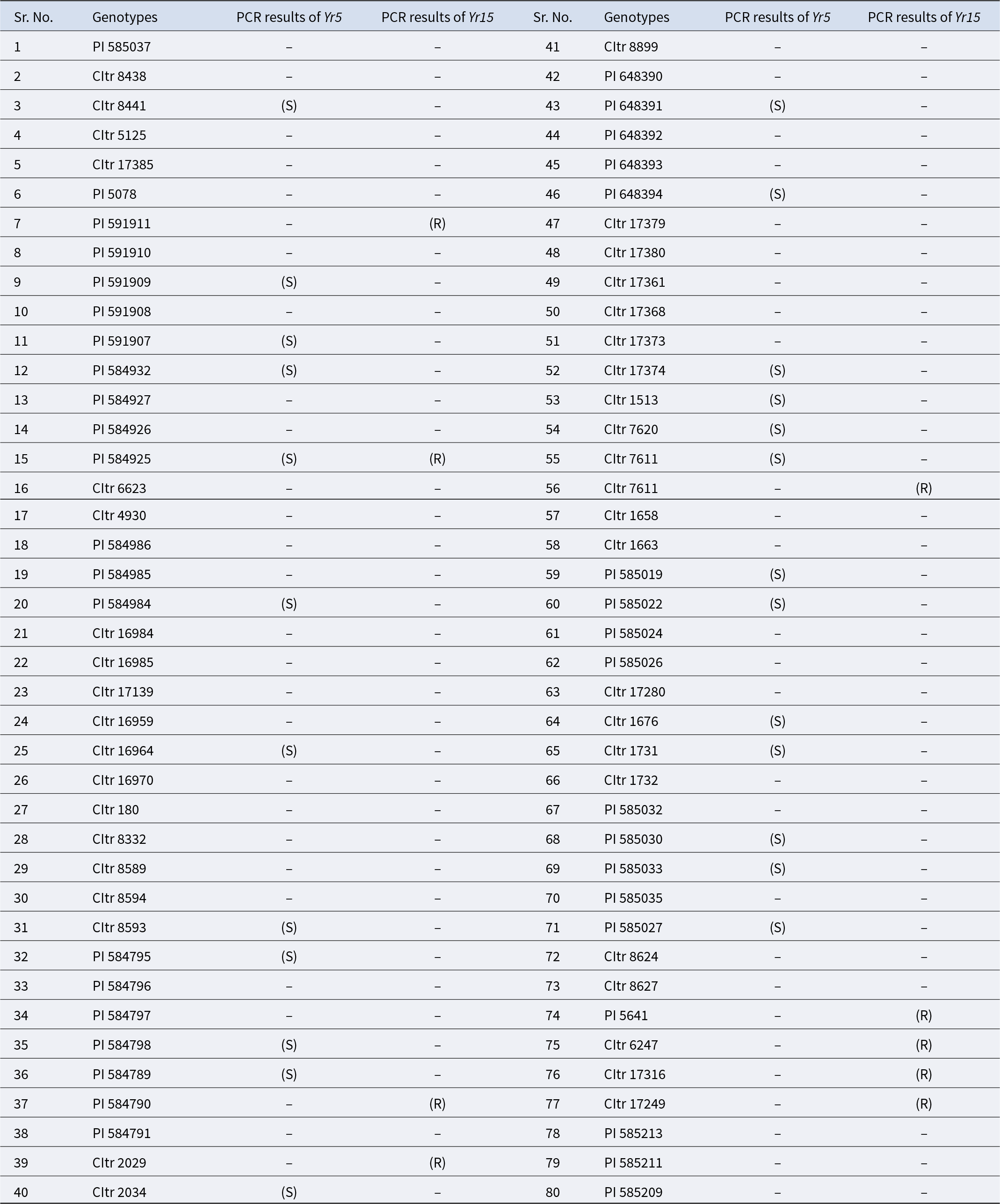
The PCR-based assessment for the Yr15 broad spectrum resistance gene using the primer (Y15K1_F2/uhw301R) showed that 9 out of 80 USDA bread wheat cultivars (11.25%) showed the presence of the Yr15 gene with a length of 991 bp (Fig. 3a, Table 3). The remaining 71 out of 80 genotypes (88.75%) have not showed the presence of the targeted gene for the Pst pathogen. The PCR-based screening results for the Yr5 resistance gene with the used primer (Yr5-F/R) revealed that none of the tested USDA bread wheat genotype had the Yr5 gene at 1260 bp (Fig. 3b). However, 25 out of 80 (31.25%) genotypes showed susceptibility to the targeted Pst pathogen (Fig. 2).
Agarose gel (2%) showing results for primers (a) Yr15 (991 bp) and (b) Yr5 (320 bp) in USDA bread wheat germ plasm. No band at 1260 bp indicates susceptibility to pst.

PCR results of 80 USDA bread wheat genotypes for the presence of Yr5 and Yr15 genes

S: Susceptible genotypes that ar showing the band of 320 bp; R: Resistant genotypes are showing the band of 991 bp.
Discussion
Overall, the wheat plant serves as the primary host for all the rust diseases (Khushboo et al., Reference Khushboo, Gupta, Pandit, Abrol, Choskit, Farooq and Hussain2021; Zulkiffal et al., Reference Zulkiffal, Kanwal, Ghafoor, Khokhar, Abdullah, Ajmal, Tanveer, Owais, Ahmed, Ahsan and Javed2024). The biotrophic rust pathogens cause a severe infection that can result in a complete yield loss, reaching up to 100% (Baloch et al., Reference Baloch, Ali, Tajibayev, Nadeem, Ölmez, Aktaş and Yang2024). The host resistance, and by developing resistant bread wheat cultivars is the most efficient approach for managing this pathogen. Wheat breeding has a long-standing global history, with Türkiye being one of the early contributors. In Türkiye, systematic wheat improvement began in 1925 with the establishment of the Islah Buzur research station in Eskişehir (Özbek et al., Reference Özbek, Keskin, Zencirci, Zencirci, Altay, Baloch, Nadeem and Ludidi2024). This initiative laid the foundation for a broader network of breeding centres, including stations in Adapazarı, Yeşilköy (Istanbul) and Ankara, all operational before 1930. By 1989, Türkiye had developed 14 public research institutes dedicated to wheat improvement, and the first registered variety, Karakılçık1133, was released in 1928 (Altay, Reference Altay2018). The National Wheat Breeding Program was launched in 1967 under the National Wheat Release and Training Project, in collaboration with CIMMYT and ICARDA (Aktaş and Baloch, Reference Aktaş and Baloch2017). To date, 221 wheat cultivars have been released in Türkiye, with valuable contributions from international germ plasm, particularly from Italy, France and Bulgaria. However, many Turkish cultivars, especially those grown in the Aegean and Mediterranean regions, remain vulnerable to diseases such as Septoria tritici blotch, where high rainfall can cause yield losses of 30–40% (Ünal et al., Reference Ünal, Kayım, Ay and Yones2017). In parallel, the USDA has played a significant role in global wheat breeding, maintaining a diverse germ plasm collection representing various agro-ecological zones (Byrne et al., Reference Byrne, Volk, Gardner, Gore, Simon and Smith2018; Vitale et al., Reference Vitale, Adam and Vitale2020). In the current study, integrating Turkish (cultivars) and USDA bread wheat (landraces) germ plasm provides a comprehensive genetic perspective, facilitating the evaluation of resistance genes such as Yr15 and Yr5 and supporting future breeding strategies at both national and international levels.
In the present study, the Yr15 resistance genes were detected in 31 genotypes from the USDA and Turkish germ plasm. However, 9 out of 31 genotypes were observed with Yr15 resistance genes in the USDA bread wheat germ plasm. The accession PI 591911 (Australia), PI 584925 (Brazil), PI 584790 (Czech Republic), CItr 2029 (Hungary), Cltr 7612 (Russia), PI 5641 (Ukraine), CItr 6247 (USA), CItr 17316 (USA) and CItr 17249 (USA) showed the positive amplification with an excepted band size of 991 bp. In the present study, the three accessions collected from the USA, showed the positive amplification for Yr15 resistance gene. The detection of Yr5 with the used primer revealed that none of the wheat genotype was observed with the said resistance gene (1260 bp) in the USDA germ plasm. However, the susceptible gene with 320 bp was detected in 25 out of 80 USDA bread wheat genotypes. The study of Xi et al. (Reference Xi, Wang, Yang, Zhu, Chen, Wang and Kang2021) also reported that the Yr5 gene was not detected in any of the 243 tested Yunnan wheat landraces, indicating a 0% frequency of this resistance gene within the population. In another study, Guan et al. (Reference Guan, Long, Yao, Wang, Jiang, Kang and Chen2020) revealed that among the 152 wheat landraces, none carried the Yr5 gene, indicating its absence in the evaluated germ plasm. This highlights the need for further exploration of Yr5 in other wheat populations or its potential incorporation into breeding programmes for stripe rust resistance. But the study of Li et al. (Reference Li, Wang, Chao, Guo, Song, Yue and Li2016) reported the Yr5 gene was detected in 5 (4.3%) of the 115 wheat cultivars (lines) evaluated. This gene is suggested for use in future breeding programmes to enhance resistance to stripe rust, as it offers effective protection against prevalent races in China.
Furthermore, the Yr15 resistance gene was detected in 22 out of 31 Turkish bread wheat cultivars. The cultivar Haymana-79, Türkmen, Eser, Tosunbey, Lütfibey, Sertak, Yektay-406, Bolal-2973, Porsuk-2802, Porsuk-2805, Porsuk-2807, Porsuk-2810, Porsuk-2811, Porsuk-2815, Porsuk-2826, Porsuk-2840, Porsuk-2851, Porsuk-2852, Porsuk-2853, Porsuk-2854, Porsuk-2856 and Porsuk-2858 showed the positive amplification with an excepted band size of 991 bp. The PCR-based screening results for the Yr5 resistance gene with the used primer (Yr5-F/R) revealed that none of the tested bread wheat cultivars had the Yr5 gene at 1260 bp (Fig. 1). However, 46 out of 94 (48.94%) genotypes showed susceptibility to the targeted Pst pathogen. The Yr15 gene detection in the cultivated bread wheat has also been reported in several studies (Liu et al., Reference Liu, Lu, Zhou, Zheng, Liu, Zhang and Zhang2020; Ragab et al., Reference Ragab, Shahin and Abdelkhalik2020; Sharma et al., Reference Sharma, Srivastava, Mavi, Kaur, Kaur, Bala and Singh2021; Waris et al., Reference Waris, Kaur, Bala, Singh, Srivastava, Sharma and Kumari2022; Lai et al., Reference Lai, Shen, Yang, Fernando, Ren, Deng and Li2024). Salarpour et al. (Reference Salarpour, Mohammadi-Nejad, Afshari and Abdolshahi2025) successfully enhanced the stripe rust resistance of the susceptible wheat cultivar Roshan by transferring Yr5 and Yr15 genes using marker-assisted backcrossing. Through successive backcross generations (BC1_11F1_11–BC5_55F1_11) and marker screening, they developed three near-isogenic lines (NILs): NILsYr5, NILsYr15 and NILsYr5 + Yr15, all exhibiting stable resistance to yellow rust. The pyramiding of Yr5 and Yr15 into the Roshan genetic background ensures durable resistance while preserving its desirable agronomic traits. Hagras et al. (Reference Hagras, Ragab, Abdelkhalik, Shahin, Youssef, Sehsah and Hamwieh2025) developed 173 wheat lines carrying Yr5, Yr10 and Yr15 through crosses with susceptible cultivars Sids 12 and Gemmeiza 11. Of these, 126 lines were resistant at both seedling and adult stages, with 15 lines outperforming the Giza 171 check cultivar in yield. These lines represent valuable genetic resources for breeding stripe rust-resistant wheat in Egypt.
During 2019 and 2020, a total of 54 T. turgidum var. durum genotypes and 11 T. turgidum var. dicoccoides genotypes were collected and evaluated for the presence of the Yr15, Yr5 and Yr10 genes that confer resistance against Pst (Ipek et al., Reference Ipek, Tekin, Cat and Akar2022). Their results revealed that the Yr5 gene was not found in any genotype. The presence of Yr10 and Yr15 was confirmed in 12 and 17 genotypes, respectively, with both resistance genes co-localised in 7 T. turgidum var. durum genotypes. Furthermore, Sharma-Poudyal et al. (Reference Sharma-Poudyal, Chen, Wan, Zhan, Kang, Cao and Patzek2013) findings enunciated that the distribution of virulent Pst strains against Yr10 has been increasing on a daily basis; and this gene has continued to confer resistance to a significant number of Pst strains from all over the world. According to Seifi et al. (Reference Seifi, Serajazari, Kaviani, Pauls, Booker and Navabi2021), the Yr5 gene was utilised to develop the Pst-resistant cultivars in the wheat breeding programmes. Klymiuk et al. (Reference Klymiuk, Wiebe, Chawla, Ens, Subramaniam and Pozniak2025) evaluated 86 Russian spring soft wheat varieties (2019–2023) for yellow rust resistance using four Pst populations and molecular markers for 10 Yr genes. Only six cultivars (7%) showed resistance to all populations, and highly effective genes such as Yr5, Yr10, Yr15, Yr24 and Yr40 were absent. The findings reveal low genetic diversity in resistance genes among these varieties, highlighting the urgent need for advanced breeding programmes targeting Pst resistance.
At the global level, Yr5 and Yr15 genes continue to be effective against Pst strains. Several virulent strains that are resistant to Yr5 gene have been documented in India. However, the Yr5 and Yr15 genes continue to be effective against various strains of Pst around the world (Ipek et al., Reference Ipek, Tekin, Cat and Akar2022; Tekin et al., Reference Tekin, Cat, Akan, Demir and Akar2022). Furthermore, Huang et al. (Reference Huang, Feng, He, Tang, He, Sela, Krugman, Fahima, Liu and Wu2019) stated that none of the 53 wheat cultivars that were investigated in Hungary exhibited the most significant Yr5, Yr10 and Yr15 resistance genes. Researchers in Ethiopia and Pakistan have reported that there was no evidence of Yr15 genes in their wheat populations (Sobia et al., Reference Sobia, Muhammad and Chen2010; Gebreslasie et al., Reference Gebreslasie, Huang, Zhan, Badebo and Zeng2020). The study conducted by Arya et al. (Reference Arya, Shal, Niranjana, Jha, Patial, Saharan and Vinod2025) identified a novel stripe rust resistance gene, YrIARI276, from Triticum spelta accession IARI276, which is distinct from Yr5. Through bulked segregant analysis, multi-stage screening and genotyping, YrIARI276 was mapped to putative chromosomal regions on 1BL, 1DL, 5AL or 7BL and showed a single dominant inheritance pattern. The gene uniqueness and effectiveness highlight its potential for broadening the Yr gene pool in wheat breeding programmes. Kaur et al. (Reference Kaur, Kaur, Bala, Srivastava, Sharma, Kaur and Kaur2025) reported that out of 374 European winter wheat lines, 258 showed resistance to all four prevalent Pst pathotypes, while 112 displayed variable reactions. Field evaluations at Ludhiana and Gurdaspur identified nine highly resistant lines with AUDPC and FRS = 0. Gene postulation and marker analysis confirmed the presence of Yr5, Yr10, Yr15 and Yr24/Yr26, either singly or in combination, indicating valuable sources for breeding durable stripe rust resistance.
The Yr10 gene is only effective against a single strain of Pst, although it was found effective against all the strains in Pakistan, Iran, China and the United States (Wang et al., Reference Wang, Ma, Zhou, Wang and Jia2002; Bux et al., Reference Bux, Ashraf, Hussain, Rattu and Fayyaz2012; Kokhmetova et al., Reference Kokhmetova, Rsaliyev, Malysheva, Atishova, Kumarbayeva and Keishilov2021). Past studies reported that seven wheat accessions from Balochistan, Pakistan contained five Yr genes, while six wheat accessions from Gilgit – Baltistan and Punjab Pakistan had four Yr genes (Tahir et al., Reference Tahir, Zia, Dilshad, Fayyaz, Noureen and Farrakh2020). The findings also suggest that these wheat genotypes hold strong potential for inclusion in future breeding programmes aimed at wheat improvement. The present study presents innovative opportunities to improve the wheat crop and provide food security in the face of climate change. The Yr15-positive genotypes identified in this study hold significant potential for future wheat breeding programmes. Given the absence of Yr5 in our germ plasm, pyramiding Yr15 with other effective resistance genes (e.g., Yr10, Yr24/26 or newly characterised adult plant resistance genes) could enhance the durability of resistance against evolving Pst races. MAS and genomic selection strategies can be employed to combine Yr15 with complementary loci to achieve broad-spectrum and long-lasting protection (Shahin et al., Reference Shahin, Omara, Omar, El-Din, Sehsah, Essa and Omar2024). The study of Sivhada et al. (Reference Sivhada, Boshoff, van Biljon and Labuschagne2025) revealed that stripe rust and resistance genes (Yr9, Yr10, Yr15) significantly influence gluten protein fractions in Avocet near-isogenic lines. Notably, disease presence affected protein quality, and the effects of resistance genes were variable but significant. These findings emphasise that breeding for stripe rust resistance should also consider end-use quality traits to avoid compromising wheat’s baking performance. Furthermore, integrating these genotypes into pre-breeding pipelines would facilitate the development of high-yielding, stripe rust-resistant cultivars adapted to diverse agro-climatic conditions, thereby strengthening global food security efforts. These findings are anticipated to catalyse further investigations and progress in the field of wheat crop breeding, leading to even more significant breakthrough in the future.
The durability of resistance genes such as Yr15 and Yr5 must be considered in the context of climate change. Warm winters altered rainfall patterns, and increased frequency of extreme weather events can create conditions conducive to earlier onset and longer duration of stripe rust epidemics, even in traditionally low-risk regions (Yan et al., Reference Yan, Wang, Zhang, Liu, Wei, Shi, Lan, Zhang, Xu, Baloch, Rasheed, Ni, Sun and Gou2025). Such shifts may accelerate the breakdown of resistance and facilitate the spread of new virulent races (Yao et al., Reference Yao, Guo, Gou, Hu, Liu, Ma, Zong, Xin, Chen, Li, Wang, Zhang, Uauy, Baloch, Ni and Sun2025). Therefore, proactive strategies, including gene pyramiding and continuous monitoring of pathogen populations, should be integrated into breeding programmes to ensure resilience under changing climatic conditions.
Conclusions
The study emphasises that molecular-based screening play a vital role in the detection of stripe rust resistance genes, Yr15 and Yr5, in the USDA landraces and Turkish bread wheat cultivated germ plasm. The Yr15 gene was prevalent in 31 cultivars, while the Yr5 gene was not found. The findings support the implementation of targeted breeding strategies to enhance resistance against stripe rust.
Supplementary material
The supplementary material for this article can be found at https://doi.org/10.1017/S1479262125100245.
Acknowledgements
This research was supported by the Brain Pool program funded by the Ministry of Science and ICT through the National Research Foundation of Korea (RS-2024-00403759) to FSB.
Author contributions
Muhammed Tatar: Writing – original draft, Methodology, Investigation, Data curation, Formal analysis, Visualization. Amjad Ali, Jazib Javed, and Muhammad Azhar Nadeem: Writing – original draft, Methodology, Validation, Data curation, Investigatio1qan, Formal analysis. Fatih Ölmez and Manh Cuong Do: Supervision, Project administration, Writing – review & editing, Resources. Jin-Ying Gou and Jun Ma: Writing – review & editing. Faheem Shehzad Baloch and Yong Suk Chung: Writing – review & editing, Supervision, Methodology.
Competing interests
The authors declare that they have no known competing financial interests or personal relationships that could have appeared to influence the work reported in this paper.
Data availability materials
All data about related to this study are present within the manuscript.
Abbreviations
- ATAEM/ESK
Geçit Kuşağı Tarımsal Araştırma Enstitüsü Müdürlüğü/Eskişehir-Transition Zone Agricultural Research Institute Directorate/Eskişehir
- TARM/ANK
Tarla Bitkileri Araştırma Enstitüsü Müdürlüğü/Ankara-Field Crops Research Institute Directorate/Ankara
- TTAEM/EDN
Trakya Tarımsal Araştırma Enstitüsü Müdürlüğü/Edirne-Thrace Agricultural Research Institute Directorate/Edirne
- STAEM/SKY
Sakarya Tarımsal Araştırma Enstitüsü Müdürlüğü/Sakarya-Sakarya Agricultural Research Institute Directorate/Sakarya
- DATAE/ERZ
Doğu Anadolu Tarımsal Araştırma Enstitüsü Müdürlüğü/Erzurum-Eastern Anatolia Agricultural Research Institute Directorate/Erzurum
- BDUAAEM/KNY
Bahri Dağdaş Uluslararası Tarımsal Araştırma Enstitüsü Müdürlüğü/Konya-Bahri Dağdaş International Agricultural Research Institute Directorate/Konya
- GATAEM/DYB
GAP Agricultural Research Institute Directorate/Diyarbakır.