

Introduction
Schizophrenia is a chronic debilitating illness with serious concern of relapses during the disease course.Reference Robinson, Woerner and Alvir 1 About 74% of schizophrenia patients discontinue antipsychotics within 18 months of starting it, and so treatment nonadherence leads to increased relapse and readmission rates, longer inpatient stay, and higher costs.Reference Lieberman 2 , Reference Lafeuille, Laliberte-Auger and Lefebvre 3 Other barriers that can forbid these patients from receiving treatment are cognitive decline with difficulty taking/refilling medications, treatment cost, and inability to receive outpatient care and negative stigma toward psychiatric illness.Reference Gadkari and McHorney 4
The 2020 American Psychiatric Association practice guidelines recommend the use of long-acting injectable antipsychotics (LAI-a) for at-risk and nonadherent patients.Reference Keepers, Fochtmann and Anzia 5 LAI-a helps in reducing relapse, and maintaining steady plasma concentrations, and reducing the risk of overdose, and improving patient outcomes.Reference Gerlach 6 Despite the advantages of LAI-a over oral antipsychotics in schizophrenia, LAIs are underutilized.Reference Correll, Citrome and Haddad 7
Earlier clinical trials compared the effectiveness of LAI-a and oral antipsychotics but yielded unconvincing results in reducing the readmission rate. Such trials are the gold standard for research-based comparisons but are not suitable in clinical practice, and so a study with a more realistic design is required.Reference Correll, Citrome and Haddad 7 A meta-analysis of clinical trials found that LAI-a did not reduce relapse compared with oral antipsychotics in schizophrenia patients.Reference Kishimoto, Robenzadeh and Leucht 8 Though this findings are affected selection bias, and were combination of inpatient and outpatient settings and variable study duration. Another meta-analysis of 25 observational studies including 5940 schizophrenia patients found that LAI-a had significant effectiveness in reducing readmission (risk ratio of 0.43) compared to oral antipsychotics.Reference Kishimoto, Nitta and Borenstein 9 The discrepancy in findings compared to the trials is due to the study design of naturalistic cohort studies which have higher predictability in clinical practice.
Our primary goal is to evaluate the “real-world” effectiveness of LAI-a compared to oral antipsychotics in reducing the 90-day and annual readmission rates in underserved populations with psychotic disorders. Our next goals are to delineate the differences in readmission rates between first-generation antipsychotics (FGA) and second-generation antipsychotics (SGA) LAIs and to study the impact of the number of LAIs given during inpatient stay and number of days from last LAI to discharge on 90-day and annual readmission rates.
Methods
Study design
Ours is an observational study with a retrospective cohort design that was conducted at Griffin Memorial Hospital (GMH), a public psychiatric state hospital located in central Oklahoma. Data were extracted from the electronic health records (EHRs) of the patients discharged from GMH between January 1, 2018 and December 31, 2019.
Study population
The inclusion criterion was age 18 years and above with primary psychiatric discharge diagnosis of psychotic disorders (schizophrenia, schizoaffective disorders, and substance-induced psychosis). The diagnoses were made by board-certified psychiatrists and/or psychiatry residents based on the Diagnostic and Statistical Manual of Mental Disorders, 5th edition (DSM-V) diagnostic criteria, and was based on clinical observations and interviews and past psychiatric history.
Patients were excluded from the study if they were primarily diagnosed with a psychiatric illness other than psychotic disorders. Also, patients with schizophrenia who were not treated with antipsychotic medication and those patients discharged to jail were excluded.
Subject recruitment methods and privacy
EHRs from January 1, 2018 and December 31, 2019 were reviewed. The number of discharged patients between the study period was identified by the clinical informatics director as 380. However, 180 patients were selected based on our study criteria. Data were extracted from each patient’s initial evaluation and inpatient physician and social workers’ progress notes and discharge summary by the principal investigator (R.S.P.) on a password protected state-owned computer thereby following the Health Insurance Portability and Accountability Act (HIPAA) rules and regulations.
A waiver of documentation of informed consent was obtained from the Oklahoma State University’s (OSU’s) Institutional Review Board (IRB). The study was approved by the OSU IRB.
Study variables and outcome
Data collected included patient demographics (age, gender, and race), past histories obtained during patient interviewing (of suicide attempt, trauma including physical, emotional, or sexual abuse or exposure to other traumatic events), family history of psychiatric illness, and legal history (including prison/jail time), primary psychiatric diagnosis of psychotic disorders, comorbidities (depressive disorders, bipolar disorders, anxiety disorders, personality disorders, and alcohol, cannabis, stimulant and opioid abuse/dependence), current tobacco use, admission status (voluntary or involuntary), medication noncompliance (based on psychiatric interviewing), treatment (LAI, oral antipsychotics, antidepressants, mood stabilizers, and anticholinergic), and disposition (to home, group home/residential care or rehabilitation/nursing facility). The median number of hospitalizations for the study sample was three, and so we converted the continuous variable of number hospitalization into less than or equal to 3 and above 3.
Readmission was defined as a subsequent admission for any cause in psychiatric emergency department after the index hospitalization discharge date. Psychiatric readmission in 90-day and/or 1-year periods after discharge from index hospitalization during the study period was defined as the primary outcome. The time frames of 90-day and annual readmission are important for inpatient quality measure, and provide a broader window after an acute episode of psychiatric care (as seen in 30-day readmission).
Data analysis
Descriptive analyses and cross-tabulation using frequencies for categorical variables were used to describe study sample characteristics. In the first step, logistic regression analyses were conducted to examine the unadjusted association between 90-day readmission and annual readmission (in independent models). For these analyses, the effect size was estimated using the odds ratio (OR) with associated 95% confidence intervals (CI). In the second step, only variables associated with 90-day and annual readmission from the first step were included in a multivariate logistic regression analysis and had Nagelkerke R Square value of 0.213 (for 90-day readmission) and 0.287 (for annual readmission) indicating a good model fit. Independent sample t-test was used to measure the differences in continuous variables for inpatients receiving LAI-a (number of LAIs received, number of days from last LAI-a to discharge and length of stay [LOS]). A significance level of P ≤ .05 was used in all analyses and was conducted using IBM SPSS ver. 26 (IBM Corp., Armonk, NY).
Results
Sample characteristics
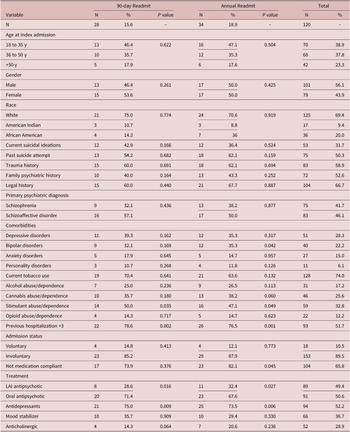
The study sample is comprised of a majority of male (56.1%) and White (69.4%) patients, mostly between 18 and 50 years of age (76.7%). A higher proportion of inpatients had past legal history (66.7%), trauma history (58.9%), and family psychiatric history (52.6%). About 46.1% of inpatients had a primary psychiatric diagnosis of schizoaffective disorders followed by schizophrenia (41.7%) and substance-induced psychosis (12.2%). Seventy-four percent of inpatients had current tobacco use, and 17.2% had alcohol abuse/dependence, and other significant substances included stimulants, that is, cocaine/methamphetamine (32.8%), cannabis (25.6%), and opioids (12.2%). The majority of inpatients were admitted involuntarily (89.5%) and were discharged to their homes (71.7%) at the end of their stay. During the hospitalization, 49.4% of inpatients received LAI-a and other concomitant medications included antidepressants (52.2%), mood stabilizers (36.7%), and anticholinergic medication (28.9%) as shown in Table 1.
Differences in the Sample Population by Readmission

The proportion between total inpatients and patients in 90-day and annual readmit cohorts were obtained using cross tabulation and the Pearson’s chi-square test and were significant with P value ≤ .05.
Abbreviation: LAI, long-acting antipsychotic.
Predictors of 90-day and annual readmissions
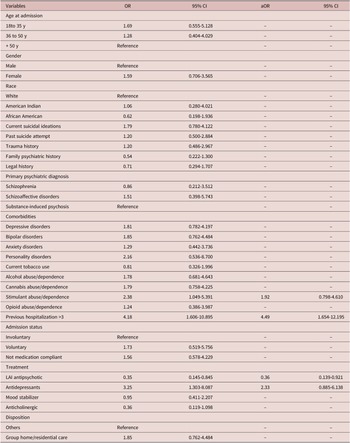
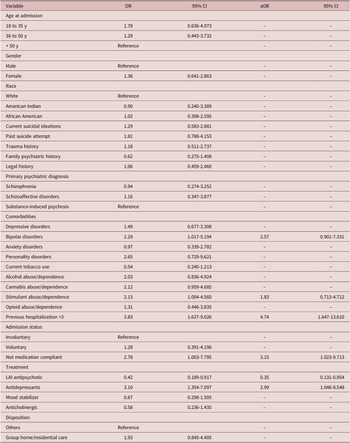
A higher proportion of inpatients with comorbid stimulant abuse/dependence were readmitted in 90-day (50%) and 1-year (47.1%) periods. In logistic regression analysis, stimulant abuse/dependence was significantly associated with 90-day readmission (OR 2.38, 95% CI 1.049-5.391) and annual readmission (OR 2.13, 95% CI 1.004-4.560) by two times. Comorbid bipolar disorder was only associated with increased odds for annual readmission by two times (OR 2.29, 95% CI 1.017-5.194).
About 76% to 78% of inpatients readmitted had more than three past psychiatric hospitalizations with higher odds for 90-day readmission (OR 4.18, 95% CI 1.606-10.895) and annual readmission (OR 3.83, 95% CI 1.627-9.026). There was statistically no significant difference on readmission rates based on admission status and disposition. Medication noncompliance was associated with a significant increase in the odds of annual readmission by three times (OR 2.78, 95% CI 1.003-7.795). Inpatients receiving concomitant antidepressants were significantly higher in both 90-day (75%) and annual (73.5%) readmission cohort compared to not being readmitted. So, concomitant antidepressant use increased the odds for 90-day (OR 3.25, 95% CI 1.303-8.087) and annual readmission (OR 3.10, 95% CI 1.354-7.097) by three times.
Impact of LAI-a on 90-day and annual readmissions
A lower proportion of patients receiving LAI-a were readmitted within 90-day (28.6%) and 1-year (32.4%) periods. The use of LAI-a was associated with lower odds for 90-day (OR 0.35, 95%CI 0.145-0.845) and annual (OR 0.42, 95%CI 0.189-0.917) readmissions. After controlling the multivariable logistic regression analyses for significant predictors, the odds of association were statistically significant for both 90-day (OR 0.36, 95% CI 0.139-0.921, B −1.027; P = .033) and annual (OR 0.35, 95% CI 0.131-0.954, B −1.041; P = .040) readmissions as shown in Tables 2 and 3, respectively.
Logistic Regression Model for 90-Day Readmission

The odds ratios were obtained using logistic regression model; and were significant with P value ≤ 0.05.
Abbreviations: aOR, adjusted odds ratio; CI, confidence interval; LAI, long-acting antipsychotic; OR, odds ratio.
Logistic Regression Model for Annual Readmission

The odds ratios were obtained using logistic regression model; and were significant with P value ≤ 0.05.
Abbreviations: aOR, adjusted odds ratio; CI, confidence interval; LAI, long-acting antipsychotic; OR, odds ratio.
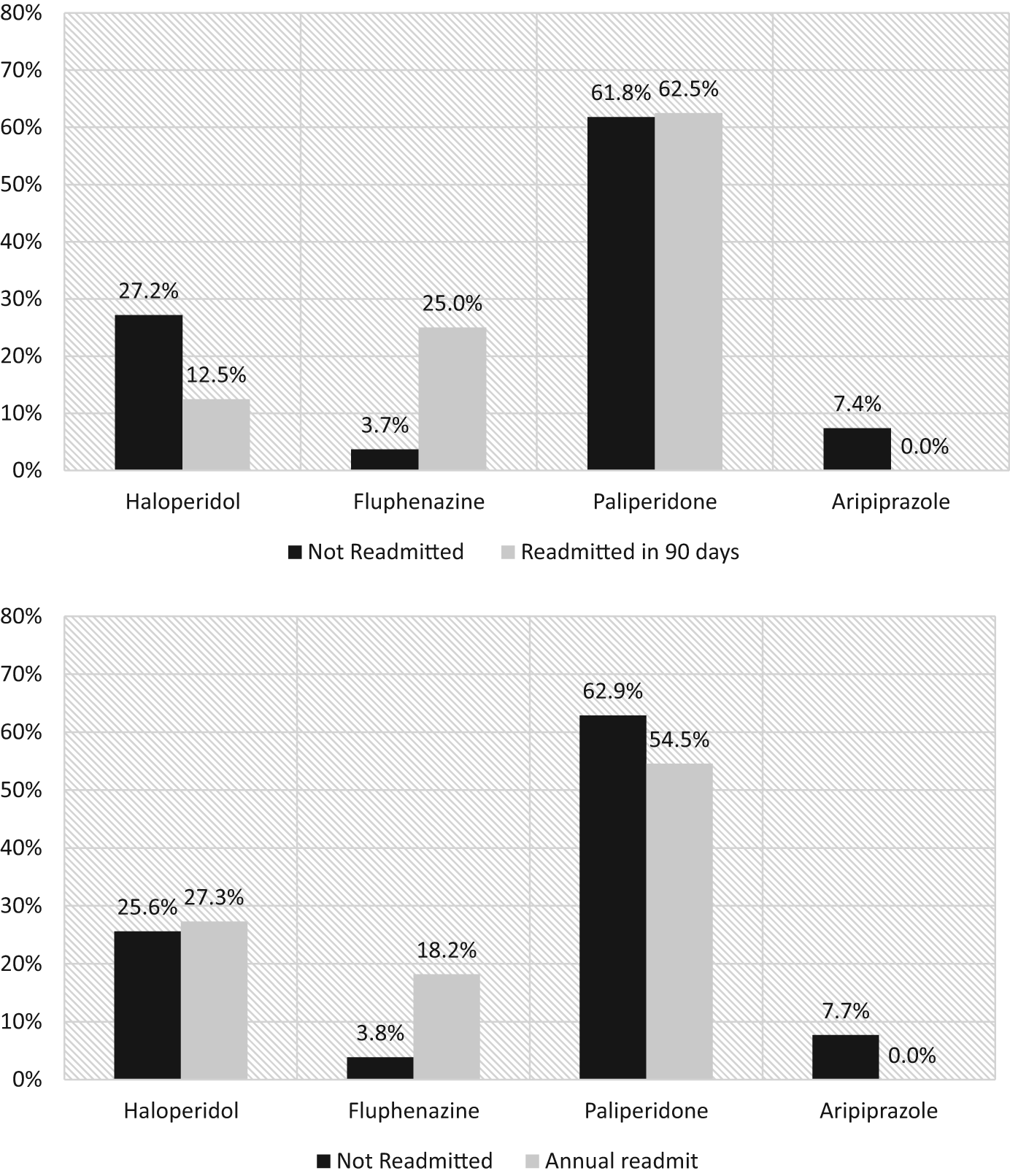
A higher proportion of inpatients who received fluphenazine LAI were readmitted in 90 days (25% vs 3.7% not readmitted), whereas on the other side only 12.5% of inpatients on haloperidol LAI were readmitted in 90 days (vs 27.2% not readmitted). When considering annual readmission, a lower proportion of inpatients on LAI paliperidone were readmitted (54.5% vs 62.9% not readmitted) whereas those on fluphenazine were in a higher proportion (18.2% vs 3.8% not readmitted) as shown in Figure 1.
Readmissions by long-acting injectable antipsychotics.

Among inpatients receiving LAI-a, there was a statistically significant difference in the mean number of days from receiving the last LAI-a to discharge in 90-day readmission (5.3 days for readmitted cohort vs 15.8 days for not-readmitted cohort). There was no significant difference in the number of LAI-a received during hospitalization between cohorts for both 90-day and annual readmission. On the contrary, the total LOS significantly differed between cohorts for 90-day and annual readmission as shown in Table 4.
Differences in Long-Acting Injectable Antipsychotic Recipients by Readmission

Abbreviation: LAI-a, long-acting injectable antipsychotics.
Discussion
Our study analyzed inpatient discharge data from a state psychiatric hospital of patients with psychotic disorders. These patients who were discharged on an LAI-a formulation were less likely to be readmitted within 90-day and annual periods compared to those discharged on oral antipsychotics. The protective effect of LAI-a was consistent even after controlling for potential confounders including demographic characteristics, past history, diagnoses, comorbidities, and hospitalization outcomes.
Consistent with current literature, demographic characteristics (age, gender, and race) did not predict psychiatric readmission.Reference Lorine, Goenjian and Kim 10 , Reference Zhang, Harvey and Andrew 11 As per a nationwide study, stimulant-use disorders increases the odds of 30-day all-cause readmission by 20%.Reference Mejia de Grubb, Salemi and Gonzalez 12 Among substance use disorders (SUDs), we found that stimulant abuse/dependence increase the odds for 90-day and annual psychiatric readmission by two times. Also, alcohol and cannabis abuse/dependence increased the readmission rates by two times but was statistically not significant which correlated with current literature. This could be also related to a higher risk of medication noncompliance seen in schizophrenia patients abusing cannabis (by 1.38 times), alcohol (by 1.35 times), and opioids (by 1.15 times).Reference Patel, Sreeram and Vadukapuram 13 So, treating SUDs can reduce readmission rates and so should be included in the risk predictor model.Reference Mejia de Grubb, Salemi and Gonzalez 12 A retrospective study (N = 2443) found that primary diagnosis of bipolar disorder type and/or manic episode does not predict psychiatric readmission.Reference Hamilton, Passos and de Azevedo Cardoso 14 But, in our study, we found that comorbid bipolar disorder in patients with psychotic disorders increases the odds for annual readmission by two times supported by current literature.Reference Monnelly 15 , Reference Swett 16
We found that past history of three or more past psychiatric hospitalizations increased the odds of 90-day and annual readmission by four times which is consistent with past studies.Reference Zhang, Harvey and Andrew 11 , Reference Monnelly 15 – Reference Bockmann, Lay and Seifritz 17 This could be due to instability before discharge which needs to be identified through careful assessment and clinical indicators with a robust transition plan for outpatient care to prevent readmissions. There was no significant relationship seen between the admission status and disposition with readmissions across both periods after controlling for potential confounders.Reference Bockmann, Lay and Seifritz 17
About 71% of 1.2 million schizophrenia patients are noncompliant with medications which adversely affects the course of illness and patient outcomes.Reference Desai and Nayak 18 Medication noncompliance increased the risk of annual readmission in our study. So, recording medication noncompliance in patient charts on the EHRs can be helpful to identify patients at high risk of readmission.Reference Andrews, Baker and Howell 19 Schizophrenia patients with depressive symptoms have increased suicide risk and so adequate management of comorbid depression is vital to improve the quality of life. Also, there are problems in delineating depressive symptoms in schizophrenia as it can be confused with negative symptoms and extrapyramidal symptoms.Reference Whitehead, Moss and Cardno 20 In our study, about one-third of the patients with psychotic disorders had comorbid depression and about 52% patients were on concomitant antidepressants. This increased the odds for 90-day and annual readmissions by three times. There is no substantial evidence to support or contest the use of antidepressants in managing depressive symptoms in schizophrenia patients, and we need more studies to determine the gold standard approach in treating depression in these patients.Reference Whitehead, Moss and Cardno 20 Concomitant use of anticholinergics with antipsychotics in patients with psychotic disorders was associated with reducing the 90-day readmission by 64% and annual readmission by 36% but was statistically not significant.
As per a large nationwide study in Finland, FGA and SGA LAIs were identical in reducing the risk of psychiatric readmission by 54% to 55% compared to those managed with oral antipsychotics.Reference Taipale, Mehtala and Tanskanen 21 We found that LAI-a reduced the odds for 90-day and annual readmissions by 64% to 65% after controlling for potential confounders and was supported by current literature.Reference MacEwan, Kamat and Duffy 22 – Reference Lin, Chen and Chan 26 LAI-a (risperidone, perphenazine, olanzapine, and haloperidol) were significantly superior to corresponding oral formulation in reducing the risk of psychiatric readmission.Reference Taipale, Mehtala and Tanskanen 21 Whereas, another study found that there exists no difference in readmission rates or time to readmission between the schizophrenia patients receiving FGA LAI-a vs SGA LAI-a.Reference Stone, Roux and Taylor 27 In our study, a higher proportion of patients discharged on LAI fluphenazine were readmitted in 90-day and one-year periods whereas those on LAI paliperidone had a lower annual readmission rate. But, physician’s choice and other factors such as side-effect profile, patient acceptability, and costs should be considered in guiding the treatment plan for patients with psychotic disorders.
LAI-a recipients in our study that got readmitted in 90-day and annual periods had a lesser number of days from receiving the last LAI-a to discharge and total LOS. It is controversial whether a shorter inpatient stay is associated with a higher risk of readmission.Reference Heeren, Dixon and Gavirneni 28 , Reference Hodgson, Lewis and Boardman 29 As the number of LAI-a received during inpatient stay was not significantly associated with readmission risk in our study which means that the quality of inpatient care does not influence the risk of psychiatric readmission.
Our study results should be considered with few limitations and strengths. We used the underserved inpatients with psychotic disorders discharged from a state psychiatric hospital, and so our results may not be generalizable to the vast population across the United States. The sample size for LAI-a was much similar to that for oral antipsychotics which was not present in past studies. Our main outcome was psychiatric readmission and we included clinical indicators and patient outcomes related to relapse which were not included in previous studies. Due to the nature of the cross-sectional study, we did not follow-up the discharge patients to examine medication compliance or refills. In our study, the estimations of the medication compliance may be inaccurate as it was quantified by patient interviewing and it is an all or none phenomenon. Some factors that can be related to readmission risks like cognitive deficits, medical comorbidities, adverse effects, and reasons for discontinuation, and follow-up with outpatient were not included. Other factors that may affect the utilization of LAI-a like physician’s choice, costs, and type of clinical settings were not included which may confound our study results. About 46% of our study population had schizoaffective disorders, but we did not measure the reason for their psychiatric readmission if it was due to suicide risk rather than relapses. Lastly, we did not extract the variable of time to readmission during the data extraction as our two primary outcomes were to find the odds of 90-day and annual admission. We included comorbidities and concomitant medication use, admission, and disposition status which makes our results representative of real-world clinical settings. Lastly, the major strength of this study is that we included potential factors associated with the risk of readmission to control the regression model and study the effectiveness of LAI-a vs oral antipsychotics on readmissions.
Conclusion
Utilization of LAI-a in an underserved patient population with psychotic disorders can decrease both 90-day and annual psychiatric readmissions by 64% to 65%. Physicians should prefer LAI-a for patients with recurrent psychotic disorders to reduce the readmission rate and improve the quality of life, and decrease the healthcare-related financial burden. The healthcare system should reduce the constraint of usage or reimbursement of LAI-a in at-risk patients.
Acknowledgments
We would like to thank Dr. Hema Mekala for obtaining IRB approval for this project. We would like to thank Ms. Fancher, the Reimbursement Director and the Department of Pharmacy team at Griffin Memorial Hospital for supporting this project.
Funding
This research did not receive any specific grant from funding agencies in the public, commercial, or not-for-profit sectors.
Disclosures
The authors do not have anything to disclose.