


Due to the increasing world population, there is a need to identify of alternative but sustainable alternative protein sources to support both human diets and animal agriculture(1). Livestock, poultry and fisheries, require large amount of land and water resource, but also have significant impact on greenhouse gas emissions(Reference Poore and Nemecek2). Increasingly a ‘protein gap’ is developing which has advanced the need to identify and then produce viable sustainable protein sources, which are also nutritionally adequate(Reference Godfray, Beddington and Crute3). In response to this challenge, researchers and innovators are exploring alternative protein sources, such as insect and microbial proteins(Reference Boland, Rae and Vereijken4).
Insect species have been identified as an alternative protein source, because of their ability to convert waste streams (e.g. wheat bran or food waste) into insect protein, whilst potentially requiring less land and water than livestock species(Reference Hawkey, Lopez-Viso and Brameld5). There are range of species that have been identified as potential sources. The most commonly reared are Black Soldier Fly Larvae (BSFL, Hermetia illucens), yellow mealworms (MW, Tenebrio molitor) and house crickets (HC, Acheta domesticus). This review will focus on the protein nutritional quality of these species, then focus on the MW, describing how its body composition can be manipulated.
Nutrient composition of production insects
On a live weight basis insects consist of significant amount of water, which can be very variable dependent on the species the substrate they are fed (70–75% for BSFL, 48–80% MW, 69–71% crickets (unpublished observations)). In general, when assessing nutrient composition on a dry matter basis, insects compare well to traditional protein sources, such as soybean protein concentrate (50–60%) and fishmeal (62–70%)(6). Generally, protein is the main component of insects(Reference Rumpold and Schluter7) but this can vary greatly within the species considered in this review, reported values ranging between 34 and 72%, with crickets having the highest and BSFL the lowest (Table 1). These values are usually over-estimates when measured based on nitrogen, as chitin, which makes up their exoskeleton, is nitrogen-containing polysaccharide. In addition, it has been reported a significant proportion of insect protein is chemically bound within the exoskeleton so is likely to be unavailable(Reference Barker, Fitzpatrick and Dierenfeld8). The usual nitrogen-to-protein conversion factor of 6.25(Reference Jonas-Levi and Martinez9) therefore overestimates the crude protein content. Various alternative nitrogen-to-protein conversion factor have been suggested ranging from 4.64 to 5.61(Reference Janssen, Vincken and Van Den Broek10–Reference Boulos, Tännler and Nyström12). There appears to be no consensus on what value should be applied; however, this could be overcome by determining total amino acid composition. Insects are a good source of indispensable amino acids (IAA) and for all insect species used as food and feed their IAA content compares favourably with the other high-protein sources such as meat and fish(Reference Hawkey, Lopez-Viso and Brameld5,Reference Van Huis, Van Itterbeeck and Klunder13) .
Nutritional composition (%) and energy content (MJ/kg) of commonly used insects in food and feed on a Dry Matter (DM) basis

Table 1. Long description
The Crude Protein, Total Fat, Fibre, Ash and Energy content of Tenebrio molitor larvae (yellow mealworm), Acheta domesticus (house cricket), and Hermetia illucens (black soldier fly larvae) are shown. Yellow mealworm had the highest protein content and biggest range, as was the case for its fat content. The house cricket had the next highest protein content but had lower fat content. Black soldier fly larvae had the lowest protein content and fat content was similar to yellow mealworms.
The reported fat content of insects is variable, both between species and within species, as can be seen in Table 1. Fat content of BSFL and MW is particularly variable. The quantity of fat is problematic for animal feeds, as common ingredients such as soybean and fish meal have less fat. Therefore, it is likely the fat will have to be removed before most insects could be used in animal feed(Reference Makkar, Tran, Heuze and Ankers14). We have previous described a summary of the fatty acid composition of insects used in food and feed(Reference Hawkey, Lopez-Viso and Brameld5). In production insect species the predominate saturated fatty acid across species is palmitic acid (C16:0). However, in BSFL it is lauric acid (C12:0), which is found in relatively high concentrations in coconut oil and has antimicrobial activity(Reference Müller, Wolf and Gutzeit15). The main monounsaturated fatty acid found in insects is oleic acid (18:1). The predominant essential polyunsaturated fatty acid is linoleic acid (n-6, 18:2), whilst alpha linoleic acid (n-3, 18:3) is low, usually more than 10 times lower than the n-6 fatty acids(Reference Hawkey, Lopez-Viso and Brameld5).
The reported vitamin and mineral content are reported to be variable(Reference Van Huis, Van Itterbeeck and Klunder13). Generally, the mineral content is sufficient to meet the requirements of most animals(Reference Barker, Fitzpatrick and Dierenfeld8). However, insects have very low vitamin A and D(Reference Finke16). Most insect species are a relatively good source of B-vitamins, particularly vitamin B12(Reference Finke16).
Protein quality
Protein quality is defined by the indispensable amino acid (IAA) composition and their digestibility relative to an organism’s requirements. The Food and Agriculture Organization of the United Nations (FAO) recommend the digestible indispensable amino acid score (DIAAS) is used as an assessment of the protein quality(25). The reference requirement is routinely given relative to the IAA requirements for young children (6months to 3years)(25). DIAAS is based on determining the availability of IAA at the ileum. This data is limited for humans, therefore in vitro determinations are often used. The standardised in vitro static digestion methodology INFOGEST has been developed to estimate human ileal protein digestibility(Reference Egger, Blanco-Doval and Sousa26).
There is limited data available on the human digestibility of insect-derived protein, but relatively recently various labs, including our own, have used the INFOGEST methodology on MW(Reference Hammer, Moretti and Abbühl-Eng27), HC(Reference Hammer, Moretti and Abbühl-Eng27) and BSFL(Reference Traksele, Speiciene and Smicius28–Reference Graham, de Matos and Parr30). As can be seen in Table 2 the reported digestibility of insect proteins is variable. This is dependent on the processing methods used, but for MW digestibility is higher than 90%, whilst for HC it is more variable 79– 93%, again dependent on the processing procedure(Reference Hammer, Moretti and Abbühl-Eng27). In general, for both these species blanched insects had the highest digestibility, whilst when chitin is removed digestibility is decreased to 91% or 79% for MW and HC respectively(Reference Hammer, Moretti and Abbühl-Eng27). For BSFL the digestibility is generally lower than the other two species and varies more greatly 48–84%(Reference Traksele, Speiciene and Smicius28–Reference Graham, de Matos and Parr30). The variation in values appear to be related to whether the sample has been processed – the fat removed and protein isolated(Reference Traksele, Speiciene and Smicius28). Although digestibility of the three commonly grown insects vary, the higher digestibility values are like the digestibility of other food ingredients, such as milk protein (86–91%), soya protein isolate (85%) and wheat (82%)(Reference Komatsu, Tsuda and Wada31).
Protein digestibility and digestible indispensable amino acid scores (DIAAS) of commonly used insects in food and feed

Table 2. Long description
The protein digestibility and highest reported digestible indispensable amino acid scores (DIAAS) of Tenebrio molitor larvae (yellow mealworm), Acheta domesticus (house cricket), and Hermetia illucens (black soldier fly larvae) are shown. Yellow mealworm had the highest protein digestibility followed by house cricket and then black soldier fly larvae. Yellow mealworm, house cricket and black soldier fly larvae had DIAAS values of 89, 92 and 75%, respectively with limiting amino acids of sulphur containing amino acids, Tryptophan and Lysine respectively.
* values range obtained from references indicated in Reference column
† values for limiting IAA and DIAAS this processed product obtained from reference 27
‡ values for limiting IAA and DIAAS this processed product obtained from reference 28
For the three production insects described in this review(Reference Hammer, Moretti and Abbühl-Eng27–Reference Komatsu, Tsuda and Wada31), various groups have used in vitro INFOGEST digestibility data to calculate the digestible indispensable amino acid ratio (DIAAR), using the reference IAA requirements for young children (6 months to 3 years)(25). This has then allowed DIAAS of these insects to be determined along with the associated limiting IAA(25). Indicated in Table 2 are the highest reported values for DIAAS for each insect. Reflecting high digestibility values for MW, they have the highest DIAAS value 89% with limiting IAA being sulphur-containing amino acids (methionine and cysteine)(Reference Hammer, Moretti and Abbühl-Eng27). For HC, DIAAS was 92% with tryptophan as the limiting amino acid, although the DIAAR for SAA was only a little higher(Reference Hammer, Moretti and Abbühl-Eng27). For these species, although the limiting amino acid remained the same, different processing methods affected DIAAS. In MW this ranged from 89 to 59% whilst in HC the range was 92 to 40%, the lowest DIAAS being associated with samples that had been processed to reduce the chitin content(Reference Hammer, Moretti and Abbühl-Eng27). In BSFL had the lowest DIAAS value of the insect species being considered in this review, with a value of 75% and lysine being the limiting amino acid(Reference Traksele, Speiciene and Smicius28). Like the other species a range of DIAAS values have been reported dependent on the way the BSFL have been processed, with the lowest value of <20% and tryptophan being the limiting amino acid(Reference Bonomini, Prandi and Caligiani29). Our research on BSFL has described DIAAS within this range (44%), but SAA was the limiting amino acid(Reference Graham, de Matos and Parr30). Clearly different processing methods impact on the DIAAR and in turn the DIAAS values across the three species. It is suggested differences are caused by interactions between the protein and other components of the insects, particularly the concentration of lipid(Reference Traksele, Speiciene and Smicius28,Reference Bonomini, Prandi and Caligiani29) . The high variability of BSFL and MW body composition (Table 1) may also have an impact of the types of protein they deposit, thereby also affecting the IAA composition, which affects the DIAAS and limiting amino acid.
Factors affecting production MW growth and nutrient body composition
Insects are a very diverse phylum of invertebrates characterised by a segmented body and a nitrogen-containing chitin exoskeleton(Reference Chapman32). Based on their development insects are classed in 3 groups ametabolous, hemimetabolous or holometabolous(Reference Reynolds33). Crickets are hemimetabolous, the larvae hatch in a body form like the adult, and, when they kept on the same feed, their body composition does not vary much as they grow. Holometabolous insects have three distinct phenotypes larvae, pupal stage and then an adult form, undergoing metamorphosis between these stages. Both BSFL and MW are larval-stage holometabolous insects. Holometabolous insects accumulate protein and fat which allows them to achieve critical body weight (also known as threshold size) for metamorphosis to occur(Reference Malita and Rewitz34,Reference He, Shin and Wang35) . In BSFL fat deposition was associate with increasing larval growth and progression toward metamorphosis(Reference Li, Dong and Sun36). Our previous work in MW(Reference Lopez-Viso, Castellanos-Uribe and May17) and that of others(Reference Yu, He and Wang37,Reference Kröncke, Neumeister and Benning38) has shown the proportion of body fat increases, whilst protein decreases, when MW progress toward pupation.
Metamorphosis is then controlled by a range of endocrine factors. Juvenile hormones are sesquiterpenes have significant role in regulating progression through the different life stages during growth and metamorphosis(Reference Jindra, Palli and Riddiford39). It has long been established that Juvenile hormone (JH) prevents metamorphosis and maintains the larval stage(Reference Wigglesworth40). At a nutritional level, JH influences lipid metabolism. In Drospohila melanogaster down-regulated JH signalling reduces the quantity of lipid in the fat body of larvae(Reference Liu, Sheng and Liu41).
In animal production systems increasing animal size is a fundamental objective, as well as increasing the production efficiency (i.e. growth per unit feed). In production animals used for food, such as pigs and poultry, production efficiency has been increased by selective breeding, as well as feed formulation to meet production-specific nutrient requirements. This has had a remarkable effect. For example, in broiler meat-producing chickens from 1957 to 2005 there has been 400% increase in growth and 50% decrease in feed conversion ratio (feed intake/weight gain)(Reference Zuidhof, Schneider and Carney42). Exogenous growth-promoting agents have also been used to gain insights into the mechanisms regulating nutrient deposition in production animals(Reference Brown, Ryan and Daniel43) and the consequences for product quality(Reference Kemp, Sensky and Bardsley44). There is both existing regulation on the application of JH analogues, as well as the general principle of the prohibition of pharmaceutical growth promoter use in food production livestock – both would likely prevent the use of JH analogues in insect food production systems. However, since JH is known to influence lipid deposition, by investigating the effect of JH on MW body composition this should help identify the capacity and potential limits of altering body composition, thereby may lead to a better understanding of the mechanisms involved.
Impact of exogenous JH on mealworm growth (before pupation) and body composition
We determined the impact on larval growth (before pupation) and body composition of administering the JH analogue, pyriproxifen, on MW for 28 days(Reference Hill, Lopez-Viso and Brameld45). The MW were fed for 28 days on wheat bran containing pyriproxifen at either 2 mg pyriproxifen/kg wheat bran (JH-PL) or 15 mg pyriproxifen/kg wheat bran (JH-PH). The MW exposure to the higher dose of JH (JH-PL) tended to be bigger/heavier from around 11 days compared to the control MW (Figure 1). As expected, there was significant effect of treatment on the cumulative number of mealworms pupating. Treatment with JH entirely inhibited pupation (Figure 1). Pyriproxifen is a well-studied inhibitor of pupation(Reference Dhadialla, Carlson and Le46) that mimics the effects of JH in insects, following similar pathways that involve binding to methoprene-tolerant (Met), a basic helix-loop-helix-Per-Arnt-Sim (bHLH-PAS) family protein transcription factor. These transcription factors influence gene transcription by subsequently binding to JH response elements within gene promoters. For example, the Krüppel-homolog 1 transcription factor is an early JH response gene, which has an anti-metamorphosis effect(Reference Zhang, Li and Liu47).
Effect of 28 days treatment with the Juvenile Hormone analogue, pyriproxifen, on MW growth and composition characteristics. Control = acetone control, JH-PL = 2 mg pyriproxifen/ kg wheat bran, JH-PH = 15 mg pyriproxifen/ kg wheat bran. A) average individual MW weight. There was a trend for treatment x time interaction (P = 0.052) with a significant effect of time (P < 0.001), but no effect of treatment (P = 0.126) B) Images of selected MW from different treatment groups taken at end point of trial (day 28). Scale shown is cm. C) The cumulative MW pupating as proportion of remaining viable larvae. There was a significant treatment x time interaction (P = 0.006). (D) crude protein content (g/100g DM) (P < 0.001), (E) total fat content (g/100g DM) (P < 0.001). Data are presented as average ± standard error of the mean. a,b,cDifferent letters indicate significant differences (P < 0.05, Bonferroni host-hoc test). Data from Hill et al. (2024)(Reference Hill, Lopez-Viso and Brameld45).

Figure 1. Long description
Part A of multiple part figure 1 - line graph showing the change in individual mealworm weight of three treament groups JH-PL = 2 mg pyriproxifen/ kg wheat bran (JH-PL), 15 mg pyriproxifen/ kg wheat bran (JH-PH), or control over a 28 day treatment period. There is a trend for an interaction between time and treatment with the JH-PL treated mealworms having the highest weight after 28 days and the JH-PH the lowest. There is a significant effect of time with mealworms increasing their body weight obver the 28 days of the treatment. Part B of multiple part figure 1 - Images of selected MW from three treament groups JH-PL = 2 mg pyriproxifen/ kg wheat bran (JH-PL), 15 mg pyriproxifen/ kg wheat bran (JH-PH), or control taken at end point of trial (day 28). Three mealworms per group are shown in the image. There is no clear visual difference in the mealworms between treatment groups. Part C of multiple part figure 1 - line graph showing the cumulative mealworms pupating as proportion of remaining viable larvae of three treament groups JH-PL = 2 mg pyriproxifen/ kg wheat bran (JH-PL), 15 mg pyriproxifen/ kg wheat bran (JH-PH), or control over a 28 day treatment period. There is a significant interaction between time and treatment with an increasing number of control mealworms pupating with time, whilst neither of the pyriproxifen treated groups had any pupation. Part D of multiple part figure 1 - bar chart showing the crude protein content of mealworms per unit dry matter of three treament groups JH-PL = 2 mg pyriproxifen/ kg wheat bran (JH-PL), 15 mg pyriproxifen/ kg wheat bran (JH-PH), or control over a 28 day treatment period. The bar chart shows a significant differences between all three treament groups, with the JH-PH group having the highest protein content and the control group the lowest. Part E of multiple part figure 1 - bar chart showing the fat content of mealworms per unit dry matter of three treament groups JH-PL = 2 mg pyriproxifen/ kg wheat bran (JH-PL), 15 mg pyriproxifen/ kg wheat bran (JH-PH), or control over a 28 day treatment period. The bar chart shows a significant differences between all three treament groups, with the control group having the highest fat content and the JH-PH group the lowest.
Associated with these changes there were dramatic effects on the nutritional composition. JH-PH induced a substantial repartitioning effect, resulting in an increase in the proportion of protein by 46% and a decrease in total fat by 68% compared to control (Figure 1). In comparison, the beta-adrenergic agonists, the most potent repartitioning growth agent used in livestock, have the greatest effect in cattle, reducing fat by 30% (Reference Mersmann48) which is significantly lower than the effect of the JH analogues in MW. There are multiple other endocrine factors that also influence lipid metabolism(Reference Toprak, Hegedus and Doğan49). Therefore, the concentration of other endocrine factors may have also influenced the response to exogenous JH observed at the late stage of MW development (pre-pupation) investigated in our research. However, we have also investigated the impact of the monoamine, octopamine (OA) in MW, as it has a similar role in insects to that of noradrenaline in mammals(Reference Hill, Williams and Salter50). We hypothesised that OA would have similar affect as the beta-adrenergic agonists. Like the JH analogue OA tended to increase body weight(Reference Hill, Williams and Salter50). It also decreased fat content and increased protein, but these changes were minor compared to JH. Fat decreased by 8% and protein increased by 6% relative to the control(Reference Hill, Williams and Salter50). The impact of other insect endocrine factors on nutrient body composition needs to be investigated.
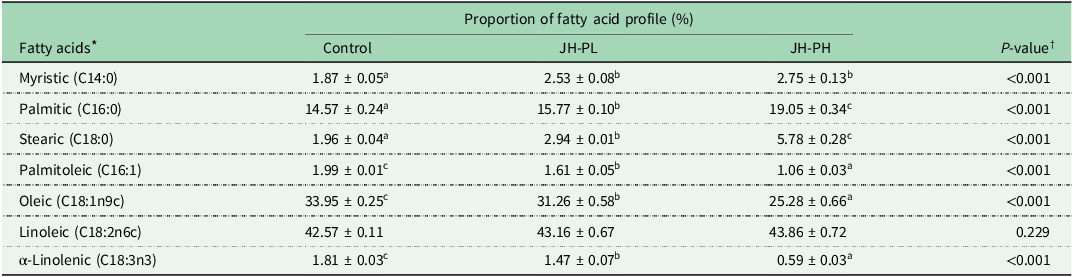
As described above, MW have higher proportions of unsaturated than saturated fatty acids, with oleic and linoleic acids being the predominant (Table 3). This composition appears to reflect the fatty acid content of their feed(Reference Kröncke, Wittke and Steinmann51). In wheat bran linoleic acid is the predominant fatty acid representing over 50% of the total fatty acids present, compared to 15% oleic acid. Treatment of MW with pyriproxyfen increased the proportions of saturated fatty acids, reduced oleic acid, but there was no effect on linoleic acid (Table 3). This might be due to a decrease in MW stearoyl-CoA desaturase (SCD) activity, which would reduce desaturation of stearic acid to oleic acid. However, it must be remembered total fat decreased in pyriproxyfen-treated MW, so the increased proportion of saturated fatty acids resulted in a decrease of the fatty acid as a proportion of MW dry matter, compared to the control.
The effect of the Juvenile hormone analogue pyriproxifen treatment for 28 days on whole mealworm fatty acid composition (Data from Hill et al. (2024)(Reference Hill, Lopez-Viso and Brameld45))

Table 3. Long description
The effects of 28 day exposure to JH-PL = 2 mg pyriproxifen/ kg wheat bran (JH-PL), 15 mg pyriproxifen/ kg wheat bran, (JH-PH,) or control, on mealwormʼ s percentage fatty acid composition are reported in the table. The percentage composition of saturated fatty acids myristic, palmitic and stearic acids) all significantly increased relative to the control as the dose of pyriproxifen increased. The unstaurated fatty acids palmitoleic, oleic, alpha-linolenic all significantly decreased relative to the control as the dose of pyriproxifen increased. There was no effect on linoleic acid.
JH-PL = 2 mg pyriproxifen/ kg wheat bran, JH-PH = 15 mg pyriproxifen/ kg wheat bran.
a,b,c For each fatty acid, means with different superscript letters are significantly different (P < 0.05, Bonferroni host-hoc test). Where there are no letters, no significant differences were noted.
* Individual FAs are expressed as mean % of the total of all fatty acids detected by GCMS ± standard error of the mean (n = 4). Fatty acids with <1% abundance are not shown.
† P-value for One-Way ANOVA of effect of treatment on fatty acid proportion.
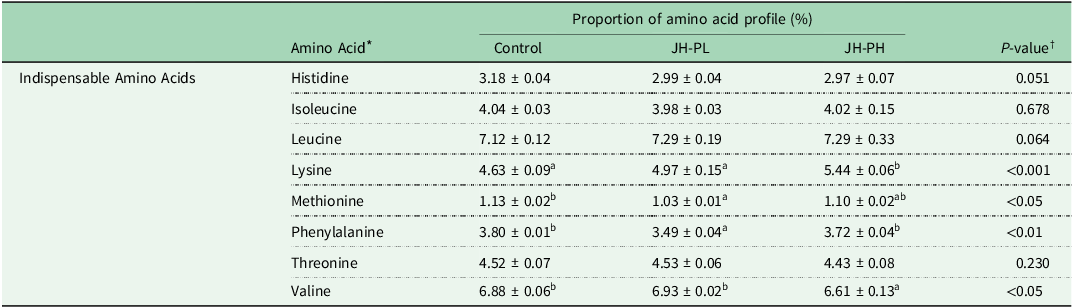
In JH analogues treated MW there was not a dramatic shift in the indispensable amino acid composition (Table 4). This suggests that although the proportion of protein in the insects increased there was little change in types of polypeptides making up the total protein composition. However, interestingly the proportion of lysine was significantly increased following JH treatment relative to the control. As the proportion crude protein increased per unit dry matter then the lysine content of MW on dry matter basis increased by 17% in JH-PH.
The effect of treatment with the Juvenile Hormone analogue, pyriproxifen, for 28 days on whole mealworm indispensable amino acid composition (Data from Hill et al. (2024)(Reference Hill, Lopez-Viso and Brameld45))

Table 4. Long description
The effects of 28 day exposure to JH-PL = 2 mg pyriproxifen/ kg wheat bran (JH-PL), 15 mg pyriproxifen/ kg wheat bran (JH-PH), or control on mealwormʼ s percentage indispenable amino acid composition are reported in the table. There was no significant change in percentage composition of histidine, isoleucine, leucine and threonine. Although there were significant changes in methionine, phenylalanine and valine this was not consisent relative to the control for the two pyriproxifen doses. Lysine had the greatest change with the JH-PH having the greatest highly significant increase relative to the control.
control = acetone control, JH-PL = 2 mg JH-PL = 2 mg pyriproxifen/ kg wheat bran, JH-PH = 15 mg pyriproxifen/ kg wheat bran.
a,b,c For each amino acid, means with different superscript letters are significantly different (P < 0.05, Bonferroni host-hoc test). Where there are no letters, no significant differences were note.
* Individual amino acids (excluding tryptophan) are expressed as mean % of the total of all amino acids detected ± standard error of the mean (n = 4), except for JH-PH (n = 3).
† P-values for One-Way ANOVA of effect of treatment on amino acid proportion.
The treatment with the JH analogue clearly demonstrates that MW have the potential to dynamically alter their body composition. There was a repartitioning effect resulting in an increase in the proportion of protein (to 70% per unit dry matter) and a decrease in fat (to 8% per unit dry matter), This dry matter composition is similar to fish meal(6). By exploration of the mechanisms by which JH analogues effect body composition potential targets for selective breeding and/or genetic manipulation to enhance nutrient composition could be identified.
Impact of manipulating feed nutrient constituents on mealworm growth (before pupation) and body composition
As MW progress toward pupation their moisture content declines and the proportion of body fat increases, whilst protein content decreases(Reference Lopez-Viso, Castellanos-Uribe and May17,Reference Yu, He and Wang37,Reference Kröncke, Neumeister and Benning38) . Like for all production insects, the specific nutrient requirements of MW are still unclear. Mealworms can digest a range of substrates, with some evidence suggesting that they even digest non-nutrient substrates such as polystyrene(Reference Yang, Hu and Li52). However, while they may survive on such diets, the evidence that they are able to grow on such substrates is very weak(Reference Yang, Brandon and Flanagan53). They will utilise and grow on various agricultural industry by- or co-product low-nutrient-density feeds such as distiller’s grains(Reference Zhang, Tang and Chen54), through to garden and vegetable waste(Reference Harsányi, Juhász and Kovács55) and cereals (barley, oats and buckwheat)(Reference Jajić, Krstović and Petrović56). Most typically they are fed wheat bran(Reference Lopez-Viso, Castellanos-Uribe and May17). The crude protein and total fat composition of MW varies depending on the type and composition of their feed, with crude protein ranging from 39 to 76% and total fat from 6 to 58% (Reference Syahrulawal, Torske and Sapkota57). The main approach to determine the appropriate nutrition for MW, like all production insects, tends to follow an empirical-based strategy, testing the response to specific whole foods/feed substrates(Reference Syahrulawal, Torske and Sapkota57–Reference Khanal, Pandey and Næss59) or composite diets made from different ingredients or by-products(Reference van Broekhoven, Oonincx and van Huis60).
There have been several studies that have sought to investigate the impact of specific macronutrients on growth and MW composition, particularly focusing on fat. For example, Kröncke et al. (Reference Kröncke, Wittke and Steinmann51) used different feed ingredients rich in specific fatty acids to determine effects on their deposition in mealworms. They found that the fatty acid composition of MW generally reflected their feed content, but diets high in fat reduced growth. These types of study are difficult to interpret as single nutrients (macro- or micro-nutrients) cannot be independently varied due to the use of feed ingredients composed of multiple nutrients. Consequently, unlike livestock production animals (pigs and poultry), the specific nutrient requirements of MW are still unclear. The challenge for insect production is establishing feeds that allow consistent efficient growth as well as development(Reference Heckmann, Andersen and Gianotten61). For MW to be established as a viable alternative ingredient for livestock feed, maximising the protein yield whilst also maximising the sustainability of their feed may be key(Reference Pexas, Doherty and Kyriazakis62). However, for human consumption, in addition to MW protein content, the amount and composition of their lipid may also be important. Therefore, we sought to determine the impact of the inclusion of distinct macro- (protein, lipid and carbohydrate) and micro-nutrients (minerals and vitamins) in a synthetic diet on MW growth and development(Reference Tamim, Salter and Parr63,Reference Tamim, Parr and Brameld64) . These studies have also given an insight into the impacts feed nutrient manipulation on MW nutrient body composition to determine whether this can be manipulated by altering feed to the same extent as the administration of exogenous JH in feed.
Not surprisingly when MW were fed only alpha-cellulose they failed to grow but they did survive(Reference Tamim, Salter and Parr63), suggesting that MW are unlikely to digest cellulose, which agrees with the report that the ability to digest cellulose is rare in insects(Reference Martin65). When protein in the form of casein (Cas) was added to the alpha-cellulose (C) to generate a synthetic feed (C+Cas) there was no effect on improving their growth over 24 days. The MW lost weight relative to wheat bran (WB) fed controls but as more protein was added to the feed pupation increased, as did the mealworm protein to fat ratio(Reference Tamim, Parr and Brameld64).
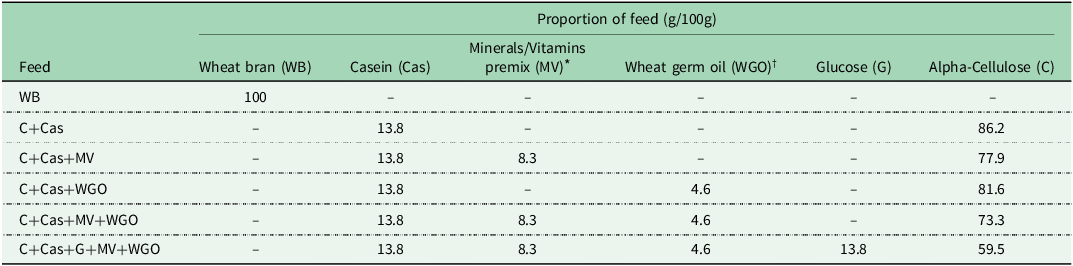
The WB protein content, fatty acid profile and mineral and vitamin composition have been determined(6,Reference Stevenson, Phillips and O’Sullivan66,Reference Onipe, Jideani and Beswa67) . Therefore, using an alpha-cellulose (C)-based feed we made a range of synthetic feeds (Table 5). The synthetic feeds contained various combinations of individual nutrients, equivalent to what is found in wheat bran(Reference Tamim, Salter and Parr63): casein (Cas) as a source of crude protein; wheat germ oil (WGO), a source of lipid containing similar proportions of fatty acids as wheat bran; glucose (G) as a readily available carbohydrate source; a premix of the minerals and vitamins (MV) equivalent to that found in wheat bran.
Composition of synthetic feeds fed to mealworms (Data from Tamim et al. (2025)(Reference Tamim, Salter and Parr63))

Table 5. Long description
Synthetic feeds consisted of various combinations of alpha-cellulose, casein, glucose, wheat germ oil and a mineral/vitamins premix, at proportions that were equivalent to the match macro or micronutrients in wheat bran. Various combinations of ingredients were in each synthetic feed so there was a successive increment in the nutrient density of each feed - WB contained only wheat bran; C+Cas contained alpha-cellulose and casein; C+Cas+MV contained alpha-cellulose, casein and the mineral/vitamins premix; C+Cas+WGO contained alpha-cellulose, casein and wheat germ oil; C+Cas+MV+WGO contained alpha-cellulose, casein, the mineral/vitamins premix and wheat germ oil; C+Cas+G+MV+WGO contained alpha-cellulose, casein, glucose, the mineral/vitamins premix and wheat germ oil.
* premix of the minerals and vitamins (MV) found in wheat bran, see reference 63 for composition.
† wheat germ oil (WGO), a source of lipid containing similar proportions of fatty acids as wheat bran, see reference 63 for composition.
The MW were fed the synthetic feeds for 24 days. The addition of MV to the C+Cas feed restored growth and pupation, though not to the same level as the control WB feed (the commonly used feed for mealworms). The additional inclusion of WGO or WGO+glucose to the C+Cas feed further increased growth, with the C+Cas+G+ MV+WGO feed achieving MW growth near equivalent to those fed WB (Figure 2). On a dry matter basis all the synthetic feeds decreased the total fat content of the MW compared to the control WB feed, to be less than 10% fat. The exception to this was the MW fed C+Cas+G+MV+WGO, which had no difference in their total fat content compared to WB (Figure 3). This suggests that the addition of carbohydrate to MW feed increased their ability to deposit fat, which could be due to de novo fatty acid synthesis. Like the total fat content in MW, fatty acid composition is also significantly affected by their diet (Reference Kröncke, Wittke and Steinmann51,Reference Dreassi, Cito and Zanfini68) . Our studies with the synthetic feeds demonstrated this too. The three synthetic diets that contained WGO resulted in the MW having significantly higher proportions of the essential PUFA (linoleic and alpha linolenic acids) compared with the diets that did not contain WGO. The mealworms reflected the fatty acid composition of WGO. However, only the MW fed the diet containing all four nutrients (i.e. C+Cas+G+MV+WGO) had a significantly higher proportion of alpha linolenic acid than any other diet – although this was <2% of the total fatty acids(Reference Tamim, Salter and Parr63). We have suggested the reason for this is that glucose is an energy substrate and when it is absent fatty acids are oxidised for energy (so not stored as fat). When glucose is present it acts as an energy source and therefore the fatty acids are stored as fat, resulting in increased storage of PUFA (i.e. linoleic and α-linolenic acids). Overall, it appears that reducing the nutritional quality causes MW to reduce fat deposition and thereby increasing the proportion of protein per unit dry matter. Not surprisingly for all the synthetic feeds that did not contain both WGO+MV the protein content was significantly higher than WB fed mealworms, due to decreased fat content of the MW.
Effect of 24 days feeding mealworms on cellulose supplemented with protein, glucose, wheat germ oil and/or a mixture of minerals and vitamins on growth characteristics. Mealworms were fed on wheat bran (WB), cellulose (C) or cellulose supplemented with glucose (13.8% w/w) (G), casein (13.8% w/w) (Cas), wheat germ oil (4.6% w/w) (WGO) and/or a premix (8.3% w/w) of minerals and vitamins (MV). A) average individual MW weight. There was a significant treatment x time interaction (P < 0.001). B) The average cumulative number of MW pupating. There was a significant treatment x time interaction (P < 0.001). C) Average cumulative number of dead mealworms. There was a significant treatment x time interaction (P = 0.044). D) Average total mealworm live weight (excluding pupated). There was a significant treatment x time interaction (P < 0.001). Data are presented as means ± standard error of the mean. Data from Tamim et al. (2025)(Reference Tamim, Salter and Parr63).

Figure 2. Long description
Part A of multiple part figure 2 - line graph showing the change in average individual mealworm weight over a 24 day treatment period with different synthetic feeds. There are 6 different synthetic feed treament groups - WB contained only wheat bran; C+Cas contained alpha-cellulose and casein; C+Cas+MV contained alpha-cellulose, casein and the mineral/vitamins premix; C+Cas+WGO contained alpha-cellulose, casein and wheat germ oil; C+Cas+MV+WGO contained alpha-cellulose, casein, the mineral/vitamins premix and wheat germ oil; C+Cas+G+MV+WGO contained alpha-cellulose, casein, glucose, the mineral/vitamins premix and wheat germ oil. There is a significant interaction between time and treatment with WB group showing the greatest weight gain and the C+Cas and C+Cas+WGO the lowest, with no weight gain from day 10 to 24. The other three treatment groups are clustered between these two extremes, with C+Cas+G+MV+WGO having the highest weight gain whilst C+Cas+MV the lowest. Part B of multiple part figure 2 - line graph showing the cumulative numbers of pupated mealworms over a 24 day treatment period with different synthetic feeds. There are 6 different synthetic feed treament groups - WB contained only wheat bran; C+Cas contained alpha-cellulose and casein; C+Cas+MV contained alpha-cellulose, casein and the mineral/vitamins premix; C+Cas+WGO contained alpha-cellulose, casein and wheat germ oil; C+Cas+MV+WGO contained alpha-cellulose, casein, the mineral/vitamins premix and wheat germ oil; C+Cas+G+MV+WGO contained alpha-cellulose, casein, glucose, the mineral/vitamins premix and wheat germ oil. There is a significant interaction between time and treatment with WB group showing the greatest pupation and the C+Cas and C+Cas+WGO the lowest, with few pupating. The other three treatment groups are clustered between these two extremes, with C+Cas+G+MV+WGO having the lowest pupation whilst C+Cas+MV+WGO the highest. Part C of multiple part figure 2 - line graph showing the cumulative numbers of dead mealworms over a 24 day treatment period with different synthetic feeds. There are 6 different synthetic feed treament groups - WB contained only wheat bran; C+Cas contained alpha-cellulose and casein; C+Cas+MV contained alpha-cellulose, casein and the mineral/vitamins premix; C+Cas+WGO contained alpha-cellulose, casein and wheat germ oil; C+Cas+MV+WGO contained alpha-cellulose, casein, the mineral/vitamins premix and wheat germ oil; C+Cas+G+MV+WGO contained alpha-cellulose, casein, glucose, the mineral/vitamins premix and wheat germ oil. There is a significant interaction between time and treatment with the C+Cas+WGO group showing the greatest number of deaths and the WB and C+Cas+MV+WGO the lowest. The other three treatment groups are clustered between these two extremes. Part D of multiple part figure 2 - line graph showing the total container live weight of mealworms (excluding pupated) over a 24 day treatment period with different synthetic feeds. There are 6 different synthetic feed treament groups - WB contained only wheat bran; C+Cas contained alpha-cellulose and casein; C+Cas+MV contained alpha-cellulose, casein and the mineral/vitamins premix; C+Cas+WGO contained alpha-cellulose, casein and wheat germ oil; C+Cas+MV+WGO contained alpha-cellulose, casein, the mineral/vitamins premix and wheat germ oil; C+Cas+G+MV+WGO contained alpha-cellulose, casein, glucose, the mineral/vitamins premix and wheat germ oil. There is a significant interaction between time and treatment with the C+Cas+G+MV+WGO group showing the greatest total container weight and the WB the lowest, with their weight declining from day 17 to 24 . The other four treatment groups between these two extremes.
Effect of 24 days feeding mealworms on cellulose supplemented with protein, glucose, wheat germ oil and/or a mixture of minerals and vitamins on nutrient composition. Mealworms were fed on wheat bran (WB), cellulose (C) or cellulose supplemented with glucose (13.8% w/w) (G), casein (13.8% w/w) (Cas), wheat germ oil (4.6% w/w) (WGO) and/or a premix (8.3% w/w) of minerals and vitamins (MV). The constituents of the feeds are indicated. A) Crude protein and total fat content (g/100g DM) (P < 0.001) after 24 days on the different feeds. B) The number of live mealworms per container (excluding pupated mealworms) at 24 days on the different feeds. The total container weight of crude protein and fat at 24 days on the different feeds (P < 0.001). Data are presented as means ± standard error of the mean. a,b,cDifferent letters indicate significant differences (P < 0.05, Bonferroni host-hoc test) within the same nutrient. Data from Tamim et al. (2025)(Reference Tamim, Salter and Parr63).

Figure 3. Long description
Part A of multiple part figure 3 - bar chart showing the crude protein and total fat content per unit dry matter of mealworms after 24 day treatment period with different synthetic feeds. There are 6 different synthetic feed treament groups - WB contained only wheat bran; C+Cas contained alpha-cellulose and casein; C+Cas+MV contained alpha-cellulose, casein and the mineral/vitamins premix; C+Cas+WGO contained alpha-cellulose, casein and wheat germ oil; C+Cas+MV+WGO contained alpha-cellulose, casein, the mineral/vitamins premix and wheat germ oil; C+Cas+G+MV+WGO contained alpha-cellulose, casein, glucose, the mineral/vitamins premix and wheat germ oil. The crude protein of WB, C+Cas+MV+WGO and C+Cas+G+MV+WGO was significantly lower than the other treatments. The fat content of C+CAS, C+Cas+MV, C+Cas+WGO and was C+Cas+MV+WGO had significantly lower than the other 2 treatments. Overall the C+Cas treatment had the highest protein and lowest fat than other treatments. Part B of multiple part figure 3 - combined bar and line chart showing total live mealworms (line) and their total crude protein and total fat weight per container after 24 day treatment period with different synthetic feeds. There are 6 different synthetic feed treament groups - WB contained only wheat bran; C+Cas contained alpha-cellulose and casein; C+Cas+MV contained alpha-cellulose, casein and the mineral/vitamins premix; C+Cas+WGO contained alpha-cellulose, casein and wheat germ oil; C+Cas+MV+WGO contained alpha-cellulose, casein, the mineral/vitamins premix and wheat germ oil; C+Cas+G+MV+WGO contained alpha-cellulose, casein, glucose, the mineral/vitamins premix and wheat germ oil. Comapred to WB only the C+Cas+MV+WGO treatment group had significanly high crude protein and lower fat on a total weight per container basis
It is important to consider the potential practical considerations of the combinations of the nutrients in the synthetic feeds. In JH fed MW grew a little more than the WB fed controls(Reference Hill, Lopez-Viso and Brameld45), but importantly the pupation rate was also reduced (Figure 1), which results in more live MW per container (there were a fixed number of MW per container at the start of treatment) and therefore the container yields were increased. Likewise for the various synthetic feeds there were significant differences in pupation rates (Figure 2). The MW on feeds that did not contain MV (i.e. C+Cas and C+Cas+WGO) showed little pupation but unfortunately also had very low growth. The other synthetic feeds had pupation rates that were between either the feeds where MV was absent or WB. Due to these effects, the highest yield of protein (per container) was seen in the C+Cas+MV+WGO-fed MW, which was 50% higher than in the WB group (largely due to the decreased pupation rate) (Figure 3). Furthermore, the lipid yield was 50% lower than in WB-fed MW. By contrast, the addition of glucose to this diet maintained a high protein yield but increased the lipid yield to similar levels as seen in WB-fed MW (Figure 3).
The results indicate that sources of protein, lipid, minerals and multivitamins are all required to maximise protein whilst decreasing lipid deposition in MW. However, the addition of glucose (and presumably other digestible carbohydrates) increased lipid deposition. Manipulation of feed nutrient content can alter growth and pupation characteristics but also mealworm nutrient composition.
Conclusion
The treatment of mealworms with JH analogue causes the expected inhibition of pupation and this is associated with the repartitioning effect of increasing the protein:fat ratio. This results in a MW composition that is like fish meal(6) and clearly indicates that MW nutrient composition can be manipulated. The restrictions on food contamination and the prohibition of use of pharmaceutical growth promoters in food production livestock would likely prevent the use of JH analogues in insect food production systems. However, our experiments with synthetic feeds which allow us to independently manipulate individual nutrients, indicate that sources of protein, lipid, minerals and multivitamins are all required to maximise protein whilst decreasing lipid deposition in MW. However, the addition of glucose (and presumably other digestible carbohydrates) increased lipid deposition. It appears, exposure of MW to diets that result in a reduction in body fat, also reduced pupation rates. The use of feed substrates with varying nutrient content, could potentially be used to differentially alter protein:fat ratios in MW, inhibit pupation and increase the total yield of protein, thereby potentially achieving similar outcomes as observed for JH analogues or other exogenous ‘growth promoter’ type agents. However, further exploration of the mechanisms by which JH analogues and dietary manipulation effects body composition could identify potential targets for selective breeding and/or genetic manipulation to enhance nutrient composition and growth efficiency.
Acknowledgements
We acknowledge and thank the excellent technical support of Mrs Louise Williams in carrying out the mealworm proximate nutrient analysis.
Financial support
This research was also supported by the Food Systems Institute at the University of Nottingham (UK); Kingdom of Saudi Arabia (BT, PhD studentship); the Biotechnology and Biological Sciences Research Council Doctoral Training Programme PhD studentship (VH, grant number BB/M008770/1).
Author contributions
TP, JB and AS contributed to the conceptualisation and structure of the review. TP, BS, VH, JB and AS drafted the initial manuscript. TP, VH and BS created the figures and tables. TP supervised the review. All authors contributed to writing the review. TP edited and wrote the final manuscript.
Competing interests
There are none to declare for all the authors.