





India’s Supreme Court has very recently upheld that the rights of persons with disability (PwD) to access environment, services, and opportunities is an essential human and fundamental right which is yet to be realized, and directed the Government of India to enable the creation of public and private spaces, services and products of an “universal design” which could be accessed by everyone, regardless of their ability, age, or status.Footnote 1 The term “universal accessibility” refers to the free and equal access that everyone should have to all spaces, locations and services ranging from communication and information technologies to accessibility to buildings and transportation.Footnote 2 This forms a landmark judgement for universal accessibility in India and recognizes it as a basic human and fundamental right for everyone. Though the judgement is rooted in a constitutional framework, it also gestures towards the broader idea of disability justice, aligning with the RPWD Act. This also calls to reimagine public spaces and institutions through the lived experiences of PwDs rather than through compliance alone. It marks a shift from viewing accessibility as a technical goal to understanding it as a collective ethical responsibility. In this context, there is crucial evidence that PwDs continue to face disproportionate challenges due to environmental, societal, personal, and health factors. PwDs continue to experience several hardships and challenges despite international and national initiatives to improve accessibility, and this also results in lower participation rates in socioeconomic activities as compared to their non-disabled peers.
In the current context, a structural failure that the disability justice framework makes visible and that the Supreme Court’s November 2024 judgement now creates a legal opportunity to correct. The landmark judgement highlights the need for universal accessibility and the assurance of fundamental rights. The seed of this judgement roots in a writ petition in 2005, which documents the plausible directions that ensure a comprehensive understanding of the access to public places for PwDs. The petition is raised by Rajive Raturi (an individual with visual challenges) to seek measures towards ensuring safety and accessibility in public spaces. After a decade in 2017, the court passed another judgement through Justice AK Sikri on abiding by 11 action points, falling under RPWD Act (2021) and Accessible India Campaign, to ensure universal accessibility by states and union territories (UTs). To accelerate progress, a dedicated department—the Centre for Disability Studies at the National Academy of Legal Studies and Research (NALSAR) University—was established to assess the contemporary status of accessibility standards on the ground and make recommendations to ensure compliance.Footnote 3 The situational assessment portrays a poor status on the discussed objectives, as many states and UTs are unable to provide adequate information and requisite compliances within the scheduled time period. Advocates for PwDs, activists, academicians, and researchers view this ruling as the recognition of fundamental rights for every individual, going beyond the reliance on physical infrastructure requirements and facilitating quick policy amendments. However, disability justice frameworks remind us that accessibility must go beyond infrastructural compliance. It requires dismantling social hierarchies and building interdependent communities where access is not granted as charity or accommodation, but it is co-created through solidarity among disabled and non-disabled people alike.Footnote 4
Achieving universal accessibility recognizes the idea of disability inclusion, which goes beyond motivating people to focus on adequate policies and practices to be put forward that are aimed at increasing the participation of PwDs in socially expected life roles and activities.Footnote 5 Disability justice further urges that these efforts must account for how disability intersects with other social roles such as caste, gender, class and rural–urban divides, which indicates that experiences of exclusion are uneven. The pejorative cultural attitudes towards disability are used to separate people with disabilities through classification systems covering education, housing, transportation, and healthcare—all key domains of access and justice.Footnote 6 Justice thus requires structural modification of these intersecting inequities.
Currently, about one billion people, or 15 percent of the global population, are disabled, and around 110–190 million individuals live with major impairments.Footnote 7 In India, the count of PwDs in the total population is 26 million (i.e., around 2.1% of the total population) according to the last available Census (2011) (Office of the Registrar General and Census Commissioner, India (ORGI). 2011). PwDs are known to typically face disproportionate challenges compared to their non-disabled counterparts due to the complex and varying interplay of environmental, personal, and health factors.Footnote 8 Accessibility is one of the contributing factors that increase the likelihood of deprivation in a range of socio-economic dimensions, such as lower levels of education, poor health outcomes, lower employment rates, and higher rates of poverty.Footnote 9 In comparison to persons without disabilities, the societal participation and labour participation rate of PwDs is largely compromised.Footnote 10 PwDs are deprived of equal participation owing to various obstacles that hinder basic rights, including healthcare, employment, education, and transportation.Footnote 11 The framing of disability inclusion in the workplace has been constructed through multiple frameworks and models over the years. The frameworks, such as biomedical, karma, charity, social, rights-based, and economic frames, coexist; however, there has been a migration from karma- and charity-based frames to rights-based frames currently.Footnote 12 Although the Constitution of India upholds the principles of equality, freedom, and fraternity, and prohibits any discrimination based on caste, class, religion, or sex, PwDs continue to face significant challenges in achieving these ideals and in demonstrating full participation. This paper argues that India’s persistent accessibility gap stems not only from resource inadequacy or weak enforcement, but from the systematic exclusion of organizations of persons with disabilities (OPDs) (organizations led by and accountable to PwDs) from policy design, implementation, and monitoring.
1. Data and methodologies
The study aims to explore and comprehensively assess the status of accessibility of PwDs in the background of human rights and justice in India; therefore, this follows a desk review approach to satisfy the objective. An extensive literature review, news articles/judgement draft reviews, and an archival study have been adopted, along with analysing a secondary data set on PwDs. The 76th round (2018–2019) of the National Sample Survey on PwDs provides information on the accessibility of the built architecture in India. This survey specifically interrogates two questions, firstly, whether access to public transport, and secondly, whether access to public buildings, which portrays the current accessibility situations. A descriptive analysis has been conducted in STATA-16 software. All information and data findings are compiled in MS Office to critically evaluate the policy perspectives and bring out the insights. This study limits the scope to incorporate the lived experience of PwDs on issues of accessibility due to the defined scope and time constraints. The results of the study shed light on the following domains, such as universal designs, evaluation of universal rights globally and in India, initiative to provide an enabling environment, budgetary estimates, recent development post the Incheon Strategy (Figure 3), non-governmental effort for disability rights, built environment and statistics related to it, impact of limited accessibility, disability and associated with transport poverty, and alternatives adopted by different countries.
2. Universal design
The concept of accessibility is closely associated with the universal design idea, which was first coined and propagated by architect Ronald L. Mace. It propagates design that is aesthetic and usable for all people.Footnote 13 The design industry had been under increasing pressure to provide environments, services, and goods that were both usable and accessible over time. The notion of barrier-free designs was developed by the design industry to eliminate barriers for PwDs within built environments. In India, the need for accessible environmental and architectural designs is gaining momentum; however, it is still developing. Several Indian government entities have recently modified or created new rules that incorporate the principles of universal design. The most recent release from the Government of India, titled “Harmonized Guidelines and Space Standards for Barrier-Free Environment for Persons with Disability and Elderly Persons,” serves as an example where the Universal Design principle has been integrated into the design of building materials.Footnote 14 Yet, while universal design promises inclusivity, its translation in India often remains bureaucratic. Focuses on physical infrastructure rather than on lived accessibility. The design must also address attitudinal, sensory, and cognitive barriers to meet the principles of disability justice. The guidelines are in line with Sustainable Development Goal (SDG) 11, that is, making cities and human settlements inclusive, safe, resilient, and sustainable. To ensure that cities are accessible to women, children, PwDs, and other vulnerable populations in the city, it is expected that the master plans will embrace a rights-based and human-centred urbanism. The guidelines noticeably neglect psychosocial disability, particularly when it comes to addressing requirements for accessibility in metropolitan areas. The guidelines currently provide little to no consideration for the needs of people with psychosocial disabilities in relation to accessibility to urban infrastructure and planning, even though the RPWDA lists mental illness as a type of disability.Footnote 15 This highlights how policy frameworks continue to privilege visible and physical forms of disability, ignoring the lived realities of those with invisible or psychosocial conditions. The universal design should have an inclusive urban planning that redefines participation, belonging, and care in public spaces, not merely a physical entry.
3. Evolution of disability rights globally and in India
Through a persistent campaign that raised awareness and highlighted the demands of PwDs for fundamental human rights reforms, the attitude towards and the treatment of PwDs have changed dramatically since the turn of the 20th century.Footnote 16 The disability rights movement has a long history, much like other civil rights movements. The Declaration of the Rights of Disabled Persons in 1975 and the Declaration of 1981 as the International Year for Disabled Persons integrated the concepts of equal rights, opportunity, and full social participation. This includes the 13 proclamations that broadly advance the rights of PwDs.Footnote 17 In subsequent years, the World Programme of Action Concerning PwDs was brought into place along with the declaration of the Decade of Disabled Persons. In 1989, the Tallinn Guideline on Action of Human Resources Development in the field of disability in General Assembly Resolution emphasizes a rights-based and community-centred approach, stressing that PwDs should be active participants in decisions affecting their lives rather than passive recipients of charity or care.Footnote 18
Before this, the World Programme of Action Concerning Disabled Persons was approved by the UN General Assembly in 1982, marking the beginning of a series of important international changes in disability rights. The Decade of Disabled Persons (1983–1992) ended, and in 1993, the UN created the Standard Rules on the Equalization of Opportunities for Persons with Disabilities (UNSR) to further promote equal rights and opportunities for PwDs globally.Footnote 19 In 1990, the Americans with Disabilities Act (ADA) was signed into law, forbidding discrimination against PwDs across a broad range of public settings—including employment, educational institutions, public transit, and many other public and private locations. This ensures that PwDs have equal access to State and municipal government services, telecommunications, public accommodations, jobs, and transportation.Footnote 20 To understand the demand for addressing these rights, one way to approach the issue is to focus our attention on a region that has a higher concentration of PwDs.
The Asia-Pacific region stands out for a significant proportion of (more than 60%) of all PwDs (600 million), and this region was therefore the first to announce and observe the Asian and Pacific Decade of Disabled Persons (1993–2002). Next to that, the inception of the UNESCAP pilot project in 1992 on a barrier-free environment proclaimed by ESCAP Resolution 48/3, developed an agenda for action on first formally placed accessibility on the regional policy agenda. Following this, the Biwako Millennium Framework (2003–2012) served as the framework for the Second Decade and deepened commitments to inclusive built environments and accessible transport. Hence, the Incheon Strategy built on these by setting 10 measurable goals, including five direct measurable goals on accessibility benchmarked against the UNCRPD and the 2030 Sustainable Development Agenda. The 2019 ESCAP review document (Incheon Strategy Strengthening the 2030 Agenda) subsequently evaluated progress on these goals.
It is quite evident that the ADA and the movement it generated have pushed global leaders to adopt the norms of UNCRPD (Article 4.3 & Article 33) (United Nations, Human Rights Office of the High Commissioner 2006). As of December 2021, the convention has been ratified by 184 parties. The governments of these nations at the High-level Intergovernmental Meetings adopted the Ministerial Declaration on the Asian and Pacific Decade of Persons with Disabilities, 2013–2022, and the Incheon Strategy to “Make the Right Real” for PwDs in Asia and the Pacific. The Incheon Strategy builds on sets of conventions such as the Convention on the Rights of Persons with Disabilities (RPwD), the Biwako Millennium Framework for Action and Biwako Plus Five towards an Inclusive, Barrier-free and Rights-based Society for Persons with Disabilities in Asia and the Pacific.
Table 1 provides a historic roadmap of the global conventions and declarations in chronological order.
Timeline of disability rights globally

Table 1 Long description
The table consists of two columns: the year or period on the left and the corresponding milestone on the right.
* 1975: Declaration of the Rights of Disabled Persons.
* 1981: International Year for Disabled Persons.
* 1983 to 1992: Declaration of the Decade of Disabled Persons.
* 1990: The Americans with Disabilities Act A D A was signed into law.
* 2002: Biwako Millennium Framework for Action towards an Inclusive, Barrier-free and Rights-based Society in Asia and the Pacific.
* 2006: Adoption of the U N Convention on the Rights of Persons with Disabilities C R P D.
* 2007: Biwako Plus Five.
* 2012: Ministerial Declaration on the Asian and Pacific Decade of Persons with Disabilities, 2013 to 2022, and the Incheon Strategy to Make the Right Real for Persons with Disabilities in Asia and the Pacific.
* 2017: Governments in the region adopted the Beijing Declaration, including the Action Plan to Accelerate the Implementation of the Incheon Strategy.
* 2019: U N Disability Inclusion Strategy U N D I S.
* 2022: The Jakarta Declaration reaffirms the continued importance and relevance of the Incheon Strategy to Make the Right Real for Persons with Disabilities in Asia and the Pacific.
Source: Disability Events | Division for Inclusive Social Development (DISD) 2024.
Meanwhile, in India, the National Council of Handicapped Welfare was established to formulate policy guidelines and regulate the activities of both public and voluntary organizations that were working for PwDs (Table 2). Prior to independence, disability in India was scarcely prioritized in the administrative affairs of the nation, and rehabilitative services were provided only through a handful of charitable organizations that could cater to very few. During the colonial era, British legislation focused mainly on segregation, custodial care, and institutionalization without any framework to integrate PwDs in education, employment, and society.Footnote 21 Following independence, Subsequently, the Government of India took several steps to address the concerns of PwDs. Constitution of 1950 treated disability through a welfare lens, with Article 41 being the only reference, conditioning state obligation on “the limits of its economic capacity.”Footnote 22 Another of it highlighted as enumerating PwDs and collected demographic and socio-economic details in the Census conducted in 1981. However, the identification of PwDs has always remained controversial due to different measurements and scales being employed over and over again.Footnote 23
Timeline showing the evolution of disability rights in India

Table 2 Long description
The timeline consists of twelve chronological entries moving from top to bottom.
* 1986: The Rehabilitation Council of India was set up by the Government of India to regulate and standardize training policies and programmes for the rehabilitation of persons with disabilities.
* 1995: Persons with Disabilities (Equal Opportunity, Protection of Rights and Full Participation) Act.
* 1999: National Trust Act.
* 2006: National Policy for Persons with Disabilities.
* 2007: India ratified the U N C R P D.
* 2015, December: Accessible India Campaign (Sugamya Bharath Abhiyan) launched by D E P w D.
* 2016: Rights of Persons with Disabilities Act.
* 2019: Guidelines for Indian Government Websites.
* 2020: Harmonized guidelines for standards of accessibility and provisions of facilities for Persons with Disabilities (Divyangjan) in Indian Railways issued by the Ministry of Railways.
* 2021: Harmonized Guidelines and Standardized for Universal Accessibility in India.
* 2022: Two entries. First, Accessibility Guidelines and Standards for Higher Education Institutions and Universities. Second, Accessibility Standards and Guidelines for Civil Aviation.
* 2024: Supreme Court Judgement stating accessibility for disabled persons is a human and a fundamental right.
Source: Poornamidam (2023) “Chronological Timeline of Disability and Accessibility-Related Laws and Policies,” Medium.
While the struggle to fulfil the demands for the rights of PwDs began in the early 1970s, it was during the 1980s that the demands from various organizations were consolidated under a cross-disability umbrella to advance the interests of the disabled fraternity.Footnote 24 It starts from the case of Umed Ram Sharma v State of Himachal Pradesh, where the right to accessibility came into the picture with a demand for the right to life. After a few years, demands for the implementation of PwD Acts on non-discrimination in transport or roads in the State of West Bengal remained unfulfilled, resulting instead in the reservation of only a few seats in buses. Later, the Supreme Court case Rajive Raturi v Union of India addressed safe accessibility of pavements, roads, transport, and public places for persons with visual disabilities, reaffirming their rights to dignity and equality. The judgement is frequently cited in matters of reasonable accommodation and inclusive design and calls for more effective implementation of the Accessible India Campaign (Sugamya Bharat Abhiyan).Footnote 25 Some more instances surfaced on this issue have accelerated the demand for better accessibility across India. In 2001, with the arrival of Stephen Hawking in India, the spark of inaccessibility in several public/ monumental places ignited again, resulting in additional enforcement towards highlighting the accessibility in India. However, this remains largely unfulfilled even though India has been a signatory to several international resolutions and schedules that support the inclusion and rights of PwDs, and thus, it results in a protracted gap in meeting many of the goals mentioned in these schedules.
The mode of identification of PwDs using different disability models has also changed over time. In the Persons with Disabilities Act (1995), identification was based on the medical model of disability. However, this is the first India’s first comprehensive disability legislation and contains provisions on accessibility in transport, roads, and the built environment. This act is centralized upon more welfare-oriented rather than rights-based approach. Judicial interventions were required repeatedly because the PwD Act (1995) accessibility provisions are not self-executing. The Rajive Raturi v Union of India case (WP No. 228/2006) was itself a product of this failure. This PIL was filed because the state had not delivered on the Act’s accessibility commitments. A court had to compel these outcomes is itself evidence that OPDs had not been meaningfully integrated into the original standards-setting process; if they had, the gap between the law’s promise and reality would not have been so wide.Footnote 26 Later, the social model was adopted in the revised form of the Act, which was known as the Rights of Persons with Disabilities Act (RPwD Act) of 2016. There has, however, been progress in incorporating broader forms of disability and promoting inclusiveness across different aspects, explaining a shift from a welfarist to a rights-based approach.
The RPwD Act, enacted in 2016, is a benchmark development in that it guarantees equal, effective, and sustainable enjoyment of rights and opportunities for PwDs in India. This is accompanied by coherent legislation that aligns with the United Nations Convention on the Rights of Persons with Disabilities (UNCRPD), to which India is a signatory. Article 4(3) of the CRPD explicitly requires that States “closely consult with and actively involve PwDs, including children with disabilities, through their representative organizations” in developing and implementing legislation and policy.Footnote 27
Significantly, the RPwD Act (2016) expands the definition of disability and has identified 21 diverse types of disability as compared to the initial seven covered by the PwDs (equal opportunities, protection of rights and full participation) Act, 1995. There, it is more inclusive and broader in its definition. The Act provides individuals with disabilities the right to equality and right against discrimination, along with the right to access and participate in all aspects of community living. It also lays down the legal requirements to be provided by the State and calls on all governments and organizations to make the necessary and reasonable accommodations so that PwDs should be able to have an equal chance in educational institutions, workplaces, public premises, transport services, and other services. The RPwD Act guarantees inclusive education and mandates that every educational institution, both private and public, set apart 5 percent of the seats for PwDs. There are also mandates on safeguards that ensure that schools, colleges, and other institutions provide basic amenities as well as the infrastructure required for the execution of inclusive education. For employment, the Act mandates that every employer should accommodate PwDs, alter facilities and practices with regard to PwDs, and develop policies to recruit and retain employees with disabilities.Footnote 28 The public sector job reservations have seen an increase from 3 percent in 1977 to 4 percent under the RPwD Act.Footnote 29
The Act also envisages social security measures such as the disability pension, insurance, and assistance to the disabled in situations of distress. The Act further directs provisioning health care in such a way that all healthcare facilities and services are available and integrated. The RPwD Act focuses on physical accessibility as one of the major requirements, with the mentioned specifications governing the architecture of public buildings, transportation systems, and information and communication services, which should be provided according to the needs of PwDs, and these include government websites and other digital content. Part 5 of the Act has guidelines on recognizing the legal capacity of PwDs and supported decision-making. It permits the authorities to grant limited powers of attorney where a PwD may need support; however, their rights shall not be infringed.Footnote 30
To meet the legitimate and long-pending demands of PwDs, the Department of Empowerment of Persons with Disabilities (DEPwD) initiated the Accessible India Campaign (AIC) on December 3rd, 2015, a flagship programme aimed at enhancing accessibility across key domains including the built environment, transportation, information and communication technology (ICT), and public services. By setting ambitious targets and timelines, the Accessible India Campaign aligned closely with the goals of the Incheon Strategy (Figure 3).Footnote 31 A target was set to achieve disability inclusivity in infrastructure by June 2022, which was then extended to March 2024 due to the complexities that persisted in realizing adequate infrastructure development and the need for a more consistent effort to achieve those targets. Nonetheless, it is essential to fathom the progress of development in terms of inclusive adaptations in infrastructure and how closely that would align with the goals. It becomes important to study the pace of progress from a wider perspective to assess the situation and draw attention to the elements that contribute to the modifications in the inclusive built environment and transportation, for example.
In continuation of the Act, a detailed description of inclusive infrastructure inside or outside of a building has been thoroughly developed by the Ministry of Housing and Urban Affairs in the Harmonized Guidelines and Standards for Universal Accessibility in India in 2021. This guideline has been structured following the seven principles of Universal Design (1997) and eight goals mentioned in the definition of the principles of Universal Design (at the Center of Inclusive Design at the University of Buffalo) (2012). While integrating this, the adaptation of the Universal Design India Principle followed five unique principles (equitable, usable, cultural, economic, and aesthetic) to adapt the designs in the Indian context.Footnote 32 The Accessible India Campaign (Sugamya Bharat Abhiyan), launched on December 3, 2015, is the most prominent accessibility initiative in India’s recent history. The Campaign set targets across the built environment, transportation, and ICT domains, aligned with the Incheon Strategy. Targets for disability-inclusive infrastructure were originally set for June 2022, then extended to March 2024 “due to the complexities that persisted in realizing adequate infrastructure development. Accessibility in public infrastructure: due to no constitutional mandate, implementation is patchy, with minimal accountability; PwDs face daily mobility challenges, restricting access to work, education, leisure, and public services.” If OPDs had been meaningfully consulted during the Campaign’s development, one would expect the resulting standards to reflect disabled people’s lived priorities; instead, the evidence points to standards that look adequate on paper but fail in implementation, precisely the pattern that emerges when policy is designed without the experiential knowledge that OPDs possess. The constitutional silence is not a technical gap but rather reflects and reproduces the marginalization of OPDs from the very processes that shape their lives.
4. Evolution of disability rights and the Accessible India Campaign
4.1. Political will and representation: a paradigm shift
India’s political views regarding disability rights have witnessed major developments, yet systemic challenges persist. The recent legislative amendments in Tamil Nadu, permitting the nomination of PwDs to local governance bodies, signify a progressive step towards inclusive political representation. By planning to nominate over 14,000 PwDs across various local institutions, the state demonstrates a commitment to integrating disability rights into governance structures.Footnote 33 This initiative not only empowers PwDs but also enriches decision-making processes with diverse perspectives. However, the broader political climate still necessitates comprehensive policies to ensure consistent representation and participation of PwDs at all levels of government.Footnote 34 The Odisha Disabled Government Employees’ Welfare Association’s plea for the implementation of a 4 percent reservation in promotions for employees with benchmark disabilities highlights ongoing challenges in policy execution. Despite a directive from the Orissa High Court in January 2024, the policy remains unimplemented, reflecting systemic inertia.Footnote 35 Such instances necessitate judicial interventions to enforce existing laws and emphasize the importance of robust mechanisms to translate policy into practice effectively.
While legal frameworks like the RPwD Act, 2016, provide a foundation for disability rights, there is a pressing need for a cultural shift to ensure genuine inclusion. As highlighted in recent discussions, treating PwDs as first-class citizens requires moving beyond token compliance to fostering an environment of respect and equal opportunity.Footnote 36 This involves not only policy enforcement but also societal change to dismantle deep-seated prejudices and promote inclusivity in all spheres of life.
5. Initiatives to provide an enabling environment for PwDs in India
Ever since 2014, the Government of India’s efforts to address concerns regarding accessibility for PwDs have been demonstrated through increased provisions for accessible facilities and services in public areas. This was strengthened by the creation of two programmes—the Barrier Free Environment and the Accessible India Campaign, introduced as parts of the larger Scheme for Implementation of Rights of Persons with Disabilities (SIPDA). The UNCRPD served as the model for the Accessible India Campaign, and the campaign’s action plan and goals were aligned with Goal 3 of the Incheon Strategy, which aims to “Make the Right Real.” To create a universal environment free of barriers, the campaign aims to provide accessibility elements in the three verticals—the built environment, the transportation sector, and the ICT ecosystem.Footnote 37
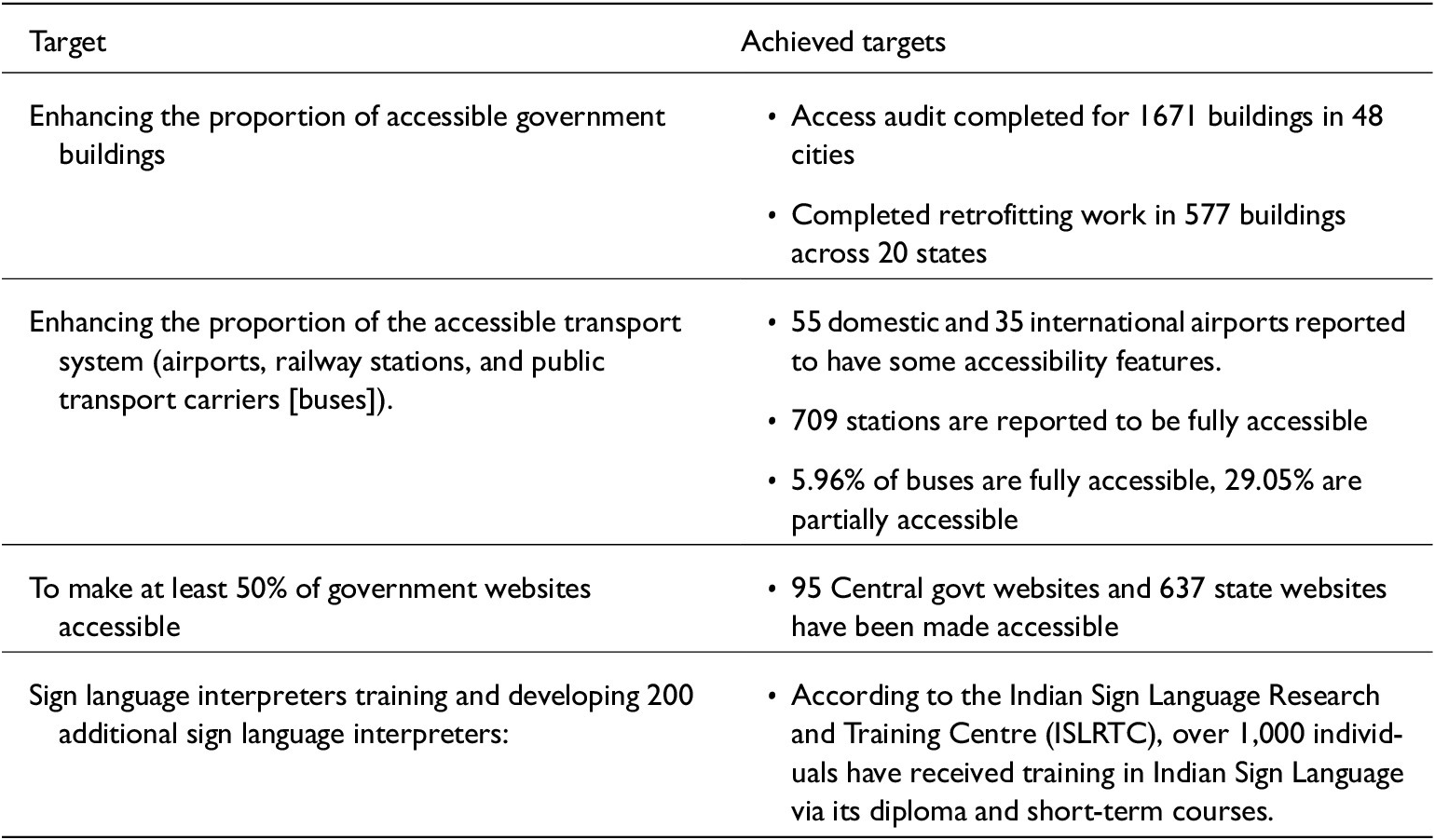
However, due to rather slow progress, the campaign missed the deadlines in several aspects. Against the target of converting 50 percent of State and Central government websites to be disabled-friendly, only 36 percent of State government websites were converted to be accessible to PwDs. To facilitate access to transport facilities, the Government had targeted to convert 10 percent of the public transport carriers to be disabled-friendly. However, by 2019, only 3.6 percent of the buses could be completely modified to facilitate wheelchair access. According to DEPwD, only 55 of the 104 airports in the country are disabled-friendly.Footnote 38 The deadline date for this campaign was set for March 2024, after which AIC would be merged with the Barrier Free Environment component under SIPDA (Table 3).
Achieved targets of AIC till 2021–2022

Table 3 Long description
The table consists of two columns titled Target and Achieved targets.
* Row 1: Target is enhancing the proportion of accessible government buildings. Achieved targets include access audits completed for 1671 buildings in 48 cities and completed retrofitting work in 577 buildings across 20 states.
* Row 2: Target is enhancing the proportion of the accessible transport system including airports, railway stations, and public transport carriers. Achieved targets include 55 domestic and 35 international airports with accessibility features, 709 stations reported as fully accessible, and bus accessibility at 5.96 percent fully accessible and 29.05 percent partially accessible.
* Row 3: Target is to make at least 50 percent of government websites accessible. Achieved targets include 95 Central government websites and 637 state websites made accessible.
* Row 4: Target is sign language interpreters training and developing 200 additional sign language interpreters. Achieved targets include over 1,000 individuals trained in Indian Sign Language via I S L R T C diploma and short-term courses.
Data Source: Survey on Accessible India Campaign, GOI.
Following the campaign’s initial accessibility audit phase, which was conducted in 31 cities, several significant changes have been observed. This study also highlights the absence of accessible restrooms for PwDs in 95 percent of the buildings that were audited. Of the meagre 5 percent of accessible restrooms for PwDs, 75 percent were in regrettable situations. Out of 29 buildings in Goa, only three have basic amenities such as ramps, accessible entrances, stairs with handrails, etc.; however, none of them can be considered completely accessible according to the Universal Design Principle.Footnote 39
Even if the AIC report displays the targets as met, there is evidence in practice that the targets were yet to be achieved within the designated timeline. Retrofitting has been proposed for an estimated 1484 structures; however, only 577 of those have been completed as per available data.Footnote 40 Concerns arise over the actual degree of accessibility achieved as per the airport’s accessibility features. Additionally, there is a lack of complete accessibility to railway infrastructure, including inaccessible restrooms, train doors, and ticketing machines. The digital websites also fall short of a clear indicator of the accessibility level attained.Footnote 41 Thus, the Supreme Court ruling on November 8th is timely and apt in recognizing the slow pace in this regard and in highlighting unequal accessibility and providing the legal resolve to ensure inclusivity and accessibility as a basic human right for everyone.
6. Budgetary funds
The efficacy of disability inclusion policies in India hinges not only on their design but also on their financial backing. There is a visible disconnect between the stated policy goals and actual budgetary allocations. For evidence in the financial year 2023–2024, DEPwD under the Ministry of Social Justice and Empowerment was allocated INR 1,225 crore, which amounts to 0.025 percent of the total budget, whereas it was 0.027 percent in the FY 2022–2023, a marginal drop from the previous year (Figure 1). Budgetary support for DEPwD increased gradually up to FY 2020–2021, and later, it decreased and remained stagnant. Despite a steady increase in MoRD’s overall spending, the agency’s spending on disability under the Indira Gandhi National Disability Pension Scheme has remained stagnant from 2016 to 2017.Footnote 42 Underfunding of disability programmes reflects a systemic undervaluing of disabled lives, where accessibility and participation are treated as secondary priorities. This financial injustice directly limits mobility, employment, and autonomy, especially for women and rural PwDs.
Budgetary allocations for disability sector over the years. Data Source: Budgetary Trends over the years up to 2024–25 by PACTA (Reference Pacta2024).

Figure 1. Long description
The X-axis represents the Financial Year from 2016-17 to 2024-25. The Y-axis represents Budget allocation in crores, ranging from 0 to 1500. Three data series are tracked.
* M S J E (dark blue line): This is the highest allocation series. It starts at 783.56 in 2016-17, rises steadily to a peak of 1325.39 in 2020-21, dips to 1171.77 in 2021-22, and ends at 1225.27 in 2024-25.
* M o H F W (medium blue line): This middle series starts at 393 in 2016-17, shows a gradual increase with a slight dip in 2020-21 to 487.63, followed by a sharp upward trend reaching 910 in 2024-25.
* M o R D (light purple line): This is the lowest allocation series. It remains relatively stagnant, starting at 279 in 2016-17, dipping to 247.37 in 2019-20, and plateauing at 290 from 2022-23 through 2024-25.
7. Estimates for the disability sector (2016–2017 to 2024–2025)
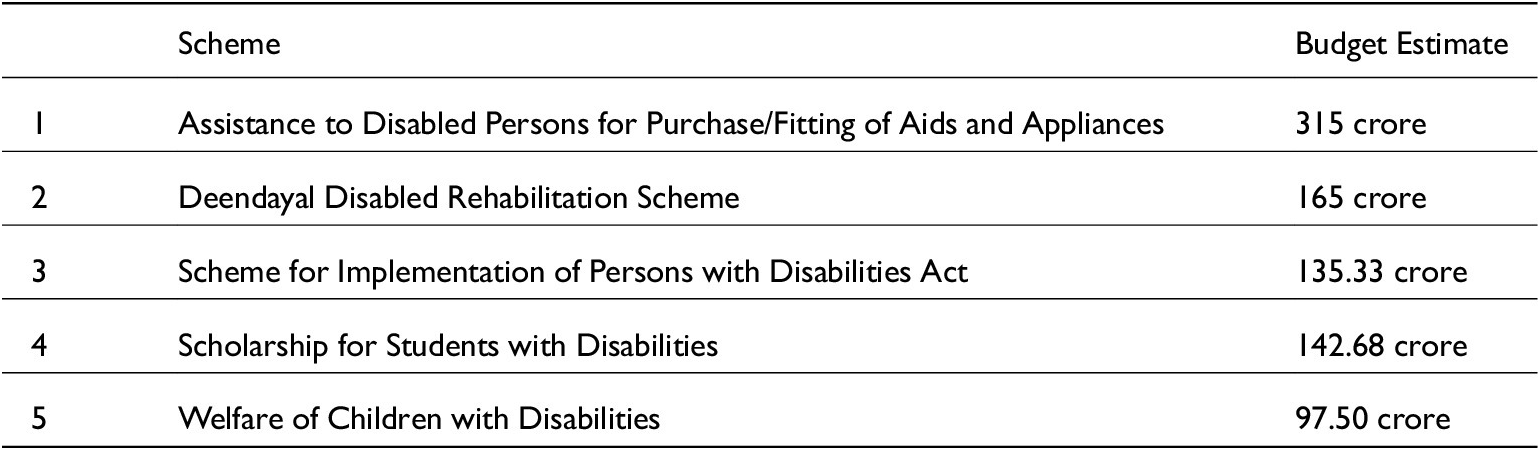
A similar pattern of budgetary reduction observed in other schemes like SIPDA. SIPDA is an Umbrella scheme that includes several critical sub-schemes such as—Creation of Barrier Free Environment Accessible India Campaign, National Action Plan for Skill Development of PwDs, Unique Disability Identification (UDID), Project Awareness Generation and Publicity (AGP) and In Service Training Research on Disability Related Technology Product and Issues and Development and so forth The budget allocations for SIPDA have drastically decreased from INR 315 crore in FY 2019–20 to INR 135 crore in FY 2022–23 (Table 4) which might be due to the magnitude of unspent funds which is higher in the case of SIPDA. This is reflected in Figure 2. Despite these reductions, the need for accessible infrastructure, inclusive education, and public transport continues to grow. Underutilization of funds and poor spending efficiency further widen the gap between policy and practice.Footnote 43 The reduction in allocations and persistent underutilization of funds represent not only administrative inefficiency but a deeper accountability failure.
Budget estimates for schemes under the Department of Empowerment of Persons with disabilities for the FY 2024–2025

Table 4 Long description
The table consists of three columns: an index number, the Scheme name, and the Budget Estimate in crore.
* Row 1: Assistance to Disabled Persons for Purchase or Fitting of Aids and Appliances, 315 crore.
* Row 2: Deendayal Disabled Rehabilitation Scheme, 165 crore.
* Row 3: Scheme for Implementation of Persons with Disabilities Act, 135.33 crore.
* Row 4: Scholarship for Students with Disabilities, 142.68 crore.
* Row 5: Welfare of Children with Disabilities, 97.50 crore.
The data is sourced from the Department of Empowerment of Persons with Disabilities 2024 Establishment Expenditure of the Centre.
Source: Department of Empowerment of Persons with Disabilities (2024). Establishment Expenditure of the Centre.
Budgetary Trends over the years up to 2024–25 by PACTA. Data Source: (PACTA Reference Pacta2024).

Figure 2. Long description
The Y-axis represents Budget in crores, ranging from 0 to 350 in increments of 50. The X-axis represents Financial Year from 2019-20 to 2022-23. Each year contains two bars: a dark blue bar for Estimates and a light blue bar for Actual spending.
* 2019-20: Estimates at 315 and Actual at 217.34.
* 2020-21: Estimates at 251.5 and Actual at 103.43.
* 2021-22: Estimates at 209.77 and Actual at 108.44.
* 2022-23: Estimates at 240 and Actual at 65.59.
The data shows a general downward trend in actual spending over the four-year period, with the largest gap between estimates and actuals occurring in the final year.
Disability inclusive development strategies mentioned in the Incheon Strategy. Source: Incheon Strategy strengthening the 2030 Agenda| Make the Right Real.

Figure 3. Long description
The flowchart connects 10 numbered purple hexagonal icons on the left to 11 circular S D G icons on the right.
Incheon Strategy Goals (Left):
1. Reduce poverty and enhance work prospects.
2. Promote participation in political processes.
3. Enhance physical and information accessibility.
4. Strengthen social protection.
5. Expand early intervention and education of children.
6. Ensure gender equality and women’s empowerment.
7. Ensure disability-inclusive disaster preparedness.
8. Improve quality of disability data.
9. Promote C R P D ratification and implementation.
10. Advance cooperation within and between regions.
Sustainable Development Goals (Right):
8. Decent work and economic growth.
1. No poverty.
10. Reduced inequalities.
16. Peace, justice and strong institutions.
5. Gender equality.
4. Quality education.
9. Industry, innovation and infrastructure.
11. Sustainable cities and communities.
3. Good health and well-being.
13. Climate action.
17. Partnerships for the goals.
Mapping Details:
- Incheon Goal 1 branches to S D Gs 8, 1, and 10.
- Incheon Goal 2 branches to S D Gs 16 and 10.
- Incheon Goal 3 branches to S D Gs 9 and 11.
- Incheon Goal 4 branches to S D Gs 1, 10, and 3.
- Incheon Goal 5 branches to S D Gs 4 and 10.
- Incheon Goal 6 branches to S D Gs 5 and 10.
- Incheon Goal 7 branches to S D Gs 11 and 13.
- Incheon Goal 8 branches to S D Gs 17 and 10.
- Incheon Goal 9 branches to S D G 16.
- Incheon Goal 10 branches to S D G 17.
Note: S D Gs 8, 10, 4, 11, and 17 are marked with an asterisk.
8. Recent developments post the Incheon Strategy
-
a. Incheon Strategy strengthening the 2030 Agenda: The potential to “Make the Right Real” for PwDs in Asia and the Pacific through the Incheon Strategy emerged with the recent adoption of the 2030 Agenda for Sustainable Development. The two frameworks encourage national leadership to initiate the change. Both the Incheon Strategy and the 2030 Agenda approach development from a people-centred and gender-sensitive perspective, with a perceptible foundation in respect for human rights. Goal 3 of the Incheon Strategy—Strengthening physical and information accessibility for PwDs is linked with the SDGs 9, 11, 16, and 4. By collaborating on infrastructure and industrial advancement, any individual with a disability can contribute to social and economic elements of life, paving the path for more extensive efforts towards inclusion.Footnote 44
-
b. Asian Development Bank (ADB) Strengthening Disability-Inclusive Development 2021–2025 Road Map: The objective of this road map has been to create a more organized strategy for implementing disability-inclusive development within the ADB, beginning in 2021 and continuing until 2025. The road map focuses on short- and medium-term actions that extend the five core priority components to develop an inclusive organizational culture and introduce disability-inclusive development approaches that can strengthen and accelerate the implementation of Strategy 2030 goals and priority areas.Footnote 45
9. Non-governmental efforts for the rights of PwD
While governments and political will are important in creating a supportive environment, non-governmental organizations (NGOs) also play a crucial role in supporting and highlighting the rights of PwDs to create an inclusive society. Hence, in addition to private citizens, several NGOs in India are recognized for supporting and assisting PwDs by enabling them to work and lead regular lives in the community (Table 5). In 2019, an NGO named Samarthyam published a report claiming that schools in Hyderabad lacked ramps, accessible drinking water facilities, information and communication systems, and accessible restrooms and entrances. The report further explains that the lack of awareness of access standards among construction workers results in school infrastructure being unsafe for children with disabilities.Footnote 46 Additionally, to promote and support the rights of PwDs, the government has also partnered with several civil society organizations. One of the most recent agreements is to promote accessible training programmes and build more inclusive environments for PwDs, which was signed by the DEPwD and an NGO headquartered in Gujarat.Footnote 47
List of some NGOs working towards disability rights in India

Table 5 Long description
The table consists of two columns: the first column lists the name of the organization, and the second column lists their Key activities.
* Samarthyam: Focused on empowering rural, poor, marginalized, and women with disabilities as part of the Leave No One Behind and Disability Inclusive 2030 Agenda. They advocate for S D G accountability with partners like SightSavers India and the European Disability Forum.
* EnableMe Access Association E M A: Conducts comprehensive accessibility assessments in educational settings.
* Help Age India: Explores the intersectionality of age with gender and disability.
* Narayana Seva Sansthan: Produces laminated and carbon fiber prosthetic limbs and helps children and adults develop essential skills.
* Association for the mentally challenged: Enhances lives of individuals with Intellectual Disability Disorder I D D. They have educated 1356 children, supported 2320 families, and employed 32 adults.
* Samarthanam Trust: Provides quality education, accommodation, food, vocational training, and placement-based rehabilitation.
* C B M India: Works to build an inclusive society through interventions in health, education, livelihood, and disaster response.
Source: The National Trust, Government of India. Information about Registered Organisations 2014.
Evidence from a research report published by HelpAge India describes the vulnerabilities experienced by older women. For instance, older women in India are thought to have a respectable level of social inclusion, but have very limited access to digital channels of connectivity.Footnote 48 To minimize vulnerability, several evidence-based interventions have been initiated by the Government through the establishment of local academic bodies in special collaboration with international expertise. With the mission “Inclusive Millennium: Evidence for Empowering Persons with Disabilities,” the Public Health Foundation of India (PHFI) in partnership with the London School of Hygiene and Tropical Medicine (LSHTM) and its subsidiary institution, the International Centre for Eye Health (ICEH), London, UK, developed a Center of Excellence known as “The South Asia Centre for Disability Inclusive Development & Research (SACDIR)” to understand the magnitude of disabilities in the South Asian context as well.Footnote 49 These civil society efforts illustrate how disability justice often advances through grassroots mobilization rather than state initiative. Organizations such as Samarthyam and HelpAge India have not only filled service gaps but have also challenged systemic ableism, holding institutions accountable for accessibility and inclusion. Their advocacy reframes disability from a welfare issue to a question of justice, dignity, and citizenship.
10. Statistics on the accessibility of the built environment and transport
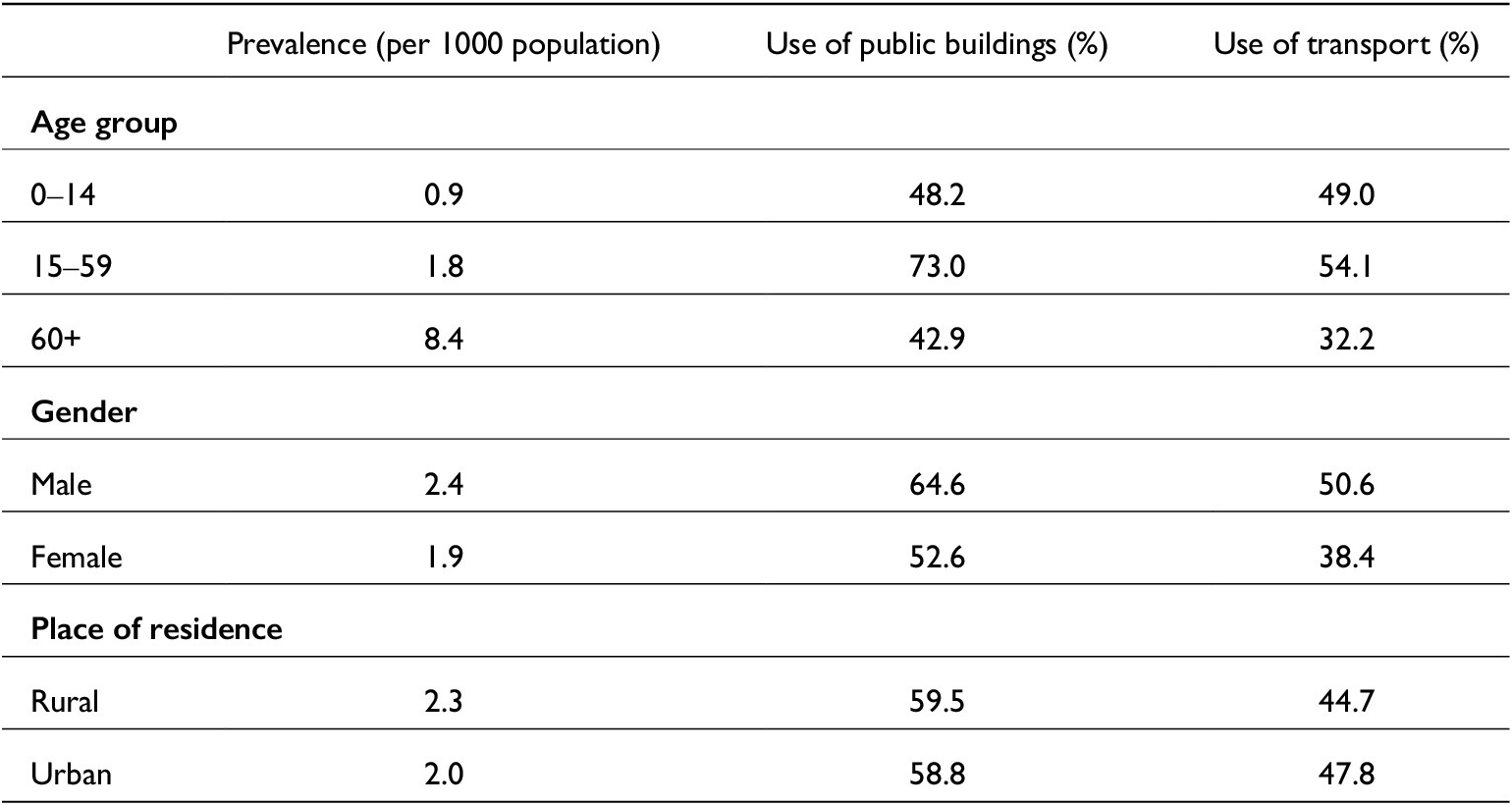
The range and magnitude of limitations in achieving universal accessibility in public spaces are challenging to articulate. Currently, there are very few timely and regular forums available in the public domain to voice, discuss, and address this issue. To understand the current situation in this regard, a few notable data points are quite pertinent. The Census of India (2011) enumerates 26.8 million (2.1%) people as reporting certain kinds of disabilities. The National Sample Survey 76th round (2018–2019) provides limited evidence on the access to public buildings and transport among PwDs in India (Table 6) NSS finds that 2.2 percent of the population in India is suffering from one or more forms of disability (N 106894). The prevalence is higher for the elderly (8.4 per 1,000 population), males (2.4 per 1,000 population), and those belonging to rural areas (2.3 per 1,000 population) (Table 6). The report finds that only 57 percent accessed public buildings in the last 365 days; however, among them, around 68 percent find it difficult to use public buildings.
Use of public buildings and transport by PwDs in the last 365 days as asked in the National Sample Survey (2018–2019) in India

Table 6 Long description
The table contains four columns: Demographic Category, Prevalence per 1000 population, Use of public buildings percentage, and Use of transport percentage.
* Age group breakdown:
- 0 to 14: Prevalence 0.9, Public buildings 48.2 percent, Transport 49.0 percent.
- 15 to 59: Prevalence 1.8, Public buildings 73.0 percent, Transport 54.1 percent.
- 60 plus: Prevalence 8.4, Public buildings 42.9 percent, Transport 32.2 percent.
* Gender breakdown:
- Male: Prevalence 2.4, Public buildings 64.6 percent, Transport 50.6 percent.
- Female: Prevalence 1.9, Public buildings 52.6 percent, Transport 38.4 percent.
* Place of residence breakdown:
- Rural: Prevalence 2.3, Public buildings 59.5 percent, Transport 44.7 percent.
- Urban: Prevalence 2.0, Public buildings 58.8 percent, Transport 47.8 percent.
Data Source: National Sample Survey, 76th round 2018 to 2019.
Data Source: National Sample Survey, 76th round (2018–19).
In terms of availing transportation facilities, only 42 percent of individuals had used any form of transportation in the last 365 days, of whom 64 percent had faced difficulties in using these facilities.Footnote 50 Undoubtedly, the number of PwDs is expected to continue to grow considering the population growth rate, and the incidence of disability-causing illness and/or prevalence of injuries and trauma in India. The challenges and difficulties faced by PwDs cannot be viewed through a single lens. The difficulties recognized here are several, multi-layered, and defined through the types of disability, dimensions of gender, place of residence, financial domains, and educational categories. Less than 50 percent of the children or older PwDs use public buildings or transport. Only 60 percent of males and 50 percent of females use public buildings, and 50 percent of males and 38 percent of females have used any form of public transport in the last 365 days (Table 6). However, the data do not reveal much variation in usage across places of residence. Older individuals are perceived to face greater difficulty while accessing physical structures without adequate infrastructure, assistive aids, or personal assistance.
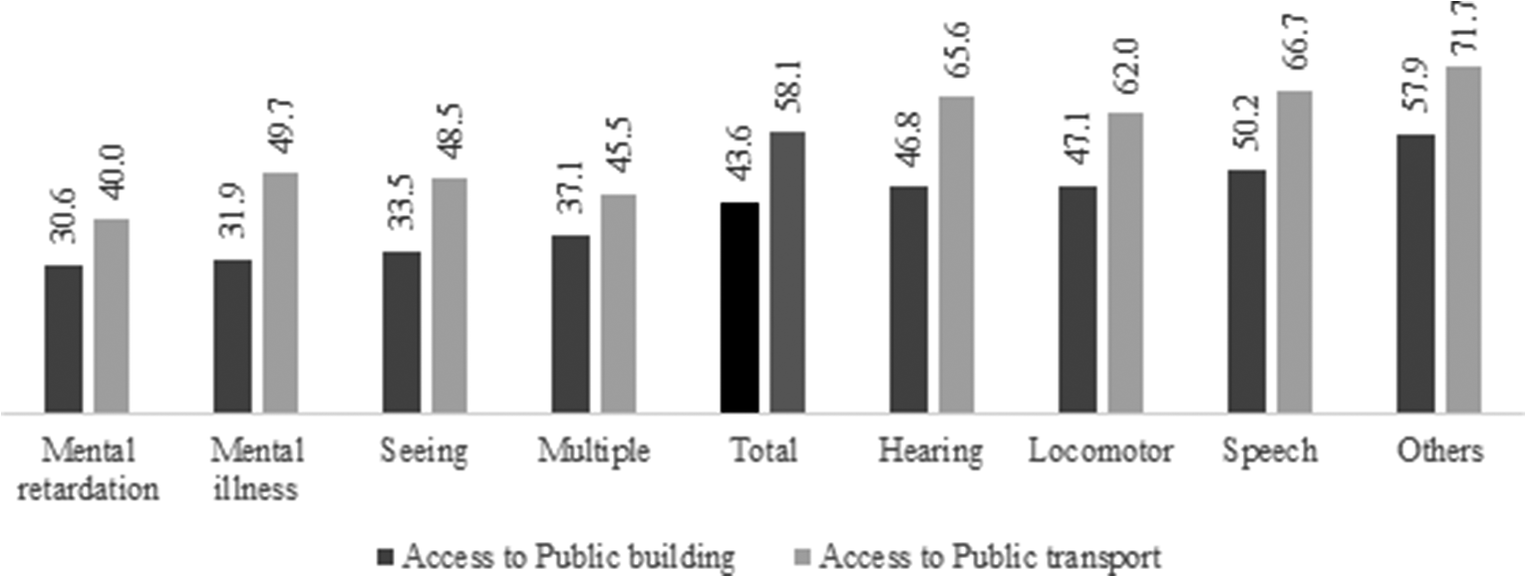
Individuals with mental health difficulties, such as mental retardation and mental illness, had similar clustering in terms of limited access to public buildings (30.6% and 31.9%) and public transport (40% and 49.7%) (Figure 4). Though disability in hearing, locomotor, and speech present a slightly better picture, there remains a gap between access to public buildings and transport in India. The underlying reasons are several and are indicative of poor accessibility and a lack of a conducive built environment for PwDs in India. Some of the most common difficulties in access are challenges faced in accessing steps or stairs, non-availability of ramps, grooved tiles, or lifts, no signage for direction or instruction, and the absence of a public announcement system. The reasons for difficulties faced while accessing both buildings and transport vary extensively across the different types of disability. Disability justice insists on expanding the notion of access beyond ramps and lifts to include attitudinal, sensory, and cognitive accessibility that affirms the full humanity of all PwDs.
Access to public buildings and transport for different types of PwDs in India. Data Source: National Sample Survey, 76th round, 2018–2019.

Figure 4. Long description
The X-axis lists ten categories of P w D s. For each category, a black bar represents Access to Public building and a grey bar represents Access to Public transport. In all categories, access to public transport is higher than access to public buildings.
Data points from left to right are as follows.
* Mental retardation. Public building 30.6, Public transport 40.0.
* Mental illness. Public building 31.9, Public transport 49.7.
* Seeing. Public building 33.5, Public transport 48.5.
* Multiple. Public building 37.1, Public transport 45.5.
* Total. Public building 43.6, Public transport 58.1.
* Hearing. Public building 46.8, Public transport 65.6.
* Locomotor. Public building 47.1, Public transport 62.0.
* Speech. Public building 50.2, Public transport 66.7.
* Others. Public building 57.9, Public transport 71.7.
11. Discussions
-
1. The study finds the rigorous struggle of the PwDs and associated bodies for inclusivity in terms of accessibility in India. Despite several norms and policies, the endeavour towards achieving an accessible infrastructure requires the potential to transform policies into actions. Looking beyond the judicial attempt to address the right, this study has comprehensively addressed how inclusivity and accessibility have taken a turn over the ages and how far it has to go. There are major imperatives that hinder the development of PwDs in terms of available resources and financial constraints, inadequate enforcement of existing laws, lack of awareness among stakeholders, insufficient skilled human resources, fragmented coordination across government agencies, and deep-rooted societal attitudes that continue to marginalize PwDs rather than treat accessibility as a fundamental right. However, a well-planned measure of development would accelerate the change in the lives of PwDs by fostering an inclusive built environment, ensuring equitable access to education, employment, transportation, and public services. The impact of limited accessibility is multifaceted in nature. Because of social norms and practices that lead to discrimination, limited employment opportunities, and other access issues, social structures systematically produce and maintain poverty among PwDs. The combination of poverty and disability thereby increases vulnerability and exclusion. Through hunger, poor access to healthcare and education, unsafe work environments, a contaminated environment, and lack of clean water and sanitary facilities, poverty is known to raise the risk of disability.Footnote 51 For instance, the incidence of disability among the lowest economic categories is more than twice as high in South Africa as it is in other groups. Disability and poverty reinforce one another, and this explains why many PwDs feel that their circumstances make it more difficult to attend school, find employment, enjoy family life, and participate equally in society.Footnote 52
Numerous factors, including the cost of transport and mobility, their availability and accessibility, and negative externalities such as long travel times or safety concerns, can all contribute to transport poverty.Footnote 53 Lack of infrastructure (such as access to all-weather roads), the distance or time required for travel, costs, scarcity of fuel, or a combination of these factors can all contribute to transport poverty that affects several people globally.Footnote 54 According to a study, the affordability of public transportation is only one aspect of transport poverty. Mobility is far more important since not all groups can access transportation equally, and this can be a distinguishing feature that results in social exclusion.Footnote 55 One of the main causes of the Disability Transport Gap is financial obstacles as well. Even in evidence from a developed context, in the United Kingdom (UK), PwDs travel less in the UK than their peers, and they are frequently compelled to rely on private vehicles or taxis for transportation since public transportation is inaccessible. Consequently, PwDs often overspend on their transportation.
The transport accessibility crisis in India is not unique to the subcontinent. Across Southeast Asia, PwDs routinely face the same combination of formal policy commitments and physical barriers on the ground. Thailand is a case in point. Despite concessional fare schemes for disabled passengers on Bangkok’s public transport, access remains conditional on registration processes that many disability advocates have called humiliating and exclusionary; UNESCAP data suggest that roughly 1.5 million of Thailand’s 2.1 million PwDs are effectively shut out of mainstream urban mobility infrastructure.Footnote 56
-
2. Injustice in mobility is a form of social exclusion that limits not only movement but also participation in democratic and economic life.
Inadequate enforcement of current accessibility laws has been identified as a roadblock to inclusive transportation in developing nations, too. According to the laws in Mozambique, Malawi, and India, there are a few seats reserved for PwDs on trains and in urban public transportation, and these passengers must receive fee discounts of up to 100 percent. However, experience shows that these protocols are rarely implemented or followed in letter and spirit.Footnote 57
12. The major gap in achieving accessibility
The lack of data regarding accessibility to PwDs in the public domain hinders the inclusion of PwDs. From difficulty in defining disability to reluctance to report disability due to stigma poses an issue for the collection of data and in measuring disability. Though there have been many policies and schemes aiming towards achieving accessibility, poor implementation of policies and the lack of monitoring largely impede the inclusion of PwDs. There is, of course, a direct effect when budgetary allocations are reduced or plateauing, when the need for addressing disability is getting higher. The Union Budget for the financial year 2023–2024, for example, has very little to offer to the marginalized groups—the vulnerable children, the disabled, and the elderly thereby slowing down the progress in mainstreaming PwDs. Compared to the previous year, there is a very marginal 1 percent rise in allocation for the sector, and there is further evidence of underutilization of the amount allocated for the financial year 2022–2023.Footnote 58 Both indicate that the will to allocate and to spend effectively is not yet convincing enough.
According to available literature, women who have locomotor disabilities endure great hardship because the built environment is quite inaccessible to them. Their access to public transit, healthcare, work, and education is hampered by a multitude of compounding obstacles. For several women, barriers such as the type and severity of their impairment, gender, social class, and lack of support from their families—including from their husbands—are intersectional with pre-existing institutional and mental barriers. These cumulative intersectional disadvantages produce specific forms of discrimination and exclusion from mainstream society.Footnote 59 Many hospitals in the nation were unable to provide accessible built environments as well for individuals with disabilities during the COVID-19 pandemic, highlighting the challenges to accomplishing the Accessible India Campaign. In addition to dealing with financial hardship and job losses, PwDs were finding it difficult to get medical attention and necessary information about COVID-19, as evidenced by a survey conducted by the NCPEDP, which had over 1,000 respondents.Footnote 60
Alternatives adopted by different countries suggests in high-income nations such as South Africa and others, there is a necessity for “twin tracking” accessible and inclusive transportation, which entails actively encouraging bus and taxi drivers to pick up passengers with disabilities, in addition to updating and ensuring that new buses and minibuses are made accessible.Footnote 61 This could be accomplished through a variety of strategies, such as offering more financial incentives (e.g., lowering fares) as well as educating and training drivers and car owners. In addition, there are public awareness efforts aimed at highlighting transportation as a secure environment for all users, as well as channels of appeal for individuals who encounter discrimination when utilizing public or private transportation.Footnote 62 Many countries have implemented the idea of free or reduced transit fares for older adults and PwDs to combat transportation poverty. Several cities across Europe, including a few French towns, the capital of Estonia, Tallinn, and the whole nation of Luxembourg, have made all public transport free.Footnote 63 In July 2021, the UK government unveiled a new National Disability Strategy (NDS) that featured several goals for several government agencies and outlined “the actions the government will take to improve the everyday lives of all disabled people.” Its objectives included bringing legislation pertaining to taxis and private hire vehicles to Parliament, conducting a thorough accessibility audit of all train stations, and improving the audio and visual announcements on buses.Footnote 64 The introduction of low-floor cars has enhanced bus accessibility throughout Europe. Cities in Asia and South America are gradually introducing lower-floor vehicles, too.Footnote 65
13. Towards Achieving Universal Accesibility
Universal accessibility is a fundamental right of the PwDs as it addresses inclusivity towards education, employment, health, and other needs and wants of life; it is also not merely a policy goal but a cornerstone of disability justice grounded in the recognition of dignity, equity and the right to full participation in society. Despite global and national conventions and various strategies and commitments aimed at ensuring an inclusive built environment for people with diverse disabilities, universal accessibility remains a distant dream. As we discussed, there are significant lags that exist in terms of achieving the targets. This narrative attempts to provide a comprehensive understanding of the barriers to accessibility that exist in multiple forms and why concerted efforts are required to overcome them. Achieving universal accessibility requires a transformative shift towards justice-oriented governance that dismantles institutional barriers and centres the lived experiences of PwDs. The Supreme Court’s recent judgement on providing universal access to all people comes as a shot in the arm for numerous attempts being made to highlight and mainstream disability rights. Some of the findings indicate that there is a lack of initiative to achieve these targets by the stakeholders, despite programmes and provisions in existence, indicating that monitoring and evaluation of progress needs to be enhanced. This paper serves to highlight, document, promote, and motivate efforts from all the stakeholders to work towards making India truly barrier-free and hence, accessible for all. PwDs constitute a significant percentage of the population, and with a rise in the greying population, the integration of inclusive environments for everyone is necessitated. Hence, programmatic monitoring and evaluation in this domain are of utmost necessity, along with acknowledging the successes and achievements in the recent past. The recent Supreme Court ruling for universal accessibility should act as a catalyst for renewed efforts to achieve universal accessibility in India, and this direction from the judiciary has the potential to be replicable and utilized across other LMIC contexts where universal access for PwDs is taking shape. The Supreme Court’s landmark judgement must now translate into concrete action through annual monitoring, adequate funding, and cross-sectoral coordination led by politically empowered institutions. True accessibility cannot be achieved through legal mandates alone; it must be built into the political fabric of governance.
Conflict of interests
The authors declare no competing interests.
Author contribution
Conceptualization: S.C., A.P.U.; Data curation: S.C.; Formal analysis: S.C., A.P.U.; Investigation: S.C., A.P.U.; Methodology: S.C., A.P.U.; Project administration: S.C., S.K.; Software: S.C., S.K.; Validation: S.C., A.P.U., S.K.; Visualization: S.C., A.P.U.; Writing - original draft: S.C., A.P.U.; Resources: A.P.U., S.K.; Supervision: A.P.U.; Writing - review & editing: S.K.






 Open access

