Introduction
Facial emotion expresses feelings, but is also a vehicle for social communication. Facial expression reflects what we feel (emotional expression), but also what we want people to think we feel, a form of cognitive control termed emotive communication in which the expression on the face is consciously pantomimed or even deceptive (e.g., a sad expression in a child whose older tormentor has just fallen in the mud). Emotive communication is fundamentally social because it involves modulating emotional expression according to the perceived mental states of a viewer in a social context. In this sense, emotive communication is a form of affective theory of mind (Hein & Singer, Reference Hein and Singer2008), which involves understanding and communicating affective states to others based on what we believe they will think and feel.
Children with traumatic brain injury (TBI) display impairments in social-affective functions, including pragmatic language, the understanding of mental state language, the production of speech acts, understanding forms of complex language that involve emotion (e.g., irony and empathy), and the production of coherent social discourse (Chapman et al., Reference Chapman, Sparks, Levin, Dennis, Roncadin, Zhang and Song2004; Dennis & Barnes, Reference Dennis and Barnes2000, Reference Dennis and Barnes2001; Dennis, Purvis, Barnes, Wilkinson & Winner, Reference Dennis, Purvis, Barnes, Wilkinson and Winner2001).
Part of the impairment in social affective-function after TBI is misunderstanding emotional expression. Adults and children with TBI show emotion recognition deficits (see Bornhofen & McDonald, Reference Bornhofen and McDonald2008 for a review; Croker & McDonald, Reference Croker and McDonald2005; Green, Turner, & Thompson, Reference Green, Turner and Thompson2004; Ietswaart, Milders, Crawford, Currie, & Scott, Reference Ietswaart, Milders, Crawford, Currie and Scott2008; Spell & Frank, Reference Spell and Frank2000; Tonks, Williams, Frampton, Yates, & Slater, Reference Tonks, Williams, Frampton, Yates and Slater2007; Tonks et al., Reference Tonks, Williams, Frampton, Yates, Wall and Slater2008). Difficulty in emotion comprehension after childhood TBI includes not only facial emotion, but also affective prosody (Schmidt, Hanten, Li, Orsten, & Levin, Reference Schmidt, Hanten, Li, Orsten and Levin2010). Generally, children with TBI have more difficulty recognizing negative emotions such as anger, sadness, and fearfulness than positive emotions such as happiness (Croker & McDonald, Reference Croker and McDonald2005; Green et al., Reference Green, Turner and Thompson2004).
Emotive communication, the use of facial expressions for social purposes, has been less often studied than emotional expression. When given a brief narrative (e.g., “Terry woke up with a tummy ache. Terry's mom would not let her go out to play if she knew she had a tummy ache”) and asked to choose emotional expression (“How does Terry feel inside?”) and emotive communication (“How does Terry look on her face?”) on a face display, children with TBI have particular difficulty with emotive communication (Dennis, Barnes, Wilkinson, & Humphreys, Reference Dennis, Barnes, Wilkinson and Humphreys1998). To date, comprehension of emotive communication has been studied with happy and sad, but not with other basic emotions.
Although basic emotions are usually studied as categories, they may also be considered dimensionally (e.g., Russell, Reference Russell1979). Valence refers to the positive and negative character of an emotion, and ranges from highly positive (elation) to highly negative (extreme sadness); positive emotions are processed more readily than negative emotions (Bennett, Reference Bennett2002). Arousal ranges from low (tranquil) to high (agitated) (Cunningham & Johnson, 2007); high arousal emotions are processed more readily than low arousal emotions (Bennett, Reference Bennett2002). Action impulse concerns how motivational tendencies to approach or avoid are embedded in facial expressions (for example, a happy expression conveys a heightened likelihood of approach; Davidson, Reference Davidson1992; Berkman & Lieberman, Reference Berkman and Lieberman2009); approach emotions are processed more readily than avoidance emotions (Davidson, Reference Davidson1992). Facial expressions also convey information about threat level (Gray, Reference Gray1990); for example, facial displays of anger and fear result in a “vigilant” style of scanning compared to non-threat facial expressions (e.g., sad, happy, and neutral) (Green, Williams, & Davidson, Reference Green, Williams and Davidson2003); low threat emotions are processed more readily than high threat emotions (Schrammel, Pannasch, Graupner, Mojzisch, & Velichkoysky, Reference Schrammel, Pannasch, Graupner, Mojzisch and Velichkoysky2009). The dimensionality of emotion has not been studied in TBI, although this information would provide new information about the sensitivity of children with TBI to shared and unshared affective dimensions of different emotions.
This study investigated comprehension of emotional expression and emotive communication for five basic emotions in children with TBI. We had two specific aims and associated hypotheses:
1. To compare emotional expression and emotive communication in children with TBI and age peers with orthopedic injuries (OI). We predicted: (a) emotional expression and emotive communication would be more accurate in children with OI than in those with TBI; (b) for within-group comparisons, emotional expression would be more accurate than emotive communication, both for overall scores and for individual emotions; (c) children with TBI would demonstrate less sophisticated strategies for emotive communication.
2. To compare groups on four dimensions of emotional expression, consistent with previous findings (Croker & McDonald, Reference Croker and McDonald2005; Green et al., Reference Green, Turner and Thompson2004). We predicted, for all groups, that: (a) comprehension accuracy for positively valenced emotion (happy) would be higher than that for negatively valenced emotion (sad, angry, fearful, and disgusted); (b) comprehension accuracy for high arousal emotion (happy, angry, disgusted, and fearful) would be higher than that for low arousal emotion (sad); (c) comprehension accuracy for approach emotion (i.e., happy and angry) would be higher than that for avoidance emotion (sad, scared, and disgusted); (d) comprehension accuracy for low threat emotions (i.e., happy and sad) would be higher than that for high threat emotions (i.e., angry, scared, and disgusted).
Method
Participants
Participants included children previously hospitalized for either a TBI or OI who were 8 to 13 years of age and who were injured between 6 and 48 months before testing. All children were injured after 3 years of age, the majority after 4 years of age.
Recruitment occurred in three metropolitan sites: Toronto (Canada), Columbus (U.S.), and Cleveland (U.S.). Among children eligible to participate and approached about the study, 82 (47%) of those with TBI and 61 (26%) of those with OI agreed to enroll. The participation rate was significantly higher for TBI than OI. However, participants and non-participants in both groups did not differ in age at injury, age at initial contact about the study, sex, race, or census tract measures of socioeconomic status (SES; i.e., mean family income, percentage of minority heads of household, and percentage of households below the poverty line). Participants and non-participants also did not differ on measures of injury severity [i.e., mean length of stay, median Glasgow Coma Scale (GCS, Teasdale & Jennett, Reference Teasdale and Jennett1974) score for children with TBI]. The participation rate for severe TBI was 43% and mild/moderate TBI was 51% (not significantly different).
For both TBI and OI participants, we applied the following exclusion criteria: (a) history of more than one serious injury requiring medical treatment; (b) premorbid neurological disorder or mental retardation; (c) any injury resulting from child abuse or assault; (d) a history of severe psychiatric disorder requiring hospitalization before the injury; (e) sensory or motor impairment that prevented valid administration of study measures; (f) primary language other than English; and (g) any medical contraindication to MRI or behavioral study. Children in full-time special education classrooms were excluded (in all but one case), although those with a history of premorbid learning or attention problems were not excluded. All participants scored a minimum of 70 on Verbal and/or Performance IQ (WASI; Wechsler, Reference Wechsler1999).
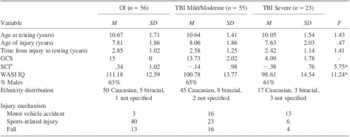
One hundred forty-three participants were recruited into the multi-site study. Scores from seven participants were dropped from the study: six children were found to be univariate outliers on the emotion task (i.e., performed more than 3 SDs from the M), and one child with TBI failed the emotion pretest. Because of time constraints two children were not administered the emotion task. Of the remaining 134 eligible participants three groups were established, 78 had sustained a TBI and 56 children had sustained orthopedic injuries that required hospital admission (OI group). Children with TBI were grouped by injury severity: GCS scores 9–15 defined a complicated Mild/Moderate TBI group (n = 55) and GCS score 3–8 defined a Severe TBI group (n = 23). Severe TBI was defined based on a lowest post-resuscitation GCS score of 8 or less, moderate TBI was based on a GCS score from 9 to 12, with or without abnormal time-of-injury neuroimaging, and complicated mild TBI was based on a GCS score of 13–15 in association with abnormal time-of-injury neuroimaging. The OI group consisted of children who sustained fractures without loss of consciousness or other indications of brain injury. The human data included in this manuscript were obtained in compliance with formal ethics review committees at the participating institutions in Columbus, Toronto, and Cleveland. Parent consent and child assent was obtained before testing. All participants were assessed a minimum of 1 year post-injury. Participant demographics, including sex, race, socioeconomic status, SES (Hauser & Warren, Reference Hauser and Warren1997; Yeates et al., Reference Yeates, Taylor, Rusin, Bangert, Dietrich, Nuss and Jones2009), IQ, age at injury, age at time of test, and mechanism of injury are shown in Table 1.
Demographic Information

*p < .05.
Task
The Emotional and Emotive Faces Task (EEFT) is an expansion of an earlier comprehension task (Dennis et al., Reference Dennis, Barnes, Wilkinson and Humphreys1998) that evaluates emotional expression (the emotion that a character actually feels) and emotive communication (the emotion that a character consciously chooses to express socially). We studied five basic emotions: happiness, sadness, fear, disgust (yucky), and anger.
Children listened to 25 short narratives (5 narratives for each different emotion) about a character, Terry, each involving a discrepancy between Terry's “inside” feeling and his/her facial expression. The participants were told, “I will ask you questions about how Terry looked on his (or her) face and how he (or she) felt inside. He (or she) might look one way on his (or her) face but feel a different way inside.” The child's task was to choose a face from a display of facial emotions with a neutral face at the center, surrounded by faces expressing a mild and strong expression of each emotion. (Figure 1
Emotional and emotive faces task face display.

).
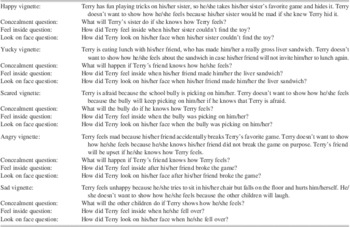
To highlight the social display rule (and why the true emotions should be hidden), each narrative provided concealment information. Children answered 3 questions for each narrative: a concealment information question about the reason for concealment, a feel inside (emotional expression) question, and a look on face (emotive communication) question. Table 2 shows examples of vignettes and questions. Order of feel inside and look on face questions was counterbalanced across trials.
Sample vignettes and questions for each emotion type

Two pretests established that children could perform the task. The lexical emotion terms pretest required matching of lexical terms (happy, sad, scared, angry, and yucky) facial expressions. The training narrative pretest required children to match simple narratives that involved situations where it would be socially appropriate to conceal “true” emotions (i.e., smiling in response to receiving an unwanted or disliked gift) to facial expressions. The child was told, “You know how kids show what they feel on their face. But sometimes kids feel one way on the inside, but look a different way on their face.” All children who were able to perform both pretests continued to the test proper.
EEFT scoring
For concealment information questions, participants were given 1 point for correctly identifying the reason for hiding the emotion. For example, a correct response to the concealment question for the happy vignette example (see Table 2, happy vignette, “What will Terry's sister do if she knows how Terry feels?”) is “She would get mad.” Total possible Concealment score was 25.
For the feel inside questions, participants were given 1 point for correct identification of the real emotion, with 25 as the total possible Feel Inside score. For the look on face questions, participants were awarded 2 points when the face selection was an appropriate masked expression of the felt emotion. For example, in the happy vignette, see Table 2, selection of “very sad” or “a bit sad” expression would be awarded 2 points. One point was awarded if the child selected the neutral face, or minimized the felt emotion by selecting a milder expression of the feel inside emotion). For Look on Face, 50 points was the total possible Look on Face score. Concealment, Feel Inside, and Look on Face scores were summed to form an Overall EEFT score out of 100. All EEFT scores were converted to percentages. Strategy scores were also derived, based on the developmental comprehension data showing that moderating a facial expression (e.g., from very happy to moderately happy) is less developmentally sophisticated than inhibiting any valenced expression (e.g., producing a neutral expression), which in turn is less sophisticated than generating a deceptive expression (e.g., from very happy to very sad) (e.g., Saarni, Reference Saarni1984). While the first two strategies reveal an awareness of the need to modulate felt emotion, only the latter reflects awareness of what is in the viewer's mind. In a masking strategy, the child answered the concealment information question correctly, identified the Feel Inside emotion correctly, and provided the Look on Face response that masked the “true” emotion by choosing a contrasting emotion. In a neutralizing strategy, the child answered the concealment question correctly, identified the Feel Inside emotion correctly, and selected the neutral face for the Look on Face question. In a minimizing strategy, the child answered the concealment question correctly, identified the Feel Inside emotion in stronger form, and chose the milder manifestation for the Look on Face question. The proportion of items completed using each strategy was calculated. A total deception strategy score was also calculated. Participants were given 2 points for each use of a masking strategy; 1 point for each use of a neutralizing strategy, and 0.5 point for each use of a minimizing strategy. The maximum score of 50 indicated application of a masking strategy on each item. A separate tally was made for inappropriate Look on Face emotions, defined as the number of times the child correctly identified the Feel Inside emotion but nevertheless failed to select any appropriate Look on Face emotion.
Data Analysis
To assess SES, a socioeconomic composite index score (SCI) was calculated by averaging sample Z scores for years of maternal education, occupational prestige, and median family income for census tract (Yeates et al., Reference Yeates, Taylor, Rusin, Bangert, Dietrich, Nuss and Jones2009). The SCI was significant higher for the Orthopedic Injury group than for either TBI group and had weak but significant relationships with the overall Feel Inside score (r = .26; p = .002) and EEFT total (r = .27; p = .002) scores, but was unrelated to the overall Look on Face score. The groups also differed in the distribution of mechanism of injury, with injuries arising from motorized vehicles being most common in the Severe TBI group and injuries arising from sports and recreational events being most common in the OI group. The group differences in SCI were no longer significant when injury mechanism was taken into account. These findings are consistent with epidemiological studies showing that the risk of TBI, particularly those linked to motorized vehicles, is highest for children of lower SCI and minority status (Brown, Reference Brown2010; Howard, Joseph, & Natale, Reference Howard, Joseph and Natale2005; Langlois, Rutland-Brown, & Thomas, Reference Langlois, Rutland-Brown and Thomas2005; McKinlay et al., Reference McKinlay, Kyonka, Grace, Horwood, Fergusson and MacFarlane2010; Parslow, Morris, Tasker, Forsyth, & Hawley, Reference Parslow, Morris, Tasker, Forsyth and Hawley2005; Yates, Williams, Harris, Round, & Jenkins, Reference Yates, Williams, Harris, Round and Jenkins2006). For that reason, we did not treat SCI as a covariate in data analyses, because the SCI differences appeared to be intrinsic to the injury groups. When a covariate is an attribute of a disorder, or is intrinsic to the condition, it is not meaningful and can be potentially misleading to adjust for differences in the covariate (Dennis et al., Reference Cunningham and Johnson2009).
Data analysis proceeded in a series of steps. First, a series of planned contrasts examined group differences on the EEFT overall score and overall Feel Inside and Look on Face scores. The latter two scores were included in a repeated-measures analysis to examine whether children with severe or mild/moderate TBI showed a selective deficit in emotive communication as compared to emotional expression, when contrasted with the OI group. Second, we explored group differences in the same manner for each emotion type (i.e., happy, sad, scared, angry, and yucky). To test our hypothesis that children with TBI would exhibit fewer deceptive strategies, we compared groups on strategy types, total strategy deception score, and inappropriate Look on Face emotions. Lastly, group differences were examined on the four dimensions of emotions. Each analysis was structured with planned contrasts comparing each of the TBI groups to the OI group, and with repeated measures for the dimension in question (e.g., low arousal vs. high arousal). For all analyses, effect sizes were estimated using η2.
Results
Emotional and Emotive Faces Task (EEFT) Overall scores
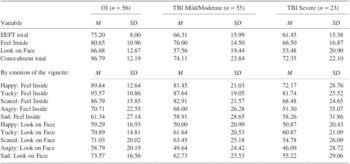
The OI group performed significantly better than both TBI groups based on the EEFT overall score, F(1,131) = 17.95, p < .000, η2 = .12, for Severe TBI versus OI, and F(1,131) = 12.78, p < .000, η2 = .09, for Mild/Moderate TBI versus OI (Table 3).
Performance (percentage correct) on Emotional and Emotive Faces task

All groups performed better on the Feel Inside than the Look on Face questions, as reflected in a significant main effect for question type, Wilks's Λ = .59, F(1,131) = 89.54, p < .000, η2 = .41. The group × question type interaction was not significant for either the Severe TBI versus OI contrast, F(1,131) = 0.05, p > .10, or the Mild/Moderate TBI versus OI contrast. F(1,131) = 1.91, p > .10. Compared to the OI group, both TBI groups demonstrated poorer performance across question types, reflected in significant group main effects, for Severe TBI versus OI, F(1,131) = 18.14, p < .000, η2 = .12, and for Mild/Moderate TBI versus OI, F(1,131) = 7.82, p < .01, η2 = .06.
Individual emotions
For disgust and happiness, results were similar to those for the overall scores (significant main effect for group and question type but no group by question type interaction). For anger and fear, the Mild/Moderate TBI group did not differ significantly from the OI group across question types, although the Severe TBI group did so. For sadness, performance did not vary significantly across question types, and only the severe TBI group performed more poorly across question types than the OI group.
Strategy
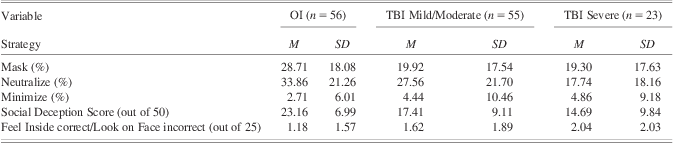
A multivariate analysis of variance (MANOVA) was conducted on strategy scores (i.e., masking, neutralizing, and minimizing). Results (Table 4) revealed a significant multivariate contrast between the Severe TBI and OI groups, Wilks's Λ = .86, F(3,129) = 7.01, p < .001, multivariate η2 = .14. The Severe TBI group demonstrated significantly less masking, p < .05, and neutralizing, p < .01, but did not differ on minimizing, p > .10, compared to the OI group. The multivariate contrast between the Mild/Moderate TBI and OI groups was also significant, Wilks's Λ = .91, F(3,129) = 4.40, p < .006, multivariate η2 = .09. The Mild/Moderate TBI group demonstrated significantly less masking, p < .01, but not neutralizing or minimizing, both p > .10, than the OI group.
Strategy use on Emotional and Emotive Faces task
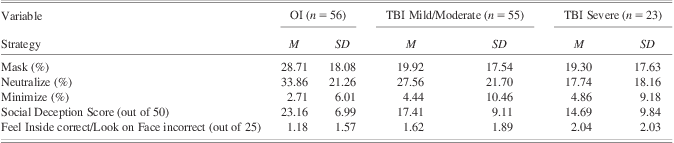
An analysis of variance using the total deception strategy score showed that the Severe TBI group had a lower score than the OI group; the contrast between the two groups was significant, F(1,131) = 16.47, p < .001, η2 = .11. The Mild/Moderate TBI group also had a lower score than the OI group, F(1,131) = 12.94, p < .001, η2 = .09.
Inappropriate Look on Face responses were infrequent, but occurred marginally more often in the Severe TBI group than in the OI group, F(1,131) = 3.80, p = .053, η2 = .03. The Mild/Moderate TBI and OI groups did not differ in the number of inappropriate Look on Face responses, F(1,131) = 1.67, p > .10, η2 = .01.
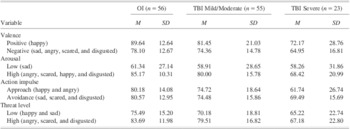
Dimensions of Emotion (Table 5)
Valence: positive versus negative
Positive emotions (happiness) were judged more accurately than negative emotions (average of sadness, anger, disgust, fear); the main effect for valence was significant, Wilks's Λ = .85, F(1,131) =22.63, p < .001, η2 = .15. However, the TBI groups were not less sensitive to valence than the OI group; thus, neither of the group × valence interactions was significant.
Dimensions of emotions performance means by group

Arousal level: high versus low
High arousal emotions (happiness, anger, disgust, fear) were judged more accurately than low arousal emotions (sadness); the arousal main effect was significant, Wilks's Λ = .77, F(1,131) = 38.53, p < .001, η2 = .23. However, sensitivity to arousal level varied somewhat across groups; the interaction involving the contrast of the Severe TBI and OI groups showed a trend toward significance, F(1,131) = 3.08, p < .09, η2 = .02. Post hoc comparisons showed that the accuracy of the Severe TBI group did not vary as a function of low versus high arousal emotions (p > .10); in contrast, the OI group judged high arousal emotions more accurately than negative emotions (p < .001). Alternatively, the Severe TBI and OI groups did not differ in accuracy for low arousal emotions (p > .10), but the OI group judged high arousal emotions more accurately than the Severe TBI group (p < .001). The Mild/Moderate TBI group did not differ from the OI group as a function of arousal level.
Action impulse: avoidance versus approach
Accuracy tended to be higher for emotions evoking avoidance (disgust, fear, sadness) than for those evoking approach (happiness, anger), Wilks's Λ = .86, F(1,131) = 3.45, p < .07, η2 = .03. However, sensitivity to action impulse did not differ across groups; neither of the group × action impulse interactions was significant.
Threat: high versus low
High threat emotions (anger, disgust, sadness) were judged more accurately than low threat emotions (happiness, sadness), Wilks's Λ = .93, F(1,131) = 10.59, p < .001, η2 = .08. However, the TBI groups were not less sensitive to threat than the OI group; neither of the group × threat interactions was significant.
Discussion
Childhood TBI disrupts the understanding of emotion. Both TBI groups performed more poorly than the OI group in overall performance on the EEFT task. This confirms previous studies of childhood TBI showing impaired comprehension of emotional expression (Schmidt et al., Reference Schmidt, Hanten, Li, Orsten and Levin2010; Tlustos et al., Reference Tlustos, Chiu, Walz, Taylor, Yeates and Wade2011; Tonks et al., Reference Tonks, Williams, Frampton, Yates, Wall and Slater2008) and emotive communication of happy and sad (Dennis et al., Reference Dennis, Barnes, Wilkinson and Humphreys1998). It expands previous reports by showing that, within the same task, both emotional expression and emotive communication are more difficult for children with TBI when the task involves discriminating among five (rather than two) basic emotional expressions.
Other new information is that the TBI and OI groups differed in the strategies for emotive communication. Even when they were successful in communicating a socially appropriate emotion, rather than a felt emotion, the TBI groups were less developmentally mature in their strategies and were less likely to be actively deceptive. Both TBI groups used masking and deception strategies less frequently than the OI group, like younger, typically developing children (Saarni, Reference Saarni1984). Children with TBI of any level of severity may have difficulty understanding how emotions are modulated socially, and this may make their awareness of social affect both more unreliable and more limited in range. That children with TBI are less likely to choose a contrasting emotion when understanding emotional deception may also make more shallow their reciprocal peer comprehension of emotional communication. Whether and how deficits in affective ToM are related to peer rejection remains to be studied. Even with less mature strategies for social emotions, the Mild–Moderate TBI group was socially appropriate. In contrast, the Severe group produced socially inappropriate responses (albeit infrequently), which underscores their more severe affective ToM deficit.
This study, we believe, is the first to demonstrate that children with severe TBI fail to differentiate the core emotional dimension of arousal. Compared to the OI and Mild–Moderate groups, who judged high arousal emotions more accurately than low arousal emotions, the Severe TBI group showed no arousal effect, suggesting that they may fail to discriminate the social message conveyed by the level of arousal in an affective situation. How this is related to cooperative group play and reciprocal social activities remains to be determined.
The TBI-OI group differences are not a function of inability to perform the task. All children included in the study had successfully demonstrated that they understood the parameters of the task and could perform it on pretests. In addition, the groups did not differ on certain individual emotions (e.g., Look on Face for sad emotion scenarios). More significantly, the within-group analyses showed that, for all groups, emotional expression was easier than emotive communication. Furthermore, all groups show many of the dimensional effects reported in the literature: they judged positive emotions more accurately than negative emotions; they judged emotions evoking avoidance more accurately than those evoking approach; and high threat emotions more accurately than low threat emotions.
As the products of attention currently in a state of activation, working memory is now invoked to explain performance on many cognitive tasks. To be sure, any cognitive task requires an alerting network, response preparation, sustaining instructions in memory for the duration of the task, and so on; furthermore, children with TBI perform poorly on a range of working memory tasks (e.g., Roncadin, Guger, Archibald, Barnes, & Dennis, Reference Roncadin, Guger, Archibald, Barnes and Dennis2004). However, working memory is a poor explanation of emotion task performance. Working memory demands (recalling the brief oral vignettes) for the Feel Side and Look on Face conditions were the same, but the Look on Face condition was more difficult for all groups. Performance varied by emotion type, even though the working memory demands were comparable across emotion types.
The study is not without limitations. The study design is retrospective, and an optimal study would be prospective, following many children for several years from the time of injury. The sample is age-restricted because we studied preadolescent children, 8–13 years of age, so we cannot make generalizations about affective ToM in preschoolers or adolescents. The sample of 134 participants is smaller than optimal for the exploration of complex interactions among variables. The sample size of the severe TBI group is relatively small, so power is limited.
Despite these limitations, the study indicates that childhood TBI is associated with deficits in identifying basic emotions, insensitivity to the dimensions that differentiate basic emotions, and the ability to understand deceptive facial expressions that serve a social-communicative function. Three sets of future directions emerge from these social-affective problems, the first concerned with real-world social consequences, the second with underlying cognitive mechanisms, and the third with neural bases.
Children with TBI have difficulty understanding emotions as a form of communication nuanced according to the needs and mental states of the viewer. Facial expressions provide an overt cue about others’ intentions; for example, anger and fear result in a “vigilant” style of scanning compared to non-threat facial expressions (e.g., sad, happy, and neutral) (Green et al., Reference Green, Williams and Davidson2003). Our ability to detect another's intention to approach or avoid may shape social interactions (Adams, Ambady, Macrae, & Kleck, 2006). The social consequences of insensitivity to key emotional dimensions in faces, such as arousal, are likely to be considerable for children with severe TBI.
Poor emotive communication may also be related to an inability to detach from the typical or habitual. Humans have an ability to display facial expressions that contradict their mental states, termed mind-body dissonance (Huang & Galinsky, Reference Huang and Galinsky2011). There are obvious social advantages to this skill, such as being able to feel an emotion but modulate its expression according to the informational needs of the recipient and the social needs of the sender. More broadly, however, the mismatch of felt and expressed emotion provides a cognitive advantage because it expands the boundaries of cognitive categories to include atypical exemplars when the environment becomes atypical (Huang & Galinsky, Reference Huang and Galinsky2011). The difficulty of children with TBI in emotive communication, a form of mind-body dissonance, suggests the testable prediction that they will also fail to exhibit the typical expansion effect (i.e., an increase in category inclusiveness whereby atypical exemplars or non-prototypes become incorporated into a given category; Huang & Galinsky, Reference Huang and Galinsky2011) during situations such as recalling a sad event while smiling.
How performance on the present task is related to measures of more ecological or “real-world” social performance remains to be studied. Although a recent study failed to find an association between emotional expression and parent ratings of social outcomes after TBI (Tlustos et al., Reference Tlustos, Chiu, Walz, Taylor, Yeates and Wade2011), the social expression of emotions, emotive communication, may be related to post-injury social adjustment, as well as to a lack of emotional flexibility in real-world contexts involving the home, playground, and classroom.
The relation between understanding and producing emotions remains to be investigated. Because our study is about social cognition (specifically, what children understand about facial expressions of emotion), our measures involve comprehension. Future research might ask children with TBI and OI controls to express happiness, sadness, anger, fear, and disgust, while measuring the 42 muscles involved in expressing facial emotion. Hypotheses could concern the difference between how children express emotions they feel and how they produce deceptive facial expressions that serve a social communication purpose. In a “felt” smile, for instance, the orbicularis oculi, pars lateralis muscle make the eyebrows and the skin between the upper eyelid and the eyebrow come down slightly, whereas in a deceptive “look on face” smile, only the zygomatic major muscle moves.
Complex cognitive-affective behaviors such as those studied here are based in dynamic coalitions of “cognitive” and “affective” brain areas, especially hubs like the amygdala with a high degree of connectivity (Pessoa, Reference Pessoa2008) and the anterior cingulate cortex, where reinforcers are linked to motor centers that express affect and execute controlled, goal-directed behavior (Shackman et al., Reference Shackman, Salomons, Slagter, Fox, Winter and Davidson2011). Recent theoretical models dissociate an automatic social processing of inner feelings from a social processing system under conscious cognitive-inhibitory control (Satpute & Lieberman Reference Satpute and Lieberman2006). Children with TBI have difficulties with inhibitory control (Leblanc et al., Reference Leblanc, Chen, Swank, Ewing-Cobbs, Barnes, Dennis and Schachar2005; Sinopoli, Schachar, & Dennis, Reference Sinopoli, Schachar and Dennis2011; Sinopoli & Dennis, Reference Sinopoli and Dennis2012) that may make it difficult for them to cancel or restrain typical response patterns, and thereby contribute to difficulties in emotive communication. Recent research has investigated the brain regions associated with avoidance and approach motivation (Berkman & Lieberman, Reference Berkman and Lieberman2009), and the brain systems concerned with affective mental states (Hein & Singer, Reference Hein and Singer2008), but the relation between sensitivity to emotion dimensions and pattern of damage in this childhood TBI cohort in relation to cognitive-affective networks is yet to be investigated.
Although clinical reports about children with TBI often highlight their limited and/or unmodulated social-affective behavior, research studies have generally concerned cognition rather than affect, and research on affect has focused on how children with TBI understand facial and vocal expressions of emotion. In this study, we have assessed directly the ability of children with TBI to identify both inner feelings and socially expressed emotions. The data provide some insights into how and why disorders of affect might contribute to the documented social difficulties of these children (Yeates et al., Reference Yeates, Bigler, Dennis, Gerhardt, Rubin, Stancin and Vannatta2007).
Acknowledgments
This paper was supported by National Institute of Neurological Diseases and Stroke Grant 1 RO1 HD 04946,“Social Outcomes in Pediatric Traumatic Brain Injury.” The information presented in this manuscript has never been published either electronically or in print elsewhere. No conflicts of interest exist regarding this manuscript.