





Introduction
Thermal tolerance is a key component of insect physiology and has been central to ecological and evolutionary research (Hoffmann et al., Reference Hoffmann, Anderson and Hallas2002; Feder and Mitchell-Olds, Reference Feder and Mitchell-Olds2003; Chown and Nicolson, Reference Chown and Nicolson2004). Because insects rely on ambient temperatures to regulate their physiological processes (Heinrich, Reference Heinrich1994; Colinet et al., Reference Colinet, Sinclair, Vernon and Renault2015), increasing climatic variability and the rising frequency of extreme temperatures pose major challenges by increasing the likelihood of exceeding critical thermal limits (Easterling et al., Reference Easterling, Meehl, Parmesan, Changnon, Karl and Mearns2000; Sunday et al., Reference Sunday, Bates, Kearney, Colwell, Dulvy, Longino and Huey2014). Many species, particularly those in tropical environments, already live close to their upper thermal limits and experience high energetic demands and reduced tolerance (Dillon et al., Reference Dillon, Vennard, Buckling and Charnley2005; Deutsch et al., Reference Deutsch, Tewksbury, Huey, Sheldon, Ghalambor, Haak and Martin2008; Sunday et al., Reference Sunday, Bates, Kearney, Colwell, Dulvy, Longino and Huey2014). Survival under such conditions depends on behavioural thermoregulation, microhabitat selection, and inducible physiological responses to heat and cold stress (Pincebourde and Suppo, Reference Pincebourde and Suppo2016; Denlinger and Yocum, Reference Denlinger, Yocum, Hallman and Denlinger2019). Importantly, thermal tolerance is shaped not only by genetic architecture but also by ecological and developmental factors such as thermal history, host nutritional quality, and life stage (Huey et al., Reference Huey, Berrigan, Gilchrist and Herron1999; Nyamukondiwa and Terblanche, Reference Nyamukondiwa and Terblanche2009; Phungula et al., Reference Phungula, Krüger, Nofemela and Weldon2023), which ultimately influence insect distribution, population dynamics, and evolutionary trajectories (Pörtner et al., Reference Pörtner, Bennett, Bozinovic, Clarke, Lardies, Lucassen, Pelster, Schiemer and Stillman2006; Angilletta, Reference Angilletta2009; Chown et al., Reference Chown, Gaston and Fox2016).
Nutrition plays a central role in shaping thermal tolerance because it determines the accumulation of key metabolic reserves – particularly lipids – that underpin stress resistance (Mitchell et al., Reference Mitchell, Boardman, Clusella-Trullas and Terblanche2017). Reduced lipid stores may weaken certain physiological responses, yet reductions in body lipids can also increase water uptake (Raubenheimer and Gäde, Reference Raubenheimer and Gäde1993), enhancing heat tolerance through improved evaporative cooling or desiccation resistance (Chown and Nicolson, Reference Chown and Nicolson2004). Crucially, the nutritional environment experienced during larval development determines much of the structural and physiological foundation of the adult phenotype (Prekas et al., Reference Prekas, Rodovitis, Bataka, Nestel, Nakas and Papadopoulos2023). Adult body size and the development of wings and reproductive organs are largely fixed during larval growth (Chaudhury, Reference Chaudhury1989; Awmack and Leather, Reference Awmack and Leather2002; Nijhout, Reference Nijhout2003; Boggs and Freeman, Reference Boggs and Freeman2005; Colasurdo et al., Reference Colasurdo, Gélinas and Despland2009; Araújo et al., Reference Araújo, Gil and e-Silva2012; Helm et al., Reference Helm, Rinehart, Yocum, Greenlee and Bowsher2017; Poças et al., Reference Poças, Crosbie and Mirth2022). Moreover, the quantity and quality of larval nutrition determine the energetic reserves available to sustain metamorphosis and fuel adult physiological processes (Nijhout, Reference Nijhout2003; Nijhout and Grunert, Reference Nijhout and Grunert2010).
Consistent with this, diet quality and quantity during development and adulthood strongly influence reproduction, ageing, and stress tolerance through carry-over effects (Yuval et al., Reference Yuval, Kaspi, Shloush and Warburg1998; Hahn, Reference Hahn2005; Andersen et al., Reference Andersen, Kristensen, Loeschcke, Toft and Mayntz2010). As larvae acquire nutrients, these resources support immediate growth but also provide essential reserves used during pupation and adulthood, a critical feature of holometabolous life cycles (Mattson, Reference Mattson1980; Vijendravarma et al., Reference Vijendravarma, Narasimha and Kawecki2012). Many holometabolous insects even accumulate residual larval reserves that enhance adult reproductive success (De Block and Stoks, Reference De Block and Stoks2005; Pechenik, Reference Pechenik2006). Because larval growth affects adult size and metabolic budgets, robust mechanisms regulate the attainment of a ‘critical weight’ before metamorphosis (Davidowitz et al., Reference Davidowitz, D’Amico and Nijhout2003, Reference Davidowitz, Roff and Nijhout2005; Nijhout, Reference Nijhout2003), and larvae can adjust growth rates via endocrine pathways such as the insulin receptor drop (Mirth et al., Reference Mirth, Truman and Riddiford2005). Phenotypic plasticity in dietary responses also mediates life-history trade-offs and may facilitate evolutionary diversification (West-Eberhard, Reference West-Eberhard2003; Levis and Pfennig, Reference Levis and Pfennig2016), although distinguishing plastic from evolved responses remains challenging.
In both larval and adult stages, insects regulate their intake of proteins, carbohydrates, and lipids to optimise performance (Mayntz et al., Reference Mayntz, Raubenheimer, Salomon, Toft and Simpson2005; Lee et al., Reference Lee, Simpson, Clissold, Brooks, Ballard, Taylor, Soran and Raubenheimer2008; Behmer, Reference Behmer2009; Jensen et al., Reference Jensen, Mayntz, Toft, Clissold, Hunt, Raubenheimer and Simpson2012), and macronutrient balance shapes major life-history traits such as lifespan and fecundity. Diets with low protein-to-carbohydrate (P:C) ratios can extend longevity, whereas higher P:C ratios maximise egg production (Carvalho et al., Reference Carvalho, Kapahi and Benzer2005; Lee et al., Reference Lee, Simpson, Clissold, Brooks, Ballard, Taylor, Soran and Raubenheimer2008; Fanson et al., Reference Fanson, Fanson and Taylor2012; Fanson and Taylor, Reference Fanson and Taylor2012). Nutrient deficiencies impair growth and reproduction (Bauerfeind and Fischer, Reference Bauerfeind and Fischer2005; Raubenheimer et al., Reference Raubenheimer, Simpson and Mayntz2009), with protein limitation reducing fecundity (Wang and Clark, Reference Wang and Clark1995), a common constraint for fruit-feeding insects (Mattson, Reference Mattson1980; Adams and Gerst, Reference Adams and Gerst1991; Hendrichs et al., Reference Hendrichs, Katsoyannos, Papaj and Prokopy1991). These nutritional influences interact with physiological and behavioural mechanisms – including hardening responses, altered energy allocation to growth, extended development time, or adaptive changes in foraging behaviour – to modulate stress tolerance under fluctuating environmental conditions (Mattson, Reference Mattson1980; Reichling and German, Reference Reichling and German2000; Sørensen et al., Reference Sørensen, Kristensen and Loeschcke2003, Reference Sørensen, Norry, Scannapieco and Loeschcke2005; Lobe et al., Reference Lobe, Bernstein and German2006; Lalouette et al., Reference Lalouette, Koštál, Colinet, Gagneul and Renault2007).
Ceratitis capitata (Diptera: Tephritidae) is a globally important, polyphagous, and highly invasive pest, able to establish beyond its northern distribution limits due to repeated introductions and its ability to survive in marginal environments (Siebert and Cooper, Reference Siebert and Cooper1995; Papadopoulos et al., Reference Papadopoulos, Carey, Katsoyannos and Kouloussis1996, Reference Papadopoulos, Katsoyannos and Carey1998; Peñarrubia-María et al., Reference Peñarrubia-María, Avilla and Escudero-Colomar2012; Wernicke et al., Reference Wernicke, Egartner, Blümel, Moraiti and Papadopoulos2024). Its invasion success worldwide further reflects traits such as rapid generation times, polyphagy, host-switching, plastic and adaptive responses to thermal stress, combined with high propagule pressure (Carey, Reference Carey1991; Malacrida et al., Reference Malacrida, Gomulski, Bonizzoni, Bertin, Gasperi and Guglielmino2007). The species possesses a broad thermal niche supported by physiological mechanisms – including heat-shock protein induction and cryoprotectant production (Toxopeus and Sinclair, Reference Toxopeus and Sinclair2018; Dionysopoulou et al., Reference Dionysopoulou, Papanastasiou, Kyritsis and Papadopoulos2020; Papadopoulos et al., Reference Papadopoulos, Koskinioti, Zarpas and Papadopoulos2023) and by behavioural and developmental plasticity (Nyamukondiwa et al., Reference Nyamukondiwa, Kleynhans and Terblanche2010; Dionysopoulou, Reference Dionysopoulou2021; Papadogiorgou et al., Reference Papadogiorgou, Papadopoulos, Moraiti, Verykouki and Papadopoulos2024). Although medfly thermal tolerance has been extensively studied across life stages (Terblanche et al., Reference Terblanche, Nyamukondiwa and Kleynhans2010; Pieterse et al., Reference Pieterse, Terblanche and Addison2017; Weldon et al., Reference Weldon, Nyamukondiwa, Karsten, Chown and Terblanche2018; Papadopoulos et al., Reference Papadopoulos, Koskinioti, Zarpas and Papadopoulos2023) and acclimation responses are well documented (Whitman and Agrawal, Reference Whitman and Agrawal2009; Nyamukondiwa et al., Reference Nyamukondiwa, Kleynhans and Terblanche2010; Papadogiorgou et al., Reference Papadogiorgou, Moraiti, Nestel, Terblanche, Verykouki and Papadopoulos2023, Reference Papadogiorgou, Verykouki and Papadopoulos2025), diet-induced variation – particularly from early-life nutrition – remains poorly understood.
Beyond its ecological importance as one of the most invasive agricultural pests, C. capitata is also among the most extensively mass-reared insect species because of the central role of the Sterile Insect Technique (SIT) programmes in controlling this pest. Billions of sterile flies are produced annually worldwide, making larval diet composition a major determinant of production costs and insect quality (Klassen et al., Reference Klassen, Curtis, Hendrichs, Dyck, Hendrichs and Robinson2021; Parker et al., Reference Parker, Mamai and Maiga2021). Brewer’s yeast constitutes the principal protein source in standard larval diets and is also one of the most expensive ingredients. Consequently, numerous studies have investigated whether reducing brewer’s yeast content affects developmental performance and adult quality (Economopoulos et al., Reference Economopoulos, Al-Taweel and Bruzzone1990; Nestel et al., Reference Nestel, Nemny‐Lavy and Chang2004). Most nutritional studies in medfly mass-rearing systems have focused on conventional quality parameters, such as development, survival, fecundity, and reproductive performance, whereas possible carry-over effects of larval diet on physiological traits associated with environmental stress resistance remain poorly understood.
This study investigates how larval nutritional environment influences adult physiological responses to thermal stress, including critical thermal limits (CTmin, CTmax) and chill coma recovery time (CCRT), providing insight into how early-life nutrition shapes developmental plasticity and adult thermal physiology. Understanding these nutritional carry-over effects may improve predictions of medfly responses to increasing climatic variability and contribute to the development of more effective pest management strategies under fluctuating thermal conditions. Based on previous evidence that larval diet can have lasting effects on adult physiology under artificial rearing conditions, we hypothesised that variation in larval brewer’s yeast content would influence adult thermal tolerance, with larvae reared on brewer’s yeast-rich diets expected to produce adults with enhanced resistance to thermal extremes.
Materials and methods
Laboratory conditions
The study was conducted in the Laboratory of Entomology and Agricultural Zoology, at the University of Thessaly (Greece, Magnesia, Volos), from January to July 2023. Experimental conditions were maintained at 24 ± 1°C, 65 ± 5% relative humidity (RH), and a 14:10 (L:D) photoperiod with light from 07:00 to 21:00.
Insects and rearing procedures
The C. capitata population used in the current study was derived from infested mandarins collected in Lechonia (Volos, Greece). Infested fruits were placed in trays containing sand and covered with organdie cloth to prevent infection by other insects. Upon completion of larval development, larvae exited the fruits and pupated in the sand. Pupae were subsequently collected by sieving, transferred to Petri dishes, and maintained in adult rearing cages until emergence.
Adults were kept in 30 cm × 30 cm × 30 cm wooden cages, with three sides covered with wire mesh to ensure ventilation and the fourth side made of glass. Adults were provided ad libitum access to water and a standard diet consisting of yeast hydrolysate, sugar, and water in a 1:4:5 ratio (Papanastasiou et al., Reference Papanastasiou, Carey and Papadopoulos2019). Females laid eggs in plastic, hollow domes containing 0.5 mL of orange juice (Diamantidis et al., Reference Diamantidis, Papadopoulos and Carey2008). Eggs were transferred to cotton disks saturated with larval diet for development (Boller et al., Reference Boller, Katsoyannos, Remund and Chambers1981). The larval diet comprised 50 g sugar, 50 g brewer’s yeast, 25 mg soybean flour, 1 g salt mixture, 4 g ascorbic acid, 4 g citric acid, 0.75 g sodium propionate, and 250 mL water (Boller et al., 1981). Larvae pupated in sterilised sand until adult emergence. The F4 progeny of wild flies were used in the current study.
Experimental procedure
To evaluate the effect of larval diet on adult C. capitata responses to environmental stressors, larvae were reared on an artificial gel-based diet. The diet consisted of 250 g water, 25 g soybean flour, 40 g sugar, 1 g salt mixture, 4 g citric acid, 0.75 g sodium propionate, 2 g agar, 0.2 g nipagin, and brewer’s yeast as the primary protein source. Brewer’s yeast was provided at six different levels (table 1), with 50 g corresponding to 100% brewer’s yeast levels, representing the standard laboratory diet, and lower levels expressed as percentages of this reference level.
Composition of the larval gel diet treatments used for Ceratitis capitata. Brewer’s yeast was used as the primary protein source and was provided at different proportions relative to the reference laboratory diet. The reference diet contained 50 g brewer’s yeast and was defined as 100% of the reference brewer’s yeast level. The remaining treatments contained 50%, 25%, 10%, 5%, and 2.5% of the brewer’s yeast content of the reference diet, corresponding to 25, 12.5, 5, 2.5, and 1.25 g brewer’s yeast, respectively. All other diet components were kept constant among treatments and consisted of 250 g water, 25 g soybean flour, 40 g sugar, 1 g salt mixture, 4 g citric acid, 0.75 g sodium propionate, 2 g agar, and 0.2 g nipagin

Table 1 Long description
Diet treatments are listed with brewers yeast given as percent of the reference diet and as grams. Treatment 1 lists 100 percent and 50 g. Treatment 2 lists 50 percent and 25 g. Treatment 3 lists 25 percent and 12.5 g. Treatment 4 lists 10 percent and 5 g. Treatment 5 lists 5 percent and 2.5 g. Treatment 6 lists 2.5 percent and 1.25 g.
Eggs were collected from artificial oviposition substrates placed in the rearing cages and transferred onto black filter paper for counting before being placed in Petri dishes containing the larval gel diet at varying brewer’s yeast levels. Each Petri dish was individually placed inside a plastic container on a sand layer and covered with organdie cloth secured with an elastic band. Containers were labelled to identify each treatment. All containers were maintained under controlled laboratory conditions (25°C).
Three days post-placement, egg hatching was assessed under a stereomicroscope to determine hatch rates. Larvae completing development exited the gel diet, fell into the sand, and pupated. The number of pupae per replicate and treatment was recorded daily, and both pupation rate and development duration (egg to pupa) were calculated. Pupae from each treatment were subsequently transferred to individual Petri dishes and maintained under the same laboratory conditions until adult emergence. Adult emergence was recorded daily.
Emerging adults were sexed and grouped in cohorts of seven individuals per plastic demography cage (400 mL plastic cup) according to their larval diet treatment. Cages were maintained under controlled conditions (25 ± 2°C, 50 ± 20% RH, photoperiod 14L:10D) with ad libitum access to sugar and water. Water was provided via a sponge wick placed in direct contact with the cage base that was filled with water. We recorded (a) egg-to-pupa survival, (b) egg-to-pupa developmental duration, and (c) egg-to-adult survival.
Critical thermal limits (CTmin and CTmax)
To determine critical thermal limits, 5-day-old adults obtained from the above larval diet treatments were used (20 males and 20 females). On the fifth day post-emergence, individuals (from each larval diet) were introduced into jacketed chambers containing organ pipes, which were connected to a programmable circulating refrigerated bath (Lauda Eco RE 2025 S) filled with Kryo 30 (a mixture of water, ethylene glycol, and corrosion inhibitors) to allow precise temperature regulation.
Temperature within each chamber was monitored using type T thermocouples (36 SWG) inserted into one of the organ pipes. Thermocouples were interfaced with a Picotech TC-08 device (Pico Technology, Cambridge, UK), and temperatures were recorded at 1 Hz using PicoLog software.
All trials began at 25°C, followed by a 10-min equilibration period. Temperature was gradually decreased (to determine CTmin) or increased (for CTmax) at a constant rate of 0.25°C/min. Critical thermal limits were defined as the temperature at which individuals lost coordinated movement and no longer responded to gentle tactile stimulation with a thermally inert probe, such as a fine paintbrush (Nyamukondiwa and Terblanche, Reference Nyamukondiwa and Terblanche2010).
Chill coma recovery time (CCRT)
On the fifth day after emergence, cohorts of 20 individuals (10 males and 10 females) from each larval dietary treatment were placed into 35-mL glass vials closed with cotton wool stoppers. The vials were immersed in an ice–water mixture at 0°C for 4 h, inside a Styrofoam cooler kept at ambient laboratory temperature (25°C) and in complete darkness. Temperature within the vials was continuously monitored using either an analogue thermometer or a HOBO data logger positioned in an empty reference vial submerged in the slurry water.
After the cold exposure, individuals were transferred to Petri dishes (Ø 5 cm) in a supine position using a fine paintbrush. Recovery was observed for a period of 1 h under controlled laboratory conditions (25 ± 1°C, 60 ± 5% RH), with dishes covered by a transparent lid to prevent escape. Recovery was defined as the ability to right themselves without external stimulation. The time required for each fly to assume an upright posture was recorded as the CCRT, following the protocol of Overgaard and MacMillan (Reference Overgaard and MacMillan2017). Mortality during the assay (i.e. flies that did not survive the 0°C exposure) and censored individuals (alive but failing to recover within 1 h) were recorded.
Statistical analysis
All statistical analyses were performed using Jamovi v.2.6.19 (The Jamovi Project, 2023). The effects of larval dietary brewer’s yeast level on immature performance were analysed separately for egg-to-pupa and egg-to-adult emergence. Egg-to-pupa developmental success and adult emergence were treated as binary outcomes (survived/did not survive) and analysed using binary logistic regression models. Developmental duration from egg to pupa was analysed as a continuous response variable using linear regression, with brewer’s yeast level included as a continuous predictor.
Thermal tolerance traits, including CTmin, CTmax, and CCRT, were analysed using generalised linear models, with larval brewer’s yeast level included as a continuous predictor and sex included as a fixed factor. For multiple comparisons across traits and levels, Bonferroni correction was applied to adjust P-values. Model assumptions were verified through examination of residuals and model fit diagnostics. Statistical significance was set at α = 0.05, and effect sizes were reported where appropriate.
Results
Descriptive statistics for all response variables are provided in tables 2–4, complementing the results presented in the figures.
Descriptive statistics of egg–pupa survival, egg–adult survival, and developmental duration of Ceratitis capitata reared on diets with different brewer’s yeast contents

Table 2 Long description
Measurements compare brewers yeast content as a percent of the reference diet with egg to pupa survival percent, egg to adult survival percent, and developmental duration in days reported with plus or minus values. At 100 percent yeast, egg to pupa survival is 67.50 percent, egg to adult survival is 43.00 percent, and developmental duration is 8.80 plus or minus 0.96 days. At 50 percent yeast, egg to pupa survival is 55.60 percent, egg to adult survival is 45.60 percent, and developmental duration is 9.32 plus or minus 1.40 days. At 25 percent yeast, egg to pupa survival is 76.50 percent, egg to adult survival is 65.50 percent, and developmental duration is 12.75 plus or minus 2.25 days. At 10 percent yeast, egg to pupa survival is 81.00 percent, egg to adult survival is 70.50 percent, and developmental duration is 12.78 plus or minus 2.77 days. At 5 percent yeast, egg to pupa survival is 74.50 percent, egg to adult survival is 63.50 percent, and developmental duration is 13.52 plus or minus 2.49 days. At 2.5 percent yeast, egg to pupa survival is 59.00 percent, egg to adult survival is 41.43 percent, and developmental duration is 11.21 plus or minus 1.86 days.
Descriptive statistics of critical thermal limits (CTmin and CTmax) of adult Ceratitis capitata according to brewer’s yeast content and sex

Table 3 Long description
Brewers yeast percent of the reference diet is listed with CTmin and CTmax in degrees C, each reported as mean with standard deviation and a separate range. At 2.5 percent yeast, CTmin is 6.68 with SD 0.56 and range 5.54 to 8.06; CTmax is 44.21 with SD 0.68 and range 41.35 to 45.35. At 5 percent, CTmin is 6.16 with SD 0.43 and range 5.02 to 7.09; CTmax is 44.40 with SD 0.35 and range 43.69 to 45.00. At 10 percent, CTmin is 6.10 with SD 0.40 and range 5.32 to 6.85; CTmax is 44.19 with SD 0.40 and range 43.49 to 44.88. At 25 percent, CTmin is 6.23 with SD 0.54 and range 5.08 to 8.05; CTmax is 44.44 with SD 0.50 and range 43.01 to 45.73. At 50 percent, CTmin is 6.22 with SD 0.45 and range 5.04 to 7.02; CTmax is 44.30 with SD 0.40 and range 43.58 to 45.06. At 100 percent, CTmin is 6.08 with SD 0.50 and range 4.82 to 7.24; CTmax is 44.29 with SD 0.38 and range 43.27 to 45.08.
Descriptive statistics of chill coma recovery time (CCRT) of adult Ceratitis capitata reared on diets containing different proportions of brewer’s yeast relative to the reference diet, by sex

Table 4 Long description
Chill coma recovery time in minutes is reported as mean with standard deviation and as a range, across brewers yeast levels expressed as percent of the reference diet. At 2.5 percent, mean recovery time is 18.41 minutes with standard deviation 5.91, range 12.09 to 37.03 minutes. At 5 percent, mean is 14.11 with standard deviation 4.96, range 10.00 to 37.42. At 10 percent, mean is 14.93 with standard deviation 5.10, range 10.21 to 32.40. At 25 percent, mean is 16.34 with standard deviation 5.60, range 10.25 to 34.29. At 50 percent, mean is 17.38 with standard deviation 5.86, range 10.18 to 38.07. At 100 percent, mean is 18.94 with standard deviation 8.07, range 10.44 to 45.09.
Effect of larval nutritional regime on immature survival and developmental durations
The relationship between larval dietary brewer’s yeast level and pupation rate in C. capitata is shown in fig. 1. Binary logistic regression indicated that brewer’s yeast level had a marginal effect on pupation (B = −0.002 ± 0.001, z = −1.83, P = 0.067). According to the model, pupation rates slightly changed with increasing brewer’s yeast level, but the effect per unit increase was small and marginally not significant.
Effect of larval dietary brewer’s yeast level on egg-to-pupa survival, with brewer’s yeast content expressed as a percentage of the reference diet (100% = 50 g brewer’s yeast).

The effect of larval dietary brewer’s yeast level on the egg-to-pupa developmental duration is presented in fig. 2. Larval diet brewer’s yeast level had a significant effect on developmental duration from egg to pupa. Higher brewer’s yeast levels reduced the developmental duration, with each unit increase in brewer’s yeast slightly decreasing development time (B = −0.041 ± 0.002, z = −25.6, P < 0.001). The effect was statistically highly significant, and brewer’s yeast levels explained approximately 26% of the variation in developmental duration (R 2 = 0.258).
Effect of larval dietary brewer’s yeast level on egg-to-pupa developmental duration. Brewer’s yeast levels are expressed as a percentage of the brewer’s yeast content in the reference diet (100% = 50 g brewer’s yeast).

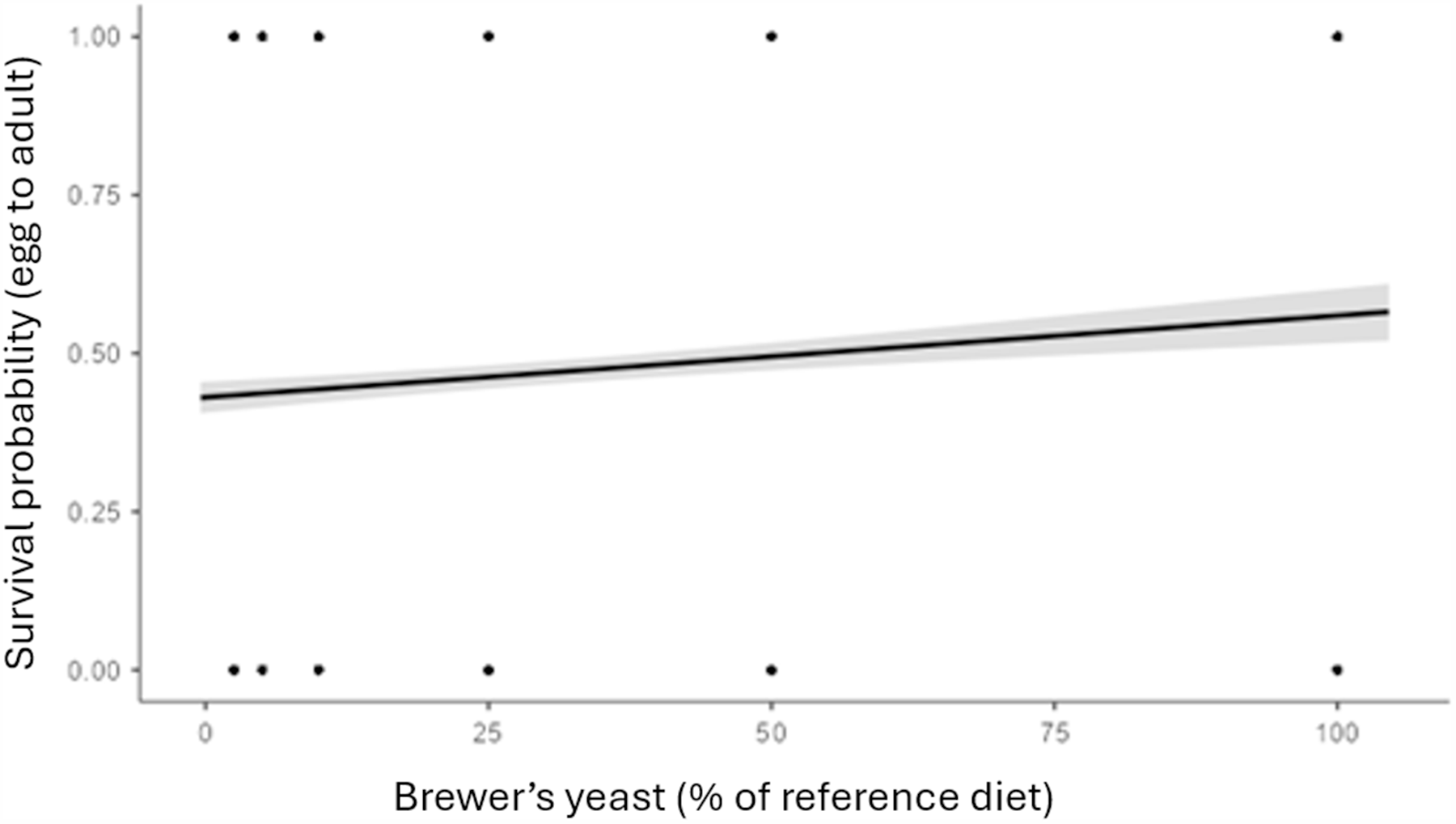
As shown in fig. 3, larval dietary brewer’s yeast level had a significant effect on egg-to-adult emergence. Binary logistic regression indicated that brewer’s yeast level was a significant predictor of adult emergence (B = −0.005 ± 0.001, z = −4.54, P < 0.001). According to the model, adult emergence decreased with increasing brewer’s yeast level, although the effect per unit increase was small.
Effect of larval dietary brewer’s yeast level on adult emergence. Brewer’s yeast levels are expressed as a percentage of the brewer’s yeast content in the reference diet (100% = 50 g brewer’s yeast).

Critical thermal limits (CTmin and CTmax)
Among the factors tested (brewer’s yeast level and sex), only brewer’s yeast level had a significant effect on CTmin (B = −0.0027 ± 0.001, z = −2.79, P = 0.005), indicating that higher brewer’s yeast slightly reduced the CTmin. Sex did not have a significant effect on CTmin (B = 0.0015 ± 0.066, z = 0.02, P = 0.982), and there was no significant interaction between brewer’s yeast level and sex (B = 0.0015 ± 0.002, z = 0.76, P = 0.447), suggesting that the effect of brewer’s yeast level was similar in males and females. Overall, brewer’s yeast explained a small but significant proportion of the variation in CTmin (η 2 = 0.12) (fig.4) .
Critical thermal minimum (CTmin) of adult Ceratitis capitata (females and males) reared on larval diets with different brewer’s yeast levels. Brewer’s yeast levels are expressed as a percentage of the brewer’s yeast content in the reference diet (100% = 50 g brewer’s yeast). Each point represents the observed CTmin of an individual fly. The lines indicate the predicted mean CTmin at each brewer’s yeast level for each sex (blue = females, orange = males), while the shaded areas represent the 95% confidence intervals around these predictions, reflecting the uncertainty of the fitted model.

CTmax was not significantly affected by larval dietary brewer’s yeast level (B = 0.0001 ± 0.0009, z = 0.11, P = 0.911), and sex also had no significant effect (B = 0.080 ± 0.061, z = 1.31, P = 0.189). Additionally, there was no significant interaction between brewer’s yeast level and sex (B = 0.0014 ± 0.0018, z = 0.77, P = 0.443), indicating that the effect of brewer’s yeast on CTmax was similar in males and females (fig. 5).
Critical thermal maximum (CTmax) of adult Ceratitis capitata (females and males) reared on larval diets with different brewer’s yeast levels. Brewer’s yeast levels are expressed as a percentage of the brewer’s yeast content in the reference diet (100% = 50 g brewer’s yeast). Each point represents the observed CTmax of an individual fly. The lines indicate the predicted mean CTmax at each brewer’s yeast level for each sex (blue = females, orange = males), while the shaded areas represent the 95% confidence intervals around these predictions, reflecting the uncertainty of the fitted model.

Chill coma recovery time (CCRT)
Figure 6 shows the effect of larval dietary brewer’s yeast level and sex on the CCRT in C. capitata adults. CCRT increased slightly with increasing brewer’s yeast level (B = 0.032 ± 0.012, z = 2.76, P = 0.006). Sex had no significant effect, and no significant interaction between brewer’s yeast level and sex was detected (P > 0.05), indicating that the brewer’s yeast effect was consistent between males and females.
Chill coma recovery time (CCRT) of adult Ceratitis capitata (females and males) reared on larval diets with different brewer’s yeast levels. Brewer’s yeast levels are expressed as a percentage of the brewer’s yeast content in the reference diet (100% = 50 g brewer’s yeast). Each point represents the observed CCRT of an individual fly. The lines indicate the predicted mean CCRT at each brewer’s yeast level for each sex (blue = females, orange = males), while the shaded areas represent the 95% confidence intervals around these predictions, reflecting the uncertainty of the fitted model.

Discussion
Effects of larval diet on immature survival and adult emergence
The present study demonstrates that larval dietary brewer’s yeast level influences immature performance in C. capitata in a stage-specific manner. While variation in brewer’s yeast level did not significantly affect egg-to-pupa survival, clear effects were observed on developmental timing and survival through to adulthood. Specifically, increasing brewer’s yeast availability accelerated development from egg to pupa but was associated with reduced egg-to-adult emergence, indicating a trade-off between developmental rate and overall survival across the brewer’s yeast gradient.
Protein has long been recognised as a critical component of larval diets in C. capitata and other insects, with severe protein limitation typically resulting in increased mortality, reduced pupation and adult emergence, and prolonged development (Zucoloto, Reference Zucoloto1987; Nestel and Nemny-Lavy, Reference Nestel and Nemny-Lavy2008; Nash and Chapman, Reference Nash and Chapman2014; Negm, Reference Negm2020). In contrast to these studies, egg-to-pupa survival in the present experiment was robust to changes in dietary protein level. Because all treatments were initiated with identical egg numbers (100 eggs in each gel diet), differences in initial larval density and crowding were minimised, suggesting that larval survival to pupation was maintained across a wide range of nutritional conditions under controlled rearing environments.
Despite the absence of brewer’s yeast effects on egg-to-pupa survival, higher brewer’s yeast levels consistently reduced egg-to-pupa developmental duration. This finding aligns with previous work showing that increased dietary protein generally promotes faster larval growth and shorter developmental times in C. capitata (Chang et al., Reference Chang, Kurashima and Albrecht2000, Reference Chang, Kurashima and Albrecht2001; Nestel et al., Reference Nestel, Nemny‐Lavy and Chang2004; Plácido-Silva et al., Reference Plácido-Silva, Zucoloto and Joachim-Bravo2005; Prekas et al., Reference Prekas, Rodovitis, Bataka, Nestel, Nakas and Papadopoulos2023). However, the accelerated development observed at higher brewer’s yeast levels did not translate into increased overall developmental success. Instead, egg-to-adult emergence declined with increasing brewer’s yeast level, suggesting that potential costs associated with high brewer’s yeast intake are expressed during later developmental stages, particularly during pupation and adult eclosion.
Such delayed costs are consistent with the idea that larval nutritional conditions shape developmental trajectories through plastic physiological responses. Larvae of C. capitata appear capable of adjusting growth and development in response to diet quality, likely mediated by endocrine system plasticity (Leftwich et al., Reference Leftwich, Nash, Friend and Chapman2017). While this plasticity allows larvae to maintain early survival and accelerate development under nutritionally rich conditions, it may also impose constraints that become apparent later in development, resulting in reduced adult emergence. More broadly, nutritional plasticity has been shown to play a key role in shaping life-history trade-offs and interactions with environmental factors (Levis and Pfennig, Reference Levis and Pfennig2016), and the patterns observed here likely reflect the limits of such plastic responses under extreme nutritional conditions.
From an applied perspective, the above nutritional effects are also relevant for artificial rearing systems of C. capitata. Larval diet composition represents a critical component of medfly mass rearing programmes, as variation in nutrient balance can influence the accumulation of physiological reserves and the quality of emerging adults (Nestel et al., Reference Nestel, Nemny‐Lavy and Chang2004; Nestel and Nemny-Lavy, Reference Nestel and Nemny-Lavy2008). Previous studies have demonstrated that manipulating larval diet composition, particularly protein availability, can affect developmental performance and adult traits relevant to sterile insect production (Kaspi et al., Reference Kaspi, Mossinson, Drezner, Kamensky and Yuval2002).
Larval nutrition and adult thermal tolerance
Larval dietary brewer’s yeast level exerted detectable carry-over effects on adult thermal performance in C. capitata, indicating that nutritional conditions experienced during development can shape adult stress-related traits. Higher brewer’s yeast intake during the larval stage was associated with a reduction in CTmin and an increase in CCRT, suggesting an influence of larval nutrition on cold tolerance and post-cold recovery. In contrast, CTmax was unaffected by brewer’s yeast level, indicating that larval diet primarily modulates cold-related thermal traits rather than heat tolerance. These effects were consistent across sexes, highlighting a general physiological response to larval brewer’s yeast availability.
Dietary conditions experienced during development are known to shape insects’ thermal tolerance by determining the availability of nutrients required for the biosynthesis of protective compounds, including cryoprotectants and energy reserves, which are essential for coping with thermal extremes (Shreve et al., Reference Shreve, Yi and Lee2007; Smith et al., Reference Smith, Hoi, Eissenberg, Shoemaker, Neckameyer, Ilvarsonn, Harshman, Schlegel and Zempleni2007; Colinet et al., Reference Colinet, Larvor, Bical and Renault2013). In the present study, variation in larval diet composition was associated with differences in adult cold tolerance, as reflected by low CTmin, suggesting that larval nutritional conditions can modify adult cold tolerance. Experimental evidence from D. melanogaster demonstrates that dietary manipulation during larval development can induce strong carry-over effects on adult thermal performance, with carbohydrate-enriched diets enhancing cold tolerance (lower CTmin), whereas protein-enriched diets primarily improve resistance to heat stress (Andersen et al., Reference Andersen, Kristensen, Loeschcke, Toft and Mayntz2010). Our findings are broadly consistent with this framework, as differences in larval protein level affected CTmin but did not significantly affect CTmax. This suggests that lower thermal limits may be more sensitive to developmental nutritional conditions than upper thermal limits in medfly. Cold tolerance is strongly linked to energy availability and the synthesis of cryoprotective compounds, processes that are directly influenced by larval nutrient intake (Shreve et al., Reference Shreve, Yi and Lee2007; Colinet et al., Reference Colinet, Larvor, Bical and Renault2013).
In contrast, the absence of a significant effect of larval brewer’s yeast level on adult CTmax may reflect fundamental physiological constraints associated with heat tolerance. Exposure to high temperatures primarily causes damage to proteins, membrane instability, and cellular damage, which may not be effectively mitigated by increased protein reserves alone. Protein-rich larval diets have been shown to enhance adult heat tolerance in D. melanogaster (Andersen et al., Reference Andersen, Kristensen, Loeschcke, Toft and Mayntz2010) and C. cosyra (Diptera: Tephritidae) (Pullock et al., Reference Pullock, Malod, Manrakhan and Weldon2023). Importantly, Ben-Yosef et al. (Reference Ben-Yosef, Altman, Nemni-Lavi, Papadopoulos and Nestel2023) also demonstrated an effect of larval nutrition on heat tolerance in Bactrocera zonata, a closely related tephritid species. In that study, reducing brewer’s yeast content in the larval diet significantly decreased adult tolerance to acute heat stress, as measured by the time required for knock-down at a constant temperature of 42°C. Thus, the results of Ben-Yosef et al. (Reference Ben-Yosef, Altman, Nemni-Lavi, Papadopoulos and Nestel2023) and the present study both indicate that larval nutritional conditions can influence adult heat responses in tephritid flies, although the magnitude and detectability of this effect may depend on the thermal trait examined. In the present study, larval protein level did not significantly affect CTmax, whereas Ben-Yosef et al. (Reference Ben-Yosef, Altman, Nemni-Lavi, Papadopoulos and Nestel2023) detected an effect using time to knock-down at a fixed high temperature. These endpoints capture related but distinct components of heat tolerance: CTmax reflects the upper critical temperature reached during acute thermal ramping, whereas time to knock-down at a constant temperature also incorporates the rate at which physiological damage accumulates during sustained heat exposure. Consequently, larvae receiving different levels of nutritional resources may differ in their ability to withstand the duration of heat exposure without necessarily differing in the maximum temperature at which coordinated movement is lost. This methodological difference, together with interspecific differences between C. capitata and B. zonata, may therefore contribute to the different patterns observed between studies. More broadly, nutritional effects on thermal tolerance appear to be trait- and taxon-dependent; for example, carbohydrate availability has been shown to increase CTmax in canopy ants (Bujan and Kaspari, Reference Bujan and Kaspari2017), emphasising that the relationship between larval nutrition and adult thermal tolerance is likely shaped by species-specific physiological strategies.
Results for CCRT indicated that larval dietary brewer’s yeast level had a significant carry-over effect on adult cold recovery performance, with CCRT increasing progressively with increasing brewer’s yeast level. Thus, adults originating from higher-level brewer’s yeast larval diets required longer periods to recover from chill coma, whereas those from lower-level brewer’s yeast diets recovered more rapidly. Comparable patterns have been reported in D. melanogaster, where carbohydrate-rich larval diets resulted in faster chill coma recovery relative to protein-rich diets (Andersen et al., Reference Andersen, Kristensen, Loeschcke, Toft and Mayntz2010). Carbohydrates are known to promote lipid accumulation in adult insects (Mayntz et al., Reference Mayntz, Raubenheimer, Salomon, Toft and Simpson2005), and increased lipid reserves have been repeatedly associated with enhanced cold tolerance and faster recovery from chill coma in Drosophila species (Hoffmann et al., Reference Hoffmann, Hallas, Sinclair and Mitrovski2001).
In C. capitata, longer CCRT has been hypothesised to reflect reduced lipid reserves (Pujol-Lereis et al., Reference Pujol-Lereis, Fagali, Rabossi, Catalá and Quesada-Allué2016), a relationship that is consistent with the present findings if increasing larval protein intake shifts resource allocation away from lipid storage. Notably, larval brewer’s yeast level exerted contrasting effects on different components of cold tolerance: higher brewer’s yeast levels reduced CTmin, whereas it simultaneously prolonged CCRT. This divergence suggests that distinct physiological mechanisms underlie cold resistance and cold recovery performance. One possible explanation involves differential allocation to cellular stress-protection pathways, such as the induction of heat shock proteins. Expression of Hsp70 has been linked to improved cold stress resistance in Drosophila (Colinet and Hoffmann, Reference Colinet and Hoffmann2010), and higher protein availability during larval development may provide the necessary reserves to support such protective mechanisms. Although lipid content and Hsp70 expression were not directly quantified in the present study, previous work has shown that adults emerging from protein-poor larval diets possess reduced protein reserves (Kaspi et al., Reference Kaspi, Mossinson, Drezner, Kamensky and Yuval2002; Nestel et al., Reference Nestel, Nemny‐Lavy and Chang2004). Consequently, increasing protein availability during larval development may enhance cold resistance at the cellular level while simultaneously constraining recovery dynamics, reflecting a trade-off between different components of cold tolerance.
In the present study, sex did not significantly influence any of the thermal tolerance traits examined. This result aligns with previous studies reporting limited sex-specific differences in hemolymph properties and cold tolerance in adults (Renault et al., Reference Renault, Hervant and Vernon2002; Papadogiorgou et al., Reference Papadogiorgou, Moraiti, Nestel, Terblanche, Verykouki and Papadopoulos2023). Although sex differences in thermal tolerance are sometimes expected due to variation in body size, energy reserves, or reproductive physiology, these factors may have been largely standardised under the controlled laboratory rearing conditions used in the present study. All individuals were maintained at the same age, temperature, and diet, which likely minimised physiological variation between males and females (Nyamukondiwa and Terblanche, Reference Nyamukondiwa and Terblanche2009). The absence of detectable sex effects also suggests that, under optimal developmental conditions, male and female C. capitata exhibit broadly similar capacities to tolerate thermal stress. This uniformity could have ecological significance, as it implies that both sexes are likely to respond similarly to temperature fluctuations in natural populations, potentially facilitating synchronised activity and reproductive timing under varying environmental conditions.
Our results demonstrate that variation in the quality of larval diet can generate persistent effects on adult thermal performance, highlighting the importance of developmental nutrition in shaping insect physiological plasticity. In natural environments, such nutritional effects may contribute to variation in thermal resilience among individuals developing in different host resources. Because C. capitata is also widely used in SIT programmes, these findings suggest that thermal tolerance could represent an additional physiological trait to consider when evaluating the effects of larval diet composition on mass-reared insects. However, further studies are required to determine whether these effects persist and determine the field performance of released sterile flies.
Acknowledgements
We thank Paraschos Prekas (UTH) for his assistance with Ceratitis capitata rearing, and Kostas Zarpas (UTH) for technical support throughout the study.
Author contributions
According to the ICMJE criteria, G.D.P. and N.T.P. contributed substantially to the conception and design of the work, the acquisition, analysis, and interpretation of data; G.D.P., I.K., and N.T.P. were involved in drafting the work, revising it critically for important intellectual content; N.T.P. provided final approval of the version to be published; and G.D.P., I.K., and N.T.P. agree to be accountable for all aspects of the work in ensuring that questions related to the accuracy or integrity of any part of the work are appropriately investigated and resolved.
Competing interests
The authors declare that they have no conflicts of interest, including specific financial interests, relationships, or affiliations relevant to the subject of this manuscript.




 Open access

