Implications
The need for water in liquid-fed pigs can, in theory and on average, be met via the water contained within the liquid feed. However, this does not take into account variations in the need for water, caused by factors such as illness or hot weather. Access to drinking water for liquid-fed pigs is necessary to ensure the physiological and behavioural requirements of all pigs in a group at all times. Water use below the requirement of the pigs has to be avoided to prevent dehydration and prolonged thirst, whereas excessive water use above requirements can lead to slippery floors and high quantities of effluents. The latter is of particular concern in liquid feeding, where water is a constituent part of the daily food intake.
Introduction
Water is an essential component for life, in pigs as in other mammals, and a 10% loss of body water content results in death (Maynard et al., Reference Maynard, Loosli, Hintz and Warner1979; Patience, Reference Patience2012b). Water has a crucial role in the sustenance of life, as it is a major part of the composition of tissues and is necessary for numerous biochemical reactions. Water is the major component of body fluids that allow transport of nutrients, metabolic waste, hormones and immune cells (Thacker, Reference Thacker2000). It is also essential for the lubrication of joints and for protection of the brain against physical impact (cerebrospinal fluid). Finally, water plays a very important role in maintaining body temperature, acid–base balance and the mineral content of the body (Thacker, Reference Thacker2000). Given its importance and because losses of body water are unavoidable, access to drinking water is essential for maintaining the body’s water content within a very narrow range of variation, which is regulated by means of highly sensitive control mechanisms.
Within the European Union, current legislation prescribes that pigs must have permanent access to fresh water (EU, 2009). In most indoor pig production systems, this obligation is met by the presence of functional drinkers in the pens. Some feeding systems provide pigs with liquid feed, that is the feed is suspended in water, and no additional independent drinker devices are available. Instead, the majority of the water is allocated as part of the liquid feed, and additional water may be provided between meals in the same trough as used for the liquid feed. Depending on the amount delivered, some water may be available permanently or temporarily to the pigs in the feed trough, and this water may contain residual feed. In these situations, liquid feeding systems may pose a problem regarding the fulfilment of pigs’ need for drinking water. In this review, we look at the need for and the provision of water for liquid-fed pigs in relation to their productive performance, health, behaviour and welfare. As most of the research on water provision and consumption has been carried out in dry-fed pigs, we will use these results whenever relevant.
Legislative background and semantic considerations
The current European legislation on the protection of pigs takes its origin in the recommendation by the Council of Europe (1986), in which it is written that ‘All pigs shall have appropriate access to adequate, nutritious and hygienic feed or wholesome liquid each day, and to adequate supplies of water of suitable quality, so as to meet their physiological needs’. In an Annex concerning sows during the perinatal period, the recommendation states that ‘Sows and piglets should have access to water at all times’. Based on the wording of these recommendations, the European Union implemented in its Directive on minimum standards for the protection of pigs (EU, 2001) that ‘All pigs over 2 weeks of age must have permanent access to a sufficient quantity of fresh water’. The reference to meeting physiological needs has thus disappeared, and been replaced by the demand for permanent access.
Despite the clear formulation of the legislation cited above, some words are nevertheless associated with a degree of ambiguity. The first of these is ‘permanent access’. On first reading, this expression appears to be unequivocal, and is thus not defined in the EU Directive. However, permanent access to water also applies to situations where pigs share access to a drinker. In this situation, when one pig is drinking, the other pigs will not have access to water, albeit transient. As such, the meaning of permanent as something that lasts, without modification or interruption, is not sustainable. In reality, permanent access to water is determined by the possibility of the animal to access a source of water available at all times, that is 24 h/day. In other words, it is the water which is permanently present.
Given the permanent presence of water, it should not be necessary to stipulate that water need to be accessible ‘in sufficient quantity’, because if it is always there, it is of unlimited quantity. However, this formulation is presumably included to ensure that the water pressure used in drinkers is sufficient to allow all the pigs to satisfy their water needs. It thus prevents the presence of a slowly dripping tap from complying with the legislation.
A third problem of terminology is the use of the word ‘fresh’ to describe the water to which the pigs shall have access. It is unclear if this means freshly tapped or refers to the quality of the water in terms of bacterial load. It has also given rise to translating problems, as for example the word in the French version of the directive (‘fraiche’) can mean both fresh and cold, whereas drinkable would be translated as ‘potable’ – a word also used in the English language.
Finally, in the literature on water provision and consumption in pigs, several terms are used inconsistently when describing the use of water by pigs. Water consumption (also called water use) by pigs is most often synonymous with the amount of water drawn from the water source, generally measured by a water metre. It therefore includes both water intake (water ingested) as well as water not ingested by the pigs. Water not ingested can be lost independently of the action of pigs, such as leaks in pipes and troughs, dripping water nipples and overflowing water bowls. Water drawn due to the action of pigs but not ingested may be caused by poor drinker design. It may include water drawn by pigs for thermoregulation or without the purpose of drinking, that is manipulation of a drinker as an expression of redirected behaviour. In many studies, the authors use the terms ‘waste’ or ‘spillage’ without defining them clearly. They can mean the difference between the water drawn and the water ingested and include losses with very different origins, as described above. They can also cover a water intake that appears excessive in relation to the physiological needs of the animals (polydipsia). The terms waste and spillage will therefore be used with caution in this review and will refer to water not contributing to the health, welfare and productivity of the pigs. This is defined as the cumulative amount of water lost due to leaking/malfunctioning or poor drinker design as well as water being drawn by the pigs without the purpose of drinking or thermoregulation.
The use of liquid feeding in pig production
In Reference Brooks, Beal and Niven2001, Brooks et al. estimated that ~30% of pigs in Northern and Western Europe were fed liquid diets. In Southern Europe, liquid feeding is widely used in Italy (Nannoni et al., Reference Nannoni, Martelli, Cecchini, Vignola, Giammarco, Zaghini and Sardi2013) and in France, where it is the most commonly used feeding method in pig production, with two out of three producers of sows (Courboulay, Reference Courboulay2015) and fattening pigs (Roguet et al., Reference Roguet, Massabie, Gourmelen and Douguet2007) using liquid feeding systems. Although not wide-spread in North America, around 20% of pigs are liquid-fed in some Canadian provinces (Anderson, Reference Anderson2011), and Asian pig producers are also increasing their investments into this type of feeding system (Caldier, Reference Caldier2005). Missotten et al. (Reference Missotten, Michiels, Ovyn, De Smet and Dierick2010) reported an increase in the use of fermented liquid feed in the EU since the ban in 2006 on the use of antibiotics as growth promoters in pig feed.
Liquid feed (also called wet feed) consists of dry feed mixed with water. It imposes a minimum amount of water that the animal has to ingest with the feed. The dilution rate, expressed as the amount of water (kg or l) per kg of feed, differs between farms and production types, and may vary according to season. In France, for example, it ranges from 2.5 to 4.8 l/kg for pregnant sows, but is usually around 4.4 l/kg, whereas for fattening pigs the ratio is between 2.4 and 3.2 l/kg, usually 2.7 l/kg (Royer et al., Reference Royer, Ernandorena and Escribano2007; Roy et al., Reference Roy, Calvar, landrain and Royer2007b; Massabie et al., Reference Massabie, Roy, Boulestreau-Boulay and Dubois2014). A homogenous mixture is important, and the preparation of the liquid feed and its distribution are usually controlled automatically by a computer. The feed is mixed with water in a tank, and the mixture is then transported by means of a pump via a set of pipes that reaches a trough in each pen. The liquid consistency of the feed enables it to be spread over the entire length of the trough, and a minimum dilution rate of 2.5 l/kg is often needed for the system to function (Royer et al., Reference Royer, Ernandorena and Escribano2007). For sows, the liquid feed is distributed in 1 to 3 meals per day, whereas two daily meals are typically supplied for growing pigs. In both cases, the liquid feed is usually supplied in a long trough, where all animals have simultaneously access to the feed, although exceptions do exist (Roy et al., Reference Roy, Calvar, landrain and Guivarc’h2007a).
The water requirement of liquid-fed pigs
Pigs need to drink water regularly as their bodies lose water constantly via urine, respiration, faeces and skin. Additional losses that must be compensated by water intake occur in sows during gestation (amniotic fluids), at farrowing (blood) and during lactation (milk). In growing pigs and foetuses, water supplies are also needed for tissue growth and body fluids. The range of variation in body water content is extremely narrow (Mroz et al., Reference Mroz, Jongbloed, Lenis and Vreman1995). In humans, a loss of only 1% of body fluids leads to a reduction in appetite and thermoregulatory capacity, a loss of 4% to headaches and difficulty concentrating and a loss in excess of 8% can lead to death (EFSA, 2010). In pigs, as soon as a lower limit of body water content is reached, neuroendocrine signals trigger a sensation of thirst, which motivates the animal to ingest water and restore body water content to its normal level, thus maintaining its water homoeostasis (Mroz et al., Reference Mroz, Jongbloed, Lenis and Vreman1995). If the animal cannot ingest water, the sensation of thirst is maintained and even increased as water content of the body gradually decreases. One of the mechanisms used by pigs to adapt to insufficient access to water is production of hypertonic urine; however, this adaptation is limited by the ability of the kidneys to concentrate urine (Andreoli, Reference Andreoli2000). Symptoms of water deficiency, such as inappetence and oliguria, are often difficult to identify in pigs except in extreme situations as the methods conventionally used for deficits of other nutrients are not adequate (Patience, Reference Patience2012b).
An animal’s physiological need for water is, under normal circumstances, covered by the water ingested together with the water contained in feed. In a thermoneutral environment where water and a standard dry feed are freely available, a healthy growing pig will usually consume between 2.1 and 2.7 l water/kg feed eaten (Li et al., Reference Li, Chénard, Lemay and Gonyou2005; Shaw et al., Reference Shaw, Beaulieu and Patience2006). This ratio may double in situations with severe thermal stress (Huynh et al., Reference Huynh, Aarnink, Verstegen, Gerrits, Heetkamp, Kemp and Cahn2005). A large proportion (85%) of water intake occurs around feeding (Bigelow and Houpt, Reference Bigelow and Houpt1988). In liquid-fed pigs, this is unavoidable as a large proportion of the daily water intake comes from the feed. The dilution rate commonly used in liquid feeding (2.5 to 2.7 l/kg feed) is similar to the ratio of water consumed by growing pigs per kg dry feed eaten. This would indicate that, in theory and on average, the need for water can be met via the intake of liquid feed. However, this does not take into account time-related variations for a given pig, nor variations due to differences between individuals or environmental conditions. Little is known about the need for additional water in liquid-fed pigs, and we have identified only four peer-reviewed studies, which specifically address this question in growing pigs at different stages of production.
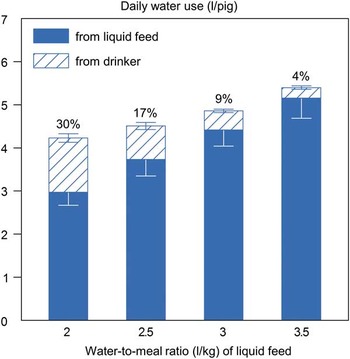
Gill et al. (Reference Gill, Brooks and Carpenter1987) measured the voluntary water consumption of growing pigs (15 to 77 kg live weight), when they were offered liquid feeds at four different dilution rates, ranging from 2 to 3.5 l/kg. Each pen of eight pigs was equipped with a drinking nipple (bite drinker), and a water metre used to measure water disappearance, although ingestion was not verified. In all treatments, the pigs consumed 1.5 kg feed/day, and the total water consumption per treatment can be seen in Figure 1. The water uptake from the liquid feed increased as a function of the dilution rate, whereas the amount of water drawn from the nipple decreased with increasing feed dilution, indicating that the water obtained from the nipple drinkers was related to thirst. Interestingly, the pigs continued to draw water from the nipple even at high dilution rates. Even at the water-to-meal ratio which most closely reflects the usual water consumption in dry-fed pigs (2.5 l/kg), there was still a substantial amount of water drawn from the nipple (17% of total). It is also important to keep in mind that the intakes presented in Figure 1 are averages across pen values, which disguise the variation between pigs, that is pigs which did not manage to eat a sufficient amount of the liquid feed may have ingested a relatively higher fraction of the water drawn from the nipple drinkers.
Total daily water use (l/pig) by growing pigs fed liquid diets at different dilution rates. Solid bars indicate water obtained from the liquid feed, and hatched bars indicate water drawn from the nipple drinker. The percentage of water drawn from the drinker is indicated for each dilution rate (adapted from Gill et al., Reference Gill, Brooks and Carpenter1987).

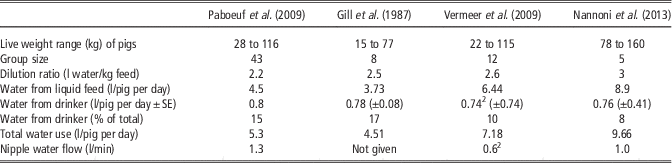
Vermeer et al. (Reference Vermeer, Kuijken and Spoolder2009) fed growing–finishing pigs (22 to 115 kg live weight) three liquid meals per day in a trough, and applied the method of elasticity of demand to assess their motivation to obtain additional water from a drinker in the pen. They imposed an increasing cost on water acquisition by gradually decreasing the flow rate of the drinker, thereby increasing the effort needed to obtain the same amount of water. They used a dilution rate equivalent of 2.6 l/kg, and the total water consumption of the liquid-fed pigs was 7.2 l/pig per day, which was much higher than that of the dry-fed pigs (4.7 l/pig per day). On average, 0.74 l/day was drawn from the drinker by the liquid-fed pigs, which is in agreement with other studies (Table 1). However, liquid-fed pigs did not display a less elastic demand than dry-fed pigs, that is they worked as hard for water as the dry-fed pigs (Vermeer et al., Reference Vermeer, Kuijken and Spoolder2009), suggesting a similar motivation for drinking water. In both treatments, pigs procured less water per day when the flow rate was low, but the effort exerted was not significantly different between dry- and liquid-fed pigs. This also led to an increase in daily drinker occupation per pig from 12 to 30 min for the liquid-fed pigs at the highest and lowest flow rates, respectively. In comparison, daily drinker occupation for the dry-fed pigs, which drank four to five times more water from the drinkers than liquid-fed pigs, were 48 and 150 min, respectively (Vermeer et al., Reference Vermeer, Kuijken and Spoolder2009).
Water useFootnote 1 by liquid-fed growing pigs with free access to a water source

1 Water contained in the liquid feed and water drawn from the drinker, not necessarily ingested.
2 Averaged over four flow rates. Water source was nipple suspended above a bowl.
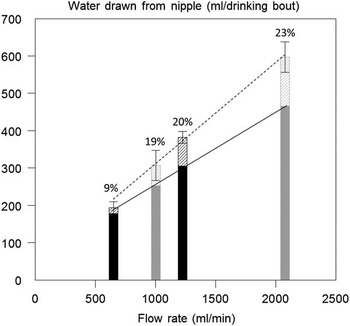
Russell et al. (Reference Russell, Geary, Brooks and Campbell1996) found that newly weaned pigs fed a liquid diet would consume 35% more water in total compared with dry-fed pigs during the first 4 weeks after weaning (20 to 37 kg live weight). Of the water consumed by the liquid-fed pigs, 19% originated from the nipple drinkers, whereas the rest was part of the liquid feed diluted at a ratio of 2.5 l/kg. However, the piglets also grew faster on the liquid diet, due to a higher feed intake, a better transition from milk feeding, lower risk of dehydration and optimal pH of the liquid feed through fermentation. Thus the increase in water use on the liquid feed when calculated per weight gain was only 13%. Water spillage was not measured, but the flow rate of the drinkers was very low (450 ml/min) which has been found to lead to a reduction in the proportion of water lost (Li et al., Reference Li, Chénard, Lemay and Gonyou2005; Figure 2).
Example of quantity of water (ml) ingested (solid bars) and lost (hatched bars) per drinking bout from a conventional nipple drinker at different flow rates (ml/min) in growing–finishing pigs. The percentage of water lost is indicated for each flow rate; bars in black are from growing pigs, and bars in grey are from finishing pigs (adapted from Li et al., Reference Li, Chénard, Lemay and Gonyou2005).

Finally, Nannoni et al. (Reference Nannoni, Martelli, Cecchini, Vignola, Giammarco, Zaghini and Sardi2013) provided liquid-fed finishing pigs (78 to 160 kg live weight) with one drinking nipple per pen, but turned off the water in half the pens. Using a flow rate of 1 l/min and a feed dilution rate of 3 l/kg, they found no differences in the performance of the pigs, and a mean daily water disappearance from the functional drinkers of 0.76 l/pig (Table 1). This mean arose from a large variation between pens ranging from 0.48 to 1.35 l/pig per day. The authors estimated that 80% of the water drawn from the drinkers was not ingested. However, they did not measure spillage, and based this only on observations of the daytime (0800 to 1600 h) duration of contact with drinkers.
These results suggest that the water provided by the liquid feed does not fully satisfy the water requirement of pigs, even at high dilution rates, especially when taking into account the individual variation in water uptake from the liquid feed.
Factors affecting water intake and requirements of pigs
The intake of water varies over time and between individuals (Renaudeau et al., Reference Renaudeau, Frances, Dubois, Gilbert and Noblet2013; Rousselière et al., Reference Rousselière, Hemonic and Marcon2016). Although, in principle, the water requirement of liquid-fed pigs on average can be met via the intake of liquid feed at an appropriate dilution rate, the distribution between pigs of the water provided within liquid feed may not be adjusted to their individual needs, neither within nor between days. The intake of liquid feed may differ greatly between pigs in a group, either due to competition for trough access or to differences in feeding rate (Nielsen, Reference Nielsen1999). In order to ensure that all of the liquid feed is eaten, the quantity distributed at each meal is adjusted to just below ad libitum intake. Even with one feeding space per animal there is still a certain competition between pigs to consume the feed as quickly as possible because the content of the trough is shared. In sows, the speed of ingestion of liquid feed ranged from 1.1 to 2.2 kg/min during the initial 5 min after being fed a liquid meal, and this was not related to the size of the animal (Bøe and Cronin, Reference Bøe and Cronin2015). Unequal distribution of the liquid feed is likely to be a major contributing cause of variation in additional water intake in pigs.
Another cause of variation in water need and intake is related to the health status of the individual pig. An increase in water consumption in piglets has been observed 24 h before an episode of diarrhoea was diagnosed (Madsen and Kristensen, Reference Madsen and Kristensen2005). However, a sick animal may also decrease its water intake due to a reluctance to move caused by fatigue or musculoskeletal disorders (Madec, Reference Madec1985; Junge et al., Reference Junge, Herd, Jezierny, Gallmann and Jungbluth2012). Fever generally induces a decrease in or a loss of appetite (Pijpers et al., Reference Pijpers, Schoevers, van Gogh, van Leengoed, Visser, van Miert and Verheijden1991) and, in the case of liquid-fed pigs where food and water are mixed, this will lead to a significant decrease in water intake. This is likely to aggravate health problems and delay recovery, or lead to death if the pigs have no access to auxiliary drinking water.
Ambient temperature also affects water intake, and this can have welfare consequences for pigs during hot weather. As pigs cannot sweat (Ingram, Reference Ingram1967), they rely on external cooling. This includes wallowing in or showering themselves with water (Bracke, Reference Bracke2011), as well as increasing evaporative heat loss via the lungs through increased respiration rate (Black et al., Reference Black, Bray and Giles1999). Schiavon and Emmans (Reference Schiavon and Emmans2000) estimated water intake of pigs to increase by 0.1 l/day for every 1°C increase in ambient temperature within a broad scale of 6°C to 32°C. Some pig producers increase the dilution ratio of the liquid feed during hot weather but time-related and individual variations in water consumption still necessitate permanent access to drinking water at all times.
The method and equipment used to provide pigs with drinking water (see section below) affect their intake and may cause under- or over-consumption of water. Not all water drawn from the drinkers is ingested by the pigs. This may be due to poor drinker design (Andersen et al., Reference Andersen, Dybkjær and Herskin2014), insufficient or excessive flow rate (Li et al., Reference Li, Chénard, Lemay and Gonyou2005; Figure 2), height of the drinker not adapted to that of the pig, insufficient number of drinkers for the group size or unsuitable position of the drinkers in the pen (Gonyou, Reference Gonyou1996). Over a range of live weights it has been found that about 30% of the water, equivalent to 1.7 l/day per pig, was lost due to an inadequate design and/or flow rate of the nipple drinkers (Larsson, Reference Larsson1997; Andersen and Herskin, Reference Andersen and Herskin2012). The latter found no indication that water spillage was caused by pigs playing with the water nipple. Instead, the nipple design appeared to make it difficult for the pigs to drink without wasting water. Up to a certain level, competition for access to drinkers does not usually limit daily water intake (Turner et al., Reference Turner, Sinclair and Edwards2000), but it leads to more water being spilled (Li et al., Reference Li, Chénard, Lemay and Gonyou2005). Such competition is exacerbated by the synchronisation of ingestive behaviour within a group (Docking et al., Reference Docking, van de Weerd, Day and Edwards2008) and by water consumption from drinkers being linked to the feed consumption (Dybkjær et al., Reference Dybkjær, Jacobsen, Tøgersen and Poulsen2006; Rivest et al., Reference Rivest, Labrecque, Roy, Ricard and Fortin2015), although the latter is less likely to be the case in liquid-fed pigs. The competition is also dependent on the type of drinker and to the flow rate, with increasing competition when the flow rate decreases (Magowan et al., Reference Magowan, O’Connell and McCann2007).
Access to poor quality water can also be a cause of inadequate water intake (Martineau and Morvan, Reference Martineau and Morvan2010). In the absence of specific standards for animals, the standards for human consumption are often used for reference (WHO, 2011), but have no legal value: drinking water should be clear, odourless, tasteless and completely free of chemical contaminants, coliforms, faecal streptococci, sulphite-reducing clostridia, pathogenic staphylococci and Salmonella, and should contain <10 colonies/ml of total bacteria of animal origin. The presence of excessive iron and sulphates can promote the proliferation of certain bacteria, especially Escherichia coli, and can be a risk factor for diarrhoea and gastrointestinal infections in new-born piglets and at weaning (Martineau and Morvan, Reference Martineau and Morvan2010). In 7-week-old piglets, Houben et al. (Reference Houben, van Nes and Tobias2015) found that water-additives that reduced the pH led to an increase in water consumption.
In pregnant sows kept on a highly restricted diet, polydipsia can be observed (Klopfenstein et al., Reference Klopfenstein, Bigras-Poulin and Martineau1996). This condition is characterised by excessive water ingestion, and it is associated with an unfulfilled feeding motivation and insufficient access to roughage to mitigate the feeling of hunger. The sows compensate for the low feed level by increased drinking behaviour (Rushen, Reference Rushen1984), thereby inducing gastric repletion, which plays a role in the short-term appetite control and may induce a satiety effect (Yang et al., Reference Yang, Howard and Macfarlane1981; McHugh and Moran, Reference McHugh and Moran1986; Close and Cole, Reference Close and Cole2000). This is supported by the finding that incorporation of fibre in the diet of sows, which promotes satiety in animals, results in decreased drinking behaviour (Meunier-Salaün et al., Reference Meunier-Salaün, Edwards and Robert2001).
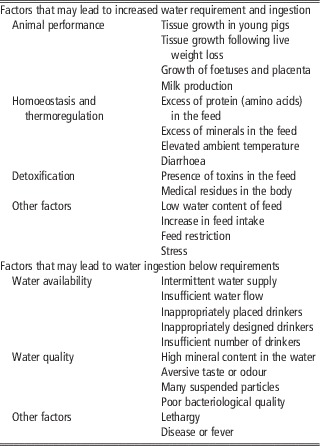
In Table 2, a summary of factors affecting the need for water and water use in pigs above and below their requirements is given. For completeness the table includes some issues not discussed further in this review (i.e. feed composition and detoxification).
Main factors affecting water requirement and ingestion in pigsFootnote 1

1 Based on Mount et al. (Reference Mount, Holmes, Close, Morrison and Start1971), Yang et al. (Reference Yang, Howard and Macfarlane1981), Fraser and Phillips (Reference Fraser and Phillips1989), Terlouw et al. (Reference Terlouw, Lawrence and Illius1991a), Harvey (Reference Harvey1994), Klopfenstein et al. (Reference Klopfenstein, Bigras-Poulin and Martineau1996), Close and Cole (Reference Close and Cole2000), Madsen and Kristensen (Reference Madsen and Kristensen2005), Shaw et al. (Reference Shaw, Beaulieu and Patience2006), Torrey et al. (Reference Torrey, Tamminga and Widowski2008), Vermeer et al. (Reference Vermeer, Kuijken and Spoolder2009), Patience (Reference Patience2012a) and Ahmed et al. (Reference Ahmed, Mun, Yoe and Yang2015).
Methods of drinking water provision for liquid-fed pigs: consequences for animal health and the environment
Drinkers commonly used for pigs are nipple or bowl drinkers. Nipple drinkers often operate on the basis of a ball or a rod for the pig to bite or push to release water flow. Bowls can have a constant water level with automatic filling or require the pig to push a plate with its snout to fill the bowl with water. Bowl drinkers are discovered significantly sooner than nipple drinkers by pigs following weaning (Phillips and Fraser, Reference Phillips and Fraser1991). The natural drinking behaviour of pigs is by lapping at a water surface, such as is provided by water bowls or troughs. Bøe and Kjelvik (Reference Bøe and Kjelvik2011) found similar amounts of water ingested from nipple drinkers as from bowl drinkers in the week following weaning, but in this study the piglets were familiar with the nipple drinkers from the nursing pen. In this and other studies (e.g. Torrey et al., Reference Torrey, Tamminga and Widowski2008), large amounts of water were spilled from the nipple drinkers, and the abrupt transition from a mainly liquid diet (milk) to a solid diet requires adaptation to drinkers as the source of liquid (Dybkjær et al., Reference Dybkjær, Jacobsen, Tøgersen and Poulsen2006). Under-consumption of water can lead to dehydration and atrophy of the intestinal villi, frequently seen in pigs within 7 days after weaning (Lallès et al., Reference Lallès, Konstantinov and Rothkötter2004). However, this risk is greatly reduced if newly weaned pigs have had access to the same type of drinker pre-weaning or if they are liquid-fed, which has been found to improve their performance (Odle and Harrell, Reference Odle and Harrell1998).
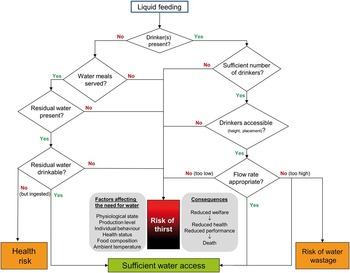
An alternative watering method to nipple and bowl drinkers in liquid-fed pigs is the provision of water in the trough, sometimes referred to as ‘water meals’ (DGAL, 2012). It consists of distributing a quantity of water in the feed trough, once the liquid feed has been eaten. This can lead to water accumulating in the feed trough – so-called ‘residual water’ – which may be associated with an increased risk of bacterial contamination depending on the cleanliness of the troughs, the quality of the water provided, the ambient temperature and the duration of time the water remains in the trough. In addition to the difficulty of maintaining water of good hygienic quality, it is difficult to gauge the volume necessary to allow permanent access to water for the pigs (Figure 3) and simultaneously ensure that the trough is empty before the next liquid meal. This is necessary to prevent both over-dilution of the feed as well as an overflow if the trough is filled beyond capacity. In France, the practice of distributing water meals is used in 65% of farms for pregnant sows, 50% of farms for lactating sows and 25% of farms for fattening pigs (Massabie et al., Reference Massabie, Roy, Boulestreau-Boulay and Dubois2014).
Flow chart illustrating factors influencing the risk of thirst, as well as the health risk and the risk of water wastage in liquid-fed pigs depending on the method of water provision (see text for details).

Just like illness can affect water intake, the reverse is also the case: in sows, insufficient drinking is an important risk factor for infections of the kidneys, the urinary tract and the bladder (Madec, Reference Madec1985), and milk production is also dependent on a sufficient water intake. On the other hand, excessive water consumption in sows is also a risk factor for infections such as cystitis. It induces urine dilution and a permanent expansion of the bladder, which may lead to impaired contraction ability and presence of residual urine colonised by environmental bacteria (Martineau and Morvan, Reference Martineau and Morvan2010). A moist environment favours ascending infections of the genital tract, and fertility can be affected by these infections. Indeed, several studies have demonstrated an increased incidence of metritis and deterioration of productivity indices, including lengthening of the weaning-to-service interval when sows are housed in humid conditions, often caused by excessive consumption of water (Madec, Reference Madec1990 and Reference Madec2009; Thornton et al., Reference Thornton, Wilson, Connaughton and Moore1998).
A number of behaviour and welfare issues arise from the presence of water in the pigs’ environment, mostly on the floor. One source of this is the amount of excreted water in urine, which is related to the amount of water ingested either by feeding or drinking. When pigs are kept on litter, such as straw bedding or sawdust, an excess of excreted water can lead to an anaerobic fermentation of the bedding and an increased emission of ammonia (Guingand and Rugani, Reference Guingand and Rugani2013; Philippe et al., Reference Philippe, Laitat and Warvreille Jand Nicks2014), which is detrimental to the health of the animals. Water drawn in excess (i.e. not consumed or used for external cooling) can result from redirected behaviour of pigs. This can be caused by a barren environment, leading to exploratory behaviour being redirected to elements in the surroundings such as drinkers. This type of manipulation varies between animals and types of drinker (Magowan et al., Reference Magowan, O’Connell and McCann2007). In sows, drinkers can be the focus of stereotypic behaviour (Terlouw et al., Reference Terlouw, Lawrence and Illius1991b). Thus, both excessive drinking and water spillage can lead to a moist environment and slippery floor. This has been found to promote locomotor disorders, particularly in sows, as well as a higher occurrence of splay-legs in piglets (Tillon and Madec, Reference Tillon and Madec1985). In systems using liquid feeding, a certain amount of water is unavoidably ingested in connection with feed intake. Thus, liquid intake by these pigs is not spread evenly across the day, which may exacerbate urination and lead to more moisture in the environment. Indeed, liquid feeding has been found to lead to poorer hygiene scores compared with dry-feeding systems (Scott et al., Reference Scott, Chennells, Armstrong, Taylor, Gill and Edwards2007). There are also practical and economic reasons to prevent excessive water use in pig production, as water spillage and increased urine will increase the amount of effluent, which needs to be stored. Better drinker design and ways to reduce water spillage should be taken into account in future housing, feeding and drinking systems.
Conclusions
The provision of water in a sufficient quantity when animals need it is essential for maintaining their homoeostasis and survival. Based on the available literature, it is evident that when group-housed pigs are fed a liquid diet, it cannot be ensured that all individuals can satisfy their water requirements through the diet alone. This is mainly due to individual differences in liquid feed intake and health status, changes in the environment, most importantly – in terms of likelihood of occurrence and number of pigs affected – increases in ambient temperature, as well as time-related variations in water needs. Only permanent access to drinking water will ensure the physiological needs of individual pigs are met at all times in a flexible and individualised way. It allows the animals to adjust their water intake in relation to risk situations, such as hot weather or when ill. This is an important contributing factor to ensuring the health and welfare of pigs, and to sustain or improve their performance. Increasing the dilution of the liquid feed is not sufficient to compensate for permanent access to water. Water provided in the feed trough between liquid meals is not a satisfactory solution because of potential problems with both the quantity and the quality of water.
Acknowledgements
This review is based on the literature survey carried out in connection with the writing of the report published by the French Agency for Food, Environmental and Occupational Health & Safety (Anses; Agence nationale de sécurité sanitaire de l’alimentation, de l’environnement et du travail) on the watering of liquid-fed pigs in the context of animal welfare.