


Is proportional representation (PR) a desirable election rule relative to majoritarian systems? Proponents of PR agree with the very aim of the rule: every group in a polity, whether it is a majority or minority, should have influence on policy making proportional to its size. For example, John Stuart Mill wrote that “[i]n a really equal democracy, every or any section would be represented, not disproportionately, but proportionately” (Mill [1861] Reference Mill1991). On the other hand, there has been a concern that PR promotes representation of extreme groups and special interests. Hermens (Reference Hermens1941), an early critic of PR, attributes the rise of Nazis in the 1930s to PR. Comparing the electoral performances of the French National Front in national and European elections, Declair (Reference Declair1999) concludes that the party has prospered under PR. Indeed, the characteristic of PR that the opponents single out as the culprit for extremism is its low electoral thresholds, the very reason that the proponents support the rule.
One may view this normative debate from a different perspective if she believes that the welfare of citizens in representative democracies is ultimately determined by policy outcomes. First, the appropriate normative standard must not be representation per se but outcomes. The goal of minority citizens may not be to have a good number of representatives who will advocate their view, but to have policies that will make them well off. Extremism may be more of a threat when it increases the likelihood of extreme policies than when it merely gives a few additional seats to an extreme party that will not govern anyway.
Second, it is noticeable that to a large extent both of the two competing arguments rely on an implicit assumption: citizens vote sincerely in elections under PR. However, if voters are motivated by policy outcomes, it is not transparent whether they will always vote for their first choice parties. Moreover, the assumption of sincere voting has been challenged by recent empirical studies. Evidence across different countries shows that strategic voting under PR is not as rare as the common wisdom suggests (Abramson et al. Reference Abramson, Aldrich, Blais, Diamond, Diskin, Indridason, Lee and Levine2010; Aldrich et al. Reference Aldrich, Blais, Indridason, Levine, Asher and Shamir2004; Bargsted and Kedar Reference Bargsted and Kedar2009; Blais et al. Reference Blais, Aldrich, Indridason and Levine2006; Gschwend Reference Gschwend2007; Hobolt and Karp Reference Hobolt and Karp2010; Kedar Reference Kedar2005; Meffert et al. Reference Meffert, Huber, Gschwend and Pappi2011).
The goal of this study is to advance our understanding of PR by examining the consequences of strategic voting by outcome-oriented citizens. The theory of strategic voting under PR is far less developed than that under plurality rule. Early studies on the issue assume that voters’ preferences over political parties are given (Cox Reference Cox1997; Cox and Shugart Reference Cox and Shugart1996). Capturing voters’ incentive to avoid “wasted votes,” this approach extends Duverger’s (Reference Duverger1954) idea to PR systems. However, when voters’ preferences over parties are instrumental (i.e., they are derived from voters’ policy preferences), the incentives for strategic voting may go well beyond voting for a viable party.Footnote 1 Moreover, without modeling voter preferences over policies, one cannot explore how policy outcomes under PR are shaped by strategic voting and how they reflect citizen preferences. These two questions are crucial in evaluating the election rule from normative perspectives.
Once one assumes that voters are concerned with policies, modeling elections under PR is certainly complex. Under the winner-take-all election rules such as plurality, a policy making body may be considered as a single agent, the winner. Thus, it is naturally assumed that the policy outcome implemented after an election is the winning party’s position. By contrast, there is rarely a sole winner in elections under PR, and important policies are decided in a subsequent bargaining stage. Thus, a nontrivial issue is how electoral outcomes are translated into policy outcomes in voters’ mind when they cast ballots.
One approach found in the literature on PR is to approximate voters’ expectation by an exogenous mapping: the policy outcome is assumed to be the weighted average of party positions with the weight on each party being equal to its vote share (De Sinopoli and Iannantuoni Reference De Sinopoli and Iannantuoni2007; Gerber and Ortuno-Ortín Reference Gerber and Ortuno-Ortín1998; Ortuno-Ortín Reference Ortuno-Ortín1997). A central finding of these studies is that the two most extreme parties tend to receive large vote shares, as voters on one side of the ideological spectrum strategically respond to those on the other side. However, the finding is not consistent with empirical observations perhaps because the vote-weighted average assumption does not capture the majoritarian nature of parliamentary decision rules. Indridason (Reference Indridason2011) proves that the results in these studies do not hold true if it is allowed for a majority party to implement its own policy. Hence, it is necessary to model how policies are made in a postelection bargaining stage. There are a few studies that explicitly model the policy making process. (Austen-Smith Reference Austen-Smith2000; Austen-Smith and Banks Reference Austen-Smith and Banks1988; Baron and Diermeier Reference Baron and Diermeier2001; Baron, Diermeier, and Fong Reference Baron, Diermeier and Fong2012; Cho Reference Cho2014). Although these models are richer in several aspects than the model I develop in this study, all of them assume that there are only three political parties. While three party systems are rare in PR systems, it is unknown whether the findings in these studies reach beyond the three party case, given the high complexity of these models.
I develop a game-theoretic model in which an arbitrary finite number of political parties compete in a parliamentary election under PR. The policy space is one dimensional, and the bargaining model provided by Romer and Rosenthal (Reference Romer and Rosenthal1978) is applied to a policy making stage that follows the election. The way electoral outcomes are mapped into policy outcomes is as follows. If there is a majority party in the election, the party becomes the proposer for sure. Otherwise, each party is selected as the proposer with probability equal to its vote share. Then, the policy proposed by the selected party is subject to a majority approval in the parliament. Thus, voters’ choices influence policies by affecting bargaining powers of political parties in two ways. The election outcome determines the probability distribution in the proposer selection as well as the set of majority coalitions that can pass a proposal.
Analyzing the model, I modify the standard equilibrium concepts in voting games. It is well known that the standard solution concepts in game theory make extremely indeterminate predictions in multiparty elections. In my model, every profile of voting strategies in which one party receives more than a majority of votes is a Nash equilibrium irrespective of voters’ preferences. Moreover, most of them are not excluded by the (iterative) elimination of weakly dominated strategies. To solve this problem, I propose a new solution concept, robust voting equilibrium, which requires voting strategies in Nash equilibria to be robust against small perturbations of the proposer selection process in the parliament. Specifically, a voter’s choice must remain a best response when there is an infinitesimally small probability that the proposer selection is proportional even in the presence of a majority party. This captures voters’ belief that their votes for a minority party may increase its policy influence in the parliament even when another party is expected to hold a majority of seats.
There are three empirical regularities that are consistent with my equilibrium predictions. First, PR elections rarely produce a majority party. While this strong regularity is also consistent with the sincere voting hypothesis, it is not obvious why strategic voters do not coordinate to make one party a majority party. That is, when one seeks to build a voting theory consistent with the growing empirical evidence of strategic voting, the absence of a majority party in most PR elections is a phenomenon that has to be explained rather than one that can be taken for granted. Yet, the prior game-theoretic models do not adequately explain the regularity as they do not solve the indeterminacy problem. Applying the robust voting equilibrium concept, I find that a necessary (but not sufficient) condition for there to be an equilibrium in which a party receives more than a majority of votes is that the party must be the first choice of such a number of voters. Thus, the vast majority of implausible Nash equilibria do not survive my robustness refinement. As the necessary condition is hardly met in multiparty systems under PR, my model provides a strong explanation of why there is rarely a majority party in PR elections.
Moreover, under a certain condition likely satisfied in the real world elections, there is a robust voting equilibrium with natural characteristics. In the equilibrium, no party receives a majority of votes, and the party that is closest to the median voter becomes the median party in the parliament. Voters compare each party’s expected proposal that is constrained by the median party’s approval. They then vote for the party whose proposal is ideologically most proximate to their bliss points. I call such a voting behavior strategically sincere voting. In such equilibria, each party represents one policy that is weakly more centrist than its original position, and each voter follows her sincere preference over the compromised policies. No complicated coordination is needed. Thus, the model shows not only that there is rarely an equilibrium with a majority party but also that in many cases there is an equilibrium in which no party holds a majority of seats and small parties are represented in the parliament.
The second empirical regularity that my model provides an explanation of is the presence of political parties whose positions are more extreme than their constituencies (Adams and Merrill Reference Adams and Merrill1999; Iversen Reference Iversen1994; Kedar Reference Kedar2009). My model predicts that a voter who does not vote for her top choice is likely to be a relatively moderate voter. She votes for a party that is more extreme than herself and her first choice party. Voters have the incentive for such strategic voting when the compromised policy of an extreme party is ideologically more proximate to them than the position of their first choice party. No “balancing” or “directional” motive is involved. Yet, supporters of an extreme party includes relatively moderate voters who vote strategically, and, as a result, the constituency of the party can be more moderate than the party. Thus, I show that the regularity is compatible with the assumption of fully strategic voters.
Third, my equilibrium prediction is consistent with the high ideological congruence between the median voter and the median party in PR systems, which is found in some empirical studies (Powell Reference Powell2000; Powell and Vanberg Reference Powell and Vanberg2000). I prove that, in all strategically sincere equilibria, the median party must be the closest party to the median voter. This is because the majority voting rule in the parliament shapes the composition of the parliament as voters are motivated by policy outcomes. An implication is that the influence of the median voter is strong on policy making since the median party is decisive in the parliament. Hence, PR may not be so contradictory to the majoritarian vision of democracy when the focus is on policy outcomes.
There are other studies that construct models of PR elections in which more than three parties are present and voters are outcome oriented. Kedar (Reference Kedar2005) develops a model of “compensational voting” and tests the model implications empirically. In her theoretical model, when voters evaluate a party, they consider the party’s impact on policy by comparing the policy outcomes in the presence and absence of the party. A similar but different approach is taken by Duch, May, and Armstrong (Reference Duch, May and Armstrong II2010). In their “coalition-directed voting” theory, a voter’s evaluation of a party depends on policy positions of the party’s potential coalition partners as well as the likelihood of each coalition conditional on the party being a member of the government. The main difference of these models from this study is that they are decision theoretic. That is, voters’ beliefs on the mapping of election results into policy are exogenous in their models while the beliefs are derived from the strategies of parties and other voters in my model. A representative voter in these studies are to some extent strategic, in that she takes the policy making process into consideration, but to some extent naive in that the voter, as an isolated maximizer, is not best responding to the other voters’ choices. Thus, the decision-theoretic models cannot explain why such isolated voters’ optimal choices produce the aggregate election outcomes. For instance, Kedar (Reference Kedar2005)’s model well explains the discrepancy between policy positions of parties and those of their supporters. Yet, it does not explain the rarity of a majority party or the congruence between the median voter and the median party in PR elections as the model does not make theoretical predictions on aggregate election results. Of course, these decision-theoretic models are richer than my model in the sense that they develop a set of parameters that can be empirically estimated and their applicability reach beyond PR systems. Adopting a different modeling strategy, I employ a stylized game-theoretic model and investigate to what extent the assumption of fully strategic voters is consistent with empirical regularities observed in PR elections.
Indridason (Reference Indridason2011) analyzes a game-theoretic model of voting in PR elections with an arbitrary finite number of parties. His model differs from mine mainly in two aspects. First, in his model, when no party holds a majority, the policy outcome is the vote-weighted average of positions of parliamentary or governmental parties. Second, perhaps more importantly, to solve the problem of multiple equilibria, Indridason uses the strong Nash equilibrium concept that assumes the ability of group coordination among voters. By contrast, the refinement concepts in this study select equlibria where voter coordination is minimal. As a result, his prediction tends to include equilibria with a majority party more frequently than the prediction of this study.
The rest of the article is organized as follows. In the following section, I set up the model. I then present the results of my equilibrium analysis in the next section, which will be followed by a concluding section. All formal proofs are contained in the Online Appendix.
MODEL
In the 1998 Swedish election, seven political parties competed for 349 seats in the Riksdag, the national parliament. Written in order of their ideologies from left to right, the Left Party received 12% of votes, the Social Democratic Party 36.4%, the Green Party 4.5%, the Center Party 5.1%, the Christian Democratic Party 11.8%, the Liberal Party 4.7%, and the Moderate Party 22.9%.Footnote 2
Three empirical phenomena regularly found in Western European election under PR were also observed in this election. First, there was no majority party. The largest party, the Social Democratic Party, only obtained 139 seats. Second, small parties were well represented and, as a result, the composition of the parliament well approximated the distribution of voter ideologies. The three small center-right parties were all represented. Also, the Left Party that had never participated in government obtained 12% of votes and 43 seats. Lastly, extreme parties were supported by relatively moderate voters. Kedar (Reference Kedar2009, 4–5) reports that, in a 0-10 left-right scale, the right-wing Moderate Party’s position is 9.1 whereas the average position of its supporters is 7.7. Similarly, the Left Party’s position is 1.2 while the average position of its supporters is 2.1.
In what follows, I present a game-theoretic model whose prediction is consistent with the above three phenomena observed in the Swedish election and many other elections under PR. I do not argue that the model below can provide a precise description of the PR systems or can explain all the dynamics of PR elections. Yet, it will provide a useful insight of how strategic environment provided by the PR rule can produce the empirical regularities.
The policy space is the real line
 $\mathbb {R}$
. Let
 $T=\lbrace t_{1},\dots ,t_{n}\rbrace \subseteq \mathbb {R}$
be the set of voters with n being odd. Let L = {1, . . ., ℓ} be the set of political parties with ℓ ⩾ 3 and let
 $\theta =(\theta _{i})_{i\in L}\in \mathbb {R}^{\ell }$
denote a profile of party positions. Define a function
 $u:\mathbb {R}\times \mathbb {R}\rightarrow \mathbb {R}$
so that for all x, t ∈ X,
 \begin{equation*}
u(x;t)=f(|x-t|),
\end{equation*}
where
 $f:\mathbb {R}_{+}\rightarrow \mathbb {R}$
is a continuous, strictly concave, and strictly decreasing function. From each policy
 $x\in \mathbb {R}$
, each voter t ∈ T receives utility u(x; t), and each party i ∈ L receives u(x; θ
i
).
A few assumptions on the configuration of ideal points are imposed throughout the article. First, I focus on the generic cases in which all party positions are distinct and all voter ideal points are distinct; that is, t
1 < ⋅⋅⋅ < tn
and θ1 < ⋅⋅⋅ < θℓ. Letting
 $M=\frac{n+1}{2}$
, we denote the median voter by tM
. Second, I assume that θ1 < tM
< θℓ ruling out the trivial cases in which every party is located on one side of the median voter. Then, there exists a unique party m ∈ L such that θ
m
⩽ tM
⩽ θ
m + 1. Without loss of generality, I assume
 $t_{M}\le \frac{\theta _{m}+\theta _{m+1}}{2}$
. Thus, party m is the (weakly) closest party to the median voter. Lastly, the following condition is imposed:
-
A1 For each i ∈ L, there exist
 $\hat{t},\tilde{t}\in T$
such that
$\hat{t}<\theta _{i}<\tilde{t}$
and
$\arg \max \lbrace u(\theta _{j};\hat{t})|j\in L\rbrace =\arg \max \lbrace u(\theta _{j};\tilde{t})|j\in L\rbrace =\lbrace i\rbrace$
.


That is, each party has at least two voters, one on its left and another on its right, who think its position is the best among all party positions. Loosely speaking, A1 means that the number of voters is large relative to that of parties and that every party is so located that there are some core supporters.
The timing of the game is as follows. First, each voter votes for one of the ℓ parties. All voters choose their votes simultaneously. Let vt
∈ L be the party chosen by voter t, and let v = (vt
)
t ∈ T
. For each i ∈ L, bi
(v) denotes the number of votes party i receives. The election rule is purely proportional, i.e., each party i’s seat share in the parliament is equal to its vote share
 $\frac{b_{i}(v)}{n}$
. Let b(v) = (bi
(v))
i ∈ L
denote the distribution of votes among parties. Second, after observing b(v), parties bargain to choose a policy where the bargaining consists of a proposer selection, proposal making, and parliamentary votes between a proposal and a status quo. If no party holds a majority of seats in the parliament, each party i is selected as a proposer with probability equal to its seat share
 $\frac{b_{i}(v)}{n}$
. If there is a majority party, say i, then party i is selected with probability
 $1-\epsilon +\frac{\epsilon b_{i}(v)}{n}$
with ε ∈ [0, 1]; and any other party j is selected with probability
 $\frac{\epsilon b_{j}(v)}{n}$
. That is, there is ε chance that the selection rule is proportional; otherwise, the majority party is selected. Then, the selected party makes a proposal, say
 $x\in \mathbb {R}$
. Lastly, all parties simultaneously respond to the proposal by either accepting or rejecting it. If the parties that accept constitute a majority in the parliament, then the outcome is x. Otherwise, the outcome is the exogenously fixed status quo
 $q\in \mathbb {R}$
. It is assumed that there is no i ∈ L such that q = θ
i
. All players receive their payoffs according to the utility functions defined above. I parametrize the game by G(T, θ, q, ε). Let
 $P\subseteq \mathbb {R}^{n+\ell +1}$
denote the set of the values of (T, θ, q) that satisfy the assumptions of the model.
My focus is on G(T, θ, q, 0), i.e., the game in which a majority party is selected as the proposer for sure, as it is the case in almost all parliaments in the real world. With small positive ε, I consider G(T, θ, q, ε) as a perturbation of G(T, θ, q, 0). As is true in other multicandidate election games, the game G(T, θ, q, 0) has a plethora of equilibria. To make the prediction sharp, I will require that equilibria be robust against small perturbations on the proposer selection process. The perturbation captures voters’ belief that their votes for a minority party might increase its policy making power even when another party holds a majority of seats.
Once the proposer is selected, the bargaining stage is identical to the well-known model by Romer and Rosenthal (Reference Romer and Rosenthal1978). Solely motivated by policy outcomes, each party accepts only proposals that are preferred to the status quo and proposes the best policy among those that are passable in the parliament.Footnote 3
To formalize parties’ strategies in the parliamentary voting stage, let Ai
be the set of policies that, if proposed, would be accepted by party i. Let
 $\underline{x}_{i}(q)=\min \lbrace 2\theta _{i}-q,q\rbrace$
and
 $\overline{x}_{i}(q)=\max \lbrace 2\theta _{i}-q,q\rbrace$
. In equilibrium, each party accepts any proposal that is at least as good as the status quo. Hence, it must be the case that, for every i ∈ L,
 \begin{equation}
A_{i}=\lbrace x\in \mathbb {R}|u(x;\theta _{i})\ge u(q;\theta _{i})\rbrace =[\underline{x}_{i}(q),\overline{x}_{i}(q)],
\end{equation}
where the last equality is due to the assumption that parties have symmetric single-peaked preferences.
Parties’ proposals may depend on the seat distribution of the parliament. Let
 \begin{eqnarray*}
B&=&\left\{ b=(b_{i})_{i\in L}\Bigg| b_{i} \mbox{ is a nonnegative integer}\right.\\
&&\left.\mbox{for every }i\in L \mbox{ and } \sum _{i\in L}b_{i}=n\right\}
\end{eqnarray*}
be the set of all possible election outcomes. A proposal strategy for party i is a mapping
 $p_{i}:B\rightarrow \mathbb {R}$
, where pi
(b) is the policy that party i would propose given an election result b. Let p(b) = (pi
(b))
i ∈ L
. Given an election result b and the response strategies described in (1), let A(b) consist of all policies that would be accepted by a majority in the parliament. Since each Ai
is a compact interval that includes q, the set A(b) is a nonempty compact interval. We can further characterize A(b) thanks to the single-peakedness of party preferences. A party i is said to be decisive in the parliament induced by b ∈ B if
 \begin{equation*}
\sum _{j\le i}b_{j}\ge M\;\;\;\mbox{and}\;\;\;\sum _{j\ge i}b_{j}\ge M.
\end{equation*}
Since n is odd, there is a unique decisive party for each b ∈ B, which is denoted by k(b). When there is a majority party, k(b) is simply the majority party; when there is none, k(b) is the median party in the weighted voting game in the parliament. Due to the single-peakedness, we then have
 \begin{equation*}
A(b)=A_{k(b)}=[\underline{x}_{k(b)}(q),\overline{x}_{k(b)}(q)].
\end{equation*}
Each party has a unique utility maximizer in this set. In equilibrium, it must be the case that, for every i ∈ L and every b ∈ B,
 \begin{eqnarray}
p_{i}(b)=\left\lbrace \begin{array}{l@{\hspace*{10pt}}l}\underline{x}_{k(b)}(q) & \mbox{if } \theta _{i}\le \underline{x}_{k(b)}(q),\\
\theta _{i} & \mbox{if } \theta _{i}\in (\underline{x}_{k(b)}(q),\overline{x}_{k(b)}(q)),\\
\overline{x}_{k(b)}(q) & \mbox{if } \theta _{i}\ge \overline{x}_{k(b)}(q).\end{array}\right.
\end{eqnarray}
Lastly, I discuss voters’ strategies. From now on, I fix parties’ behavior as described (1) and (2) and consider the game G(T, θ, q, ε) as a strategic form game in which the players are n voters and the payoffs are determined by the parties’ strategies. Note that a profile of voting strategies v = (vt ) t ∈ T is mapped into an election result (or the composition of the parliament) b(v), which further determines what will happen in the bargaining stage by determining A(b(v)), k(b(v)), and p(b(v)). For convenience, we use the following abbreviation hereafter: A(v) ≡ A(b(v)), k(v) ≡ k(b(v)), and p(v) ≡ p(b(v)). Furthermore, b(v) determines the selection probabilities for parties and, thus, a unique lottery over policy outcomes. Then, the payoff for voter t ∈ T from a voting profile v in G(T, θ, q, ε) is
 \begin{eqnarray}
&&\hspace*{-10pt}U(v;t|\epsilon )\nonumber\\
&&\hspace*{-10pt}\quad=\left\lbrace \begin{array}{l@{\hspace*{10pt}}l}(1-\epsilon )u(p_{i}(v);t)+\epsilon \sum _{j\in L}\frac{b_{j}(v)}{n}u(p_{j}(v);t) \\[8pt]
\quad \mbox{if } b_{i}(v)\ge M \mbox{ for some } i\in L,\vspace*{7.0pt}\\
\sum _{j\in L}\frac{b_{j}(v)}{n}u(p_{j}(v);t) \quad \mbox{otherwise}.\end{array}\right.
\end{eqnarray}
Given a profile of voting strategies v and a voter t ∈ T, I say vt
is a robust best response to v
− t
for t in G(T, θ, q, 0) if there exists
 $\overline{\epsilon }\in (0,1]$
such that, for every
 $\epsilon \in [0,\overline{\epsilon }]$
and every i ∈ L,
 \begin{equation}
U(v_{t},v_{-t};t|\epsilon )\ge U(i,v_{-t};t|\epsilon ).
\end{equation}
The definition of my solution concept is given below.
Definition 1 A profile of voting strategies v is a robust voting equilibrium of G(T, θ, q, 0) if, for every t ∈ T, vt is a robust best response to v − t in G(T, θ, q, 0).
That is, I require that robust equilibria be Nash equilibria of G(T, θ, q, 0). In addition, they should remain to be Nash equilibria of perturbed games that are arbitrarily close to G(T, θ, q, 0). For each (T, θ, q) ∈ P, let V(T, θ, q) denote the set of robust equilibria of G(T, θ, q, 0).
Since an equilibrium is constituted by Nash best responses of voters in each given game G(T, θ, q, ε) and each voter cares only about policies, it is important how a single vote may affect the policy outcome. Generally, there are three ways by which a single vote affects the policy outcome in the game G(T, θ, q, ε). First, by voting for a party, a voter increases the probability that the party’s proposal will be the outcome by a small positive amount. This is true for every voting profile as long as ε is positive. Secondly, a voter’s choice may change the majority status of a party. This happens when exactly a half of the other voters vote for some party. Obviously, a change of the majority status of a party will change the policy outcome in a discontinuous manner by altering the recognition probabilities drastically or altering parties’ proposals or both. When a voter has such an opportunity, I say the voter is majority-pivotal. The precise definition is provided below. For each i ∈ L and each voting profile v, let Ti (v) = {t ∈ T|vt = i} be the set of voters who vote for i in v.
Definition 2 A voter t ∈ T is majority-pivotal in a voting profile v if there is a party i ∈ L such that |Ti (v)∖{t}| = M − 1
In words, a voter is majority-pivotal in a voting profile when (1) a party, say i, receives the minimum majority of votes, and she votes for party i; or (2) a party, say j, receives one vote less than a majority, and she does not vote for j. In the former case, party i would lose the majority status if the voter voted for another party. In the latter, the voter could make party j a majority party if she voted for it.
Lastly, a voter’s choice may determine which party will be the median party in a minority parliament. The identity of the median party affects the set of passable policies and, thus, the proposals of parties. When a voter has such an opportunity, I say the voter is median-pivotal.
Definition 3 A voter t ∈ T is median-pivotal in a voting profile v if either (i) ∑ k(v) − 1 j = 1 bj (v) = M − 1 and vt ⩾ k(v) or (ii) ∑ℓ j = k(v) + 1 bj (v) = M − 1 and vt ⩽ k(v).
In the case of (i), voter t could make party k(v) − 1 the median party if she votes for some party i < k(v). In the case of (ii), the voter could make party k(v) + 1 the median party if she voted for some party i > k(v).
In sum, a strategic voter in the model has three considerations. She has an incentive to choose a party that would propose a good policy. She also wants to make a preferable party be a majority party and not to make a disliked party be a majority party. Finally, she seeks to choose the median party in the parliament so that the set of party proposals are favorable to her. These three indirect objectives that are derived from policy motivation of the voter interact with each other depending on the other voters’ strategies.
RESULTS
Robust Voting Equilibria
I first provide two examples that illustrate how the concept of robust equilibrium refines the set of Nash equilibria in the voting game. Generally, every voting profile in which more than a majority of voters support a party is a Nash equilibrium of G(T, θ, q, 0) regardless of voters’ preferences. The example below shows that my solution concept permits such an equilibrium only when it is driven by voters’ preferences.
Example 1 Let n = 101 and
 $t_{i}=\frac{i-1}{100}$
for each ti
∈ T. Let ℓ = 3 and
 $\theta =(0,\frac{3}{8},\frac{9}{16})$
. Let
 $q=\frac{1}{4}$
. Consider any voting profile
 $\bar{v}$
in which at least as many as 52 voters vote for party 1. Let ε > 0. Party 1 is the decisive party in the parliament, so the set of acceptable proposals in the bargaining stage is
 $A(\bar{v})=[-\frac{1}{4},\frac{1}{4}]$
. Then, party 1 would propose zero, and parties 2 and 3 both would propose
 $\frac{1}{4}$
, i.e.,
 $p(\bar{v})=(0,\frac{1}{4},\frac{1}{4})$
. Then,
 \begin{eqnarray*}
&&U(\bar{v};t|\epsilon )=(1-\epsilon )u(0;t)+\frac{\epsilon }{101}\Bigg[b_{1}(\bar{v}) u(0;t)\\
&&\quad+\,[101-b_{1}(\bar{v})]u\left(\frac{1}{4};t\right)\Bigg].
\end{eqnarray*}
Since
 $b_{1}(\bar{v})\ge 52$
, there must be a voter t such that vt
= 1 and
 $t>\frac{1}{8}$
. Consider voter t’s deviation by voting for party 2. The voter’s payoff from the deviation is
 \begin{eqnarray*}
&&U(2,\bar{v}_{-t};t|\epsilon )=(1-\epsilon )u(0;t)\\
&&\quad+\,\frac{\epsilon }{101}\left[[b_{1}(\bar{v})-1] u(0;t)+[100-b_{1}(\bar{v})]u\left(\frac{1}{4};t\right)\right].
\end{eqnarray*}
Thus,
 \begin{equation*}
U(\bar{v};t|\epsilon )-U_{t}(2,\bar{v}_{-t};t|\epsilon )=\frac{\epsilon }{101}\left[u(0;t)-u\left({\frac{1}{4}};t\right)\right],
\end{equation*}
which is negative for every ε > 0 since
 $t>\frac{1}{8}$
. Thus, the strategies do not constitute a robust voting equilibrium of G(T, θ, q, 0). Similarly, we can show that there is no robust equilibrium in which party 2 receives more than 51 votes.
I now consider the following voting profile
 $\hat{v}$
:
 \begin{eqnarray*}
\hat{v}_{t}=\left\lbrace \begin{array}{l@{\hspace*{10pt}}l}1 & \mbox{if } t<\frac{5}{16},\\[3pt]
2 & \mbox{if } t\in [\frac{5}{16},\frac{15}{32}],\\[3pt]
3 & \mbox{if } t>\frac{15}{32}.\end{array}\right.
\end{eqnarray*}
In the profile, 54 voters support party 3, so the party is a majority party. Then
 $A(\hat{v})=[\frac{1}{4},\frac{7}{8}]$
, and
 $p(\hat{v})=(\frac{1}{4},\frac{3}{8},\frac{9}{16})$
. Suppose a voter t with
 $\hat{v}_{t}=i$
deviates by voting for j. Then, the deviation would decrease the probability of
 $p_{i}(\hat{v})$
being the outcome by
 $\frac{\epsilon }{101}$
and increase the probability of
 $p_{j}(\hat{v})$
being the outcome by the same amount. Thus, such a deviation would be profitable only if the voter prefers j’s proposal to i’s proposal. However, each voter votes for the party whose proposal she likes the most among the three expected proposals in
 $\hat{v}$
, and, thus, the deviation does not increase the voter’s payoff. As this is true for every positive ε,
 $\hat{v}$
is a robust equilibrium. Note that party 3 is the unique party that locates on the right of the median voter and that a majority of voters likes the party’s position the most. Thus, in contrast to the Nash equilibria in which party 1 receives more than a majority of votes,
 $\hat{v}$
seems plausible.
 $\hfill\Box$
The next example considers robust equilibria with no majority party.
Example 2 Let T be as in Example 1. Let ℓ = 4,
 $\theta =(0,\frac{1}{4},\frac{1}{2},1)$
, and
 $q=\frac{1}{8}$
. Consider the following profile v:
 \begin{eqnarray}
v_{t}=\left\lbrace \begin{array}{l@{\hspace*{10pt}}l}1 & \mbox{if } t<\frac{3}{16},\\[3pt]
2 & \mbox{if } \frac{3}{16}\le t<\frac{3}{8},\\[3pt]
3 & \mbox{if } \frac{3}{8}\le t\le \frac{11}{16},\\[3pt]
4 & \mbox{if } t>\frac{11}{16}. \end{array}\right.
\end{eqnarray}
Figure 1 illustrates the strategies. The election result is b(v) = (19, 19, 31, 32). Party 3 is the median party, so
 $A(v)=A_{3}=[\frac{1}{8},\frac{7}{8}]$
. Thus, the proposals are
 $p(v)=(\frac{1}{8},\frac{1}{4},\frac{1}{2},\frac{7}{8})$
. Consider a voter t who votes for party i in v. If the voter deviated by voting for another party j, then the probability of i’s proposal being the outcome would decrease by
 $\frac{1}{101}$
and the probability of j’s proposal being the outcome would increase by the same amount. Such a deviation cannot increase voter t’s expected payoff since every voter votes according to her preference over the expected proposals in v. Thus, v is a robust voting equilibrium.
 $\hfill\Box$
Strategically Sincere Equilibrium: Example 2

In the equilibria of Examples 1 and 2, all voters vote sincerely with respect to their preferences over the equilibrium proposals by parties. I will call such a voting behavior strategically sincere voting.
Definition 4 Given voting profile v = (vt
)
t ∈ T
, we say vt
is strategically sincere for t in v if
 $v_{t}\in \arg \max \lbrace u(p_{i}(v);t)|i\in L\rbrace$
.
Strategically sincere voting is distinguished from naive sincere voting, which might be defined as voting according to voters’ preferences over the party positions θ = (θ1, . . ., θ
n
). In contrast to that, strategically sincere voting requires that voters should correctly forecast the optimal policy making strategies for parties, which in turn depend on the aggregate election result. As seen in Figure 1, the voters whose ideal points are between
 $\frac{11}{16}$
and
 $\frac{3}{4}$
in Example 2 would vote for party 3 if they voted according to their preferences over the original party positions. However, they vote for party 4 in the equilibrium as they understand that party 4 will moderate its policy choice in order to form a majority coalition with party 3. For each voting profile v, let T*(v) be the set of voters who vote strategically sincerely in v. We say a voting profile v is strategically sincere if every voter votes strategically sincerely in it; that is, T*(v) = T. Such a profile seems simple and natural in the sense that, in it, each party represents a single policy and voters’ decisions depend only on their preferences over the policies. I first investigate the conditions for a strategically sincere voting profile to be a robust equilibrium.
Observe that in the equilibria of the two examples, no voter is majority- or median-pivotal. Generally, when a voter is neither majority- nor median-pivotal, a change of the voter’s choice, say from party i to party j, would not alter any party’s proposals and would only transfer a small probability from j’s proposal to i’s proposal in the lottery of the policy outcome. Hence, the voter must vote for a party whose proposal is the best. A lemma follows from this discussion.
Lemma 1 Assume that t ∈ T is neither majority-pivotal nor median-pivotal in v. Then, vt is a robust best response to v − t if and only if vt is strategically sincere for t in v.
The lemma is useful to find conditions for strategically sincere equilibria, as it implies the following. If a voting profile is strategically sincere and no voter is majority- or median-pivotal in it, then it must be a robust equilibrium. Conversely, if no voter is majority- or median-pivotal in a robust equilibrium, then the equilibrium must be strategically sincere. Whether or not there is such an equilibrium will depend on the distribution of voter ideal points, the distribution of party positions, and the location of the status quo.
A few more notations are necessary to present our results. For each i, j ∈ L, let
 $s_{j}^{i}=\min \lbrace \max \lbrace \theta _{j},\underline{x}_{i}(q)\rbrace ,\overline{x}_{i}(q)\rbrace$
. Note that si
j
uniquely maximizes party j’s utility in Ai
, and, thus, it would be proposed by party j whenever party i is decisive in the parliament. For each i = 1, . . ., ℓ − 1, let
 $\overline{y}_{i}=\frac{\theta _{i}+s_{i+1}^{i}}{2}$
, and let
 $\overline{y}_{\ell }=t_{n}$
. For each i = 2, . . ., ℓ, let
 $\underline{y}_{i}=\frac{s_{i-1}^{i}+\theta _{i}}{2}$
, and let
 $\underline{y}_{1}=t_{1}$
. For each i ∈ L, let
 $X_{i}=\lbrace t\in T|\underline{y}_{i}\le t\le \overline{y}_{i}\rbrace$
. The interpretation of the set Xi
is as follows. When party i is the decisive party in the parliament, the party will propose its ideal point θ
i
. Thus, si
i − 1 and si
i + 1 are the two proposals that are adjacent to party i’s proposal. Then, if a voter’s ideal point belongs to Xi
, then party i’s proposal is a best proposal for the voter when party i is the decisive party. Thus, Xi
is the set of voters whose strategically sincere choices are party i when the party is decisive in the parliament.
In what follows, I present the results of the equilibrium analysis for four different cases that are mutually exclusive and jointly exhaustive. The division of the cases is expressed in terms of properties of Xm , the set of core supporters of party m, loosely speaking. From the above definition, the set is a function of exogenous parameters and can be written as follows: When m ⩾ 2,
 \begin{eqnarray*}
X_{m}&=&\bigg \{ t\in T\bigg |\;\frac{\max \lbrace \theta _{m-1},\min \lbrace 2\theta _{m}-q,q\rbrace \rbrace +\theta _{m}}{2}\le t\\
&\le& \frac{\theta _{m}+\min \lbrace \theta _{m+1},\max \lbrace 2\theta _{m}-q,q\rbrace \rbrace }{2}\bigg \} ,
\end{eqnarray*}
and when m = 1, Xm
is the set of voter ideal points that are less than or equal to
 $\frac{\theta _{m}+\min \lbrace \theta _{m+1},\max \lbrace 2\theta _{m}-q,q\rbrace \rbrace }{2}$
. Thus, the distribution of voter ideologies, the distribution of party positions, and the location of the status quo together determine the set. The equilibrium election outcome critically depends on how many and which voters are included in Xm
. In general, Xm
includes more voters as the positions of parties m − 1 and m + 1 are farther from that of party m, as more voters are located in the vicinity of party m’s position, and as the status quo is farther from party m’s position.
Generalizing the observation in Example 1, my first proposition identifies a necessary and sufficient condition for equilibria in which a party receives more than a majority of votes.
Proposition 1 For every (T, θ, q) ∈ P , the following is true:
-
1. If |Xm | > M , then there exists a robust equilibrium v of G(T, θ, q, 0) such that bm (v) > M and v is strategically sincere.
-
2. If v is a robust equilibrium of G(T, θ, q, 0) and b k(v)(v) > M , then k(v) = m and |Xm | > M.
Thus, there is a robust equilibrium in which one party receives more than a majority of votes if and only if there is a party such that more than a majority of voters prefer its position to any other party’s expected proposal in the parliament. When the condition is met, party m receives more than M votes in a strategically sincere profile, as all voters in Xm support it. Then, no voter is majority- or median-pivotal in the profile, which, therefore, is guaranteed to be a robust equilibrium by Lemma 1. Conversely, if party i receives more than M votes in equilibrium, then no voter is majority- or median-pivotal. Lemma 1 implies that the equilibrium is strategically sincere. Then, only the voters in |Xi | vote for party i. Hence, Xi must contain more than M voters, and this is possible only for the party that is closest to the median voter, i = m.
Notice that the condition |Xm | > M implies that more than M voters like party m’s position the most among all party positions. Thus, the type of equilibria exist only when one party is the first choice of more than a majority of voters in terms of their sincere preferences. This condition is hardly met by elections in multiparty PR systems, which seems a clear explanation of why we rarely observe a majority party in those systems. However, this most prominent observation in PR elections has not been well accounted for in prior game-theoretic studies on voting. As mentioned earlier, the Nash concept makes many implausible predictions. Moreover, the (iterative) elimination of weakly dominated strategies does not have much bite in multiparty contests. An alternative employed in some studies is strong equilibrium (Baron and Diermeier Reference Baron and Diermeier2001; Indridason Reference Indridason2011). Although it greatly mitigates the problem of indeterminacy, the solution concept still tends to predict election results in which a large majority of voters support one party. Consider, for instance, the voting profile in which all voters vote for party 3 in the setting of Example 2. In it, the policy outcome is party 3’s ideal point which coincides with the median voter ideal point. This is a strong Nash equilibrium in G(T, θ, q, 0) because only a majority coalition could change the outcome and it is impossible to construct a majority of voters all of whom prefer some policy lottery over the median ideal point. However, this equilibrium involves coordination among a large number of voters and seems unlikely to be played.
Applied to my model, the strong Nash concept predicts that the profile in which every voter votes for party m is an equilibrium in many cases. The prediction, of course, is inconsistent with what we observe in PR elections.Footnote 4 Why does not such large coordination of votes occur? My solution concept provides one possible reason. Voters may believe that their voting for a party has some chance to increase the party’s influence on policies even when another party holds a majority of seats in the parliament. In general, a majority party gets its own way. However, minority opposition parties may not be totally powerless in policy making, and, moreover, their influence may depend on their seat shares. Voters may believe the possibility of minority influence on policy making because they can be uncertain about the election result or unity of the majority party, or because minority parties may have some institutional sources of power such as committees. If a voting strategy is not robust against an infinitesimal possibility of such a minority influence, it seems unlikely to be chosen. Proposition 1 shows that such a small perturbation is sufficient to remove all implausible Nash equilibria in which one party is supported by more than a majority of voters including those who do not prefer the party.
Next, I discuss strategically sincere equilibria in which no party receives a majority of votes.
Proposition 2 If |Xm | < M − 1 and {t M − 1, tM , t M + 1}⊆Xm , then there exists a robust voting equilibrium v of G(T, θ, q) such that k(v) = m, bm (v) < M − 1, and v is strategically sincere.
The proposition finds a sufficient condition for minority equilibria in which party m is the median party and all voters vote strategically sincerely. Suppose the condition in Proposition 2 holds. I consider a strategically sincere profile in which all voters in Xm
vote for party m. For those voters who vote for parties on the left of party m, their ideal points must be less than
 $\underline{y}_{m}$
. But since
 $t_{M-1}\ge \underline{y}_{m}$
, the sum of the votes for parties on the left of m is less than M − 1. Applying a symmetric argument, we conclude that the same is true for parties on the right of m. This implies that no voter is median-pivotal. Also, since party m receives less than M − 1 votes, no voter is majority-pivotal. Then, Lemma 1 implies that the profile is a robust equilibrium. Notice that Example 2 belongs to this case.
In my view, the conditions in Proposition 2 is highly likely to be satisfied in the real world elections under PR. Note that the set Xm
is always contained in the set of voters who rank party m at the top of their preference orderings over the party positions. Thus, the condition |Xm
| < M − 1 will be met whenever voters whose first choice is the median party constitute less than 50 percent of the electorate. We seldom find that public opinion polls tell the contrary in multiparty PR systems. The second condition is that the median voter and the two voters adjacent to the median must prefer the median party’s position to any other party’s expected proposal in the parliament. In the model, the condition is equivalent to |θ
m
− q| ⩾ 2max{|θ
m
− t
M − 1|, |θ
m
− t
M + 1|} and
 $t_{M+1}\le \frac{\theta _{m}+\theta _{m+1}}{2}$
. In general, it is easily satisfied when the median party locates close to the median voter, and voters are densely populated within a close neighborhood of the median. Suppose, for example, that the median party locates at the median voter ideal point and that there are so numerous voters that the distribution of ideal points are well approximated by a continuous distribution. In that setting, the condition is always met. Although we do not have reliable measures of parties’ expected proposals, the data on ideologies of voters and parties in general show that voters are densely populated around the median (e.g., Powell and Vanberg Reference Powell and Vanberg2000). This suggests that the condition may be satisfied in many cases.
In this most likely scenario, the model provides very intuitive predictions. In the equilibria in Proposition 2, all voters anticipate that party m, the centrist party, will be the median party. Each party, then, is evaluated by the policy it will offer to make a coalition with the median party. They then vote according to their preferences over the compromised policies. Second, as seen in Example 2, each party’s constituency is ideologically connected, and the ideological “order” among voters are preserved in their vote choices. The existence of robust equilibria with such a natural property is generalized as will be shown later. Lastly, our equilibria do not involve a difficult coordination problem among voters. Each voter’s choice in equilibrium remains a best response even when she does not correctly forecast other voters’ strategies as long as she expects the centrist party to be the median party. It is worthwhile to note that the equilibrium with no majority party in Example 2 is not a strong Nash equilibrium. A group of voters on the left of party 3’s constituency could vote for the party to make it a majority party, which would increase all deviators’ payoffs. On the other hand, there is a strong Nash equilibrium in which all voters vote for party 3, as mentioned before. Thus, applied to the setting of Example 2, the strong Nash refinement seems too strong in the sense that it removes a plausible equilibrium and too weak in the sense that it predicts the equilibria where all voters vote for one party.
Proposition 2 helps us understand the aforementioned 1998 Swedish election. The sufficient condition in the proposition was clearly satisfied by the election as opinion polls showed that no party was top-ranked by a majority of the Swedish voters. Also, the election was largely understood as a one-dimensional competition in which the main issue was the “recovery of state finances” implemented the incumbent Social Democratic Party government (Möller Reference Möller1999). We can reasonably assume that the voters expected that no party would receive a majority of votes in the election and important policy programs are decided in parliamentary politics. Although my stylized model is in no way a perfectly accurate description of Swedish parliamentary rules, it still can capture how voters’ choices were shaped by their concerns about parliamentary bargaining. After the election, the minority government by the Social Democratic Party was formed announcing that the Left Party and the Green Party would cooperate with the government. Before the 1998 election, the important austerity measures by the Social Democratic government were mainly supported by the center-right Center Party. Outcome-oriented leftist voters might reasonably anticipate that the Social Democratic government in cooperation with the Left Party would adopt more leftist policies than the Social Democratic government with the support of the Center Party, but it would not adopt the Left Party’s ideal policy. Also, they might believe that an increase in the seat share of the Left Party would increase the likelihood that the Social Democratic Party would turn to the Left Party. Perhaps these expectations made moderate leftist voters vote for the Left Party. Indeed, the Left Party increased its seats dramatically: it obtained 43 seats almost twice as many as what it received in the 1994 election. As a result, the Social Democratic Party turned to them instead of one of the center-right parties. Voters in my simplified model have incentives to evaluate parties in terms of their compromised policies and to increase the seat share of the party that may give the best compromised outcome. This essentially captures the strategic considerations of the Swedish leftist voters described above.Footnote 5
I have so far discussed equilibria in which no voter is majority- or median-pivotal. The next result is about the existence of robust equilibria in which some voters are majority-pivotal.
Proposition 3 Assume {t M − 1, tM , t M + 1}⊆Xm . Then, the following is true.
-
1. If |Xm | = M , then there exists a robust equilibrium v of G(T, θ, q, 0) such that bm (v) = M and v is strategically sincere.
-
2. If |Xm | = M − 1, then there exists a robust voting equilibrium v of G(T, θ, q, 0) such that bm (v) = M and T*(v) = T∖{t*} for some t* ∈ T.
There is a robust equilibrium in which party m receives the minimum majority of votes when Xm
contains {t
M − 1, tM
, t
M + 1} and the number of voters in the set is either M or M − 1. First, when Xm
contains exactly M voters, the equilibrium is strategically sincere. The intuition is the following. Consider a profile, say v, in which all voters vote strategically sincerely and all voters in Xm
, including indifferent ones, vote for party m. In it, the voters whose ideal points are less than
 $\underline{y}_{m}$
vote for some party on the left of party m, and the ones whose ideal points are greater than
 $\overline{y}_{m}$
vote for some party on the right of party m. Then, since
 $\underline{y}_{m}\le t_{M-1}<t_{M+1}\le \overline{y}_{m}$
, ∑
m − 1
i = 1
bi
(v) < M − 1 and ∑ℓ
i = m + 1
bi
(v) < M − 1. This implies that no voter is median-pivotal in v. Moreover, only voters in Xm
are majority-pivotal. Then, by Lemma 1, for those who are not in Xm
, their strategically sincere choices are robust best responses. Now consider any voter t in Xm
and let v′ be the profile that is identical to v except that voter t votes for some other party. Since the voter is not median-pivotal, party m would still be the decisive party in v′. Thus, her deviation would not change the proposals by the parties. In G(T, θ, q, ε) with small positive ε, the policy lotteries induced by v and v′ have the same supports. Note that the deviation transfers the probability close to one-half from party m’s proposal to the other parties’ proposals. However, since voter t already voted for the party whose proposal is the best in v, the deviation is not profitable.
When Xm
contains M − 1 voters, there is exactly one voter whose choice is not strategically sincere. Again, consider a voting profile, say
 $\hat{v}$
, in which all voters vote strategically sincerely and all voters in Xm
vote for party m. Now, party m receives M − 1 votes, one vote less than a majority. As in the previous case, no voter is median-pivotal and party m is the median party. Any voter who does not vote for party m could make it a majority party by voting for it. Without loss of generality, assume that the mean of the policy lottery induced by
 $\hat{v}$
is greater than or equal to θ
m
. Let t* be the rightmost voter among those on the left of
 $\underline{y}_{m}$
. The voter prefers the degenerate lottery on θ
m
to the lottery induced by
 $\hat{v}$
since her preference is strictly concave. Thus, when ε is sufficiently small, she prefers to make party m the majority party. This means that the profile
 $\hat{v}$
is not a robust equilibrium. However, the profile, say
 $\bar{v}$
, in which voter t* votes for party m and all else is the same as in
 $\hat{v}$
is a robust equilibrium. In it, party m is the majority party receiving M votes. Those who do not vote for party m are neither majority-pivotal nor median-pivotal. As they vote strategically sincerely, they play robust best responses. For those who vote for party m except voter t*, the argument in the previous case is applied. Lastly, if voter t* deviates, party m will be the median party, and, thus, no proposal will be changed. Then, the best possible deviation for the voter is to vote strategically sincerely. Note that such deviation from
 $\bar{v}$
leads to
 $\hat{v}$
. However, by construction, voter t* prefers
 $\bar{v}$
to
 $\hat{v}$
. Thus,
 $\bar{v}$
is a robust equilibrium.
It should be noted that Proposition 3 only finds a sufficient condition for there to be an equilibrium in which some voters are majority-pivotal. Depending on parameters, there can be a majority-pivotal equilibrium when the conditions in Proposition 1 or Proposition 2 are satisfied. We will later discuss the issue of multiple equilibria generally.
The next result discusses the remaining cases in the parameter space of the model.
Proposition 4 Assume {t M − 1, tM , t M + 1}⊈Xm . Then, the following is true:
-
1. If t M + 1 ∈ Xm , then there exists a robust voting equilibrium v of G(T, θ, q, 0) such that k(v) = m and v is strategically sincere.
-
2. If t M + 1∉Xm , then there exists a robust voting equilibrium v of G(T, θ, q, 0) such that either (1) k(v) = m and
$T\setminus T^{*}(v)=\lbrace t\in T\:|\: \overline{y}_{m}<t\le t_{M}\rbrace$
; or (2) k(v) = m + 1 and
$T\setminus T^{*}(v)=\lbrace t\in T\:|\: t_{M}\le t<\underline{y}_{m+1}\rbrace$
.


In the equilibria in Proposition 4, some voters are median-pivotal. I first consider the case that t M + 1 ∈ Xm but t M − 1∉Xm . In a strategically sincere profile, party m will be the median party, but the parties on the left of it will receive exactly M − 1 votes. Thus, every voter who votes for party m or those on the right of it is median-pivotal. By voting for one of the parties on the left of party m, she could make party m − 1 the median party. Such a deviation would lead to changes in party proposals in general. Specifically, some parties’ proposal would move toward the left. As such, the voter who has the strongest incentive to deviate is the leftmost voter among the median-pivotal voters, the median voter tM . Essentially, the median compares the policy lottery induced by the strategically sincere profile and the policy lottery which her voting for m − 1 would result in. The fact that tM ⩾ θ m guarantees that the median prefers the former to the latter, which will be rigorously proved in the Appendix.
The situation is more complex when t M + 1∉Xm , and the intuition is best illustrated by an example.
Example 3 Let T be as in the previous examples. Let ℓ = 4,
 $\theta =(0,\frac{3}{8},\frac{3}{4},1)$
, and
 $q=\frac{1}{4}$
. Define the voting profile
 $\bar{v}$
by the following:
 \begin{eqnarray*}
\bar{v}_{t}=\left\lbrace \begin{array}{l@{\hspace*{10pt}}l}1 & \mbox{if }t<\frac{5}{16},\\[4pt]
2 & \mbox{if } t\in [\frac{3}{8},\frac{1}{2}],\\[4pt]
3 & \mbox{if } t\in (\frac{1}{2},\frac{7}{8}],\\[4pt]
4 & \mbox{if } t>\frac{7}{8}. \end{array}\right.
\end{eqnarray*}
The election result is
 $b(\bar{v})=(32,19,37,13)$
. Thus, party 2 is the median party, which implies that
 $A(v)=[\frac{1}{4},\frac{1}{2}]$
and
 $p(\bar{v})=(\frac{1}{4},\frac{3}{8},\frac{1}{2},\frac{1}{2})$
. Those voters who vote for parties 3 and 4 are neither majority- nor median-pivotal. Thus, their strategically sincere votes are robust best responses. Any voter who votes for parties 1 or 2 could make party 3 decisive by voting for 3 or 4. Pick a voter t who votes for party 2 in
 $\bar{v}$
and consider her deviation by voting for party 3. Let
 $\hat{v}$
denote the profile induced by the deviation. In it, the election result is
 $b(\hat{v})=(32,18,38,13)$
. Since party 3 is the median party,
 $A(\hat{v})=[\frac{1}{4},\frac{5}{4}]$
, and, thus,
 $p(\hat{v})=(\frac{1}{4},\frac{3}{8},\frac{3}{4},1)$
. For every ε ∈ [0, 1),
 \begin{eqnarray}
U(\bar{v};t|\epsilon )&=&\frac{32}{101}u\left(\frac{1}{4};t\right)+\frac{19}{101}u\left(\frac{3}{8};t\right)\nonumber\\
&& +\,\frac{37}{101}u\left(\frac{1}{2};t\right)+\frac{13}{101}u\left(\frac{1}{2};t\right)
\end{eqnarray}
and
 \begin{eqnarray}
U(\hat{v};t|\epsilon )&=&\frac{32}{101}u\left(\frac{1}{4};t\right)+\frac{18}{101}u\left(\frac{3}{8};t\right)\nonumber\\
&& +\,\frac{38}{101}u\left(\frac{3}{4};t\right)+\frac{13}{101}u(1;t).
\end{eqnarray}
Subtracting (7) from (6), we obtain
 \begin{eqnarray*}
&&{U(\bar{v};t|\epsilon )-U(\hat{v};t|\epsilon )}\\
&&\quad=\frac{1}{101}\left[u\left(\frac{3}{8};t\right)-u\left(\frac{3}{4};t\right)\right]\\
&&\qquad +\,\frac{37}{101}\left[u\left(\frac{1}{2};t\right)-u\left(\frac{3}{4}\right)\right]\\
&&\qquad+\,\frac{13}{101}\left[u\left(\frac{1}{2};t\right)-u(1;t)\right],
\end{eqnarray*}
which is positive because
 $t<\frac{1}{2}$
. Similarly, we can show that any deviation for any voter who vote for 1 or 2 is not profitable. Therefore,
 $\bar{v}$
is a robust voting equilibrium.
 $\hfill\Box$
.
In the example, party m = 2 because
 $t_{M}=\frac{1}{2}$
. When party 2 is the median party, the median voter prefers party 3’s proposal,
 $\frac{1}{2}$
, to party 2’s proposal,
 $\frac{3}{8}$
. But if the median voted for party 3, party 2 would not be the median party. This implies that there is no strategically sincere equilibrium in this setting. Note that the seven voters whose ideal points are in
 $(\frac{7}{16},\frac{1}{2}]=(\overline{y}_{m},t_{M}]$
vote for party 2 even though they prefer party 3’s proposal to party 2’s proposal. In a sense, these voters coordinate their votes to make party 2 the median party.
The key intuition in the proof of the proposition is the following. We can construct two profiles
 $\bar{v}$
and
 $\hat{v}$
, as in Example 3, so that: (1) Party m is the median party in
 $\bar{v}$
and party m + 1 is the median party in
 $\hat{v}$
. (2) The median voter votes for party m in
 $\bar{v}$
, and she is the rightmost voter among those who do so. (3) The median voter votes for party m + 1 in
 $\hat{v}$
, and she is the leftmost voter among those who do so. (4) The median’s deviation from
 $\bar{v}$
by voting for m + 1 leads to a policy lottery that is not better for her than the lottery in
 $\hat{v}$
. (4) The median’s deviation from
 $\hat{v}$
by voting for m leads to a policy lottery that is not better for her than the lottery in
 $\bar{v}$
. Then, either the median weakly prefers
 $\bar{v}$
to
 $\hat{v}$
, or
 $\hat{v}$
to
 $\bar{v}$
. When the former is true,
 $\bar{v}$
is an equilibrium (Case 2(1) in Proposition 4); when the latter is true,
 $\hat{v}$
is an equilibrium (Case 2(2)). In the Appendix, I prove that it is always possible to construct such two profiles.
The previous propositions altogether imply the general existence of robust equilibria. Thus, while my solution concept is able to remove some implausible Nash equilibria, it never has the problem of an empty prediction. Moreover, notice that, in every equilibrium in my examples, the set of voters who support any given party is a “connected” set. Formally, we say a voting profile v is order preserving if, for all t, t′ ∈ T, vt < v t′ implies t < t′. In an order-preserving profile, one that is ideologically more rightist than another never votes for a party that is more leftist than the party supported by the latter. The proofs of the previous propositions in fact construct order-preserving equilibria. Thus, we have:
Corollary 1 For every (T, θ, q) ∈ P , there exists a robust voting equilibrium v of G(T, θ, q, 0) such that v is order-preserving.
The predictions in order-preserving robust equilibria substantially differ from those by the behavioral assumption of “sincere (naive) voting.” However, they both predict that “leftist voters tend to support leftist parties and rightist voters tend to support rightist parties.” From eyes of researchers who do not exactly know individual voters’ ideal points, strategic voting in order-preserving equilibria might appear to be sincere voting, which one must keep in mind when examining empirical evidence of the two different hypotheses.
Multiple Equilibria and Policy Prediction
Robust voting equilibria are not generally unique. The multiplicity sometimes is due to the presence of indifferent voters. For instance, suppose Xm
contains M voters. By Proposition 3, there is a strategically sincere equilibrium, say v, in which all voters in Xm
vote for party m. Now suppose that, among those voters, one voter is exactly located at
 $\underline{y}_{m}$
and another at
 $\overline{y}_{m}$
. That is, the former is indifferent between the proposals by parties m − 1 and m, and the latter between those by m and m + 1. Letting them vote for party m − 1 and party m + 1, we have another strategically sincere equilibrium, say v′, in which party m receives less than a majority of votes. The policy outcome in v is the ideal point of party m, the majority party, while that in v′ is a nondegenerate lottery. Thus, the policy predictions by the two equilibria widely differ. However, it may not be a significant problem, as we may rarely encounter such indifferent voters. Hence, I will focus on the generic case in which no voter has two distinct party proposals by assuming the following:
-
A2 For all h, i, j ∈ L and all t ∈ T, if u(sh i ; t) = u(sj h ; t) = max{u(sh k ; t)|k ∈ L}, then sh i = sj h .
There are cases in which multiplicity of equilibria is not driven by voters’ indifference, as is shown by the next example.
Example 4 I reconsider the setting in Example 2 with the quadratic utility function: f(x) = −x
2. As is found earlier, the profile v in Example 2 is a robust equilibrium. I now show that the following profile
 $\bar{v}$
is also a robust equilibrium:
 \begin{eqnarray}
\bar{v}_{t}=\left\lbrace \begin{array}{l@{\hspace*{10pt}}l}1 & \mbox{if } t<\frac{3}{16},\\[4pt]
2 & \mbox{if } \frac{3}{16}\le t\le \frac{1}{2},\\[4pt]
3 & \mbox{if } \frac{1}{2}< t\le \frac{3}{4},\\[4pt]
4 & \mbox{if } t>\frac{3}{4}. \end{array}\right.
\end{eqnarray}
The election result is
 $b(\bar{v})=(19,32,25,25)$
. Party 2, which is not the closest party to the median voter, is the median party, so
 $A(\bar{v})=[\frac{1}{8},\frac{3}{8}]$
. Then,
 $p(\bar{v})=(\frac{1}{8},\frac{1}{4},\frac{3}{8},\frac{3}{8})$
. The voters who vote for 3 or 4 are neither majority- nor median-pivotal. Their choices are strategically sincere and hence robust best responses. The voters who vote for 1 or 2 are median-pivotal. If one of them deviated by voting for 3 or 4, then party 3 would be the median party. Let t be such that
 $\bar{v}_{t}=i\in \lbrace 1,2\rbrace$
. Consider her deviation by voting for j ∈ {3, 4}. Let
 $\bar{v}^{\prime }=(j,\bar{v}_{-t})$
. The payoff from
 $\bar{v}$
is
 \begin{equation*}
U(\bar{v};t|\epsilon )\hspace*{-1pt}=\hspace*{-1pt}\frac{1}{101}\left[19u\left(\frac{1}{8};t{\!}\right)\hspace*{-1pt}+\hspace*{-1pt}32u\left(\frac{1}{4};t\right)\hspace*{-1pt}+\hspace*{-1pt}50u\left(\frac{3}{8};t{\!}\right){\!}\right]
\end{equation*}
for every ε ∈ [0, 1]. Note that, after deviation, the proposals by parties 3 and 4 will be
 $\frac{1}{2}$
and
 $\frac{7}{8}$
, respectively. Thus,
 \begin{eqnarray*}
U(\bar{v}^{\prime };t|\epsilon )&=&\frac{1}{101}\left[19u\left(\frac{1}{8};t\right)+32u\left(\frac{1}{4};t\right) +25u\left(\frac{1}{2};t\right)\right.\\
&&\left.+\,25u\left(\frac{7}{8};t\right)+u(p_{j}(\bar{v}^{\prime });t)-u(p_{i}(\bar{v});t)\right].
\end{eqnarray*}
Then,
 \begin{eqnarray*}
&&U(\bar{v};t|\epsilon )-U(\bar{v}^{\prime };t|\epsilon ) \\
&&\quad = \frac{1}{101}[u(p_{i}(\bar{v});t)-u(p_{j}(\bar{v}^{\prime });t)]\\
&&\qquad +\,\frac{25}{101}\left[u\left(\frac{3}{8};t\right)-u\left(\frac{1}{2};t\right)\right]\\
&&\qquad+\,\frac{25}{101}\left[u\left(\frac{3}{8};t\right)-u\left(\frac{7}{8};t\right)\right]\\
&&\quad = \frac{1}{101}[p_{i}(\bar{v})+p_{j}(\bar{v}^{\prime })-2t][p_{j}(\bar{v}^{\prime })-p_{i}(\bar{v})]\\
&&\qquad+\,\frac{25}{101}\left[\frac{7}{8}-2t\right]\frac{1}{8}+\frac{25}{101}\left[\frac{5}{4}-2t\right]\frac{1}{2},
\end{eqnarray*}
which is minimized when
 $t=\frac{1}{2}$
. Note that
 \begin{eqnarray*}
U\left(\bar{v};\frac{1}{2}|\epsilon \right)-U\left(\bar{v}^{\prime };\frac{1}{2}|\epsilon \right) = \frac{1}{101}\left[-\frac{1}{8}-\frac{25}{64}+\frac{25}{8}\right]>0.
\end{eqnarray*}
Thus,
 $\bar{v}$
is a robust voting equilibrium.
 $\hfill\Box$
I argue that the equilibrium
 $\bar{v}$
is less plausible than v in the example. Note that v is strategically sincere, and it has some intuitive characteristics as we explained earlier. The profile
 $\bar{v}$
is not strategically sincere. There, the 19 voters whose ideal points are in
 $(\frac{5}{16},\frac{1}{2}]$
prefer party 3’s proposal to party 2’s proposal in
 $\bar{v}$
but vote for party 2. That is, for this equilibrium to be played, these voters need to coordinate to make party 2 the median party, which does not seem easy. Moreover, every voter in this coordinating group is median-pivotal. Thus, even when only one voter in the group fails to follow the coordinated plan and votes for party 3, voting for party 2 will not remain a best response in any of the voters. Thus, they must have a strong common knowledge of the coordination plan, which seems relatively unlikely to occur in a large election. These characteristics of the equilibrium in Example 4 turns out to be shared by every robust equilibrium that is not strategically sincere, as is shown by the next lemma.
Lemma 2 Let v be a robust voting equilibrium of G(T, θ, q). If vt is not strategically sincere in v , then vt = k(v).
Thus, all voters who do not vote strategically sincerely in a robust equilibrium support a same party, the decisive party in the equilibrium. That is, the votes that are not strategically sincere can be interpreted as coordinated choices for the purpose of making some party to be decisive. Lemma 1 implies that every voter in the coordinating group is majority- or median-pivotal. If one of them deviated perhaps by voting strategically sincerely, then the decisive party would lose its majority or median status. The coordination is somewhat fragile. By contrast, a complex coordination problem is not present in strategically sincere equilibria. For this reason, I posit that the equilibria that are strategically sincere are more likely to be played than those that are not. The next result shows that, under A2, policy predictions by strategically sincere equilibria are unique. For each voting profile v, let λ v denote the lottery over policy outcomes in G(T, θ, q, 0) induced by v.
Proposition 5 Assume A2. For all v, v′ ∈ V(T, θ, q), if v and v′ are both strategically sincere, then λ v = λ v′.
Thus, if we choose strategic equilibria over other equilibria, a unique probability distribution over policy outcomes is obtained whenever there is a strategically sincere equilibrium. Although strategically sincere equilibria do not always exist, the result is encouraging since they exist in the most likely scenario in the real world election.
Majoritarian Parliament and Strategic Voting
The decision rules in the parliament are ultimately majoritarian. I now examine how the majoritarian nature of the representative body shapes the composition of the parliament under PR. The next result shows the relationship between the median voter and the median party in equilibrium.
Proposition 6 Assume A2. If v is a strategically sincere robust equilibrium, then k(v) = m.
In words, the decisive party is the closest party to the median voter in every strategically sincere equilibrium. Thus, my model in general predicts that the median legislator in the parliament is ideologically close to the median voter in PR systems. Powell (Reference Powell2000) and Powell and Vanberg (Reference Powell and Vanberg2000) find that the congruence between the ideologies of the median voter and the median party is quite high in PR systems, which is consistent with the prediction.Footnote 6 Austen-Smith and Banks (Reference Austen-Smith and Banks1988) predict that, in their three party model, one party takes the position of the median voter and the other parties locate symmetrically around the median. Their prediction of the median correspondence is, in a sense, stronger than mine since party positions are endogenous in their model and they predict the exact location of the median party. On the other hand, my result is, in a sense, more comprehensive than theirs since we cover the PR systems with more than three parties.
Klumpp (Reference Klumpp2010) studies a model of legislative elections under the single member district system, in which the policy outcome is determined by Romer and Rosenthal’s (Reference Romer and Rosenthal1978) model. As his model differs from mine only in election rules, a comparison is worthwhile. Two results in Klumpp’s work are related to Proposition 6. First, in his model, the median legislator in equilibrium is the representative of the median district. Second, the electorate in the median district tends to strategically elect a representative who leans toward the status quo more than its median citizen. Thus, there are two possible biases in the relationship between the (national) median voter and the median legislator in Klumpp’s model. First, the median of the median district may not well reflect the national median due to other factors affecting the districting process. Second, the congruence between the median legislator and the district median may not be high because of the strategic delegation. Also, we cannot know whether these two biases work in the same or the opposite direction. Thus, a comprehensive comparison cannot be made without making further assumptions in his model and without endogenizing party positions in my model.
I now turn to the issue of strategic voting. Following the literature on voting behavior, I define strategic voting as voting for a party that is not one’s first choice. Given a profile v, and a voter t ∈ T, we say vt
is sincere if
 $v_{t}\in \arg \max \lbrace u(\theta _{i};t)|i\in L\rbrace$
. Note that this is different from strategically sincere voting. While strategically sincere voting refers to voting for the party whose expected proposal is the best among the party proposals, sincere voting is voting for the party whose original position is the best among the party ideal points. We say that vt
is strategic if it is not sincere. Given the symmetric single-peaked utility functions, a voter votes strategically if she does not vote for the party ideologically most proximate to her. Our model enables us to examine who votes strategically and how they do so.
There is a type of strategic voting that might occur in equilibrium but seems unlikely to be played in the real world. Consider the equilibrium
 $\bar{v}$
in Example 3. Given that party 2 is the median party in
 $\bar{v}$
, Parties 3 and 4 both will propose
 $\frac{1}{2}$
. Hence, the voters who vote for parties 3 or 4 ( i.e.,
 $t>\frac{1}{2}$
) are completely indifferent between these two parties. I constructed the profile so that they vote sincerely: among the voters, only those who are ideologically closer to party 4’s position than party 3’s (i.e.,
 $t>\frac{7}{8})$
vote for party 4. Instead, I could construct another profile, say
 $\hat{v}$
, so that voters with ideal points in
 $(\frac{3}{4},\frac{7}{8})$
vote for party 4 and everything else is equal to
 $\bar{v}$
. The new profile is substantively the same as
 $\bar{v}$
in the sense that the two induce the same lottery over policy outcomes, and, for every deviation from
 $\hat{v}$
, there is an equivalent deviation from
 $\bar{v}$
. Thus,
 $\hat{v}$
is also a robust equilibrium. However, in it, the voters in
 $(\frac{3}{4},\frac{7}{8})$
vote strategically. In this case, we may predict
 $\bar{v}$
is more likely to be played than
 $\hat{v}$
because those voters in
 $(\frac{3}{4},\frac{7}{8})$
find no positive incentive to vote for their second choices. For this reason, I impose the following condition:
-
C1 For every t ∈ T, if vt = i and there is j ∈ L∖{i} such that pi (v) = pj (v), then u(θ i ; t) ⩾ u(θ j ; t).
In words, when two or more parties are expected to offer a same compromised policy in the parliament, then voters vote for the one ideologically more proximate to them when choosing among the parties. When there is a strategically sincere equilibrium, there always is an equilibrium that satisfies C1.
The next result shows the way strategic voting happens in strategically sincere equilibria.
Proposition 7
Assume that v is a strategically sincere equilibrium and satisfies C1. Assume vt is strategic. Then, there exists i(t) ∈ L such that
 $\arg \max \lbrace u(\theta _{j};t)|j\in L\rbrace =\lbrace i(t)\rbrace$
. Moreover, either θ
vt
< t < θ
i(t) ⩽ θ
m
or θ
m
⩽ θ
i(t) < t < θ
vt
.
Thus, those who do not vote sincerely are relatively moderate voters. Moreover, when a voter votes strategically, she supports a party that holds a position more extreme than her own position and her first-best party’s position. The intuition is best explained by Example 2. In the equilibrium, the citizens in
 $(\frac{1}{8},\frac{3}{16})$
vote for party 1 although their first choice is party 2. Also, the voters in
 $(\frac{11}{16},\frac{3}{4})$
support party 4 although they are closer to party 3’s position. Observe that the incentive here is not a directional or balancing motivation. The moderate right voters’ strategic choices are not affected by the left parties’ expected proposals. Moreover, their strategies will not be altered by the leftist voters’ strategies as long as party 3 remains the median party. The voters support the rightmost party simply because its compromising policy in the postelection bargaining is expected to be more proximate to them than their first choice party’s position is.
As mentioned above, the two parties at both ends of the ideological spectrum in the 1998 Swedish election were supported by voters who were more moderate than them.Footnote 7 This observation is consistent with the prediction of my model. Given that the important austerity measures of the outgoing government were supported by the Center party, one reasonably assumes that the status quo in the economic left-right dimension then was slightly more rightist than the center of the voter ideology distribution. Then, relatively moderate rightist voters who disliked both a radical leftist reversal of the reform and an even further rightist reform supported the right-wing Moderate Party, perhaps because they expected that the party’s right-wing policy would anyway be vetoed by the center of the parliament, the Green Party, or the Social Democratic Party. On the other hand, leftist voters who were located on the left of the Social Democratic Party and thus disliked the status quo very much voted for the extreme Left Party because they wanted policies that were more leftist than the Social Democratic Party’s position though not as extreme as the Left Party’s position. Moreover, it should be noted that my equilibrium also predicts sincere voting by centrist voters and far extreme voters as rational decisions by outcome-oriented voters.
The observation that moderate voters support extreme parties is also found by Adams and Merrill (Reference Adams and Merrill1999) and Iversen (Reference Iversen1994).Footnote 8 Perhaps these empirical findings refute the sincere proximity voting hypothesis. However, my result suggests that they may be consistent with outcome-oriented proximity voting.
The logic of strategic voting in my model is to some extent similar to that in the model by Kedar (Reference Kedar2005). In both of the models, moderate voters support extreme parties because they expect that the effect of increase in extreme parties’ vote shares will be watered down by postelection bargaining. The difference is that, in her model, the process of “watering down” is exogenously given as a decision-theoretic form of voters’ beliefs. In my model, how much their votes for extreme parties will be watered down depends on strategic choices by parties and other voters.
Lastly, I discuss the issue of extremism under PR. There has been a conventional wisdom that PR promotes representation of extreme minorities. While I do not challenge the claim here, one implication of Proposition 7 is that an increase in vote share of an extreme party does not necessarily correspond to a change of policy outcomes in the direction of the party’s position. The extreme party’s vote share may increase due to an increase in strategic voting by moderate voters, who expect that the party will have to compromise its policy choice in the parliamentary bargaining. That is, the party may increase its support as a consequence of a change in the bargaining environmentFootnote 9 which makes voters expect that the parties’ policy influence will be greatly mitigated by centrist parties. In that case, it is not clear in which direction the increase changes the expected policy. On the one hand, the probability that the extreme party is selected as the proposer increases, which will be a force to pull the expected policy toward the extreme party’s position. On the other hand, the increase in the party’s vote share is accompanied with a moderation of its policy proposal, which will be a force in the opposite direction. The overall consequence will vary across different distributions of voters and parties. If the distribution is such that a minor compromise by an extreme party can increase a large number of strategic votes by moderate voters, the increase in the party’s seat share is accompanied by a more extreme expected policy. When the opposite is true, a rise of an extreme party may come together with a moderation of the expected policy.
Figure 2 illustrates a numerical example of the comparative statics. Here, voters are distributed by the standard normal distribution. Four parties locate at − 1, 0, 1, and 3. That is, one party takes the median voter’s position, two moderate parties locate at one standard deviation distant from the median, and an extreme right party takes three standard deviations distant from the median. In this setting, there always is a strategically sincere equilibrium. The graph on the left shows the relationship between the extreme party’s proposal and its vote share. The one on the right draws the relationship between the party’s vote share and the expected policy in equilibrium. In the figure, the expected policy becomes more extreme as the extreme right party’s vote share increases up to about 8 percent. However, if the party’s share exceeds the point, an increase in its seat share is accompanied by a moderation of the expected outcome.
Extreme Party Vote Shares and Expected Policy Outcomes

It should be noted that what I am arguing here is not a causal relationship. Certainly, all else being equal, if more people support an extreme party for reasons that are not captured by the model, it will lead to move the expected policy toward the extreme party’s position.Footnote 10 The curves in Figure 2 are parametric ones where the independent parameter is the status quo q, which captures the bargaining environment in the parliament. With voters’ and parties’ preferences given, as the bargaining environment changes, we may observe the vote share of an extreme party and the expected policy move as in the figure.Footnote 11 Still, the observational implication is that, in large data where exogenous shocks on preferences and the bargaining environment are presumably random, we may find the positive correlation between vote shares of extreme parties and moderation of final policy outcomes. A lesson is that when we observe a rise of an extreme party, we should separate the effect of the party’s mobilization (i.e., a change in voter preferences) from the effect of the bargaining environment (i.e., the situation in which the centrist outcome anyway is guaranteed). In light of my findings, the latter may not be a serious threat to democracy.
CONCLUSION
Early conventional wisdom in comparative election studies is that voters tend to vote sincerely under PR. While this assumption has been challenged by empirical studies, the theory of strategic voting under PR has been relatively underdeveloped. This study has provided a model of elections under PR that examines the consequences of strategic voting by outcome-oriented citizens.
The main characteristic of PR in terms of its “mechanical effects” is the low electoral threshold. Theoretically, it is not obvious a priori that this feature promotes representation of small parties once we assume voters are strategic and outcome oriented. The extant literature of game-theoretic voting models has not adequately explained why small parties tend to perform well under PR. As such, the tendency might be interpreted as evidence supporting the argument that voters are naive. Analyzing a model with an arbitrary finite number of parties, I predict that, in general, every party is represented in equilibrium. Thus, PR encourages representation of minority groups even when voters are strategic.
Two opposing views have been advanced on whether the low threshold is a virtue or vice of the election rule. I predict that, while PR promotes representation of (possibly extreme) minority groups, the influence of such groups on policies will be limited by the majoritarian characteristic of policy making rules in the parliament. In my model, a party that is close to the center of the voter ideology distribution plays the decisive role in policy making. The policy outcome then may not be far from the majority core. Thus, if we care solely about the outcome, then proponents of PR, on the one hand, may need to reconsider the possibility that PR does not sufficiently advance minority interests. Opponents, on the other hand, may not have to worry much about extremism under PR.
As a stylized model that pursues to reflect the essence of strategic environment in PR systems, my model certainly does not account for all the dynamics of PR elections. For instance, some parties may have a long time horizon, and thus may not maximize the policy payoffs in the current period. Those parties may not want to compromise and may make a serious effort to advocate their own policy for the purpose of persuading the electorate. If extreme ideological parties tend to behave in this way, then moderate voters’ strategic votes for them will not be as large as my model predicts. Also, some voters may choose their votes to signal their preferences rather than to obtain the best policies. Yet, a rigorous study on the consequences of purely outcome-motivated parties and voters reveals exactly what cannot be explained by such a simple assumption, and thus can be a step toward a comprehensive understanding of the PR systems. This study shows that the implications of the fully outcome-oriented political actors are to some extent consistent with empirical regularities at least in terms of aggregate predictions. Also, the predictions of this study can be used for the purpose of theoretical comparisons of PR systems and majoritarian systems as the latter systems are extensively studied under the assumption of outcome-oriented strategic actors.
In closing, I discuss a future extension of this study. A limitation of my model is that party positions are exogenously given. In a full equilibrium model where parties choose their positions, some of the parameter values in my model will amount to subgames that are not reached in equilibrium. Thus, a model with endogenous party positions will provide predictions even sharper than those of this study. My results guarantee that equilibria exist in every subgame of such a full model. Also, my result of partially unique equilibrium policies will make it relatively easy to select equilibria in those subgames. Thus, making such an extension promising, my findings contribute to the development of a more comprehensive theory of proportional representation.
Supplementary materials
To view supplementary material for this article, please visit http://dx.doi.org/10.1017/S0003055414000136
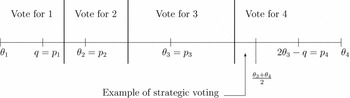
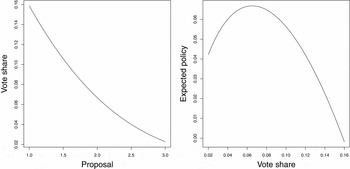




Comments
No Comments have been published for this article.