The nonenzymatic glycation and oxidation of proteins and lipids leads to the formation of a broad range of species, collectively called advanced glycation endproducts (AGEs) (Refs Reference Stevens1, Reference Day2, Reference Schnider and Kohn3). Beyond diabetes and natural ageing (Refs Reference Sensi4, Reference Brownlee5), AGEs form in advanced renal failure and atherosclerosis, even in euglycaemia (Refs Reference Miyata6, Reference Dawnay and Millar7, Reference Sakata8, Reference Mulder9, Reference Münch10). The observations that AGEs are increased in inflammatory conditions such as systemic lupus erythematosus, rheumatoid arthritis, osteoarthritis, and dialysis-related spondyloarthropathy and amyloidoses (Refs Reference Matsumoto11, Reference De Leeuw12) may provide ‘final common pathway’ mechanisms for understanding the strong epidemiological links between these inflammatory disorders and accelerated atherosclerosis (Refs Reference Charney13, Reference Farhey and Hess14). Furthermore, complications arising from atherosclerosis, characterised by superimposed hypoxia and ischaemia–reperfusion (I–R) injury, are potent and rapid generators of AGEs, both in the presence and absence of diabetes (Refs Reference Bucciarelli15, Reference Takizawa16, Reference Aleshin17, Reference Bucciarelli18). How do these AGE species contribute to cellular stress and tissue damage? This review focuses on the chief signal transduction receptor for AGEs – known as RAGE (‘receptor for AGEs’; encoded by AGER) – and the evidence linking this receptor to the complications of AGE and distinct RAGE ligand formation and accumulation in the cardiovascular system.
Not surprisingly, the highly heterogeneous AGEs may engage distinct receptors. In addition to RAGE (Refs Reference Schmidt19, Reference Neeper20), AGEs may interact with other molecular species, such as the scavenger receptors (SRs) SR-A (types I and II), SR-B (CD36), 80 K-H, OST-48 and galectin-3 (Refs Reference Horiuchi, Sakamoto and Sakai21, Reference Ohgami22, Reference Li23, Reference Lu24, Reference McFarlane25). RAGE activates a range of signal transduction cascades, including the family of mitogen-activated protein (MAP) kinases, members of the JAK–STAT signalling family, CDC42, RAC1 and other members of the Ras family, SRC1, members of the SMAD signalling family, and phosphoinositide 3-kinase (Refs Reference Taguchi26, Reference Lander27, Reference Marsche28, Reference Zeng29, Reference Reddy30, Reference Sakaguchi31, Reference Bianchi32, Reference Fukami33, Reference Vincent34). In addition, at least four central transcription factors are targets of RAGE signalling: nuclear factor (NF)-κB (Ref. Reference Yan35), cAMP-response-element-binding protein 1 (CREB; Ref. Reference Huttunen, Kuja-Panula and Rauvala36), early growth response 1 (EGR-1) (Ref. Reference Chang37), and activator protein 1 (AP-1; Ref. Reference Zeng29).
Complicating matters further, RAGE is a signalling receptor for non-AGE ligands, in addition to AGE ligands. Certain members of the S100/calgranulin family of pro-inflammatory and migration-stimulating molecules bind RAGE, activate signalling, and modulate cellular gene expression and function; for example, S100A12 and S100B have been identified as RAGE ligands (Ref. Reference Hofmann38). High-mobility group box 1 (HMGB1) is a nuclear protein in homeostasis, but in stress it may migrate to the leading edge of activated cells or be fully released into the microenvironment; in such milieu, HMGB1 may bind to and activate RAGE, thereby stimulating MAP kinase activation and upregulation of matrix metalloproteinase (MMP) protein and activity (Ref. Reference Taguchi26). β-Amyloid peptide (Aβ) and β-sheet fibrils also bind RAGE, and in murine models of Alzheimer disease (in which excess Aβ is generated), modulation of RAGE in neuronal compartments significantly impacts phenotype in the animals (Refs Reference Yan39, Reference Arancio40). In addition, MAC-1 (integrin ITGAM) binds RAGE (Ref. Reference Chavakis41).
RAGE is expressed on multiple cell types – from vascular and inflammatory cells to neurons (central and peripheral nervous systems), glomerular epithelial cells (podocytes), and cardiomyocytes, as examples (Refs Reference Brett42, Reference Tanji43). Thus, it is not surprising that the biology of RAGE impacts such diverse biological and pathological settings. In the sections to follow, we focus on mechanisms by which the ligand families of RAGE, via RAGE, contribute to cardiovascular complications, both in the presence and absence of diabetes.
RAGE, diabetic vascular dysfunction and atherosclerosis
Studies in human atherosclerosis and vascular lesions suggest that AGEs, S100/calgranulins and HMGB1 accumulate in plaques in the absence of diabetes, and to an accelerated degree in diabetes (Refs Reference Oimomi44, Reference Burke45, Reference Inoue46, Reference Kalinina47). From such studies, it was clear that both vascular and infiltrating inflammatory cells express these molecules. To provide firm and definitive support for the RAGE hypothesis in vascular pathology, studies were essential in animal models.
RAGE in diabetic vascular dysfunction
Initial work examined the effect of diabetes on the atherosclerosis-prone apolipoprotein-E-deficient (apoE-null) mouse. When apoE-null mice were rendered diabetic with streptozotocin (stz) at approximately 6 weeks of age, acceleration of atherosclerosis was noted versus euglycaemic age-matched control animals at both 14 and 20 weeks of age (Refs Reference Park48, Reference Kislinger49, Reference Bucciarelli50). Atherosclerosis was quantified at the aortic sinus, and in addition to increased mean lesion area at the aortic root, plaque complexity and progression were advanced in the diabetic state. The effects were not strictly due to direct effects of hyperglycaemia on the vasculature, as the levels of total cholesterol were significantly increased in the diabetic versus nondiabetic animals. Examination of the lesions revealed that both AGEs and RAGE were increased in the diabetic atherosclerotic plaques, particularly in the intimal macrophages and smooth muscle cells. Furthermore, assessment of the aortas from the diabetic and nondiabetic animals revealed that the degree of ‘vascular inflammation’ was greatly accelerated in the animals with diabetes: markers of inflammation, such as vascular cell adhesion molecule 1 (VCAM-1), CCL2 (also known as monocyte chemoattractant peptide 1), cyclooxygenase 2 (COX2), MMPs, tissue factor and oxidative stress were enhanced in the diabetic tissue, even at sites where frank lesions were not evident (Refs Reference Park48, Reference Kislinger49, Reference Bucciarelli50). One likely mechanism underlying these findings was that nuclear activity of NF-κB was increased in diabetic versus nondiabetic aorta (Ref. Reference Kislinger49).
Soluble RAGE (sRAGE) was used as an initial pivotal test of the premise that RAGE ligands participate in the acceleration of atherosclerosis in diabetes. sRAGE, composed of the extracellular ligand-binding domain of RAGE, binds ligands and blocks their interaction with cell-surface receptors, such as RAGE. The studies using sRAGE were designed to test two concepts in the realm of diabetic atherosclerosis.
In the first set of studies, sRAGE was administered to the diabetic apoE-null mice immediately after the demonstration of consistent hyperglycaemia (that is, serum glucose >250 mg/dl on at least two separate occasions). Compared with mice treated with vehicle (murine serum albumin), sRAGE-treated animals displayed a dose-dependent suppression of accelerated atherosclerotic lesion area and complexity after approximately 6 weeks of treatment. In the sRAGE-treated vasculature, levels of RAGE ligands AGEs were significantly lower, in parallel with markedly decreased vascular inflammation and oxidative stress (Refs Reference Park48, Reference Kislinger49). In the animals treated with sRAGE, there were no differences in levels of glucose or cholesterol/triglyceride (number and character) compared with vehicle-treated diabetic animals. These data strongly suggested that RAGE amplified inflammation and vascular stress in this environment, and that RAGE was not the direct and proximate cause driving the two major risk factors in these animals (hyperlipidaemia or hyperglycaemia). The RAGE axis was also studied in a murine model of type 2 diabetes. When sRAGE was administered to db/db mice bred into the apoE-null background, diabetes accelerated early atherosclerosis in those mice in a manner suppressed by administration of sRAGE. Treatment with sRAGE, however, had no effect on levels of glucose, lipids or insulin (Ref. Reference Wendt51). Taken together, the impact of RAGE antagonism in diabetes-accelerated atherosclerosis was not dependent on the proximate cause of hyperglycaemia in mouse models.
In the second set of studies, sRAGE was administered to diabetic apoE-null mice beginning six weeks after the initial documentation of stz-induced hyperglycaemia. In those experiments, stz was begun at six weeks of age and then sRAGE or vehicle was started at approximately 14 weeks of age and continued to age 20 weeks. When diabetic mice were sacrificed at age 20 weeks, those animals receiving murine serum albumin displayed a highly significant progression of atherosclerosis compared with age 14 weeks or with baseline, and compared with all nondiabetic apoE-null mice, in terms of lesion area and complexity at the aortic root (Ref. Reference Bucciarelli50). By contrast, those diabetic animals treated with sRAGE for the 6 week time course demonstrated stabilisation of lesion progression – that is, compared with diabetic apoE-null mice sacrificed at age 14 weeks (the ‘baseline’ for the sRAGE treatment), those mice treated with sRAGE through to age 20 weeks demonstrated no significant difference in lesion area and complexity at the aortic root (Ref. Reference Bucciarelli50). Thus, sRAGE led to stabilisation of the lesions. As in the case of diabetic mice treated with sRAGE during the early phase of progression, in these animals sRAGE had no impact on levels of glucose or lipids (Ref. Reference Bucciarelli50). Of note, multiple markers of vascular inflammation were significantly lower in the sRAGE-treated diabetic mice vessels at age 20 weeks compared with vehicle-treated diabetic mice of the same age.
Importantly, recent studies by Soro-Paavonen and colleagues revealed that homozygous RAGE-null mice in the apoE-null background displayed reduced atherosclerosis in diabetes (Ref. Reference Soro-Paavonen52). In parallel, decreased NF-κB p65 subunit, VCAM-1, CCL2, oxidative stress and reduced RAGE ligands, including S100A8/9, HMGB1 and carboxymethyllysine (CML)-AGE, were observed in the atherosclerotic plaques retrieved from apoE-null mice devoid of RAGE (Ref. Reference Soro-Paavonen52).
RAGE in atherosclerosis in nondiabetic models: roles for endothelial cell RAGE
As the ligands of RAGE, particularly the AGEs, have been shown to accumulate in nondiabetic aorta, we and others addressed their potential role in nondiabetic atherosclerosis in mouse models. To dissect the role of the ligand–RAGE interaction in atherosclerosis in nondiabetic apoE-null mice, two distinct sets of RAGE-modified mice were used. In the first studies, RAGE-null mice were bred into the apoE-null background; in the second set of studies, transgenic mice expressing dominant negative (DN) RAGE, particularly in endothelial cells (ECs) [as driven by the preproendothelin-1 (PPET) promoter], were used (Ref. Reference Harja53). The DN-RAGE construct is composed of the extracellular and membrane-spanning domains of RAGE, but is devoid of the short cytoplasmic domain (Refs Reference Neeper20, Reference Taguchi26, Reference Sakaguchi31, Reference Hofmann38). At age 14 weeks, compared with apoE-null mice, RAGE-null mice in the apoE-null background displayed significantly less atherosclerosis (Ref. Reference Harja53). Hemizygous transgenic PPET DN-RAGE mice bred into the apoE-null background also displayed reduced atherosclerosis versus apoE-null mice (Ref. Reference Harja53). In these studies, RAGE deficiency was not associated with differences in plasma cholesterol or triglyceride in apoE-null mice (Ref. Reference Harja53).
In addition to endothelial cells, at least two other highly relevant cell types express RAGE in the context of atherosclerosis – specifically, monocytes/macrophages and smooth muscle cells.
RAGE and monocytes/macrophages
In atherosclerotic lesions of diabetic Watanabe heritable hyperlipidaemic rabbits, expression of RAGE in macrophages colocalised with vascular endothelial growth factor (VEGF)-A, VEGF-D, VEGF-receptor 1 and NF-κB (Ref. Reference Roy54). These association studies were supported by experimental evidence in cultured monocytes/macrophages. The first demonstration of a role for RAGE in macrophages was made using human peripheral blood-derived monocytes. AGEs bound human monocytes with K d ∼80 nm in a manner prevented by antibodies to RAGE (Ref. Reference Schmidt55); furthermore, chemotaxis and haptotaxis of monocytes, as well as production of cytokines, in response to AGEs were dependent on RAGE. Similar findings were revealed with RAGE ligands CML-AGEs, S100A12, S100B and HMGB1 (Refs Reference Hofmann38, Reference Kislinger56, Reference Rouhiainen57). In addition to glycation of protein, glycated low-density lipoprotein (LDL) also modulates monocyte/macrophage properties. AGE-LDL increased levels of CC chemokine receptor 2 (CCR2) on human macrophages in a manner blocked by treatment with anti-RAGE IgG (Ref. Reference Isoda58). In THP1 monocytoid cells, AGE-LDL increased chemotaxis mediated by CCL2 via RAGE (Ref. Reference Isoda58).
Recent studies have suggested intriguing links of AGE–RAGE to macrophage cholesterol efflux. Microarray experiments revealed that exposure of human macrophages to AGE-BSA (bovine serum albumin) reduced mRNA levels (by 60%) and protein levels of the ATP-binding cassette transporter G1 (ABCG1), but not ABCA1, in these cells, in a manner prevented by anti-RAGE IgG (Ref. Reference Isoda59). At the functional level, exposure of human macrophages to AGE-BSA significantly reduced cholesterol efflux of high-density lipoprotein (HDL) in a manner independent of liver X receptors (LXRs) (Ref. Reference Isoda59). By contrast, AGE exerted no effect on efflux of apoA1.
In human subjects, monocytes retrieved from diabetic individuals revealed higher levels of tissue factor compared with nondiabetic cells, and, in vitro, incubation of monocytoid U937 cells with AGEs increased tissue factor expression (Ref. Reference Ichikawa60). Of note, however, this study did not test if such upregulation of tissue factor occurred via RAGE. Other studies in human diabetic mononuclear phagocytes link RAGE to phosphorylation of pleckstrin and production of inflammatory mediators (Ref. Reference Ding61).
RAGE and smooth muscle cells
Smooth muscle cells express RAGE and play notable roles in atherosclerosis. RAGE-mediated signalling in smooth muscle cells mediates ligand-stimulated proliferation, migration and generation of extracellular matrix molecules via multiple signalling pathways, including SRC kinase, MAP kinases, JAK–STAT and NF-κB (Refs Reference Lander27, Reference Reddy30, Reference Sakaguchi31, Reference Shaw62, Reference Yoon63). Roles for the Na+–H+ exchanger in AGE-mediated smooth muscle cell proliferation have been suggested. Furthermore, aortic smooth muscle cells retrieved from diabetic Goto-Kakisaki (GK) rats revealed increased expression of RAGE, NF-κB and CD36 compared with cells from nondiabetic rats (Ref. Reference Wu64). Distinct studies revealed that in cultured smooth muscle cells from the aortas of nondiabetic rats, AGE-BSA induced increased expression of CD36 in a manner reduced by treatment with insulin (Ref. Reference De Oliveira65).
In vivo, key roles for RAGE in neointimal expansion induced by guidewire injury to the carotid arteries of diabetic rats and to the femoral arteries of euglycaemic C57 BL/6 mice were illustrated. In the former case, administration of sRAGE to diabetic fatty Zucker rats resulted in a lower intima:media ratio compared with vehicle treatment after balloon injury (Ref. Reference Zhou66). In the first days after injury, sRAGE was associated with a marked reduction in smooth muscle cell proliferation in the injured carotid artery (Ref. Reference Zhou66). In the mouse, endothelial denudation injury to the femoral artery was greatly prevented by treatment with sRAGE and, especially, in homozygous RAGE-null mice or in transgenic mice expressing DN-RAGE in smooth muscle cells (SM22α promoter) (Ref. Reference Sakaguchi31).
Summary
Taken together, these findings provide strong support for fundamental roles for RAGE and its ligands in the pathogenesis of vascular dysfunction and ultimately atherosclerosis, at least in part via contributions in endothelial cells, monocytes/macrophages and smooth muscle cells. Beyond atherosclerosis, extensive evidence suggests roles for the ligand–RAGE axis in cardiac dysfunction and heart failure. In the section to follow, we address studies in human and experimental subjects linking heart failure to the RAGE mechanism.
Roles for the ligand–RAGE axis in heart failure
Association studies in humans
Epidemiological evidence is accumulating suggesting fundamental associations between AGE–RAGE and heart failure in human subjects (Ref. Reference Hartog67). For example, high serum levels of the specific AGE pentosidine were found to be an independent prognostic factor for heart failure (Ref. Reference Koyama68). CML- and carboxyethyllysine (CEL)-AGEs were examined in human subjects with congestive heart failure. Although CEL-AGE levels were not associated with heart failure, the plasma levels of CML-AGEs were related to severity and prognosis (Ref. Reference Hartog69). In other studies, left ventricular endomyocardial biopsies were performed in 28 patients with normal left ventricular ejection fraction (LVEF) and in 36 patients with reduced LVEF (none had coronary artery disease, but 16 of the normal LVEF subjects had diabetes, as did ten of the reduced LVEF subjects). The authors concluded that fibrosis and AGE accumulation in the heart were more important in the setting of reduced LVEF, but that cardiomyocyte resting tension was more relevant in subjects with normal LVEF (Ref. Reference Van Heerebeek70). In other studies, levels of sRAGE in human subjects were found to correlate with the degree of advancing heart failure. Furthermore, sRAGE levels were higher in patients with cardiac events versus subjects without events (Ref. Reference Koyama71). These studies suggested that serum sRAGE may be an independent prognostic factor for heart failure and a stratification factor in affected subjects.
In the sections to follow, we present findings in animal models linking RAGE to cardiovascular pathology.
Model systems
Ischaemia–reperfusion injury
Studies in the isolated perfused heart in nondiabetic mice revealed increased expression of RAGE as well as increased production of CML-AGEs in heart tissue in response to I–R. Biochemical assays indicated that I–R-treated hearts displayed increased pre-AGE methylglyoxal (MG), but in sRAGE-treated mice, I–R failed to increase MG (Ref. Reference Bucciarelli15). Evidence supporting release of RAGE ligands, such as AGEs, in I–R was suggested by experiments in which administration of sRAGE to wild-type mice prevented I–R injury in the isolated perfused heart (Ref. Reference Bucciarelli15). RAGE itself was a key modulator of I–R injury in response to these and perhaps other RAGE ligands, as homozygous RAGE-null mice hearts in I–R revealed marked protection, as evidenced by decreased release of lactate dehydrogenase (LDH), increased left ventricular developed pressure (LVDP) and increased ATP levels in the heart after reperfusion compared with wild-type animals (Ref. Reference Bucciarelli15).
Molecular analyses of wild-type hearts in I–R revealed significant upregulation of inducible nitric oxide synthase (iNOS) antigen by western blot, in parallel with increased NOS activity (total nitrite and nitrate) and increased cGMP, in a manner reduced by RAGE blockade (Ref. Reference Bucciarelli15). Mitochondrial oxidative stress was enhanced by I–R in the hearts, as indicated by increased nitrotyrosine epitopes in isolated mitochondria, and this was largely prevented by administration of sRAGE (Ref. Reference Bucciarelli15).
In diabetic hearts, similar protection in I–R was noted in the presence of RAGE antagonism or genetic modulation (Ref. Reference Bucciarelli18). As RAGE was particularly expressed in endothelial cells and mononuclear phagocytes in the hearts, two sets of transgenic mice expressing DN-RAGE in either of these cell types were tested. Diabetic RAGE-null mice were significantly protected from the adverse impact of I–R injury in the heart, as indicated by decreased release of LDH and lower glycoxidation products CML-AGE and pentosidine, improved functional recovery, and increased ATP. In diabetic transgenic mice expressing DN-RAGE in endothelial cells or mononuclear phagocytes, markers of ischaemic injury and CML-AGE were significantly reduced, and levels of ATP were increased in heart tissue compared with littermate diabetic controls (Ref. Reference Bucciarelli18). Key markers of apoptosis – caspase-3 activity and cytochrome c release – were reduced in the hearts of diabetic RAGE-modified mice compared with wild-type diabetic littermates in I–R (Ref. Reference Bucciarelli18). Taken together, these findings reinforced the notion that RAGE ligands were generated in I–R, irrespective of the diabetic state. Of note, these studies are particularly relevant to those related to RAGE biology, as it was previously shown that CML-AGEs are specific AGEs that bind RAGE, activate signalling and modulate gene expression and cellular properties such as migration (Ref. Reference Kislinger56).
In addition to experiments in the isolated perfused heart, recent studies have tested the role of RAGE and its ligands in a murine model of transient-occlusion–reperfusion of the left anterior descending coronary artery. Thus, in addition to cells innate to the heart as studied in the ex vivo isolated perfused heart mode, in this in vivo model RAGE- and RAGE-ligand-expressing infiltrating inflammatory cells might be expected to contribute to I–R stress responses. In an in vivo study, I–R was found to result in increased RAGE expression in multiple cell types in the heart, including cardiomyocytes (Ref. Reference Aleshin17). After 30 min of ischaemia in the wild-type mouse heart, a significant increase in pre-AGE MGs was noted, but by 1 h of reperfusion, MG species were similar to those in the baseline state (Ref. Reference Aleshin17). Interestingly, further study suggested that these pre-AGE MGs were being converted into AGEs. Whereas AGE epitopes (assessed by ELISA) in the heart were not increased after 30 min of ischaemia, at later times, specifically 1 h of reperfusion, AGE epitopes were markedly higher (Ref. Reference Aleshin17). Infarct area and release of creatine kinase (CK) were significantly lower after I–R in RAGE-null versus wild-type mice (Ref. Reference Aleshin17). Markers of apoptosis and oxidative stress (TUNEL staining, caspase 3 activity and release of cytochrome c) were all much lower in RAGE-null versus wild-type hearts, and levels of BCL2L1 were higher in the RAGE-null heart compared with wild-type heart (Ref. Reference Aleshin17). Examination of the signal transduction pathways modulated by I–R revealed that although phosphorylation of pro-apoptotic JNK MAP kinase and STAT5 was observed in wild-type hearts after I–R, in RAGE-null hearts, significantly decreased activation of these kinases was noted (Ref. Reference Aleshin17). By contrast, phosphorylated STAT3 was increased in RAGE-null versus wild-type hearts (Ref. Reference Aleshin17). These findings in the RAGE-null mouse were the result, in part, of decreased RAGE ligand stimulation, as administration of sRAGE to wild-type mice undergoing left anterior descending coronary artery I–R yielded significant cardioprotection in this model (Ref. Reference Aleshin17).
These effects of sRAGE were due to its ability to trap injurious levels of ligands, such as AGEs, HMGB1 and/or S100/calgranulins, in the I–R heart. For example, it was recently shown that infiltrating leukocytes express pro-inflammatory HMGB1, and that HMGB1 plays fundamental roles in injury responses in the I–R heart. In mice undergoing I–R of the left anterior descending coronary artery, administration of recombinant HMGB1 or antagonists of this molecule had significant pro-injury and protective impact in the wild-type mouse heart, respectively, but essentially no additive effects in mice devoid of RAGE were observed (Ref. Reference Andrassy72). The latter findings suggested that RAGE, at least in this setting, was a chief HMGB1 receptor. Note that just like AGEs, HMGB1 appears to interact with distinct molecules, such as Toll receptors (Ref. Reference Park73).
In addition to AGEs, S100/calgranulin ligands of RAGE participate in heart damage induced by ischaemia. Transgenic mice expressing S100B and S100B-null mice were studied by Tsoporis and colleagues. Pathogenic effects of S100B on apoptosis, hypertrophy and cardiac function were demonstrated in S100B-expressing transgenic mice. However, in mice devoid of S100B, these pathological effects were greatly reduced (Ref. Reference Tsoporis74). Taken together, these considerations suggest that each of these RAGE ligand families may contribute to I–R injury in the heart.
RAGE and heart failure
The AGE–RAGE hypothesis has been tested in animals and/or human models of frank heart failure. Studies in diabetic rats suggested decreased compliance of the left ventricle with accumulation of AGEs in the myocardium, as measured by collagen fluorescence. Two distinct agents were used as therapeutic intervention: captopril [an angiotenisin-converting enzyme (ACE) inhibitor] and the AGE inhibitor aminoguanidine. Aminoguanidine treatment resulted in improved myocardial compliance, in parallel with decreased myocardial collagen fluorescence. By contrast, treatment with captopril afforded no benefit (Ref. Reference Norton, Candy and Woodiwiss75). An additional anti-AGE approach, the crosslink breaker ALT-711, has recently emerged in experimental animal and clinical trial testing once safety analysis of aminoguanidine raised concerns about its long-term administration in human subjects. ALT-711 improved ventricular stiffness in aged dogs after 4 weeks of treatment (Ref. Reference Asif76). Testing of this agent in the DIAMOND and PEDESTAL trials suggested anatomical and quality-of-life improvement in human clinical trials (Refs Reference Little77, Reference Thohan78).
In the setting of systolic heart failure, AGE-lowering therapy was tested in animal models. ALT-711 therapy restored left ventricular systolic function in diabetic dogs (Ref. Reference Liu79), and demonstrated a similar beneficial effect in aged monkeys (Ref. Reference Vaitkevicius80). A novel AGE breaker, C16, was tested in diabetic rats with cardiac dysfunction; after 4 weeks of therapy with either C16 or ALT-711, cardiac output was improved, together with reduced total peripheral resistance and increased systemic arterial compliance (Ref. Reference Cheng81).
To test the role of the chief AGE receptor, RAGE, in experimental heart failure, Petrova and colleagues generated transgenic mice in which human RAGE was overexpressed in the heart. Calcium transients in cardiac myocytes upon AGE exposure were studied; overexpression of RAGE reduced systolic and diastolic intracellular calcium concentration and caused a significant delay in calcium reuptake (Ref. Reference Petrova82). As a result, the duration of the polarisation phase of the cardiac contraction might be expected to increase, thereby causing diastolic dysfunction.
In addition to the direct effect of AGEs accumulating in the vulnerable heart in diabetes or in ageing, AGEs may affect the heart in I–R injury in a manner independent of baseline diabetes or advanced age. It will be very interesting to test if and how traditional therapies for heart failure, such as β-blockers and ACE inhibitors, impact RAGE expression.
Future directions
Taken together, these findings indicate that the RAGE axis is likely a reasonable target for therapeutic intervention in the I–R heart. What, however, is/are the logical and precise ligand(s) of RAGE in this setting? Do all of the relevant ligands exert injury, or, in contrast, are some linked to repair? Very early studies suggested that AGEs bound primarily to the V-domain of RAGE (Ref. Reference Hofmann38). However, the same may not be true for specific S100/calgranulins that bind RAGE. For example, S100A12 may bind RAGE C1 domain (Ref. Reference Xie83), S100B may bind to RAGE V and C1 domains (Ref. Reference Dattilo84), and S100A6 may bind to RAGE V and C2 domains (Ref. Reference Leclerc85). Such considerations may provide first hints and suggestions to differential biological effects of RAGE ligands – depending on the specific sites to which they bind in the extracellular region of the receptor.
Solving this puzzle will be greatly aided by identification of the specific AGEs that bind RAGE. AGEs are a heterogeneous class of compounds and may be generated via 3-deoxyglucosone (3-DG) or MG species – both of which appear to be generated by I–R. At this time, studies are actively under way to identify the precise AGEs generated in I–R. Although non-AGE RAGE ligands were not detectable in endothelial cell supernatants after I–R in vitro, in the model of left anterior descending coronary artery I/R, a profound effect of infiltrating monocytes bearing HMGB1 was noted (Ref. Reference Andrassy72).
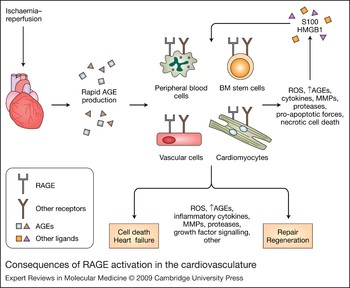
The RAGE ligand story, however, may well be a ‘mixed bag’ of injury and repair (Fig. 1). For example, in contrast to studies illustrating damaging effects of RAGE in heart I–R, it was shown that local administration of HMGB1 to the infarcted murine heart facilitated regeneration, in part by stimulating proliferation and differentiation of local cardiac cells expressing the tyrosine kinase receptor KIT (Ref. Reference Limana86). These beneficial effects of HMGB1 stand in contrast to those of Andrassy and colleagues, who showed that HMGB1 increased injury in the heart (Ref. Reference Andrassy72). Of course, the specific conditions and routes of administration of HMGB1 in the studies to date did differ. They nevertheless point out the complexity of RAGE and its ligands in I–R – no doubt a ‘double-edged’ sword (Ref. Reference Ramasamy, Yan and Schmidt87).
Consequences of RAGE activation in the cardiovasculature. We predict that in ischaemia–reperfusion (I–R) to the heart and vessels, an immediate and transforming consequence is the rapid production and release of advanced glycation endproduct (AGE) species. Although a chief goal of ongoing work is to identify the specific AGEs that are produced in I–R, it is certain that at least some of these AGE species bind to and signal through the receptor RAGE (‘receptor for AGEs’). Once RAGE is engaged, a plethora of events may ensue, given that RAGE is expressed in cells innate to the heart (such as cardiomyocytes and vascular cells), but also in cells recruited to the I–R heart, such as those emanating from the peripheral blood and bone marrow (BM) (including both mature inflammatory cells and progenitor stem cells). Interaction of AGEs with these cells results in diverse outcomes, including rapid generation of reactive oxygen species (ROS; themselves triggers to further AGE generation), production of inflammatory cytokines, generation of matrix metalloproteinases (MMPs) and other proteases, and production of cell-death-provoking factors. Distinct ligands of RAGE, such as S100s and HMGB1, may be released by cells within the injured heart tissue and/or infiltrating inflammatory cells. S100s and HMGB1 may then trigger further ROS generation, inflammation, remodelling and growth factor signalling and/or distinct events, which, in the aggregate, may lead, long-term, to repair and regeneration, versus cell death and heart failure. Within the heart, this model may not be ‘all of none’, as it is plausible that distinct mechanisms may be operative in different sites in the heart, as local versus more general cues from the microenvironment may create favourable substrates in which healing versus damage-provoking signals dominate. We speculate that in hearts preburdened with AGEs, such as in diabetes, renal failure and advanced ageing, the impact of I–R is augmented, favouring activation of mechanisms that lead to cell death and failure versus repair. Segregating the adaptive and proregenerative effect of RAGE versus its injurious signals is an essential step in identifying novel and targeted means to protect the I–R heart and vasculature.

Experimental evidence supports this concept, as the RAGE axis clearly may exert beneficial effects in biological systems. For example, RAGE is essential for effective T cell priming reactions in vivo and in vitro (Ref. Reference Moser88). In acute crush of the sciatic nerve in wild-type mice, treatment with sRAGE, or F(ab′)2 fragments of anti-RAGE, or anti-S100/calgranulin or anti-HMGB1 IgG significantly suppressed the regenerative response, as assessed by functional and pathological endpoints (Ref. Reference Rong89). In transgenic mice, impairment of RAGE signalling in vivo in either, but especially both, axonal and macrophage cellular elements in the injured sciatic nerve suppressed regeneration (Ref. Reference Rong90). Furthermore, it is not yet known whether and by what mechanisms RAGE may exert beneficial effects in atherosclerosis. Certainly, experiments in mice globally deficient in RAGE may well mask potential reparative roles for RAGE. Therefore, tissue-targeted approaches will be essential to uncover the full scope of RAGE biology in atherosclerosis.
We further propose that in future studies it will be important to extend I–R studies in the heart to late outcomes. Although these first studies address short-term endpoints, damage to the heart does not stop at the conclusion of the acute reperfusion phase. Rather, remodelling forces once set in motion may lead to loss of ventricular function. In this context, then, does RAGE impact long-term remodelling in the heart, and, if so, does RAGE-linked inflammatory cell activation contribute adversely or beneficially to such healing mechanisms? Are there differential effects of the RAGE axis in early versus late events? Although blockade of RAGE does not appear to adversely or proactively affect cutaneous wound healing in nondiabetic mice, whereas sRAGE accelerates wound healing in diabetic rodents (Ref. Reference Goova91), it will remain to be seen if such is the case in the infarcted heart. The answers to these questions are most important to address: RAGE antagonism is now in early clinical trials (in diabetes and in Alzheimer disease), and the basic science must provide a sound basis – or not – for antagonising RAGE in the I–R heart.
Acknowledgements and funding
The authors gratefully acknowledge funding from the United States Public Health Service and the Juvenile Diabetes Research Foundation. The authors also thank Ms Latoya Woods for her expertise in the preparation of this manuscript.