Research by Bialystok and her colleagues has shown that early bilingualism and constant daily use of two or more languages leads to precocious development of certain cognitive processes for children (review in Bialystok, Reference Bialystok2001), advantages that persist across the lifespan (Bialystok, Craik, Klein and Viswanathan, Reference Bialystok and Senman2004; Bialystok, Craik and Ryan, Reference Bialystok, Craik and Ryan2006). Importantly, these processing differences between monolinguals and bilinguals are not confined to linguistic tasks but have been found for a variety of nonverbal problems, such as the paper-and-pencil version (Pascual-Leone, Reference Pascual-Leone1969) of Piaget's water level task (Bialystok and Majumder, Reference Bialystok and Majumder1998), the dimensional change card sort (DCCS; Zelazo, Reznick and Pinon, Reference Zelazo, Reznick and Pinon1995) examining knowledge–action differences in a classifi-cation task (Bialystok, Reference Bialystok1999; Bialystok and Martin, Reference Bialystok and Martin2004, Study 1), the ability to see the alternate image in a reversible figure (Bialystok and Shapero, Reference Bialystok and Shapero2005), and the “reality question” in the appearance–reality problem (Flavell, Flavell and Green, Reference Flavell, Flavell and Green1983, Reference Flavell, Flavell and Green1987), for which the correct answer contradicts the current perception (Bialystok and Senman, Reference Bialystok and Senman2004). In all these studies, tasks or conditions that were similar to the experimental conditions but were not embedded in a misleading context that created a conflict were solved equivalently by children in both language groups.
The difference between children in the two language groups in these studies was in their ability to resolve perceptual conflict and respond on the basis of a non-salient target cue. In the water level task, the angle of the line defining the bottom of the beaker must be ignored in order to draw a line perpendicular to the table to indicate the gravitational horizontal; in the DCCS, the redness of the stimulus that was just relevant for sorting and provided the name, “the red one” must be overruled to reinterpret the stimulus as “the round one”; in the ambiguous figure reversal task, the interpretation of the drawing as “duck” needs to be ignored in order to see the same drawing as “rabbit”; and in the appearance–reality problem, the perceptual cues that signal that the object looks like a rock must be disregarded in order to respond that the item is actually a sponge. Therefore, the processing advantage for bilinguals occurs in problems that require cognitive control to attend to the relevant property and ignore a misleading property that is perceptually salient and presented with the target feature. This ability to control attention is part of the executive function that is developing gradually in preschool in children.
These results suggest that the development of executive functioning broadly and inhibitory control in particular is influenced by bilingualism. Children's development of inhibitory control is well documented (Diamond, Reference Diamond, Stuss and Knight2002, for review) and is a central feature of many theories of cognitive development (e.g., Dempster, Reference Dempster1992; Tipper, Reference Tipper1992; Harnishfeger and Bjorklund, Reference Harnishfeger, Bjorklund, Pasnak and Howe1993; Diamond and Taylor, Reference Diamond and Taylor1996). Moreover, inefficient inhibition has been linked to such developmental psychopathologies as attention deficit hyperactivity disorder, obsessive-compulsive disorder, Tourette syndrome, and autistic spectrum disorder (Ozonoff, Pennington and Rogers, Reference Ozonoff, Pennington and Rogers1991; Ozonoff and Jensen, Reference Ozonoff and Jensen1999). Therefore, if bilingualism influences the development of inhibitory control in children, the results would be an important contribution to understanding an essential developmental process.
The purpose of the present series of studies is to extend these earlier results to provide a more precise measure of inhibitory control and a more detailed interpretation of potential processing differences between monolingual and bilingual children. In these studies, the concept of inhibitory control is examined through tasks that demand different levels (Study 1) and types (Studies 2 and 3) of inhibitory control.
The Simon task has been studied extensively, largely as a measure of stimulus–response incompatibility, but has also become the basis for a wide range of research investigating attentional processes and executive functions (Lu and Proctor, Reference Lu and Proctor1995). In a typical Simon task, colored stimuli presented on the left or right side of the display are associated with a left or right key press. When the correct key press corresponds to the position of the stimulus in the display, the trial is congruent because both color and position information converge on the same response; when the correct key and stimulus position conflict, the trial is incongruent. In this case, the position must be ignored because the correct response is determined only by the color of the stimulus. The reliable increase in response time to an incongruent trial relative to a congruent trial is the Simon effect (Simon, Reference Simon1969). Although there is debate concerning the source of the Simon effect, most investigators attribute it to conflict during response selection. Once stimulus identification has occurred (a red square), the response selection phase ensues (hit left key). The Simon effect is the result of interference between the stimulus' spatial code and the spatial code of the associated response (Simon and Craft, Reference Simon and Craft1970).
The Simon task meets the criteria for the type of paradigm in which bilingual children have been shown to outperform monolinguals. Two stimulus cues, one relevant but less salient, and one irrelevant but more salient, compete for the child's attention. To efficiently resolve the conflict between the two cues, the more salient stimulus feature must be ignored in favor of the less salient correct option. Although the Simon paradigm has not been used extensively with children, Diamond, O'Craven and Savoy (Reference Diamond, O'Craven and Savoy1998) presented evidence from a directional Stroop task, a paradigm similar to the Simon task. In that task, children were told to press one key if a stimulus circle is shaded and a different key if the circle is striped. The keys were at opposite sides of the screen, and the stimuli were presented on the right or the left of the screen, resulting in congruent and incongruent trials as in the Simon task. The results showed that children between the ages of 4½ and 6 years committed more errors and produced longer reaction times to the incongruent trials than to congruent trials, indicating a reliable Simon effect. There is evidence, however, that inserting a delay between stimulus presentation and response simplifies tasks requiring inhibitory control (Gerstadt, Hong and Diamond, Reference Gerstadt, Hong and Diamond1994; Diamond, Kirkham and Amso, Reference Diamond, Kirkham and Amso2002). On the DCCS and the day–night Stroop task, the brief opportunity for reflection allowed children to overcome the habitual response and perform correctly. Therefore, children's control over these processes can be improved by reducing other task demands.
The Simon task has been used as a means of examining executive function differences between monolingual and bilingual adults. In research using young (20–30 years old) (Bialystok, Reference Bialystok2006), middle-aged (30–60 years old), and older (60–80 years old) adults (Bialystok et al., Reference Bialystok, Craik, Klein and Viswanathan2004), bilinguals completed the Simon task more efficiently than monolinguals and demonstrated a smaller Simon effect. However, in the study with young adults, faster bilingual performance was only found for the most demanding condition in which the stimuli created the most perceptual conflict and the task imposed the greatest processing demands through the need for rapid switching between trials. In the study with middle-aged and older participants, in contrast, the bilinguals performed better than monolinguals in all conditions and the size of the advantage increased with age, indicating a less severe decline in performance with aging for the bilinguals. Importantly, in all studies in which the bilinguals performed more rapidly than the monolinguals, the difference was equally significant for both congruent and incongruent trials. In other words, the control processes required to perform the Simon task are involved in all trials, not just those explicitly containing conflict. This is likely because the mixed blocks of congruent and incongruent trials that are essential in presenting the Simon task require that the participant constantly hold the two rules in mind and anticipate switching between responses on each trial. Supporting this interpretation, Lu and Proctor (Reference Lu and Proctor2001) point out that the irrelevant feature in mixed blocks influences responses in all trials, including congruent ones. In a study using a behavioral version of an anti-saccade task, blocks with mixed congruent and incongruent trials were performed more rapidly by bilinguals than monolinguals with faster bilingual RTs on both types of trials, but blocks with single trial types produced different results. In that case, monolinguals and bilinguals performed the same on blocks of congruent trials but bilinguals were faster than monolinguals on blocks of incongruent blocks (Bialystok et al., Reference Bialystok, Craik and Ryan2006).
In young adults, reaction time differences are not always evident in comparing performance across the two language groups (Bialystok, Reference Bialystok2006). In a study using magneto-encephalography (MEG) with young adults performing the Simon task, monolingual and bilingual participants did not differ in the speed of response but employed different frontal regions (Bialystok et al., Reference Bialystok, Craik, Grady, Chau, Ishii, Gunji and Pantev2005). Specifically, the activation for the bilinguals included regions overlapping with Broca's area while those for monolinguals did not. Again, the differences between monolinguals and bilinguals were found equally for congruent and incongruent trials of the Simon task. Together, these studies show that the Simon task is performed differently by monolinguals and bilinguals, with more efficient performance by the bilinguals. The present studies investigate whether these processing differences are also found in children.
The present paper reports three studies in which the Simon paradigm was used to investigate executive functions, in particular inhibitory control, in young monolingual and bilingual children, and to identify the processes that are different for children in these two language groups. The primary hypothesis was that bilingual children will perform the Simon task better than monolinguals as evidenced by faster reaction times. Following earlier research, this advantage should be found for both congruent and incongruent trials. Reducing the processing demands by inserting a delay before responding should produce equal performance by monolingual and bilingual children.
Study 1
The processing demands of the Simon task were manipulated by creating three versions of the task that differed in the delay between the presentation of the stimulus and the opportunity to respond. The delay reduces the saliency of the misleading cue (Diamond et al., Reference Diamond, Kirkham and Amso2002) and should therefore reduce as well the difference between children in the two language groups. The prediction was that bilinguals will outperform monolinguals in an immediate response task, but a short delay will reduce the bilingual advantage and a longer delay will eliminate it completely.
Method
Participants
There were 34 children, half of whom were monolingual. The monolinguals (6 boys and 11 girls; mean age 4;7 years) were English-speaking children recruited from childcare centers. The bilingual children (8 boys and 9 girls; mean age 5;0 years) were fluent speakers of French and English recruited from after-school programs within a French school board. The French school system provides instruction exclusively in French to children who typically speak French at home to at least one parent. English is not introduced into the curriculum until the third grade, when children are eight years old, although children are exposed to English during extracurricular activities, such as sports teams or classes. All parents of the bilingual children indicated that English was the main language spoken between siblings in the home, but that the children were read to and watched TV both in French and in English. The experimenter was French–English bilingual, and in addition to assessing their receptive vocabulary, conversed with the children in both languages prior to testing to ensure competency in both French and English. According to parental reports, all children were read to on a regular basis and had similar exposure to television and films. All the children lived in similar neighborhoods and had similar social backgrounds. All the children were born in Canada so there was no difference between children in the two groups in immigration status. The only apparent difference was that the bilingual children spoke French at home.
Materials and procedures
Forward Digit Span. This test was used as an assessment of short-term memory to ensure comparability of the two groups. Children were presented with a random string of digits and were required to repeat the string back in the same order. The strings began with two digits and increased by one digit every two trials. One point was awarded for every correctly re-produced sequence, producing the possibility for two points at each string length. Testing ended when the child incorrectly reproduced both sequences at a given string length.
Peabody Picture Vocabulary Test Revised (PPVT-R). This task was used to compare the English receptive vocabulary of the children in the two language groups. Children were shown a plate consisting of four pictures and pointed to the one named by the experimenter. Testing continued until children made six errors in eight consecutive trials. The number of correct responses is calculated as the raw score, and converted to a standard score by means of age-related norms.
Échelle Vocabulaire en Images Peabody (EVIP). This is a standardized test of receptive vocabulary in French and was administered to the bilingual children. The testing procedures and scoring criteria are the same as those for the PPVT English test.
Simon task. The Simon task was instantiated on an IBM laptop computer. Children were instructed to press the red button if a red square appeared and the blue button if a blue square appeared. The left and right shift keys were labeled with a red sticker and a blue sticker respectively. Half the trials were incongruent, so the colored square appeared on the side opposite to the appropriate shift key.
Three versions of the Simon task were administered to children. In the immediate task, the child was told to respond as quickly as possible when the stimulus appeared. Trials timed out after 5000 ms and the next trial appeared, leaving any missed trial as an error. In the two delay tasks, children were told they could not respond until a cue appeared. In the short delay task, the cue was presented 500 ms after the stimulus and remained on the screen for 800 ms, and in the long delay task the cue appeared after an interval of 1000 ms. The response could be made as soon as the cue appeared but prior to that point the response keys were locked. The cue was an icon of a hand shown in the middle of the screen with the first finger pointing downwards. The child was instructed not to press any button while waiting for the cue. Each task was administered separately with its own set of instructions and preceded by four practice trials. Children were required to achieve 100% accuracy on the practice trials before proceeding to the experimental trials for each task. The tasks were presented in the fixed order described above.
Results
The mean score on the forward digit span was 6.1 (SD = 1.3) for the monolingual children and 5.9 (SD = 1.7) for the bilingual children, a difference that was not significant, t < 1. In contrast, the monolinguals obtained a mean score of 111.4 (SD = 10.9) on the PPVT-R standard score and the bilinguals obtained a mean score of 89.6 (SD = 24.4), which was significant, t(32) = 3.36, p < .01. A paired-samples t-test indicated that the bilingual children's scores on the English PPVT-R (M = 89.6, SD = 24.4) and on the French EVIP (M = 98.8, SD = 14.8), t(17) = 1.36, n.s., were equivalent.
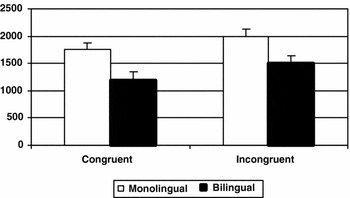
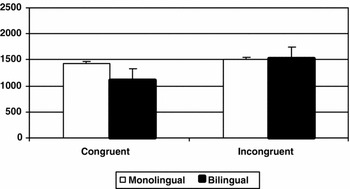
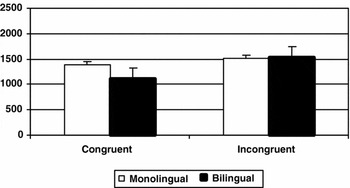
Children made very few errors in the three Simon tasks, with the mean percentage of errors ranging from 2% to 5%. There were no differences between groups in error rate on any of these tasks, all Fs < 1. The mean RT for the correct trials in each of the Simon tasks is presented in Figure 1. There was not sufficient power in the design for the three tasks to be analyzed together (because of the sample size, the number of conditions, and the number of trials in each condition) so given the different hypotheses for each task, a two-way analysis for language group and congruence was conducted separately for each. In the immediate task, congruent trials elicited faster reaction times than incongruent trials, F(1, 32) = 4.19, p < .05, and bilingual children responded more rapidly than monolinguals, F(1, 32) = 7.40, p < .01, with a power of .71. There was no language group by trial type interaction, F < 1, indicating that the reaction time difference between congruent and incongruent trials was the same for both language groups. In both the short delay and long delay tasks, there were no differences between congruent and incongruent trials, and no differences between monolingual and bilingual children, all Fs < 1.
Reaction times in ms and standard deviations on the Immediate Response task by language group and trial type in Study 1.

Reaction times in ms and standard deviations on the Short Delay Response task (500 ms) by language group and trial type in Study 1.

Reaction times in ms and standard deviations on the Long Delay Response task (1000 ms) by language group and trial type in Study 1.

Another way to consider performance is to calculate the Simon effect, namely, the RT difference between congruent and incongruent trials. In spite of large differences in this value, the difference between groups was not significant for any of the tasks. For the immediate task, the monolinguals (M = 264, SD = 881) and bilinguals (M = 306, SD = 739) did not differ, F < 1; for the short delay task, the monolinguals (M = 77, SD = 701) and bilinguals (M = 412, SD = 1159) produced a larger gap but were still not significantly different, F(1,32) = 1.08, n.s., and for the long delay task, the monolinguals (M = 72, SD = 790) and bilinguals (M = 43, SD = 719) again produced similar results, F < 1.
Discussion
Monolingual and bilingual children performed the same on a simple test of memory span, but monolinguals scored higher on a standardized measure of receptive vocabulary. This difference in vocabulary size is commonly found for monolingual and bilingual children (review in Oller and Eilers, Reference Oller and Eilers2002). Moreover, the vocabulary score in English and French was the same for the bilingual children, supporting the claim that they were balanced bilinguals.
The bilingual children performed the immediate Simon task more rapidly than monolingual children. In contrast, the children in the two groups performed equivalently when a delay allowed them to reflect briefly on the response, so there were no group differences in either the short delay or long delay tasks. Although it was hypothesized that the short delay would reduce the bilingual advantage without eradicating it, both delays were long enough to allow all the children to resolve the perceptual conflict.
The bilingual advantage in the immediate task was found for both the congruent and incongruent trials, replicating the pattern in our previous research with the Simon task (e.g., Bialystok et al., Reference Bialystok, Craik, Klein and Viswanathan2004, Reference Bialystok, Craik and Ryan2005). The consistency of the group responses to both types of trials was confirmed by the lack of significant group differences for the Simon effect in any of the tasks. Even though the absolute size of the Simon effect appeared to be different for the two groups, especially in the short delay condition, the small sample size and large variance prevented any such differences from being considered significant. For these reasons, it is especially notable that the group difference in reaction time for the immediate task emerged as strongly reliable.
Study 2
The results of Study 1 add to our previous evidence for bilingual advantages in the Simon task without identifying the source of that advantage. An important distinction between types of inhibitory control has been proposed by Bunge and her colleagues (Bunge, Dudukovic, Thomason, Vaidya and Gabrieli, Reference Bunge, Dudukovic, Thomason, Vaidya and Gabrieli2002). The distinction is based on the difference between bivalent displays which are comprised of two potentially conflicting dimensions, and univalent displays in which only a single feature is presented. The two features of bivalent displays can either converge on a single response, creating congruent trials, or conflict by indicating different responses, creating incongruent trials. Bunge et al. (Reference Bunge, Dudukovic, Thomason, Vaidya and Gabrieli2002) call the inhibition required in this case “interference suppression”. In univalent tasks, the conflict is between two response options to the same stimulus feature, creating a conflict between the habitual response and a less familiar arbitrary response that must override and replace it. According to Bunge et al., these problems require “response inhibition”. Bunge et al. (Reference Bunge, Dudukovic, Thomason, Vaidya and Gabrieli2002) have demonstrated that each of these kinds of inhibition shows a different developmental trajectory and engages different areas of the prefrontal cortex.
This distinction between interference suppression and response inhibition is useful for identifying potential processing differences in inhibitory control between monolingual and bilingual children. For bilinguals, their two linguistic systems function as bivalent representations, offering different, potentially competing response options to the same intention or goal. To manage this conflict, bilinguals must attend to the relevant language system and ignore the unwanted system to assure fluency in speech production (e.g., Kroll and Stewart, Reference Kroll and Stewart1994; Green, Reference Green1998; La Heij, Reference La Heij, Kroll and de Groot2005). This is comparable to the Simon task in which bivalent displays require children to attend to one feature (color) and ignore the other (position). Therefore, tasks requiring interference suppression to selectively attend to one of two stimulus cues should be solved better by bilinguals.
The inhibition associated with univalent displays seems to be less relevant to the bilingual experience. Bilinguals do not refrain from speaking in the manner indicated by response inhibition, but must select between two competing linguistic systems for language production. Further, Costa, Miozzo and Caramazza (Reference Costa, Miozzo and Caramazza1999) have shown that there is no evidence that the unwanted language is actually inhibited in the sense of becoming unavailable. Therefore, there is no reason to expect a bilingual advantage on tasks assessing response inhibition to univalent displays. However, in a previous study, younger and older adults who were monolingual or bilingual performed in a behavioral version of an anti-saccade task, in which anti-saccade trials constitute a univalent condition. The task is to avoid responding on the side in which a target is flashed and replace that habitual response by responding on the opposite side. Young monolinguals and bilinguals performed equivalently, but older bilinguals (approximately 65 years old) were more able than older monolinguals to override the habitual response in those trials (Bialystok et al., Reference Bialystok, Craik and Ryan2006). Therefore, the prediction is that there is no reason to expect a bilingual advantage in responding to univalent task conditions, but there may be factors that mitigate that prediction.
Most of the research comparing executive processing by monolinguals and bilinguals has been based on bivalent displays and the need for interference suppression. The present study includes a task based on response inhibition with univalent displays. Performance on the standard condition of the Simon task using immediate response and more trials than in Study 1 and on a modification of the day–night Stroop task (Gerstadt et al., Reference Gerstadt, Hong and Diamond1994; Diamond et al., Reference Diamond, Kirkham and Amso2002) is compared to assess the relation between these two aspects of inhibitory control in young children who are monolingual or bilingual. The hypothesis is that bilinguals will outperform monolinguals on tasks using bivalent displays (both congruent and incongruent trials in the Simon task) because these tasks mirror the processing required to manage two language systems, but monolinguals and bilinguals will perform the same on tasks using univalent displays (Stroop picture naming) because these do not obviously correspond to the kind of inhibitory control used in managing two language systems.
Method
Participants
There were 41 four-year-old children, including 20 monolinguals and 21 bilinguals, involved in the study. The monolingual children (10 boys, 10 girls; mean age 4; 5 years) understood and spoke only English. The bilingual children (12 boys, 9 girls; mean age 4;6 years) had three different backgrounds. Fourteen of these children were French–English bilinguals recruited from after-school programs in the French school board, as in Study 1. In addition, four Chinese–English and three Spanish–English bilinguals were recruited from the same daycare as the monolingual children. These children are exposed entirely to English at daycare but speak Chinese or Spanish at home. There was no difference between the results of the 14 French–English bilinguals and the seven remaining bilinguals, so no distinction between them is made in the presentation of the results.
Materials and procedure
The Forward Digit Span and Peabody Picture Vocabulary Test-Revised (PPVT-R) were used following the same procedures as in Study 1.
Simon task. This task was instantiated on a Dell laptop computer using DMDX software. Blue and red squares were presented on either side of the computer screen, centered between the top and bottom. The instruction was to press the blue button when a blue square appeared and the red button when a red square appeared. The right and left shift keys were marked with a blue and red sticker, respectively.
The experimenter explained the instructions to the child, followed by a set of 8 practice trials. If the child made more than 2 errors on these practice trials, the instructions and all 8 trials were repeated until children reached this criterion level. The task consisted of 40 experimental trials with a brief break after 20 trials. Each trial began with a cross fixation for 500 ms, followed by the stimulus, which remained on the screen for 5000 ms, or until the child responded. Due to an error in the programming of the task, there were 19 incongruent trials and 21 congruent trials.
Stroop Picture Naming task: The task was adapted from one developed by Gerstadt et al. (Reference Gerstadt, Hong and Diamond1994). The child is told to say “night” when presented with a picture showing a bright sun and to say “day” when shown a picture of a dark moonlit sky. There is no conflict between competing perceptual cues (because each picture only shows one kind of display) but there is a need to overcome the habitual response which is to name the display.
This was also instantiated on a Dell laptop computer using DMDX software and voice response technology. The verbal response is recorded into a wave file for each trial. Response accuracy was determined by listening to each wave file and manually recording the response as correct, incorrect, or incomprehensible. Response latency was recorded from the onset of the stimulus to the onset of the child's voice.
There were two conditions used in this task, day–night and cat–dog, with two trial types for each, same name and opposite name. In the same name trials, children named the picture as quickly as possible, and in the opposite name trials, gave the name of the other picture, for example, “day” for the picture of night, and “night” for the picture of day. Children were told to answer as quickly as possible without making errors. The task was explained using laminated cards depicting the pictured stimuli. Four computerized practice trials preceded the start of the experimental trials. The practice trials repeated until children demonstrated 100% accuracy. The image remained on the screen for 2000 ms, regardless of whether the child had responded. Each condition was presented in two blocks of 24 trials each, one consisting of same name trials and the other of opposite name trials. The order of the conditions (day–night and cat–dog) was counterbalanced across children, but same name trials were always presented first.
Results
The mean score on the forward digit span was 5.5 for children in both groups, t < 1. The mean PPVT standard score was 96.4 for the monolinguals (SD = 15.0) and 86.4 for the bilinguals (SD = 15.6), a difference that was significant, t = 2.08, p < .05, as in Study 1.
The mean percentage of errors on the Simon task ranged from 5% to 15%, with no difference between groups, F(1, 39) = 1.68, n.s. However, more errors were committed in the incongruent (13%) than congruent (8%) trials, F(1, 39) = 73.26, p < .0001, with no interaction between language group and congruence, F < 1. The mean reaction times for the correct trials in the Simon task are plotted in Figure 2 by trial type and language group. A two-way ANOVA revealed a main effect of trial type, where congruent trials elicited faster response times than incongruent trials, F(1, 39) = 52.97, p < .0001. There was a main effect of language group, in that bilingual children responded more rapidly across both trial types than monolingual children, F(1, 39) = 4.19, p < .05, with a power of .55, and no group by trial type interaction, F(1, 39) = 2.17, n.s. The Simon effect was 185 ms (SD = 140) for monolinguals and 122 ms (SD = 131) for bilinguals, a difference that was not significant, F(1,39) = 2.17, p = .14. There were no speed-accuracy trade-offs in performance, all rs < .15.
Reaction times in ms and standard deviations on the Simon task by language group and trial type in Study 2.

The accuracy scores for the picture naming task were analyzed in a three-way ANOVA for condition, trial type, and language group. There were no effects of condition (day–night = 87% correct; cat–dog = 86% correct) or language group (monolinguals = 87% correct; bilinguals = 89% correct), but there was a main effect of trial type in which the opposite name blocks (M = 84% correct) were more difficult than the same name blocks (M = 89% correct), F(1, 37) = 4.29, p < .05 for both tasks. There was no condition by language group interaction, F < 1.
Because of the sensitivity of the voice response technology, loud noises such as school bells, laughing, or coughing often interfered with the voice onset, so these trials were deleted when they were checked against the wave file. Approximately 30% of the RT data were eliminated for this reason so the analyses should be interpreted with caution. The remaining RT data were analyzed in a three-way ANOVA for condition, trial type, and language group. There were no differences for condition (day–night = 858 ms, cat–dog = 803 ms; F = 1, n.s.), trial type (same name = 822 ms, opposite name = 841 ms; F < 1, n.s.), or language group (monolingual = 870 ms, bilingual = 798 ms; F = 1.93, n.s.), and no interactions between any of the factors. There was no correlation between the RT and the accuracy score for any condition in this task, all rs < .19, ruling out speed-accuracy tradeoff as a factor in performance.
Discussion
Bilingual children who were comparable to monolingual children on a measure of short-term memory but less proficient in English receptive vocabulary were faster to respond on both congruent and incongruent trials of the Simon task, replicating the results of Study 1. The greater number of trials in this study reduced the mean RTs overall, but the difference between the language groups remained. In contrast, there was no difference between the two groups on either the response latencies or accuracy scores in the Stroop picture naming task. This pattern confirms the prediction that the processing demands of the Simon task and Stroop naming task are different and that bilingual children show an advantage only in the former.
It is possible that the bilingual children faced an additional challenge in the univalent task because the response was based on rapid retrieval of a verbal label. In both studies, the bilinguals scored lower than monolinguals on the test of receptive vocabulary. More importantly, however, bilinguals have been shown to be slower than monolinguals in rapid picture naming, and also experience more frequent tip-of-the-tongue states than monolinguals (Gollan and Kroll, Reference Gollan, Kroll and Rapp2001; Gollan and Silverberg, Reference Gollan and Silverberg2001). Therefore, the equivalent performance by monolinguals and bilinguals in the univalent task based on picture naming may mask an underlying difference between the groups in response inhibition. In other words, a potential bilingual advantage in response inhibition may have been mitigated by a bilingual disadvantage in lexical retrieval. This possibility was examined in the next study.
Study 3
To control for the role of facility in lexical access, the Simon task was adapted to create bivalent and univalent displays that did not rely on verbal ability. The stimuli were directional arrows instead of colored squares. In the bivalent condition, an arrow appeared on one side of the screen and children pressed the key to indicate the direction in which the arrow was pointing; in the univalent condition, an arrow appeared in the center of the screen and children pressed the key to indicate either the same direction the arrow was pointing or the opposite direction. In both conditions, the stimuli are identical, except for their location on the computer screen. The first condition corresponds to the standard bivalent Simon task and the second parallels the demands of the univalent Stroop naming task. If there is a bilingual advantage for interference suppression, as indicated in Studies 1 and 2, then bilinguals will again respond more rapidly than monolinguals on the congruent and incongruent trials of the bivalent conditions. If there is a bilingual advantage in response inhibition, contrary to the results of Study 2, then bilinguals will also respond more rapidly than monolinguals on the opposite trials in the univalent condition.
Method
Participants
In the previous studies, the children were about 4½ years old, and although they could perform the task to a high level of accuracy, they produced long RTs with large variances. Therefore, Study 3 examined children who were slightly older in order to observe whether there were performance differences between monolinguals and bilinguals a few years later when response times were more stable.
There were 32 participants with a mean age of 8;0 years. The monolingual and bilingual children attended the same school and lived in the same neighborhood. The school provided two hours of instruction each day in Hebrew to all the students. The monolingual students were those who did not use Hebrew outside the classroom and never used it for conversational purposes. In spite of some formal study of Hebrew, their proficiency in the language was extremely limited and the language was essentially never used for communication. This group consisted of 19 children (10 boys, 9 girls). The bilingual children were those who spoke another language at home. There were 13 children (5 boys, 8 girls) in this group, of whom nine spoke Russian and four spoke Hebrew. The bilingual children were completely fluent in both languages and used both languages every day. Some of these children were born outside Canada and immigrated as very young children with their families. However, there were no apparent social, educational, or cultural differences that distinguished between the children in the monolingual and bilingual groups. The primary factor determining membership in the two language groups was the children's knowledge and use of a non-English language.
Materials and procedures
Corsi Blocks (Corsi, Reference Corsi1972). This task is used to measure short-term spatial capacity (Kolb and Wishaw, Reference Kolb and Wishaw2001). Children are shown a set of eight blocks arranged in an uneven pattern fixed to a platform. The experimenter points to a predetermined sequence of the blocks, and the child is required to point to the same blocks in the same order. Testing begins with a series of two blocks and increases by one block after every two trials; testing ends when the child is incorrect on both trials of the same sequence length. The scores were calculated in terms of correct adjacent pairs. A child was awarded one point for every correctly identified block, provided it was adjacent to another correctly identified block. For example, if the sequence was 4 2 6 5 7, and the child pointed to 4 6 2 5 7, the child was awarded two points, one each for the 5 and 7 blocks. If the sequence was 4 2 8 6 3, and the child pointed to 4 2 8 5 7, the child was awarded three points.
Peabody Picture Vocabulary Test III. This is a more recent version of the same receptive vocabulary test used in Studies 1 and 2. The procedures and scoring system are the same as those used for PPVT-R.
Univalent and bivalent arrows task. This task was instantiated on a Dell laptop computer and programmed in Superlab software. One mouse was fixed to each side of the computer display, and the left key on each mouse was the response button. Each mouse was mounted on a black platform that covered the laptop's keyboard and anchored at either end to align it with the left or right end of the screen.
In the univalent arrows task, a black arrow on a white background appeared in the center of the screen and children pressed a key indicating either the direction the arrow was pointing (same direction condition) or the opposite direction (reversal condition). These conditions were presented in separate blocks of trials. The instructions were presented on the screen with examples, and the experimenter read the instructions to the child. There were 8 practice trials with feedback before each block. Trials began with a 150 ms inter-stimulus interval (ISI) followed by presentation of the arrow in the center of the screen that remained until a response was made. Children were told to go as fast as possible without making mistakes. There were 24 same direction trials and 48 reversal trials, half of which pointed to the right and half to the left.
For the bivalent Simon arrows task, the arrow appeared at one side of the screen and the instruction was to press the mouse button showing the direction the arrow was pointing. Half of the trials were congruent because the stimulus position and direction corresponded and half were incongruent where the position and direction conflicted. There were 12 practice trials with feedback. If more than 3 mistakes occurred, then the instructions and practice trials were repeated. The experimental block began with a 150 ms ISI, followed by presentation of the stimulus, which remained on the screen until a response was made. There were 48 trials of which half were congruent and half incongruent, presented in random order within the block.
Results
The mean score on the Corsi blocks for the monolingual children was 32.47 (SD = 10.39) and for the bilingual children, 36.08 (SD = 11.69), a difference that was not significant, t < 1. The standard scores on the PPVT-III were 100.89 (SD = 12.15) for the monolingual children and 95.53 (SD = 8.45) for the bilinguals, but this was not significant, t(32) = 1.47, p = .18. It is possible that vocabulary gap has begun to close for children of this age.
The mean percentage of errors in the univalent task ranged from 3% to 6%, with no differences between condition or language group, and no interaction. For the bivalent task, the mean percentage of errors ranged between 3% and 8%, with fewer errors on the congruent trials (4%) than incongruent trials (7%), F(1, 29) = 16.83, p < .0003. However, there was no difference between the language groups and no interaction, Fs < 1.
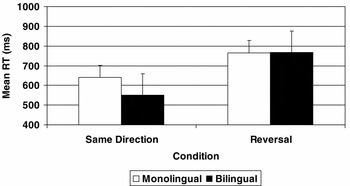
The mean RTs for the univalent arrows task are plotted in Figure 3. Response latencies were analyzed with a two-way ANOVA for condition (same direction, reversal) and language group. The same direction responses (603 ms, SD = 148) were faster than reversal responses (766 ms, SD = 189), F(1, 29) = 54.16, p < .0001, with no effect of language group, F < 1, and no interaction of condition and language group, F(1, 29) = 2.62, p = .12.
Reaction times in ms and standard deviations on the univalent Arrows task by language group and condition in Study 3.

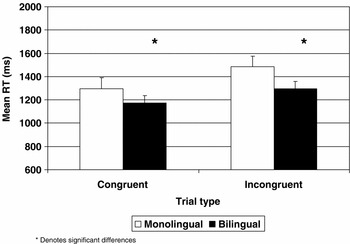
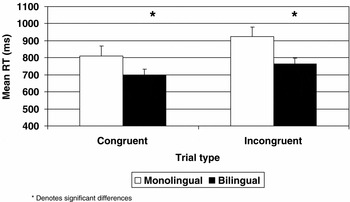
Figure 4 depicts the RTs in the congruent and incongruent trials of the bivalent Simon arrows task by language group. A two-way ANOVA revealed a significant effect of trial type, F(1, 29) = 24.37, p < .0001, as congruent trials were faster than incongruent trials, and language group, F(1, 29) = 5.95, p < .02, showing faster responding by the bilingual children, with no interaction, F(1,29) = 1.48, n.s. This was confirmed by calculating the mean Simon effect for children in the two groups. This score was not different for the monolingual (M = 113, SD = 113) and bilingual (M = 65, SD = 95) children, F(1,30) = 1.48, n.s. Finally, there was no significant correlation between errors and RT for any of the conditions, all rs < .15, so there was no speed-accuracy tradeoff.
Reaction times in ms and standard deviations on the bivalent Simon Arrows task by language group and trial type in Study 3.

Discussion
The results of the present study replicate those of Study 2 using tasks that removed the demands for verbal proficiency. The bilingual children responded more rapidly than the monolinguals in the Simon arrows task, which consisted of a bivalent display requiring interference suppression, but not in the univalent direction task, which consisted of a univalent display requiring response inhibition. The task effects were as expected: Congruent trials were faster than incongruent for the bivalent task and same direction responses were faster than reversal responses for the univalent task. Nonetheless, bilingual children completed the bivalent task more easily than the monolinguals. Also replicating previous results, the faster response times for the bilinguals were found equally for the congruent and incongruent trials. The children in this study were almost four years older than those in the previous two studies, better matched on vocabulary levels, and produced faster and more stable response times with smaller variance.
General discussion
In three studies, a reliable advantage for bilingual children was found on the Simon task under a specific set of task demands. The main criterion for demonstrating this bilingual advantage is that the task is based on a bivalent display in which two presented features potentially indicate different responses. Efficient performance requires resolving the contradictory response cues while holding two possible response options in mind through a set of mixed trials. For example, to perform efficiently on the incongruent trials, children must control attention to the color of the square (Studies 1 and 2) or direction of the arrow (Study 3) and ignore the position of the stimulus on the screen. This is a challenge for all children, and incongruent trials always produced longer response latencies than congruent trials.
The need to respond immediately upon seeing the stimulus increases the demands of the task because the perceptual competition between the two cues is enhanced. The task becomes simpler if a delay is imposed between the stimulus and response because it offers the child some time to resolve the competition, resist the immediate association, and respond in a more controlled manner. This manipulation made the task easier, and performance was similar for all the children in the two delay tasks. Therefore, the differences between the monolinguals and bilinguals in this type of conflict task based on interference suppression occur at an early stage of processing and are probably associated with the initial ability to control attention to complex stimuli. This supports the interpretation that the irrelevant spatial information in the Simon task is processed immediately (Hommell, Reference Hommel1994).
For these reasons, bilinguals outperformed monolin-guals on the immediate Simon task. The bilingual advantage, however, was found equally for congruent and incongruent trials, as in our previous research (e.g., Bialystok et al., Reference Bialystok, Craik, Klein and Viswanathan2004), but unlike the results with adults, the size of the Simon effect was the same for all the children. Regarding the first, point, the majority of our research with these conflict tasks that are presented mixed block trials have produced bilingual advantages for both trial types, making these results consistent with previous research. The second point about the relative size of the Simon effect is less clear. One possibility is that the longer latencies required by children to respond diminish the importance of the difference between congruent and incongruent latencies as a proportion of overall response time. In other words, because the latencies are long, the differences between latencies, and by extension, the variance associated with those RTs, are not sufficiently sensitive to detect differences between groups. Another consequence of this finding is that it is unlikely that the bilingual advantage is simply or exclusively in some aspect of inhibition but more likely in the ability to monitor competing cues over a set of conflicting trials and direct attention appropriately for the response.
In contrast to these tasks, those based on univalent displays require overriding a habitual or familiar response to a stimulus and replacing it with a contrary response. This type of control, response inhibition, is concerned less with attentional control and more with the execution of motor responses to familiar stimuli. These tasks were solved equivalently by children in both language groups. Nothing in the bilingual experience appears to benefit children in demonstrating this type of inhibitory control. In Studies 2 and 3, monolinguals and bilinguals performed equivalently on such a task. In a previous study, however, older bilinguals outperformed monolinguals on an anti-saccade type task that required a key press to a position opposite to one that had been cued (Bialystok et al., Reference Bialystok, Craik and Ryan2006). Two factors can explain this disparity. First, it was shown in Study 1 that changes in task demands that affect the degree of conflict influence the relative performance between the groups. The stimuli used in the study by Bialystok et al. (Reference Bialystok, Craik and Ryan2006) consisted of rapidly flashing target cues on one side of the display monitor, and this is presumably a more compelling cue to attract attention to one side than is a directional arrow passively pointing one way or the other. Second, the older adults who were the participants in the study by Bialystok et al. (Reference Bialystok, Craik and Ryan2006) had reduced resources for executive processing, a normal consequence of aging (Daniels, Toth and Jacoby, Reference Daniels, Toth, Jacoby, Bialystok and Craik2006). This reduction in resources enhances the processing demands of the task and increases the relative advantage of the bilinguals. As shown in other research, the decline of executive processing in aging is reduced for bilinguals (Bialystok et al., Reference Bialystok, Craik, Klein and Viswanathan2004). Therefore, the expectation is that there is a bilingual advantage in response inhibition only when processing demands of the task are particularly high or processing resources of the participants are particularly low. Otherwise, monolinguals and bilinguals solve these problems equivalently.
It is tempting to believe that the bilingual advantage found in these three studies is not due to the language experience of these children but to some other factor that may be correlated with bilingualism. For example, it is well known that socioeconomic status affects children's abilities in these types of tasks (e.g., Rescorla, Reference Rescorla1989; Arriaga, Fenson, Cronan and Pethick, Reference Arriaga, Fenson, Cronan and Pethick1998). However, there is no evidence that the socioeconomic status of the children in the two groups tested in the present studies was different. All the children were selected from demographically equivalent areas of the city and in many cases attended the same schools. Moreover, the young bilingual children in Studies 1 and 2 scored significantly below the monolinguals on a measure of receptive vocabulary, indicating that if different at all, their English language skills were inferior to those of the monolingual children. In most cases, the children were born in the same country – only a few of the children in Study 3 were immigrants. The non-English language spoken by the bilinguals across three studies – French, Chinese, Spanish, Hebrew, and Russian – never made any difference in the results. Finally, the monolingual and bilingual children across all three studies achieved comparable scores on rough measures of short-term memory. Therefore, there is no evidence that some factor other than bilingualism is responsible for the group differences found in the three studies.
The participants in the three studies were different in several ways – the bilinguals in the three studies spoke different home languages and the children in Study 3 were older than those in the first two studies. More importantly, the monolinguals in Study 3 were receiving formal classroom instruction in another language, although they did not use that language for conversation. In that sense, these children had some knowledge of another language but were functionally monolinguals. In spite of these differences, the pattern of results were identical: all the bilingual children performed more efficiently than monolinguals on tasks based on interference suppression and all the monolinguals and bilinguals performed the same on tasks based on response inhibition. This replication across the different participant groups establishes the generalizability of the interpretation for a bilingual advantage in one aspect of attentional control. It also highlights the importance of being functionally bilingual for cognitive effects to emerge.
In sum, the results of these three studies support the conclusion that the development of attentional control that is part of executive functioning and is used to selectively attend to target cues in conflicting situations is more advanced in bilingual children than in comparable monolinguals. These results are consistent with previous research but go beyond those earlier studies and contribute to a more detailed understanding of the source of that bilingual advantage. The advantage is not simply in inhibition – tasks that required inhibition of a habitual response were not solved better by bilinguals. Our explanation is that bilinguals must constantly control attention between two active and competing language systems so that communication can proceed fluently in the one that is required. A large body of research has documented the conclusion that both languages are simultaneously active when a bilingual is using one of them (e.g., Grainger and Beauvillain, Reference Grainger and Beauvillain1987; Brysbaert, Reference Brysbaert1998; Kroll and Dijkstra, Reference Kroll, Dijkstra and Kaplan2002). The experience of controlling attention between these two languages is a source of practice that boosts those control processes and makes them available for other tasks, such as the perceptual decision tasks used in these experiments. In contrast, the Stroop naming task does not replicate the bilingual experience; being bilingual does not entail withholding or replacing habitual responses. Therefore, the processes involved in response inhibition that are required to process tasks based on univalent stimuli are developed equally in monolingual and bilingual children. This distinction between two types of inhibitory control contributes to our understanding of these crucial developing processes in young children and the effect that a common experience, bilingualism, can have on that development.