If the initial reality [of popular narrative] is authentic and if the conditions necessary for the resolution of its contradictions do not already exist within it, then the resolutive factor must be fictitious. Insofar as it is fictitious, it can be readily presented from the beginning as already in being: so it can go into action straightway, without having to pass through the restrictive intermediary of concrete events. … Being put forward as the immediate solution to the evils of society [the man of vengeance] cannot simply obey its laws, which in any case are defective enough; so he invents his own.
Umberto EcoFootnote 1I
Revenge narratives are so ubiquitous in modern mass culture that Americans often adopt them, albeit paradoxically, as bearers of both a national and a universal appeal. Embraced by a national ideology all too frequently conflating the lawless and the lawful, even a revenge story of foreign authorship can be said to express “timeless” or “classic” truths – a casting that, on occasion, only obscures the cross-cultural transactions behind its production and reception. And so, for a customarily shrewd, historically minded reader like Justin Kaplan, the revenge plot within Alexandre Dumas's The Count of Monte Cristo (1844–45) – perhaps the most popular narrative among American boys in US history – transcends mundane considerations of place, politics, or nationality. Instead, its tale of Edmond Dantes – the unjustly imprisoned teenager who returns, years later, to punish the new aristocrats who once betrayed him – becomes, for Kaplan, the “treasure” chest of a “pure” vengeance of “archetypal” significance. “What moved me when I first read Monte Cristo,” Kaplan explains, “was the purity of Edmond's driving motive. … In a singular sense, his motive was disinterested: not the means to anything else and with no purpose other than its own fulfillment.” Monte Cristo is remembered, that is, as a Freudian family romance that makes its French backdrop alluring but ultimately insignificant.Footnote 2
Occasionally, however, interpreters of a different bent feel obliged to open up the class, cultural, and transnational exchanges that often lie behind the eliciting of such responses. Writing from prison in the late 1920s, for example, Antonio Gramsci worried over the social attitudes, gender norms, and standards of justice that traveled from Dumas's nineteenth-century French roman-feuilleton to the serial novels consumed by the twentieth-century Italian working class. In particular, Gramsci argued that Dumas's Monte Cristo exported a far less democratic fantasy than its classic reputation suggested. Though Dumas's hero speaks of a universal right to vengeance, in Gramsci's eyes the Count was really a specialized avenger akin to a modern detective, even the prototype of a “superman” who separates himself from the masses. Readers were therefore liable to imagine vengeance as a private matter rather than a blow against political tyranny. With its covert Gallicism and heroicizing of the musketeer, Dumas's work also seemed to reinforce Gramsci's fears about the retrograde sources of early fascism in Italy. Monte Cristo was, Gramsci argued – in a phrase often read more hopefully than he perhaps intended – a “real way of day-dreaming” about political authority.Footnote 3
Gramsci's meditations, it turns out, recently took on an eerie relevance in the US when Dumas's transnational adoption surfaced again. It happened in a memoir by Italian American Lorenzo Carcaterra, entitled Sleepers, which climbed nonfiction bestseller lists in 1995 and then returned as a Barry Levinson film a year later. Set in the early 1960s, Sleepers told the story of Carcaterra and three working-class friends, in the New York City neighborhood of Hell's Kitchen, who bonded around the time-honored urban high jinks of go-cart racing, reading the comics, and pilfering from street vendors, all under the watchful eye of a local parish priest named Father Bobby. But what begins as street mischief quickly takes an awful turn. Accidentally sending a vendor's cart down a subway stairwell and nearly killing a bystander, Carcaterra and his friends, he claims, were remanded to a juvenile facility which Sleepers renames “Wilkinson” – where, we soon learn, they were physically and sexually abused by a gang of guards. Years later, two of the boys – who would evolve into malevolent members of the “Westies,” or New York's West Side Gang – supposedly re-encountered the leader of those guards, a man named Sean Nokes, in a neighborhood bar, and summarily executed him. Even more sensationally, Sleepers then claims that the two other friends – one who had grown into a newspaperman (Carcaterra himself), the other into an assistant district attorney – had conspired with their neighborhood Mafia don to subvert the ensuing murder trial. The climax of the trial arrives when Father Bobby testifies, and provides a false alibi for the killers on the night of their crime. The West Side boys are exonerated, and the abuses at Wilkinson, long covered up by the state, are now exposed. And, for readers of Gramsci, what was especially startling was that all this seemed to be modeled, as Carcaterra's memoir unashamedly confessed, explicitly upon Dumas's Count of Monte Cristo.
Faced with Sleepers' sensational allegations, of course, controversy swirled more around the literal case than its literary debts. Representatives of the Manhattan District Attorney's office, the Catholic Church, and Carcaterra's own neighborhood rushed to debate the book's veracity; the New York papers were full of allegations and rebuttals for months.Footnote 4 But the more telling feature of the debate, perhaps, was the way that Carcaterra had pre-emptively constructed his own defense in the text itself. Sleepers coordinated, first of all, an emerging popular interest in recovered memory, thus predicting an official cover-up before anyone could respond;Footnote 5 it also claimed to be a victim's narrative, perversely repositioning the normally scandalous positions of both the state (a district attorney) and the Catholic Church (Father Bobby) so that they become avengers of the abused, rather than merely powers that have caused harm in the first place.Footnote 6 With its suggestion that vengeance might have its place in a legal process, the book also capitalized upon a broad public concern about street crime and the decay of white ethnic urban communities, expressed in headline stories like the Bernard Goetz subway shootings, in the soaring popularity of “True Crime,” and even in the earlier films of Barry Levinson himself. Much as in Dennis Lehane's Mystic River (2001) and its film adaptation by Clint Eastwood (2004), an abuse-and-retribution narrative about lost boys had been enfolded in a story of a white ethnic neighborhood's broader sense of isolation and powerlessness in the face of crime. Not surprisingly, Carcaterra was already well on his way to being mass-cultural impresario with ties to American “cop TV” and police melodramas like Homicide and Law & Order.Footnote 7 But, for our purposes, the capstone moment came when Carcaterra – who, if Sleepers was to be believed, had confessed to suborning perjury, and being an accessory after the fact to murder – was chosen to write the introduction for a new, prestigious Modern Library Classics edition of Monte Cristo in 2002.
These broader resonances suggest that Sleepers was culturally significant not only in the ways it marshaled such diverse modes of popular sensationalism, but in how it orchestrated them into a particularly telling act of what is often called “social memory.” Part prison exposé, part nostalgic memoir for a lost Italian American boyhood, and part Mafia and courtroom melodrama, Sleepers bound its literary antecedents together, in a way to remember the recent course of ethnic urban history, to register the shifting emphases of the American judicial system, and even to record (or so it seemed) a growing mood of citizen antipathy to the state. The recuperation of Dumas's literary status was central to this remembering. As if reading off Kaplan's intuition, Carcaterra suggested that his friends' act of revenge was itself best understood as a pure recovery of timeless truths, a transcendent act of memory much like the recovery of Dumas's lost literary classic. We might say Carcaterra re-created what memory theorists call an “infrastructure” of remembrance, an interlocking argument that contained both a complex reworking of Dumas's transnational meanings and a surprising political updating of the revenge genre. Sleepers therefore provides an instructive instance of how a deceptively formulaic act of mass-cultural fantasy can bolster its designs on the present by drawing upon the authority of literary culture – as it were, by establishing a relay between acts of literary and social memory. We need to attend not only to how Carcaterra claims to remember. Rather, to paraphrase Iwona Irwin-Zarecka, we need to see how it is that in Sleepers “the past comes to matter.”Footnote 8
My goals in this essay, therefore, will be to unpack the often dizzying transactions in Carcaterra's appropriation of Dumas, to explore the historical routes of Sleepers' invocations, and to consider the political uses to which its acts of memory are put. Part of this means coming to terms with how Carcaterra's text orchestrates its multiple genre debts, shuffles elite and popular culture, and enfolds particularistic ethnic claims into an ostensibly classic story. A pre-text like Dumas's Monte Cristo is not merely a literary allusion or genre formula for the American storyline of Sleepers. Rather, Monte Cristo functions as a marker and memory-holder in historical real time, a designator of class status and juvenile kinship for its young readers, and even a template for the future crime the boys ultimately commit. Carcaterra is thus engaged in a complex performance of cultural reordination. Despite an apparently coherent, linear sequence of victimization, silence, and retribution, in Sleepers memories skip over decades, literary debts double back upon each other, and the very events supposed to be repressed are, in the end, reclaimed as already known. And despite his highbrow patronage of Dumas through the Modern Library, Carcaterra actually draws more covertly upon a long line of popular American reading that used tales of second-generation dispossession, juvenile delinquency, and vigilantism to stage populist fantasies of social redemption.
In closing, I want to bring this orchestration of Sleepers' literary and social debts back to its contemporary moment, particularly to its political arguments about crime, incarceration, and state authority. By exposing the crimes performed by prison keepers, Sleepers would seem to expose the prison as an example of state malfeasance, and thereby present a populist allegory about the need not only to supersede the state's authority but also to punish it for offenses against the poor, the young, and the imprisoned. In these ways, Sleepers would seem consistent with the familiar argument that revenge narratives reinforce American tastes for vigilante-style, extra-legal retribution beyond the powers of the state. Indeed, Sleepers would seem to be not just a victim's narrative, but also a victims'-rights narrative. And yet, examining the workings of memory in Sleepers suggests an important set of qualifications to this apparently populist agenda. Ultimately, remembering the horror of prison means, for Carcaterra, actually reordering the American political understanding of other ravages of time and place. Perhaps most indicatively, Carcaterra and his boyhood friends love The Count of Monte Cristo long before they are ever actually in prison.
II
The dramatic sequences of Sleepers clearly present themselves as part of a recovered memory narrative, where the victim of abuse first enters a period of psychological denial and torment, then therapeutic release through confession and, finally, revenge. The middle portions of Sleepers explicitly detail, in horrific fashion, how Carcaterra and his friends were repeatedly beaten and raped in the place he calls Wilkinson, their humiliation often sadistically linked to markers of their lost innocence: to their birthdays, to their day of departure, to when the guards discover a rosary left by Carcaterra's mother. But Carcaterra says even the details his text makes explicit are, for him, now “relegated to a series of stop-action blurs” (S 177),Footnote 9 an effect Levinson would adapt faithfully to film. And partly as a mutual agreement with his three friends, Carcaterra writes that he never spoke about their abuse, about the images they kept “safely buried” (S 296). “We tried as best we could to annihilate those moments … as deep inside ourselves as possible. To this day, no clear picture of the sexual abuse we endured at the Wilkinson Home for Boys has surfaced in my mind” (S 177). As abuse victims often do, Carcaterra speaks of fighting demons, envying the dead, carrying violence in his own body. “I sometimes feel that the lucky Sleepers are the ones who died,” he writes in the present tense of 1995. “They no longer have to live with the memories. / They are free of the dreams” (S 362). The title Sleepers is itself laden with traumatic associations: beyond Carcaterra's ironic, Janus-faced connection of the term to innocent children, on the one hand, and to street slang for hired killers on the other (S xi), the word also carries an aura of nightmare, of lying in wait, of death itself. Sleepers' Gothic red-and-black cover, now conventional for True Crime, itself evokes the bloody dreams arising out of darkness – the story, that is, that awakes.
In turn, revenge is inaugurated following a scene of confession. In the apartment of Father Bobby, and in the company of Carol, the boys' female sidekick, Lorenzo unveils a plot that already anticipates measurable compensation. “I sat in that chair and told Father Bobby what was in my heart. It was the first and only time I had ever told anyone – until then – exactly what the life of Sean Nokes was worth” (S 296). The confession also allows Carcaterra the sorrowful reassurance that his three friends have been as haunted as he; both Nokes's murder and the court conspiracy unearth the common trauma and thus the common bond. Again, quite sensationally, Carcaterra admits that he shared the ecstasy of the murder itself, though he was not present to it:
John and Tommy and luck walked in on Sean Nokes halfway through a meat-loaf dinner. And for the first time in years, we all felt alive. The moment was out there now, waiting for us to grab it. Michael was the first to realize it. To figure it out. But the rest of us caught on fast. It was what we had been living for, what we had waited years for. Revenge. (S 267)
Although Sleepers is characteristically ambiguous here on whether revenge is in the past or the future, the brutal killing might easily be seen as compensatory torture, the symmetrical equity described by many explicators of revenge genres – an act of rote memory.Footnote 10 Revenge is presented as the purest form of remembering. Once in the victim's skin, pain is now reciprocally inflicted on Nokes's body, as his vicious claim to have taught the boys toughness (S 260) gets reciprocal schooling. As with respondents in victimization studies who repeatedly reverse-telescope events – that is, think of a crime as happening more recently than it did – revenge becomes to Carcaterra, as to Nietzsche, a way to annihilate Time, close the gap on one's childhood and yet also avenge the law's initial disregard.Footnote 11
At first, it seems entirely fitting that Carcaterra uses The Count of Monte Cristo to authorize his memories. Beyond the obvious parallel to the imprisonment of Edmond Dantes, Sleepers presents infirm working-class fathers unable to stop their sons' humiliation; an enchanted boyhood that, as in Dumas, undergoes a premature death; legal institutions enamored of severe punishment rather than the compassion evoked by the name of Edmond's fiancée, Mercedes. Dantes is marked as an innocent, as Carcaterra's Hell's Kitchen boys will be, partly because of his enclosure in an ethnic enclave. Dantes grows up in a Catalan village within the city of Marseilles, as if representing Mediterranean routes rather than the nation whose struggles ensnare him. The streetwise Father Bobby is also meant to recall Dumas's worldly Abbé Faria, the prisoner who trains Dantes and leaves him his fortune; Carcaterra's teacher–priest introduces the boys to reading “he felt we could identify with” (S 34), specifically Monte Cristo. As Carcaterra later claimed in his Modern Library introduction, Dumas's tale “expertly reached down deeper and burrowed in on our feelings of alienation, anger, and betrayal” (MC xvi). As if stopping time by his own act of literary recovery, Carcaterra likewise draws upon Edmond Dantes's argument about the “natural” and therefore universal “primitive justice” of retaliation (MC 659), famously made when the Count punishes the representative of Law who had imprisoned him. A former commoner thus overturns the arrogance of those who dominate the royal “court” and the courtroom.
And yet, the connections between these texts are both deeper and more problematic. Again, much of the above explains why Monte Cristo appeals to the boys prior to their incarceration and even their abuse; drawing upon broader social grievances, their alienation eerily antedates Wilkinson, and seems to anticipate it. But more importantly, this adoption of Dumas's story reveals that Monte Cristo has served as a template or memory-holder in (juvenile) real time, not simply as a retrospective appropriation by the (adult) author. And as if returning the debt, Sleepers' story works, in turn, to affirm Monte Cristo's timelessness by making it an uncanny prognosis, a text that appears and then reappears like a recovered memory itself. As a result, Monte Cristo is variously claimed to be the favorite of each individual boy, in turn; it seems to always have been read, always already known, and yet always ready to be freshly rediscovered. It seems a timeless classic without having to be made so.
References to Dumas's tale proliferate in the history Sleepers re-creates. In the first scene of the boys' childhood, we hear about their fondness for Dumas and other adventure writers (S 9), and that they even ponder naming their go-cart after Dumas's Count (S 10). Lorenzo's favorite book, Monte Cristo nevertheless initially denominates their youngest member, John, as “the Count.” The boys plan a music group they want to call “the Count and His Cristos” (S 355). On John's tenth birthday, Father Bobby gives him a copy of Monte Cristo, “a gift that moved John to tears” (S 79). Young Carcaterra is then given his first personal hardcover copy by a teacher while in Wilkinson. Lorenzo has written a report on the book, and when asked why he likes it, he says of Edmond Dantes, “He wouldn't let anybody beat him … the Count took what he had to take, beatings, insults, whatever, and learned from it. Then, when the time came for him to do something, he made his move” (S 219). Later, it becomes the boy Michael, who grows into the assistant DA, who is called “the Count” – called a real one (S 353) when his revenge plot (in which their codeword is “Edmond”) is successful. When Father Bobby testifies that he and the two killers were at a Knicks basketball game on the night of the murder, the boys cry, and look over at Carcaterra in the audience: he is holding a copy of Monte Cristo (S 337).
Perhaps the most indicative role for Dumas's narrative in Sleepers is as a real-time harbinger of the crime that will lead to prison. Carcaterra is reading Monte Cristo in a public library when he and his friends play a trick on their librarian who, we are told, has always saved the book for them. Despite her goodwill, they create an avalanche of books that buries her when she pulls down (at the boys' request) a copy of Moby Dick (S 49). Father Bobby, whose youth will repeatedly be paralleled to these boys', recognizes the old prank and, looking forward to his final testimony in court, only mildly reprimands them by having them deliver books to the elderly (S 52–53). Much as the Abbé Faria might have, Father Bobby seems ready to forgive the crime (burying a bystander) before it happens. But to scholars of revenge's extensive literary archive, it is telling not only that, in this memory, Dumas's Count displaces Melville's Ahab (the avenger who, after all, is destroyed). Rather it is that, to Carcaterra, Monte Cristo seems to become the Moby Dick of all such stories. Monte Cristo's own avalanche of appearances makes it seem like the only book that has been checked out from the library.
III
But what edition did Carcaterra himself pull from the shelves? In fact, American translations, abridgements, and adaptations of Monte Cristo have been rather notoriously variable, particularly regarding whether Edmond Dantes's obsession with revenge is ameliorated by forgiveness at the story's close. For example, the standard American edition, based on the British nineteenth-century Chapman and Hall translation, actually omits a final episode where, in the French, Dantes returns to the Château d'If, where he finds a manuscript of the Abbé Faria that cools his own vengeance.Footnote 12 Meanwhile, when Monte Cristo achieved its enormous stage popularity in the US – largely due to the nearly six-thousand performances by Eugene O'Neill's father James, starting in 1883 – Dantes was revealed (contrary to the novel) to be the biological father of his lost love Mercedes's son Albert, a change that also meant an early engagement celebration had to be turned into a wedding. In the 1934 United Artists film version of Monte Cristo starring Robert Donat, which seems to address the rise of fascism, the Count presents himself as an unmasker of criminals in a rousing final courtroom scene, and thus a savior of France itself. And in this film version Mercedes and Edmond are reunited.Footnote 13 As we shall see, Carcaterra's claim to a timeless classic actually displaces these more compassionate possibilities.
In its opening chapters, Sleepers can seem a pure act of memory, unaffected by any literary debts, much less mediated ones. Instead, Carcaterra strikes his nostalgic portrait of the Hell's Kitchen community in a strictly personal key. The mood is quite akin to the mythic roll call of ethnic semiosis William Boelhower has described in reference to Italian American memoir, a nostalgic listing of personal attachments that invokes the entire neighborhood. Carcaterra writes that
Hell's Kitchen was a place where everyone knew everything about everybody and everybody could be counted on. … Our daily escapades included an endless series of adventures and games … There were no boundaries to what we could attempt, no barricades placed on the quest for fun and laughter. (S 17–18)
In many such passages, the “used to” becomes the “always,” or what memory theorists sometimes call a “generic” remembrance that elides sequences of time. Childlike hyperbole infuses memory with a feeling of boundlessness, friendship, and loyalty (here already described as “counting” on others). Hell's Kitchen becomes a private kingdom where Lorenzo and his friends feel they are “absolute rulers” (S 17) of their world; the boys are lost princes, second-generation males who must cope with the worldly dispossession of their fathers. Suggestively, young Lorenzo is called “Shakes” by his pals, possibly a reference to nervousness, but more explicitly to the Bard, a Hamlet in waiting.Footnote 14
However, the high stylization of such memories soon betrays how Carcaterra's national identity, and his reception of Dumas, have shaped these memories. Throughout, Sleepers self-consciously invokes conventions most famously used in American “good-bad-boy” stories of the nineteenth century, as they resurfaced in modern juvenile literature, adventure fiction, and even gangster films like Little Caesar (1930) or Public Enemy (1931). In what memory analysts might call a literary variant of cryptomnesia, Sleepers filters nearly every personal memory through a corresponding US literary or mass-cultural memory template. (Father Bobby, for example, is compared to both Spencer Tracy and his role as Father Flanagan of Boys' Town (1938).) And as the Tom Sawyeresque Peck's Bad Boy, Dead-End Kids, Angels with Dirty Faces allusions of so many scenes reveal, Carcaterra weaves the rest of his story through popular traditions in which juvenile feelings of boyhood freedom and bonding were traditionally set against social dispossession, fears of parental abandonment, and the lure of criminality. As with his ubiquitous placements of Monte Cristo, Carcaterra alludes to these popular templates either through recalling the boys' own reading or by giving real characters allusive names. Their fellow prisoner Rizzo, for instance, is said to be the brother of a black gangster who took the name “Little Caesar” on the streets because his mother named him after Edward G. Robinson (S 316). (The story of Little Caesar's “Rico,” of course, is the classic tale of a gangster who loses his boyhood friend.)Footnote 15
These popular traditions of juvenile adventure and dispossession, of which Monte Cristo was only part, prove fundamental to Sleepers' ability to extend its motif of innocence to its urban setting. In essence, Sleepers creates a dream narrative where we recover, in a story ostensibly about recovered memory, all the stock items of urban boyhood from stage, film, and immigrant autobiography, but reclaimed as personal possessions: stickball, dodge ball, knock hockey, frolicking in open fire hydrants. But there is a mournful undertone as well: a lost boyhood made equivalent to its lost urban community. As writers like Kaplan and Ron Powers have suggested elsewhere, the abandoned son's plot establishes an implicit subtext that Mark Twain, a century earlier, had also parlayed into mass popularity. As in Twain's texts, this mythic recovery of boyhood freedom is poised against a pathetic strain of trouble at home (as with Huck Finn and Pap).Footnote 16 The homes of Sleepers' heroes are shadowed by domestic violence, parents trapped in frustrating working-class jobs, and criminality; reading is itself cast as “a way to keep away the family terror” (S 35). Or the innocent past is often made to hint at a darker future: the boys' recuperated innocence is rarely invoked without a sleeping counterpoint to the grim world they will soon inherit. But American popular culture always suffuses personal recollection, indeed constitutes it: “I knew more about the Three Stooges … than I did about street gangs. I cared more about a trade the Yankees were about to make than a shooting that happened three doors down” (S 24).
This extension from childhood to neighborhood intensifies the class and ethnic dimensions of the betrayal to which Carcaterra says Dumas had connected. But American reading habits in such a social context also shaped how the boys may have received Dumas in the first place. Because it so happens that the Monte Cristo the boys of Sleepers primarily use as their guidebook – literally, the one they can put their hands on – is actually the Classics Illustrated (or comics) version of Dumas's story. (The version given to John by Father Bobby is a Classics Illustrated edition; Lorenzo initially owns only this edition, thus explaining the librarian's promise to save the hardcover version for the boys.) At mid-century, Classics Illustrated remained an important mediator of juvenile romance traditions: under the tutelage of Russian American editor Albert Kanter, Classics Illustrated had schooled young working-class boys by creating a space between levels of elite and mass culture. Unlike the hardbound or library copies that arrive from patrons (the librarian, the teacher), the comics version of Monte Cristo could literally become embedded in the mobility and poverty of urban working-class and immigrant childhoods, much like its nineteenth-century cheap reading or serial novel antecedents. Often secreted within households with parents who did not read English (S 222), and where community elders were suspicious of intellectual leanings (S 44), these portable texts could be bought for nickels, and of course shared among the group. As well, the boys cherished the hybrid popular and elite style that Kanter comics represented. That is, Kanter comics were made all the more special, as Carcaterra tells us, because they were often not available in Hell's Kitchen newsstands (S 44), and had to be mail-ordered, lifted out of newspaper supplements, or, as a last resort, stolen.Footnote 17
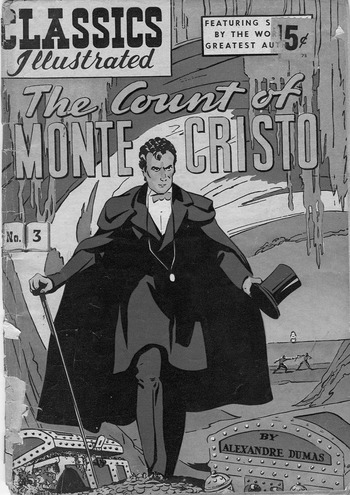
We cannot, of course, recover with any empirical precision the ways that Carcaterra, as a teenager, interpreted any particular Monte Cristo he had at hand. Nevertheless, the decidedly American ways in which Kanter gradually reshaped his Classics Illustrated (CI) version of Monte Cristo offer some suggestive clues. In its original 1942 version, Kanter had clearly attempted to format the comics in a way faithful to Dumas's labyrinthine subplots, his sweeping cast of characters, and complex settings, such as the catacombs of Rome or shadowy alleys of Paris. Necessarily, Kanter's first edition of Monte Cristo worked through the medium's trademark visual rhetoric, blocking scenes into set frames emphasizing face-to-face dialogue or internalized thoughts. Compared to mainstream comics like Action or DC, Kanter originally used smaller frames to mediate Dumas's intricacy. He made liberal use of elliptical iris cutouts and fast-frame sweeps reminiscent of early moviemaking, and the imprint of the nineteenth-century reception of Monte Cristo was still in evidence. This Count's revenge, for example, was punctuated by the counting off of his victims, a melodramatic pun famously exploited in the late Victorian stage adaptations of James O'Neill. Meanwhile, the original artwork (modeled upon book illustrations from the 1920s) presented the Count as a severe and mystical figure, reminiscent of Mandrake the Magician or nineteenth-century hypnotic villains. Clearly European and aristocratic, yet uncannily able to change his appearance, he rises from his cave of riches to enact his magic (Figure 1). While still evincing traces of the silent movie and stage melodrama, this early comics edition leaves the Count's return from near death an ominous affair; his appearance is slightly vampiric, as if – consistent with Dumas's novel – he is beset by a vengeance that nearly drains him of life altogether. This iconography actually showed that Kanter was, despite having his story filtered through stage melodrama, reasonably faithful to the essentially ameliorative story at the heart of Dumas's original novel. As in Dumas's novel, this Count is eventually mollified by the appeals of his first love Mercedes, and is ultimately returned to the human community by the love of his ward, the former Greek slave named Haydee.Footnote 18
Classics Illustrated No. 3 (formerly Classic Comics, 1942). Courtesy of Jack Lake Productions, Inc.

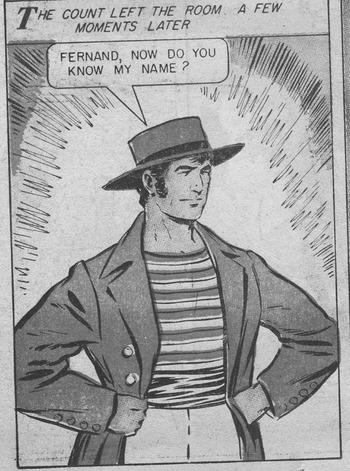
But this emphasis only reminds us that, in Carcaterra's novel and Levinson's film version, there is no such compassion at closure. The second, Americanized CI (1956) edition itself shows departures from Dumas's redemptive nineteenth-century vision. By the late 1950s – right as Carcaterra and his friends would have been collecting their comics – Kanter had instead moved to the action-based visual aura that industry leaders like DC were now using to dominate the juvenile trade. Now formatted in larger frames and twenty-five percent fewer pages, Dumas's plot undergoes significant streamlining. All the heroes are transformed into vibrant, physical, indeed proto-cinematic, figures. Edmond Dantes himself is given a more plebeian, hypermasculine, less mysterious look – returning on the new cover to his Venetian sailor's garb – and looking much like a young Victor Mature (Figure 2) or, in fact, Jason Patric (who plays Carcaterra in Levinson's film). For Italian American boys like Carcaterra, it was now as if Edmond's prior Mediterranean past, not his acquired cosmopolitanism, was the source of his power. And in the 1956 CI edition, the redeeming role for Haydee is entirely eliminated, as the Count, now closer to an American isolato, sails off alone into the sunset.Footnote 19
Classics Illustrated No. 3 (1956 revision). Courtesy of Jack Lake Productions, Inc.

In and of themselves, Kanter's revisions of Dumas's legacy would not be surprising to many analysts of mid-century American comics. The idea of a reborn commoner triumphing over a European court intrigue, of course, had resonances during the Cold War.Footnote 20 Moreover, as I have suggested, Dumas's story of second-generation dispossession and alienation, followed by triumph over community outsiders, spoke directly to the children of urban white ethnics uneasy about their future, unsettled by the path suggested by their own parents. As theorists of serial reading have argued – from Gramsci, to Umberto Eco, to recent US interpreters – American comics, even Kanter's comparatively elite version, often contributed to a signature, immanent ethos of mid-century juvenile entertainment: a mythology of a young man made an orphan, who grows into an adult isolato with a secret identity and extra-legal (and sometimes even superhuman) powers. In the second edition of Monte Cristo Kanter created, Dantes is actually given, especially in moments where he reveals himself, the exact blue-black locks and chiseled face of DC's Superman, drawn by Curt Swan. In Sleepers, we might say, adulthood is revealed to be a secret identity, and boyhood powers are derived from the lost community that exists only in memory.
There are, however, important modifications in Sleepers' adaptation of this popular template. At first, the above might seem little more than a recipe for vigilantism. Yet as Eco has famously argued – extending, in part, Gramsci's original meditations, which included discussions of the French prisoner-turned-policeman Eugène Vidocq – the essence of the belatedly American superman was actually how he takes civic consciousness and responsibility unto himself.Footnote 21 Under the cover of a timeless and transcendent justice, the modern Superman evinces a telling reduction: from combating social injustice to merely fighting crime. The imprint of this reduction is felt, in fact, within another revision in Carcaterra's literary memory. For the fact is that, even in the Modern Library Monte Cristo over which Carcaterra now presides, there is in truth no depiction of abuse or even physical beatings in its infamous prison, despite what the younger Shakes says he remembers in Sleepers. Rather, in an otherwise grim portrait, the Château d'If seems remarkably consistent with the hopes of nineteenth-century prison reformers. Ultimately, the Abbé Faria serves as Dantes's tutor in ingenuity, perseverance, learning, and forgiveness (MC 170–226); he is repelled by blood and violence (MC 196). This is not, needless to say, a legacy we see reincarnated in Father Bobby.
IV
I now want to turn from the literary to the social memory-work Carcaterra constructs, as his “sleepers” grow from children into West Side hit men and conspirators with their local Mafia. The imprint of the bad-boy juvenile tradition remains important, of course. But as the structure of obligation moves forward in time, revenge becomes an expression neither simply of four conspiring boys, nor even of their organized-crime neighbors. Rather, it summons the entire Hell's Kitchen, white ethnic, working-class community. Innocence is first transposed from the personal to the social via a recuperation of Mafia rule, which in turn schools the readers in the supposed honorability of revenge. With Father Bobby's blessing, the boys' vengeance thereby receives the backing of his neighborhood's own secret powers. This reciprocity, meanwhile, has political dimensions as well. Just as the neighborhood is restored to its earlier potency by the ensuing conspiracy – that is, restored to an independent province – so too will the conspiracy overturn the powers of the uptown state. What applies for Hell's Kitchen streets soon applies in the courtroom, in the mainstream.
As the boys move into late adolescence, we are asked to see with a double vision. That is, we are soon reminded that their innocent freedom has existed only in deference to a “structured code of behavior and an unwritten set of rules” (S 22) lorded over not by the Spencer Tracy-ish Father Bobby, but by the organized-crime system of one King Benny, reputedly a former hit man for Lucky Luciano. In a phrase evincing his own splicing of rival genres, Carcaterra now calls his neighborhood (in an allusion to The Andy Griffith Show) “Mayberry with a temper” (S 113). Using an ethnic mythology Robert Orsi has effectively debunked, Sleepers tells us that Hell's Kitchen is ostensibly a safe haven only because of Mafia rule: a code of mutual protection, disdain of drugs, and distrust of outsiders, along with the codes of vendetta and omerta.Footnote 22 And so the boys become what Carcaterra calls “street sparrows,” schooled by the older law-breakers (or padrones) in petty crime, running errands, and carrying payoffs to police, in an initiation ritual again common to gangster narratives like Public Enemy, Little Caesar, or Nicholas Pileggi's Wise Guy (1986). It should not surprise us that this coming of age is signaled by what happens after the boys steal comics from a local storeowner. The owner who protests is beaten when King Benny steps in. Signaling the rite of passage, the boy Michael throws the comics back at the owner in spite: “You can keep your comic books … I don't want 'em anymore” (S 96).
The subsequent prison sequences can easily make us forget that the boys had, in fact, been initiated into crime before their incarceration. But it is not only that the vicious sexual abuse they suffer makes their earlier crimes seem all the more petty. More to the point, the revenge plot itself works to recapture their lost boyishness. The conspiracy is cast as overcoming uptown corruption, and thus restoring the neighborhood's sovereignty through street justice. As one of the King's men says, “Court's for uptown, people with suits, money, lawyers with three names. You got cash, you can buy court justice. On the street, justice got no price” (S 330). Though one supposes that revenge could easily be paid for on the streets, in Carcaterra's carnivalesque upending the vendetta actually serves to purify those streets. Much as in a revenge tragedy, Sleepers makes the court (not the displaced King Benny) the site of corruption.
The conspiracy, however, must begin with an act of historical remembering that itself establishes an involuted or recursive pattern. Right after we witness the boys' last horrific day in Wilkinson in 1968, we jump ahead to Hell's Kitchen in 1979. Now, in contrast to the idyllic childhood Carcaterra had created in the earlier sections of the book, Hell's Kitchen is a deindustrialized, dilapidated zone: graffiti, drugs, and criminal violence dominate (S 251). The community of the early 1960s has virtually disappeared, with even King Benny and his court seemingly out of view. And as if simultaneously, two of the friends are now transformed into West Side Boys. (In a signature compression of time, the two are called founding members (255), which is virtually impossible.)Footnote 23 On the night of their revenge they are actually planning a different murder. At first, therefore, it would seem that Hell's Kitchen could not muster the communal will to enact any revenge.
However, as the Mafia's masculine power begins to reassert itself, the power of the neighborhood is revealed. King Benny helps to settle scores from Wilkinson, keeps the West Side gang from attacking Michael when it looks like he is seriously prosecuting the crime, and intimidates those outsiders in the bar who have witnessed the killing. In an important broadening of the white ethnic cause beyond its Italian locus, King Benny even arranges for the Irish defense lawyer Danny O'Connor, whose deceptive befuddlement also signals redemption of the community secretly behind him. “His sloppy attire and lack of finesse played well with the working-class jury Michael had helped to select,” Carcaterra writes. “He came off as a seasoned pro, a ruffled man of the people who had seen his share of victories and defeats.” Just as the lawyer adds a touch of “Irish drama” (S 312) to the Italian vendetta, the victorious gang sings “Danny Boy” after the not-guilty verdict. Not for nothing is the Catholic patron saint of lost causes, St. Jude, alluded to in the memoir (S 292, 358) and in Levinson's film. The abuse claim resonates within the neighborhood's own sense of victimization, coming to stand for a shared, recursive, even timeless experience of exploitation by outsiders. Through the revenge plot, conversely, the entire white ethnic community is returned to its status as Mayberry with a temper, as lost boys are delivered from the evil of sexual exploitation.
Again, however, any number of contortions are necessary to connect the community to this dark-populist ethos. First of all, the repressed memory claim must actually be undone, and instead rewritten as a tacit communal understanding that need not be stated (omerta). Thus, despite what Sleepers has said about the public taboo on expressing the truth of abuses at Wilkinson, eventually we are told that nearly all of Hell's Kitchen has really known all along. As the book moves toward trial, the turnabout of Father Bobby sets the pattern. Having been incarcerated himself at Wilkinson (S 185) – thus confirming the collapse of time at the heart of the book – he is said to implicitly know the true cause of John and Tommy's criminality. Likewise he intuits, much earlier, why Lorenzo has come to him: to ask him to commit perjury (S 294). And so we barely notice that Lorenzo's moment of confession about Sean Nokes's crime (and worth) does not appear until two pages after the priest's intuition (S 296). Memory has doubled back and become a motive before it is actually remembered or spoken. If Shakes and the others have kept their dark secret buried, their community nevertheless seems to know everything about it. Victimization achieves the status of an unspoken communal understanding.
The contradiction only begins with Father Bobby. Soon we learn that King Benny has also known, and his assistance for the court conspiracy derives from his regret at not yet having done anything earlier about Nokes's crime (S 287). Soon it seems as if everyone knows before they have to be asked. Tellingly, this sense of knowing and not telling is never held against the community; rather, it is one of its strengths. Hell's Kitchen is said to be able to both “deliver information and keep silent. Both were skills the neighborhood had in abundance” (S 284). Thus being the Count, or finally making things count, becomes an expression of the lying-in-wait ethos of Hell's Kitchen itself. When young John first wards off a guard's sexual assault, he makes a promise that is the antithesis of repressing a memory. John pledges what he calls a “devil's deal”: “First one to forget dies,” he warns (S 216). Outwardly complying with institutional denial only for the time being, John anticipates Sleepers' reversals of time. He seems to relish his day of vengeance before it has happened.
John's pledge itself signals how, in the broader schemes of Carcaterra's memory, time itself must be made to disappear so that the neighborhood's nostalgic identity will re-emerge. We have already learned how Hell's Kitchen itself, psychologically, tried to resist the passage of time that has been, in its own way, an absence for the boys while they were in prison. The lost time of the lost boys thus becomes Hell's Kitchen's own secretly held memory. But in turn this secret pledge allows the community to resist further change from the outside. We soon discover that the community resists the entire set of changes brought about by the emergence of the counterculture, of black activism, and of feminism in the years surrounding the Vietnam War. Of seeing the anti-war movement on TV, for instance, Carcaterra writes,
While they shouted their slogans, my friends and I went to funeral services for the young men of Hell's Kitchen who came back from Vietnam in body bags. That war never touched those angry young faces we saw on TV, faces protected by money and upper-middle-class standing. They were on the outside yelling about a war they would never fight. To me and my friends, they were working the oldest con in the world and they worked it to perfection.
Civil rights had become the battle of the day, but on our streets it was a meaningless issue. (S 124)
Building upon a familiar white-masculine-working-class complaint from the Vietnam era, Carcaterra transposes class conflict into a war between those “outside” and his friends. (With the image of young men coming home wounded, the entire scene replays the prison trauma.) Collaterally, those interested in rights are now involuted into the actual “cons.” The importance of this imaginative shuffling becomes clear when we recall that the most vicious sexual abuse scenes in Wilkinson take place in 1968, which the author dubs with extreme sarcasm the “summer of love” (S 247). That is, although the text's chronology actually excises the 1970s – we jump from 1968 to 1979 – Sleepers' symbolic antithesis remains the mythic, countercultural 1960s. And this, in turn, allows the community to share in the boy's rejection of those values supposedly cherished by an outer second generation. The outer world is figured as a different nation. “For me and my friends these developments carried no weight. They might as well have occurred in another country, in another century,” Carcaterra writes. “The mating call of a new generation, one whose foundation was to be built on peace, love, and harmony, simply floated past us” (S 124–25).
Of course, the transformation of Hell's Kitchen into the fallen city of the 1970s might have evolved, in another book, into a liberal parable about crime. Yet a liberal explanation for serious juvenile crime – that is, in the sad careers of the killers John and Thomas – is precisely what Carcaterra's shifting time scheme works to set aside. The turnabout is channeled through Father Bobby, who at first agonizes over the murder of Nokes like no other figure in the book. But the final decision to perjure himself – again, presented as already known, drawn out of his own history – is interpolated by Carcaterra as follows:
Father Bobby knew that it wasn't the streets that had chilled John Reilly and Thomas Marcano. And it wasn't the allure of drugs or gangs that led them to stray. You couldn't blame their fall on the harsh truth of Hell's Kitchen. There was only one place to blame. (S 293)
This seems, at first reading, a powerful claim. Implicitly, Carcaterra appears to protest the current explosion of prison populations, and the horrific conditions often facing incarcerated juveniles (male and female) in the contemporary US. Sleepers might seem to speak on behalf of those who, largely because of draconian sentencing, can face ever-diminishing psychiatric and educational resources, prison warehousing, and increasing incarceration with adults, and indeed brutal physical and sexual abuse. The term “sleepers,” after all, encodes a tale all too familiar to today's prison reformers and liberal criminologists: that prisons are where juveniles only learn more sophisticated and violent methods of crime.Footnote 24
However, despite its aura of populist empathy, Sleepers is not a cautionary tale about the broader social costs of a failed prison system; in truth, it is none too sympathetic in casting the bit players who appear as the threatening backdrop to its innocent quartet of friends. When the four boys arrive at Wilkinson, Carcaterra pointedly contrasts them to African American and Hispanic prisoners – who, he says, were taken down by the new drugs invading the neighborhood (S 173). “Most, if not all, of the inmates,” he adds, “belonged there” (S 172). Indeed, moments like these remind us that one of the most pressing limitations of the repeated American rehabilitation of Alexandre Dumas, and The Count of Monte Cristo in particular, is that mention is so rarely made of Dumas's own Afro-Caribbean descent.Footnote 25 By designating Monte Cristo as a timeless classic, Carcaterra may not so much be universalizing Dumas's legacy as “whiting” it out, a possibility pointing to a transposition of racial identities in the story of urban decline as well. By making civil rights look meaningless, and the “summer of love” a tragic farce – and, let it be said, by skipping over the entire adult, post-prison experience of his two West Side friends – Carcaterra reduces his social memory to a secret knowledge held by what is, in an unintentional implication in his title, a white ethnic sleeper cell.
V
For all its invocation of universal rights, therefore, Carcaterra's citation of the revenge of the Mediterranean commoner clearly addresses quite particular political ends. And by calling up the Abbé Faria through Father Bobby, the always-already reader of Monte Cristo itself, Sleepers works to shuffle elite and popular levels of culture, thereby sanctioning street-based schooling with classic literacy. By contrast, I have tried to suggest that Carcaterra's orchestration of personal, literary, and social memory should be understood not as an invoking of history, but as a refashioning of it – an appeal to an imagined constituency, not an unmediated expression of the past. The desire to erase certain decades, to turn back time – one thinks of the recent US interest in resurrecting “cold-case” murders – expresses the desire to link a very selective social memory with moral certainty, and redefine who is a social victim.Footnote 26 And neither does such an invoking of revenge's universality express a simple desire to move outside the law or state authority, despite what our scholarship often suggests. Rather, Sleepers is quite in keeping with contemporary British and American neoconservatism, which so often pillories the errors of the liberal state only to recuperate its powers. In fact, Sleepers helps us see several less-recognized dimensions of this recent political turn, particularly how its public rhetoric of protecting victims and restoring communal order actually entails a reordering of our urban neighborhoods.Footnote 27 Memory turns out to have very practical designs on our present.
In the allegory Carcaterra creates, the community's recuperation becomes a model for the state. First, like the victim him- or herself, the state must set aside its own denial of victims in its midst, and release the secret identity of lost neighborhood power. In Sleepers' real way of daydreaming, the state-within-the state (here, the Mafia) becomes a model of how the polity might act. Sleepers' finale thus exposes a contradiction in the neoconservative posture of being tough on crime. Much as in Sleepers itself, where crime against communities is transmuted into an expression of that community, neoconservative theorists of order-maintenance often tacitly encourage citizens to accept extra-legal methods in the name of safety and neighborhood sovereignty.Footnote 28 An impulse killing becomes, in this dark fantasy, rewritten so as to invoke community consensus. For the revenge of John and Tommy is actually not planned in advance; despite John's devil's-deal pledge, these boys have not in fact hunted down their former imprisoners, as Edmond Dantes had. Rather, in Sleepers, it is the upwardly mobile survivors, Michael and Lorenzo, who redefine the impulsive murder of Nokes and thereby reconstruct their own neighborhood (and indeed, ethnic) membership. By generalizing their victimization into a broader communal woe, Michael and Shakes – the representatives of law and literature, respectively – rejoin their lost neighborhood.
But their ambitions are even larger than that. Sleepers ultimately enacts a more fundamental, practical goal of the victims'-rights movement: to acquire power not just on the streets, but in the disposition of actual court cases. The purity of the reduction in Father's Bobby's interpolated logic – “one place to blame” – expresses a desire to localize certainty in the victim's memory and then affirm its legal impunity. Under Father Bobby's bizarre social blessing, the West Side boys are remade into innocent children again, whose testimony is pure.Footnote 29 But this transformation cannot fully hide the disturbing repercussions of such a casting. In Dumas's Monte Cristo, for example, Dantes's betrayers are punished not just for their original deceit, but for what they have become, for what they have done after Napoleon's fall and Edmond's imprisonment.Footnote 30 But in Sleepers Nokes and his cohort are punished largely for who they always were, as if before history itself: sexual predators. In fact, Nokes and his guard cohort are never proven in court to have molested the particular boys we have been following; the jury is just shown that the guards were habitual molesters. Time, once again, is restructured only to actually be erased.
Father Bobby's choice, of course, is meant to be our own. In Assistant DA Michael's closing argument to the jury, Carcaterra attempts to enfold his readers in the act of faith that the priest emblematizes. Having intentionally allowed his prosecution to lose its way, Michael then adds,
With this case, I'm asking you to do what few juries are asked to do … I'm asking you to look at the facts and then look at the reasons for those facts. I'm asking you to find the truth in what you've heard, in what you've seen and in what you believe. It might be the only way for you to come up with a decision you can live with. A decision that will not cause you doubt. Any decision that you will know is the right one.
… You have to make your decision based on the guilt of two men and the innocence of one, and you have to believe it. You have to go beyond a reasonable doubt; you have to go where there is no doubt. … Because now you are the only judges. … In your hands will rest the truth. (S 345, emphasis in original)
In a scene that finally opens up his secret identity – defender, not prosecutor – Michael's double-voiced appeal actually is quite reflective of Sleepers' quest for the mainstream. His finale, and implicitly Carcaterra's, now appeals to the jury's supposedly democratic sovereignty. Michael's overall strategy, again resonant with current victims'-rights efforts, is to effectively convert a criminal courtroom into a civil one – with the prosecutor, now the victim's secret advocate, making an appeal from a supposedly unimpeachable prerogative.Footnote 31 The sanctioning of force on the streets is conjoined with a seizing of court authority.
And yet, the appeal above marks a rather curious summation for a story, after all, supposedly about recovered memory and neighborhood recuperation. For all the talk about retribution, Hell's Kitchen is no more redeemed than it was before Sean Nokes's death. In these lights, the many complaints about Carcaterra's departures from the factual record – in a book, after all, sanctioning a perjured testimony about a night with the boys that never happened – can seem both fully justified and, to a degree, beside the point. Beside the point because in the appeal quoted above, facts are made secondary to belief, and belief is a place beyond doubt itself. Rather familiarly, a recuperated and somehow American innocence, nevertheless conjoined to lawlessness, becomes its own justification. Yet as I have tried to demonstrate, Carcaterra also asks the legal system to share in memories he has largely reimagined through the popular literary forms he has come to master. Hell's Kitchen becomes a place where doubt is no longer reasonable. To agree to such appeal, however, it was the judge who would have had to have been a sleeper.