In the “Editor's Table” for the May 1844 issue of his popular ladies’ magazine, Louis Godey features a letter from a male reader from Tazewell, Tennessee who complains, “The great objection to the Monthlies of Chestnut Street is their plates. Each has generally thirty-six plates a year – women and children. Now these may be scarce on Chestnut Street, but they are not so here.” The reader's quip about the scarcity of women and children highlights the fact that the major Philadelphia illustrated periodicals emanated from publishing houses located in close proximity to one another, on Chestnut Street. Nearly all were run primarily by male editors and publishers. The reader adds, “Now, can't you throw in a little variety – say a loafer, a bank director, a starved poet, an omnibus boy, or a cab driver, or any thing that is not common in the West?” Godey replies,
We plead guilty to the women and children, but we will say that our selection of plates has been much approved. Have we not given scriptural, historical and Shakespearean subjects? Have we not published match plates illustrative of virtue and vice; views of celebrated places, engravings from original pictures & c.?
Godey did indeed publish “match plates” illustrative of virtue and vice in the 1840s and 1850s, dozens of pairs, in fact. Not infrequently, these plates provide subtle commentary on the social, political, and economic issues of the day. In making this assertion, I am challenging the nearly universal reading of Godey's content as apolitical and asocial – a reading handed down to scholars by the great historian of American magazines Frank Luther Mott. Writing in the middle of the twentieth century, Mott asserted that Godey eschewed articles “on current problems, on politics, on social and economic questions,” and scholars have routinely reiterated similar assertions about the matter published in Godey's.Footnote 1 Although acknowledging the work of Godey's editor Sarah Josepha Hale in publishing articles advocating for education and work for women, scholars continue to insist that the publisher, Louis Godey, refrained from including material of a topical nature. Godey himself claimed to have “but little taste for politics,” and yet his choice of engravings – particularly the match plates – provides evidence to the contrary.Footnote 2 Accordingly, this article focusses on the engravings in Godey's Lady's Book (rather than the magazine's literary content) and on the textual illustrations commissioned by Louis Godey to accompany these engravings.Footnote 3
Godey's match plates proved quite popular during the 1840s and 1850s, many enacting a performative morality reminiscent of the popular stage tableaux vivants, and moral melodramas also captivating audiences at mid-century.Footnote 4 A writer for the Christian Secretary, in reviewing Godey's November 1851 issue, noted of these plates, “The match plates ‘Evil Council’ and ‘Good Council’ [sic] engraved in mezzotint, are beautiful things, and carry a good moral on the face of them.”Footnote 5 I argue that Louis Godey shrewdly capitalized on the newly emerging popularity of moral melodrama – especially the melodrama's scene-concluding dramatic tableau – and the wildly popular tableaux vivants, by offering readers similar visual material in his monthly magazine's match plates. Moreover, these plates and accompanying textual illustrations occasionally glossed the political, social, and economic issues of the day. Before examining a larger selection of these plates, however, I want to provide a bit of historical context for their creation, distribution, and popularity.
Godey's match plates evince the influence of three separate but interrelated genres of stage performance popular in the mid-nineteenth century, and offered routinely in the large East Coast cities of New York, Philadelphia, and Boston. Theater historians John W. Frick, Bruce A. McConachie, and Jack W. McCullough point out that tableaux vivants, moral melodramas, and “dramatic tableau” pre-date the nineteenth century. However, McCullough and Frick also note that use of all three increased sharply on Continental and American stages after around 1820.Footnote 6 The dramatic tableau began with the stage practice of the actors “freezing” the action of a play, usually at the end of a scene or act. In carefully tracing the overlapping influences in art, literature, and the theater in Europe during the nineteenth century, and the relationships between these art forms, Martin Meisel notes, “The dramatic tableau has so strong an association with the act endings in melodrama … that it invites entire identification with this function and technology.”Footnote 7 As Meisel explains, while the dramatic tableau freezes action in a melodrama or other stage performance, the tableaux vivants provide the opposite effect, bringing to life on the stage scenes taken from painting or sculpture.Footnote 8Tableaux vivants translates literally as “living pictures” and the practice carries a long history dating to the early Renaissance. In particular, “joyous entries” welcoming a ruler to a town or city often involved staging one or more tableaux vivants. Footnote 9 In the nineteenth century, this strategy developed into a separate dramatic genre that increased in popularity on European and American stages. According to Kirsten Gram Holmstrom and others, in Europe tableaux vivants were staged primarily for private and aristocratic entertainment. Several scholars note that Goethe observed such a performance, fictionalizing it in his 1809 novel Elective Affinities, and launching a craze for the display in Europe.Footnote 10 Moral melodrama, on the other hand, involved live performances of short plays, often involving scene-opening and -ending dramatic tableaux, accompanied by music. All three genres – the melodrama, the practice of scene-freezing in a dramatic tableau, and the tableau vivant – migrated to American theaters, and drew a mixture of upper-, middle-, and working-class audiences.
Questions of class alignment and cultural consumption can be thorny – often culture forms prove multivalent in their appeal. However, it appears that American theaters, particularly in New York where they were numerous, attracted a largely middle- and working-class audience. A writer for The Knickerbocker, New York's highbrow monthly, noted in an 1846 article entitled “The Chatham” (theater): “The wealthy classes are not the supporters of the theatre; they have abundant sources of amusement in their own houses, and are only attracted to the theatre by some foreign celebrity whom they go to see, and not to see the play.” The writer continues, “They can hire singers to amuse them in their own parlors, and get up tableaux vivant [sic] at home.”Footnote 11 Regardless of the extent to which the wealthy patronized the East Coast theaters, it is clear that an emerging middle class did enjoy these and similar amusements. In particular, the tableaux vivants, as theater historian Jack W. McCullough points out, could not be found at the larger theaters featuring more traditional dramatic offerings; however, numerous smaller theaters, museum theaters, saloons, and dance halls featured the tableaux, at an affordable admission price.Footnote 12
Melodrama became a mainstay of American theaters in the middle decades of the nineteenth century. Theater historian Bruce A. McConachie traces the evolution of American melodrama from its early stages as “paternalistic theatre” designed for the “social performance and display” of the elite (1820–35); to the middle years of “theatre of yeoman independence for Jacksonians” (1830–55); to the later years of “business-class theatre for the respectable” (1845–70) – the latter two eras descriptive of the decades covered in this study of Godey's match plates.Footnote 13 Echoing scholars cited previously, McConachie argues for a stratification of theatergoers’ experience along class lines, with the middle classes (especially the women who would likely have constituted Godey's readership) preferring to patronize the “museum theaters” managed in New York by P. T. Barnum and Moses Kimball, which outlawed the sale of liquor and offered matinee performances.Footnote 14 Barnum and Kimball also especially featured moral-reform melodramas depicting various social ills – such as Rosina Meadows (fallen woman), The Drunkard (intemperance), and Uncle Tom's Cabin (slavery) – between 1845 and 1860. These moral melodramas proved popular, particularly for women and families.Footnote 15 Moreover, as McConachie notes, the final tableau proved particularly potent because it “presented the core of melodramatic truth to the audience.”Footnote 16
As America's leading illustrated monthly magazine in the middle decades of the nineteenth century, Godey's Lady's Magazine saw its readership explode from around 40,000 in 1839 to well over 100,000 by 1850. Louis Godey maintained his magazine's ascendancy, in large part, by offering content designed to be both edifying and morally uplifting. In doing so, Godey shrewdly capitalized on the popularity of other cultural forms circulating at mid-century, including the three in question here – the moral melodrama, dramatic tableau, and tableau vivant. Louis Godey was a proud supporter of American art and artists, and took special pride in selecting the artwork for his magazine.Footnote 17 Most of the match plates featured between 1840 and 1860 were engraved from original paintings commissioned by Godey for exclusive use in his magazine, though often based on European models and inflected by these popular American culture forms.
In announcing the volume to begin January 1852, Godey boasted, “We give, and will continue to do so, more engravings, both useful and ornamental, than any other publication in this or any other country – religious, moral, humorous, and useful.”Footnote 18 Godey's observation covered the expanded variety of his match plates as well: from their moral and religious tendencies in the early 1840s, the match plates began to enact humorous scenes in the 1850s, and to bleed over beyond the decorative into the “useful” offerings of the magazine. By 1860, the match plate mania induced Godey to add match plates of the fashions, of his traditional Christmas-season gift plates, and even of the useful and popular pattern work that greeted Godey's practical-minded readers in the opening pages of each monthly issue.
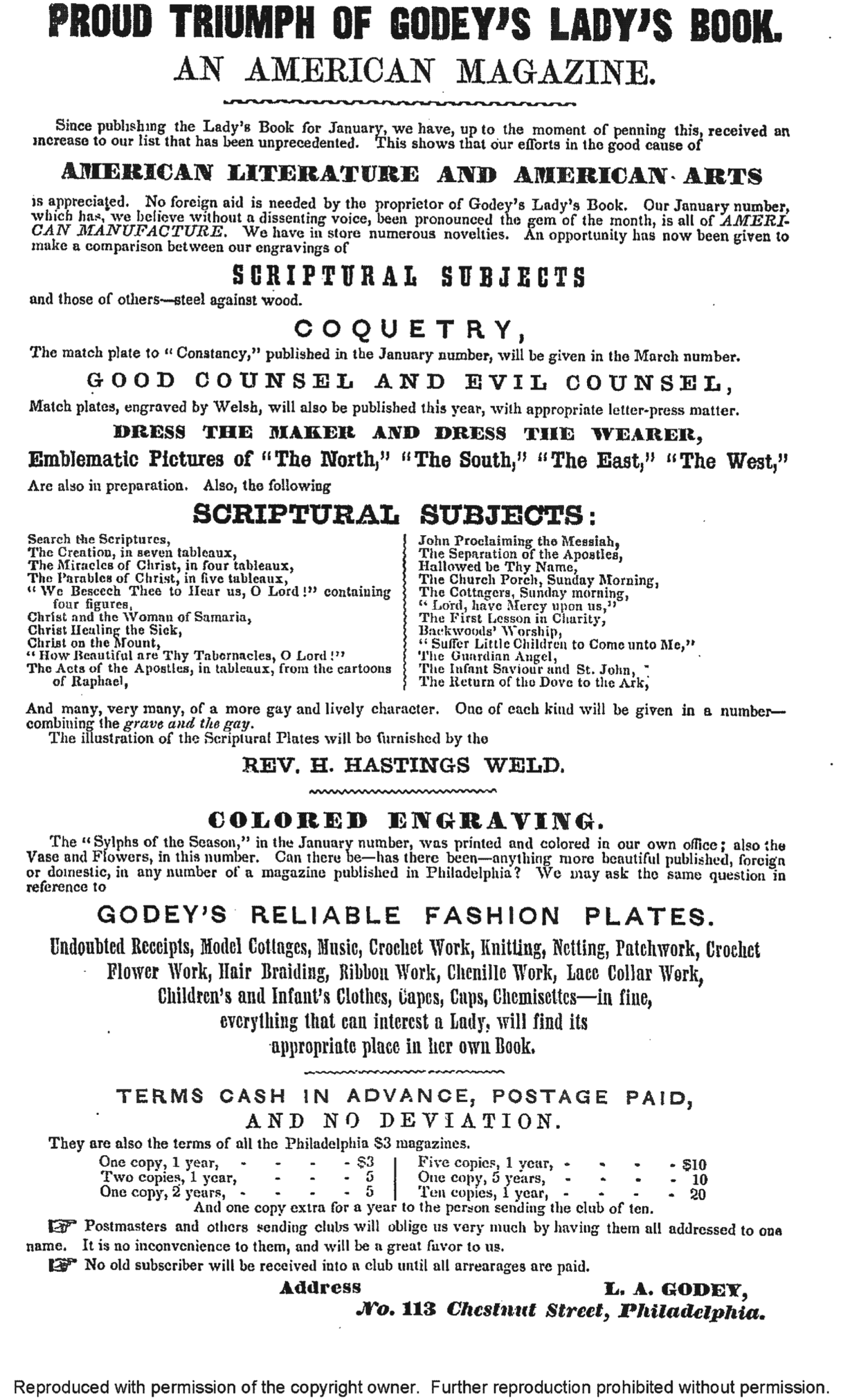
While Godey was not alone in featuring match plates – they could be found in The Eclectic (New York), Peterson's (Philadelphia), and the Ladies’ Repository (Cincinnati), all would-be competitors at some point during these decades – Godey clearly made the match plates a hallmark of his popular monthly magazine.Footnote 19 The annual “Prospectus” for the forthcoming volume boasted of match plates to come, as did Godey's ads in the daily newspapers on the East Coast, and the popular press frequently took note of Godey's plates when reviewing the periodical literature of the day. For example, the prospectus for the 1851 volume specifically highlights the match plates Coquetry and Constancy, Good Counsel and Evil Counsel, and Dress the Maker and Dress the Wearer (Figure 1). Godey's engravings were drawn from preexisting artwork – in most cases, from pendant paintings commissioned by Godey expressly for use in his magazine. In some cases, particularly the Christmas-season gift plates, Godey also arranged for plates to be hand-colored as a holiday present to his fair readers. For example, in the “Godey's Arm-Chair” column for December 1860, an issue containing Christmas in the City and Christmas in the Country, to his readers, he notes, “Two splendid steel engravings also grace this number. Match plates, designed expressly for Godey … We cordially wish our readers a Merry Christmas” (at 561).
Prospectus, April 1851. Courtesy the Winterthur Library, Printed Book and Periodical Collection. 234 × 398 mm.

Art historian Ed Lilley noted over a decade ago, writing specifically then about eighteenth-century pendants, that, in spite of their popularity, surprisingly little scholarly work had been done on pendant paintings.Footnote 20 Likewise, I could find no previous scholarly treatment specifically on American “match plates” – Godey's engravings or others. Monika M. Elbert has written about the similarities between tableaux vivants and some of Godey's engravings, including Evil Counsel/Good Counsel (from November 1851). However, Elbert does not identify Evil Counsel/Good Counsel as belonging to a separate genre of images engraved from “match plates” commissioned by Louis Godey for his magazine.Footnote 21 In a more recent article for a special 2010 issue of American Periodicals devoted to visual culture, Karin J. Bohleke traces the subtle differences between Godey's fashion plates and the French models on which many were based.Footnote 22 While Elbert and Bohleke focus on Godey's engravings, Joseph Michael Sommers targets the literary matter in the magazine. Sommers argues that while Louis Godey proclaimed his avoidance of material with an overtly political or nationalistic message, literary editor Sarah Josepha Hale used poetry, in particular, to subtly promote her political agenda of national unity.Footnote 23 My article differs in approach by specifically targeting the match plates, and the pendant paintings from which they were engraved.
Lilley notes that pendant paintings likely were popular due largely to the “narrative possibility” presented by the medium.Footnote 24 He suggests obvious “oppositions” for pendant paintings: scenes of beginning, then ending; before/after; oppositions of gender and/or occupation. Additionally, as Henry Adams notes, pendant paintings can be found in virtually every genre. For example, Adams has argued that George Caleb Bingham's Fur Traders Descending the Missouri was intended as a pendant to Bingham's Concealed Enemy, both considered genre paintings, and that Bingham painted landscape pendants as well.Footnote 25 Thomas W. Gaehtgens also points out that pendant paintings relate closely to narrative series of paintings. For example, both Joseph-Marie Vien and Jean-Honoré Fragonard painted a cycle of paintings on the progress of love, from which subsequent pendant paintings on the theme likely took their cue.Footnote 26
The predominance of match plates, particularly earlier in this two-decade span under examination, are, as Louis Godey himself claimed, “of a moral tendency” – more specifically, as Godey notes, “illustrative of virtue and vice.” The earliest I have discovered in Godey's Lady's Magazine date to January 1842, at the same time that our writer for the New-York Mirror was defining tableaux vivants for his reading audience.Footnote 27 For most of Godey's prized plates – and indeed as is true for most engraved material in the illustrated periodicals in the 1840s – the textual material “illustrated” the engraving rather than the other way around.Footnote 28 In fact, Godey frequently used his “Publisher's Arm-Chair” column to “puff” particular writers in his stable that had provided the textual illustrations for his prized engravings. Godey commissioned engravings first and textual material to illustrate the engravings last. Since some match plates received no accompanying textual illustration, it seems clear that Godey intended them to convey their own lesson, whether “religious, moral, humorous, or useful.”
Some of Godey's moralizing match plates, such as the pair shown in Figures 2 and 3, Fruits of Industry/Fruits of Idleness (January 1842), clearly derive from European models, although with significant departures from those models. These match plate titles echo William Hogarth's 1747 twelve-plate engraving series Industry and Idleness, with its comparison of the industrious apprentice, Francis Goodchild, and the lazy apprentice, Thomas Idle. As Martin Meisel has demonstrated, Hogarth's prints influenced generations of painters, engravers, and dramaturgists. Moral melodramas based on Hogarth's prints began playing in England as early as April 1811.Footnote 29 However, Hogarth's series focussed on the ills of city life, and the dangerous enticements awaiting youths migrating from the country to the city for work. Godey's engravings and accompanying tales differ from Hogarth's series in several important ways. First, Godey's match plate engravings, taken from pendant paintings by English artist Edward Prentis completed in 1836–37, clearly reflect a rural, rather than urban, setting. In fact, the subtitle for Prentis's first painting reads, “a farmworker's family at supper with a beggar at the door,” while the subtitle for the second reads, “a wounded poacher surrounded by his family and friends who are hiding the day's spoils.”Footnote 30 English laws dating to the fourteenth century restricted the shooting of wild game and treated poaching as an act punishable by death.Footnote 31 These laws had caused tremendous public controversy because they restricted the rights of landowners to shoot game even on their own land, unless the landowner met certain acreage and income requirements.Footnote 32 Public sentiment, therefore, pitted the wealthy, aristocratic landowners against the tenant farmers struggling to make ends meet. Prentis's pendant paintings echo that controversy, and, when viewed in their original English context, likely aroused sympathy for the wounded poacher.Footnote 33 Initially, the opening paragraphs of the accompanying textual illustration written by T. S. Arthur appear to offer a critique of the English game laws and English class-based privilege, in the dialogue given to the main characters. Very likely, Godey's American readers would have sympathized with the implied critique of the English landed aristocracy. It is also worth remembering that although produced in Philadelphia, Godey's circulated widely, and at a time when the bulk of Americans still lived in rural areas.Footnote 34 Prentis's genre paintings clearly appealed to the publisher as artistic matter adaptable for Godey's American audience. What is perhaps most interesting, as will be noted below, is the ways in which Arthur's tale moves away from a class-inflected critique to a critique of insobriety.
Fruits of Industry, frontispiece, Godey's, January 1842. Courtesy the Winterthur Library, Printed Book and Periodical Collection. 158 × 128 mm.
Fruits of Idleness, frontispiece, Godey's, January 1842. Courtesy the Winterthur Library, Printed Book and Periodical Collection. 154 × 127 mm.
The match plate engravings Fruits of Industry and Fruits of Idleness present two contrasting interior scenes. The first is a clean and well-kept kitchen with a recognizable family unit of father, mother, daughter, son, and infant, with a domestic servant. The second shows the interior of what appears to be a local alehouse, with a disheveled male figure slumped in a chair while a woman, kneeling, appears to offer a drink, presumably to revive him. Close examination reveals doubling of the facial features of the industrious father and the slovenly bar figure, as well as the doting mother and the bedraggled female companion in the bar scene. The fruits of industry can be seen quite literally in the baskets of collected fruit to the right of the first engraving, and in the hand of the father dangling a piece of fruit over the infant. Upon closer examination, the fruits of idleness in the second engraving appear to be the game birds slung across the lap of the male figure to the right of the engraving, and held between the legs of the younger male figure in the background. The three figures to the right of the scene all carry guns, suggesting the game fowl had indeed been bagged by hunting. The composition of the paintings/engravings suggests the scene-opening or -ending “dramatic tableau” – a feature of the Hogarth-inspired moral melodramas popular in Europe and America during this decade.
To “illustrate” these match plates, Godey turned to Timothy Shay Arthur, best known a decade later as the author of Ten Nights in a Barroom (1854), and a popular writer of moral tales for the illustrated monthlies in the 1840s and 1850s. Before leaving Baltimore for Philadelphia to further his writing career, Arthur had attended, and written about, several meetings of the Washingtonians temperance society.Footnote 35 Godey's selection of Arthur to illustrate these engravings created an opportunity for Godey to introduce into his magazine commentary on the evils of intemperance. Intemperance was a social issue deeply personal to Godey: his brother, Francis, had died from delirium tremens in 1836, and Godey held the funeral in his own home.Footnote 36
Arthur contributed two tales: “Industry and Idleness No. I: The Married Sisters,” and “Industry and Idleness No. II: The Poachers.” In the first tale, two childhood companions, William Moreland and Henry Thorne, grow up to marry sisters, and work together in a manufacturing establishment. Henry routinely skips work to fish or shoot while William remains industrious, saving up enough money to purchase a small farm, the scene of our Fruits of Industry engraving. Meanwhile Henry is discharged from his manufacturing job, moves south to Charleston, South Carolina, but continues his idle ways and dies, leaving his wife to beg for shelter from her sister and William. The illustration Arthur contributed for Fruits of Idleness, “The Poachers,” also features a farmer, James Maxwell, but this tale is set in England. Maxwell, indignant at the long-standing game laws, declares to his neighbor, Colin Jones, that he will not respect them, and intends to continue hunting where he always has. His once prosperous farm begins to decline as Maxwell exhausts himself from nights poaching and frequenting the local alehouse. One night he is shot and nearly caught, and resolves to mend his ways. His long-suffering wife, presumably pictured at his shoulder in the engraving, is grateful that he survives the shooting, and Maxwell recovers and restores his farm to its former prosperity.
The artistic and textual contexts alike require an interpretation of this image–text combination that distances these engravings from their European models. Unlike Hogarth's series, Godey's match plates focus not on the city life of the young apprentice, but rather on the rural life of the family farmer. Both tales cast the practice of shooting game as an act of idleness unbefitting the industrious (and, by implication, American) farmer. However, Arthur's tales recontextualize Prentis's original pendant paintings, overwriting their English origins as class-inflected artistic commentary on English game laws with a narrative layer that situates them instead within an American tradition of temperance reform. The moral of Arthur's tale – the possibility of the chronic idler and drunkard to reform – closely aligns with that of the Washingtonians at this stage of the reform movement's growth.Footnote 37 Godey may have been unable to save his brother, Francis, from the consequences of intemperance, but in commissioning engravings clearly echoing Hogarth's Industry and Idleness series, and in choosing temperance advocate T. S. Arthur to illustrate these match plates, Godey provided his own pictorial interpretation of the consequences of alcohol abuse.
Published in January 1842, Fruits of Industry/Fruits of Idleness appear to be two of the earliest match plates commissioned by Godey to depict contrasting virtue and vice. Drawing on nearly a century's worth of stage and artistic adaptations of Hogarth's series, these plates demonstrate Godey's ability to adapt both European and American culture forms to suit his magazine's readership. Appearing nearly a decade later, but also in this vein, were The Constant/The Coquette mentioned in the “Prospectus” shown previously (Figures 4 and 5), and Good Counsel/Evil Counsel, from December 1850 – both featuring female rather than male central figures. Industry and Idleness counseled Godey's women readers to avoid choosing idle and intemperate mates. The Constant/The Coquette and Good Counsel/Evil Counsel additionally warn Godey's readers to avoid their own idleness and flirtatiousness, and to choose companions wisely.
The Constant, frontispiece, Godey's, January 1851. Courtesy the Winterthur Library, Printed Book and Periodical Collection. 141 × 222 mm.
The Coquette, frontispiece, Godey's, March 1851. Courtesy the Winterthur Library, Printed Book and Periodical Collection. 141 × 219 mm.
The figure of the coquette was a staple of the European and American stage, with roots running back to Molieère's L'école des femmes (1662) and Sheridan's School for Scandal (1777), and typified in Russian playwright Aleksandr Aleksandrovich Shakhovsko's A Lesson to Coquettes (1815).Footnote 38 Novels depicting the coquette as protagonist date at least to Mary Davys's 1724 English novel The Reform'd Coquet, and American Hannah Webster Foster's 1727 novel The Coquette, whose heroine Eliza Wharton was based on the real-life figure of Elizabeth Whitman.Footnote 39 As Shelly King and Yael Schick have shown, the figure of the coquette in the eighteenth century served as a central figure “to an emerging modernity tied to the rise of capitalism … and a specular economy.”Footnote 40 By the mid-nineteenth century, the coquette was a well-recognized trope in popular literature and drama, and, as Theresa Braunschneider and Tamara Wagner demonstrate, the figure served paradigmatically as a critique of the excesses of the market economy, and the consumption of luxury goods.Footnote 41
Short tales of coquettes proved commonplace in the illustrated magazines, including Godey's, and engravings of the same title were included in many other magazines.Footnote 42 However, Godey appears to be the first to commission match plates contrasting the “Constant” (January 1851) with the “Coquette” (March 1851). The engravings likely proved expensive and time-consuming to produce: each central engraving of a female figure is surrounded by a series of smaller vignettes. The Coquette depicts a woman with a lapdog lazed across her lap, a cat at her feet, gazing admiringly into a hand mirror. The vignettes depict her as a young girl primping in front of the mirror, as a belle surrounded by admirers, as a bride admiring in a mirror her wedding gown, and again surrounded by male admirers. A small cupid draws an arrow in the bottom vignette. The Constant, on the other hand, shows a domestic scene in which the wife literally centers the image, with a sleeping child on one side, and her husband looking on from the other. Vignettes show her a young girl, listening at the foot of her mother while the mother reads; as an older girl walking to church and reading to an aged parent; and holding hands with her husband as she takes her wedding vows. A sober cherub anchors the bottom vignette.
Godey's practice was to first arrange for the paintings and engravings, then to commission an author to write textual material to “illustrate” the engravings.Footnote 43 In this case, Godey commissioned Alice B. Neal to write textual material to accompany both engravings. A widow who had been married briefly to Joseph C. Neal, well-known author and editor of Neal's Saturday Gazette, Neal had been writing under various aliases since she was a teenager, and was left to support herself by her writing upon her husband's death in 1847, less than a year after their marriage.Footnote 44 Neal contributed frequently to Godey's in the years following her husband's death, and for The Constant and The Coquette she crafted a pair of interlocking tales following the trials and tribulations of two girlhood friends, Catherine Grant (the “Constant”) and Nell Morgan (the “Coquette”). The first tale, “The Constant; Or, the Anniversary Present,” relates the steadfastness of Catherine Grant when her husband maintains his nightly visitations to his men's club, leaving her alone with their newborn daughter. Her friend, Nell, counsels her to retaliate by playing the flirt, but Catherine refuses. Catherine's husband, Willis, overhears a conversation in which his preference for the men's club is attributed to his wife's ill temper. Knowing this to be untrue, Willis must face his own selfishness, and eventually resigns his membership of the club, presenting to his wife his resignation letter as an anniversary present. In “The Coquette” Nell Morgan, Catherine's best friend, and now newly wed to Willis's good friend and business associate, begs her husband to take rooms in a boardinghouse so that she will not have to assume housekeeping duties. Although married, she continues to play the coquette in the boardinghouse, and her husband, feeling neglected, begins to gamble. When a flirtation nearly goes too far, Nell reflects ruefully on her bad behavior, and when her husband returns from a night of gambling, they confess their shortcomings to each other. Nell's flirtations, leading to Morgan's gambling, have left them in financially reduced circumstances. Once reconciled, the pair must go into modest housekeeping circumstances in their own small home, to live within their now-reduced budget, and to avoid former temptations at the boardinghouse. In this way, The Constant/The Coquette warns Godey's readers against not only the vanity and flirtatious behavior of the coquette, but also the possible financial ruin (occasioned by the husband's turn to gambling) that might result. The social order is restored only when the coquette agrees to take charge of her own household duties rather than purchase them through a boardinghouse arrangement.
Many of Godey's match plates between 1842 and 1851 could be described as being of a “moral” nature, though not explicitly contrasting vice and virtue, nor extolling religion. The Widow/The Widower, published December 1847, fits this description. The theme of these plates echoes earlier tableaux vivants produced at the Drury Lane theater in London in June 1831 entitled The Soldier's Widow, and based upon an 1830 Ary Scheffer painting. Scheffer's painting references events of the Napoleonic Wars; as Martin Meisel has demonstrated, Napoleon's reign (1804–15) served up fruitful material for the staging of “history as spectacle” in European art, literature, and theater during these decades.Footnote 45 Once again, the composition of the engravings suggests the influence of the melodrama's dramatic tableau. However, the narrative submitted by T. S. Arthur to illustrate the engravings resituates the pictured events in an American setting.
“The Widow” relates the tale of Captain Henry Lee, a southerner who joins the continental army during the American Revolution, to fight against the British troops, only to die in battle and leave a grieving widow. This plate and illustrative tale appeared shortly after the United States entered into the war against Mexico, and Arthur's moral encouragement to Godey's women readers likely would have resonated in the face of the new conflict. Arthur's second tale, “The Widower,” focusses on one Albert Ernest, who enters the law profession only to be seduced by political ambition to win a seat in Washington. Ultimately, political ambition costs him the life of his wife, who dies in childbirth while Albert is away at a foreign post. Consequently, these Christmas present match plates counsel duty to country during a time of war, but warn against overweening political ambition – demonstrating that such political ambition can destroy the family unit.
Similar to the match plates The Widow/The Widower, Dress the Maker and Dress the Wearer (December 1851) were intended as “holiday presents” for Godey's patrons. Godey began the practice of preparing special gift plates for his patrons as early as 1843, using his “Arm-Chair” publisher's column to create the Christmas message accompanying these plates. Godey's Christmas present for 1851 melded the match plate genre to the fashion plate, contrasting Dress the Maker with Dress the Wearer. A writer for the New York Observer and Chronicle praised the novelty of the match plates, noting that they were “printed in colors,” and pronouncing their contrast “suggestive.”Footnote 46 While Godey did not provide holiday greetings to his patrons, or reference these plates, the lead article for this issue of the magazine was a tale illustrating the plates submitted by Mary Spenser Pease, and entitled “The Dress-Maker and the Dress-Wearer.”
Pease, wife of Joseph Ives Pease, an engraver who frequently contributed fashion plates to Godey's and other illustrated monthlies, proved an apt choice for the illustration of these plates. Her tale describes the woes of the virtuous Ruth Lee, forced to turn to dressmaking when her father loses his fortune. Meanwhile Ruth's haughty cousin, Bertha, asks Ruth to make dresses for her, and treats her no more as a cousin but as a servant, going so far as to try to steal Ruth's former beau from her when he sails back into the city a newly promoted lieutenant. Ruth triumphs over Bertha's wiles in the end and Lieutenant Raymond buys back Ruth's old house and restores her to it. Tales of poor but virtuous seamstresses formed a staple of this magazine literature – and Godey's editor, Sarah Joseph Hale, frequently featured such tales, and used the “Editors’ Table” to advocate for genteel employment for women thrown into poverty. In commissioning these match plates and their textual illustrations, Louis Godey added his own gloss on the problem of female poverty – reminding readers that poverty lurked just one bad business deal away, and encouraging empathy for the less fortunate, including one's own mantua-maker.
Although Godey largely kept his magazine free from reading matter that might suggest social, political, or economic partisanship, his match plates toward the end of the 1850s reference obliquely the economic downturn of 1857, particularly its impact in urban areas, and reverberate with other cultural forms proving popular at the time. In particular, Eugene Sue's Mystères de Paris, published serially between June 1842 and October 1843, focussed on Parisian street life, and ushered in a genre known as “city-mysteries” novels.Footnote 47 These novels were cheaply produced and targeted a working-class audience. The genre was soon imitated in England and the Continent, and later migrated to America. Frick and McConachie have demonstrated the channels through which these novels moved from print popularity in America in the 1840s to the American stage in the 1850s.Footnote 48 Likewise, European-trained playwright Dion Boucicault scored success in America with a series of melodramas based on the French play Les pauvres de Paris. Boucicault customized the plot and setting with new scripts for the East Coast theater market, under the titles The Poor of New York, The Streets of Philadelphia and The Rich and Poor of Boston.Footnote 49 Godey first capitalized on the rich–poor theme in his choice of plates for January 1858, offering Christmas in Difficulty/Christmas in Comfort, a diptych fashion match plate that also throws in a bit of the “useful.” In a lengthy article entitled “Chitchat upon New York and Philadelphia Fashions for January,” published in the same issue, the fashion editress describes useful ways to economize with the fashions, given the financial situation.Footnote 50
Likewise, he presented his readers in December 1858 with match plates Christmas for the Rich and Christmas for the Poor (Figures 6 and 7). Godey notes this in his “Arm-Chair” column:
Christmas for the Rich and Christmas for the Poor need no remarks from us to commend them to the admiration of the public. The design and engraving are both equally good; and so is the letter-press illustration. Stephens designed the plates; Walter engraved them; and Annie Franst wrote the illustrations.
Franst's tale echoes the theme of many moral melodramas of the 1850s treating the type of the “fallen woman.”Footnote 51 The story begins with a mother telling her young daughter about how she had behaved willfully as a young woman, ignoring her father's warning against marrying a man who presented himself as a count, and learning too late she had been deceived. Cast out by her father and left alone by the death of her abusive spouse, she tried to provide for her son and daughter by giving French lessons, until her health gave way. In the scene Christmas for the Poor, she has sent her children out to retrieve fruit and jelly promised to them by an older gentleman who came into the store where her son has been working. Meanwhile, her more obedient sister and brother prospered, and are enjoying the comforts of Christmas, as shown in Christmas for the Rich. In a plot twist uniting both match plates, the narrator reveals that the two children present themselves at the older gentleman's home only to learn that he is their grandfather. Smitten by their tattered dress, the old man decides to forgive his wayward daughter and sends a carriage to bring her to him, and the family is reunited. The match plates and accompanying textual illustration accordingly address the social problems attendant upon the seduced and fallen woman, while counseling Godey's paterfamilias readers to practice forgiveness and reconciliation.
Christmas for the Rich, frontispiece, Godey's, December 1858. Courtesy the Winterthur Library, Printed Book and Periodical Collection. 140 × 217 mm.
Christmas for the Poor, frontispiece, Godey's, December 1858. Courtesy the Winterthur Library, Printed Book and Periodical Collection. 141 × 220 mm.
Godey's Christmas gift match plates for December 1859, The Departure/The Return (Figures 8 and 9), rely on the fondness of audiences for another form of popular melodrama: the nautical melodrama. Martin Meisel traces this genre to an 1819 painting by Theodore Géricault, Le radeau de la “Méduse” (The Shipwreck of the Medusa), stage versions of which began appearing in England as early as 1833. The nautical melodrama spawned a host of imitations on the stage, on canvas, and in the form of popular prints and short tales, with such titles as “The Wreck of the Hope,” “The Rescue,” “The Sea!” and “My Child! My Child!”Footnote 52 Most treat the hero's daring escapades at sea and his harrowing escape from a watery grave. The engraving The Departure depicts a young man, humbly dressed and seated in a very plain open-air conveyance, being counseled by what appears to be a mother figure, while a younger woman and two other persons look on. The Return depicts an older, better-dressed young man seated in a more opulently appointed conveyance, accompanied by a well-dressed older man and younger woman. The composition of the engravings again suggests the melodrama's scene-opening/-closing dramatic tableau.
The Departure, Godey's, December 1859. Courtesy the Winterthur Library, Printed Book and Periodical Collection. 154 × 103 mm.
The Return, Godey's, December 1859. Courtesy the Winterthur Library, Printed Book and Periodical Collection. 150 × 109 mm.
Godey again chose Annie Franst to illustrate the plates. Franst skillfully combined elements of the nautical melodrama with elements of the industrious apprentice tales in crafting her narrative. Readers learn that in The Departure Harry Sanford is being taken by his widowed mother to be apprenticed to a sea captain who was the dear friend of her recently deceased husband. As the narrative unfolds, Harry saves the life of a young woman, May, after a shipwreck, during his first voyage at sea. Her guardian, in gratitude, arranges a new assignment for Harry, and Harry works his way up the ranks. Ten years later Harry is reunited with May by chance, while returning home to visit his mother and sister. About to step once again into a railway carriage for the last leg of his journey home, Harry is invited instead by May's guardian to accompany them in his private carriage, the scene depicted in The Return. Harry and May eventually marry and Harry's mother comes to live with them. Harry's selfless courage saving May during his first shipwreck, accompanied by subsequent hard work and virtuous living, contribute directly to his upward mobility. The engravings consequently draw on the popularity of pendants designed to show “before” and “after” scenes, as well as the popularity of nautical melodramas and stage and fictional depictions of virtuous apprentices, to draw the moral for the reader.
Godey capitalized on the match plates’ popularity once again in February 1860 – this time by offering needlework patterns designed also to be paired. These match plates functioned both as artwork to be admired and as pattern-work to be put to useful ends. In his “Arm-Chair” column for February 1860, Godey notes, “Flowers for Working” is a match plate for “Fruits” published in our December number (183).” Like many others of the fancywork illustrations featured in his magazine, additional copies of these patterns could be purchased by readers from Godey's by sending money and a note addressed to the “Fashion Editress, in care of L. A. Godey.”Footnote 53 Material-culture scholars Beverly Gordon and Nancy Dunlap Bercaw have analyzed the ways in which women's construction of fancywork in the antebellum era contributed to the creation of a shared bourgeois culture that valued affordable luxury and self-expression.Footnote 54 By constructing items using the fancywork patterns provided in the magazine rather than purchasing these consumer luxury items, women readers could literally “perform” both frugality and tasteful household decoration. Additionally, women readers could pull out and frame the needlework match plates for tasteful parlor display, as Godey encouraged his readers to do with all his prized engravings.
By 1860, Godey had offered match plates across multiple genres of engraved matter – from frontispieces, fashion plates, and his annual Christmas present, to the more useful needlework patterns that were also intended as pairs. Although he was not alone in presenting match plates, Godey certainly seems to have presented a larger number and greater variety than any of his competitors, explicitly relying on their popularity when marketing a new volume. While the match plates glossing social, economic, and political themes prove the exception rather than the rule in the magazine, they argue for a reassessment of the assertion that Godey's was completely asocial and atopical. Although protesting a personal diffidence towards politics, Louis Godey nonetheless utilized his prized match plates to comment subtly on some of the social, economic, and political issues of the day – including war, recession, intemperance, poverty, political ambition, and gambling – while employing the match plates primarily to extol the female virtues of piety, constancy, and honest hard work in the face of these challenges.