





Introduction
The consultation is central to quality health care. It is the core activity of healthcare because the consultation is the patient-healthcare worker interaction that is the bedrock of medicine (Pellegrino, Reference Pellegrino2001; Launer, Reference Launer2017; Caldwell, Reference Caldwell2019). The consultation brings about a common understanding of what a patient’s problem is and what the solution can be. Good consultations are characterized by good facility organization (e.g., shorter patient waiting times, and quiet private consultation room), process factors (e.g., physical examination of patients, and taking the patient’s medical history well), and outcome factors (e.g., patient satisfaction, and patients’ recovery from their illness) (Bahadori et al., Reference Bahadori, Yaghoubi, Haghgoshyie, Ghasemi and Hasanpoor2019). These factors (facility organization, process factors, and outcome factors) are difficult to optimize in many low- and middle-income countries (LMICs) because of resource, technology, and institutional capacity challenges.
In many LMICs, the consultation often does not bring about patient satisfaction nor desired results (Brito Fernandes et al., Reference Brito Fernandes, Netshiombo, Gulácsi, Klazinga, Péntek and Baji2020). Doctors sometimes find it frustrating to consult with patients (Chipidza et al., Reference Chipidza, Wallwork and Stern2015; Kumar et al., Reference Kumar, Paul and Pal2020a). In most cases this may not be due to intentional ill will on the part of doctors or patients but due to inherent weaknesses in the health system.
Good consultations promote quality health care because they improve adherence to treatment, patient safety, desired health outcomes, health seeking behaviour, and healthcare worker satisfaction, while preventing misdiagnoses (Chipidza et al., Reference Chipidza, Wallwork and Stern2015; Chandra et al., Reference Chandra, Mohammadnezhad and Ward2018; Caldwell, Reference Caldwell2019). It is therefore worthwhile for governments and health facilities to invest in improving the quality of consultations. However, there are barriers to good consultations.
There are several barriers to good consultations (Mbwele et al., Reference Mbwele, Ide, Reddy, Ward, Melnick, Masokoto and Manongi2013; Rocque and Leanza, Reference Rocque and Leanza2015; Camara et al., Reference Camara, Belaid, Manet, Kolie, Guillard, Bigirimana and Delamou2020). Barriers to good consultations make patients feel more ill, and decrease adherence to treatment, health outcomes, as well as health seeking behaviour (Ha and Longnecker, Reference Ha and Longnecker2010; Hansen and Zech, Reference Hansen and Zech2019; Lazris et al., Reference Lazris, Roth, Haskell and James2021).
Barriers to good consultations include poor doctor and patient behaviours and attitudes that result in poor consultations (Isangula et al., Reference Isangula, Seale, Jayasuriya, Nyamhanga and Stephenson2020; Sepako and Molwantwa, Reference Sepako and Molwantwa2023). Poor behaviours include doctors shouting at patients, disrespecting patients, and not showing empathy. Poor doctor attitudes are exemplified by having an unsmiling face, discriminating against certain types of patients, and a condescending demeanour towards patients (Skär and Söderberg, Reference Skär and Söderberg2018). It makes sense that these poor doctor attitudes and behaviours would affect patients negatively, making patients disengage from the consultation process. The suboptimal consultation results in poor patient care.
Poor doctor communication skills and insufficient time for the consultation, result in poorer health outcomes, increased medical costs, poor quality of care, misuse of health resources, and make the consultation experience unpleasant for patients and doctors (Ajayi et al., Reference Ajayi, Olumide and Oyediran2005; Skär and Söderberg, Reference Skär and Söderberg2018; Alder, Reference Alder2026). Many LMIC patients, and immigrant communities in high income countries are served by doctors who do not speak their language and this may cause negative health outcomes (Cano-Ibáñez et al., Reference Cano-Ibáñez, Zolfaghari, Amezcua-Prieto and Khan2021, Ellahham, Reference Ellahham2021). Language translators or interpreters are often untrained to interpret and may not be able to translate correctly (Ramafikeng and Marshall, Reference Ramafikeng and Marshall2023). The evidence shows that if there is a breach in doctor patient communication, the consultation is compromised, and healthcare is inhibited.
Other barriers to the consultation include lack of physical examination of patients, lack of interest in a patient’s condition, and non-performance of laboratory tests. The physical examination reassures patients that the doctor has a strong basis for his diagnosis and treatment plan (Hyman, Reference Hyman2020; Ayyad, Reference Ayyad2026). Patients were dissatisfied with the consultation when doctors did not examine them or when they did not ensure privacy during the consultation (Berhane and Enquselassie, Reference Berhane and Enquselassie2016; Kabatooro et al., Reference Kabatooro, Ndoboli and Namatovu2016; Devillers et al., Reference Devillers, Subts, De Bandt, Druais and Gilles De La Londe2023). Another reason for patients’ dissatisfaction with the consultation was due to doctors’ lack of interest in patients’ conditions (Cash, Reference Cash2009; Faytong-Haro, Reference Faytong-Haro2025; Carvalho, Reference Carvalho2026). Patients expected doctors to prescribe laboratory tests to investigate their illness if they were not getting better, and patients were frustrated if tests were not done (Berhane and Enquselassie, Reference Berhane and Enquselassie2016). Patients may not be satisfied with history taking alone. One would think that when doctors do a physical exam and order laboratory tests, patients are assured that the doctor is really interested in getting to the correct diagnosis. If these are not done, patients may feel that the consultation is incomplete, and the diagnosis is suspect.
Health system barriers to good consultations include shortage of doctors, high patient volumes, as well as poor doctor behaviours and attitudes (Oleribe et al., Reference Oleribe, Momoh, Uzochukwu, Mbofana, Adebiyi, Barbera, Williams and Taylor-Robinson2019; Konlan and Shin, Reference Konlan and Shin2022, De Carvalho Maquengo et al., Reference De Carvalho Maquengo, Bastos and Santana2025). High patient volumes and doctor shortages result in short consultation times which put patients at risk and inhibit patient satisfaction (Berhane and Enquselassie, Reference Berhane and Enquselassie2016; Wang et al., Reference Wang, Adhikari, Wu, Sunil, Mao, Ye, Sun, Shi, Zhou, Sylvia, Rozelle and Zhou2022). Other health system barriers are shortage of medicines, repeating failing prescriptions, or asking poor patients to buy expensive medicines (Azevedo, Reference Azevedo2017). Lack of functional medical equipment leads to repeat unproductive consultations that frustrate patients (Phuong et al., Reference Phuong, Penm, Chaar, Oldfield and Moles2019b; Van Pelt et al., Reference Van Pelt, Massar, Van Der Eem, Shields-Zeeman, De Wit and Ruiter2020). High patient volumes and doctor shortages erode time for proper physical examination, and appropriate emotional support of patients. Lack of medicines and shortage of medical equipment diminish the purpose of the consultation. These factors contribute to dissatisfaction with the consultation.
There are patient related barriers to good consultations (Davies, Reference Davies2013; Street et al., Reference Street, Liu, Farber, Chen, Calvitti, Weibel, Gabuzda, Bell, Gray, Rick, Ashfaq and Agha2018). Older age, being shy, low English proficiency, and culture have been identified as barriers to good consultations (Cvetanovska et al., Reference Cvetanovska, Jessup, Wong Shee, Rogers and Beauchamp2023). Drunk patients may quarrel with doctors. Sometimes patients do not reveal ‘shameful illnesses’ readily and thus make the consultation difficult. Health system overuse by patients increases doctors’ workloads, resulting in negative doctor behaviours that compromise the consultation (Williams et al., Reference Williams, Rondeau, Xiao and Francescutti2007; Cordero-Guevara et al., Reference Cordero-Guevara, Parraza-Díez, Vrotsou, Machón, Orruño, Onaindia-Ecenarro, Millet-Sampedro and Regalado De Los Cobos2022; Duong and Vogel, Reference Duong and Vogel2023). Thus, any efforts to improve consultations should address patient related barriers to good consultations
The aim of this study was to explore the barriers to good consultations in government (public) primary health care (PHC) clinics in Botswana. Knowledge of these barriers may help in improving consultations, and the quality of healthcare in public PHC clinics.
Methods
Study design
This was a descriptive qualitative study in which we wanted to relate the perspectives of the participants as accurately as possible without over interpreting what they said (Hall and Liebenberg, Reference Hall and Liebenberg2024). Semi-structured in-depth interviews were conducted with doctors and patients in public PHC clinics across Botswana. A qualitative methodology was chosen because qualitative studies are best suited to understanding complex phenomena in depth (Wenzel et al., Reference Wenzel, Senf, Koch, Berger and Kuckertz2016; Lim, Reference Lim2025).
The study setting was seven public clinics located in four health districts of Botswana, that were selected purposively such that there was a national spread, covering a geographical, tribal, and socioeconomic diversity of patients, and doctors. Selected clinics also had high patient volumes by Botswana standards, and they served patients who presented with a wide range of illnesses including, trauma, obstetrics and gynaecology, infectious, as well as non-communicable diseases. All identified clinics agreed to participate through their managers, because the government of Botswana, which administers all public clinics, had approved the study. Clinic managers were approached with relevant research permits, advised about the study, and asked for permission to do the study in their clinics. Botswana public PHC clinics provide free medical care to about 93% of the population. In these clinics, patients are consulted by nurses, though many clinics have a doctor in attendance from daily to once a week. All selected clinics had a doctor present at least once a week. A detailed description of the study setting, methods, materials and procedures are described elsewhere (Setlhare and Madiba, Reference Setlhare and Madiba2023).
Patients were approached in the study clinics after collecting their medications, when they were ready to go home. Doctors were also approached in the study clinics, between consultations. They were told about the study and its purpose. Those who were willing to participate in the study were asked to sign consent forms, after they were satisfied that all their queries about the study had been satisfactorily answered.
Study population
The study population consisted of patients 18 years and older who had consulted a doctor at least twice in the previous 12 months in public PHC clinics, and doctors who consulted with these patients. The principle of maximum variation (Alaba et al., Reference Alaba, Osaretin, Rocha, Alaba, osaretin and Rocha2026) was applied in sampling to ensure that the sample reflected a diverse group of participants with different characteristics such as age, gender, occupation, education, and medical condition. This diversity captured a variety of consultations, as experienced by these patients and doctors, and addressed study objectives.(Suri, Reference Suri2011; Alaba et al., Reference Alaba, Osaretin, Rocha, Alaba, osaretin and Rocha2026)
Conceptual framework
This study was informed by constructivist and interpretivist paradigms, which presume that reality is socially constructed and that meaning emerges through interactions between researcher and participants (Lincoln and Guba, Reference Lincoln and Guba1985; Denzin and Lincoln, Reference Denzin and Lincoln2011). This worldview informed the choice of methods, the role of the researcher, and the approach to interpreting participants’ lived experiences. The study was also informed by patient-centredness, that prioritizes the needs, values, preferences, and lived experiences of patients as the central drivers of clinical decision-making (Mead and Bower, Reference Mead and Bower2000; Epstein and Street, Reference Epstein and Street2011; Edgman-Levitan and Schoenbaum, Reference Edgman-Levitan and Schoenbaum2021).
Study personnel
Two research assistants were trained in qualitative research interviewing and research ethics for one week. They were both female adults; one had completed secondary school education while the other had a university degree and both were proficient in the local language and English. They were both familiar with public PHC clinics which they used for themselves and their children.
The principal investigator (PI) was a family physician with more than 30 years of private PHC clinic and 10 years of public PHC clinic experience. He was teaching family medicine and research in a university, and the study was part of his PhD thesis. The PI was supervised in his PhD work by a professor of public health in another university, who had many years of experience as a nurse in public PHC clinics, and was a qualitative researcher of note.
Data collection, tools, and procedures
Data were collected from participants through face-to-face interviews using interview guides with open ended questions. Two interview guides (one for doctors and another for patients) were designed after reviewing relevant literature (Marcinowicz et al., Reference Marcinowicz, Chlabicz and Grebowski2009). Participants were asked two broad questions followed by probing and follow up questions to clarify responses, thus ensuring rich data. The broad questions covered doctor attributes that patients did not desire during consultations, and how doctors and patients should relate during consultations.
Interviews were conducted in the local language or English, after giving a full explanation of the research, discussing ethical aspects of the study, and obtaining written informed consent. The interviews were audio-recorded. Field and interview notes were collected.
Data collection was guided by data saturation (Rahimi and khatooni, Reference Rahimi and Khatooni2024) during data collection. Saturation was also determined by inductive thematic saturation during analysis when finding new codes and themes became more and more difficult with further analysis (Saunders et al., Reference Saunders, Sim, Kingstone, Baker, Waterfield, Bartlam, Burroughs and Jinks2018). A short demographic tool was administered at the end of each interview. Small tokens of appreciation (Pula 30, about US$2.00, or some refreshments) were given to participants at the end of the interview, to cover transport and inconvenience costs.
Data analysis
Data were analysed for themes, following the steps described in Braun and Clarke (Braun and Clarke, Reference Braun and Clarke2006). The interviews were transcribed verbatim. Both authors read the transcripts several times to familiarize themselves with the data. They independently searched for meanings and patterns that appeared across the transcripts to identify codes, using manual coding. They discussed their initial codes until consensus on the codes, and then developed two codebooks (one for patient data and another for doctor data).
The authors then engaged in an iterative, rigorous process of searching for themes and subthemes through a process of merging similar codes and agreeing on the definition and naming of themes and subthemes. The authors revisited the themes several times, redefining and regrouping them, until the final doctor and patient codebooks were made. The authors then uploaded all the transcripts into NVivo 12, a qualitative analysis software package, for final coding (Patton, Reference Patton1999).
New codes and themes were made as more transcripts were analysed by the main author. The authors discussed the new codes and themes until consensus. Though patient and doctor data were analysed separately, the separate themes and subthemes from these datasets were discussed thoroughly and merged to present one set of themes and subthemes.
Rigour
For rigour and credibility, we employed research assistant or investigator triangulation throughout all stages of data analysis and interpretation to reduce bias (Korstjens and Moser, Reference Korstjens and Moser2018). We achieved prolonged engagement with the data by listening to the audio recordings of the interviews repeatedly. Both local language and English transcripts were checked for accuracy against audio recordings by the main author. As recommended in the literature (Lincoln and Guba, Reference Lincoln and Guba1985), we improved credibility by transcribing the audio recordings verbatim. Bracketing throughout data analysis reduced inherent author biases that could influence data analysis and interpretation.(Finlay et al., Reference Finlay, Wilson, Javaheri, Pearson, Connolly, Elliott, Graham, Norris, Wilton and James2020).
Findings
Sociodemographic profile of the participants
Most of the patients who were approached agreed to participate and five declined because of time constraints. The sample consisted of 32 adult patients who had consulted a doctor at least twice in the previous 12 months. The ages of the patients ranged from 19 to 67 years with a mean age of 38 years and most of the patients were female (22/32). Half (16/32) of the patients reported being employed and more than half (18/32) had secondary or tertiary school education. These patients were selected from PHC clinics in rural and urban districts of Botswana; 13 of the 32 lived in a rural setting.
All the doctors who were approached agreed to participate. Seventeen doctors participated in the study and 10 were female. Their ages ranged from 28 to 58 years, with a mean age of 37 years. Most of them (10/17) had more than five years of work experience in Botswana. Four doctors worked in a rural PHC clinic, while the rest worked in a city or small town PHC clinic.
Interviews lasted from 30 to 60 minutes.
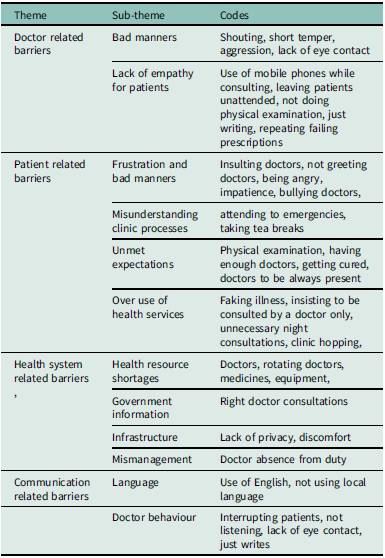
Barriers to good consultations were categorized into themes, subthemes, and codes as shown in Table 1.
Themes, subthemes, and codes from the study

Table 1. Long description
A table categorizing barriers to good consultations into themes, subthemes, and codes. The table has three columns: Theme, Sub-theme, and Codes. It is divided into four main themes: Doctor related barriers, Patient related barriers, Health system related barriers, and Communication related barriers. Each theme is further divided into sub-themes and codes. Doctor related barriers include Bad manners and Lack of empathy for patients. Patient related barriers include Frustration and bad manners, Misunderstanding clinic processes, Unmet expectations, and Over use of health services. Health system related barriers include Health resource shortages, Government information, Infrastructure, and Mismanagement. Communication related barriers include Language and Doctor behaviour. Each row lists specific codes under the respective sub-themes.
Doctor related barriers
Inappropriate doctor behaviours that inhibited the consultation included bad manners, and lack of care for patients.
Examples of doctors’ bad manners included the following:
‘The kind of doctor that shouts at you when you come to the consultation room. I do not like that kind of doctor…’ (35-year-old female patient).
‘Some doctors don’t control their temper’, (38-year-old doctor with eight years’ service).
‘When the doctor is aggressive with you when you are talking, you cannot thoroughly explain your illness’, (44-year-old male patient).
Doctors’ lack of care for patients was described as follows:
‘Using the mobile phone. The doctor is consulting you, but he is also busy on his phone. When he does that, he is not helping me properly’, (25 years old female patient).
‘The kind of doctor just leaves and goes. He does not tell you that he is going, where is going, and when he will be back’, (a female, 31-year-old patient).
Patient related barriers
Patient factors that were barriers of good consultations included frustration and bad manners, misunderstanding of clinic processes, overuse of health services, and patients’ unmet expectations.
Frustration and bad manners among patients were exemplified by:
‘Sometimes when the patient is queuing and then the queue moves slowly, then the patient would start insulting doctors’, (28-year-old doctor with three years’ service).
‘After greeting the patients, sometimes others are not even greeting you. There are others who can just come faking a disease’, (37-year-old doctor with 12 years’ service).
‘A patient can come here being very angry and it would become difficult for you to explore more because the patient would not want to talk. This may be due to the way patients are; that if they bully you they will control you because there are those patients who will tell you what they want.’, (28-year-old doctor with three years’ service).
‘Sometimes patients nag with their impatience; and we sometimes won’t know what to do. I don’t think doctors disrespect patients, but patients come with an attitude, you see? And then they would harass you, they would shout at you to the extent that some even start howling insults at you’, (37-year-old doctor with nine years of service)
When patients did not understand clinic processes, the consultation was affected negatively:
‘With an emergency there is no time frame of how long you are going to take or how quickly you going to finish. So, people get aggravated when you take 30 minutes to 45 minutes or even longer with the patient not understanding that it’s an emergency’, (35 years old doctor with 5 years’ experience).
Overuse of health services was a barrier to the consultation. Doctors said that patients were bringing minor ailments to clinics. Overuse of health services overburdened doctors as oftentimes patients refused to be consulted by nurses and moved from clinic to clinic before completing a course of treatment.
‘The public feels that if it’s a 24-hour clinic it means they can come with any minor disease even at night, and that causes frustration among doctors. It runs 24 hours so that if there are any emergencies in the evening, they can get medical attention, but I think the public is not well informed on that’, (29-year-old doctor with four years of service).
‘What I have noticed because in Gaborone doctors rotate, the patient will be seen maybe in Gaborone West (clinic), and the next day she will be at Block 9 (clinic). And when I say, ‘madam the medication hasn’t… it’s been one day you haven’t taken the medication’. She would say I don’t believe the assistance I got there was ok’. (35 years old doctor with 5 years’ experience).
Patients’ expectations were sometimes a barrier to good consultations. This happened when expectations were unmet or misplaced, such as, expecting to be consulted by a doctor, having a physical examination, to be healed quickly, and to always find a doctor in a 24-hour clinic.
‘So, the doctor is willing to examine but the long queue requires that the doctor process patients quickly by not wasting time examining them. If you say let me examine each person, then they will start complaining that this doctor is very slow. If the patients are not many you can take time, but if they are many you have to go fast, they want a doctor who is fast’, (58-year-old doctor with 10 years of service).
‘The patients want a doctor to be always there. They want more doctors but looking at the current situation, we are understaffed’, (28-year-old doctor with three years’ service).
‘Patients come with problems, and they expect you to give them one pill and they get healed there and then. And there is no medication that works like that you know, things take time’, (29-year-old doctor with four years of service).
Health system related barriers
Shortage of doctors and medicines, government information, as well as mismanagement contributed to negative experiences of the consultation.
‘You see all the patients wanting to see the doctor. Everyone wants to be seen by the doctor. The government says that you can choose anyone you want to be seeing you on that day’, (female, 37 years old doctor with 12 years’ service).
‘We understand from the frustration of patients and doctors that there is shortage of doctors. But there is nothing we can do’, (37-year-old doctor with 9 years of service).
‘You know we may queue here for the doctor only to find that there are no drugs at the pharmacy. My main concern is like today there is only one doctor consulting. This affects many of us, the time we spend here, because only one doctor is consulting’, (40-year-old female patient).
‘When clinics are too full you are forced to see a lot of patients, and the care or quality of care is reduced’, (35 years old doctor with five years’ experience)
‘The patients want a doctor to be always there. They want more doctors but looking at the current situation, we are understaffed. So, there is nothing much we can do about it’. (28-year-old doctor with three years’ service).
Mismanagement was exemplified by doctors being absent from duty.
‘I come often to see a doctor but sometimes I go back home without having seen a doctor. They would say the doctor has knocked off around 2 pm, but we know that this clinic is a 24-hour clinic. We had hoped that this clinic would be like other 24-hour clinics, where doctors come in when others knock off’, (a male, 39-year-old patient).
Communication related barriers
Participants were frustrated when doctors spoke English only, during the consultation as this limited patients’ understanding of what the doctor said, inhibited engaging with the doctor, and increased the risk of poor-quality care. There were other communication factors that inhibited the consultation, besides the use of English.
‘The type of doctor that only speaks English, of which all will be lost for you if you do not know English. It is because that doctor and patient will not be understanding each other’, (19-year-old female patient).
‘There are some doctors who interrupt you while you are talking, with the intent of cutting your conversation with him short so that he can knock off, or whatever would be the case, I do not know…, I feel very bad indeed and regret ever having to come here’. (67-year-old female patient).
‘They do not want a doctor that does not listen, when they talk the doctor just writes down. The doctor cannot even make eye contact with the patient’, (28-year-old female doctor, with three years of working experience).
‘I do not like doctors that do not look at me or ignore my presence when I get in the consultation room. Even when you talk, he will not look or check if what you are saying is right but rather just prescribes Panado (a pain killer) for you to go drink at home’, (48-year-old female patient).
‘So, patients feel that the diagnoses from the doctor might be incorrect because the doctor does not know Setswana (the local language)’, (45-year-old doctor, with 12 years’ experience).
Discussion
This aim of this study was to explore the barriers to good consultations by interviewing doctors and patients in public PHC clinics across Botswana. The study findings were that the barriers to good consultations were doctor, patient, health system, and communication related. These barriers frustrated participants, and this frustration resulted in sub-optimal consultations.
Doctor behaviours and attitudes lacked patient centredness when doctors communicated with patients in a language that patients could not understand, when they disrespected patients, and when they did not care for patients (Saha et al., Reference Saha, Beach and Cooper2008; Edgman-Levitan and Schoenbaum, Reference Edgman-Levitan and Schoenbaum2021; Khosravi et al., Reference Khosravi, Azar and Izadi2024). Similarly, health systems failed the patient centredness test when they did not meet patients’ expectations due to shortages of staff, medicines, and medical equipment. From a constructivist perspective, the lived reality of patients and doctors in the study clinics was – frequently under resourced health systems, communication barriers, and the resultant dysfunctional doctor patient interactions which manifest in poor quality health care (Saini et al., Reference Saini, Garcia-Armesto, Klemperer, Paris, Elshaug, Brownlee, Ioannidis and Fisher2017; Kumah, Reference Kumah2025).
Consistent with the WHO framework of action to strengthen the doctor patient relationship (WHO, Reference Organisation2013), we found that the consultation was negatively affected by negative behaviours and attitudes of doctors and patients, as well as by challenges within the healthcare system.
Communication barriers such as lack of attention to what patients said, interrupting patients, and being impolite resulted in patients experiencing the consultation negatively. Similar doctor behaviours were reported in Singapore and India, resulting in patients’ negative consultation experiences (Kee et al., Reference Kee, Khoo, Lim and Koh2018; Kumar et al., Reference Kumar, Paul and Pal2020a). We found that that poor doctors’ listening skills hindered gathering of clinical data, jeopardizing accurate diagnosis. This finding is similar to a study that highlighted that listening is essential for appropriate clinical data gathering, diagnosis, and choice of therapeutic interventions (Jagosh et al., Reference Jagosh, Donald Boudreau, Steinert, Macdonald and Ingram2011; Mckenna et al., Reference Mckenna, Brown, Oliaro, Williams, Williams, Worthington and Bodie2020). Our study corroborates others that showed that disrespectful communication such as shouting, rude comments, and interrupting the patient were detrimental to the consultation (Thorne et al., Reference Thorne, Oliffe, Stajduhar, Oglov, Kim-Sing and Hislop2013; Kee et al., Reference Kee, Khoo, Lim and Koh2018; Guppy et al., Reference Guppy, Widlund, Munro and Price2024). Despite the widely known benefits of good doctor-patient communication, poor communication still occurs between doctors and patients, compromising the quality of healthcare (Tiwary et al., Reference Tiwary, Rimal, Paudyal, Sigdel and Basnyat2019). Our study showed that time constraints and high patient load are barriers to effective communication, and good consultations. These findings are consistent with those of other studies (Claramita et al., Reference Claramita, Nugraheni, Van Dalen and Van Der Vleuten2013; Kumar et al., Reference Kumar, Paul and Pal2020b).
Our study showed that language barriers impede communication and increased the risk of patients receiving inadequate care. Studies in other settings also highlighted that when patients and doctors do not share the same language, health care may be compromised (Partida, Reference Partida2007; Al Shamsi et al., Reference Al Shamsi, Almutairi, Al Mashrafi and Al Kalbani2020; Whitaker et al., Reference Whitaker, Krystallidou, Williams, Black, Vindrola-Padros, Braun and Gill2022).
In a Canadian study, patients who did not speak the main official language believed that they were likely to be incorrectly assessed, misdiagnosed, given treatment late, and misunderstand the diagnosis (De Moissac & Bowen, Reference De Moissac and Bowen2019). The importance of language congruence cannot be overstated because good communication promotes the development of trust and a good doctor patient relationship (Rocque and Leanza, Reference Rocque and Leanza2015; Cox and Li, Reference Cox and Li2020).
Our study showed that doctors’ poor social skills inhibited the consultation. Patients thought doctors’ poor social skills deterred information gathering, and treatment outcomes. Similar findings of unpleasant social attributes of doctors have been reported in studies in Sub Saharan Africa (SSA) and other parts of the world (Igboanugo and Martin, Reference Igboanugo and Martin2011, Bogart et al., Reference Bogart, Chetty, Giddy, Sypek, Sticklor, Walensky, Losina, Katz and Bassett2013; Siu, Reference Siu2014; Guppy et al., Reference Guppy, Widlund, Munro and Price2023).
It is therefore essential that doctors should communicate with patients in a language that patients understand, and in a manner that makes patients receptive. Failure to do this limits information gathering and dissemination during consultations and jeopardizes the quality of health care.
Doctor related barriers to good consultations in this study, included bad behaviours or manners and lack of empathy for patients, or seemingly not caring much about the welfare of patients. Studies describe such bad doctor behaviours as discriminating against certain patients, despising patients, and not smiling at patients (Skär and Söderberg, Reference Skär and Söderberg2018; Wells et al., Reference Wells, White, Naganathan, Ambrose and Thillainadesan2025). This negative doctor behaviour has been termed ‘disruptive behaviour’ by others and can be directed at patients, patients’ relatives or colleagues and it compromises patient care (Gautham, Reference Gautham2020). Disruptive or negative doctor behaviours or manners can be verbal, physical, overt, or covert. The negative behaviours compromise working relationships such as the consultation. These behaviours not only upset patients, but also negatively impact patients’ health (Eriksen et al., Reference Eriksen, Fegran, Fredwall and Larsen2023). Patients are upset when they feel that doctors are dismissive of their problems and seem not to care (Hildenbrand et al., Reference Hildenbrand, Perrault and Rnoh2022).
Thus, doctors’ bad behaviours and lack of empathy have a negative impact on the consultation and worsen patients’ illnesses. Many of our participants said that they came out of unpleasant consultations feeling worse than they did before the consultation.
In this study, we found that patient related barriers affected the consultation negatively. Consultations are sometimes inhibited by patient attitudes, perceptions, and reactions (Chipidza et al., Reference Chipidza, Wallwork and Stern2015, Guppy et al., Reference Guppy, Widlund, Munro and Price2023). Our participants thought that patients were rude, aggressive, insulting, and threatened doctors during the consultation, in line with what Kumar et al., found in India (Kumar et al., Reference Kumar, Paul and Pal2020a).
Patients’ unmet or misplaced expectations were another barrier to good consultations. A study in four European countries showed that patients contribute to building a good doctor patient relationship based on mutually met needs (Mazzi et al., Reference Mazzi, Rimondini, Boerma, Zimmermann and Bensing2016). Unmet patient needs frustrate patients and increase health costs (Nguyen and Häkkinen, Reference Nguyen and Häkkinen2025). Doctor rotation (discontinuity) was a manifestation of the unmet patient need to be seen by the same doctor. This was a barrier to consultations because it resulted in disjointed care and patients having to restate what had been explained to a previous doctor (Stransky, Reference Stransky2018).
Thus, our study corroborates studies that showed that patients’ negative behaviours and attitudes, as well as their unmet expectations were barriers to good consultations, increased health costs, and decreased the quality of care.
Our participants preferred being attended to by older or mature doctors. This is because with time, doctors usually become more proficient in their work. Similar findings were reported in a systematic review in Africa (Tessema et al., Reference Tessema, Streak Gomersall, Mahmood and Laurence2016). A study in China also showed that patients trust older doctors’ clinical acumen and diagnoses (Bai et al., Reference Bai, Tan, Zhao, Yu, Zhang and Li2024) However in a hospital based care study, older doctors were associated with poorer patient outcomes (Aiken and Dahlerbruch, Reference Aiken and Dahlerbruch2017). A study in Poland showed that youths preferred to be consulted by young doctors and felt that consulting with an elderly doctor was embarrassing (Wróblewski and Zimna, Reference Wróblewski and Zimna2021).
Our findings may have resulted from our participants being mostly adults. There may also be a cultural factor to the older doctor preference of Botswana and Chinese patients.
We found that health system related barriers like time constraints, high patient load, high demand for doctor consultations, the doctor rotation system, and resource compromised the consultation. Other studies have shown that time constraints affect various aspects of the consultation (Rocque and Leanza, Reference Rocque and Leanza2015; Qiao et al., Reference Qiao, Fan, Geater, Chongsuvivatwong and Mcneil2019). When doctors are pressed for time, the consultation becomes mechanical with a focus on the physical problems, while other factors contributing to disease are disregarded (WHO, 2013). Adequate consultation time is a necessary for good consultations and high-quality care (Braddock and Snyder, Reference Braddock and Snyder2005, Wang et al., Reference Wang, Adhikari, Wu, Sunil, Mao, Ye, Sun, Shi, Zhou, Sylvia, Rozelle and Zhou2022).
Inadequate human resources, equipment, and physical infrastructure were barriers to the consultation in our study. These compromise patient care and patient-health provider relations, which may result in litigation (Howie et al., Reference Howie, Hill, Peel, Sanneh, Njie, Hill, Mulholland and Adegbola2008; Merriam et al., Reference Merriam, Sogo and Mokoko2017). A study conducted in India found that poor infrastructure leads to disgruntlement among patients (Kumar et al., Reference Kumar, Paul and Pal2020b).
Our study showed that doctor shortages, rotating doctors among several clinics, and high patient loads resulted in long waiting times which caused patient disgruntlement. Understaffing was perceived to compromise health care in other SSA countries (Jaeger et al., Reference Jaeger, Bechir, Harouna, Moto and Utzinger2018). A review of literature on human resources for health in five African countries, showed a significant doctor shortage especially in rural areas (Willcox et al., Reference Willcox, Peersman, Daou, Diakité, Bajunirwe, Mubangizi, Mahmoud, Moosa, Phaladze, Nkomazana, Khogali, Diallo, De Maeseneer and Mant2015). A South African university tracked its medical graduates and found that only 6.6% of them worked in a rural setting (George et al., Reference George, Blaauw, Thompson and Green-Thompson2019), highlighting rural shortage of doctors. Doctor shortage hampers health delivery in Botswana and other settings (Mosadeghrad, Reference Mosadeghrad2014; Nkomazana et al., Reference Nkomazana, Peersman, Willcox, Mash and Phaladze2014).
In our study, medicine shortages caused misunderstandings between doctors and patients during consultations. In many countries, drug shortages frustrate patients, compromise patients’ health, impose financial burdens on patients, make patients start treatment late, lead to poor adherence, and increase the risk of morbidity and mortality (Angwenyi et al., Reference Angwenyi, Aantjes, Kajumi, De Man, Criel and Bunders-Aelen2018; Phuong et al., Reference Phuong, Penm, Chaar, Oldfield and Moles2019a; Atif et al., Reference Atif, Sehar, Malik, Mushtaq, Ahmad and Babar2021; Kuruc Poje et al., Reference Kuruc Poje, Kifer, Huys, Miranda, Jenzer, Miljković, Hoppe-Tichy, Bochniarz, Frontini, Schwartz, Vujić-Aleksić, Nežić, Rinaki, Tzimis, Green, Jovanić, Carić, Mandić, Vilić, Bochenek, Bačić Vrca and Marušić2021).
Our study showed that lack of proper confidentiality and privacy were a barrier to good consultations. A Canadian study reported similar findings (Serenko and Fan, Reference Serenko and Fan2013), while a systematic review showed that lack of privacy and confidentiality compromised health care and health seeking behaviour among adolescents (Corley et al., Reference Corley, Sprockett, Montagu and Chakraborty2022). For good consultations, it is imperative that consultation rooms should ensure privacy and confidentiality (Hartigan et al., Reference Hartigan, Cussen, Meaney and O’Donoghue2018).
Health system factors contribute to the quality of consultations and health care. Health system factors such as resource shortages, resource mismanagement, and infrastructural deficits, negatively affect the consultation and patient care.
Study limitations
The study did not include nurses who consult with patients in public PHC clinics. Clinic managers who are promoted from the ranks of nurses due to years of experience and qualifications were also not included. Inclusion of participants from these cadres would have added depth to the study findings.
Though this study was done in public PHC clinics across Botswana and its findings are corroborated by studies across the globe, it is a qualitative study. Its findings are therefore not necessarily generalizable.
Conclusion
Barriers to good consultations in this study were found to be patient, doctor, communication and health system based. Undesirable doctor and patient behaviours and attitudes, healthcare system challenges, as well as poor doctor patient communication constrained the consultation. Poor communication and social skills in doctors and patients, together with not performing physical examinations, negatively impacted the consultation. Health system factors like high patient volumes, resource shortages, as well as infrastructural challenges underlined the patient and doctor barriers to the consultation. Therefore, holistic and wide-ranging interventions are required to remove barriers to good consultations, to improve the quality of health care in Botswana and other similar contexts.
Recommendations
Strengthening the quality of healthcare delivery requires coordinated action across multiple levels of the health system. Policymakers should prioritize investment in language proficiency programmes for doctors and nurses, ensuring that healthcare providers can communicate effectively with patients in local languages. This step is critical for building trust, improving adherence to treatment, and reducing misunderstandings that compromise care. Health managers, in turn, should integrate these language courses into professional development plans and allocate resources to sustain them over time.
Equally important is the need for structured communication and interpersonal relationship training. Healthcare providers – doctors, nurses, and allied staff – must be equipped with skills to engage patients respectfully, listen actively, and foster collaborative decision-making. Researchers and training institutions can support this by designing evidence-based curricula that emphasize empathy, cultural competence, and patient-centred care. Development partners can contribute by funding pilot programmes and scaling successful models across clinics and hospitals.
Addressing persistent shortages of medicines and ensuring the availability of functional medical equipment is a responsibility that falls primarily on policymakers and health managers.
Policymakers must strengthen procurement systems, streamline supply chains, and enforce accountability mechanisms to prevent stockouts. Health managers should monitor inventory closely, establish rapid response systems for shortages, and maintain equipment through regular servicing. Development partners can provide technical assistance and financial support to modernize supply chain infrastructure, while researchers can evaluate interventions to identify the most effective strategies for sustaining reliable access.
Finally, improving infrastructure to guarantee privacy and comfort is essential for dignified care. Policymakers should allocate funds to upgrade facilities, ensuring consultation rooms, wards, and waiting areas meet standards of confidentiality and patient well-being. Health managers must oversee renovations and enforce compliance with privacy protocols. Healthcare providers should advocate for these improvements, highlighting how infrastructure directly affects patient trust and outcomes. Researchers can document the impact of improved environments on patient satisfaction and adherence, while development partners can invest in infrastructure projects that align with broader health system strengthening goals.
Taken together, these recommendations form a practical roadmap for stakeholders at every level. By investing in language proficiency, communication training, reliable supplies, and patient-centred infrastructure, the health system can move closer to delivering equitable, high-quality care that meets the needs of communities.
Data availability statement
All data generated from this study are available from the corresponding author, upon reasonable request.
Acknowledgements
Prof Bgoyega A. Ogunbanjo played a crucial role in connecting and encouraging the authors in this work.
Author contributions
The first author: Conceptualization, methodology, field research, analysis, writing original and final draft. The second author: Conceptualization, supervision, validation, analysis, reviewing original and final draft.
Funding statement
This study did not receive any external funding.
Competing interests
The authors declare no conflicts of interest relevant to this work.
Ethical standards
Permission to do this study was obtained from relevant ethical committees as indicated by the IRB approval certificates SMUREC/M/115/2018: PG, and HPDME 13/18/1. Managers of the selected clinics gave verbal consent upon seeing the IRB certificates. All participants gave informed consent to participate in the study and signed consent form.

 Open access

