INTRODUCTION
The concept of mild cognitive impairment (MCI), as originally conceived, was thought to represent a borderland between normal age-related cognition and the early but unambiguous signs and symptoms of dementia, particularly Alzheimer’s disease (AD) (Petersen et al., Reference Petersen, Smith, Waring, Ivnik, Tangalos and Kokmen1999). It required an objective memory impairment, a lack of impairment in other areas of cognition, and an absence of appreciable declines in activities of daily living. In more recent years, however, the concept of MCI has evolved to include multiple clinical subtypes that allow for impairments in domains of cognition aside from memory (Petersen & Morris, Reference Petersen and Morris2005), although the etiology and course of different MCI subtypes remain unclear.
Petersen and Morris (Reference Petersen and Morris2005) also offered the possibility that the various subtypes of MCI may relate to distinct neuropathological substrates, although such evidence is only beginning to emerge. Particularly in the amnestic form of MCI (aMCI), converging evidence supports that entorhinal cortex and hippocampal volumes may be predictive of progression from normal cognition to MCI (Martin et al., in press) and from MCI to AD (Whitwell et al., Reference Whitwell, Przybelski, Weigand, Knopman, Boeve, Petersen and Jack2007). Hippocampal volumes of those with aMCI are more similar to those with early AD than to cognitively healthy older adults (Stoub et al., in press), and hippocampal volumes in aMCI generally are intermediate between those in normal aging and with AD (Mariani et al., Reference Mariani, Monastero and Mecocci2007).
When comparing different MCI subtypes, Bell-McGinty et al. (Reference Bell-McGinty, Lopez, Meltzer, Scanlon, Whyte, DeKosky and Becker2005) found that an aMCI group had greater volume loss in the left entorhinal cortex and inferior parietal lobe as compared with multidomain MCI. In another study, a multidomain MCI group exhibited neuropathological changes in other areas, including smaller right inferior frontal gyrus, right middle temporal gyrus, and bilateral superior temporal gyrus as compared to aMCI (Becker et al., Reference Becker, Davis, Hayashi, Meltzer, Toga, Lopez and Thompson2006). In a sample comprising both amnestic and nonamnestic MCI subtypes, hippocampal volumes have been able to predict progression from MCI to dementia, particularly the volume of the left hippocampus (Eckerström et al., Reference Eckerström, Olsson, Borga, Ekholm, Ribbelin, Rolstad, Starck, Edman, Wallin and Malmgren2008). However, others have found that hippocampal volumes in those with multidomain MCI were not statistically different from those of control groups but were significantly larger than both the aMCI and AD groups (Becker et al., Reference Becker, Davis, Hayashi, Meltzer, Toga, Lopez and Thompson2006).
Petersen and Morris (Reference Petersen and Morris2005) suggested that the multidomain subtypes of MCI may reflect a vascular etiology. Thus, it could be that cerebrovascular disease (CVD) risk factors provide supplementary information among those with MCI to better characterize this heterogeneous group. Recent research has shown that multidomain or nonamnestic MCI subtypes may be more likely to have CVD risk factors than either those with single-domain amnestic presentations or those without MCI (Di Carlo et al., Reference Di Carlo, Lamassa, Baldereschi, Inzitari, Scafato, Farchi and Inzitari2007; Verghese et al., Reference Verghese, Robbins, Holtzer, Zimmerman, Wang, Xue and Lipton2008; Zanetti et al., Reference Zanetti, Ballabio, Abbate, Cutaia, Vergani and Bergamaschini2006). In contrast, there is also compelling evidence that CVD risk factors pose a risk for MCI in general (Delano-Wood et al., in press), not specifically for nonamnestic presentations, though the specific cardiovascular risk factors most strongly related to MCI remain unclear. Some have reported that hypertension is a general risk factor for all subtypes of MCI (Reitz et al., Reference Reitz, Tang, Manly, Mayeux and Luchsinger2007). Others have found a relationship between MCI and some CVD risk factors, such as smoking and cholesterol, but not among other risk factors such as hypertension, stroke, or diabetes (Solfrizzi et al., Reference Solfrizzi, Panza, Colacicco, D’Introno, Capurso, Torres, Grigoletto, Maggi, Del Parigi, Reiman, Caselli, Scafato, Farichi and Capurso2004).
Complicating the outcomes of any investigation of MCI subtypes is the lack of a universally accepted approach to the objective identification of cognitive impairment in MCI. As an example, a wide range of conceptual and diagnostic approaches to MCI have led to highly variable prevalence rates from 1 to 30% and annual rates of progression from MCI to dementia that vary drastically from 1 to 72% (Tuokko & McDowell, Reference Tuokko, McDowell, Tuokko and Hultsch2006). In one recent study, Jak et al. (in press) demonstrated that widely varying prevalence rates result from the same subject pool, depending on the diagnostic scheme used. These challenges to diagnosing MCI also lead to difficulty interpreting with certainty findings regarding differences between MCI subtypes. In other words, differences may simply be due to varying diagnostic strategies and not due to any inherent neuropathological or etiologic distinctions.
Because of these uncertainties, we sought to evaluate potential anatomical support for two different and common neuropsychological diagnostic approaches to MCI subtypes. There is emerging evidence that supports distinct neuropathological etiologies for amnestic versus nonamnestic MCI. Hippocampal volume reductions are a robust finding in early AD and are predictive of the likelihood of cognitive decline, particularly in amnestic presentations. Therefore, we examined bilateral hippocampal volumes in individuals characterized by two different neuropsychological definitions of objective cognitive impairment. We hypothesized that those identified as aMCI via a comprehensive approach, which requires impairment on more than one neuropsychological measure within a domain (see Jak et al., in press, for discussion), would have expected hippocampal volumes across groups, namely, smaller hippocampi in the amnestic group. However, we predicted that the diagnoses would be less reliable with a typical approach used in many published studies that relies on impairment on only one test within a cognitive domain and, therefore, would not result in the expected relationship between hippocampal volume and group. Finally, since CVD risks may represent nonspecific factors that increase risk for any MCI or dementia subtype, we also examined magnetic resonance imaging (MRI)-derived hippocampal volumes in amnestic and nonamnestic MCI in concert with stroke risk factors to better characterize brain structural correlates of different MCI subtypes. We hypothesized that expected relationships, where higher CVD risk is related to poorer executive functioning, in particular, would emerge in the groups identified using a comprehensive diagnostic approach but would be less clear in groups determined by a typical diagnostic approach.
MATERIALS AND METHODS
Subjects
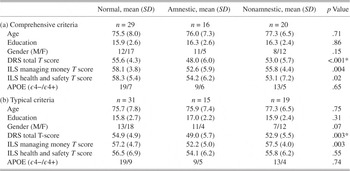
Participants were community-dwelling volunteers drawn from a larger group of individuals enrolled in a longitudinal study of normal aging who were consecutively accrued and selected because they had both undergone an MRI and received a comprehensive neuropsychological evaluation. All participants provided informed consent, and the research was conducted in accordance with the Institutional Review Board of the University of California, San Diego. Sixty-five nondemented older adults, ages 62–91 (mean age = 76) years, were assessed. Participants were determined to be nondemented based on consensus diagnosis utilizing all available neurological, neuropsychological, and functional data. As shown in Table 1, all participants were free of functional impairment [Independent Living Scales (Loeb, Reference Loeb1996) T scores >39] and exhibited normal global cognitive functioning [Dementia Rating Scale (DRS: Mattis, Reference Mattis1988) total score ³ 129, mean = 139; SD = 3.9]. Those with a history of alcoholism, drug abuse, learning disability, neurological, or major psychiatric illness were excluded.
Demographic characteristics by diagnostic approach

Note
F, female; ILS, Independent Living Scales; M, male; APOE, apolipoprotein E.
* Statistically significant.
Neuropsychological Assessment
All participants underwent a comprehensive neuropsychological assessment. The tests of interest included measures from five cognitive domains (memory, attention, language, visuospatial functioning, and executive functioning) with at least three measures from each domain. These tests were selected from the larger assessment to be used in the diagnoses because they covered multiple cognitive domains, are widely employed in the clinical assessment of older adults, and were judged to be psychometrically sound. Memory was measured by the Logical Memory Subtest of the Wechsler Memory Scale—Revised (Wechsler, Reference Wechsler1987) [WMS-R; immediate and delayed free recall, normative data drawn from Mayo’s Older Americans Normative Studies (MOANS: Ivnik et al., Reference Ivnik, Malec, Smith, Tangalos, Petersen, Kokmen and Kurland1992)], the Visual Reproduction subtest of the WMS-R [immediate and delayed free recall, normative data drawn from the MOANS (Ivnik et al., Reference Ivnik, Malec, Smith, Tangalos, Petersen, Kokmen and Kurland1992)], and the California Verbal Learning Test [(Delis et al., Reference Delis, Kramer, Kaplan and Ober1987); Trials 1–5 total recall and long delay free recall, normative data drawn from Norman et al., Reference Norman, Evan, Miller and Heaton2000]. Attention was assessed with the attention subscale of the DRS [published norms (Mattis, Reference Mattis1988)], the Digit Span subtest of the Wechsler Adult Intelligence Scale—Revised [(Wechsler, Reference Wechsler1981); normative data drawn from the MOANS (Ivnik et al., Reference Ivnik, Malec, Smith, Tangalos, Petersen, Kokmen and Kurland1992)], and Trail Making Test, Part A [(Reitan & Wolfson, Reference Reitan and Wolfson1985); normative data drawn from the MOANS (Ivnik et al., Reference Ivnik, Malec, Smith, Tangalos, Petersen, Kokmen and Kurland1992)]. Language was measured with the Boston Naming Test [BNT (Kaplan et al., Reference Kaplan, Goodglass and Weintraub1983); normative data drawn from the MOANS (Ivnik et al., Reference Ivnik, Malec, Smith, Tangalos, Petersen, Kokmen and Kurland1992)] and letter fluency and category fluency (Gladsjo et al., Reference Gladsjo, Schuman, Evans, Peavy, Miller and Heaton1999). Visuospatial functioning was measured with the Block Design subtest of the Wechsler Intelligence Scale for Children—Revised [(Wechsler, Reference Wechsler1974); age- and education-adjusted norms drawn from local unpublished data derived from the University of California, San Diego, Alzheimer Disease Research Center (UCSD ADRC)], the Visual Scanning condition of the Delis–Kaplan Executive Function System Trail Making Test (D-KEFS) and the D-KEFS Design Fluency Test [empty and filled dot conditions; published norms (Delis et al., Reference Delis, Kaplan and Kramer2001)], DRS construction [published norms (Mattis, Reference Mattis1988)], and draw-a-clock. Executive functioning was measured with the modified Wisconsin Card Sorting Test [(Lineweaver et al., Reference Lineweaver, Bondi, Thomas and Salmon1999); WCST-48-card version; categories achieved and perseverative errors], Trail Making Test, Part B [(Reitan & Wolfson, Reference Reitan and Wolfson1985); normative data drawn from the MOANS (Ivnik et al., Reference Ivnik, Malec, Smith, Tangalos, Petersen, Kokmen and Kurland1992)], D-KEFS Color-Word Interference Test (inhibition and inhibition/switching), and D-KEFS fluency switching conditions (visual and verbal).
MCI Classification
Each participant was classified as normal or MCI on the basis of two sets of neuropsychologically based criteria for MCI that differed in their characterization of objective cognitive impairment. For all criteria, participants were labeled as Single-Domain aMCI if only the memory domain was impaired, as Single-Domain Nonamnestic MCI if only one nonmemory domain was impaired, as Multiple-Domain aMCI if memory and at least one other domain showed impairment, and as Multiple-Domain Nonamnestic MCI if more than one nonmemory domain was impaired.
Two distinct diagnostic approaches were employed. Variations on cutoffs for impairment and number of tests required to be in the impaired range are delineated as follows. The “comprehensive criteria” impairment objectively required that at least two performances within a cognitive domain fell greater than one standard deviation (SD) below normative expectations in order for that domain to contribute to the MCI classification. By this approach, individuals were classified as normal if, at most, performance on one measure within one or two cognitive domains fell more than 1 SD below age-appropriate norms. The “typical criteria,” adapted from the most recent criteria outlined by Petersen and Morris (Reference Petersen and Morris2005), operationally defined objective cognitive impairment for multiple subtypes of MCI. Individuals were classified as normal if no neuropsychological measure fell greater than 1.5 SD below age-appropriate norms in any cognitive domain. Impairment required scores to fall more than 1.5 SD below age-appropriate norms on any test within a domain (for additional information on the diagnostic approaches, see Jak et al., in press).
According to the comprehensive criteria, 29 individuals were characterized as cognitively normal, 16 as aMCI (5 single and 11 multiple domain), and 20 as nonamnestic MCI (15 single and 5 multiple domain). No significant differences between groups on any demographic factors, including presence of the apolipoprotein epsilon 4 allele (APOE є 4), were noted (Table 1, Panel a). DRS total T scores were within normal limits for all subjects, although as expected there was a significant main effect of group on DRS total T scores (F 2,62 = 12.5, p < .0001,  = .29). Tukey post hoc comparisons of the three groups indicated that the amnestic group (M = 48.0) had significantly lower scores than either the normal group (M = 55.6, p < .0001) or the nonamnestic group (M = 53.1, p = .008). Comparisons between the nonamnestic and the normal groups were not statistically significant (p = .19).
When the typical criteria were applied, 31 individuals were characterized as cognitively normal, 15 as aMCI (6 single and 9 multiple domain), and 19 as nonamnestic MCI (16 single and 3 multiple domain). Despite the overall samples sizes remaining similar, 15 participants changed diagnostic category depending on the neuropsychological approach applied. Again, no significant differences between groups on any demographic factors, including presence of the APOE ε4allele, were noted with the application of the typical criteria (Table 1, Panel b). DRS total T scores were within normal limits for all subjects, although again there was a significant main effect of group on DRS total T scores (F 2,62 = 6.4, p = .003,  = .17). Tukey post hoc comparisons of the three groups indicated that the amnestic group (M = 49.0) had significantly lower scores than the normal group (M = 54.9, p < .002). Comparisons between the nonamnestic (M = 52.9) and the normal or amnestic groups were not statistically significant (p values >.08).
CVD Risk Factors
Validated health risk appraisal functions used for the basis of the evaluation of stroke risk [Framingham Stroke Risk Profile (FSRP); D’Agostino et al., Reference D’Agostino, Wolf, Belanger and Kannel1994] were available for 53 participants. The following stroke risk factors were included: age, systolic blood pressure, diabetes mellitus, cigarette smoking, prior cardiovascular disease, atrial fibrillation, left ventricular hypertrophy by electrocardiogram, and the use of antihypertensive medication. Using the methods previously described by D’Agostino et al. (Reference D’Agostino, Wolf, Belanger and Kannel1994), a total stroke risk score summing the assigned number of points related to each of the individual stroke risk factors was calculated for each participant.
Structural Imaging Acquisition and Regions of Interest Protocol
Participants were scanned either on a 3.0-Tesla General Electric (GE) Medical Systems EXCITE whole-body imager or on a 1.5-Tesla GE Signa imager (General Electric Medical Systems, Milwaukee, WI). Hippocampal volumes were obtained (bilaterally) via visual inspection and manual outlining performed in the coronal plane. Images were realigned perpendicular to the anterior–posterior commissure line but not transformed into standard space coordinates. Regions of interest were delineated using Analysis of Functional NeuroImages software and completed by an experienced operator (A.J.J.), who was blind to participant identity and group. High levels of intra- and inter-rater reliability for the procedure were established on a separate set of images not among those studied presently (intraclass correlation coefficients >.90). Hippocampal regions of interest were delineated using a stereotactic approach using methods published previously (Jak et al., Reference Jak, Houston, Nagel, Corey-Bloom and Bondi2007). Briefly, the anterior bound of the hippocampus was chosen as the coronal slice through the fullest portion of the mammillary bodies, and the posterior boundary was traced on the last coronal slice on which the superior colliculi could be fully visualized. Whole-brain images were also skull-stripped and segmented into gray matter, white matter, and cerebrospinal fluid compartments. Scans were manually edited when necessary to remove any residual non-brain material. Whole-brain volume was derived and used in normalizing hippocampal volumes (Bigler & Tate, Reference Bigler and Tate2001).
Statistical Analyses
Data were analyzed using multiple one-way analyses of variance, where diagnostic group represented the independent variable and imaging, neuropsychological, or stroke risk variables represented the dependent variables. Tukey honestly significant difference tests were applied for post hoc comparisons. Bonferroni corrections for multiple comparisons were performed, and for the hippocampal volume and stroke risk analyses, an α level of .025 was considered significant; for neuropsychological variables, an α level of .003 was considered significant. Pearson correlations or partial correlations were used to determine the relationship between neuropsychological, stroke risk, and imaging variables in each of the three diagnostic groups.
RESULTS
When groups were created based on the comprehensive neuropsychological criteria and compared, normalized hippocampal volumes were significantly different between groups bilaterally. There was a significant group effect for the left hippocampus (F 2,62 = 5.46, p = .007,  = .15) and a trend for right-sided hippocampal volumes (F 2,62 = 3.84, p = .03,
 = .11). Tukey post hoc comparisons of the three groups indicated that the amnestic group (M = 0.21) had significantly smaller left hippocampal volumes than did the normal group (M = 0.25, p = .01). Comparisons between the amnestic (M = 0.21) and the nonamnestic group (M = 0.24) and between the normal and the nonamnestic groups were not statistically significant (all p values >.14). Similarly, on the right side, post hoc comparisons of the three groups indicated that the amnestic group (M = 0.23) had a trend toward smaller right hippocampal volumes than did the normal group (M = 0.27, p = .03). Comparisons between the amnestic and the nonamnestic groups (M = 0.25) and between the normal and the nonamnestic groups were not statistically significant (all p values >.28). These results are in the context of no group differences in either whole-brain volume (F 2,62 = 0.58, p = .56,
 = .02) or total white matter volume (F 2,62 = 0.60, p = .55,
 = .02).
In contrast, when the typical diagnostic approach was applied, normalized hippocampal volumes were not significantly different between groups (left hippocampus: F 2,62 = 2.43, p = .10,  = .07; right hippocampus: F 2,62 = 2.4, p = .10,
 = .07). There were also no group differences in either whole-brain volume (F 2,62 = 1.4, p = .27,
 = .04) or total white matter volume (F 2,62 = 2.32, p = .11,
 = .07).
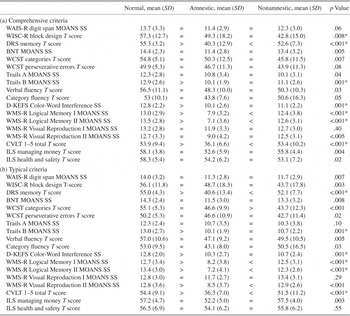
Neuropsychological differences between groups are depicted in Table 2. Regardless of diagnostic criteria, there was a significant group effect for the DRS Memory subscale (comprehensive criteria: F 2,62 = 19.9, p < .0001,  = .39; typical criteria: F 2,62 = 15.8, p < .0001,
 = .34). With the comprehensive criteria, Tukey post hoc comparisons of the three groups indicated that the amnestic group (M = 40.3) had significantly lower DRS memory scores than did the normal group (M = 55.3, p < .0001) or the nonamnestic group (M = 52.6, p < .0001). The nonamnestic and normal groups were not significantly different (p = .44). With the typical criteria, Tukey post hoc comparisons of the three groups indicated that the amnestic group (M = 40.6) had significantly lower DRS memory scores than did the normal group (M = 54.9, p < .0001) or the nonamnestic group (M = 52.1, p < .0001). The nonamnestic and normal groups were not statistically different (p = .46). This measure was not part of the neuropsychological diagnosis.
Neuropsychological performances by group

Note
CVLT, California Verbal Learning Test; ILS, Independent Living Scales; WAIS-R, Wechsler Adult Intelligence Scale—Revised; WISC-R, Wechsler Intelligence Scale for Children—Revised; SS – Scaled Score; WCST, Wisconsin Card Sorting Test.
* Statistically significant.
When creating groups based on the comprehensive criteria, Pearson correlations revealed that normalized hippocampal volumes (bilaterally) were related to DRS Memory performance in the amnestic group but not the normal or nonamnestic group (right: r = .55, p = .03; left: r = .61, p = .01). Delayed memory on WMS-R Logical Memory was related to hippocampal volumes bilaterally in the amnestic group (right: r = .66, p = .006; left: r = .51, p = .04) and on the left on the nonamnestic group (r = .45, p = .05). Delayed memory on the WMS-R Visual Reproduction was also related to hippocampal volumes bilaterally in the amnestic group only (right: r = .85, p < .001; left: r = .65, p = .009). Left hippocampal volumes were related to immediate memory on the Logical Memory subtest in the nonamnestic group only (r = .46, p = .04).
When the typical criteria were applied, relationships between the amnestic group and neuropsychological functioning were similar. Pearson correlations revealed that normalized hippocampal volumes (bilaterally) were related to DRS Memory performance in the amnestic group but not the normal or nonamnestic group (right: r = .68, p = .005; left: r = .64, p = .01). Delayed memory on WMS-R Logical Memory was related to hippocampal volumes bilaterally in the amnestic group (right: r = .71, p = .003; left: r = .71, p = .003). Delayed memory on the WMS-R Visual Reproduction was also related to hippocampal volumes bilaterally in the amnestic group only (right: r = .79, p < .001; left: r = .60, p = .02). There were no significant correlations between hippocampal volumes and neuropsychological variables in the nonamnestic or cognitively normal group, as defined by the typical criteria.
Use of the comprehensive criteria revealed no significant differences between groups in FSRP percent risk (F 2,50 = 0.76, p = .47,  = .03) or in blood pressure between groups (F 2,50 = 0.74, p = .48,
 = .03). Results were similar for the main effect of group produced through application of the typical criteria for both FSRP percent risk (F 2,50 = 0.07, p = .93,
 = .003) and blood pressure (F 2,50 = 1.21, p = .30,
 = .05).
Relationships between stroke risk and cognitive performances differed depending on the diagnostic strategy applied. When using the comprehensive criteria, Pearson partial correlation coefficients controlling for age indicated that higher stroke risk was related to lower performance on block design in cognitively healthy individuals (r = −.57, p = .002) and in the amnestic group (r = −.75, r = .01). In the cognitively healthy group, higher stroke risk was related to poorer performance on WCST perseverative errors (r = −.40, p = .04) and Trails B performance (r = −.51, p = .007). In the amnestic group, higher stroke risk was associated with lower BNT (r = −.74, p = .01). No significant correlations were noted between FSRP stroke risk percent and cognitive performances in the nonamnestic group. In contrast, no significant relationships between stroke risk and neuropsychological functioning emerged in any diagnostic group when the typical criteria were used.
DISCUSSION
Neuropsychological definitions of MCI that require the presence of more than one impaired score in a cognitive domain resulted in expected anatomical results, where hippocampal volumes were significantly smaller in the aMCI group as compared to cognitively normal or nonamnestic MCI participants. However, diagnoses based only on the presence of one impaired score within a cognitive domain did not result in this expected anatomical difference. Specifically, those diagnosed with aMCI via the comprehensive criteria have significantly smaller left-sided hippocampal volumes than cognitively healthy individuals, whereas those with nonamnestic MCI had volumes intermediate between aMCI and normal groups. A similar trend was noted for right-sided hippocampal volumes. However, there were no differences in hippocampal volumes between any of the groups when diagnoses were arrived at using the typical criteria. These differential neuroanatomical findings depending on the diagnostic criteria applied were present despite the fact that, neuropsychologically, the groups were generally similar, regardless of the diagnostic strategy applied. That is, the diagnostic groups differed on the same tests of memory and executive functioning, irrespective of the diagnostic strategy applied. Yet, the typical criteria lacked the expected difference in hippocampal volumes between groups that was evident when the comprehensive criteria to group classification were applied.
Global stroke risk factors did not differ between diagnostic groups for either the comprehensive or the typical criteria. However, the relationship between stroke risk variables and neuropsychological functioning did vary by diagnostic approach. When the comprehensive criteria were applied, higher stroke risk was related to poorer executive functioning and visuoconstruction in cognitively healthy and aMCI participants. However, when the typical criteria were applied, no relationships between stroke risk factors and cognitive performances emerged for any group. Again, the literature tends to support stroke risk as a general risk factor for MCI or cognitive weaknesses, and the failure to find any relationship between stroke risk factors and neuropsychological test performances when using the typical criteria further calls into question the validity of this method of objectively defining impairment in MCI.
The alignment of anatomical and stroke risk variables in the comprehensive neuropsychological approach but not in the typical approach is noteworthy as it further highlights the role that diagnostic rigor can play in studies of MCI. Not only do different diagnostic strategies result in different prevalence estimates of MCI, but they can also suggest very different neuropathological substrates. The group differences in hippocampal volumes noted with use of the comprehensive diagnostic criteria add support to the concept of multiple MCI subtypes, which appear to be associated with different neuropathological processes and disease risk factors (see also Busse et al., Reference Busse, Hensel, Guhne, Angermeyer and Riedal-Heller2006; Storandt et al., Reference Storandt, Grant, Miller and Morris2006).
It is also of note that stoke risk profiles did not correspond to cognitive functioning in the nonamnestic subtype, despite suggestions in the literature that this particular subtype of MCI may have a more vascular etiology (Petersen & Morris, Reference Petersen and Morris2005). The results of the current study are more supportive of CVD factors as more general risks for cognitive changes with age or even more preferentially in amnestic forms of MCI. Many have begun to highlight the strong relationship between CVD and AD (Cechetto et al., Reference Cechetto, Hachinski and Whitehead2008; Hachinski, Reference Hachinski2008), and our findings are consistent with stroke risk factors as potentially more salient in amnestic versus nonamnestic presentations.
The composition of the MCI subtype groups may have also contributed to some of the differential findings related to CVD risk. The amnestic group had a majority of multidomain presentations, while the nonamnestic group was predominantly single-domain presentations. Some evidence suggests that those with multidomain aMCI appear to be at greatest risk for future dementia (Di Carlo et al., Reference Di Carlo, Lamassa, Baldereschi, Inzitari, Scafato, Farchi and Inzitari2007; Palmer et al., Reference Palmer, Backman, Winblad and Fratiglioni2008; Tabert et al., Reference Tabert, Manly, Liu, Pelton, Rosenblum, Jacobs, Zamora, Goodkind, Bell, Stern and Devanand2006), while others indicate that aMCI places one at highest risk for progression to dementia (Ravaglia et al., Reference Ravaglia, Forti, Maioli, Martelli, Servadei, Brunetti, Pantieri and Mariani2006; Yaffe et al., Reference Yaffe, Petersen, Lindquist, Kramer and Miller2006). It may be that the relationship of CVD risk and cognition in the amnestic group reflects the greater general risk factor burden of multidomain presentations, as opposed to relating specifically to amnestic versus nonamnestic distinctions. Future investigations with a larger sample size allowing for separation into four MCI groups are warranted to further examine these issues.
Additional limitations of the study include the fact that, despite being a community sample, the group is highly educated and therefore may not generalize to lower education levels, although the use of age- and education-corrected norms in the current study represents an improvement from most decision-making methods in the existing literature.
Because there is no “gold standard” operational criterion for diagnosis of MCI and its subtypes, and none of our sample has yet progressed to AD, it is impossible to determine with certainty which diagnostic strategy is ultimately the most valid or has the highest sensitivity or specificity. The convergence of neuropsychological, neuropathological, and stroke risk findings within the groups identified by the comprehensive criteria nonetheless offers strong support for the use of diagnostic approaches that consider impairments on more than one neuropsychological test as the criteria for objective cognitive impairment in MCI subtypes.
These study results and the larger research literature are generally supportive of the MCI construct. However, the work presented here highlights the importance of utilizing comprehensive neuropsychological data in MCI determinations as well examining multiple subtype presentations. It seems imperative that investigations of MCI consistently examine multiple cognitive domains, not just memory, and continue to explore additional neuroanatomical correlates of clinical subtypes of MCI. While hippocampal volumes were the only neuroanatomical structure examined in the current study, a more detailed examination of other neuroanatomy, particularly white matter, in relation to MCI diagnosis and cerebrovascular risk factors is certainly warranted. Clinical outcomes of those with MCI should also be a focus of continued investigation. Future research focused on rigorous objective definitions and cognitive characterization of clinical subtypes of MCI will continue to add to the clinical utility of the construct.
ACKNOWLEDGMENTS
This work was supported by National Institute on Aging grants R01 AG012674 (MWB), K24 AG026431 (MWB), and T35AG026757 (SU), by a VA Career Development Award (AJJ), by an Alzheimer’s Association New Investigator (AJJ) and Investigator Initiated (MWB) Research Grants. The authors gratefully acknowledge the assistance of Heather Alviso; Gali Weissberger; the VA/UCSD Laboratory of Cognitive Imaging; as well as the staff, patients, and volunteers of the UCSD ADRC.