Introduction
Total laryngectomy continues to be an effective surgical option for advanced laryngeal and hypopharyngeal carcinoma.Reference Choi, Park, Song, Cho, Park and Park1 The creation of an end stoma following complete removal of the tumour and reconstruction of the pharynx separates the trachea from the upper airway. Transection of the communication with the upper airway leads to lack of airflow through the nasal cavity, pharynx and oral cavity, with resultant loss of the sensation of smell. Loss of olfaction after laryngectomy and its rehabilitation are often overlooked, although it is well known that the sense of smell does affect human behaviour and emotions. Olfaction, which is one of the special senses, enhances an individual's quality of life (QoL) and enables appreciation of the flavour of food.Reference Miwa, Furukawa, Tsukatani, Costanzo, DiNardo and Reiter2 Thus, laryngectomised patients experience not just a loss of smell but also a significant loss of appreciation of flavour.Reference Risberg-Berlin, Möller and Finizia3–Reference Mumovic and Hocevar-Boltezar8 The loss of smell in laryngectomised patients could lead to life-threatening situations too, as they fail to smell leaking gas, burnt substances, spoilt food and toxins.
A number of techniques have been described to rehabilitate laryngectomised patients with olfaction and taste disturbances. The techniques developed may broadly be divided into: (1) those in which a connection is created between the mouth (and nose) and the lower airway; and (2) those in which the orofacial musculature is moved to create a limited amount of airflow in the posterior part of the mouth, oropharynx and nose. Some patients have developed their own methods (without professional help) to overcome this handicap, with techniques like moving the facial or neck muscles or soft palate.Reference van Dam, Hilgers, Emsbroek, Touw, van As and de Jong4,Reference Schwartz, Mozell, Youngentob, Leopold and Sheehe9,Reference Moore-Gillon10 Others, with professional help, have shown improved sense of smell with either a larynx bypass device, glossopharyngeal press, buccopharyngeal manoeuvre (sniffing) or ‘polite yawn’ technique.Reference Schwartz, Mozell, Youngentob, Leopold and Sheehe9–Reference Hilgers, van Dam, Keyzers, Koster, van As and Muller12
This prospective study was conducted to assess reduction in olfaction as well as QoL in patients undergoing total laryngectomy. We also sought to assess the efficacy of the nasal airflow inducing manoeuvre, also called the polite yawn technique, in treating affected patients. To the best of our knowledge, there is no information regarding the use of this technique among Indian patients, in whom the prevalence of laryngeal cancer is high and total laryngectomy is performed frequently for the same.
Materials and methods
Participants
A cohort of 42 consecutive patients with laryngeal and hypopharyngeal malignancy who were scheduled for laryngectomy (primary surgery or salvage laryngectomy) at our institution, a tertiary care referral centre, was prospectively recruited to the study. Patients with co-existent sinonasal pathology or a history of past nasal surgery were excluded from the study.
Methodology
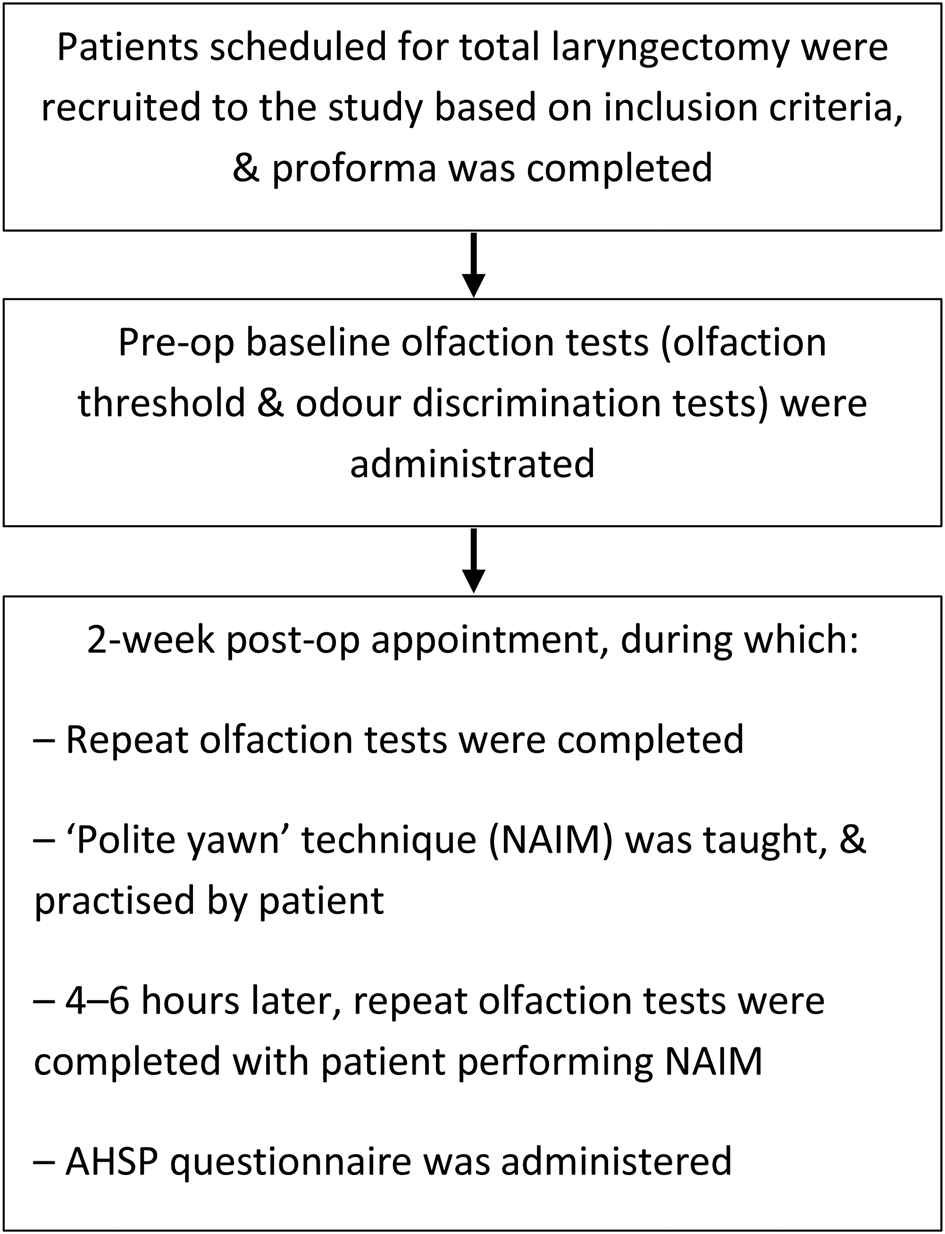
The study protocol is illustrated in Figure 1. Pre- and post-operative assessments were documented.
Flow chart of study protocol. Pre-op = pre-operative; post-op = post-operative; NAIM = nasal airflow inducing manoeuvre; AHSP = Appetite, Hunger and Sensory Perception

Pre-operative evaluation
After obtaining informed consent, demographic details of each patient were inserted in the proforma. This included information regarding the presence of co-morbidities, smoking or alcohol consumption habits, type of cancer for which laryngectomy was being planned, and whether the patient had received prior radiotherapy. Baseline olfaction testing was performed using the Connecticut Chemosensory Clinical Research Center test.
Post-operative evaluation
The same olfaction test was repeated two weeks after surgery. Following this, on the same day, patients were taught the nasal airflow inducing manoeuvre by the speech and language pathologist, using asafoetida (a gum obtained from the roots of a variety of Ferula plants, which naturally has a strong and pungent smell). All the 42 patients were able to learn the technique. After practising the nasal airflow inducing manoeuvre for a few hours until the technique was perfected, olfaction testing was performed again and the results noted. At the same sitting, QoL assessment was performed using the Appetite, Hunger and Sensory Perception questionnaire.
Nasal airflow inducing manoeuvre
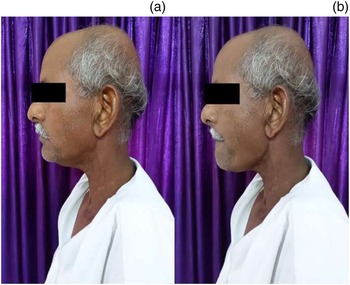
The nasal airflow inducing manoeuvre or ‘polite yawn’ technique – a manoeuvre used to improve olfaction in laryngectomised patients – was described first by Hilgers et al.Reference Hilgers, van Dam, Keyzers, Koster, van As and Muller12 When a patient yawns with the lips closed, and simultaneously lowers the floor of mouth, base of tongue and soft palate, it induces negative pressure in the oral cavity and oropharynx. This creates a flow of air in the posterior part of the oral cavity, nasopharynx and posterior part of the nasal cavity, and the odorant is thus able to reach the olfactory receptors in the nasal cavity. The technique of performing the nasal airflow inducing manoeuvre is illustrated in Figure 2a and b.
Total laryngectomy patient (a) before performing and (b) while performing nasal airflow inducing manoeuvre.

Olfaction testing
The Connecticut Chemosensory Clinical Research Center test is a two-component test that assesses the olfactory threshold, using various butanol dilutions and odour identification.Reference Cain, Gent, Goodspeed and Leonard13 In the butanol threshold test, performed using seven decreasing concentrations of butanol, the patient is asked to decide which of the two bottles presented, which contain either butanol or deionised water, smells stronger. The correct result was obtained if the patient consistently identified the difference on at least three trials for each strength of butanol used. The patient scored 1 point for each such correctly identified difference. If the patient failed to identify the difference on all three trials, the next higher strength of butanol was used.
The smell identification test was performed next, in which seven different odorants (jasmine, rose, cinnamon, lemon, talcum powder, coffee and moth balls) were presented randomly and the patient was asked to identify the odour with a forced-choice procedure. The odorants used in the smell identification test were familiar to the Indian population. A score of 0 to 7 was given for this part of the test.
The composite score was the average of the threshold and identification test scores. A patient's olfaction status was classified based on the composite score as follows: normosmia, score higher than 6; mild hyposmia, score of 5–6; moderate hyposmia, score of 4–5; severe hyposmia, score of 2–4; and anosmia, score of lower than 2.
Patients underwent olfaction testing at baseline (pre-operatively) and at two weeks following surgery. At the post-operative visit, they underwent olfaction testing both before and after performing the nasal airflow inducing manoeuvre under supervision, on the same day.
Quality of life questionnaire
The Appetite, Hunger and Sensory Perception questionnaire, designed by de Jong et al.,Reference de Jong, Mulder, de Graaf and van Staveren14 is a validated, 29-item, multi-domain appetite assessment tool that is scored with a 5-point (A to E) Likert-type scale. The mean scores for each domain (taste perception, appetite, present odour perception, present odour perception compared with the past, and daily feeling of hunger) and the total score are calculated. The total Appetite, Hunger and Sensory Perception score is the sum of all domain scores, and can range from 29 (worst) to 145 (best). A low score indicates poor function. It suggests that the perception has deteriorated compared with the pre-operative situation. Conversely, a higher score indicates good function or improvement in these domains.
Patients were administered the questionnaire two weeks following surgery, after practising the nasal airflow inducing manoeuvre.
Ethical approval
Institutional Review Board and ethics committee approval was obtained (Institutional Review Board minutes number: 9044).
Sample size calculation
In a previous study,Reference Risberg-Berlin, Möller and Finizia3 olfaction rehabilitation was achieved in 11 of 14 patients with anosmia (79 per cent) following laryngectomy. Based on the results of this study, in order to observe an effect size of 0.50, with a power of 80 per cent and with an alpha error of 5 per cent, a sample size of 42 was calculated using the single mean paired t-test formula.
Statistical analysis
Frequencies and percentages were calculated for categorical variables, and mean and standard deviation (SD) values were calculated for continuous variables. The paired t-test was used to compare baseline olfaction values with immediate pre- and post-nasal airflow inducing manoeuvre values in all patients. A sub-analysis comparing patients who received radiotherapy pre-operatively with those who did not was also performed using a two-sample t-test. Mean scores for all domains of the Appetite, Hunger and Sensory Perception questionnaire were also calculated.
Results
A total of 42 patients who fulfilled the inclusion criteria as per the study protocol (Figure 1) were recruited to the study.
Demographic data
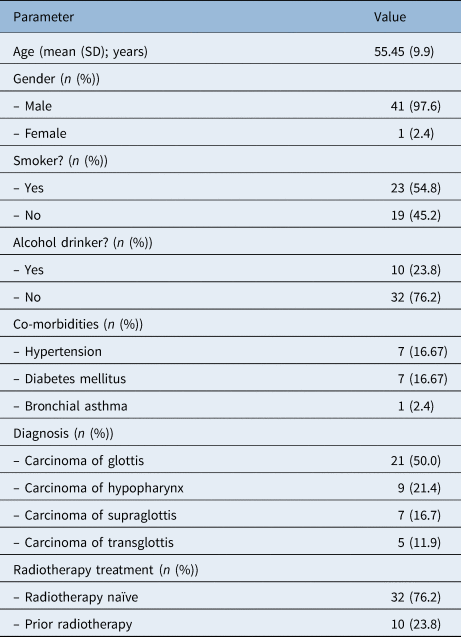
The mean age (SD) of the patients was 55.45 (9.9) years, with the youngest aged 27 years and the oldest being 76 years. Most of the study subjects were men (97.6 per cent), had a smoking habit (54.8 per cent) and did not consume alcohol (76.2 per cent). The study group included patients with carcinoma of the glottis, supraglottis, transglottis or hypopharynx. Most patients (50 per cent) were diagnosed with carcinoma of the glottis (Table 1).

The majority of patients (76.2 per cent) had not undergone prior radiotherapy. Thirty-two patients had primary surgery and 10 had salvage laryngectomy. The dose of radiation therapy received in those 10 patients was 60–66 Gy over six weeks.
Olfaction assessment
Baseline assessment
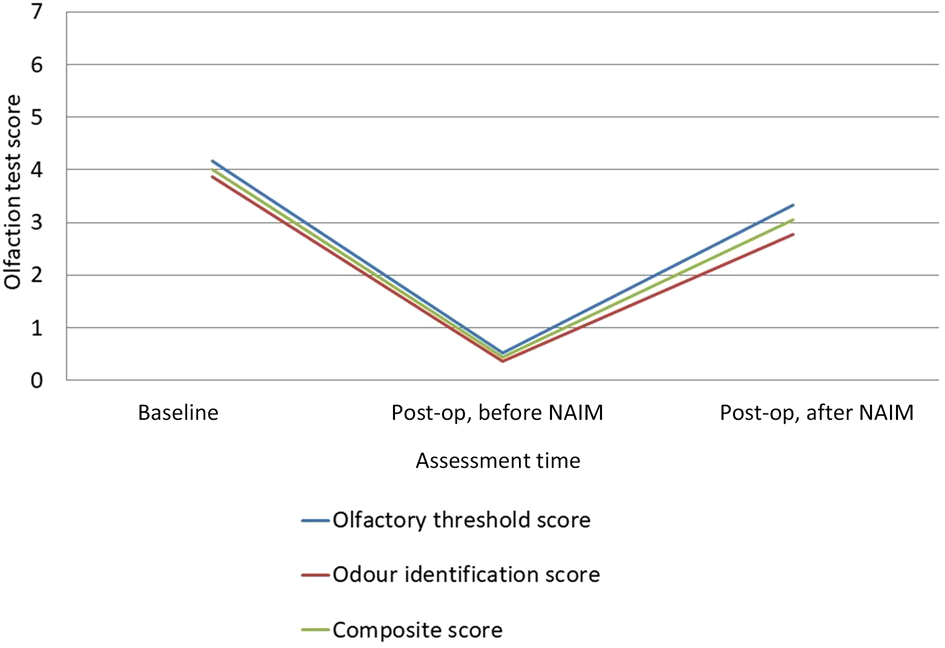
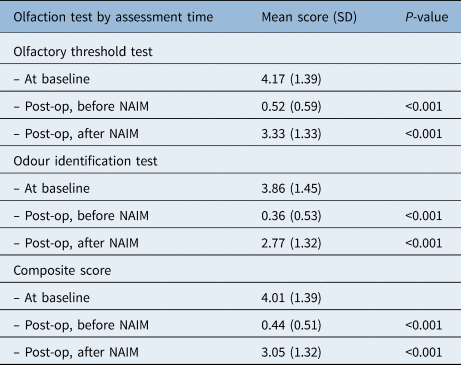
Analysis of the olfactory threshold score, odour identification score and mean composite olfaction score at baseline suggested the presence of different degrees of olfaction impairment in the study cases. The composite olfaction score ranged from 1 to 6.5, with 19 per cent of patients having severe hyposmia (score lower than 3), 53 per cent having moderate hyposmia, 19 per cent having mild hyposmia (score of 5–6), 7 per cent having anosmia and 2 per cent of patients having normosmia. The patients’ mean (SD) baseline composite olfaction score (4.01 (1.39)) suggested moderate hyposmia prior to laryngectomy (Table 2 and Figure 3).
Mean olfaction scores obtained at baseline (pre-laryngectomy) and post-laryngectomy, both before and after performing the nasal airflow inducing manoeuvre (NAIM). Post-op = post-operatively

Olfaction test scores at baseline and post-operatively
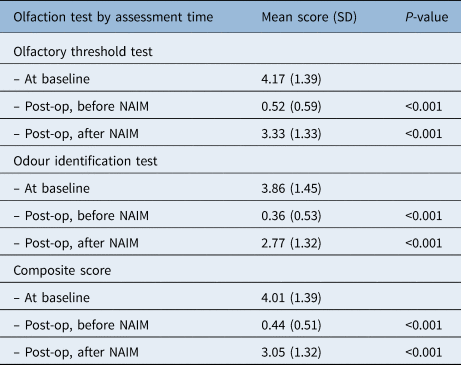
SD = standard deviation; post-op = post-operatively; NAIM = nasal airflow inducing manoeuvre
Post-laryngectomy assessment
The mean (SD) composite score at two weeks after laryngectomy surgery, but prior to the nasal airflow inducing manoeuvre, fell to 0.44 (0.51), and this reduction was significant (p < 0.001). Both the odour identification score and the olfactory threshold score were also significantly reduced in the post-operative period compared with the baseline (p < 0.001). Two weeks after surgery, 97.6 per cent of patients had anosmia and 2.4 per cent had severe hyposmia.
Post-manoeuvre assessment
After practising the nasal airflow inducing manoeuvre (two weeks after laryngectomy), the mean (SD) olfactory thresholds improved to 3.05 (1.32); this improvement, although it did not reach pre-operative levels, was significant compared with pre-nasal airflow inducing manoeuvre values (p < 0.001). Similar improvements were noted in both the odour identification and composite scores.
Radiotherapy influence on manoeuvre
A sub-analysis was performed to study the improvement in composite olfaction score before and after the nasal airflow inducing manoeuvre by comparing those who had undergone radiotherapy with those who had not (Table 3). The mean scores were first obtained for both left and right nostrils. There was no significant difference in mean composite scores for either nostril in those who had undergone radiotherapy and those who had not (p = 0.79 and p = 0.83 for the left and right side, respectively). Thus, prior radiotherapy did not influence the effectiveness of the nasal airflow inducing manoeuvre among the study subjects.
Mean composite score according to pre-operative radiotherapy

Data represent mean (standard deviation) scores. *n = 32; †n = 10. RT = radiotherapy
Quality of life assessment
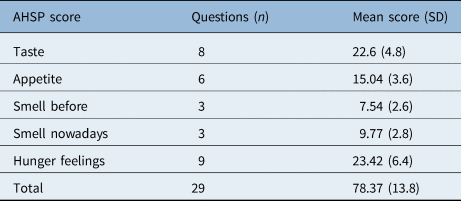
Quality of life was assessed using the Appetite, Hunger and Sensory Perception questionnaire. The total mean score was 78.37 (range, 52–110) (Table 4). The relatively high scores obtained (normal range, 29–145) suggested that the nasal airflow inducing manoeuvre helped in improving QoL too in this patient cohort.
Mean post-operative AHSP questionnaire scores in NAIM patients

AHSP = Appetite, Hunger and Sensory Perception; NAIM = nasal airflow inducing manoeuvre; SD = standard deviation
Discussion
Head and neck cancers account for about 30–40 per cent of all malignancies in India, and laryngeal cancer is the second commonest head and neck cancer.Reference Prabhash, Babu, Chaturvedi, Kuriakose, Birur and Anand15,Reference Tuljapurkar, Dhar, Mishra, Chakraborti, Chaturvedi and Pai16 Total laryngectomy is offered as a primary treatment modality for patients with locally advanced laryngeal and hypopharyngeal cancers, and for those in whom organ preservation treatment with chemoradiation fails. The need for rehabilitation of the laryngectomised patient is well recognised. Great attention is paid to the voice rehabilitation of these individuals, unlike olfaction, and patients are seldom advised about techniques to improve the sense of smell.
Studies conducted to evaluate the need for olfactory rehabilitation in laryngectomised patients have not assessed olfaction prior to total laryngectomy.Reference Risberg-Berlin, Möller and Finizia3,Reference Risberg-Berlin, Ylitalo and Finizia17,Reference Risberg-Berlin, Rydén, Möller and Finizia18 In addition, the effect of manoeuvres like the nasal airflow inducing manoeuvre in improving olfaction has not been extensively studied. To the best of our knowledge, this is the first study from India on the subject. In India, because of the generally late presentation of these patients, laryngectomy continues to be performed in large numbers, and laryngeal or laryngopharyngeal cancer continues to be highly prevalent in the country.Reference Pantvaidya, Raina, Mondal, Deshmukh, Nair and Pai19
A reduced sense of smell is an inevitable consequence of total laryngectomy, as there is a discontinuity between the upper and lower respiratory tract. During respiration, which now occurs through the tracheostoma, no air flows to the olfactory epithelium, affecting the sense of smell, which in turn affects taste and flavour perception too.Reference Leon, Catalanotto and Werning20 This also affects the alimentation and nutrition of these patients, as foods may appear tasteless, further reducing appetite and intake. The possibility of the olfactory mucosa being exposed to a number of factors, like viral and environmental insults, including tobacco smoke, along with the changes that occur with ageing, could account for the lower than normal composite olfaction score of less than 6 seen in this study.Reference Doty and Kamath21,Reference Moor, Rafferty and Sood22
Two weeks following surgery, there was a significant drop in the olfaction score (p < 0.001); the findings indicated anosmia in 97.6 per cent of patients (score of 0.54), and suggested that these patients were not using any technique to augment or enhance their sense of smell. The main reason for hyposmia or anosmia is the lack of nasal airflow due to the disconnection of the upper and lower airway. For rehabilitation of olfactory function in laryngectomised patients, it is essential that nasal airflow is restored. While this can be done using prosthetic devices like the nipple device, oral tracheal breathing tube or laryngeal bypass device, they are cumbersome to use.Reference Bosone23–Reference Mozell, Schwartz, Youngentob, Leopold, Hornung and Sheehe25 An easily learnt technique like the nasal airflow inducing manoeuvre technique, which can be taught in a short single session of 15 minutes and which requires no external device or manual manipulation, should be accepted by most laryngectomy patients and should be incorporated in the rehabilitation programme of these individuals.
In the present study, the composite olfaction score obtained following the nasal airflow inducing manoeuvre showed a significant improvement compared with both baseline and pre-nasal airflow inducing manoeuvre scores. Similar findings were noted in two other studies.Reference Hilgers, van Dam, Keyzers, Koster, van As and Muller12,Reference Bosone23 In a study by Hilgers et al.,Reference Hilgers, van Dam, Keyzers, Koster, van As and Muller12 the nasal airflow inducing manoeuvre helped in converting 46 per cent of non-smellers to smellers. When followed up in the long term (41 patients for a mean of 4 months to 2 years), the success in olfactory rehabilitation was maintained in about 50 per cent of the patients.Reference Hilgers, Jansen, Van As, Polak, Muller and Van Dam26 The authors mentioned the need for repeated sessions for sustained rehabilitation.
Miwa et al.,Reference Miwa, Furukawa, Tsukatani, Costanzo, DiNardo and Reiter2 in their study of 1407 patients, found that olfactory disturbance had a significantly negative effect on QoL. Anosmia or hyposmia following laryngectomy can lead to reduced gustation and appetite, which affects a patient's sense of well-being.Reference Caldas, Facundes, Cunha, Balata, Leal and da Silva5 Assessment of health-related QoL is a means of evaluating these patients, and it has now become a part of the evaluation of cancer treatment and rehabilitation.
• Laryngectomised patients experience olfactory function loss or reduction
• The nasal airflow inducing manoeuvre is inexpensive, simple and patient-friendly
• This manoeuvre can effectively increase olfaction scores and quality of life after laryngectomy
• Olfaction rehabilitation should be included in the management of laryngectomy patients
Quality of life after laryngectomy in relation to olfaction, taste and appetite can be assessed using various available questionnaires. Risberg-Berlin et al.Reference Risberg-Berlin, Möller and Finizia3 used the Questionnaire on Olfaction, Taste and Appetite, and the European Organization for Research and Treatment of Cancer ‘QLQ-C30’ and ‘QLQ-H&N35’ QoL questionnaires. Bjordal et al.,Reference Bjordal, Hammerlid, Ahlner-Elmqvist, de Graeff, Boysen and Evensen27 in a study to validate the European Organization for Research and Treatment of Cancer Quality of Life Questionnaire – Head and Neck ‘QLQ-H&N35’ questionnaire, mentioned a high compliance rate but low internal consistency with respect to special senses. Risberg-Berlin et al.Reference Risberg-Berlin, Möller and Finizia3 in their follow-up study on olfaction and health-related QoL, mentioned a similar problem with the questionnaire. The questionnaire of the sense scale, which included ‘problems with smell’ and ‘problems with taste’, did not show a significant difference between the smellers group and the non-smellers group.Reference Risberg-Berlin, Rydén, Möller and Finizia18 In comparison, the Appetite, Hunger and Sensory Perception questionnaire used in the current study, which is very similar to the Questionnaire on Olfaction, Taste and Appetite, has high internal consistency and can thus be used as an effective tool for evaluating QoL in patients undergoing total laryngectomy.
A limitation of the present study is the short follow-up period. A longer follow-up period would have provided information regarding sustained olfaction improvement in the study group.
Conclusion
Laryngectomy performed for laryngeal and laryngopharyngeal cancer can significantly reduce olfaction and QoL because of the loss of continuity of airflow between the trachea and the nasal cavity. This is best measured by olfaction tests and QoL questionnaires like the Connecticut Chemosensory Clinical Research Center test, and the Appetite, Hunger and Sensory Perception questionnaire, respectively. Olfaction rehabilitation by the nasal airflow inducing manoeuvre results in significant improvements in both olfaction and QoL. Incorporation of these assessment and rehabilitation tools should necessarily form part of the protocol for post-surgical management of laryngectomised patients.
Acknowledgements
We thank Dr B Antonisamy, Department of Biostatistics, Christian Medical College, Vellore, India, for his contribution towards designing the study, and Mrs Indumathi, for secretarial assistance in preparing the manuscript. This research was partly funded by the Fluid Research Grant from the institution.
Data availability statement
All data that are relevant to the study are included in this published article. Further datasets analysed during the current study are available from the corresponding author.
Competing interests
None declared