INTRODUCTION
Throughout the Guinea savanna of West Africa, settled farmers increasingly combine crop farming with livestock production (Tiffen, Reference Tiffen, Williams, Tarawali, Hiernaux and Fernandez-Rivera2004). The integration of crop and livestock production is especially visible in intensively farmed and densely populated areas with access to urban markets. Here, raising goats, sheep and cattle for human consumption is the dominant form of livestock production by smallholder farmers. Besides providing animal products, livestock offer a means to store wealth and a form of insurance in the absence of properly functioning financial institutions (Moll, Reference Moll2005). Mixed crop-livestock farming potentially leads to synergies between crop and livestock production, supposedly improving the overall productivity and resilience of agricultural production (McIntire et al., Reference McIntire, Bourzat and Pingali1992; Tarawali et al., Reference Tarawali, Keatinge, Powell, Hiernaux, Lyasse, Sanginga, Williams, Tarawali, Hiernaux and Fernandez-Rivera2004). Crop-livestock integration is frequently advocated as one of the most promising solutions to soil fertility decline and productivity losses in intensifying systems in West Africa (e.g. Smith et al., Reference Smith, Naazie, Larbi, Agyemang and Tarawali1997).
The introduction of livestock in the predominantly cereal-based system of the Guinea savanna may stimulate farmers to increase the area cropped with legumes, breaking the cycle of continuous cereal cultivation with its negative impact on soil fertility and the control of biotic pressures (Alvey et al., Reference Alvey, Bagayoko, Neumann and Buerkert2001; Bagayoko et al., Reference Bagayoko, Buerkert, Lung, Bationo and Römheld2000). Legume haulms represent high-value feed for ruminants and their presence on or near the farm could increase the profitability of legume cultivation. The cultivation of dual-purpose legumes such as groundnut, soyabean and cowpea, providing both edible grain and animal fodder, has rapidly grown in popularity among farmers of the Guinea savanna (Sanginga et al., Reference Sanginga, Dashiell, Diels, Vanlauwe, Lyasse, Carsky, Tarawali, Asafi-Adjei, Menkir, Schulz, Singh, Chikoye, Keatinge and Ortiz2003). Integrated crop-livestock production offers opportunities to increase the carry-over of carbon and nutrients from one cropping season to the next. Especially in the drier areas, almost all aboveground biomass disappears from the field over the dry season. Collecting plant residues, feeding them to ruminants over the dry season, and returning the ruminants’ manure to the field at subsequent planting helps to reduce carbon and nutrient losses (Franke et al., Reference Franke, Laberge, Oyewole and Schulz2008a). Another potential benefit of applying manure, instead of plant residues, is that nitrogen mineralization rate from manure may be more in synchrony with crop demand (Powell et al., Reference Powell, Ikpe and Somba1999). Furthermore, crop-livestock integration with cattle facilitates the implementation of animal traction, improving the quality and timeliness of cropping operations (McIntire et al., Reference McIntire, Bourzat and Pingali1992).
Some biophysical aspects of cereal-legume-livestock systems in the Guinea savanna have been well studied. For instance, N fixation by legumes has been quantified (Laberge et al., Reference Laberge, Franke, Ambus and Høgh-Jensen2009; Okogun et al., Reference Okogun, Sanginga, Abaidoo, Dashiel and Diels2005), as well as the impact of different legumes on the productivity of cereal crops (Bagayoko et al., Reference Bagayoko, Buerkert, Lung, Bationo and Römheld2000; Franke et al., Reference Franke, Laberge, Oyewole and Schulz2008a). Also the impact of manure applications to cereals, in combination with synthetic fertilizers, on soil fertility and crop performance has been assessed (Agbenin and Goladi, Reference Agbenin and Goladi1997; Franke et al., Reference Franke, Schulz, Oyewole and Tobe2008b; Iwuafor et al., Reference Iwuafor, Aihou, Jaryum, Vanlauwe, Diels, Sanginga, Lyasse, Deckers, Merckx, Vanlauwe, Diels, Sanginga and Merckx2002). Quantitative research on the interaction between crop systems and livestock has been conducted in the region (Harris, Reference Harris1998; Powell and Mohamed-Saleem, Reference Powell and Mohamed-Saleem1999), but remains incomplete. It is still unclear if and under which conditions the potential (agronomic) benefits of integrated crop-livestock production actually occur and whether they act as main drivers for the ongoing adoption.
In this paper, we present the results of on-farm, researcher-managed trials conducted in the northern Guinea savanna, comparing different cropping systems with and without the integration of livestock. Goats were kept in zero-grazing systems as this is the dominant form of livestock production in the densely populated areas. Emphasis was given to nutrient cycling through manure production, crop productivity and the economics of crop production. Livestock performance, the associated economics and the non-tangible benefits of livestock could not be assessed within the current trial due to its scale. Also the topic of animal traction as facilitated by crop-livestock interactions was ignored, as it fell out of the scope of the study design. Based on a comparison of farmers’ traditional farming practice and alternative best-bet options, we aimed to answer the following questions:
– What quantities of manure can be produced in situ from residues of cereal-legume rotations in zero-grazing systems, and what is the nutrient content of this manure?
– Does the application of in-situ produced manure in combination with synthetic fertilizer lead to increased crop production compared to the use of synthetic fertilizer alone?
– Does the integration of livestock with crops lead to improved economic profitability of crop production relative to cropping without livestock?
MATERIALS AND METHODS
Field trials were set up in three villages in the vicinity of Kaduna and Zaria towns in the northern Guinea savanna of Nigeria: Danayamaka (11°20′01″N, 07°50′48″ N), Hayin Dogo (11°13′54″ N, E07°35′29″E) and Ikuzeh (10°28′29″ N, 07°46′02″E). The area annually receives about 1050 mm rain distributed mono-modally, and has a growing season of 120–150 days. Socio-economic, farm management and geographic data for the three villages were collected in a baseline study in 2002 through interviews with 94 farmers and village mapping during community meetings (Vandeplas, Reference Vandeplas2001). In each village the community nominated four farmers referred to as ‘lead farmers’ who participated in the implementation of the trials and were responsible for sharing knowledge and germplasm from the trials with other community members. Annual meetings were held with the lead farmers to discuss the implementation of the trials and the adoption of the technologies.
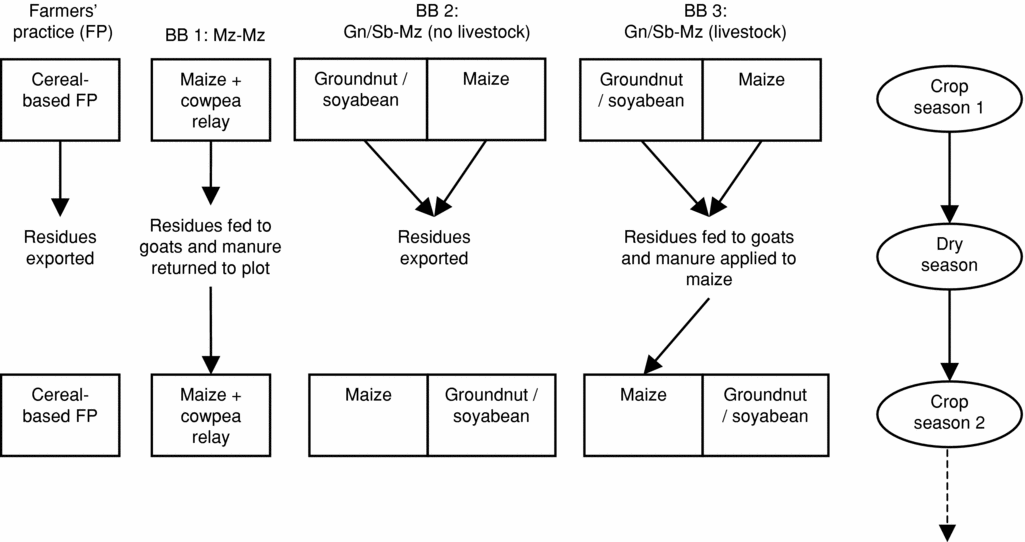
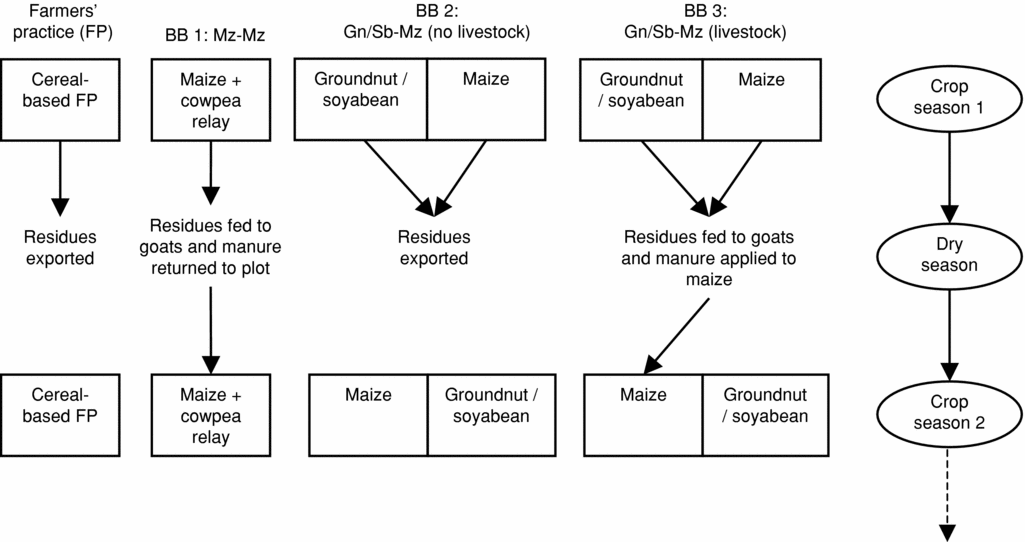
The trials were set up as a randomized block design with each lead farmer having a block with four treatments. Six farmers (two in each village) participated in the experiment in 2002–2005 (1st group); six other farmers (two in each village) participated in 2003–2006 (2nd group). All farmers had a plot with a farmers’ practice (FP) treatment where they implemented traditional maize-based practices with their own varieties, fertilization strategy and field management, which were monitored during the trial. The other three treatments of each block were so-called best-bet (BB) treatments identified through stakeholder meetings with scientists and extension workers as promising systems combining new germplasm with appropriate fertilizer applications, crop rotations, and sometimes a livestock component with improved husbandry and manure handling practices. In BB 1, maize (Mz) was grown annually as a main crop with cowpea relayed into maize towards the end of the cropping season (BB 1: Mz-Mz). The residues of maize and cowpea were combined and fed to goats over the dry season. Manure produced by the goats was returned to the plot at subsequent maize planting (Figure 1). BB 2 was a two-year legume-maize rotation without livestock and relatively high applications of synthetic fertilizer. This treatment occupied two plots: in the first year, one plot was cultivated with a full-season legume and the other plot with maize; in following years, maize and legume were annually interchanged (Figure 1). As a legume, six farmers cultivated groundnut (Gn) and the other six, soyabean (Sb). BB 2 will be referred to as Gn/Sb-Mz without livestock. BB 3 was a legume-maize rotation with livestock. The crop rotation was similar to BB 2 but in BB 3 a livestock component was integrated with the cropping. Residues produced by maize and legumes were combined and fed to goats over the dry season. Manure produced from residues of the two plots and feed refusals were applied to the single plot where maize was grown in the subsequent year (Figure 1). Again, six farmers cultivated groundnut and the others soyabean (BB 3: Gn/Sb-Mz livestock).
Schematic representation of field treatments and residue management in the first 18 months of the trial.
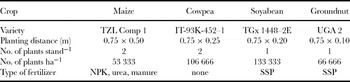
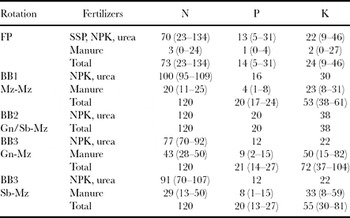
The farmers selected a field on which the trial was implemented themselves. The average distance between homestead and trial field was 236 m. In all cases the plots were well within the intensively cultivated area in the villages. Plots were 20 m × 20 m in size. In BB treatments, all crops were grown on ridges 0.75 m apart. Other management details are given in Table 1. Crops were planted at the start of the rainy season, except for cowpea that was relayed into maize five weeks before maize harvest. Groundnut and soyabean received 10 kg P ha−1 as single super phosphate (SSP) applied prior to land cultivation. Cowpea did not receive any fertilizers besides those applied to maize earlier in the season. In maize, NPK fertilizer was applied prior to planting, and urea before remoulding ridges at five weeks after planting. Manure was applied before soil cultivation in-between the old ridges and covered with soil when new ridges were formed. In maize in BB 2, the amount of nutrients applied as synthetic fertilizers was fixed (Table 2). In BB 1 and 3, the quantity of NPK fertilizer was fixed, whereas the urea rate depended on the N content of the applied manure. The total amount of N applied to maize in BB 1 and 3 (from synthetic fertilizers and manure) was always 120 kg N ha−1, while P and K rates were variable. In the first cropping season, ex-situ produced manure was applied: in BB 1, 1.0 t dry matter (DM) ha−1 containing 25 kg N, 8 kg P and 22 kg K; in BB 3, 2.0 t DM ha−1 with 50 kg N, 15 kg P and 44 kg K. Thereafter, in-situ produced manure was used. Nutrient application rates in BB treatments reflected the expected nutrient uptake by the crop. Crops were harvested at full maturity. Total fresh grain, empty pod and leafy biomass weight were assessed by harvesting four rows of each plot. Dry matter content was determined from subsamples. Subsequently, the entire plot was harvested and combined with the experimentally harvested plant material. Empty pod and leafy biomass together is referred to as stover. In BB 2, stover was exported from the farm. In BB 1 and 3, it was stored near the homestead under a roof. Local breeds of Nigerian dwarf goats were fed with this stover in the second half of the dry season (February–April). In this period, poor feed availability constrains livestock production. Goats were kept in pens on compacted soil floors under a roof. The number of goats per BB treatment varied (1–3 goats) as well as the length of the feeding (40–90 days), depending on the available stover and the weight of the goats. Goats received 1.0–1.6 kg DM feed d−1. The share of maize and legume in the diet depended on the amounts of stover produced in the previous crop season. In BB 1, cowpea stover production was low, relative to that of maize, and ex-situ produced stover was added to the diet so that goats received at least 200 g cowpea stover d−1. Pens were cleaned weekly and the manure, mixed with urine and feed refusals, was stored under a roof on compacted soil until planting. The amount of dry manure at planting was calculated by assessing the total fresh weight and the DM content from representative samples.
Details of planting arrangements and field management of crops in BB treatments.

Nutrients applied to maize: type of fertilizers, their nutrient content, and the total nutrient rate (all inputs combined), average over the duration of the trial (kg N, P or K ha−1). If the nutrient content varied, minimum and maximum values are given in parentheses.

Grain and stover yields in the paper are presented based on a moisture concentration of 0%. When farmers grew other crops besides maize in the FP (11% of the cases), the yield of these crops was converted to maize, using the market value of other crops and maize. Manure samples were taken before application in the field and analysed for their N, P and K concentration using hot acid digestion followed by colorimetric analysis (IITA, 1982). Also nutrient concentration of stover produced in 2004 and 2005 was analysed using similar methods. These data were extrapolated to other years to estimate the nutrient content of the goats’ diet. Soil samples were taken in the top 10 cm (Ikuzeh) or 15 cm (Danayamaka and Hayin Dogo) in all plots at the end of the trial, and analysed for organic C, total N (Kjeldahl), Olsen P, pH (1:2.5 soil:H2O ratio) and exchangeable cations (IITA, 1982).
Residual maximum likelihood (REML) analyses were used to assess annual variation in yield, and within years, the variation between treatments and between villages. Differences were considered significant at a confidence level of p ≤ 0.05. Standard errors of means (s.e.m.) predicted by the statistical model are presented in the tables. The software package GenStat Release 10.2 was used for the analyses.
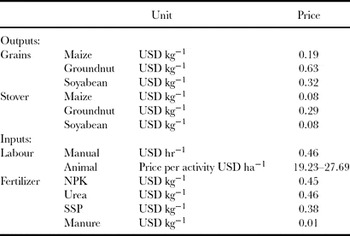
In an economic analysis the profitability of crop production was assessed by comparing input costs (synthetic fertilizer, labour, seed) with the value of outputs (grain and stover). Labour costs for manure application were included, while benefits and costs related to goat keeping were not. Labour demand was assessed in 2005 by interviewing participating farmers fortnightly on time spent on field activities related to the trials. Labour carried out by children and women was multiplied by 0.5 and 0.67, respectively, to obtain standard man hours (Van Heemst et al., Reference Van Heemst, Merkelijn and van Keulen1981). Data on post-harvest activities such as threshing were excluded from the analysis. Records of wages in Kaduna, Kano and Katsina States in 2005–2007 provided an estimate of labour costs (Table 2). Farm-gate prices of grains and synthetic fertilizer were obtained from state agencies and verified with the authors’ records (Table 3). Market prices of stover products were measured by taking samples in the region. A sensitivity analysis was conducted in which we compared scenarios with nil market value of stover and varying labour and fertilizer prices with the baseline study. Labour costs were reduced by 50% reflecting lower opportunity costs for family labour and varied by 20% reflecting observed variation in labour price in the region. Fertilizer costs were varied by 50% reflecting regional variations over time. Benefits from livestock production were neglected in the analyses. It was impossible to collect data on live weight gain during the trial, while reports on live weight gain potentials in relationship to feeding strategies in the Guinea Savannas are scarce (e.g. Savadogo, Reference Savadogo2000). Also non-tangible benefits of livestock production are difficult to estimate (e.g. Moll, Reference Moll2005) and were excluded from our analyses, but are referred to in the discussion.
Unit prices used in partial budget analysis. Original prices were measured in Naira (130 Naira is about 1 USD)

RESULTS
Site description
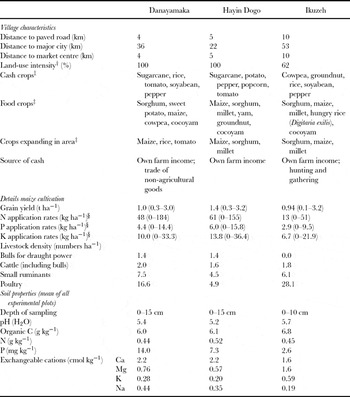
Ikuzeh was a village with a relatively traditional farming system and a low use of inputs (Table 4). The village was far from a main road, a market centre and a city, which all became inaccessible occasionally in the rainy season. As the pressure on land was limited, fields were left fallow in three out of eight years. The geographically more accessible locations of Hayin Dogo and Danayamaka brought farmers easier contact with inputs and knowledge. Danayamaka was the most market-oriented village, with mainly cash crops expanding in the area over the past 10 years and with additional non-agricultural sources of cash income. Maize was an expanding main crop in all villages. The application of small amounts of animal manure to crops was common in all three villages. In Danayamaka this was in combination with household waste and ashes. In Hayin Dogo and Danayamaka, farmers stored crop residues to feed animals over the dry season. They also sold crop residues as livestock feed and purchased feed when necessary. In Ikuzeh, no market outlet for crop residues was available and the collection and storage of crop residues was less common. Livestock (poultry, small ruminants and cattle) keeping was widespread in all villages. Bulls providing animal traction were present in Hayin Dogo and Danayamaka only; in Ikuzeh land was entirely manually cultivated. Fertilizer was commonly applied to maize in all three villages. Application rates in maize were relatively low in Ikuzeh, where also average maize grain yields were lowest. A large variation between farmers in nutrient rates and maize yields was observed. Some farmers reported high fertilizer application rates (e.g. up to 184 kg N ha−1) and high maize grain yields of up to 3.2 ton ha−1.
Characteristics of the study area (minimum and maximum observed values given in brackets) and soil properties at the end of the trial.

†Land-use intensity calculated as: c/(c+f) with c = years of cultivation; f = years of fallow.
‡Farmers were asked to list the crops grown and rank them towards greater importance for cash and food, and to indicate those which have increased in area over the last 10 years.
§Minimum and maximum observed application rates between brackets.
Soil properties (taken at the end of the trial) showed marked differences between the villages (Table 4), but no significant differences between experimental treatments (data not shown). Soils were slightly acidic and low in organic carbon and soil N in all three villages. Soil available P was significantly higher in Danayamaka and lower in Ikuzeh. P availability was likely to limit crop growth in Ikuzeh. Reserves of exchangeable Mg and K were significantly higher in Dayanamaka than in Hayin Dogo and Ikuzeh.
Field management and yield
Most farmers applied substantial doses of synthetic fertilizer in the FP, although differences in application rate between farmers were large (Table 2). On 10% of the FP plots, manure was applied (on average 1 t ha−1) in addition to synthetic fertilizers. On 11% of the FP plots, other crops besides maize were cultivated: cowpea or red pepper was relayed into maize towards the end of the season, or sorghum or soyabean was intercropped with maize. In BB 1 and 3, the total P application to maize (synthetic fertilizer and manure combined) was approximately similar to that in BB 2, while the total K application was higher in BB 1 and 3 than in BB 2 (Table 2). The impact of this additional K on maize production was likely to be small, as crops in the region are usually not limited by K availability, partly because Harmattan dust deposits additionally provide 15–20 kg K ha−1 y−1 (Von Jahn et al., Reference Von Jahn, Herrmann and Stahr1995).
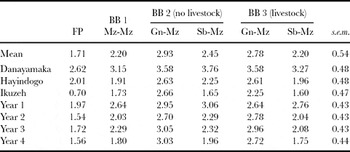
Maize grain yield was significantly affected by treatment, village and year (Table 5). Yield in BB treatments was higher than in the FP. In Ikuzeh, yield in the FP was well below that in other villages. Gains in yield made by the adoption of BB treatments over the FP were larger in Ikuzeh, reducing but not annihilating the difference with the other villages. As field management in BB treatments was more or less uniform across villages, poor soil fertility probably contributed to low yields in Ikuzeh, which is in line with the poor soil P status in this village (Table 4). The Gn-Mz rotation gave higher yields than the Sb-Mz and Mz-Mz rotations. Poor yields of maize after soyabean particularly occurred in Ikuzeh where a poor soyabean performance (Table 6) may have affected the subsequent maize crop. The variation in yield between Gn/Sb-Mz rotations with and without livestock (BB 3 v. BB 2) was insignificant, though yield was slightly higher in BB 2 (without manure). Treatment effects became more pronounced over the course of the trial. In the first year, differences in yield between BB treatments were small. In the following years, maize production in Gn-Mz rotations was fairly stable, while it declined in the other rotations.
Maize grain yield in FP and BB treatments: overall mean, and yield aggregated by village and year (t ha−1).

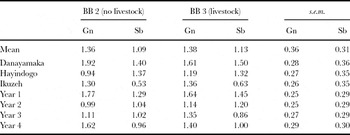
Groundnut and soyabean grain yield in FP and BB treatments: overall mean, and yield aggregated by village and year (t ha−1).

Soyabean grain yield was significantly affected by year and village and not by treatment, while groundnut yield was not affected by any experimental factor (Table 6). No impact from manure applications on legume yield was observed, which is not surprising as manure was only applied to the preceding maize crop. Grain yield of cowpea in BB 1 was very low in 2002 and 2003 (on average 0.07 t ha−1, data not shown). Probably, the dense maize canopy did not allow sufficient light to reach cowpea relayed into maize. Cowpea planting became optional for farmers from 2004, and most farmers decided not to plant cowpea.
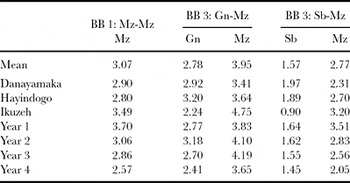
Groundnut produced more stover than soyabean (Table 7). Also maize stover production in the Gn-Mz rotation was significantly higher than in Sb-Mz. As with grain, maize stover yield in the Gn-Mz rotation was stable over the years, while it declined in the other treatments. Maize stover yield in Ikuzeh was higher than in the other villages, suggesting that the low grain yield in Ikuzeh (Table 5) was, besides a poor soil fertility, caused by a low harvest index. Cowpea stover yield in BB1 was minimal in 2002 and 2003 (on average 0.06 t ha−1, data not shown).
Maize and legume stover yield in treatments with livestock: overall mean, and yield aggregated by village (t ha−1).

Manure production
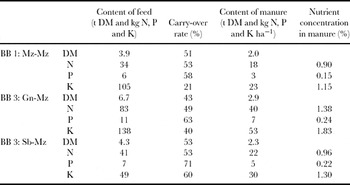
The total amount of feed (stover) produced in BB 3 (two plots) was higher than in BB 1 (one plot) (Table 8; Figure 1). The carry-over rate of DM and nutrients from stover at harvest to manure at planting was fairly consistent between rotations, except for K, with an overall mean carry-over of 48% for DM, 52% for N, 64% for P and 40% for K. Dry matter and nutrients were lost during storage as stover or manure and through the digestion and uptake by goats. Manure application rates were higher in BB 3 than in BB 1, reflecting the differences in stover production. In contrast with BB 1 where manure was applied to the plot annually, in BB 3 each plot received manure only once in two years. The highest amounts of manure were applied in the Gn-Mz rotation, where manure provided about one-third of the expected N, P and K uptake of maize. As externally produced cowpea was added to the goat diet in BB 1, the amount of manure from in-situ produced feed was less than the total amount of manure applied. Based on the ratio of in-situ and ex-situ produced feed in the diet, the estimated content of the manure from in-situ produced feed in BB 1 was 1.6 t DM, 13 kg N, 2 kg P and 20 kg K ha−1. The concentration of N, P and K in manure varied between treatments and was highest in the Gn-Mz treatment.
DM and nutrient content of feed at harvest and manure at planting and the carry-over rate from feed to manure (mean of villages and years).

Economic analysis
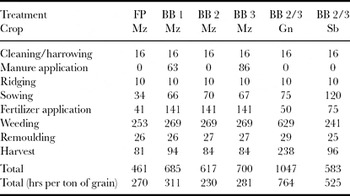
Labour demand for crop production was high in all treatments and additional family or hired labour would be required besides farmers’ own labour for the cultivation of a hectare of land (Table 9). Weeding was the operation demanding most labour. For groundnut, this accounted for more than half the total labour demand making groundnut a labour-intensive crop. In BB treatments, the plant-by-plant application of urea to maize, supposedly leading to a higher N use efficiency, required an additional 100 hours per hectare compared to farmers’ conventional way of broadcasting fertilizer. Differences between treatments in labour demands per ton of maize grain were smaller. Rotations with livestock required more labour per ton of maize grain than BB 2 and the FP because of lower yields and higher labour requirements for manure application. Soyabean and groundnut required about two to three times more labour per ton of produce than maize.
Labour requirements of field activities in villages where animal traction was used in the production process (Danayamaka, Hayin Dogo). The total labour use in the village in which no animal labour was used (Ikuzeh) was 34% higher (hrs ha−1).

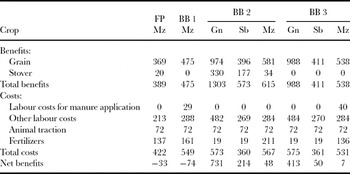
Opportunity costs for labour were by far the most important input costs (Table 10). In BB treatments, labour constituted 70% of the total costs. In the FP this was 50%. Although maize in BB 1 and 3 had additional costs for manure application, the total costs of maize production were less than in BB 2 due to lower synthetic fertilizer costs. Net benefits from growing legumes were larger than from maize. Groundnut with its high grain values obtained higher returns than soyabean. The continuous maize treatment of BB1 was less profitable than the FP. Higher input costs for labour and synthetic fertilizer were insufficiently compensated by increased yields in BB 1. The difference in net benefits between BB 2 and BB 3 were primarily caused by the additional benefits from the sale of stover obtained in BB 2, whereas in BB 3 all stover was used in situ to feed livestock.
Partial budget of crop production in FP and BB treatments (USD ha−1).

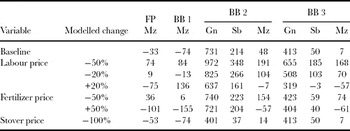
In the sensitivity analysis (Table 11), the net benefits in the baseline study (Table 10) were compared with a number of alternative scenarios. Fluctuations in fertilizer price primarily affected the net benefits of maize cultivation, as legumes required little fertilizer. This implies that a reduction in fertilizer price, e.g. due to subsidies on fertilizers, could stimulate farmers to increase the area with cereals at the expense of legumes. BB treatments with their high labour demand were more sensitive to changes in labour price than the FP. A reduction of labour costs by 20 or 50% increased the advantage of BB treatments over the FP. Groundnut cultivation, in particular, was affected by changing labour prices. The market value of stover presumably reflects the profits that can be made from livestock production. As benefits from livestock production were excluded from this analysis, it can be argued that stover prices in treatments without livestock should be as well. When stover benefits were excluded, the net benefits of BB 2 and 3 were about similar, indicating no impact of the type of fertilizer inputs on the economics of legume-maize rotations.
Results of the sensitivity analysis: impact of changes in input and output prices on the net benefits for each rotation, in comparison with the baseline study in Table 10 (USD ha−1).

Farmers' perceptions and adoption
In the last year of the trial all lead farmers used new varieties introduced through the trial on their own fields. Most farmers (>80%) also copied techniques related to intensification of the cropping system (planting density, fertilizer application rate and technique) and followed legume-cereal crop rotations. In all three villages, including Ikuzeh where fallow land was still abundant, farmers mentioned that a valuable aspect of the trials was the demonstration that crop production can be increased without increasing the area of cultivated land. However, the additional work associated with the intensification of crop production (e.g. narrow ridging, plant-by-plant fertilizer application, weeding in a densely planted maize crop) was considered unpleasant, even when the amount of additional labour required per ton of produce is small. Improved goat housing and manure storage was adopted by less than 50% of the lead farmers. Some farmers were not convinced that the returns on investments in these activities are worthwhile. Labour required for manure application was generally not perceived as a major drawback, as this was done at a time labour was abundant. Farmers did not appreciate the cowpea crop in BB 2 relayed into maize towards the end of the season, as yields were poor. Farmers themselves often successfully grow cowpea as a relay crop in cereals, but they plant cereals at lower densities and apply fewer nutrients than in the current trial.
DISCUSSION
Opportunity costs for labour had a high share in the total costs of crop production, but our labour estimates were nevertheless low compared to a literature survey by Van Heemst et al. (Reference Van Heemst, Merkelijn and van Keulen1981). They, for instance, estimated labour demands for harvest at 195 hrs t−1 for groundnut and close to 100 hrs t−1 for maize and soyabean, which is about double the demand we recorded. Labour was unlikely to be applied in optimal quantities in our trial and was probably the outcome of economic choices, whereby scarce labour was allocated to both trial fields and own fields.
Fertilizer application rates and yield in maize in the FP were higher than the averages reported by villagers in the baseline study. Possibly farmers selected by the communities to participate in the trials were socio-economically better off, and were farming on more fertile soils with more resources available for inputs. In addition, farmers copied management methods from the BB treatments and in some cases tried to compete, in terms of yield, in the FP with these researcher-managed plots. Thus, results from the FP were not entirely representative for the common practices. In the baseline study the reported ranges in fertilizer rates and maize yields were high, and the fertilizer rates and yields in the FP and the BB treatments were within these ranges.
Grain yield in the Mz-Mz treatment (BB 1) was on average 0.5 t ha−1 higher than in the FP, probably as a result of improved germplasm and field management practices in BB 1. Net benefits in BB 1 were nevertheless lower, as higher input costs of labour and fertilizer were insufficiently compensated by increased yields. The full-season soyabean or groundnut crop in BB 2 and 3 improved maize yield, relative to the continuous maize system of BB 1. The positive impact of incorporating legumes into cereal-based systems in the Guinea savanna due to nitrogen fixation, disease suppression and other factors has been well documented (e.g. Alvey et al., Reference Alvey, Bagayoko, Neumann and Buerkert2001; Bagayoko et al., Reference Bagayoko, Buerkert, Lung, Bationo and Römheld2000; Franke et al., Reference Franke, Laberge, Oyewole and Schulz2008a). Maize in BB 2 and 3 gave higher net benefits than in BB 1 and the FP. The legumes improved the response of maize to fertilizer and labour inputs in comparison with BB 1, thus offering opportunities to intensify maize production.
The net benefits of the legume cultivations made the Sb/Gn-Mz rotations considerably more profitable than the other treatments. The economic analysis showed that prices of legume stover, grain and labour had a large impact on the profitability of groundnut and soyabean. Groundnut and soyabean required considerably more labour (per ha and per ton of grain) than maize, and labour availability, also constrained by labour market imperfections, could limit the adoption of these legumes. The actual value of legume stover in the region is uncertain, but it is likely that this value reflects the benefits of livestock keeping, as the ruminant feed market is the main market outlet for legume stover. The presence of livestock at or near the farm is likely to increase the value of legume stover, thereby stimulating farmers to incorporate more legumes into their cereal-based rotations.
In our trial, groundnut was a better provider of fodder than the dual-purpose soyabean variety, as groundnut provided more stover biomass with a higher N concentration (data not shown). The Gn-Mz rotation with livestock achieved the highest carry-over of nutrients through manure from one season to the next, on average 40 kg N, 7 kg P and kg 53 K ha−1, covering approximately one-third of the expected N, P and K uptake by maize. The advantage of lower synthetic fertilizer costs in legume-maize rotations with livestock was offset by higher labour costs for manure application and slightly lower values of maize grain. Overall, no clear agronomic or economic benefits for crop production were observed from the combined application of manure and synthetic fertilizer over the application of synthetic fertilizer alone. This is in contrast with experimental studies in the region reporting higher cereal yields following the application of synthetic fertilizers combined with organic inputs, relative to synthetic fertilizer only (Agbenin and Goladi, Reference Agbenin and Goladi1997; Franke et al., Reference Franke, Schulz, Oyewole and Tobe2008b; Iwuafor et al., Reference Iwuafor, Aihou, Jaryum, Vanlauwe, Diels, Sanginga, Lyasse, Deckers, Merckx, Vanlauwe, Diels, Sanginga and Merckx2002; Jones, Reference Jones1971). The quantity of manure applied in the current trial was well below the amounts used in other studies (2.5–10.0 t ha−1 annually). In some cases, the quality of the applied manure was worse in our trial. Manure could be valuable to crop production in ways other than assessed in our trial, for example by improving long-term (>4 years) soil fertility, or direct impacts on production when manure is concentrated on small, high-potential plots (e.g. near the homestead). Moreover, we only looked at crop residue recycling in our trial, while livestock can utilize a variety of feed resources (biomass from wastelands, paths and roadsides, household waste, etc.), which could lead to a greater manure production than observed in our trial.
The results of our trial did not indicate a large impact of integrated crop-livestock production on the agronomic and economic performance of crop farming. Nor did we find evidence in favour of the idea that integrated crop-livestock production is somehow an imperative for the sustainable intensification of crop production in the region. While benefits of crop-livestock production obviously may occur under circumstances different from our trial, we believe that the increasing adoption of integrated crop-livestock production in the Guinea savanna is, at least to a certain extent, driven by factors other than those currently assessed. These may include:
– Livestock providing animal traction, thereby improving the timeliness of crop operations and reducing labour inputs of cropping. In Hayin Dogo and Danayamaka, the use of animal traction was common and draft animals were, to a great extent, fed with in-situ produced crop residues.
– Direct tangible benefits of livestock production, i.e. live weight gain and possibly dairy production. All farmers in our trial had access to markets for livestock products.
– Non-tangible benefits of livestock production, i.e. livestock as an insurance against shocks, uncertain input and output prices and unstable fertilizer supply, and livestock as a mean to store wealth. These non-tangible benefits are likely to grow in importance in the presence of emerging cash crop opportunities.
More research on the interaction between biophysical, socio-economic and cultural factors associated with the process of crop-livestock integration is required to better understand the drivers of crop-livestock integration and to identify windows of opportunities for new technologies to contribute to a sustainable intensification of agricultural production in the Guinea savanna.
Acknowledgements
The contributions of Messrs. Sadiq Bako, Olelekan Tobe, Zachariah Jamagani and Tunde Oyewole to the implementation of the trials and data collection are gratefully acknowledged.