Introduction
Bycatch in commercial fisheries represents one of the main conservation threats to albatrosses and other seabirds (Croxall et al. Reference Croxall, Prince, Rothery and Wood1998, Gales Reference Gales1998). Albatross life history strategies (i.e. delayed maturity, low reproductive output and great longevity) make these species particularly vulnerable to any additional source of mortality. Adult survival is the most important demographic parameter influencing population trends (Weimerskirch & Jouventin Reference Weimerskirch and Jouventin1987, Gales Reference Gales1998). As such, population declines associated with reduced adult survival rates observed in some colonies have been attributed to bycatch in longline fisheries (Weimerskirch & Jouventin Reference Weimerskirch and Jouventin1987, Croxall et al. Reference Croxall, Prince, Rothery and Wood1998). Albatrosses are monogamous and the sex ratio in the breeding population is expected to be 1:1. Sexual segregation at sea can therefore have implications for conservation, as sex-specific overlap with fisheries can produce sex-biased mortality (Jiménez et al. Reference Jiménez, Domingo, Brazeiro, Defeo, Wood, Froy, Xavier and Phillips2016); this translates both to an immediate, direct effect on the total number of potential breeders, as well as an indirect effect on fecundity (mean number of offspring produced per adult) because it affects the availability of one sex as partners (Mills & Ryan Reference Mills and Ryan2005).
Sexual segregation in at-sea distribution has been reported in great albatrosses (Diomedea spp.), particularly in the wandering albatross (Diomedea exulans L.; Prince et al. Reference Prince, Wood, Barton and Croxall1992, Jiménez et al. Reference Jiménez, Domingo, Brazeiro, Defeo, Wood, Froy, Xavier and Phillips2016), a species that, like others in the genus, exhibits noticeable sexual size dimorphism (SSD) (Shaffer et al. Reference Shaffer, Weimerskirch and Costa2001, Cuthbert et al. Reference Cuthbert, Phillips and Ryan2003). On average, males have longer bills (c. 4%, 170 vs 164 mm), greater wing span (c. 4%, 311 vs 299 cm) with c. 7% more wing area (6260 vs 5860 cm2), and are 20% heavier (9.4 vs 7.8 kg) than females (Shaffer et al. Reference Shaffer, Weimerskirch and Costa2001). Female wandering albatrosses typically forage in sub-Antarctic and subtropical waters, whereas males usually forage further south, in sub-Antarctic and Antarctic zones (Xavier & Croxall Reference Xavier and Croxall2005, Froy et al. Reference Froy, Lewis, Catry, Bishop, Forster, Fukuda, Higuchi, Phalan, Xavier, Nussey and Phillips2015). This partial sexual segregation is attributed either to competition, with larger males excluding the smaller females from access to nearby resources, forcing them to travel further from the colony (Phillips et al. Reference Phillips, Croxall, Silk and Briggs2008), or the relationship between SSD and flight performance (Shaffer et al. Reference Shaffer, Weimerskirch and Costa2001). The latter hypothesis is that as wing loading determines flight speed, the windier regions of the sub-Antarctic and Antarctic are more optimal for males, which have c. 12% higher wing loading than females, whereas females and fledglings are better adapted for exploiting the lighter winds of subtropical regions. Consequently, bycatch of wandering albatrosses in pelagic longline fisheries, which mainly operate in subtropical regions, is female-biased (Jiménez et al. Reference Jiménez, Domingo, Brazeiro, Defeo, Wood, Froy, Xavier and Phillips2016). Because both hypotheses explaining this latitudinal segregation are mediated by SSD, similar processes and consequences (female-biased bycatch in pelagic longline fisheries) are expected for the other Diomedea species.
Large proportions of the global population of the southern royal albatross (SRA) Diomedea epomophora (Lesson) and the northern royal albatross (NRA) Diomedea sanfordi (Murphy) migrate from New Zealand to the south-west Atlantic (Nicholls et al. Reference Nicholls, Robertson, Prince, Murray, Walker and Elliott2002, Robertson et al. Reference Robertson, Bell, Sinclair and Bell2003, Moore & Bettany Reference Moore and Bettany2005). Separation of these two species was proposed by Robertson & Nunn (Reference Robertson and Nunn1998), and adopted subsequently by both BirdLife International (the listing authority for the World Conservation Union, IUCN) and the Agreement for the Conservation of Albatross and Petrels (ACAP). According to the IUCN, NRA and SRA are globally threatened (Endangered and Vulnerable, respectively). More than 99% of breeding pairs of NRA and SRA nest at the Chatham Islands and Campbell Island, respectively. The global population trend for the SRA appears to be stable, and is unknown for the NRA (ACAP 2009a, 2009b). During breeding, both species are distributed in the New Zealand continental shelf waters (Nicholls et al. Reference Nicholls, Robertson, Prince, Murray, Walker and Elliott2002, Waugh et al. Reference Waugh, Troup, Filippi and Weimerskirch2002), while during the non-breeding season, they occur in the southern Pacific, Atlantic and Indian oceans (Nicholls et al. Reference Nicholls, Robertson, Prince, Murray, Walker and Elliott2002, Robertson et al. Reference Robertson, Bell, Sinclair and Bell2003, Moore & Bettany Reference Moore and Bettany2005). They winter mainly in the southern continental shelf waters of South America, both on the Pacific and Atlantic coasts, and particularly off Argentina and Uruguay (Nicholls et al. Reference Nicholls, Robertson, Prince, Murray, Walker and Elliott2002, Robertson et al. Reference Robertson, Bell, Sinclair and Bell2003, Jiménez et al. Reference Jiménez, Phillips, Brazeiro, Defeo and Domingo2014). This preference for continental shelf habitat contrasts with the wandering albatross, which remains mainly oceanic (Froy et al. Reference Froy, Lewis, Catry, Bishop, Forster, Fukuda, Higuchi, Phalan, Xavier, Nussey and Phillips2015). The limited data on body size for both species of royal albatrosses suggest that males are larger than females (Westerskov Reference Westerskov1960, Tickell Reference Tickell2000), but SSD has not been tested statistically. In this study, data were collected from both species of royal albatrosses bycaught in pelagic longline fisheries in the south-west Atlantic to first test for SSD and then to apply discriminant analyses to assign sex and species in indeterminate birds. Most of these birds were partially eaten by scavengers, which is common in bycatch studies. We also tested for a biased sex ratio in the complete sample of bycaught birds, and the potential conservation implications will be discussed. Despite the difference in foraging habitats compared with the wandering albatross, comparable latitudinal segregation among sexes in the two royal albatross species were predicted, and hence a biased sex ratio in bycatch in pelagic longline fisheries in the north of their ranges.
Materials and methods
This work used data from seabird carcasses collected on pelagic longline vessels by the Programa Nacional de Observadores a bordo de la Flota Atunera Uruguaya (PNOFA) of the Dirección Nacional de Recursos Acuáticos (DINARA). These specimens were caught incidentally by Uruguayan commercial and research vessels in 2004–12 and 2009–12, respectively, and Japanese commercial vessels operating off Uruguay under an experimental fishing license in 2009–11. All vessels fished in shelf break, slope and deeper waters off Uruguay, and Uruguayan commercial vessels also operated in international waters. The temporal distribution of fishing effort, and the captures of royal albatrosses until 2011, are presented in Jiménez et al. (Reference Jiménez, Phillips, Brazeiro, Defeo and Domingo2014). A total of 1599 sets and 3 311 113 hooks were observed during 81 commercial fishing trips by Uruguayan vessels from January 2004 to November 2011. For Japanese vessels, a total of 1114 sets and 2 589 465 hooks were observed in 26 trips in 2009–11. During these sets of observations, a total of 137 royal albatrosses were captured: 68 NRA, 46 SRA and 23 undetermined. We also include data from ten individuals (three NRA, five SRA and two undetermined) captured incidentally by a Uruguayan research vessel during three surveys (October 2010, July 2011 and July 2012) to assess large pelagic fisheries on the shelf break off Uruguay, and ten individuals (one SRA and nine undetermined) caught incidentally during three commercial fishing trips observed by PNOFA on Uruguayan vessels in May and June, July and September 2012.
Each albatross carcass was referenced and kept frozen in a labelled plastic bag for subsequent analysis on land. Most bycaught birds could be identified as NRA or SRA in the laboratory by their plumage. The NRA has an entirely black upper wing, whereas the SRA has a black upper wing that becomes progressively whiter with age; this white plumage develops first at the leading edge and progresses backwards across the wing towards the trailing edge (Marchant & Higgins Reference Marchant and Higgins1990, Nicholls Reference Nicholls2007, Onley & Scofield Reference Onley and Scofield2007). Some bycaught birds were in poor condition, with ruffled feathers or damaged plumage, and the species could not be distinguished. The sex was determined directly, where possible, by examining the gonads, unless these were missing as a result of scavengers. Morphometric data were taken from 133 royal albatrosses, including 96, 17 and 20 birds of known species and sex, species only and sex only, respectively. Of these birds, 84, 39 and 10 were measured by SJ, RF and MA, respectively. Each observer followed the same protocol and has extensive experience with hundreds of bycaught seabird samples. All observers were supervised initially by SJ, reducing the variability among observers. The remaining 24 birds, excluded from analyses, were released alive (two NRA, six SRA and four undetermined), not landed (one NRA and ten undetermined) or not sampled (one undetermined). A total of 19 measurements were taken: bill length (culmen), basal bill depth (BBD), minimum bill depth (MBD), bill depth at unguis (BDU), basal bill width (BBW), basal bill width at commissures (BBWb), head length (HL), maximum head width (MHW), tarsus, middle toe with claw (MTCLAW), middle toe without claw (MTnoC), claw, total length (TL), wing length (WL) and wing cord (WC) from both right and left wings, tail length (Tail) and wing span (WS). Full definitions for all of these measurements and pictures of several of them (Fig. S1) are provided in the supplemental material found at http://dx.doi.org/10.1017/S0954102016000493. The TL, Tail, WL, WC and WS were measured using metal rules to the nearest 1 mm. All other measurements were made with Vernier callipers to the nearest 0.1 mm.
Comparison of mean values between species and sexes were conducted using one-way ANOVA or the Student’s t-test, after testing for normality (Kolmogorov–Smirnov test) and homogeneity of variance (Levene test). Otherwise, Kruskal-Wallis and Mann–Whitney test were used. Measurements with sample sizes of less than eight in one or both groups were not compared statistically. The percentage of dimorphism between sexes for each measurement was calculated as:
 $$\left[ {{{\left( {{\rm \bar{X}}_{{\rm m}} {\hbox \-}{\rm \bar{X}}_{{\rm f}} } \right)} \mathord{\left/ {\vphantom {{\left( {{\rm \bar{X}}_{{\rm m}} {\minus}{\rm \bar{X}}_{{\rm f}} } \right)} {{\rm \bar{X}}_{{\rm f}} }}} \right. \kern-\nulldelimiterspace} {{\rm \bar{X}}_{{\rm f}} }}} \right]{\times}100,$$
where X̅m and X̅f are mean values for males and females, respectively (Cuthbert et al. Reference Cuthbert, Phillips and Ryan2003). Discriminant function analysis (DFA; Phillips & Furness Reference Phillips and Furness1997, Cuthbert et al. Reference Cuthbert, Phillips and Ryan2003) was used to assign species and sex. Nine measurements were initially considered for all functions: culmen, BBD, MBD, BDU, BBW, HL, MHW, tarsus and MTnoCL. These were available for 98 birds of known species (58 NRA and 40 SRA). Of which, 88 were of known sex (females: 42 NRA and 23 SRA, males: 11 NRA and 12 SRA). Therefore, separate DFAs were used to assign species and sex. Eight measurements were excluded: BBWb had low repeatability, MTCLAW and claw were not always available as the claw was often worn or broken (and MTCLAW was highly correlated with MTnoCL; see below), WL, WC and WS, and LT and Tail, as P10 or central rectrices, respectively, were sometimes unreliable because feathers were very worn, broken, missing or re-growing resulting in small sample sizes (particularly for males). However, some of these were included in the paired comparisons (see Results, Tables I–III). As the right wing of some birds was damaged, measurements from the left wing were used for WL and WC to maximize sample sizes. Of the 98 birds, 14 (12 SRA and two NRA) and 71 (21 SRA and 50 NRA) were assigned to first-year juveniles (no replacement primaries or rectrices) and immatures/adults (moulting primaries or rectrices), respectively. In the latter group, the state of the gonads was noted in 30 birds; of which, 27 (six SRA and 21 NRA) were assigned to old immature or adult (granular ovary or enlarged testes).
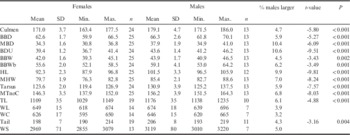
Measurements (in mm) of female and male southern royal albatrosses, and sexual size dimorphism.

BBD=basal bill depth, BBW=basal bill width, BBWb=basal bill width at commissures, BDU=bill depth at unguis, HL=head length, MBD=minimum bill depth, MHW=maximum head width, MTnoC=middle toe without claw, SD=standard deviation, Tail=tail length, TL=total length, WC=wing cord, WL=wing length, WS=wing span.
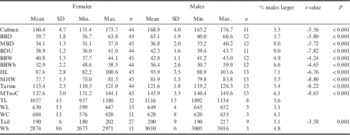
Measurements (in mm) of female and male northern royal albatrosses, and sexual size dimorphism. For details of abbreviations see Table I.

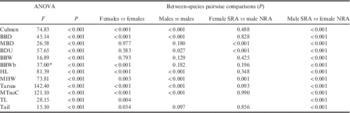
Comparison of body size between northern (NRA) and southern (SRA) royal albatrosses. For details of abbreviations see Table I.

P<0.05 is considered to be statistically significant.
* Kruskal-Wallis test and Mann–Whitney post hoc comparisons were used.
Backward stepwise DFA was used to establish which characteristics contribute the most to species and sex classification. In this analysis, characteristics that contribute least to species or sex discrimination are determined according to a threshold of F values (4.0; significance level of α=0.05) and successively removed from the analysis until the least number of characteristics remains. Analyses included all birds for which all nine measurements were available. Each bird was reclassified by calculating the score for each of the two classification groups (i.e. SRA or NRA, male or female) and the associated probability, assuming an equal a priori probability of belonging to each group. Prior to each backward stepwise DFA, collinearity was investigated by examining variance inflation factors, and one variable was removed from each pair of highly correlated variables (≥0.9, following Zuur et al. Reference Zuur, Ieno and Smith2007 for DFA). This only occurred in the analysis to assign species. Tarsus and MTnoCL were highly correlated (0.91) and the latter was removed. The performance of each backward stepwise DFA was also compared with that of a DFA using a jackknifed classification. This classifies each individual using the coefficients derived from all the other birds, eliminating bias and providing a more rigorous estimate of the ability of the functions to separate groups (Phillips & Furness Reference Phillips and Furness1997, Thalmann et al. Reference Thalmann, Baker, Hindell, Double and Gales2007). To separate species (because sample sizes were larger), a second backward DFA based on a random sample of 60 birds (training set) was also performed. The resulting discriminant function was then used to predict the species of the remaining 38 birds. In some cases an alternative DFA was constructed based on fewer measurements than those included in the backward stepwise DFA, particularly when a measurement is not commonly taken by the observers or is difficult to take consistently. However, in order to assign species and sex for the analysis of bycatch composition, those discriminant functions with a higher correct assignment rate were used. Deviations of the sex ratio from 1:1 were tested using Chi-square tests with Yates’ correction for continuity. All statistical analyses were conducted in R (version 2.13.1).
Results
Both SRA and NRA showed sexual dimorphism, with males larger on average than females in all body measurements tested statistically, although there was always some overlap (Tables I & II). In both species, MBD and BDU, and then HL, showed a higher degree of dimorphism. On average, SRA were larger than NRA, but there was considerable overlap between species and sexes (Table III). Pairwise comparisons of mean values showed that male SRA were larger than female NRA in all measurements, but differences between female SRA and male NRA were not significant, with the exception of MBD, BDU and MHW (Table III). There were significant differences between species in mean values for most measurements in comparisons of birds of the same sex, except MBD and BBW (both sexes), BDU (females) and BBWb (males) (Table III).
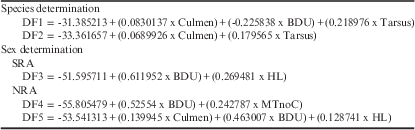
The backward stepwise DFA including all 98 birds (58 NRA and 40 SRA) with eight of the nine characteristics (MTnoC excluded because of collinearity), correctly assigned 95% of the birds to species using a combination of culmen, BDU and tarsus (DF1, Table IV). The five misclassified birds included an SRA of unknown sex and four NRA (three males and one female). After the jackknifing procedure, 94% of birds were assigned correctly. In a backward stepwise DFA including a random sample of 60 birds (36 NRA and 24 SRA), again with eight of the nine characteristics, the same three characteristics were retained and 90% of birds were assigned correctly to species (88% after jackknifing). When this equation was applied to the remaining 38 birds (22 NRA and 16 SRA), 89.5% were assigned correctly.
Discriminant functions for species and sex determination in northern (NRA) and southern (SRA) royal albatrosses. For species determination, scores>0 indicate SRA and <0 NRA. For sex determination, scores>0 indicate male and <0 female.
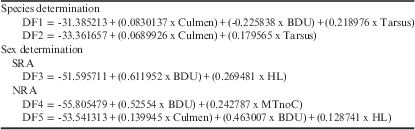
Because culmen and tarsus are frequently measured by observers, another backward stepwise DFA was constructed, including the original 98 birds, excluding BDU. The equation (DF2, Table IV) correctly assigned 92% of the birds. Eight NRA (seven males and one female) were misclassified as SRA. After the jackknifing classification, the correct species allocation was again 92%.
For SRA, the analysis including the nine characteristics measured in 35 sexed birds (23 females and 12 males) showed that a combination of the BDU and HL (DF3, Table IV) correctly assigned sex to 100% of individuals (100% again after the jackknifing classification). A similar analysis based on 53 sexed birds (42 females and 11 males) showed that a combination of BDU and MTnoC (DF4, Table IV) correctly assigned 98% of the birds (also 98% after jackknifing). Because measuring MTnoC can be problematic (e.g. in living birds), another backward stepwise DFA was conducted based only on head measurements. A combination of three measurements (culmen, BDU and HL; DF5, Table IV) correctly assigned 98% of the birds to sex (96% after jackknifing). The only misclassification in the first DFA was a male NRA classified as female, and vice versa in the other DFA.
By including results obtained with the DFAs, both species and sex were determined for 128 (54 SRA and 74 NRA) of the 133 royal albatrosses caught in the fishery under study. For the remaining five birds (three NRA and two SRA) measurements for applying discriminant functions for sex determination were missing. The bycatch of both species was female-biased; however, the difference from a 1:1 ratio was highly statistically significant for NRA (χ 2 Yates =20.55, df=1, P<0.01, 57 females and 17 males), but not significant for SRA (χ 2 Yates =2.24, df=1, P>0.05, 33 females and 21 males).
Discussion
In both SRA and NRA, SSD was apparent in all body measurements. The measurements with higher SSD (MBD, BDU and HL) follow the general patterns for the species of Procellariiformes with marked size differences between sexes, such as albatrosses and giant petrels (Macronectes spp.), where males often have noticeably bigger bills and heads (Warham Reference Warham1996). Similar to other species of great albatrosses, such as wandering, Tristan (Diomedea dabbenena Mathews; Cuthbert et al. Reference Cuthbert, Phillips and Ryan2003) and Antipodean (Gibson’s) albatross (Diomedea antipodensis gibsoni Robertson & Warham; Walker & Elliott Reference Walker and Elliott1999), and mollymawks (Thalassarche spp.; Hedd et al. Reference Hedd, Gales and Brothers1998, Ryan Reference Ryan1999, Gandini et al. Reference Gandini, Frere, García and Seco Pon2009), measurements of the depth of the bill (MBD and BDU) of both royal albatross species showed higher dimorphism values. Cuthbert et al. (Reference Cuthbert, Phillips and Ryan2003) also found high SSD in the total HL (from the bill tip to the occiput at the rear of the skull), but not culmen, in Tristan albatrosses. These findings are comparable to our results for the royal albatrosses.
Interspecific differences in the biogeography of albatrosses have been ascribed to aerodynamic features (Suryan et al. Reference Suryan, Anderson, Shaffer, Roby, Tremblay, Costa, Sievert, Sato, Ozaki, Balogh and Nakamura2008); the hypothesis relating wing loading and wind patterns to sexual segregation may also explain interspecific segregation at sea. Although there was considerable overlap between species and sexes, SRA was on average larger in body measurements than NRA. Although not measured in the present study, a lower wing loading is expected for NRA, in which case this species might be better adapted to exploiting the lighter winds of subtropical regions. This is supported by our findings, with higher numbers of NRA, particularly females (the smaller sex), bycaught in the northern part of the distribution of royal albatrosses. However, NRA has a considerably lower global population than SRA (c. 5800 and 7800 annual breeding pairs, respectively; ACAP 2009a, 2009b), and hence the inference that different bycatch rates relate to wing loading would need to be confirmed by analysis of habitat preferences and better data on the densities of each species at sea during the non-breeding period.
Assessing the effect of fisheries on seabird populations requires bycaught birds to be identified to species and provenance (except for endemics), and for sex and age to be determined (Alexander et al. Reference Alexander, Robertson and Gales1997). An age bias towards young birds is less of a concern than if all bycatch were adults. Sex-biased mortality in fisheries has reproductive costs beyond the immediate reduction of the breeding population because widowed individuals of the more abundant sex may have difficulties in securing a new partner. Therefore, the impact of the skewed sex ratio on fecundity is additive and may persist once bycatch ceases (Mills & Ryan Reference Mills and Ryan2005). The present study provides a valuable tool for on board scientific observers to separate species and sex of bycaught royal albatrosses using combinations of two or three morphometric measurements (with accuracies of 90–100%), two of which are standard (culmen and tarsus) and two are unusual but easy to take (BDU and HL). These discriminant functions were based on birds of a range of ages, which can be considered broadly representative of the age structure in the south-west Atlantic; ring recoveries and tracking data indicate that first-year birds are more abundant off Chile, and immatures and adults are more common in the south-west Atlantic (Nicholls et al. Reference Nicholls, Robertson, Prince, Murray, Walker and Elliott2002, Moore & Bettany Reference Moore and Bettany2005, Thomas et al. Reference Thomas, Minot and Holland2010). Nevertheless, as our analyses included juveniles and younger immatures, which may not have completed growth in skeletal traits (Ryan Reference Ryan1999), it would be useful to confirm the wider application of these DFAs to identify species and sex of royal albatrosses outside the south-west Atlantic by applying them to birds measured at breeding sites. We have performed this to some extent, but involving few individuals (see below).
Based on a small sample, Westerskov (Reference Westerskov1960) suggested that tarsus may be useful for discriminating royal albatross species. We found overlap among species in this measurement, but it had the greatest standardized discriminant coefficient in both functions based on three (culmen=0.448, BDU=-0.484, tarsus=0.859) or two (culmen=0.372, tarsus=0.704) measurements. The power of our discriminant functions for species identification was lower for NRA, particularly males. This is because of the high overlap in measurements of male NRA and female SRA (see Tables I–III). Misidentification in the opposite direction between these two groups may be expected. When we applied our DFAs to discriminate species using culmen and tarsus (DF2, Table IV) to published data from ten SRA (five males and five females) from Campbell Island (Westerskov Reference Westerskov1960) nine (90%) were sexed correctly. This performance is similar to that within our own sample, either by cross-validation or jackknifing (92%). In addition, two of the bycaught female NRA in our study were ringed (one from Middle Sister Island, Chatham Islands, and another from Taiaroa Head), and both were correctly assigned using our two DFAs for species and the two DFAs for sexing NRA, respectively (Table IV).
Based on the complete data set of birds identified and sexed by necropsy or discriminant analysis, both species have female-biased mortality (although this finding was not significant in SRA) in pelagic longline fisheries operating in the northern range of their distribution in South America. In subtropical regions, female-biased mortality in seabird bycatch is common, contrasting with male-biased mortality in subpolar regions, a pattern explained by differential at-sea distributions of the two sexes (Bugoni et al. Reference Bugoni, Griffiths and Furness2011). Therefore, our results strongly suggest that non-breeding NRA and SRA segregate at sea, with females in more northerly areas than males. These results have implications for conservation of these globally threatened species. Not only are females more likely to be caught in greater numbers in pelagic longline fisheries in other regions, but males are potentially more susceptible to bycatch in fisheries operating in southern regions. However, little is known about the bycatch rates of either royal albatross species and the magnitude of their global bycatch is completely unknown. Both species have been captured incidentally in longline (Gales et al. Reference Gales, Brothers and Reid1998, Jiménez et al. Reference Jiménez, Phillips, Brazeiro, Defeo and Domingo2014, this study) and trawl fisheries (Waugh et al. Reference Waugh, MacKenzie and Fletcher2008, Favero et al. Reference Favero, Blanco, García, Copello, Pon, Frere, Quintana, Yorio, Rabuffetti, Cañete and Gandini2011). Usually few individuals are captured, with the exception of Australian waters in early 1990s (Gales et al. Reference Gales, Brothers and Reid1998) and recently in the south-west Atlantic (Jiménez et al. Reference Jiménez, Phillips, Brazeiro, Defeo and Domingo2014), where the bycatch rates for both species in pelagic longline were very high. However, bycatch observer coverage of most fishing fleets is very poor (Phillips Reference Phillips2013). More data are required on fisheries bycatch throughout the at-sea ranges of these and other vulnerable species, and there is a pressing need to determine not only the species, but also the sex and, where possible, the age of captured individuals in order to improve our understanding of the impact of global fishing on their populations.
Acknowledgements
We would like to thank the observers of the Programa Nacional de Observadores de la Flota Atunera Uruguaya (PNOFA), the boat owners of the Uruguayan fleet, Japan Tuna Fisheries Co-operative Association and the crews of the vessels for their continued co-operation. Graeme Taylor and Lyndon Perriman kindly confirmed the specific identification of the few ringed albatrosses. We would also like to thank the reviewers for helpful comments. SJ gratefully acknowledges the support by Graham Robertson, the British Embassy (Montevideo), and ACAP for three study visits to the British Antarctic Survey where some of this work was carried out. This paper is part of a PhD thesis by SJ, who receives a scholarship from Agencia Nacional de Investigación e Innovación (ANII).
Author contribution
SJ and RAP determined the basis for the paper, with contributions of AD, OD and AB. AD and SJ designed the sampling on fishing vessels, and SJ, MA and RF undertook part of the field work and all the necropsies. SJ undertook the analyses and wrote the first draft with contributions from RAP. All authors contributed to subsequent drafts.
Supplementary Material
Full descriptions and images of the measurements used for this study will be found at http://dx.doi.org/10.1017/S0954102016000493.