1. Introduction
1.1 Bilingualism and cognitive control
A large body of research has sought to answer the question of whether use of more than one language affects cognitive functions. The seminal (though not uncontroversial) finding that bilinguals may exhibit enhanced mental flexibility, as reported in Peal & Lambert (Reference Peal and Lambert1962) and subsequent studies (Kovács & Mehler, Reference Kovács and Mehler2009; Bialystok & Viswanathan, Reference Bialystok and Viswanathan2009), has been associated with the discovery that bilinguals experience a parallel activation of both languages during comprehension and production (Beauvillain & Grainger, Reference Beauvillain and Grainger1987; Brysbaert, Van Dyck & Van de Poel, Reference Brysbaert, Van Dyck and Van de Poel1999; Colomé, Reference Colomé2001; Costa, Reference Costa, Kroll and de Groot2005; de Groot, Delmaar & Lupker, Reference de Groot, Delmaar and Lupker2000; Kroll, Bobb, Misra & Guo, Reference Kroll, Bobb, Misra and Guo2008). In order to manage these competing linguistic systems, it has been theorized that bilinguals recruit domain general cognitive functions (i.e. attentional processes which work in conjunction to effectively plan and coordinate behavior) to monitor the linguistic environment and select the appropriate language while suppressing the other (Kroll, Bobb & Hoshino, Reference Kroll, Bobb and Hoshino2014). In turn, these functions may adapt to become more efficient, leading to better cognitive performance. Nevertheless, questions remain regarding the exact nature of this enhancement and the specific conditions of the bilingual experience that give rise to these cognitive adaptations.
In the following subsections (1.2–1.6), we present the theoretical background which motivated our current study on factors affecting the impact of language learning on attentional functions. In section 1.2, we detail influential models of bilingualism and attention, situate our current study within these models, and explain the rationale behind our choice of attentional measures. In section 1.3, we make principled predictions for our study based on these models. In section 1.4, we describe the current debate on bilingualism and cognition. In light of this debate, in section 1.5, we discuss the importance of assessing individual variability in bilingualism research and explain how we address this in our current study. Finally, in section 1.6, we make additional predictions for our study based on recent findings in the literature regarding factors such as participant age, familiarity with the target language, and previous language experience and its relation to cognitive outcomes.
1.2 Models of bilingualism and attention
Early models of bilingualism attributed better cognitive performance to the role of inhibitory control, emphasizing its importance in managing cross-linguistic interference through top-down suppression of non-target language representations (Green, Reference Green1998; Dijkstra, van Heuven & Grainger Reference Dijkstra, Van Heuven and Grainger1998; Abutalebi & Green, Reference Abutalebi and Green2007). According to Green's Inhibitory Control (IC) model, inhibition can be viewed as a reactive mechanism executed by a higher level of control, namely a supervisory attentional system (SAS), which regulates ‘language task schemas’ (i.e. mental devices constructed or adapted on the spot to achieve a specific linguistic task, such as translation or word production). This concept of task schemas originates from a model of cognitive control proposed by Norman and Shallice (Reference Norman and Shallice1986), which describes the way in which we control routine and non-routine behavior: the model posits that when a task has been previously performed, the relevant schema (or action sequences) can be retrieved from memory, allowing for automatic performance of that task. However, where automaticity is insufficient (e.g. a novel task), the SAS is recruited to construct new task schemas and monitor their performance in relation to the specified task goals. In the context of bilingual language processing, the IC model proposes that task schemas associated with different languages are activated by perceptual or cognitive cues, and are thus often in direct competition with one another; reactive inhibition adapts to resolve this conflict, triggered by the activation of lexical nodes in the irrelevant language and modulated by the degree of that activation (i.e. the greater the activation, the more inhibition is applied). As such, inhibitory processes of the SAS are theorized to become more efficient in the presence of that competition.
A further prediction of the IC model relates to the process of switching between languages and the associated cost of doing so. Previous studies have shown a reduction in speed when transitioning from trials in one language to trials in another (e.g. Thomas & Allport, Reference Thomas and Allport1995; Von Studnitz & Green Reference Von Studnitz and Green1997). The IC model posits that these transitional delays are brought about by the twofold challenge of having to change the language task schema as well as apply inhibition to active lemmas from the previous language. Moreover, the IC model predicts that in the case of unbalanced bilinguals, the costs associated with switching languages may be asymmetrical relative to language dominance. Switching from a weaker language to a more dominant language should incur more processing delays than switching in the opposite direction, as the magnitude of inhibition required to suppress the dominant language is greater. As such, reconstructing the task schema to activate the strongly inhibited language may be more cognitively taxing, leading to greater switching latencies.
Taken together, the IC model and its predictions emphasize the role of reactive inhibition in controlling and switching between two language systems. Indeed, numerous studies support this inhibition-focused model, with evidence demonstrating that bilinguals experience smaller interference effects than monolinguals on measures of attentional control involving task-relevant and task- irrelevant dimensions, such as Flanker, Simon, and Stroop tasks (e.g. Blumenfeld & Marian, Reference Blumenfeld and Marian2011; Tao, Marzecová, Taft, Asanowicz & Wodniecka, Reference Tao, Marzecová, Taft, Asanowicz and Wodniecka2011; Bialystok, Craik, Klein & Viswanathan, Reference Bialystok, Craik, Klein and Viswanathan2004). Moreover, recent studies have confirmed the asymmetrical costs when switching from a weaker to a dominant language, demonstrating that strong inhibition of the dominant language can result in subsequent negative priming of that language (e.g. Meuter & Allport, Reference Meuter and Allport1999; Costa & Santesteban, Reference Costa and Santesteban2004; Costa, Santesteban & Ivanova, Reference Costa, Santesteban and Ivanova2006; Calabria, Hernández, Branzi & Costa, Reference Calabria, Hernández, Branzi and Costa2012).
Nevertheless, as the literature on bilingualism and cognition has expanded over the last two decades, new findings emerged which cannot be explained by the IC model alone, namely faster reaction times for bilinguals on non-linguistic tasks even in contexts where no transition is required (e.g. both congruent and incongruent trials) (Martin-Rhee & Bialystok, Reference Martin-Rhee and Bialystok2008; Costa, Hernández & Sebastián-Gallés, Reference Costa, Hernández and Sebastián-Gallés2008) and in high but not low monitoring conditions (i.e. conditions where the distribution of congruent and incongruent trials are similar —requiring continuous monitoring of trial type— versus conditions when the majority of trials are either congruent or incongruent) (Costa, Hernández, Costa-Faidella & Sebastián-Gallés, Reference Costa, Hernández, Costa-Faidella and Sebastián-Gallés2009). Additionally, work has shown that bilinguals may experience larger inhibition of return effects on non-linguistic tasks compared to monolinguals even when response suppression capacity does not differ across groups, indicating that mechanisms beyond inhibition are at work (Colzato, Bajo, van den Wildenberg, Paolieri, Nieuwenhuis, Heij & Hommel, Reference Colzato, Bajo, van den Wildenberg, Paolieri, Nieuwenhuis, Heij and Hommel2008). Finally, research on unbalanced bilinguals has found longer naming latencies in the dominant language as opposed the to weaker language(s), which has been interpreted as an effect of inhibition at the global level (Costa & Santesteban, Reference Costa and Santesteban2004). Together, these studies suggest that monitoring processes and goal-maintenance also play a critical important role in bilingual language processing. This type of global inhibition would likely require additional mechanisms of control to allow for a proactive (as opposed to reactive) inhibition of the dominant language (Wu & Thierry, Reference Wu and Thierry2017). This has raised questions on how to elaborate inhibitory-focused models to account for additional cognitive mechanisms in regulating competing linguistic systems.
Recent interdisciplinary work has drawn a parallel between models of cognitive control in attentional research (particularly Braver's Reference Braver2012 dual-mechanisms framework) with theories surrounding bilingual language control (Colzato et al., Reference Colzato, Bajo, van den Wildenberg, Paolieri, Nieuwenhuis, Heij and Hommel2008; Costa et al., Reference Costa, Hernández, Costa-Faidella and Sebastián-Gallés2009). The dual-mechanisms framework postulates that the ability to coordinate, regulate, and maintain goal-directed behavior is operationalized through the dynamic use of two semi-independent yet complementary modes of cognitive control: a proactive mode which optimally biases attention to a given goal, and a reactive mode in which a response is triggered after interference is detected. Applying this model to bilingual language control, the proactive mode can be viewed as sustaining the goal of communicating in the appropriate language until contextual cues indicate otherwise (Costa et al., Reference Costa, Santesteban and Ivanova2006; Finkbeiner, Almeida, Janssen & Caramazza, Reference Finkbeiner, Almeida, Janssen and Caramazza2006), while the reactive mode can be viewed as a response to the activation of inappropriate linguistic candidates through the inhibition of that interference (Morales, Padilla, Gómez-Ariza & Bajo, Reference Morales, Padilla, Gómez-Ariza and Bajo2015). From this perspective, the locus of a potential bilingual advantage may originate from the complex interplay between parallel modes of cognitive control involving numerous aspects of attention, from sustained attention to attentional switching, and inhibition (Costa et al., Reference Costa, Santesteban and Ivanova2006; de Groot & Christoffels, Reference de Groot and Christoffels2006; Festman & Münte, Reference Festman and Münte2012; Green & Abutalebi, Reference Green and Abutalebi2013; Kroll & Bialystok, Reference Kroll and Bialystok2013; Morales, Gómez-Ariza & Bajo, Reference Morales, Gómez-Ariza and Bajo2013). Indeed, bilinguals may adapt to optimally balance between proactive and reactive modes of control depending on the conditions of the environment (e.g. high versus low interference), an approach laid out in the Adaptive Control Hypothesis (Green & Abutalebi, Reference Green and Abutalebi2013).
In their model, Green and Abutalebi argue that distinct interactional contexts such as single language, dual language, and dense code-switching vary in the demands imposed on bilingual control processes. Of specific relevance to the current study on language learners in an immersive course is the dual-language context in which switching between languages typically occurs within a conversation but not within an utterance and where different languages may be used with different partners.
In the dual-language context, demands on control processes are highly complex as either language could become the target or non-target language at any moment. Thus effective communication in this environment requires a careful balance of proactive and reactive modes of control to allow for the selection and continuous activation of the intended language of use (otherwise known as goal maintenance), as well as the reactive inhibiting of representations from competing task schemas (i.e. interference control). Beyond this, speakers must also be able to efficiently disengage from goal-directed behavior and interference control to switch into another language (e.g. upon detecting a new addressee enter the scene). This involves an additional mechanism of cognitive control: salient cue detection. According to Green and Abutalebi, salient cue detection triggers a cascade of other processes to allow for a smooth transition into the other language. These processes include selective response inhibition, which halts a speaker's production in the current language, task disengagement, which disengages control mechanisms from that language, and task engagement, which engages control mechanisms in another language. Altogether, the dual-language context is hypothesized to increase demands on six specific cognitive mechanisms: goal maintenance, interference control, salient cue detection, selective response inhibition, task disengagement, and task engagement; as a result, these processes are theorized to adapt and become more efficient to meet the conditions of that environment.
In this study, we assess whether these processes improve in adult second language learners immersed in a dual-language environment. We test this through the use of three attentional measures that specifically tap into these processes. The first measure assesses participants’ sustained attention abilities, which can be viewed as an index of continuous goal maintenance (Langner & Eickhoff, Reference Langner and Eickhoff2013). The second measure assesses inhibition (or selective attention depending on the strategy used by the participant), which can be viewed as an index of interference control. The third measure attention switching which can be viewed as an index of the flow of processes that are salient cue detection, selective response inhibition, task disengagement, and task engagement.
1.3 General predictions based on these models
Applying the predictions of the Adaptive Control Hypothesis from the dual- language bilingual context to adults acquiring a foreign language, the same areas of attentional control would be expected to experience increased demands (i.e. sustained attention, inhibition, and attention switching); thus this model would predict language-learning-related improvement would be found in those specific attentional mechanisms. However, an important distinction should be made: unlike balanced bilinguals, language learners in the earlier stages of acquisition must necessarily switch between using the dominant native language and a much weaker foreign language. According to the IC model, shifting from a weaker language to a dominant language is especially difficult, as it requires strong inhibition of the dominant language as well as efficient release of that inhibition to switch back into it. Based on this account, the demands placed on language learners’ attention switching abilities (in having to disengage strong inhibition and refocus attention to the previously inhibited language) would be especially taxing, and therefore attention switching skills may adapt the most from the start to the end of the course, resulting in the largest improvement. Furthermore, we would expect this attention switching improvement to be greatest in beginner language learners compared to those in higher levels.
1.4 Current literature on bilingualism: the big debate
Much of the initial work following Peal & Lambert's Reference Peal and Lambert1962 study focuses on ‘classic’ bilinguals: children exposed to more than one language from birth or shortly thereafter. However, over the past fifteen years, the general study of bilingualism has expanded to include those who have acquired another language after childhood and without reaching full proficiency, offering a more representative picture of the general population (Kroll, Dussias, Bice & Perrotti, Reference Kroll, Dussias, Bice and Perrotti2015). Along with this shift, researchers began exploring bilingualism in its many forms, and started to look beyond the early years to examine whether the cognitive effects of bilingualism are detectable across the lifespan.
To date, the findings are inconclusive. Some studies have found that the same enhanced mental flexibility documented in bilingual children also extends to young adults (Costa et al., Reference Costa, Hernández, Costa-Faidella and Sebastián-Gallés2009; Bak, Vega-Mendoza & Sorace, Reference Bak, Vega-Mendoza and Sorace2014; Vega-Mendoza, West, Sorace & Bak, Reference Vega-Mendoza, West, Sorace and Bak2015), and continues into later life (Bialystok et al., Reference Bialystok, Craik, Klein and Viswanathan2004). There is even evidence that bilinguals may experience a delayed onset of dementia (Bialystok, Craik & Freedman, Reference Bialystok, Craik and Freedman2007; Alladi, Bak, Duggirala, Surampudi, Shailaja, Shukla, Chaudhuri & Kaul, Reference Alladi, Bak, Duggirala, Surampudi, Shailaja, Shukla, Chaudhuri and Kaul2013; Woumans, Ceuleers, Van der Linden, Szmalec & Duyck, Reference Woumans, Ceuleers, Van der Linden, Szmalec and Duyck2015) and better cognitive recovery following stroke (Alladi, Bak, Mekala, Rajan, Chaudhuri, Mioshi, Krovvidi, Surampudi, Duggirala & Kaul, Reference Alladi, Bak, Mekala, Rajan, Chaudhuri, Mioshi, Krovvidi, Surampudi, Duggirala and Kaul2016). Notably, however, other studies have found no differences between bilinguals and monolinguals (Paap & Greenberg, Reference Paap and Greenberg2013; Clare, Whitaker, Craik, Bialystok, Martyr, Martin-Forbes, Bastable, Pye, Quinn, Thomas & Gathercole, Reference Clare, Whitaker, Craik, Bialystok, Martyr, Martin-Forbes, Bastable, Pye, Quinn, Thomas and Gathercole2016), calling into question the very notion of a bilingual cognitive advantage (Hilchey & Klein, Reference Hilchey and Klein2011). Moreover, some have proposed that a publication bias is responsible for inflating an otherwise small or non-existent effect (de Bruin, Treccani & Della Sala, Reference de Bruin, Treccani and Della Sala2015).
Interestingly, while behavorial results are mixed, neural findings are less conflicting: numerous studies using a wide range of techniques have found changes to the structure and functional connectivity of the bilingual brain (e.g. Hosoda, Tanaka, Nariai, Honda & Hanakawa, Reference Hosoda, Tanaka, Nariai, Honda and Hanakawa2013; Pliatsikas, Moschopoulou & Saddy, Reference Pliatsikas, Moschopoulou and Saddy2015; Stein, Federspiel, Koenig, Wirth, Strik, Wiest, Brandeis & Dierks, Reference Stein, Federspiel, Koenig, Wirth, Strik, Wiest, Brandeis and Dierks2012; Mårtensson, Eriksson, Bodammer, Lindgren, Johansson, Nyberg & Lövdén, Reference Mårtensson, Eriksson, Bodammer, Lindgren, Johansson, Nyberg and Lövdén2012; Schlegel, Rudelson, & Tse, Reference Schlegel, Rudelson and Tse2012). Indeed, recent work comparing monolinguals and bilinguals found that bilinguals had increased gray matter in the prefrontal cortex (the area regulating executive functions) and this correlated with enhanced attentional performance (Abutalebi, Guidi, Borsa, Canini, Della Rosa, Parris & Weekes, Reference Abutalebi, Guidi, Borsa, Canini, Della Rosa, Parris and Weekes2015). Other work has shown that while neural activation tends to increase with age, elderly bilinguals experience reduced activation compared to monolinguals, and this attenuation of over-recruitment directly correlates with better task-switching skills (Gold, Kim, Johnson, Kryscio & Smith, Reference Gold, Kim, Johnson, Kryscio and Smith2013). Additional research has found that bilinguals engage in more distribution across brain networks, potentially better equipping them to compensate for neurodegeneration through alternative pathways (for recent reviews on this literature see: Baum & Titone, Reference Baum and Titone2014 and Antoniou, Reference Antoniou2019). Nevertheless, while neural differences in bilinguals are widely accepted as true, there is still disagreement about the extent to which neural changes correspond to behavioral differences (Paap, Johnson & Sawi, Reference Paap, Johnson and Sawi2016).
1.5 A new approach: the study of individual differences in cognitive outcomes
While this debate is on-going, it is important to consider that there are many social, environmental, and educational factors at play in these studies (Bak, Reference Bak2016a). Indeed, these conflicting results may be in part due to experimental design: most studies address this question by comparing group performance (bilinguals versus monolinguals or language learners versus controls) on measures of cognitive functions. The interpretation of this type of analysis, however, is complicated by a large number of confounding variables, with many complex factors that vary across individuals and populations, potentially affecting performance (Bak, Reference Bak2016b). Indeed, a recent study demonstrates that reliance on aggregated data alone may lead to imprecise or even inaccurate conclusions (Fisher, Medaglia & Jeronimus, Reference Fisher, Medaglia and Jeronimus2018). Against this background, we set out to address a novel line of research which explores individual differences in cognitive outcomes following language learning. Instead of measuring whether or not significant cognitive change arises from language learning at the group-level (the results of which have proven inconclusive), we are interested in how – based on a variety of outside variables – language learning may differentially affect individuals. That is, rather than testing whether an aggregated set of learners differ significantly from an aggregated set of controls, we look within a group of language learners to analyze the role of individual differences when modelling the impact of language learning on cognitive functions. As such, our study broadens the scope of previous research (e.g. Bak, Long, Vega-Mendoza & Sorace, Reference Bak, Long, Vega-Mendoza and Sorace2016), which has suggested that language learners, compared to controls, may experience improvement in attention switching after an intensive Gaelic course. The aim of the Bak et al., Reference Bak, Long, Vega-Mendoza and Sorace2016 study was to test whether adults of all ages experience attentional improvement following language learning, and whether the effects emerge as early as one week after an intensive language course. In the study, 33 Gaelic learners (aged 18–78) were tested before and after a week-long residential course on the Isle of Skye and compared to active controls (n = 18) enrolled in courses of the same duration and intensity but not involving foreign language learning, and passive controls (n = 16) who followed their regular routines. Results revealed that language learners experienced the most improvement in attention switching, followed by active controls, then passive controls (who did not improve at all).
In our current inquiry, we set out to uncover the potential differential effects of intensive language learning on subjects with distinct language experiences and demographic profiles by collecting data from a much larger sample of Gaelic language learners enrolled in the same type of courses (n > 100). Whereas the previous study focused on comparing performance between groups, here we apply an individual differences approach to the analysis of this extended dataset. The aim of this research, therefore, is to highlight important facets of interindividual variability that could influence language learning-related cognitive outcomes.
Educational background and motivation factors have been studied extensively in adult bilingualism research (e.g. Gollan, Salmon, Montoya & Galasko, Reference Gollan, Salmon, Montoya and Galasko2011; Alladi et al., Reference Alladi, Bak, Duggirala, Surampudi, Shailaja, Shukla, Chaudhuri and Kaul2013; Dörnyei & Ushioda, Reference Dörnyei and Ushioda2009). Our study, on the other hand, focuses on a well-defined group of language learners: all of our participants had a high level of education (university degree) and a strong motivation to learn the language (as demonstrated by their willingness to spend a week learning Gaelic in a remote college specifically dedicated to this purpose). By gathering data on a homogenously highly educated and highly motivated group of learners, we focus on understudied factors which could affect language-related changes in cognition, namely previous exposure to the target language (i.e. the familiarity versus novelty factor), age, gender, and language background, and how they may interact with one another.
For the analysis of novelty and familiarity, language background and Gaelic level are both of interest as indicators of a participant's language-learning experience and their (un)familiarity with Gaelic. Our statistical analysis specifically addresses the interdependence of these two factors.
1.6 Further predictions based on prior studies
If prior work on the impact of age on cognitive function and cognitive change replicates, younger adults are predicted to outperform older adults, but improvement is not expected to vary by age (e.g. Bak et al., Reference Bak, Long, Vega-Mendoza and Sorace2016). Given that gender has been found to influence older adults’ cognitive performance but that the effect disappears when knowledge of other languages is accounted for (Kavé, Eyal, Shorek & Cohen-Mansfield, Reference Kavé, Eyal, Shorek and Cohen-Mansfield2008), we did not predict gender to influence cognitive performance following language learning. In fact, previous work shows no differences in gender with regard to language learning outcomes (Ehrman & Oxford, Reference Ehrman and Oxford1995). Nevertheless, the effect of gender on cognitive performance has yet to be tested in the context of language learning. We therefore included gender in our model to test its influence on cognitive outcomes after the course and to control for any potential gender differences in cognitive performance before the course. In line with predictions from the Adaptive Control Hypothesis, as well as recent findings in the literature (e.g. Bjork & Kroll, Reference Bjork and Kroll2015; Bak et al., Reference Bak, Long, Vega-Mendoza and Sorace2016) those in lower-level courses are predicted to experience the greatest cognitive improvement while those enrolled in more advanced language courses may initially outperform those in lower level courses in cognitive performance (as found in Vega-Mendoza et al., Reference Vega-Mendoza, West, Sorace and Bak2015). Finally, existing evidence did not allow us to make an unequivocal prediction about whether knowledge of more than two languages (in this case English and Gaelic plus additional ones) would lead to better performance on the attentional tests. Evidence regarding additional effects of knowledge of more than two languages is highly inconsistent: some studies find that cognitive performance improves with the number of languages spoken (Kavé et al., Reference Kavé, Eyal, Shorek and Cohen-Mansfield2008) or that better cognitive performance is only observed in trilinguals as opposed to bilinguals (Chertkow, Whitehead, Phillips, Wolfson, Atherton & Bergman, Reference Chertkow, Whitehead, Phillips, Wolfson, Atherton and Bergman2010). Others find no improvement (Alladi et al., Reference Alladi, Bak, Duggirala, Surampudi, Shailaja, Shukla, Chaudhuri and Kaul2013) or only very subtle improvement (Bak et al., Reference Bak, Vega-Mendoza and Sorace2014) with a third or fourth language.
2. Methods
2.1. Participant recruitment
A total of 132 language learners were recruited from Sabhal Mòr Ostaig, the National Centre for Gaelic Language and Culture located on the Isle of Skye, Scotland (see 3.1 for a full description of participant characteristics). Over the summer, the Centre offers intensive one-week Gaelic language courses, averaging a total of 14 hours of tuition, in addition to cultural entertainment offered in the evening such as ceilidhs, films, and conversation circles. Participants from beginner, elementary, and intermediate Gaelic levels were tested before and after their course. All participants who signed up for the study were tested. Written informed consent was obtained from each participant prior to commencing the tests and the study was approved by the University of Edinburgh Psychology Ethics Committee.
As there was remarkably little variation in the educational background of our sample (therein sub-optimal for the analyses of individual differences), we focused on a homogenous group of degree-holding individuals (n = 105) by removing participants with education below university (n = 27). This allowed us to control for education, a factor which has been studied extensively in adult bilingualism (e.g. Gollan et al., Reference Gollan, Salmon, Montoya and Galasko2011; Alladi et al., Reference Alladi, Bak, Duggirala, Surampudi, Shailaja, Shukla, Chaudhuri and Kaul2013), in order to examine understudied factors influencing language-related cognitive change. Moreover, by focusing exclusively on degree-holding individuals we avoided potential confounds such as equating older adults who left university after one year with younger adults who had only been in university one year due to age.
2.2. Materials/procedures
Test of Everyday Attention
The Test of Everyday Attention (TEA) (Robertson, Ward, Ridgeway & Nimmo-Smith, Reference Robertson, Ward, Ridgeway and Nimmo-Smith1994) is a clinical test that measures aspects of attention based on Posner and Petersen's (Reference Posner and Petersen1990) multi-system attentional model. It offers a fine-grained method of assessing an individual's cognitive resources by separating attention into theoretically distinct factors through the use of three auditory subtests — sustained attention, inhibition alone, and attention switching (jointly tapping into inhibition and release from inhibition) — factors which are particularly relevant for testing predictions of the IC model and Adaptive Control Hypothesis as discussed in the introduction. As such, these subtests have been increasingly applied to studies on bilingualism and spoken language learning (Bak et al., Reference Bak, Vega-Mendoza and Sorace2014; Vega-Mendoza et al., Reference Vega-Mendoza, West, Sorace and Bak2015; Bak et al., Reference Bak, Long, Vega-Mendoza and Sorace2016). The TEA was originally designed to measure the effects of neuro-rehabilitation in patients with brain damage, thus it is sensitive enough to detect subtle differences in attention and comes with parallel versions to avoid practice effects. In fact, the test-retest reliability rate after one week is high (Robertson, Ward, Ridgeway & Nimmo-Smith, Reference Robertson, Ward, Ridgeway and Nimmo-Smith1996), meaning that the measurements obtained in one sitting are reliable and stable over time and should not be influenced by the brief one week period between testing sessions. Further, the test has been standardized on adults aged 18–80, making it particularly suitable for our sample of younger and older adult language learners (Robertson et al., Reference Robertson, Ward, Ridgeway and Nimmo-Smith1996).
For each of the three subtests, the experimenter plays the audio files from the testing CD. Participants are asked to envision that they have entered an elevator on the ground floor. The floor light indicator does not work, so in order to know which floor they are on they must count the tones they hear. After each trial a recorded voice asks which floor they are on.
Elevator Task (sustained attention, n = 7 trials)
Participants are presented with tones of the same pitch at irregular intervals and must keep track of the count. This task is not computationally difficult, but participants must maintain attention to the tones without losing focus. As such, it serves as an index of continuous goal maintenance.
Elevator Task with Distraction (selective attention/inhibition n = 10 trials)
Participants are presented with low and high tones. They must selectively attend to and count the low tones only while ignoring interspersed high tones. This task thus serves as an index of interference control.
Elevator Task with Reversal (attention switching, n = 10 trials)
Participants are presented with low, medium, and high tones in random order. They must count medium tones only. Low tones indicate the elevator will begin to move down with the subsequent medium tones (thus low tones aren't counted), while high tones indicate the elevator will begin to move up with subsequent medium tones (thus high tones aren't counted). Performing well requires inhibiting low and high tones from the count while efficiently disengaging inhibition and refocusing attention upon hearing a middle tone. As such, this task serves as an index of the flow of processes that are salient cue detection, selective response inhibition, task disengagement, and task engagement.
Each of the subtests included practice trials (2 for the Elevator Task, 2 for the Elevator Task with Distraction, and 3 for the Elevator Task with Reversal). Participants demonstrated that they understood the instructions for each task by completing the practice trials correctly. Following the instruction manual, we did not include the practice trials in our analysis (Robertson et al., Reference Robertson, Ward, Ridgeway and Nimmo-Smith1994).
For each of the subtests we calculated the percentage of trials with correct responses, 0–100. The small number of trials allows the attentional tests to be conducted in a timely manner. (Note that we followed the standard testing procedure and administered the maximum number of trials for each subtest). Normative data demonstrates that participants’ performance varies greatly across the scoring range (Robertson et al., Reference Robertson, Ward, Ridgeway and Nimmo-Smith1996), with the exception of the sustained attention task (the least computationally difficult of the three measures) in which adults generally make few errors (Robertson et al., Reference Robertson, Ward, Ridgeway and Nimmo-Smith1994).
Questionnaire
Participants completed a demographic and language background questionnaire in which they identified their gender, age, and education level. Using 5-point scales, participants rated their expression, comprehension, reading, and writing skills in every language they had at least basic knowledge of. Following the same procedure from the initial Gaelic study (Bak et al., Reference Bak, Long, Vega-Mendoza and Sorace2016) as well as other language learning studies (e.g. Vega-Mendoza et al., Reference Vega-Mendoza, West, Sorace and Bak2015), we compiled this into a composite language background score for each participant. All participants reported a score of at least 20 (full fluency) in their native language and any additional knowledge of other languages increased this score. Some participants reported having previous knowledge of Gaelic. In the following section we discuss the steps taken to address the potential duplication of this information in our statistical models.
2.3 Statistical analyses
In order to ensure we were not measuring the same information more than once (i.e. language background score and Gaelic level), our analysis approach was to build two models, one with the self-reported language background scores for all languages, and another with an adjusted language background score which excluded previous knowledge of Gaelic. Following Bonferroni corrections (outlined in the following section), the results remained the same. Therefore we report results below from the model with self-reported language background score for all languages since that score is more general.
Using linear mixed effects regression for each attentional test, we modelled the outcome variable of test score. Fixed effects consisted of session (pre- and post-course), age, gender, language background, and Gaelic level and their two way interactionsFootnote 1 Participants were included as random effects; there was no trial random effect because we are modelling the participant's overall score on each TEA task (consistent with previous research using the TEA). The session and gender variables were centered (set as -.5/+.5 for pre-course/post-course and for female/male), while participant age, language background, and Gaelic level were entered as scaled continuous predictors. We assessed multicollinearity in each of the models: all variance inflation factors were below 2. To test for main effects and two-way interactions, we conducted likelihood ratio tests between mixed-effects models differing only in the presence or absence of that fixed effect. Given possible interdependence across the TEA tests and our construction of a separate model for each test score, we account for multiple comparisons from these three cognitive measures with Bonferroni corrections (adjusted significance level of p = .0166).
3. Results
3.1. General characteristics of the participants
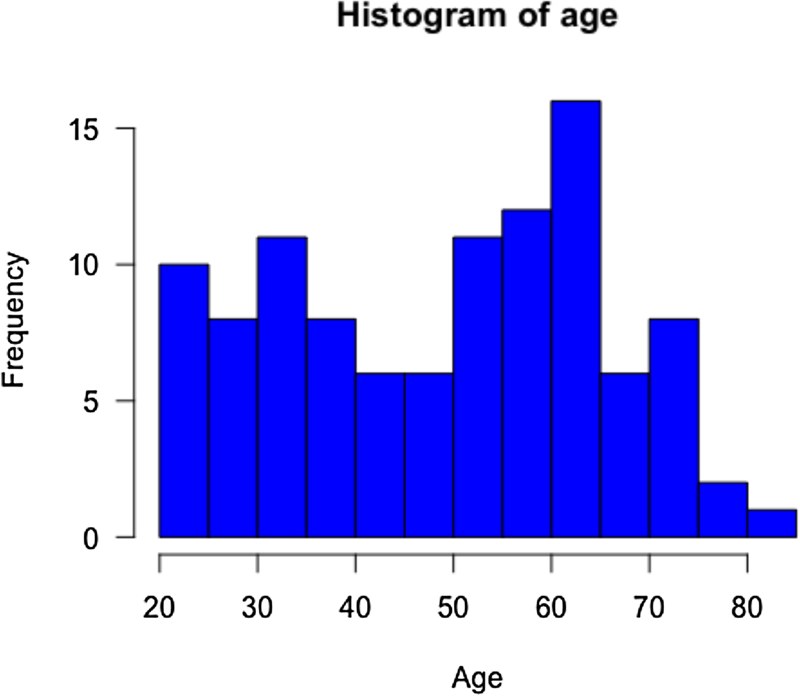
A total of 105 university-educated adults were included in our sample. The majority were female (67 female, 38 male). There was a wide spread of ages within the group, from 21 to 85 years old, with those in the 60–65 age group representing the largest number of participants (see Fig 1).
Distribution of participant age within our sample

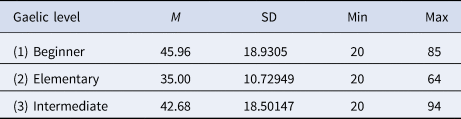
Participants’ composite language background score ranged from 20 (complete monolingual) to 94, with a median score of 37. The majority of participants were enrolled in Gaelic level 1 (n = 47), Gaelic level 2 had the fewest participants (n = 21), and Gaelic level 3 was in the middle (n = 37). See Table 1 for descriptive statistics of participants’ language background by Gaelic level.
Descriptive statistics for participants’ language background by Gaelic level

Note: A one-way ANOVA revealed no significant difference in participants’ language background score by Gaelic level (p > .05).
3.2. Performance on TEA subtests
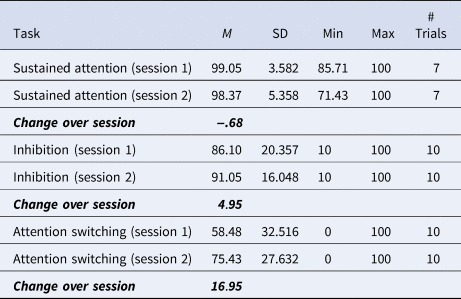
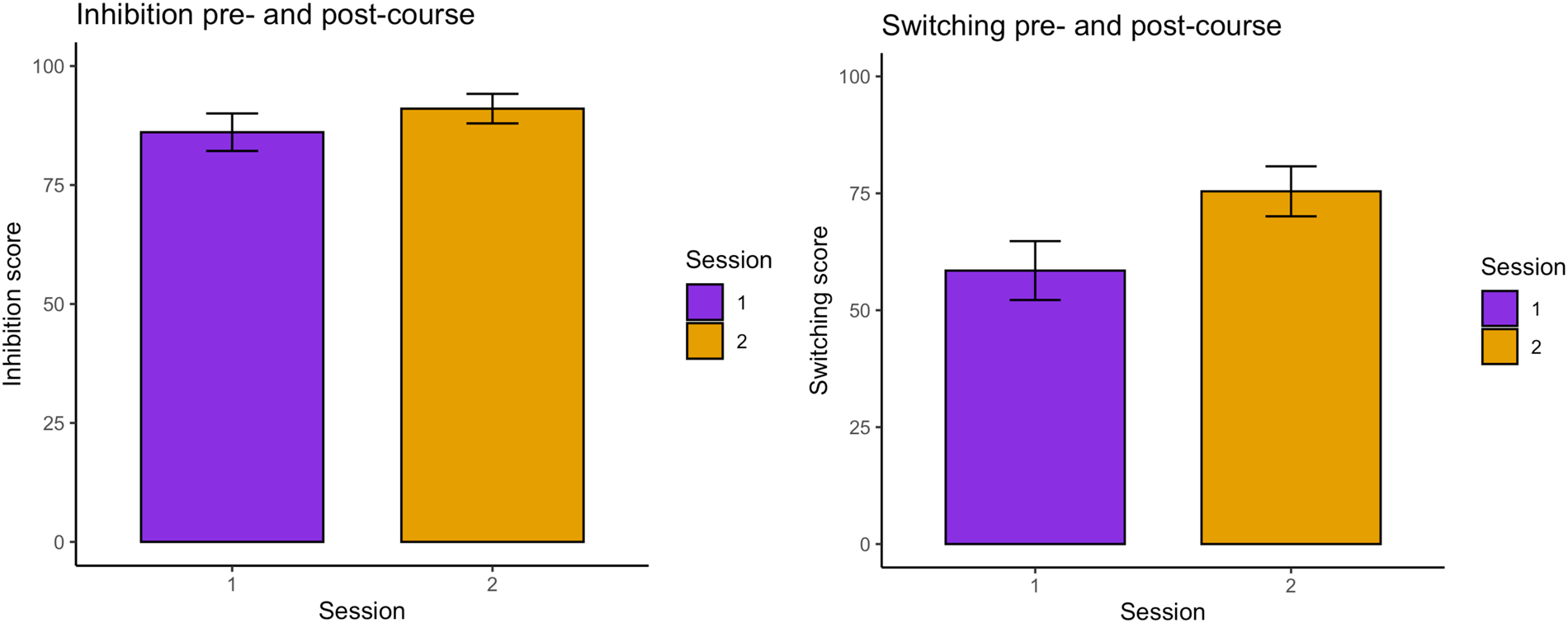
On the sustained attention measure, performance was close to ceiling both pre- and post-course (see Table 2). On the inhibition measure, performance increased by 4.95 points following intensive language exposure. The greatest change was found on the attention switching measure, where the performance increased from session 1 to session 2 by 16.95 points.
Descriptive statistics for Test of Everyday Attention (TEA) subtests

3.3. Relationship between individual characteristics and performance
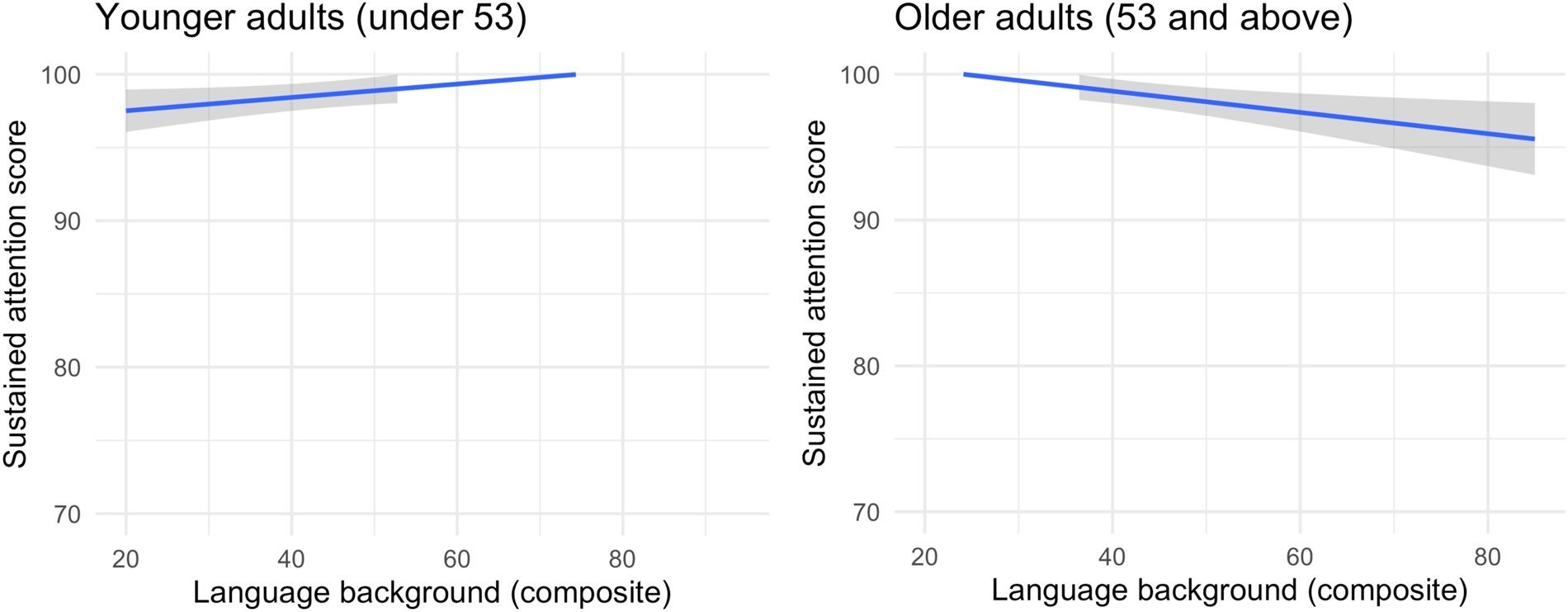
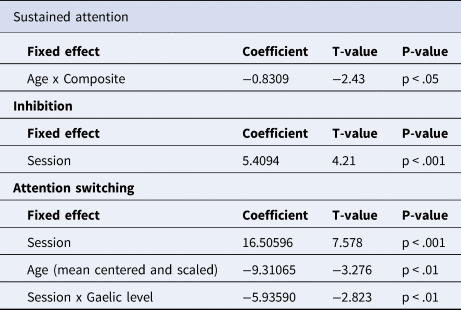
Table 3 lists the significant effects and interactions found in the respective models for sustained attention, inhibition, and attention (see Appendix A in Supplementary Material for full model output). For sustained attention, the only effect that emerged was an age x language background interaction, one for which prior work had not indicated clear predictions. We found that younger adults’ performance increased with greater knowledge of other languages whereas the contrary was true for older adults (Fig 2). We conducted follow-up analyses of the subsets of younger and older adults (divided by the median age of 53). The older adults showed a main effect language background (β = −1.20, t = −2.08, p <.05), with more extensive language background being associated with lower performance; the younger adults showed the opposite pattern, but it was marginal (β =.94, t = 2.00, p =.05).
Age x composite for sustained attention score on the task (median age split)

Significant main effects and interactions for the three measures

Note: This table shows significant results following Bonferroni corrections.
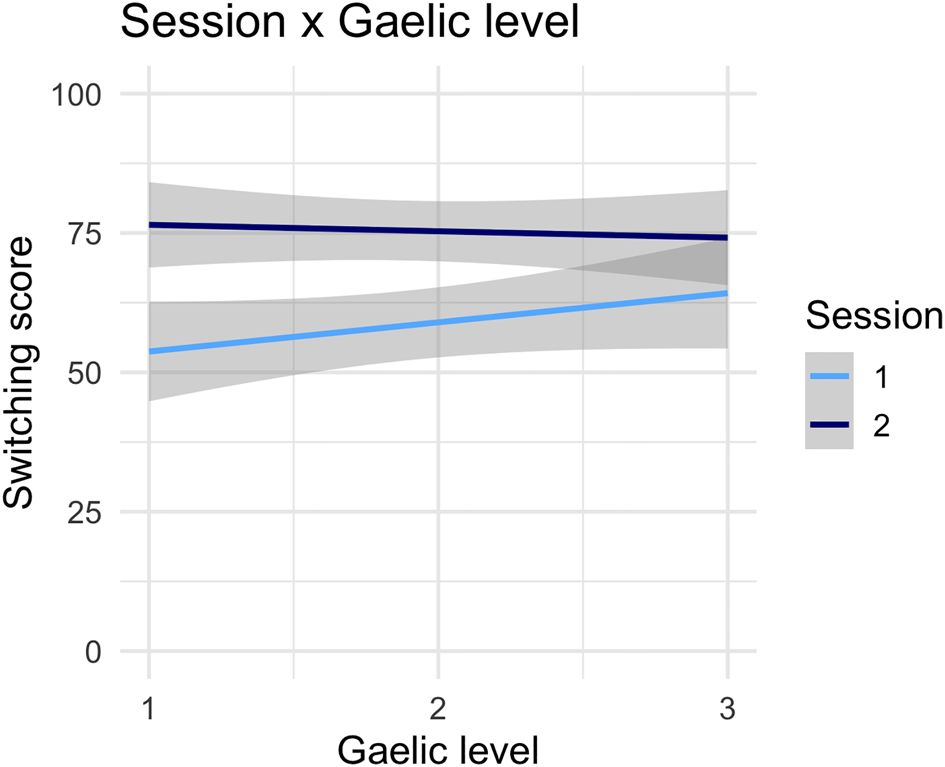
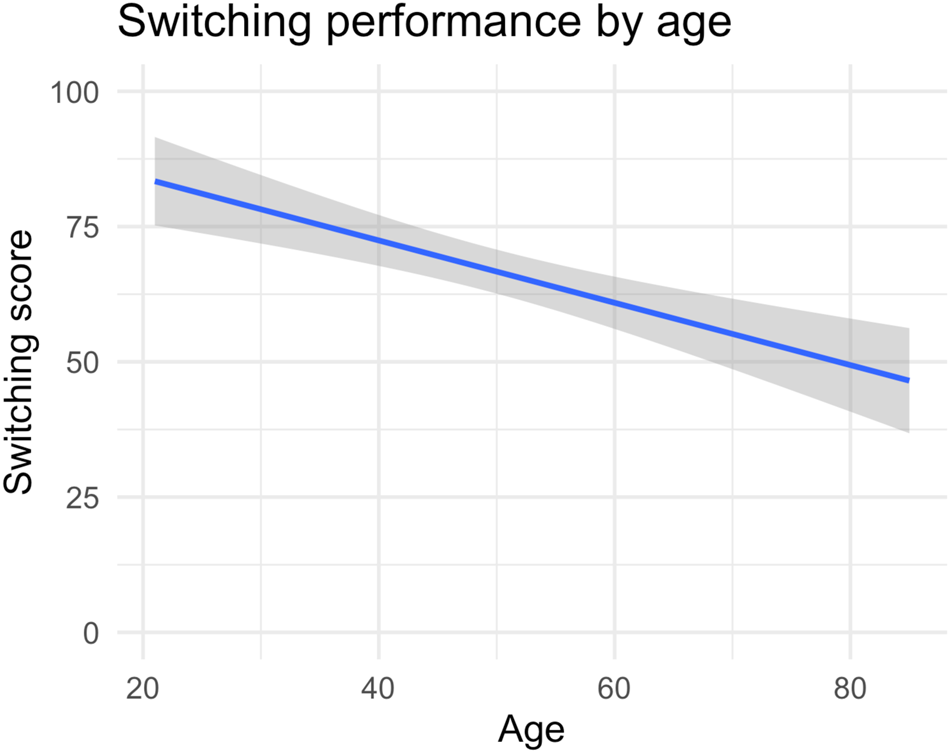
For both inhibition and attention switching, we found a main effect of session with improved performance post-course (Fig 3), which is in keeping with results from Bak et al., Reference Bak, Long, Vega-Mendoza and Sorace2016. For attention switching, there was an additional session x Gaelic level interaction which is relevant to our prediction about novelty and language background based on results from Vega-Mendoza et al., Reference Vega-Mendoza, West, Sorace and Bak2015 and Bjork & Kroll, Reference Bjork and Kroll2015: those in higher levels initially performed better but those in lower levels improved the most (Fig 4). Lastly, there was a main effect of age on attention switching: as age increased, scores decreased (Fig 5), in line with findings from Bak et al., Reference Bak, Long, Vega-Mendoza and Sorace2016 that performance on this task decreases over the lifespan. There was no effect of gender on any of the measures.
Main effect of session for inhibition and attention switching score on the task

Session x Gaelic level for attention switching score on the task

Main effect of age for attention switching score on the task

4. Discussion
Our study is one of the first to look within a group of language learners, here all adult university-educated learners, to identify factors responsible for individual differences in domain general cognitive functions following language learning. In line with predictions based on the IC model and Adaptive Control Hypothesis as well as previous work on language-related cognitive change (e.g. Bak et al. Reference Bak, Long, Vega-Mendoza and Sorace2016), there was an overall improvement in inhibition and attention switching after the course, with participants’ attention switching adapting the most, likely due to the demands incurred when shifting between languages (i.e. having to disengage strong inhibition and refocus attention to the previously inhibited language).
While these results cannot fully corroborate the findings of Bak et al. (Reference Bak, Long, Vega-Mendoza and Sorace2016) (as this was not our intended research question and we therefore did not recruit matched controls), these results do demonstrate the impact of individual differences on attentional performance and, most interestingly, on the degree of performance improvement that an individual shows post-course. Both the level of language knowledge and course experience appear to have influenced individual attention switching performance. Specifically, those in higher levels of Gaelic were initially better at attention switching, while those in lower levels of Gaelic experienced the greatest improvement post-course. These results confirm our predictions based on the IC model: shifting from a much weaker language into a dominant language is especially difficult as it requires strong inhibition of the dominant language as well as efficient release of that inhibition to switch back into it. This would explain why beginners (whose languages are extremely unbalanced) experienced the greatest improvement. Moreover, the finding that those in higher courses initially showed better attention switching skills could be interpreted as reflecting a higher attention switching baseline. As these individuals likely have more experience switching between the target language and their dominant language (given that those in higher levels have typically spent more time studying/practicing the language in order to advance to that level), it is conceivable that their attentional abilities may have already adapted to meet the needs of such recurrent demands.
While it could be argued that the attentional improvement we attribute here to language learning outcomes (in keeping with Bak et al., Reference Bak, Long, Vega-Mendoza and Sorace2016) could be merely practice effects, one would then have to explain why a lower level of Gaelic exposure would lead to stronger practice effects (as opposed to our conclusion in line with the IC model), though the alternative cannot fully be ruled out.
The fact that we did not find an effect of composite score of other languages beyond Gaelic on attentional performance could suggest that such effects, if they exist, are substantially smaller and might only be detected in much larger cohorts. Another alternative is that there is no systematic additive benefit of knowledge of more than two languages. As numerous studies suggest, bilinguals are able to acquire third languages more easily than monolinguals learning a second language (for a full review see Cenoz, Reference Cenoz2003). Perhaps the reason for this is that bilinguals have already become efficient at juggling competing linguistic systems through the development of enhanced inhibitory control and attention switching. Therefore they may be better equipped to manage additional languages. This interpretation would suggest that a threshold of attentional efficiency may already be met through the cognitive demands imposed by a second language. Therefore we should not expect cognitive gains to increase systematically with every additional language acquired, but rather recognize that the brain may have already optimally adapted to accommodate the use of more than one language.
In addition to Gaelic level, participant age also played a role in predicting cognitive performance: our results show that older adults performed worse on the attention switching task, the most cognitively complex of the three tasks. Further, the impact of language knowledge on sustained attention affected younger and older adults differently: younger adults' performance increased with more language exposure whereas older adults showed the opposite pattern. The latter result is surprising given that when a positive effect of bilingualism is reported in the literature, it is often larger in older adults than younger adults (e.g. Bialystok et al., Reference Bialystok, Craik, Klein and Viswanathan2004). One possibility is that this result is due to a trade-off between easy and difficult cognitive tasks. A more likely explanation, however, may be that since the average score on this measure was close to ceiling in both sessions, the result is simply not reliable. This result should therefore be interpreted with caution.
Notably, age did not interact with session for any of the attentional measures. While we see that cognitive performance varies with age, we have no evidence that the impact of language learning on attention is age-dependent, thereby highlighting a seemingly adaptable brain across the lifespan. What's more, even though we did not measure whether participants improved in language skills following the course, our findings suggest that irrespective of potential language gains, the demands of having to juggle more than one linguistic system in an immersive language learning environment can significantly impact attentional functions at any age. This is particularly important in the context of the age-profile of our participants, with those aged 50–65 years old forming the largest group (Fig 1). The histogram shows that young adults’ enrolment in language courses peaks in their 30's and that there is an even greater peak later in life at what appears to be a crucial period in one's early 60's when many adults are preparing for or settling into retirement. While most language courses are aimed at school children, students, and young adults, catering to their specific learning needs, we may be overlooking an important population of older adults who are interested in language learning and have the time to undertake such courses. As the increase in life expectancy has not been matched by a comparable change in retirement age, the percentage of life spent in retirement is continuously increasing. Moreover, the age of retirement in many countries is not voluntary and does not reflect the preferences of individuals to continue working (Steiber & Kohli, Reference Steiber and Kohli2017); this resulting period of time spent without the routine mental and social stimulation associated with work can lead to many adults seeking opportunities to fill this void. As our observations suggest, older adults may perceive learning new languages (or refreshing familiar ones) as an attractive retirement activity. This brings forth both opportunities and challenges in adapting teaching materials and styles to suit this growing population whose needs are just beginning to be recognized and addressed (Gabrys-Barker, Reference Gabrys-Barker2017).
Overall, our results provide new insights that could help to address some of the bigger questions in the field of bilingualism, especially with regards to the linguistic circumstances that give rise to cognitive change and to individual differences in cognitive performance. As detailed above, the predictions we made based on the IC model and Adaptive Control Hypothesis were confirmed. This provides further evidence that these models represent an accurate picture of the processes involved in managing two languages not only at the late stages of bilingualism (e.g. when two languages are fully formed and represented in the mind), but also during the early stages (i.e. the start of second language acquisition). Accordingly, this work contributes to a comprehensive account of bilingual language control in a dual-language environment.
Naturally, our study has limitations. With a brief window of time to administer the cognitive measures to each individual before and after the course it was necessary to select short tests. As such, we were unable to compare reliability across multiple tasks separately tapping into attention switching, inhibition, and sustained attention. Only after evaluation did we note an ambiguity in the language background questionnaire, which caused some participants to exclude knowledge of Gaelic from their language background. As this was a self-selected group of learners, the results of this study are not immediately generalizable to all sub-communities in the greater public. Moreover, although we investigated five understudied factors and their relation to language-related cognitive outcomes, other inter-individual differences may also play a role such as participants’ IQ, aptitude for language learning, leisure activities (e.g. playing a musical instrument), etc; these additional factors should be considered in future work. Finally, since we focus our study on language learners, we cannot determine whether other types of intensive courses produce similar effects, a question which will need to be addressed in further studies.
Nevertheless, despite the challenges involved in this type of fieldwork, we were able to collect a relatively large amount of data and control for both motivation and education, allowing us to gain new perspectives on the role of novelty, age, language background in predicting individual differences in language-related cognitive change. We hope these findings encourage others to look beyond categorical grouping of individuals (e.g., bilinguals versus monolinguals) to more deeply explore the complexities of the language learner profile and how these features may influence performance.
Supplementary material
For supplementary material accompanying this paper, visit https://doi.org/10.1017/S1366728919000749
Acknowledgements
We would like to thank our participants for their help and co-operation and Sabhal Mòr Ostaig for their support and assistance with recruitment. We would also like to thank the editor, Professor Abutalebi, and the anonymous reviewers for their helpful feedback. We gratefully acknowledge the funding bodies that made this research possible: PPLS Research Support Grants awarded to ML, an AHRC Open World Research Initiative grant “Multilingualism: Empowering Individuals, Transforming Societies” awarded to THB and MVM, A Knut and Alice Wallenberg Foundation Grant (No. KAW 2014.0205) that supported MVM, a Leverhulme Trust Prize in Languages and Literatures awarded to HR, and an EU-funded grant “Advancing the European Multilingual Experience” awarded to AS.