




No CrossRef data available.
Article contents
Efficacy of two cyclooctadepsipeptides, PF1022A and emodepside, against anthelmintic-resistant nematodes in sheep and cattle
Published online by Cambridge University Press: 04 October 2004
Abstract
Resistance against the major currently available anthelmintics has reached a critical level in many small ruminant herds world-wide, and is increasingly becoming a problem in horses and cattle. Therefore, new products with different modes of action are urgently needed. Recently, such a new class of compounds, the anthelmintically active cyclooctadepsipeptides, was described. Here, the effects of cyclooctadepsipeptides on benzimidazole-, levamisole- and ivermectin-resistant populations of Haemonchus contortus in sheep as well as an ivermectin-resistant Cooperia oncophora population in cattle were studied. Experimentally infected sheep and cattle were used. Animals were treated orally, subcutaneously, or intravenously with cyclooctadepsipeptides. The anthelmintic effects were assessed by means of fecal egg count reductions and/or worm count reductions. Both, PF1022A and emodepside were found to be fully effective against these parasite populations. These findings confirm that this new class of compounds acts by a different mode of action compared to the above-mentioned anthelmintics.
Information
- Type
- Research Article
- Information
- Copyright
- 2004 Cambridge University Press
INTRODUCTION
The control of gastrointestinal nematodes is vital for the welfare and productivity of farm animals, especially sheep and cattle. Three classes of anthelmintics are commonly used for parasite control. These are: the benzimidazoles and probenzimidazoles; the imidazothiazoles (e.g. levamisole) and tetrahydropyrimidines (e.g. pyrantel and morantel); and the macrocyclic lactones (e.g. avermectins and milbemycins). Resistance has developed to all three groups especially in nematodes of sheep (Waller, 1997; Sangster & Gill, 1999; Sangster, 2001) and more recently cases of macrocyclic lactone resistance have been reported in parasites of cattle (Coles, 2002; Mejia et al. 2003) and horses (Boersema, Eysker & Nas, 2002). The introduction of novel anthelmintics that will control nematodes resistant to all three groups would be of major benefit in those areas where no or only one anthelmintic remains effective.
Information about anthelmintic effects and mechanisms of two novel cyclooctadepsipeptides, PF1022A and emodepside, have been reported in detail in two recent reviews (Harder & Samson-Himmelstjerna, 2002; Scherkenbeck, Jeschke & Harder, 2002). Thereby, the latrophilin-like receptor plays a crucial role as target of these depsipeptides, resulting in changes of intracellular calcium concentrations. In the present study it is shown that these novel products will control ovine and bovine nematodes that are resistant to the three major classes of anthelmintics.
MATERIALS AND METHODS
Several experimental trials on the efficacy of one of these compounds were performed in artificially infected sheep and cattle in Germany and Australia. The cyclooctadepsipeptides used in this study were considered to be suitable for treatment of infections by a broad range of nematode species, at the dose rates applied (unpublished data).
Benzimidazole-resistant parasites in sheep
The efficacy of PF1022A was evaluated against a benzimidazole-resistant laboratory isolate of Haemonchus contortus in Germany. This isolate was recovered from the field 30 years ago and showed resistance to febantel and has subsequently been maintained in sheep in the laboratory and selected by treating the sheep at each passage with 10 mg/kg febantel, twice the recommended dose rate for sheep. The larvae used for infection were cultured from the feces of a donor sheep 2 months before the trial and stored at 10 °C. They were Baermanized to remove any dead larvae prior to counting and aliquoting into individual doses of 5 ml. As controls, other sheep were infected with a drug-susceptible isolate of H. contortus that is fully susceptible to 0·5 mg/kg febantel. It was passaged without treatment. Sheep (Merino or Schwarzkopf breed, 25–35 kg body weight) were infected experimentally with 5000 H. contortus third-stage larvae (L3) by oral application in a gelatine capsule and treated with test substances after the pre-patency period of the parasite (Samson-Himmelstjerna et al. 2000). The animals were treated orally (p.o.) or intravenously (i.v.) with PF1022A, dissolved in an emulsifying solution, or with febantel (10% commercial drench formulation). The anthelmintic effects were measured by reduction in fecal egg counts. Freshly obtained feces from experimental animals were processed using the McMaster method as modified by Wetzel (1951), as described by Samson-Himmelstjerna et al. (2000), and the egg count was calculated per gram of feces (epg). The egg counts were determined at least twice before treatment and post-treatment up to 20 days. For each dosage 1 sheep was used.
Ivermectin-resistant parasites in sheep
Infections and assessment of fecal egg counts were performed at the Bayer facilities (Germany) in the same way as described above, except that the laboratory ivermectin-resistant H. contortus isolate had been passaged and selected for 14 years by treating infected sheep at each passage with ivermectin at 0·2 mg/kg b.w., 20 times higher than the dosage needed to eliminate susceptible worms. Animals were treated with ivermectin (Ivomec, 1% injectable, Merial) either orally or subcutaneously; with PF1022A, dissolved in an emulsifying solution, either orally or intravenously; or with emodepside in an oily formulation (2%) either subcutaneously or orally. As controls, sheep were infected with an isolate of H. contortus that is removed by 0·01 mg/kg. For each dosage 1 sheep was used.
Levamisole-resistant H. contortus in sheep
Wether sheep were sourced from a property in the Southern Highlands of New South Wales (Australia). One month prior to the commencement of the trial 20 wethers, 9–12 months old, were treated with 0·2 mg/kg ivermectin and moved to indoor concrete pens with steel mesh floors. The wethers were fed lucerne and wheaten chaff and provided with water ad libitum. Eighteen sheep with negative egg counts were selected from the trial.
The Lawes isolate of H. contortus has been laboratory maintained for 15 years and treated with 16 mg/kg levamisole at each passage. The larvae used for infection were cultured from the feces of a donor sheep 2 months before the trial and stored at 10 °C. Sheep were infected with 5000 larvae by intraruminal injection.
Fecal egg counts were performed by the standard McMaster technique with a minimum detection of 40 epg. Worm counts were performed at post-mortem by WAAVP methods. The abomasa were washed into a volume of 2 l and a representative sample of 100 ml was removed. Male and female worms were differentiated and counted. The minimum detection limit was 20 worms.
Eighteen sheep were infected with the levamisole-resistant isolate of H. contortus and patent infections were confirmed by positive fecal egg counts on at least 3 days. Animals were treated 7–9 days after the first positive eggs counts. Following ranking on mean egg count each animal was allocated at random into one of 3 treatment groups. Group 1 served as placebo-treated control, group 2 was treated with levamisole (Levamisole Gold, Virbac, levamisole 32 g/l) at 7·5 mg/kg, and group 3 was treated with an oral formulation of emodepside (2%) at the dosage of 1 mg/kg body weight. Necropsy for worm counts followed 7–9 days post-treatment. Efficacies were assessed by standard formula: % effectiveness=(GeoMean control – GeoMean treated)×100/GeoMean control. Prior to analysis the transformation log10 (epg+20) was used for egg counts and log10 (worm count+10) for worm counts.
Ivermectin resistance in cattle
To test the efficacy of emodepside on ivermectin-resistant cattle nematodes, a recent Cooperia isolate from the UK (Stafford & Coles, 1999) was used. In total, 18 fecal egg count-negative calves randomly assigned to 3 groups were each experimentally infected with a single inoculum of 20000 L3 of Cooperia oncophora. Treatment doses were calculated based on body weight. At day 32 post-infection, 6 animals each were treated with ivermectin (0·2 mg/kg, s.c.), emodepside (1·0 mg/kg, p.o.), or left untreated. Nine days post-treatment, animals were necropsied. Intestinal washings, worm counts and calculations of efficacy were performed according to WAAVP guidelines (Wood et al. 1995).
RESULTS
Benzimidazole-resistant H. contortus in sheep
Febantel was fully effective against the susceptible H. contortus at oral dosages of 1 or 0·5 mg/kg as measured by fecal egg count reduction (Table 1). However, the drug was not fully effective against the febantel-resistant isolate at the oral dosages of 5 or 2·5 mg/kg. PF1022A was highly effective at 1 mg/kg following oral application or at 0·25 mg/kg after intraveneous application.
Table 1. Effect of febantel and PF1022A, and different routes of administration, on fecal egg count (FEC) obtained by testing single sheep infected with benzimidazole-resistant Haemonchus contortus compared with sheep infected with wild-type (susceptible) H. contortus (p.o., oral administration; i.v., intravenous administration. FEC expressed as eggs per gram of feces, epg.)

Ivermectin-resistant H. contortus in sheep
Ivermectin was fully effective against susceptible H. contortus after oral and subcutaneous administration (Table 2), as measured by fecal egg count reductions. PF1022A, applied at an oral dosage of 1 mg/kg and at an intravenous dosage of 0·25 or 0·1 mg/kg was highly effective against the ivermectin-resistant H. contortus, while emodepside was fully effective at a subcutaneous dosage of 0·1 mg/kg and an oral dosage of 0·05 mg/kg (Table 2).
Table 2. Effect of different dosages of ivermectin, PF1022A or emodepside, and different routes of administration on fecal egg count (FEC) obtained in single sheep infected with Haemonchus contortus resistant to ivermectin compared to wild-type H. contortus (s.c., subcutaneous administration; p.o., oral administration; i.v., intravenous administration. FEC expressed as eggs per gram of feces, epg.)

Levamisole-resistant H. contortus in sheep
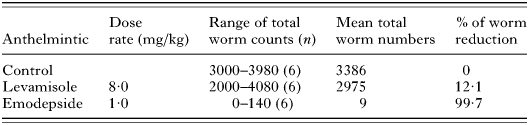
The results of the levamisole trial are given in Table 3. At post-mortem in each sheep in the placebo group 3000–4000 worms were found, demonstrating a high infection rate. Levamisole had no significant effect on egg counts of the Lawes isolate of H. contortus, causing only a 12% decline in worm counts (Table 3). Emodepside at 1 mg/kg given orally was highly effective at removing the Lawes isolate of H. contortus. On average it reduced egg counts by 99·94% (not shown) and worm counts by 99·7% (Table 3).
Ivermectin-resistant Cooperia oncophora in cattle
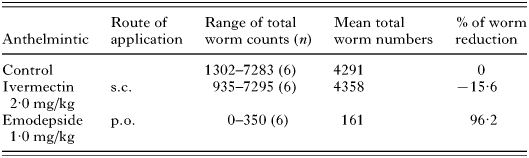
All 18 experimentally infected calves developed patent infections as demonstrated by positive fecal egg count 21 days post-infection (data not shown). Subcutaneous treatment with 0·2 mg/kg ivermectin did not significantly reduce worm burdens in 4 of 6 ivermectin-resistant C. oncophora-infected calves, while in the remaining 2 calves the worm counts were only slightly reduced compared to control values. The mean worm count reduction was 23%. Emodepside, on the other hand, was highly effective (Table 4) in all 6 animals following oral treatment with 1 mg/kg, achieving 96% reduction in worm burdens compared with controls.
Treatment of infected animals with placebo or low dosages of cyclooctadepsipeptides did not result in measurable anthelimintic effects (unpublished data).
DISCUSSION
The present data from trials in sheep shows clearly that PF1022A and emodepside remove worms and depress fecal egg counts in treated animals. Efficacy has been shown against adult isolates of H. contortus resistant to benzimidazole, levamisole and ivermectin. They are also effective against ivermectin- resistant C. oncophora in cattle and thus provide a potentially valuable new tool for nematode control in grazing animals. Given the existing knowledge of the mechanism of action of these novel anthelmintics, the lack of cross-resistance would be expected.
PF1022A and emodepside belong to the novel class of cyclooctadepsipeptides, discovered in 1990 (Fukashe et al. 1990; Tagaki et al. 1991; Sasaki et al. 1992, Terada, 1992). PF1022A exerts electrophysiological effects on Ascaris suum muscle cells unrelated to GABA function (Martin et al. 1996). Emodepside causes muscle relaxation, inhibition of acetylcholine-elicited muscle contraction and a rapid relaxation of muscle tonically contracted by acetylcholine (Willson et al. 2003). These actions were not observed in denervated muscle strips, suggesting that emodepside acts pre-synaptically. Furthermore, the action is dependent on Ca++ and extracellular K+, similar to the action of the inhibitory neuropeptides PF1 and PF2. These data suggest that emodepside may exert its activities at the neuromuscular junction to stimulate release of an inhibitory neurotransmitter or neuromodulator, perhaps a PF1-like neuropeptide. In addition, it was recently shown that the molecular mechanism of action may rely on the interference of a latrophilin-like receptor in nematodes (Saeger et al. 2001). These properties of PF1022A and the related emodepside indicate that the molecular mechanism of action of these cyclooctadepsipeptides are distinct from the known modes of action of the three main classes of anthelmintics: the benzimidazoles which act via interference with tubulin polymerization, levamisole which is a nicotinic receptor agonist, and the macrocyclic lactones which open the glutamate-gated chloride channels in nematodes (for review see Harder, 2002).
These compounds could provide a new class of anthelmintic that would find a use in the control of anthelmintic-resistant nematodes. The need for such new anthelmintics with efficacy against anthelmintic resistant nematodes warrant further trials of PF1022A and emodepside in sheep, cattle and horses containing immature resistant nematodes and different species, such as ivermectin-resistant Parascaris equorum. The compounds may be used alone or in mixtures to delay the selection of resistant worms in these hosts.
The authors wish to thank Dr William Blackhall for helpful comments on the manuscript.
References
REFERENCES
BOERSEMA, J. H.,
EYSKER, M. &
NAS, J. W. (
2002).
Apparent resistance of Parascaris equorum to macrocyclic lactones.
Veterinary Record 150,
279–281.CrossRefGoogle Scholar
COLES, G. C. (
2002).
Cattle resistant to anthelmintics: why so few cases?
Veterinary Research 33,
481–489.Google Scholar
FUKASHE, T.,
KOIKE, T.,
CHINONE, S.,
AKIHAMA, S.,
IAGAKE, H.,
TAKAGI, M.,
SHIMIZU, T.,
YAGUCHI, T.,
SASAKI, T. &
OKADA, T. (
1990).
Anthelmintic effects of PF1022, a new cyclic depsipeptide, on the intestinal parasitic nematodes in dogs and cats.
Proceedings of the 110th Meeting of the Japanese Society of Veterinary Science, 122 (Abstr.).Google Scholar
HARDER, A. (
2002).
Chemotherapeutic approaches to nematodes: current knowledge and outlook.
Parasitology Research 88,
272–277.Google Scholar
HARDER, A. &
SAMSON-HIMMELSTJERNA, G.VON (
2002).
Cyclooctadepsipeptides – a new class of anthelmintically active compounds.
Parasitology Research 88,
481–488.CrossRefGoogle Scholar
MARTIN, R.,
HARDER, A.,
LONDERSHAUSEN, M. &
JESCHKE, P. (
1996).
Anthelmintic actions of the cyclic depsipeptide PF1022A and electrophysiological effects on muscle cells of Ascaris suum.
Pesticide Science 48,
343–349.3.0.CO;2-X>CrossRefGoogle Scholar
MEJIA, M. E.,
FERNANDEZ IGARTUA, B. M.,
SCHMIDT, E. E. &
CABARET, J. (
2003).
Multispecies and multiple anthelmintic resistance on cattle nematodes in a farm in Argentina: the beginning of high resistance?
Veterinary Research 34,
461–467.Google Scholar
SAEGER, B.,
SCHMITT-WREDE, H. P.,
DEHNHARDT, M.,
BENTEN, W. P.,
KRÜCKEN, J.,
HARDER, A.,
SAMSON-HIMMELSTJERNA, G.VON,
WIEGAND, H. &
WUNDERLICH, F. (
2001).
Latrophilin-like receptor from the parasite nematode Haemonchus contortus as target for the anthelmintic depsipeptide PF1022A.
FASEB Journal 15,
1332–1334.CrossRefGoogle Scholar
SANGSTER, N. C. (
2001).
Managing parasiticide resistance.
Veterinary Parasitology 98,
89–109.CrossRefGoogle Scholar
SANGSTER, N. C. &
GILL, J. (
1999).
Pharmacology of anthelmintic resistance.
Parasitology Today 15,
141–146.CrossRefGoogle Scholar
SAMSON-HIMMELSTJERNA, G.VON,
HARDER, A.,
SCHNIEDER, T.,
KALBE, J. &
MENCKE, N. (
2000).
In vivo activities of the new anthelmintic depsipeptide PF1022A.
Parasitology Research 86,
194–199.CrossRefGoogle Scholar
SASAKI, T.,
TAKAGI, T.,
YAGUCHI, T.,
MIYADOH, S.,
OKADA, T. &
KOYAMA, M. (
1992).
A new anthelmintic cyclodepsipeptide, PF1022A.
Journal of Antibiotics 45,
692–697.CrossRefGoogle Scholar
SCHERKENBECK, J.,
JESCHKE, P. &
HARDER, A. (
2002).
PF1022A and related cyclodepsipeptides – a novel class of anthelmintics.
Current Topics in Medicinal Chemistry 2,
759–777.CrossRefGoogle Scholar
STAFFORD, K. &
COLES, G. C. (
1999).
Nematode control practices and anthelmintic resistance in dairy calves in the south west of England.
Veterinary Record 144,
659–661.CrossRefGoogle Scholar
TAGAKI, M.,
SASAKI, T.,
YAGUCHI, T.,
KODAMA, Y.,
OKADA, T.,
MIYADOH, S. &
KOYAMA, M. (
1991).
On a new cyclic depsipeptide, PF1022 with anthelmintic effects.
Nippon Nogeikagaku Kaishi 65,
326.Google Scholar
TERADA, M. (
1992).
Neuropharmacological mechanism of action of PF1022A, an antinematode anthelmintic with a new structure of cyclic depsipeptide, on Angiostrongylus cantonensis and isolated frog rectus.
Japanese Journal of Parasitology 41,
108–117.Google Scholar
WALLER, P. J. (
1997).
Anthelmintic resistance.
Veterinary Parasitology 72,
391–412.CrossRefGoogle Scholar
WETZEL, R. (
1951).
Verbesserte McMaster Kammer zum Auszählen von Wurmeiern.
Tierärztliche Umschau 11,
209.Google Scholar
WILLSON, J.,
AMLIWALA, K.,
HARDER, A.,
HOLDEN-DYE, L. &
WALKER, R. (
2003).
The effect of the anthelmintic emodepside at the neuromuscular junction of the parasitic nematode Ascaris suum.
Parasitology 126,
79–86.CrossRefGoogle Scholar
WOOD, I. B.,
AMARAL, N. K.,
BAIRDEN, K.,
DUNCAN, J. L.,
KASSAI, T.,
MALONE, J. B.,
PANAKOVICH, J. A.,
REINECKE, R. K.,
SLOCOMBE, O.,
TAYLOR, S. M. &
VERCRUYSSE, J. (
1995).
World Association for the Advancement of Veterinary Parasitology (W.A.A.V.P.) second edition of guidelines for evaluating the efficacy of anthelmintics in ruminants (bovine, ovine, caprine).
Veterinary Parasitology 58,
181–213.Google Scholar

Table 1. Effect of febantel and PF1022A, and different routes of administration, on fecal egg count (FEC) obtained by testing single sheep infected with benzimidazole-resistant Haemonchus contortus compared with sheep infected with wild-type (susceptible) H. contortus
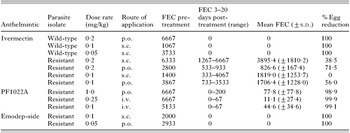
Table 2. Effect of different dosages of ivermectin, PF1022A or emodepside, and different routes of administration on fecal egg count (FEC) obtained in single sheep infected with Haemonchus contortus resistant to ivermectin compared to wild-type H. contortus
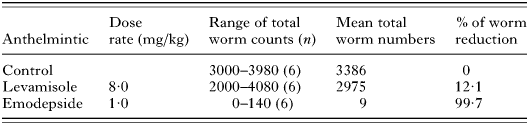
Table 3. Effect of levamisole at an oral dosage of 8 mg/kg body weight or emodepside at an oral dosage of 1 mg/kg body weight on worm counts (reductions expressed in % of control) obtained in sheep infected with Haemonchus contortus resistant to levamisole
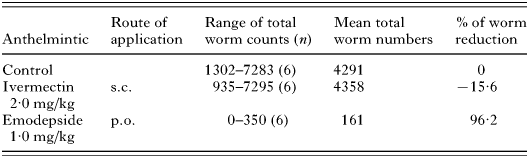
Table 4. Effect of ivermectin at a subcutaneous dose of 0·2 mg/kg or emodepside at an oral dosage of 1 mg/kg on worm counts obtained in cattle infected with ivermectin-resistant Cooperia oncophora
 You have
Access
- 70
- Cited by