Emergency public health responders are personnel participating in the immediate integrated effort to move resources and provide support during public health emergencies. They are a critical asset during an emergency response, and the effective management of an emergency depends on their wellbeing. Responders may face situations that place their personal health and wellbeing at risk, depending on the nature and length of the response. One such response that affected the health and wellbeing of many responders was the 2014 Ebola outbreak response in West Africa. The outbreak led to the deployment of approximately 2015 emergency public health responders from the Centers for Disease Control and Prevention (CDC) to Guinea, Liberia, and Sierra Leone. CDC responders abroad served as public health practitioners, researchers, laboratorians, and other experts while others worked in the Emergency Operations Center (EOC) at headquarters in Atlanta, GA. In the aftermath of the 2014 Ebola response, as part of an Agency-wide initiative to mitigate systemic risks in preparation for future emergency responses, the CDC began identifying the main factors detracting from responder wellbeing throughout the deployment continuum. The identification of potential risk factors for poor health outcomes is intended to lay the groundwork for the development of effective and relevant strategies for intervention.
Written reports about factors affecting emergency public health responders are largely absent from the peer-reviewed literature. Documented information on relevant risk factors among other responder populations (namely, military personnel) may be relevant to better understanding risk and mitigating factors for the wellbeing of public health responders. These studies indicate that the cumulative impact of negative experiences during an emergency response, coupled with underlying demographic and personal history factors increasing their vulnerability, may threaten the mental and physical wellbeing of responders during deployment and upon their return home. Reference Stellman, Smith and Katz1,Reference Hall2
Research from military studies also indicates that the impact of deployment on responder wellbeing manifests differently. Studies show that after deployment and upon returning to regular duty stations, military personnel may experience several changes in their neuropsychological performance. Reference Proctor, Heaton and Dos Santos3 As a result of their experiences, some may develop risky coping mechanisms, Reference Eisen, Schultz and Vogt4 such as heavy alcohol or drug abuse (including prescription drugs); cigarette smoking; feelings of shame, despair and hopelessness; physical symptoms; difficulty finding and maintaining employment; divorce; and violence. Reference Hermes, Wells and Smith5-Reference Feinstein, Owen and Blair7 Other research indicates that post-traumatic stress disorder (PTSD) and suicide attempts are associated with deployment. Reference Bray, Pemberton and Lane8
The potential risks responders face postdeployment are argued to hinder productivity in the workplace, the ability to reintegrate upon return, and the potential willingness to participate in future responses. 9,Reference Possemato, McKenzie and McDevitt-Murphy10 The need to protect the responder workforce has inspired state and local governments, the US military, and private organizations to identify risk factors and support targeted evidence-based interventions to enhance responder wellbeing throughout the deployment continuum.
As mentioned above, the current literature focuses on risk factors affecting military personnel with few studies exploring the experiences of humanitarian relief workers. This narrative review seeks to fill the gap that exists due to the scarcity of published research that investigates factors influencing the wellbeing of public health responders deployed during emergencies. This narrative review identifies the main factors negatively impacting responders and applies those factors relevant to the unique experiences of public health responders. A comprehensive, streamlined understanding of the factors influencing responder wellbeing is critical to laying the groundwork for sustainable interventions. The integration of evidence-based interventions from the onset of deployment is postulated to both facilitate constructive reintegration post-deployment and improve mental health and wellbeing.
Methods
All articles included in the review were published between 2005 and 2019 in the English language. Studies using quantitative and qualitative methods in their data collection were included in the review. Studies were rooted in primary data (data collected first hand and later analyzed) and secondary data (data analysis that was conducted on an existing data set). Eligibility for inclusion was not restricted based on the type of responder; responder populations included military personnel, humanitarian aid workers, and journalists (Table 1).
Inclusion criteria for the narrative review on emergency responder risk factors

Due to the limited amount of literature exploring risk and protective factors influencing responder wellbeing, exclusion criteria were limited. Articles that did not discuss risk and protective factors for responders’ wellbeing, were published outside of the 14-y timeline, and were duplicative, were excluded from the database. The quality of the studies’ methods was not a criterion for exclusion; however, all articles included were peer-reviewed.
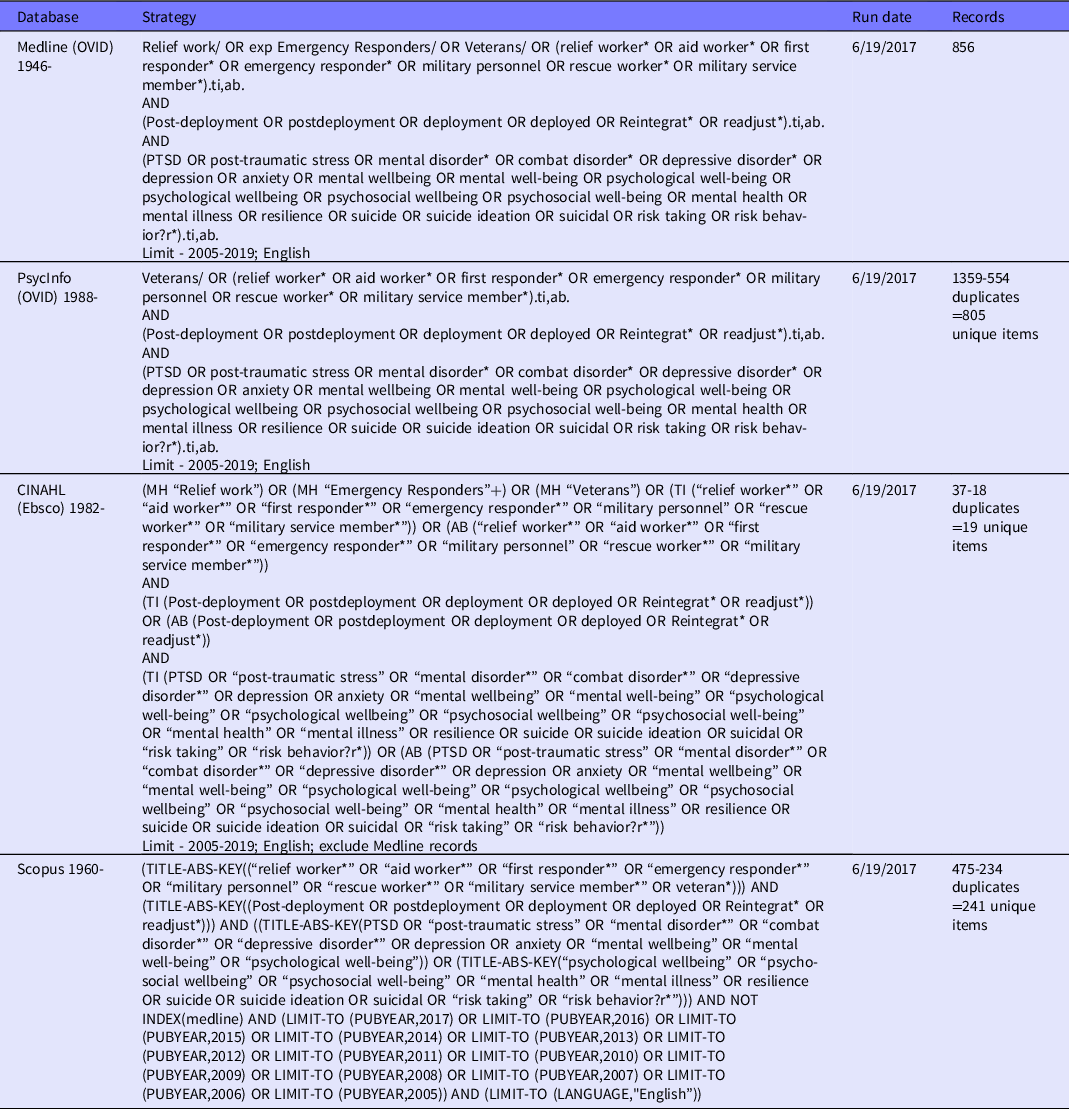
The initial search was conducted in 4 electronic databases—Medline, PsychInfo, CINAHL, and Scopus, with the assistance of CDC librarians—yielding a repository of 2727 articles. All resulting citations were downloaded into EndNote version X7 (Thomson Reuters, New York, New York, USA). Search terms were developed based on the research question. To capture a broad scope of peer-reviewed publications discussing factors influencing the wellbeing of responders (“risk” or “protective”), a pre-determined set of search terms was used. These search terms varied by database to ensure that all relevant articles were included in the initial database (Table 2). Of the total 2727 documents identified in the initial search, 806 were removed due to duplication (n = 1921 records remained in the database).
Search terms by database

Of the 1921 unique records (peer-reviewed articles) in the database, 628 of them discussed the risk and protective factors generally. Of these 628 articles, 449 were found to discuss risk and protective factors for wellbeing related to deployment. Upon completion of the 2 rounds of exclusion, titles and abstracts were reviewed by 2 independent researchers to assess eligibility for inclusion in the narrative review. Researchers discussed the relevance of articles to ensure agreement on the relevance of the topics. The search term “wellbeing” was added to further focus and narrow the sample of articles in the database. Of the 449 articles, 58 articles met the inclusion criteria (focusing on risk and protective factors related to deployment and wellbeing). Reviewers added 10 articles that met the inclusion criteria and were highly relevant to the subject matter, resulting in a total of 68 articles selected for final review (Figure 1). Each researcher identified relevant factors independently and then met to discuss the list of factors to ensure agreement on their relevance. Risk factors were grouped into overarching domains identified during the review.
Stages of narrative review.

Due to the limitations in the peer-reviewed literature on the topic of “responder risk factors and wellbeing postdeployment among public health emergency responders,” we extended our search to include the experiences of responders in general, thus including the additional 10 articles mentioned above. This review summarizes the common considerations that according to the researchers overlap with our population of interest, public health responders.
Results
All risk factors identified during the full-review of the 68 peer-reviewed articles were categorized into 5 overarching domains (Figure 2). Each domain also contained sub-domains according to the general influence of the risk factors on the responder’s mental health and wellbeing. Risk factors that influenced the wellbeing of responders throughout the deployment continuum and potential mitigation strategies were identified among the publications included for full-review. While there were studies exploring challenges faced by health-care workers, humanitarian relief workers, and emergency public health responders, these findings are based on retrospective quantitative and qualitative studies the majority of which were conducted among military personnel.
Five domains of responder wellbeing.

Demographics
The first overarching domain of risk factors is demographics, as studies demonstrate that many of these factors may be associated with increased risks to responder wellbeing.
Age
Age was identified as a potential risk factor for responder wellbeing, however, the age group at the highest risk of developing response-related mental illness has not been determined as risks are influenced by other factors such as gender and occupation. One study found that older age was associated with higher risk for negative PTSD results. Reference Maguen, Madden and Neylan11 Another study indicated that military personnel ages 45 to 54 y were at an increased risk for mental illness as compared to those between the ages of 35 and 44 y. Reference Sareen, Belik and Stein12 A different study found that women between the ages of 30 and 39 y had increased odds of developing PTSD, whereas women over the age of 40 y had lower rates of risky drinking post-combat exposure. Reference Adams, Nikitin and Wooten13 Another study conducted among Marines found that those in the youngest age category of 18 to 21 y were at the highest risk for developing PTSD as compared to older groups. Reference Booth-Kewley, Larson and Highfill-McRoy14 Although age has been identified as a risk factor for development of PTSD, the exact age has not been determined.
Gender
Gender is another demographic associated with responder wellbeing, primarily exacerbated by exposure to combat and sexual harassment. Studies indicate that female responders experience a higher risk to their wellbeing than male responders. Reference Maguen, Madden and Neylan11,Reference Sareen, Belik and Stein12,Reference Groër and Burns15 A study assessing PTSD found that women exposed to combat had an increased likelihood of mental illness postdeployment, with the odds of PTSD increasing with exposure to combat. Reference Adams, Nikitin and Wooten13 A study conducted among veterans deployed to Afghanistan and Iraq indicated that, while men and women shared behavioral health outcomes in many regards, increased risks to female responder’s wellbeing was in part due to stressors related to sexual harassment. Reference Street, Gradus and Giasson16
Race
Race was also shown to be associated with differences in responder wellbeing, with non-White minorities suffering from poor mental health outcomes disproportionately. Reference Maguen, Madden and Neylan11,Reference Adams, Nikitin and Wooten13 A study assessing mental health among active duty women with combat exposure found that Black women had higher rates of PTSD and depression and Hispanic women had higher rates of PTSD. Reference Adams, Nikitin and Wooten13 The results of this study also indicated that Black, Hispanic, and Asian/Pacific Islander responders had lower odds of at-risk drinking as compared to their White counterparts. Reference Adams, Nikitin and Wooten13 Another study examining race among veterans found that White veterans generally had lower rates of PTSD postdeployment, and Black veterans demonstrated slightly lower rates of improvement of their PTSD symptoms with time. Reference Maguen, Madden and Neylan11
Sexual Orientation
Research indicates that sexual orientation may be associated with the type of trauma responders experience as well as their likelihood of experiencing mental illness postdeployment, with nonheterosexual responders being disproportionately affected. This study also found that lesbian and bisexual veterans experienced higher rates of military sexual trauma, affecting their wellbeing negatively. Reference Mattocks, Sadler and Yano17 Another study found that lesbian and bisexual veterans were more likely to report mental health conditions postdeployment as compared to their heterosexual counterparts. Reference Mattocks, Sadler and Yano17-Reference Averill, Fleming and Holens19
Mental Health
The second overarching domain of risk factors identified in our review was mental health, as many studies show that predeployment mental health disorders (often associated with traumatic events during childhood) pose serious threats to responder wellbeing during and after deployment.
Existing Mental Disorders
Studies indicate that predeployment mental illness may exacerbate poor responder wellbeing. Research shows that a range of underlying neurobiological and mental health factors before deployment may increase the odds of poor responder wellbeing throughout the deployment continuum. Reference Wittchen, Schönfeld and Thurau20,Reference Javidi and Yadollahie21 Another study demonstrated that stressors (defined as exposure to highly stressful or traumatic events) that occurred before deployment were found to directly impact a responder’s risk for poor mental wellbeing. Reference Vogt, Smith and Elwy22
Adverse Childhood Events (ACEs)
The literature indicates that experiences during childhood negatively affect wellbeing during deployment. More specifically, abuse (including sexual violence during childhood) can be associated with suicide and other mental illness among military personnel. Reference Barrera, Graham and Dunn23,Reference Street, Kimerling, Bell, Ruzek, Schnurr and Vasterling24 One study exploring the potential reasons for poor responder wellbeing among female veterans found that approximately half of the women reported being raped in their lifetime, with one-third of the rapes occurring during their childhood and adolescence. Reference Booth, Davis and Cheney25 Another study conducted among military personnel found that a nonfunctional family environment during childhood increased stress during deployment, serving as a reference for the need of social support postdeployment. Reference Vogt, Smith and Elwy22
Social Networks
The third domain of factors associated with responder wellbeing is social networks, which are influenced by communication and social support. Studies indicate that a lack of communication (including social support) with others postdeployment as well as relationship stress Reference Balderrama-Durbin26 may contribute to poor mental health outcomes. One study found that separation during deployment negatively influenced responder mental health. Reference Groër and Burns15,Reference Brooks, Dunn and Sage27 Another study demonstrated that a lack of social support for responders postdeployment played a direct role in poor mental wellbeing. Reference Vogt, Smith and Elwy22 Negative media coverage of the context in which they deployed was also found to influence the stress levels of the families of responders, in turn negatively impacting the responder’s wellbeing. Reference Brooks, Dunn and Sage27
Marital Status and Quality of Partnerships
Research indicates that marital status is associated with responder wellbeing. Reference Maguen, Madden and Neylan11 Various studies found that unmarried responders may experience increased risks to their mental health throughout the deployment continuum. Reference Sareen, Belik and Stein12,Reference Booth-Kewley, Larson and Highfill-McRoy14 Another study found that rates of poor health outcomes were higher among divorced personnel. Reference Smith, Ryan and Wingard28 Specifically, a study conducted among marines found lower rates of PTSD among responders who were married as compared to those who were unmarried. Reference Booth-Kewley, Larson and Highfill-McRoy14
Some research indicates that the stability of relationships may influence the supposed benefits of marital partnerships. One review found that these associations varied depending on the quality of the relationships, as some studies have found that unstable marriages have deleterious effects on responder wellbeing. Reference Averill, Fleming and Holens19 Research also indicates that relationship problems negatively influenced the wellbeing of responders (particularly among women) by increasing their risk for posttraumatic stress syndrome (symptoms of trauma that are less severe and of a shorter duration than those observed in PTSD). This study also found that relationship concerns led to less social support postdeployment, and subsequently, poorer responder wellbeing. Reference Vogt, Smith and Elwy22
Work Environment
The fourth domain of risk factors identified in our review as associated with wellbeing is work conditions that are inherent to the nature of response work, thus playing a role in any adverse events experienced during deployment.
Type of Work
The variation in the type of work that responders are sent to conduct during their deployment has been found to be associated with responder wellbeing. Reference Wittchen, Schönfeld and Thurau20,Reference Javidi and Yadollahie21 One study found that role and rank had an impact, with female military personnel of higher rank having lower odds of developing PTSD and depression as compared to women of lower rank. Reference Adams, Nikitin and Wooten13 In addition to the role and rank of the responder, Reference Wittchen, Schönfeld and Thurau20,Reference Brooks, Dunn and Sage27 demands on time and workload also contributed to poorer responder outcomes. Reference Brooks, Dunn and Sage27 One study found that active-duty responders had a higher risk of mental illness as compared to reserve responders. Reference Sareen, Belik and Stein12
The narrative review identified lack of support in the field (namely poor leadership) Reference Javidi and Yadollahie21,Reference Brooks, Dunn and Sage27,Reference Castro29 and lack of access to necessary safety equipment as important factors negatively influencing responder wellbeing. Reference Brooks, Dunn and Sage27
Research conducted among responders in the aftermath of 9/11 found that PTSD reports varied by occupation, due to differing levels of exposure to trauma in the field. Reference Perrin, DiGrande and Wheeler30 One study conducted among military personnel found that, as the combat exposure score increased, the odds of having PTSD also increased. Reference Adams, Nikitin and Wooten13
Traumatic Exposure
One reason that type of work influences responder wellbeing is because of the differential exposure to potentially stressful and traumatic events in various roles. Traumatic exposure during deployment, Reference Brooks, Dunn and Sage27,Reference Konvisser31,Reference Rona, Hooper and Jones32 such as witnessing death or experiencing personal injury/health problems, was found to negatively influence responder wellbeing postdeployment. Reference Konvisser31,Reference Stojanovic, Fonda and Fortier33,Reference Aoun, Roqueplo and Rapp34 A study conducted among military personnel found that individuals who experience the highest level of threats from warfare were at the greatest risk for additional stressors following deployment. Reference Vogt, Smith and Elwy22 Another study found that those with combat exposure had 6 times the odds of developing mental illness as compared to those who had not deployed. Reference Adams, Nikitin and Wooten13 Yet another study found that context-related stress during deployment negatively influenced the mental health of responders. Reference Groër and Burns15,Reference Brooks, Dunn and Sage27
Sexual Trauma During a Previous Deployment
One type of traumatic exposure that is relevant in the case of military personnel health outcomes is sexual trauma during a previous deployment. A study showed that nearly one-quarter of women interviewed reported being raped during their military service. Reference Booth, Davis and Cheney25 Another study conducted among veterans suffering from PTSD, anxiety, and other mental illnesses indicated that 15.1% of these women and 0.7% of these men reported military sexual trauma during their deployments. Reference Kimerling, Street and Pavao35 Studies conducted among military personnel argue that military sexual trauma is a risk factor for poor mental health outcomes and in some cases, postdeployment homelessness. Reference Brignone, Gundlapalli and Blais36,Reference Barth, Kimerling and Pavao37
Length and Number of Deployments
Increased length of deployment is another risk factor for poor responder wellbeing, particularly among men. Reference Wittchen, Schönfeld and Thurau20,Reference Brooks, Dunn and Sage27,Reference Adler, Huffman and Bliese38 One study indicated that the risk of PTSD increased with the length of time spent deployed. Reference Perrin, DiGrande and Wheeler30 Another study conducted among diplomats and other nonmilitary staff found that deployments exceeding a threshold of 6 to 12 mo within a period of 3 y increased staff risk for PTSD, depression, and alcohol abuse. Reference Dunn, Williams and Kemp39 Another study indicated that as cumulative lifetime combat exposure score increased, the odds of diagnoses of PTSD, depression, and risky alcohol consumption increased when compared with those who had never deployed. Reference Adams, Nikitin and Wooten13
Increased number of deployments is also associated with poor mental health of responders upon return. Reference Wittchen, Schönfeld and Thurau20,Reference Brooks, Dunn and Sage27,Reference Adler, Huffman and Bliese38 One study found an increase in depression cases associated with number of deployments. Reference Cardozo, Holtz and Kaiser40 Another study conducted among active duty and National Guard/reserve women found that the odds of PTSD, depression, and risky drinking increased with number of deployments. Reference Adams, Nikitin and Wooten13 Corroborating this argument, another study found lower odds of PTSD and risky drinking among active duty women with no previous deployment experience. Reference Adams, Nikitin and Wooten13
In addition to number of deployments negatively impacting responder wellbeing, studies indicate that first deployments may also seriously impact mental health outcomes for responders. Studies show worse impacts on mental health for first-time responders due to the novelty of the challenges experienced. Reference Adler, Huffman and Bliese38,Reference Cardozo, Holtz and Kaiser40
Postdeployment Life
To develop a comprehensive understanding of the factors affecting responders’ wellbeing, it is critical to explore their experiences upon returning home. These experiences influence both those who are retiring from service and those who seek to deploy again. According to the literature, the compounding impact of demographic, mental health, social networks, and work-related factors present various challenges during reintegration postdeployment. Studies indicate that difficulty finding work and disability as a result of deployment were associated with poor responder wellbeing. Reference Konvisser31 Exacerbating these concerns is the limited access and use of necessary health-care services, Reference Hoge, Grossman and Auchterlonie41 arguably in part due to the stigma of seeking these services, Reference Hoge, Grossman and Auchterlonie41-Reference Ricchiardi44 particularly among female responders. Reference Bagby45
Discussion
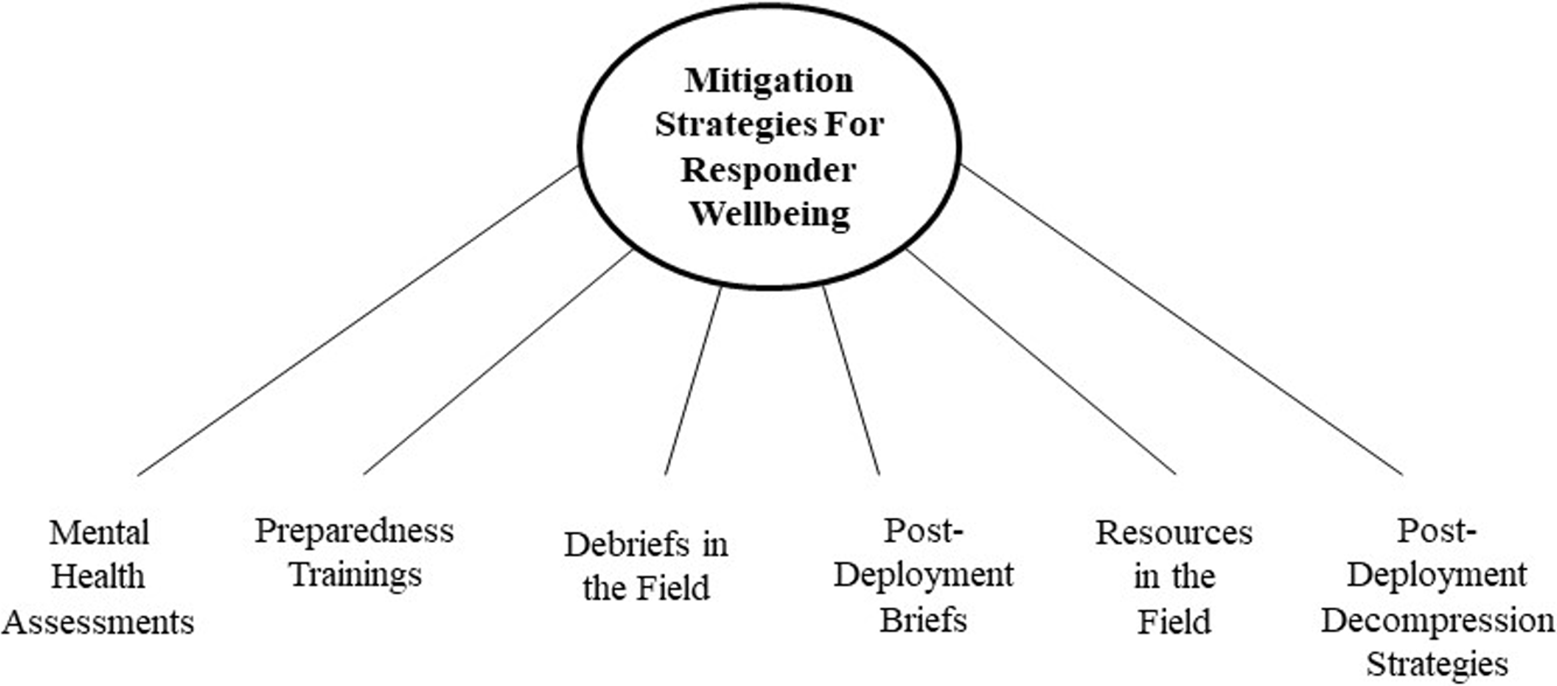
Our analysis identified risks factors associated with mental health and wellbeing throughout the deployment continuum. Overall, risks factors from this narrative review could be grouped into 5 main domains, namely: (1) demographics; (2) mental health; (3) social networks; (4) work environment; and (5) postdeployment life. Within each domain, the risk factors could be further grouped into sub-domains according to their effects on responder wellbeing. Each factor within these sub-domains shapes the way that responders experience their deployment as well as their ability to cope and reintegrate into society afterward. While many factors that negatively affect responders’ wellbeing are inherent to their identity or their critical role during public health emergencies, we provide in this discussion several strategies that may protect them based on the collective risk mitigation experience of the authors and the risk mitigation analysis drawn from this narrative review (Figure 3). We draw on strategies used to support military personnel and have tailored these strategies to the unique needs of public health responders who deploy during emergencies. In the following sections, we discuss the particular strategies that may mitigate the risk factors identified in this narrative review.
Mitigation strategies for responder wellbeing.

Mental Health Assessments
Military personnel who experienced ACEs or who struggle with other mental illnesses predeployment experience greater challenges to their wellbeing. Research shows that mental health assessments that evaluate exposure to ACEs may be a mechanism to provide additional support to affected responders.
Researchers found that mental health assessments Reference Sareen, Belik and Stein12,Reference Afari, Pittman and Floto46 that include a section for self-report allows for the evaluation of responder needs and screening for PTSD while mitigating self-censorship due to perceived or real stigma. Reference Hoge, Grossman and Auchterlonie41,Reference Warner, Appenzeller and Grieger43,Reference Gonzalez, Singh and Schell47,Reference Jones, Burdett and Wessely48 Responders identified through the assessments as struggling with symptoms associated with PTSD or vicarious traumatization may benefit from a referral to support services.
Preparedness Trainings
Work-related exposures (eg, lack of support and resources in the field, trauma exposure, previous sexual trauma, number and duration of deployments) seriously impact responder wellbeing. Preparedness trainings that brief responders on topics including but not limited to cultural sensitivity, context-specific risks, strategies for dealing with crises in the field, critical terms to be used in the field (particularly if traveling to a different linguistic-context), and understanding equipment/safety could serve as a source of psychological preparation for work-related exposures. Responders could also be briefed on technological tools that are available to connect with families while in the field to reduce feelings of isolation. Studies indicate that trainings in mindfulness, stress management, and moral distress Reference Almonte49 are helpful in mitigating negative impacts of deployment. Reference Johnson, Thom and Stanley50 Preparedness trainings may improve responder wellbeing (and the wellbeing of their families) by setting reasonable expectations for deployment. Reference Gonzalez, Singh and Schell47
Similar trainings would also be helpful for those serving in a leadership role. Leadership trainings would help those responsible for responder morale and safety to develop the necessary skillset to lead effectively. For example, trainings could emphasize the role of strong leadership, Reference Groër and Burns15 good team functioning (group cohesion), and interagency cooperation Reference Rona, Hooper and Jones32,Reference van der Velden, van Loon and Benight51 to create an environment that supports responder wellbeing.
Debriefs in the Field
The literature also indicates that psychological debriefs in the field Reference Adler, Castro and McGurk52 are associated with improved deployer wellbeing. During emergency public health responses, group debriefs after a crisis with trained leadership personnel could mitigate the impact of witnessing a traumatic event and remind responders of the availability of support. Simultaneously, agencies could operate a 24-h hotline (staffed by personnel familiar with the challenges associated with response work) to assist those in the field who may be experiencing depression, anxiety, or who need other psychosocial support.
Post-deployment Briefs
Another useful intervention identified in the literature is post-deployment briefs. Agencies could design and conduct postdeployment briefs for responders, home supervisors, and family members of responders to prepare them for the challenges that may occur during the reintegration phase of deployment. Such briefs would incorporate a discussion on risky coping mechanisms postdeployment, Reference Brief, Rubin and Enggasser6 psycho-educational information, Reference Gonzalez, Singh and Schell47 the possibility of experiencing stigma, the unique challenges faced by minorities in the field, challenges of reintegrating back into family and workplace environments, and reverse culture shock. The briefs could highlight signs indicating a need to seek support, as well as a list of referrals services. A Web-based briefing may be helpful for those who require privacy or those responders who work remotely and are unable to come in person. Reference Brief, Rubin and Enggasser6
Resources in the Field
Policies ensuring guaranteed time for deployers to reconnect with family, friends, or other loved ones regularly Reference Ricchiardi44 improved reports of wellbeing among responders. An intervention that may in part address the need for social support in the field would be to amend relevant human resource policies to ensure responders have time to connect with their families consistently during deployment. Research indicates that technology in the field that facilitates communication with family has the potential to improve responder wellbeing. Reference Ricchiardi44,Reference Greene, Buckman and Dandeker53 Agencies may also consider encouraging inter-agency communication to broaden the network of support while responders are working in the same sites.
The development of a mentorship program or buddy system similar to that implemented in the military is another opportunity to support responder wellbeing. Reference Adler, Castro and McGurk52 This sort of program could focus on pairing newly returned responders facing the challenges of reintegration with previous responders who are further along in the reentry process. A parallel “peer mentorship” system could be encouraged for responder families.
Post-Deployment Decompression Strategies
Reintegration programs for newly returned responders could incorporate a component dealing with the reintroduction to alcohol and other potentially risky coping mechanisms. Reference Jones, Burdett and Wessely48,Reference Burdett, Jones and Fear54 Postdeployment decompression activities that improve health outcomes for responders could include regular social activities to rejuvenate old relationships and foster new ones. Studies among veterans have also found that sharing experiences among groups of responders is important to responder wellbeing Reference Konvisser31 and can be facilitated through technology. One way to do this is by empowering responders to produce short informational videos depicting the challenges that they (and their families) experienced during the reintegration process. Reintegration programming should also keep in mind that physical exercise, practicing religion and spirituality, Reference Baroody, Everson and Figley55 sustaining social support, mind-body techniques and meditation, sound sleep routines, cognitive behavioral therapy, and support in finding new work opportunities have been shown to help maintain responder wellbeing. Reference Zodkoy56
Implications for Public Health
There has been a lack of studies that investigate factors that influence the wellbeing of public health emergency responders. This narrative review of the risk factors faced by other response personnel as well as potential mitigation strategies for responder wellbeing can inform how public health institutions develop programs and strategies to support the mental health and wellbeing of public health responders. These strategies, when translated into practice, may facilitate the development of a more resilient workforce ready to re-deploy. Understanding the challenges in the field allows for deploying public health institutions to design supportive work environments and monitor and evaluate their efficacy. Protecting the health of the responder population will not only benefit those serving but may also benefit the deploying institutions socially and economically as well as society as a whole.
Limitations
We sought to systematically and thoroughly review the existing literature, however, as a narrative review, the search primarily focused on risk and protective factors and as a result of this limited scope, is not a full review of all of the existing literature on responder wellbeing. In regard to content, our work focuses primarily on deployment outside of the country, and the data come largely from studies conducted among military populations. This is due to the gap in existing literature that hinders our ability to credibly extrapolate findings to that of the emergency public health responder population as the military deployment experience differs significantly. For example, military deployment is compulsory with little control as to area or conditions of deployment. Furthermore, by limiting our search to articles in English, we may have excluded relevant research published in other countries in other languages. Despite these limitations, our review offers an opportunity to synthesize the deployment experiences and the factors that serve as barriers and facilitators to wellbeing and translate these findings to other, less studied populations. This review included publications from January 2005 to December 2019, and it was conducted before the 2019 coronavirus pandemic. The effects of this devastating pandemic on the physical and mental wellbeing of both emergency and public health responders are likely to be discussed in future literature reports. At the time of manuscript preparation, there were no publications available on this topic as it relates to the pandemic.
Conclusions
There are risk factors contributing to responder wellbeing that occur throughout the deployment continuum, including social and emotional concerns that are often not considered or acknowledged when choosing to deploy. Such risks necessitate strategies for improving emergency response, such as inclusion of mental health assessments, briefings, and trainings at all stages of deployment, in addition to ongoing social support, and individual coping strategies. There is a heightened need for the field of public health emergency response to provide adequate tools and support to ensure the mental health and wellbeing of their most important resource, their responders.
Disclaimer
The findings and conclusions in this report are those of the authors and do not necessarily represent the official position of the Centers for Disease Control and Prevention.