INTRODUCTION
Reef building corals are generally considered highly sensitive to environmental stresses, such as sediment loading and turbidity (Hubbard, Reference Hubbard and Birkeland1997; Fabricius, Reference Fabricius2005). However, some species such as Mussismilia braziliensis (Verrill, 1868) occur in high-sediment habitats, which have been suggested as a local adaptation to environmental extremes (Leão & Ginsburg, Reference Leão and Ginsburg1997). Here, we investigate how reproductive effort in a coral species varies across a wide range of sediment conditions from inshore to offshore reefs, since previous studies have found a lower carbonate and higher siliciclastic content on inshore reefs sediments and a higher carbonate content on offshore reefs in the Abrolhos area (Leão & Ginsburg, Reference Leão and Ginsburg1997; Segal-Ramos, Reference Segal-Ramos2003).
Most previous studies of reproduction in Brazilian reef corals have focused on reproductive cycles (e.g. Pires et al., Reference Pires, Castro and Ratto1999, Reference Pires, Castro and Ratto2002; Neves & Pires, Reference Neves and Pires2002; Pires & Caparelli, Reference Pires and Caparelli2002; Lins de Barros et al., Reference Lins de Barros, Pires and Castro2003; Castro & Pires, Reference Castro and Pires2006). This study is the first to investigate how reproductive effort in corals in marginal reef environments is related to environment gradients, such as surrounding sediment composition.
Mussismilia braziliensis (Verrill, 1868) is endemic to Bahia State, and plays an important role as a major reef builder in Abrolhos (Castro & Pires, Reference Castro and Pires2001). It grows by intratentacular budding, so that colonies have several mouths opening up from a gastric cavity common to all polyps. This species is hermaphroditic, with the oocytes and spermatocytes developing in the same mesenteries. It reproduces by broadcast spawning gametes for external fertilization. The spawning period of M. braziliensis in Abrolhos occurs between March and mid-May (Pires et al., Reference Pires, Castro and Ratto1999).
The Abrolhos Reef Complex is the largest and richest coral reef area of the south-western Atlantic (Leão et al., Reference Leão, Kikuchi, Testa and Cortés2003). This area harbours 1% of the shallow coral reefs around the globe. Although less diverse in coral species than Caribbean reefs, it presents a high endemism (Castro & Pires, Reference Castro and Pires2001). The present study evaluated the reproductive effort of M. braziliensis at three different sites of the Abrolhos Reef Complex, using data on egg production (fecundity) as estimates of reproductive effort.
MATERIALS AND METHODS
Sampling for estimates of fecundity was undertaken at three different sites in the Abrolhos Reef Complex: ‘Parcel dos Abrolhos’ (PA), ‘Pontas Sul’ (PS) and ‘Pedra de Leste’ (PL). These sites are located at distances of approximately 15, 27 and 60 km, respectively, from the coast of mainland Brazil, along an inshore–offshore transect. Importantly, this transect represents a strong gradient in sediment conditions. According to Segal-Ramos (Reference Segal-Ramos2003), who analysed sediment composition (deposited on the reefs) at the same sites in 2000 and 2001, PL sediments had 54.6% (±4.4 SD) of carbonate during winter and 51% (±1.7 SD) during summer. The PS site, which is intermediate in the terrestrial gradient, had 65.9% (±0.3 SD) of carbonate during winter and 66.4% (±1.3 SD) during summer. PA, the outermost site had 91.7% (±2.4 SD) of carbonate during winter and 92.1% (±2.4 SD) during summer. Sedimentation rates were lower at summer (~5 mg.cm−2.day−1) and higher at winter (~10 mg.cm−2.day−1). Sediment deposition rate was not different from site to site, only between summer and winter and was related to wind-driven sediment resuspension due to polar front activity (see also Segal et al., Reference Segal, Hevangelista, Kampel, Gonçalves, Polito and Santos2008).
Coral colonies were collected by SCUBA diving, between 4 and 8 m depth, during 28 and 29 February, 2000, just before its expected spawning period, which means that maturation of gametes would be close to its maximum (Pires et al., Reference Pires, Castro and Ratto1999). At this time eggs were larger and easier to count for estimates of reproductive effort. At each site, one central fragment (~115 cm in diameter) of 10 colonies with similar size (~20 to 50 cm diameter) was collected, using hammer and chisel. Fragments were fixed in a solution of 10% formalin in seawater and deposited in the Cnidaria Collection of the Museu Nacional (MNRJ). All 30 samples were decalcified in a solution of 10% formic acid and 5% formalin for 48 hours. The decalcified polyps were rinsed in running tap water for 24 hours and then preserved in 10% formalin.
Reproductive effort was estimated as fecundity (egg counts). Fecundity was recorded, under a stereoscopic microscope, for five polyps, from each of the 30 colony fragments. To allow further comparisons, numbers of eggs per mesentery, per cm2 of colony surface area, and per polyp volume (mm3) were estimated. Decalcified fragments of colonies were directly computer scanned, and based on the image we estimated the number of polyps per cm2 of tissue surface area. The area of each colony was estimated using Scion Image software (1988 Scion Corporation). Due to the irregular polyp morphology of M. braziliensis, we considered mouth, and not gastric cavity to comprise a polyp. Fecundity per cm2 was calculated by multiplying mean fecundity per polyp by the number of polyps per cm2.
Before the dissection of each polyp, height and diameter were recorded and then area and volume were estimated. The number of mesenteries of each polyp was also counted and the ones bearing eggs were considered fertile. Due to the conical polyp morphology of M. braziliensis, polyp volume was estimated as: [1/3*3.14159* Rmaximum*Rminimum* Height], where R is half the length of the diameter. Polyp area was calculated using the formula: [3.14159* Rmaximum*Rminimum]. Fecundity per polyp volume was then calculated.
Statistical assumptions of normality and homoscedasticity were tested using the Kolmogorov–Smirnov (KS) test (Zar, Reference Zar1999) and Levene's test (Underwood, Reference Underwood1997), respectively. Data on fecundity per mesentery were used to compare the reproductive effort of M. braziliensis among sites and colonies in each site. These comparisons were performed using the Kruskal–Wallis test (Siegel, Reference Siegel1975), since assumptions for ANOVA were not met. Post-hoc non-parametric Tukey-type multiple comparison, using the Nemenyi test (q0,05,∞,3) (Zar, Reference Zar1999) was performed. We used one-way ANOVA to compare fertile mesenteries percentage among sites, since these data met the ANOVA assumptions (Zar, Reference Zar1999). The simple linear correlation between polyp fecundity and morphology data was assessed through Spearman correlation-coefficient using Statistica 4.3.
RESULTS
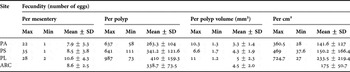
Fecundity per polyp, per cm2, and per polyp volume (mm3) was inversely related with distance to the shore (Table 1). Table 1 shows maximum, minimum, mean and standard deviation values of fecundity for each sample site. Colonies from PS showed intermediate fecundity per polyp, per cm2, and per mm3. Colonies from PA showed the lowest values of fecundity, while the closest to the coast area (PL) showed the highest mean fecundity. Mean fecundity per polyp was 55% higher in PL than PA and 20% higher in PS compared to PA. Data of fecundity per mesentery, per polyp, per cm2 and per mm3 for M. braziliensis from the Abrolhos Reef Complex are also presented in Table 1. Mean fecundity per polyp was 338.7 (±73.5 SD), per cm2 was 175 (±50.7 SD), and per mm3 was 4.46 (±2.0 SD). The highest number of eggs per polyp was 987 at PL.
Values of fecundity per mesentery, per polyp, per cm2 and per polyp volume (mm3) of Mussismilia braziliensis in the three sample sites. PA, Parcel dos Abrolhos; PS, Pontas Sul; PL, Pedra de Leste; ARC, Abrolhos Reef Complex; Max, maximum; Min, minimum; SD, standard deviation.

Fecundity per mesentery was significantly different among colonies at each site, for all sites (Kruskal–Wallis, df = 9; PA: N = 1733, H = 393.5; PS: N = 2004, H = 455.6; PL: N = 1933, H = 460.1; P < 0.05) as well as among sites (Kruskal–Wallis, df = 2; N = 5670; H = 519.3; P < 0.05). The post-hoc test showed that all sites differed from each other with respect to fecundity per mesentery (PL × PA: q = –1683. PS × PA: q = –816.7; PL × PS: q = 866.6; P < 0.05).
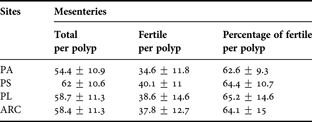
The percentage of fertile mesenteries per polyp (Table 2) did not vary significantly among sites (ANOVA, df = 2; N = 150; F = 0.38; P > 0.05). Also, there was no significant difference in polyp morphology traits among sites (Kruskal–Wallis, df = 2; N = 150; Height: H = 1.77; Area: H = 4.67; Volume: H = 2.16; P > 0.05). Results of the simple linear correlation showed that fecundity per polyp increases as its area (N = 150; r = 0.54; P < 0.05), volume (N = 150; r = 0.59; P < 0.05), height (N = 150; r = 0.46; P < 0.05) and number of fertile mesenteries increases (N = 150; r = 0.78; P < 0.05).
Mean and standard deviation of total number of mesenteries, number of fertile mesenteries, percentage of fertile mesenteries per polyp of Mussismilia braziliensis at each of the three sample sites and a mean for the Abrolhos Reef Complex. PA, Parcel dos Abrolhos; PS, Pontas Sul; PL, Pedra de Leste; ARC, Abrolhos Reef Complex.
DISCUSSION
Mussismilia braziliensis colonies showed high fecundity values in all sites along the inshore–offshore gradient. When comparing its reproductive effort with other massive coral species with similar morphology and oocyte sizes we found that M. braziliensis had a high investment in reproductive output (Table 1). For example, while Mycetophyllia ferox (see Szmant, Reference Szmant1986), Diploria strigosa, and Diploria clivosa (Vargas, 2002 cited in Morales-Tirado, Reference Morales-Tirado2006) presented two to four eggs per mesentery, M. braziliensis had a mean of 8.6 (±2.5 SD) eggs per mesentery. Hall & Hughes (Reference Hall and Hughes1996) found ~46 eggs per polyp in Goniastrea retiformis, while M. braziliensis presented 338.7 (±73.5 SD) eggs per polyp. Goniastrea aspera had ~0.8 to 2.8 eggs per mm3 (Sakai, Reference Sakai1998), while we found 4.5 (±2.0 SD) eggs per mm3 in M. braziliensis.
Sakai (Reference Sakai1998) stated that the polyp is the basic unit for physiological activities, and the present work showed that polyp morphology plays a crucial role in determining the reproductive output. The irregular polyp morphology of M. braziliensis is due to its intratentacular budding. This fact results in a variation in the number of mesenteries (Table 2). This can explain the variability in polyp fecundity within colonies, since we found a positive correlation between fecundity and polyp morphology traits. It is possible that the variation of fecundity found among colonies and sites can also be explained by this relationship. Other studies have also revealed that polyp size (Sakai, Reference Sakai1998; Shlesinger et al., Reference Shlesinger, Goulet and Loya1998; Kapela & Lasker, Reference Kapela and Lasker1999) and the number of fertile mesenteries (Hall & Hughes, Reference Hall and Hughes1996) are a physical limitation of space for the number of eggs (see also Leuzinger et al., Reference Leuzinger, Anthony and Willis2003). This corroborates Harrison & Wallace's (Reference Harrison, Wallace and Dubinsky1990) view that it is better to express the fecundity per unit area, because this allows a comparison of species with different growth forms and polyp morphology. For the same reason we also presented results in terms of eggs per volume (mm3).
According to Leão & Ginsburg (Reference Leão and Ginsburg1997), sediment deposition on inshore reefs has a higher proportion of silicilastic components (muddy sediment). Also, Dutra et al. (Reference Dutra, Kikuchi and Leão2006) reported higher sedimentation rates at Pedra de Leste, the closest-to-shore reef. Segal-Ramos (Reference Segal-Ramos2003) observed a higher non-carbonate contribution (see Materials and Methods section) and smaller colonies of M. braziliensis closer to shore. The coral energy balance is strongly affected by environmental conditions, including sediment regimes (Anthony & Fabricius, Reference Anthony and Fabricius2000; Fabricius, Reference Fabricius2005)—and, in particular, sexual reproduction is one of the key life functions limited by resources and stressors (e.g. Harrison & Wallace, Reference Harrison, Wallace and Dubinsky1990; Harrison & Ward, Reference Harrison and Ward2001). Fabricius (Reference Fabricius2005), in a review of terrestrial runoff and its effects on reef corals, presented the negative effects of dissolved inorganic nutrients, sedimentation and light reduction on coral fecundity. However, the physiology of some well-adapted species from inshore, naturally turbid environments is not necessarily negatively impacted by high turbidity levels (Anthony, Reference Anthony2006). Our data on Mussismilia braziliensis fecundity showed an inverse trend related to the terrestrial gradient. Although smaller-sized colonies occur on inshore reefs (Segal-Ramos, Reference Segal-Ramos2003), increased fecundity towards inshore, turbid waters may indicate adaptative and evolutionary responses of this endemic species occurring in naturally high turbidity reefs (Leão & Guinsburg, Reference Leão and Ginsburg1997; Sanders & Baron-Szabo, Reference Sanders and Baron-Szabo2005). Sanders & Baron-Szabo (Reference Sanders and Baron-Szabo2005 and references therein) pointed out that some taxa are more resilient to sedimentation and turbidity and that corals from intermittently turbid waters are not necessarily more stressed than clear-water counterparts.
At Abrolhos inshore reefs (PL and PS) terrestrial runoff and re-suspension of bottom sediments result in light attenuation for reef communities (Segal et al., Reference Segal, Hevangelista, Kampel, Gonçalves, Polito and Santos2008). However, at these circumstances there could be more resources (for example plankton and nutrients) on inshore reefs, leading to enhancement of tissue growth and reproductive effort. Anthony (Reference Anthony2006) found a higher lipid content on Turbinaria mesenterina and Acropora valida from inshore reefs at the Central Great Barrier Reef, Australia. His results indicated that turbidity and particulate matter did not necessarily incur greater physiological stress and otherwise could be beneficial through higher rates of particle feeding. This situation could explain the trend here observed where inshore colonies seem to have a higher reproductive output than offshore ones. Further experimental studies on the environmental traits along this inshore–offshore gradient, as well as on the physiological responses of endemic reef corals may clarify these relationships.
The present work is of major significance since it represents the first data on fecundity of M. braziliensis, a key species endemic to the South Atlantic. Furthermore, M. braziliensis was recently being considered under serious risk due to an increase in disease prevalence since 2005 (Francini-Filho et al., Reference Francini-Filho, Moura, Thompson, Reis, Kaufman, Kikuchi and Leão2008). Since our data are from a previous period, and reproductive effort is responsive and sensitive to environmental disturbance, our data may represent an important baseline for the assessment of responses of an endemic reef builder to environmental threats.
ACKNOWLEDGEMENTS
We are grateful to K. Anthony for manuscript review and valuable suggestions and M. Lins de Barros for useful comments. C. Zilberberg and C. Castro provided advice on statistical analyses. We thank the ‘Parque Nacional Marinho dos Abrolhos (PARNA/IBAMA)’ and the Brazilian Environment Agency (IBAMA) for collecting permits. This research was funded by ‘Conselho Nacional de Desenvolvimento Científico e Tecnológico (CNPq)—Grant number 471059/2003-0’ and ‘Fundação de Amparo à Pesquisa do Estado do Rio de Janeiro (FAPERJ)—Grant number E-24/171.663/1999’. Thanks to ‘Coordenação de Aperfeiçoamento de Pessoal de Nível Superior (CAPES)’ and FAPERJ for the graduate fellowship to A.C.C. and CNPq for the research fellowship to D.O.P.