


Introduction
Body dysmorphic disorder (BDD) is characterized by excessive preoccupation with an imagined or minimal defect in appearance that causes clinically significant distress and/or impairment in functioning (American Psychiatric Association, 2000). The disorder has an estimated prevalence of 0.7–2.4% in community samples of adults (Bienvenu et al., Reference Bienvenu, Samuels, Riddle, Hoehn-Saric, Liang and Cullen2000; Rief, Bulhmann, Wilhelm, Borkenhagen and Brahler, Reference Rief, Bulhmann, Wilhelm, Borkenhagen and Brahler2006; Koran, Abujaoude, Large and Serpe, Reference Koran, Ebujaoude, Large and Serpe2008). The onset typically occurs during adolescence (Phillips and Diaz, Reference Phillips and Diaz1997; Gunstad and Phillips, Reference Gunstad and Phillips2003), and estimated prevalence rates in young people are comparable to those found in adults (Mayville, Katz, Gipson and Cabral, Reference Mayville, Katz, Gipson and Cabral1999). The clinical presentation of BDD is similar across the lifespan, in terms of the nature of the symptoms and their impact (Phillips et al., Reference Phillips, Didie, Menard, Pagano, Fay and Weisberg2006). BDD in youth results in major functional impairment, including reduced academic performance, social withdrawal, and dropping out of school (Albertini and Phillips, Reference Albertini and Phillips1999; Phillips et al., Reference Phillips, Didie, Menard, Pagano, Fay and Weisberg2006). It is also associated with high rates of comorbidity, particularly major depression (Albertini and Phillips, Reference Albertini and Phillips1999), and a reported 21–44% of young people attempt suicide (Albertini and Phillips, Reference Albertini and Phillips1999; Phillips et al., Reference Phillips, Didie, Menard, Pagano, Fay and Weisberg2006).
Cognitive behavioural models of BDD highlight key processes that are understood to maintain body image concerns (e.g. Veale, Reference Veale2004). For example, repetitive behaviours (e.g. grooming/camouflaging rituals, mirror checking, reassurance seeking) and avoidance (e.g. of social situations) may reduce distress in the short-term but ultimately prevent disconfirmation of feared outcomes and therefore maintain unhelpful beliefs. Cognitive behaviour therapy (CBT) aims to reverse such maintaining factors, and there is accumulating evidence for the efficacy of CBT in the treatment of BDD in adults. A number of case series and two randomized controlled trials (RCTs) of CBT versus waitlist (Veale et al., Reference Veale, Gournay, Dryden, Boocock, Willson and Walburn1996; Rosen, Reiter and Orosan, Reference Rosen, Reiter and Orosan1995) have been conducted. Outcomes consistently demonstrate that CBT is associated with a significant reduction in symptoms, ranging from 32% (Wilhelm, Otto, Lohr and Deckersbach, Reference Wilhelm, Otto, Lohr and Deckersbach1999) to 53% (Neziroglu, McKay, Todaro and Yaryura-Tobias, Reference Neziroglu, McKay, Todaro and Yaryura-Tobias1996), when delivered either individually (e.g. Veale et al., Reference Veale, Gournay, Dryden, Boocock, Willson and Walburn1996) or in a group format (e.g. Rosen et al., Reference Rosen, Reiter and Orosan1995). The content of CBT has varied from being largely behavioural with a primary focus on exposure with response prevention (ERP; McKay et al., Reference McKay, Todaro, Neziroglu, Campisi, Moritz and Yaryura-Tobias1997) to being purely cognitive (Geremia and Neziroglu, Reference Geremia and Neziroglu2001), with most protocols incorporating both ERP and cognitive techniques (Neziroglu et al., Reference Neziroglu, McKay, Todaro and Yaryura-Tobias1996; Rosen et al., Reference Rosen, Reiter and Orosan1995; Wilhelm et al., Reference Wilhelm, Otto, Lohr and Deckersbach1999).
The current treatment literature for BDD in adolescents is limited to a small number of single case reports. Three case studies have demonstrated good clinical outcomes with CBT alone (Aldea, Storch, Geffken and Murphy, Reference Aldea, Storch, Geffken and Murphy2009; Greenberg et al., Reference Greenberg, Markowitz, Petronko, Taylor, Wilhelm and Wilson2010) and in combination with doxepin (Sobanski and Schmidt, Reference Sobanski and Schmidt2000). In contrast, two others have reported minimal improvement with behavioural therapy (Braddock, Reference Braddock1982) and CBT combined with family therapy, pharmacotherapy and psychodynamic psychotherapy (Horowitz, Gorfinkle, Lewis and Phillips, Reference Horowitz, Gorfinkle, Lewis and Phillips2002). However, it is of note that in the former case report, behavioural therapy focused on social skills and assertiveness training and hence was not comparable to current CBT protocols (Braddock, Reference Braddock1982).
In summary, there is preliminary evidence for the efficacy of CBT in treating BDD in adulthood, and given the similarity between adult and adolescent BDD, it is reasonable to assume that CBT will prove to be an effective intervention in adolescent populations. This assumption is partially supported by published single case reports, but more systematic investigation is required. The aim of the current study was to investigate the efficacy of ERP-based CBT in adolescents with BDD using a case series design. The primary hypothesis was that CBT would be associated with an overall reduction in BDD symptoms. A secondary hypothesis was that the mean percentage symptom reduction would be in line with those reported in previous adult studies (i.e. 32–53%).
Method
Participants
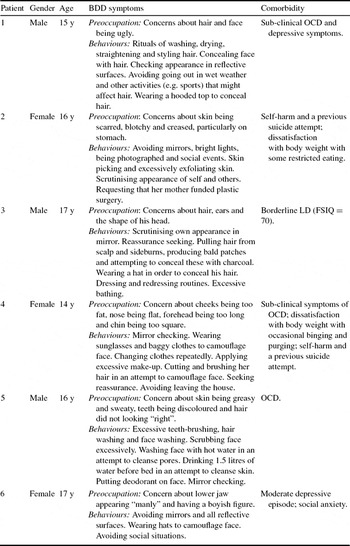
The cases presented were referred to a specialist Obsessive Compulsive and Related Disorders Clinic (n = 5) and Anxiety Disorders Clinic (n = 1) for young people. All patients met DSM-IV (APA, 1994) diagnostic criteria for BDD as determined by a comprehensive clinical assessment. Patient characteristics and BDD symptoms are shown in Table 1. Two individuals had had previous attempts at CBT for BDD (Patients 3 and 4). Three patients were taking medication at the start of CBT: Patient 3, fluoxetine 40mg and risperidone 1mg; Patient 4, sertraline 150mg; Patient 5, fluoxetine 20mg. All three patients had been on a stable dose for at least 3 months prior to CBT and their dose remained unchanged during the course of CBT and follow-up. In addition, Patient 1 commenced a trial of fluoxetine 40mg during the course of CBT due to low mood.
Patient characteristics and details of BDD symptoms

Assessment and measures
All patients attended an initial assessment with a specialist team. Assessment included a mental state examination and interview with the young person to obtain a detailed account of their BDD symptoms, and an interview with parents to obtain a developmental history and an account of current difficulties. In addition, patients completed a number of standardized symptom measures.
A structured diagnostic measure was completed pre-treatment: five families completed the Development and Well-Being Assessment (DAWBA; Goodman, Ford, Richards, Gatward and Meltzer, Reference Goodman, Ford, Richards, Gatward and Meltzer2000) and one completed the Mini International Neuropsychiatric Interview (MINI; Sheehan et al., Reference Sheehan, Lecrubier, Sheehan, Amorim, Janavs and Weiller1998). BDD symptoms were evaluated using the Yale-Brown Obsessive Compulsive Scale for BDD (BDD-YBOCS; Phillips et al., Reference Phillips, Hollander, Rasmussen, Aronowitz, DeCaria and Goodman1997), a widely used clinician-administered severity measure that yields a total score ranging from 0–48. The BDD-YBOCS was administered pre- and post-treatment, and where possible at 3- and 6-month follow-up. Treatment response was defined as ≥30% decrease in score. The Beck Depression Inventory-Youth (BDI-Y; Beck, Beck and Jolly, Reference Beck, Beck and Jolly2001) was included as a secondary outcome measure and was administered pre- and post-treatment.
Treatment
All participants received a course of individual CBT. Treatment broadly followed CBT protocols developed for adults with BDD (e.g. Wilhelm, Buhlmann, Cook, Greenberg and Dimaite, Reference Wilhelm, Buhlmann, Cook, Greenberg and Dimaite2010) but delivery was modified to ensure that it was developmentally appropriate. For example, language was modified, structured worksheets and handouts were provided, and treatment involved parents. A greater emphasis was placed on behavioural strategies compared to existing adult protocols, in keeping with CBT protocols for obsessive-compulsive disorder (OCD) in youth (e.g. March and Mulle, Reference March and Mulle1998). There were three main phases to treatment: psychoeducation (sessions 1 and 2), ERP (sessions 3 onwards) and relapse prevention (final session).
Psychoeducation included discussion about: the symptoms, possible causes and prevalence of BDD; the role that compulsive behaviours and avoidance play in maintaining dysmorphic preoccupations and anxiety (i.e. the CBT model); and anxiety recognition and habituation. One or both parents were present throughout these sessions in order that they understood the cognitive behavioural formulation.
ERP was graded, as guided by a hierarchy of feared situations. ERP tasks were completed with the therapist in most sessions and as homework between sessions. For example, the young person might be encouraged to go into a social situation and resist concealing their perceived defect with make-up or clothes. Parental involvement varied depending on the developmental level of the young person and the extent to which parents were accommodating BDD-related behaviours. Formulation-driven cognitive strategies, including challenging dysfunctional beliefs about the importance of appearance, were utilized as appropriate but were not the main focus of treatment. Finally, relapse prevention included consolidating CBT skills, identifying possible relapse triggers, and developing a management plan if relapse were to occur.
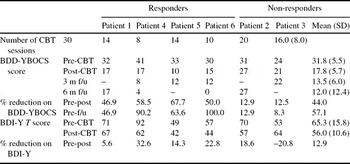
Sessions were generally 60 minutes and were offered on a weekly basis, although the mean attendance rate was fortnightly. The total number of sessions completed ranged from 8 to 30, with a mean of 16 (see Table 2). Therapists were clinical psychologists, a clinical psychologist in training, and a consultant psychiatrist, all of whom were experienced in the delivery of CBT, with particular expertise in treating anxiety disorders in children and adolescents.
BDD and depressive symptoms over the course of CBT

Results
Table 2 presents the BDD-YBOCS scores for all patients before and after CBT, as well as at follow-up. The mean BDD-YBOCS score was 31.8 (SD = 5.5, range 24–41) at baseline and 17.8 (SD = 5.7, range 10–27) at post-treatment, indicating a 44% decrease in symptoms over the course of treatment for the group as a whole. At the last follow-up point (3- or 6-month follow-up) the mean BDD-YBOCS score was 13.7 (SD = 10.41, range 0–27), representing a 57% reduction in BDD symptoms from baseline, and demonstrating that overall further gains were made during the follow-up period. At post-treatment and at follow-up, four of the six patients met criteria for being treatment “responders” and the remaining two were “non-responders”. These analyses were repeated excluding Patient 1, given that in this case a trial of fluoxetine was commenced during CBT, which may have accounted for improvement. After excluding Patient 1, a similar pattern of results was found: the mean BDD-YBOCS scores pre- and post-treatment were 31.8 (SD = 6.14, range 24–41) and 18 (SD = 6.4, range 10–27) respectively, indicating a 43% decrease in BDD symptoms over CBT. The mean BDD-YBOCS score at the last follow-up was 13.0 (SD = 11.5, range 0–27), demonstrating a 59% reduction in symptoms compared to baseline.
Raw scores on the BDI-Y were converted to T scores using data from Beck, Beck, Jolly and Steer (Reference Beck, Beck, Jolly and Steer2005). The mean T score was 65.3 (SD = 15.8, range 49–92) before treatment and 56.0 (SD = 10.6, range 42–67) after treatment, indicating a group decrease in depressive symptoms from the moderately elevated to the mildly elevated range over the course of CBT. Analysis by responder status indicated that this pre- to post-treatment reduction in depressive symptoms was greater in the treatment responder group. For the treatment responders, the mean T score decreased from 67.3 (SD = 18.8, range 49–92) to 53.8 (SD = 12.6, range 42–67), indicating a reduction in depressive symptoms from the moderately elevated to the average range. For the non-responders, one patient showed a decrease in depressive symptoms while the other displayed an increase, resulting in a negligible group decrease from 61.5 (SD = 12.0, range 53–70) to 60.5 (SD = 4.9, range 57–64).
The four treatment responders reported significant improvements in functioning in social, educational and family domains. For example, at pre-treatment, two cases had completely withdrawn from school because of BDD, one had poor attendance, and one was attending most days but BDD was significantly impairing her academic performance. At post-treatment, improvements were evident in all four cases: three were attending school without difficulties, and the fourth young person was working in paid employment and was planning to start college. Of the two patients who did not respond to CBT, one had erratic school attendance that remained problematic post-treatment, and the other did not have any educational difficulties before or after treatment. No adverse events occurred during treatment that could have been attributable to therapy.
Discussion
The current case series demonstrates that CBT can be an effective treatment for BDD in young people. Despite having relatively severe BDD before starting CBT, symptoms decreased by 44% on average over the acute phase of treatment, with residual symptoms falling in the mild-moderate range. At the 3- to 6-month follow-up point, symptoms had decreased by 57% on average compared to pre-treatment, indicating that further gains were made after completing the course of CBT. Although these results suggest that CBT is an effective intervention in this population, it must be noted that one of the cases commenced a trial of fluoxetine during the course of CBT. It is possible that this may have contributed to the reduction in BDD symptoms observed in this case given that fluoxetine has been demonstrated to be an effective treatment for BDD (Phillips, Albertini and Rasmussen, Reference Phillips, Albertini and Rasmussen2002), but nevertheless the overall group outcomes remained similar after this patient was excluded from the analyses. Moreover, due to the lack of control group, the improvements seen in four of the six cases cannot unequivocally be attributed to the CBT. However, it is unlikely that symptom decrease was a consequence of the passage of time, as all patients had had stable or worsening symptoms for at least 18 months prior to treatment, and three young people had failed to respond to previous treatment. Furthermore, adult BDD treatment studies that have included a waiting list control have demonstrated that spontaneous remission is unlikely (Rosen et al., Reference Rosen, Reiter and Orosan1995; Veale et al., Reference Veale, Gournay, Dryden, Boocock, Willson and Walburn1996). It is still possible that patients in the current study, and previous studies, improved with CBT due to non-specific effects of treatment. Future treatment trials should include a non-targeted therapy as a control in order to disentangle specific and non-specific effects.
In addition to the reduction in BDD symptoms reported here, there was a decline in self-reported depression over the course of CBT for the treatment-responders, with symptoms decreasing from the moderately elevated to the average range overall. Improvements in depression following CBT for BDD have been observed in several adult studies (e.g. McKay et al., Reference McKay, Todaro, Neziroglu, Campisi, Moritz and Yaryura-Tobias1997; Wilhelm et al., Reference Wilhelm, Otto, Lohr and Deckersbach1999), and suggest that depressive symptoms may often occur secondary to BDD, as is also indicated by the finding that the onset of BDD usually precedes depression (Phillips, Didie and Menard, Reference Phillips, Didie and Menard2007; Gunstad and Phillips, Reference Gunstad and Phillips2003). This is important because depression has the most common comorbid diagnosis in patients with BDD, approximately three-quarters of individuals with BDD having a lifetime history of the disorder (Phillips et al., Reference Phillips, Didie and Menard2007). The clinical impact of comorbid depression remains unclear but the current findings support the notion that it may not require independent treatment routinely, and may improve as BDD symptoms resolve.
The clinical outcomes reported here are in line with those found in previous studies of adults with BDD, suggesting that CBT might be an equally appropriate treatment for adolescents with the disorder, provided that it is adjusted to their development level. All of the adolescents described here received CBT that was primarily focused on ERP. This suggests that ERP, delivered in the context of appropriate psychoeducation, may be an effective intervention for BDD, which is consistent with the literature on OCD showing that ERP is an active element of CBT. For example, in a controlled study of 35 outpatients, Vogel and colleagues demonstrated that ERP alone was associated with a significant reduction in OCD symptoms (Vogel, Stiles and Götestam, Reference Vogel, Stiles and Götestam2004). Interestingly, adding cognitive therapy interventions did not augment treatment with respect to symptom outcome, but lower drop-out rates were observed in the cognitive therapy plus ERP group. The extent to which additional cognitive methods enhance treatment outcome in BDD remains an important question for future research. Another important question relates to the number of sessions delivered. Wilhelm et al. (Reference Wilhelm, Otto, Lohr and Deckersbach1999) administered session-by-session symptom measurement over a course of 12 sessions of CBT for BDD and found a linear improvement, suggesting that additional sessions may lead to further symptom reduction. In the current case series the average number of sessions delivered was 16, although there was a wide range, which is in line with many of the adult protocols. Future studies should explore the extent to which there is a dose-response relationship with CBT and establish the optimal number of sessions.
Although the findings of this case series are encouraging, it is of note that two of the six cases reported here did not show a treatment response, and of the four that did, two had clinically significant residual symptoms at follow-up. This highlights the need for further research into, and refinement of, cognitive behavioural models and treatments for adolescents with BDD. Of the two non-responders in the current study, one had a borderline learning disability and struggled to grasp the central concepts of treatment, such as exposure and anxiety habituation. The second non-responder lacked insight into her symptoms (although, as mentioned above, insight was not formally measured) and hence was ambivalent about receiving psychological treatment. It may be that in such cases CBT requires further adaptation (e.g. greater parental involvement for those who struggle to understand the treatment model) or adjunctive treatment modules (e.g. motivational interviewing for those who are ambivalent about therapy). Cognitive techniques may also prove to be valuable in individuals who lack insight. However, it is equally important that individual components of CBT packages are empirically validated in order to maximize efficacy and ensure that the active elements of CBT are not diluted.
In summary, the current case series represents the first evaluation of CBT for BDD in a group of adolescents. The results suggest that ERP-based cognitive behavioural treatment can be an effective treatment in this population, and the clinical outcomes obtained here are comparable to those found in adult studies. Given the small sample size and lack of control group, findings must be interpreted cautiously. Nevertheless, the results are encouraging and indicate the value of further investigation in this field, which should include evaluating the efficacy of CBT for adolescent BDD via a randomized controlled trial.



Comments
No Comments have been published for this article.