


Introduction
Modern economic growth requires a permanent stream of innovation that continuously increases productivity. Academic debates begin with the question of how to generate and sustain this constant stream of innovation. Many scholars argue that patents are necessary to encourage private inventors and companies to undertake risky research and development projects.Footnote 1 According to this view, these actors will only be willing to risk financial resources if they can obtain intellectual property rights and hope for ample monopoly profits in the event of an economically successful innovation. An important assumption is usually not explicitly stated: proponents of patent systems implicitly assume that inventors operate in a free society in which the patent authority does not discriminate against them based on origin, ethnicity, religion, or gender, and in which inventors are free to choose the scope and direction of their innovation projects.
In authoritarian states, patent systems may function differently, depending on the degree to which personal and economic freedom is restricted.Footnote 2 Even if patent rights continue to be granted under authoritarian rule, there are three main reasons to believe that fewer innovations are created and patented in authoritarian regimes than in democratic states. First, authoritarian regimes tend to reduce the pool of potential inventors by simply denying patents to certain undesirable groups. The same effect occurs when patents are still formally granted to all, but people who are discriminated against refrain from acquiring this intellectual property right because they cannot rely on the courts to enforce their rights in the event of patent infringements.Footnote 3 Second, authoritarian regimes often deny certain groups access to tertiary education and subsequent employment in development and research, which is why these people cannot pursue careers linked to the development of innovations.Footnote 4 In this case, the low number of patents held by the discriminated groups is not the result of discrimination by the patent office, but rather of a state-enforced misallocation of talent (Hsieh et al. Reference Hsieh, Hurst, Jones and Klenow2019; Hunt et al. Reference Hunt, Garant, Hermann and Munroe2013; Lubczyk and Moser Reference Lubczyk and Moser2024). Third, authoritarian regimes restrict access to certain information through censorship; sometimes they even knowingly provide their citizens with false information. It is doubtful that the creativity of inventors is unaffected by this restriction of their information set, even if the information withheld is related to political or social rather than to economic and technological issues.
To examine the influence of authoritarian states on the patenting activities of their citizens, we take a closer look at two cases from German history: the “Third Reich” from 1933 to 1945 and the German Democratic Republic (GDR), the socialist state that was created in East Germany and existed from 1949 to 1990. In this article, we focus on the role of female patentees in these two regimes by quantifying their number, their technological specialization, and by identifying the “great inventors” among them.Footnote 5 In doing so, we contribute to the emerging field of economic history research that explores the reasons for the persistent underrepresentation of female inventors at the international level.
The National Socialist regime, which sought to achieve self-sufficiency in goods essential to the coming war effort, should have been keen to promote technological progress on a wide scale.Footnote 6 Nevertheless, we show that the proportion of female inventors in the “Third Reich” remains low, which may have been due to ideology. Seeing women primarily as mothers and keepers of the home (Klinksiek Reference Klinksiek1982), the Nazi regime may have suppressed them as inventors directly or indirectly in a similar way as it discriminated against women in other professions. According to Gary S. Becker (Reference Becker1971: 14), a government’s “taste for discrimination” always comes with an economic price. Not employing a group of people according to their abilities means that the price of labor rises and output goes down, which also includes new ideas that women could have come up with.
In the GDR, the policy was different. From its foundation until the building of the Berlin Wall in 1961, the GDR faced a steady loss of well-educated workers who fled to the free West. Perhaps born out of necessity, and in contrast to the “Third Reich,” the regime therefore sought to increase the participation of women in the labor force (Budde Reference Budde2003; Kaminsky Reference Kaminsky2016). The efforts of the GDR government of making it easier for women to enter higher education and industrial professions in STEM (science, technology, engineering, mathematics) fields provide a plausible explanation for the increase in the rate of female inventors, which rose from less than 1 percent in the 1950s to over 19 percent in the 1980s, as we document in this article. Given the political will, an authoritarian regime has the power to make its society more inclusive in certain areas.
This article contributes to the literature on female inventors and their human capital. Zorina Khan has pioneered quantitative research on female inventors in the nineteenth century in several studies, including the United States (Khan Reference Khan2000, Reference Khan1996), Britain (Khan Reference Khan2023), and France (Khan Reference Khan2016).Footnote 7 Merouani and Perrin (Reference Merouani and Perrin2024) deepen the historical analysis of female inventors in France. Frietsch et al. (Reference Frietsch, Haller, Funken-Vrohlings and Grupp2009) show that in modern-day Germany, women contribute less to scientific and technological output through patents and publications than women do in France and Spain. For Italy, Giuri et al. (Reference Giuri, Grimaldi, Kochenkova, Munari and Toschi2020) find that university policies to foster female academics increase the share of women involved in patenting, and for Sweden, Ejermo and Lavesson (Reference Ejermo and Lavesson2012) show that female academics are as likely as their male colleagues to become inventors after obtaining a professorship. Lubczyk and Moser (Reference Lubczyk and Moser2024) show that the low share of female scientists in patent-intensive STEM fields was the main driver of the innovation gender gap in the United States during the interwar period. Using US biomedical patent data from 1976 to 2010, Koning et al. (Reference Koning, Samila and Ferguson2020) claim that female inventors focus on women’s needs. In a more general study, Bell et al. (Reference Bell, Chetty, Jaravel, Petkova and van Reenen2019) use patent data to analyze the social background of US inventors. Their results highlight the role of exposure to innovation during childhood, increasing the probability to become an inventor, for both men and women.
Second, we add to the literature on patenting and innovation in Germany, which has focused on the nineteenth and early twentieth centuries so far. Recent research covers the period before the introduction of the nationwide German Patent Law in 1877, including studies on the discrimination against foreigners in the patent system (Lehmann-Hasemeyer and Streb Reference Lehmann-Hasemeyer and Streb2020) and the social background of patentees (Donges and Selgert Reference Donges and Selgert2023, Reference Donges and Selgert2021). For the period after 1877, Streb et al. (Reference Streb, Baten and Yin2006) have built a patent dataset to analyze the role of knowledge spillovers both regionally and technologically. Subsequent research on this period focuses, for example, on the financing of innovative companies (Lehmann-Hasemeyer and Streb Reference Lehmann-Hasemeyer and Streb2016), the role of human capital for innovation (Cinnirella and Streb Reference Cinnirella and Streb2017), and the importance of inclusive institutions (Donges et al. Reference Donges, Meier and Silva2023). Recently, scholars have also been studying different waves of migration of East German inventors to West Germany after World War II. Bergeaud et al. (Reference Bergeaud, Deter, Greve and Wyrwich2025) examine developments prior to the construction of the Berlin Wall in 1961, whereas Hipp and Hünermund (Reference Hipp and Hünermund2025) look at the period following reunification in 1990.
Third, we contribute to the historical literature on the role of women and discrimination against women in Nazi Germany and the GDR. Stephenson (Reference Stephenson1975) elaborates on women in the society of Nazi Germany, with particular emphasis on the roles of motherhood and employment. The implementation of women’s policies measures in Nazi Germany has also been analyzed by Klinksiek (Reference Klinksiek1982). Schubert (Reference Schubert and Gerhard1997) discusses the status of women in German family law. For the GDR, Kaminsky (Reference Kaminsky2016) has written an overview of all aspects of life as a woman in East Germany. In her comprehensive overview of women in the intelligentsia, Budde (Reference Budde2003) focuses on the GDR’s policy toward female students. Hildebrandt (Reference Hildebrandt and Schulz2000) studies female scientists in the GDR and Burkhardt and Schlegel (Reference Burkhardt and Schlegel2004) women in East German universities and colleges of higher education. Overall, it seems that, in comparison with West Germany, a more gender-egalitarian culture developed in the GDR, an argument that is supported by Boelmann et al. (Reference Boelmann, Raute and Schönberg2025), who use the German reunification as a natural instrument.
The article is structured as follows: we start with a review of the quantitative literature on the role of female inventors and patentees to show how the shares evolved over time and differed between countries. Then, we provide a general overview of the women’s policies in Nazi Germany and the GDR, which potentially have affected female inventorship. Afterward, the patent dataset is described. Furthermore, we discuss the role of women inventors using patents as a measure for innovation. This is followed by a brief discussion of evidence for the persistence in female inventorship from Nazi Germany to the GDR. We conclude with a summary of the results.
The importance of female inventors in history
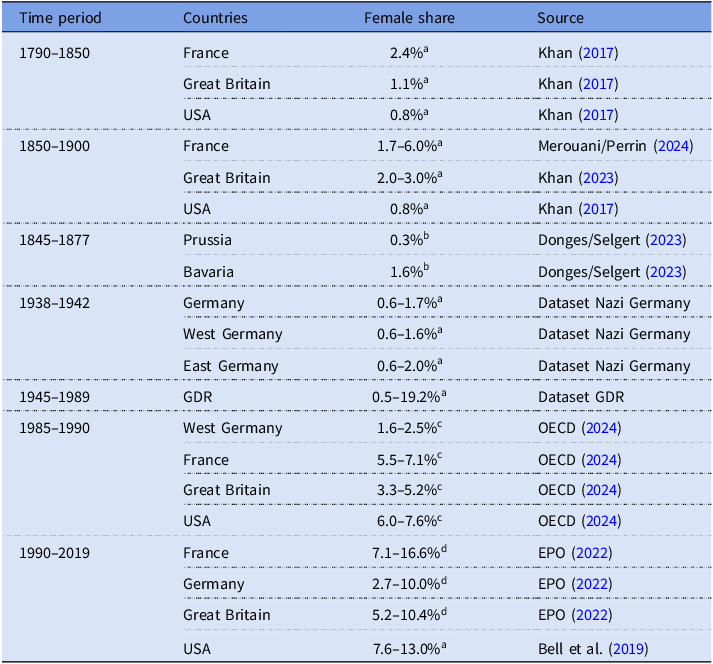
Research on female patentees and inventors has become increasingly popular since the turn of the twenty-first century. Previously, there was little research on the quantitative contribution of female inventors to innovation and technological change, although women have always invented and have done so since the beginning of civilization (Gage Reference Gage1883). Autumn Stanley (Reference Stanley1995) goes so far as to claim that all inventions whose inventors are not known by name could just as well have been invented by a woman. However, the gender gap in patenting has existed from the beginning of modern patent systems, and, even today, the proportion of women inventors is still lower than that of men in all major countries. From a historical perspective, we can think of many reasons for this; unequal access to education, family responsibilities, and a lack of property rights might have hindered female inventors in the past, and the consequences of these disadvantages might still be felt today. In the following, we provide an overview of research that quantifies the proportion of female inventors by using patent data. The evidence is limited to a small number of countries and is not available for all periods. Although there is more research on the nineteenth century, the period of industrialization, there is less evidence for the twentieth century. In particular, there is a huge gap for the period 1900−85. Table 1 shows the share of female inventors in different periods, based on the available literature, the results presented in this article, and information extracted from official statistics of the Organisation for Economic Co-operation and Development (OECD) and the European Patent Office (EPO). We include information only for Germany, France, Great Britain, and the United States, but data on the share of female inventors are also available for other countries.Footnote 8
Women inventor rate: Overview of the quantitative literature

Long description
The table presents the share of female inventors in different countries over several time periods. It has four columns: Time period, Countries, Female share, and Source. The table includes data for France, Great Britain, USA, Prussia, Bavaria, Germany, West Germany, East Germany, and GDR. The time periods range from 1790 to the present. The Female share column lists percentages or ranges of percentages of female inventors. The Source column cites various studies and datasets. Row 1: Time period 1790–1850, Countries France, Female share 2.4 percent a, Source Khan (2017). Row 2: Time period 1790-1850, Countries Great Britain, Female share 1.1 percent a, Source Khan (2017). Row 3: Time period 1790–1850, Countries USA, Female share 0.8 percent a, Source Khan (2017). Row 4: Time period 1850–1900, Countries France, Female share 1.7–6.0 percent a, Source Merouani/Perrin (2024). Row 5: Time period 1850-1900, Countries Great Britain, Female share 2.0–3.0 percent a, Source Khan (2023). Row 6: Time period 1850-1900, Countries USA, Female share 0.8 percent a, Source Khan (2017). Row 7: Time period 1845–1877, Countries Prussia, Female share 0.3 percent b, Source Donges/Selgert (Reference Donges and Selgert2023). Row 8: Time period 1845–1877, Countries Bavaria, Female share 1.6 percent b, Source Donges/Selgert (2023). Row 9: Time period 1938–1942, Countries Germany, Female share 0.6–1.7 percent a, Source Dataset Nazi Germany. Row 10: Time period 1938–1942, Countries West Germany, Female share 0.6–1.6 percent, Source Dataset Nazi Germany. Row 11: Time period 1938–1942, Countries East Germany, Female share 0.6–2.0 percent, Source Dataset Nazi Germany. Row 12: Time period 1945–1990, Countries GDR, Female share 0.5–19.2 percent a, Source Dataset GDR. Row 13: Time period 1985-1989, Countries West Germany, Female share 1.6–2.5 percent c, Source OECD (2024). Row 14: Time period 1985-1990, Countries France, Female share 5.5–7.1 percent c, Source OECD (2024). Row 15: Time period 1985–1990, Countries Great Britain, Female share 3.3–5.2 percent c, Source OECD (2024). Row 16: Time period 1985–1990, Countries USA, Female share 6.0–7.6 percent c, Source OECD (2024). Row 17: Time period 1990-present, Countries France, Female share 7.1–16.6 percent d, Source EPO (2022). Row 18: Time period 1990-present, Countries Germany, Female share 2.7–10.0 percent d, Source EPO (2022). Row 19: Time period 1990-present, Countries Great Britain, Female share 5.2–10.4 percent d, Source EPO (2022). Row 20: Time period 1990-present, Countries USA, Female share 7.6–13.0 percent a, Source Bell et al. (Reference Bell, Chetty, Jaravel, Petkova and van Reenen2019).
Notes: Since 1949, Germany was divided into two separate countries, the Federal Republic of Germany (West Germany) and the GDR in the East. For the period between 1938 and 1942, we refer to the territory that became the GDR in 1949 as “East Germany” (excluding Berlin). The data for West Germany, as well as the other data taken from the OECD, only cover the years 1985−90, as the OECD data do not go back further. Note that the WIR has been calculated by the authors in different ways.
a The WIR is the share of patents with at least one female inventor in all patents.
b The WIR is the share of patents with at least one female patentee and/or inventor in all patents.
c The WIR is the weighted share of female inventors among all inventors named in the patents. Each inventor receives a weight corresponding to the number of patent families for which he/she is listed.
d The WIR is the share of female inventors among all inventors named in the patents of a given year.
There are different ways to quantify the share of female inventors, depending on the available data (Martinez et al. Reference Martinez, Raffo and Saito2016). In this article, we compute the “Women Inventor Rate” (WIR) for Nazi Germany and the GDR by counting the number of patents with at least one female inventor and dividing this number by the total number of patents granted in the respective year. The EPO, for example, uses a different definition and computes the share of female inventors among all inventors named in the patents of a given year. Thus, compared with the EPO’s definition, our WIR produces higher values, which must be considered when comparing the data. Historical figures from other countries and periods are also not fully comparable due to different sample sizes.
For Germany, we have first empirical evidence for the mid-nineteenth century. By using patents filed in the German states between 1845 and 1877, prior to the introduction of the nationwide German Patent Law, Donges and Selgert (Reference Donges and Selgert2023) find that the share of patents granted to women was only 0.3 percent in Prussia and even lower for all other states except for Bavaria. In Bavaria, this share was around 1.6 percent, which is still a low figure, but much closer to the shares documented for other countries such as France (see Table 1). One reason for the higher share in Bavaria is that the Bavarian patent law explicitly stipulated that women were eligible for getting a patent granted. In all other German states, only widows and unmarried women could get patents, and the rights of married women were restricted by marital law (Donges and Selgert Reference Donges and Selgert2023: 131–3). Consequently, the true WIR may have been higher, assuming that some inventions were patented by the husbands of the original female inventors.
So far, no quantitative research has been conducted on the role of female inventors during the period from 1877 to 1932. Studying the role of female inventors during this period is challenging, since German patents only began to include information about the inventor in 1937. Therefore, we cannot directly compare our estimates for Nazi Germany and the GDR with the period of the Weimar Republic (1919–32). At first glance, the low rate of female inventors in the 1930s reflects the women’s policy of the Nazi regime, which created incentives to push women out of the labor force, as we describe in the next section. Looking at the GDR, we find a WIR of a similarly low magnitude in the 1950s, but it increased massively until the 1980s. For West Germany, there are no comparable data for the 1950s. During the 1980s, the GDR had a markedly higher proportion of female inventors than West Germany. In this period, it was also higher than in France, Great Britain, and the USA. A plausible explanation for this development is the GDR’s policy of promoting women in all areas of professional life – a clear contrast to the policies of the Nazi regime. At the end of the GDR, the WIR was also much higher than it is in unified Germany today, as the more recent data in Table 1 show. Based on the EPO statistics we find a WIR of only 10 percent. This puts Germany almost at the bottom of the list, with France faring much better at 16.6 percent.Footnote 9
Historical background
Women in Nazi Germany
When thinking about the role of women in Nazi Germany, the Mutterkreuz (“Cross of Honour of the German Mother”), the Bund Deutscher Mädel (“League of German Girls”), and propaganda posters showing a housewife at the stove may be the first things that come to a historian’s mind. According to Stephenson (Reference Stephenson1975: 190), the Nazis were primarily concerned with women as child bearers so that they should be removed from work that could damage their “reproductive capacity.” In fact, at the beginning of their dictatorship, the Nazis tried to push married women out of the workforce and back into the private sphere of the home, which was also a means to reduce (male) unemployment (Harvey Reference Harvey, Boldorf and Scherner2023). A well-known attempt to achieve this goal was the Ehestandsdarlehen, which was a marriage loan program designed to help young families to buy household goods. However, to receive a marriage loan, the newlywed wife had to give up her job, a rule that remained in force until 1937 (Somcutean Reference Somcutean2022).
The economic boom of the mid-1930s, which was driven by government demand for armaments and investment in autarky industries, reduced unemployment and led to significant labor shortages even before the outbreak of World War II. As a result, the Nazis gave up their attempts to force women out of the workforce; on the contrary, they now tried to make better use of the remaining female labor reserves and to recruit women as industrial workers. Whether this was successful is still disputed in the literature (Harvey Reference Harvey, Boldorf and Scherner2023). What reduced the pressure to mobilize German women for the war economy was the use of millions of foreign forced laborers, including many female civilians from Russia (Herbert Reference Herbert1997). Still, during World War II, the proportion of German women in employment increased compared with the 1930s, reaching 34 percent in 1943 (Tooze Reference Tooze2006: 515). The group that profited from this development were women who had been educated in the so-called “male domains.” They were given the opportunity to enter the professions for which they had been trained. Female inventors may have also benefited from this development.
There is a long history of legal discrimination against women. In the nineteenth century, patents were not granted to married female inventors but only to their husbands so that, in general, only unmarried or widowed women could get a patent on their own (Donges and Selgert Reference Donges and Selgert2023: 131). By the time of the 1930s, this official legal discrimination had ended so that married women could also patent inventions. The German Patent Law of 1936 did not include any discriminatory clauses against women, and we find no evidence for discriminatory practices against women by the German Patent Office,Footnote 10 but the patent system was still dominated by men. For example, we could not identify any female patent attorneys in the patent lists, and the archival sources also indicate no evidence for any female patent examiner.
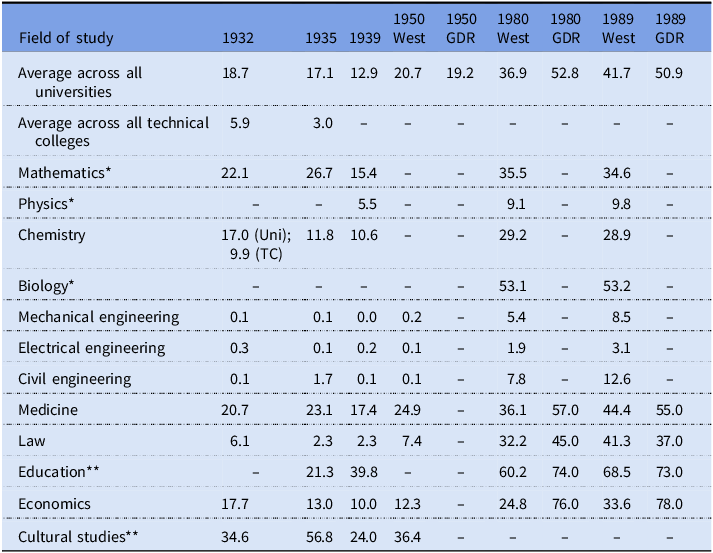
Regarding the ability of women to invent new products and technologies, the role of education and human capital must be highlighted. Since the nineteenth century, human capital has become increasingly important for innovation, particularly in the chemical and electrical industries, which were the leading sectors of the second industrial revolution (Cinnirella and Streb Reference Cinnirella and Streb2017; Donges and Selgert Reference Donges and Selgert2023: 133–35). The issue of women’s rights had always been intertwined with educational opportunities and the possibility to work. Although German women had been allowed to enroll in universities before World War I – in Prussia, for example, since 1908 – they could still be legally excluded from attending classes or taking exams as mere enrollment was not yet linked to the right of partaking in examinations (Klinksiek Reference Klinksiek1982: 13).Footnote 11 When women did study, they preferred the humanities and medicine to other fields of study (see, for example, the year 1932 in Table 2). Very few women chose to attend a technical college (von Soden and Zipfel Reference von Soden and Zipfel1979: 40). In April 1933, the Nazi government introduced a “law against overcrowding at German schools and universities,” which stipulated that a maximum of 10 percent of a reduced total number of students could be female (Mertens Reference Mertens1989). In addition, prospective female students were required to complete the Reich Labor Service for Female Youth (Reichsarbeitsdienst der weiblichen Jugend), the duration of which varied between 10 and up to 52 weeks (von Soden and Zipfel Reference von Soden and Zipfel1979: 29). Even though the maximum quota for female students was lifted again in February 1935, the number of female students enrolled in universities decreased from 18.7 percent in the winter semester of 1932 to just 12.9 percent in the winter semester of 1939. At the technical universities (TH), where engineers were trained, the share of female students halved between 1932 and 1935 from just under 6 percent to 3 percent (see Table 2).Footnote 12 Because formal academic education was important for inventive activity in knowledge-intensive sectors such as the chemical industry, where industrial R&D departments were the drivers of innovation (Murmann Reference Murmann2003), the decline in the number of female students reduced the pool of potential female inventors. Although this development may have had long-run consequences for the 1950s, it can hardly explain the low number of female inventors in the 1930s. This situation resulted more from the fact that employment opportunities in engineering were virtually nonexistent for women in the 1930s, lowering also their potential for technical inventions (Vogt Reference Vogt, Canel, Oldenziel and Zachmann2000: 186).
Share of female students in Nazi Germany, West Germany, and the GDR in percent

Table 2. Long description
A table comparing the share of female students in various fields of study across different years and regions. The table has 15 rows and 9 columns. The columns are labeled with years: 1932, 1935, 1939, 1950 West, 1950 GDR, 1980 West, 1980 GDR, 1989 West, and 1989 GDR. The rows are labeled with fields of study: Average Uni, Average TH, Mathematics, Physics, Chemistry, Biology, Mechanical engineering, Electrical engineering, Civil engineering, Medicine, Law, Education, Economics, and Cultural studies. Each cell contains the percentage of female students in the respective field and year. Notable trends include a general increase in the share of female students over time, with significant variations across different fields of study and regions.
Notes: Basis for all numbers is the respective winter semester, if data on the winter semester are not given, we use data for the summer semester. Data source for Nazi Germany: Statistisches Reichsamt (1933: 522–25, 1936: 544–47, 1940: 618). Data source for the GDR: Staatliche Zentralverwaltung für Statistik (1981: 298–99), Statistisches Amt der DDR (1990: 344–47). Statistisches Amt der DDR (1981: 41). Data source for West Germany: Statistisches Bundesamt (1952: 71, 1981: 353–54, 1990: 367–68). Additional information on the share of women by subject in the GDR is from Hildebrandt (2000: 177).
* For 1932 and 1935, the figures for the number of students in mathematics include also students in physics and biology. For 1939, no data is reported and for 1950, all of the above disciplines are combined under natural sciences.
** For 1932, the figures for students in Cultural Studies also include students in Education.
Women in the GDR
In the GDR, campaigns to promote women in the workplace began very early. What began as a campaign to combat labor shortages ended up as a nearly 40-year-long legislative process accompanied by dozens of laws and regulations that affected all aspects of women’s lives, including making it easier for women to become inventors.
In the 1950s, the main incentive was to get women back into the workforce, while ensuring that other areas of women’s lives did not suffer from this “double burden” (Kaminsky Reference Kaminsky2016: 10). This meant that a woman had to work and be willing to constantly improve her education through training programs. She was also expected to be active in socialist organizations, keep house, and have children. In the later years of the GDR, the aim of the women’s programs changed slightly. Although the campaign still aimed to increase women’s participation in the labor force, from the 1960s onward it focused on getting them into more male-dominated jobs and providing them with further education programs (Kaminsky Reference Kaminsky2016: 13). In the end, all this was only partially successful.
The laws and regulations in the GDR and, before 1949, in the Soviet occupation zone in Germany (SBZ), which brought about these changes for women, can be divided into three categories. The first category aimed to achieve economic and political equality between men and women. One of the earliest measures to bring economic equality to women in the SBZ was Law No. 247, which established equal pay for equal work. It was passed on October 28, 1947. However, this law did not change the fact that wages in occupations typically carried out by women, such as caretaking and nursing, as well as jobs in the textile industry, were lower than wages in male-dominated occupations. It was not until two years later, with the constitution of the GDR, that women and men were officially considered equal before the law. To promote political participation, women’s political committees were set up very early on. The Central Committee (Zentralkomitee) had its own women’s commission, as did the Political Bureau (Politbüro) later on. Despite these efforts, women remained underrepresented in higher political positions. In the 40 years of the GDR, only two women were ever appointed as Minister (Hilde Benjamin as Minister of Justice and Margot Honecker, the wife of Erich Honecker, as Minister of Education), and only a few others made it into high-ranking political and operational positions (Kaminsky Reference Kaminsky2016: 64).
The second category includes laws and regulations that integrated women into the workforce and provided them with opportunities to further develop their skills. When the GDR’s first five-year plan came into effect in early 1951, 800,000 women who had not previously been employed entered the labor force (Kaminsky Reference Kaminsky2016: 285). In the spring of 1952, the GDR issued its first plans for the advancement of women, which focused on establishing apprenticeships and further training programs for women in companies.Footnote 13 In 1959, the government stressed that such training programs for women should include the STEM subjects in particular. Women would also be given paid days off to participate in these programs (Kaminsky Reference Kaminsky2016: 286). First signs of success became apparent in the increasing share of female trainees in technical professions. For chemical workers, for example, the figure rose from 55.3 percent in 1962 to 89.0 percent in 1968. For telecommunications mechanics, the figures doubled from 21.0 percent in 1962 to 44.9 percent in 1968. For chemical laboratory technicians this figure remained constant at an already high level of around 80 percent (von Friesen Reference von Friesen1972: 45). In West Germany, by comparison, these figures were much lower, often even close to zero for electricians, machinists, and others (von Friesen Reference von Friesen1972: 46). Table 2 shows that in the 1980s, more women than men studied in the GDR, whereas in West Germany men were still clearly in the majority with a share of around 60 percent. The GDR also beat West Germany when it came to female academic careers. For example, in 1988, women in the GDR accounted for 38 percent of all doctoral degrees and 15 percent of all professorships, whereas in West Germany the numbers only came to 26 and 9 percent, respectively. The GDR also prevailed with respect to the share of female students with STEM degrees (Hildebrandt Reference Hildebrandt and Schulz2000: 167). At least in “modern” industries such as chemicals, electrical engineering, machine building, or information technology, higher education in STEM subjects is important, if not a prerequisite, for inventive activity.Footnote 14 It is therefore not surprising that the WIR of the GDR grew faster and reached a higher level than in West Germany.Footnote 15
The third category aimed at supporting women in the home and family life. The whole process of promoting women’s equality and getting them into the workforce was complicated by the fact that the GDR first had to overcome the traditional role model, which had been reinforced by the Nazi ideology. To ease the double burden of work and family for women, the GDR created accessible daycare for children under the age of three in the 1960s. The government also extended pregnancy and maternity leave and reduced working hours for women with children. In 1972, the GDR passed a law allowing women to terminate pregnancies. In 1986, paid maternity leave for a whole year (Babyjahr) was introduced for new mothers, during which they were paid 80 percent of their previous salary (Kaminsky Reference Kaminsky2016: 288–92). These measures were intended to help women reconcile work and family life.
All these factors contributed to an astonishing increase in female employment; the share of women in employment rose from 51 percent in 1950 to 92 percent in 1989 (Kaminsky Reference Kaminsky2016: 97). If we compare these figures to the proportion of women in work in West Germany, we see that their share only rose from 48 percent to 59 percent between 1960 and 1990.Footnote 16
Description of the data
We use information from two newly constructed patent databases that cover patents granted in two authoritarian regimes: Nazi Germany and the GDR. In this section, we describe the data as well as some important features of the underlying patent systems.
Patents in Nazi Germany
Patent data for Nazi Germany are based on the annually published directory of patents granted by the German Patent Office (Verzeichnis der vom Reichspatentamt erteilten Patente), which we digitized as part of this project. In this article, we use a sample including patent data from five years encompassing both the prewar and war period: 1933, 1936, 1938, 1941, and 1942.
The directories include all patents that were granted and publishedFootnote 17 by the German Patent Office in the respective year. As there was a time lag between the patent application and the decision by the patent office, the granted patents of 1933, the year when the Nazis came to power, mainly reflect inventions that were developed and for which a patent was applied in the last years of the Weimar Republic. In total, our sample includes information on 65,698 patents granted to domestic patentees (1933: 15,046; 1936: 12,675; 1938: 12,030; 1941: 12,797, 1942: 13,150).Footnote 18 Although the number of granted patents decreased compared with 1933, this pattern provides no evidence for less innovation under the Nazi regime because the administrative capacity of the patent office became more limited in this period due to a lack of manpower leading to an increase in the stock of unsettled patent requests.Footnote 19
In the first years of the Nazi regime, the existing patent law remained in place, but it was reformed in 1936. The presumably most important change was the strengthening of the inventor’s role:Footnote 20 the 1936 patent law reform marked a change from the applicant principle toward the inventor principle that was already used in the patent law of other countries such as the United States. Before, according to the older German Patent Law (introduced in 1877 and modified in 1891), it was not necessary for a patent application to indicate the original inventor. That is why employed inventors usually did not appear on the patent, but only the firm (the applicant).Footnote 21 This practice changed after 1936. Now, the “true inventor” of a new product or process had to be named mandatorily in a patent application and on the patent document, thus strengthening the position of the inventor.
The patent data include the names of the patentees and, in addition, the names of the inventors for all patents granted after 1936. We have used the first names of the patentees (inventors) to manually determine their gender. In case of ambiguity, we used the German-language website vorname.com to verify whether a first name was associated with a female or male. Because the patent directory also lists the maiden names of women, we have been able to identify those female patentees (inventors) who were married or widowed in a second way that was independent of their first names. This minimized the risk of overlooking female patentees (inventors). The patent directory also indicates the place and country of residence of the patentee (inventor), which we use to identify domestic patentees (inventors), on whom we focus in this article. Professions are never mentioned, so the patent directories do not allow for the classification of the patentees (inventors) by their social status, yet academic titles are sometimes given. Some patents were granted to more than one patentee, for which we use the term “cooperations.” Cooperations can include all possible combinations between individuals and firms or two or more individuals. To quantify the number of patents with female patentees (inventors), we identify all patents that include at least one female patentee (inventor). All patents are classified by technological class. The German patent office used 89 different main technological classes, most of them divided in subclasses. To allow for a comparison with GDR patents, we reclassify all patents using the International Patent Classification (IPC). We then aggregate these classes to form larger technology groups.
Patents in the GDR
Data on patents granted in the GDR are taken from the records of the German Patent and Trademark Office (DPMA). After the German Reunification, the West German patent law was adopted in East Germany, and all GDR patent records were transferred to the DPMA, which then became the sole German patent authority. The records cover all patents granted in the GDR between 1950 and 1990. Most of the information we use in this article is from the first page of the patent document. The patent documents are available via the document archive DEPATISnet. In total, the GDR granted approximately 262,000 patents (including patents to foreigners) over the span of 40 years (Donges and Streb Reference Donges and Streb2024). In the following, we use a sample including all patents filed in the 1950s and 1980s, about 146,000 in total. The 1950s serve to describe the starting point of the patent system in the GDR, which was influenced by the long-term effects of the previous National Socialist women’s policy. The 1980s, on the other hand, show the consequences of decades of women’s advancement in the GDR.
One innovation of the GDR patent law, which replaced the German Patent Law of 1936 in 1950, was the creation of two different types of patents: the “economic patent” (Wirtschaftspatent) and the “exclusion patent” (Ausschließungspatent).
The “economic patent” was crafted after the Soviet role model, reflecting the socialist ideology and the development toward a fully planned economy in the GDR (Wießner Reference Wießner, Otto and Klippel2015: 239–88).Footnote 22 By granting an “economic patent,” the patent office was given the legal option of allowing any company in the GDR to use the invention at its own discretion. Thus, in contrast to regular patents in free market economies, the owner of an “economic patent” was not granted a temporary monopoly on production and sales. If the invention was used by third parties, the patentee received a financial compensation proportional to the benefit the other users gained by using the “economic patent.” Thus, the use of “economic patents” resembles the practice of compulsory licensing clauses, which are known from nonsocialist patent systems. Overall, we can argue that, in general, an “economic patent” was financially less lucrative than an exclusion patent, even when accounting for the fact that patent fees were lower for “economic patents” than for exclusion patents.Footnote 23 Although private inventors could apply for both types of patents, employees of state-owned companies were only allowed to apply for the “economic patent” (Wießner Reference Wießner, Otto and Klippel2015: 239–88).
The exclusion patent stood in contrast to the economic patent. It was mainly used for foreign inventors to give them the opportunity and an incentive to file patents in the GDR. The exclusion patent was designed like a traditional patent, granting temporary monopoly rights to the patentee, but the patent office had the right to convert it to an economic patent if there was a “cultural, social, or economical need”Footnote 24 for it, again similar to compulsory licensing clauses in non-socialist patent systems. The patent office had the final decision on what type of patent an invention would be granted, regardless of what the patent applicant wanted. The patent term was up to a maximum of 18 years for both types of patents.
Over time, the legal separation between the two patent types grew. The target group of the exclusion patent became increasingly restricted. Any incentives for citizens of the GDR to patent their inventions as exclusion patents were removed over time. After the last patent law reform of 1983, any state-owned company in the GDR was allowed to use an economic patent without having to obtain prior permission from the patent authority.Footnote 25
Some of the information contained in the patent documents of the GDR have already been digitized by the DPMA. Their dataset includes the patent number, the dates of application and granting, the names of the inventors and patentees, and the technological class of the patented invention. Although the GDR government revised the 1936 patent law to suit its purposes, it retained the rule that the name of the inventors should be known in addition to the name of the patentees. Thus, the inventor names are available for the whole period. We cleaned the predigitized data from optical character recognition errors and collected further information from the headers of the patent documents, including the gender of the inventor, whether the patentee was a firm or whether the patent was a cooperation of one or more patentees, and whether one or more inventors were involved. Again, we use the first names of the inventors to manually identify gender.Footnote 26
Limitations
Typically, only a small proportion of all patents granted generate a high private or societal benefit, whereas most patents are of low value (Streb Reference Streb2023). Today, researchers identify valuable patents in a patent population with the help of citations. Because citations were not common in either the “Third Reich” or the GDR, this method was not available to us. We also do not know the lifespan of patents, which Streb et al. (Reference Streb, Baten and Yin2006) used to find the valuable patents of the German Empire. We are therefore unable to assess whether women in our observation periods produced patents of above- or below-average value.
We must also bear in mind that our data only include patented inventions. In some industries, it is believed that secrecy is a better strategy for capturing the benefits of innovation than disclosing new knowledge through patents (Griliches Reference Griliches1990; Moser Reference Moser2005, Reference Moser2012). Whenever female inventors are overrepresented in industries that primarily rely on secrecy, only a below-average proportion of their innovations will be visible as patents.
Finally, the underrepresentation of female inventors in our patent statistics could also have been caused by financial constraints. Patents were not cheap in Germany. In 1936, it cost 55 Reichsmark to obtain a patent, which was more than a quarter of an average white-collar worker’s monthly salary.Footnote 27 The patent renewal fees became an even greater financial burden as the term of the patent increased. For the tenth year, more than a month’s salary had to be paid, and for the eighteenth and final year, five times a month’s salary. In the GDR, it was particularly expensive to register an exclusion patent. In the 1960s, for example, applying for an exclusion patent cost around half of an average gross monthly income, whereas the economic patent was available for about 5 percent of this reference value.Footnote 28 As we have no information on the financial background of the inventors, we cannot assess whether the budget constraints were stronger for women than for men. However, given the greater economic equality in the GDR, we can assume that a financial disadvantage for female inventors, if any, may have been more pronounced in Nazi Germany than in the GDR.
Female inventors in Nazi Germany
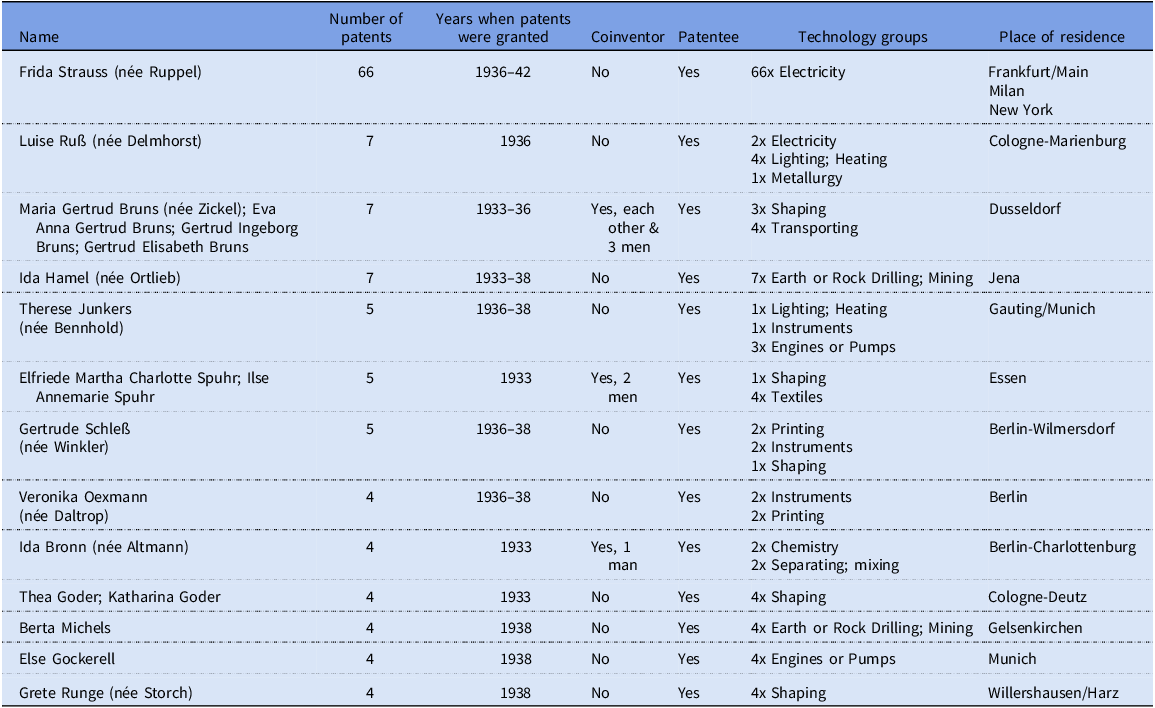
In Nazi Germany, most patents involving women are patents with more than one inventor (cooperations). The annual share of patents with female inventors in our patent dataset ranges between 0.6 and 1.7 percent. These low figures are in line with previous findings for nineteenth-century Germany, showing a very large gender gap in patenting. Overall, the distribution of patents with female participation is very skewed, which means that most female inventors (about 68 percent) were involved in only one patent and only few women were serial inventors. Table 3 shows the latter, including all female inventors with at least four patents. We report not only the number of patents in which the women were involved, but also their specialization in certain technology groups, their place of residence, the period of their patent activities, whether they were not only inventors but also patentees, and whether they worked with coinventors.
Great female inventors in Nazi Germany

Table 3. Long description
A table comparing female inventors in Nazi Germany by the number of patents, years when patents were granted, coinventors, patentee status, technology groups, and place of residence. The table has 13 rows and 7 columns. Column headers are Name, Number of patents, Years when patents were granted, Coinventor, Patentee, Technology groups, and Place of residence. Row 1: Frida Strauss (née Ruppel), 66, 1936–42, No, Yes, 66x Electricity, Frankfurt/Main Milan New York. Row 2: Luise Ruß (née Delmhorst), 7, 1936, No, Yes, 2x Electricity 4x Lighting; Heating 1x Metallurgy, Cologne-Marienburg. Row 3: Maria Gertrud Bruns (née Zickel); Eva Anna Gertrud Bruns; Gertrud Ingeborg Bruns; Gertrud Elisabeth Bruns, 7, 1933–36, Yes, each other & 3 men, Yes, 3x Shaping 4x Transporting, Dusseldorf. Row 4: Ida Hamel (née Ortlieb), 7, 1933–38, No, Yes, 7x Earth or Rock Drilling; Mining, Jena. Row 5: Therese Junkers (née Bennhold), 5, 1936–38, No, Yes, 1x Lighting; Heating 1x Instruments 3x Engines or Pumps, Gauting/Munich. Row 6: Elfriede Martha Charlotte Spuhr; Ilse Annemarie Spuhr, 5, 1933, Yes, 2 men, Yes, 1x Shaping 4x Textiles, Essen. Row 7: Gertrude Schieß (née Winkler), 5, 1936–38, No, Yes, 2x Printing 2x Instruments 1x Shaping, Berlin-Wilmersdorf. Row 8: Veronika Oexmann (née Daltrop), 4, 1936–38, No, Yes, 2x Instruments 2x Printing, Berlin. Row 9: Ida Bronn (née Altmann), 4, 1933, Yes, 1 man, Yes, 2x Chemistry 2x Separating; mixing, Berlin-Charlottenburg. Row 10: Thea Goder; Katharina Goder, 4, 1933, No, Yes, 4x Shaping, Cologne-Deutz. Row 11: Berta Michels, 4, 1938, No, Yes, 4x Earth or Rock Drilling; Mining, Gelsenkirchen. Row 12: Else Gockerell, 4, 1938, No, Yes, 4x Engines or Pumps, Munich. Row 13: Grete Runge (née Storch), 4, 1938, No, Yes, 4x Shaping, Willershausen/Harz.
Notes: Additionally, there are 10 female solo inventors and 1 inventor duo who patented three inventions during this time. Forty female inventors were listed with two patents each, with one inventive trio having two patents in 1933. See the text for additional information on the data.
Frida Strauss, née Ruppel, is the most fascinating case. In the five sample years used in this article, she patented more inventions than all other great female inventors combined, and all these were in the technology class “electrical engineering,” including patents on switches and related equipment. She always invented on her own and was the sole patentee. The patent lists do not provide her occupation or any academic title. From other sources, we know that she was the daughter of the engineer Sigwart Ruppel,Footnote 29 who was also from Frankfurt (Main) and received 15 patents in 1933 and 1936. Because she was Jewish, Frida fled Nazi Germany and emigrated to the United States via Italy. Her route to safety can be traced in the patent data, where her place of residence changes from her birthplace Frankfurt (Main) to Milan and, finally, New York. She is listed in the US Census of 1940 as a 31-year-old resident of New York City, living together with her husband Richard and two children named Hans and Ursula.Footnote 30 She continued to be granted patents in Germany after emigration, but did not file any new inventions after 1937.Footnote 31 By November 1943, the German Patent Office had changed its course regarding the granting of patents to Jews and called into question whether her not-yet-decided patent applications should be processed any further.Footnote 32
Luise Ruß (née Delmhorst) received seven patents in three different technology groups. However, the inventions share a common theme, as all of them were about the improvement of various kinds of stoves. She does not appear on any other patent list than 1936 (based on the lists analyzed in this article). Luise does not have any coinventors and is the sole patentee.
The other great female inventors listed in Table 3 patented in a wide range of technology groups, some of them with and without coinventors. Further examples that are worth mentioning are Therese Junkers (née Bennhold) (five patents), who was the wife of the well-known engineer and entrepreneur Hugo Junkers and a mother to 12 children,Footnote 33 Veronika Oexmann (née Daltrop), who did not only invent on her own but also tried to defend the patents of her deceased husband Heinrich against I.G. Farbenindustrie AG (Engel et al. Reference Engel, Kuper, Bell and Münzner2020: 53), and Ida Bronn (née Altmann), who is the only female inventor on the list to be associated with a company, Concordia Bergbau AG in Oberhausen, with which she held patents jointly.
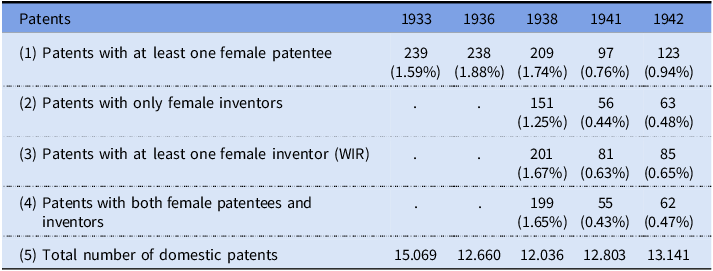
Table 4 provides additional information on the total number of patents with female participation for each of our sample years and the corresponding percentage shares relative to all domestic patents the respective years (in parentheses). The first row of the table provides all the patents that had at least one female patentee. In the second row, we list all the patents that were invented exclusively by women (including single inventors and cooperations between female inventors). The third row contains all patents in which at least one woman is listed as an inventor, patents with male coinventors included. The share of these patents in all patents represents our WIR definition. In the fourth row, we show the number of patents for which at least one female inventor was also among the patentees. The fifth row shows the total number of domestic patents granted each year.
Patents with female patentees and inventors in Nazi Germany

Table 4. Long description
The table presents data on patents with female participation in Nazi Germany across five sample years: 1933, 1936, 1938, 1941, and 1942. It includes five rows and six columns. The columns are labeled with the years, and the rows are labeled with different categories of patents. Row 1: Patents with at least one female patentee. Row 2: Patents with only female inventors. Row 3: Patents with at least one female inventor. Row 4: Patents with both female patentees and inventors. Row 5: Total number of domestic patents. Each cell contains the number of patents and the corresponding percentage relative to all domestic patents for that year. The table shows a decline in the number and percentage of patents with female participation over the years.
Source: We only include domestic patents. The % shares indicate the shares relative to the total number of all domestic patents. The data include all patents granted in the respective year. See the text for additional information on the data and the source.
Our main variable of interest is the WIR. In the first year for which we have information on the inventors, in 1938, the WIR is at 1.67 percent, but it then falls to 0.63 in 1941 and 0.65 percent in 1942. This decline is due to an absolute decrease in the number of patents with at least one female inventor. Although in 1938 we find 201 patents with at least one female inventor, in 1942 there were only 85. As the first row shows, the share of patents with female patentees also decreases from 1.74 percent in 1938 to less than one percent in 1942. The decline in the share of patents with both female patentees and female inventors (fourth row) is even more pronounced. In 1938, this share was similar to that of the WIR, but by 1942 it had fallen to only 0.47 percent. The higher share of patents with female patentees (compared with the WIR) can be explained by the fact that women more often became the beneficiaries of patents whose original inventors were men, who often shared the same surname as the female patentee and must therefore be assumed to be her husband or father. An example are “widow and orphan” patents, where the male inventor is marked with a cross in the records and the patentee is, for example, a woman with the same surname. Although only three such patents can be found before the war (all in 1938), the patent data for 1941 (1942) includes 25 (37) of these patents.
Because we do not have information about the names of inventors before 1938, we cannot compute the WIR for the years 1933 and 1936. As the number and share of patents with at least one female patentee hardly changed between 1933 and 1938, we can assume that the WIR was also rather constant during this period. Because the patents granted in 1933 mainly concerned patent applications from the Weimar Republic, we find no obvious evidence for an immediate structural break in the role of female inventors after 1933. Only during World War II, we observe a notable decrease of patents with female inventors, leading to a lower WIR. One explanation for this pattern could be an overall reallocation of inventive activity toward technology groups in which women patented less.
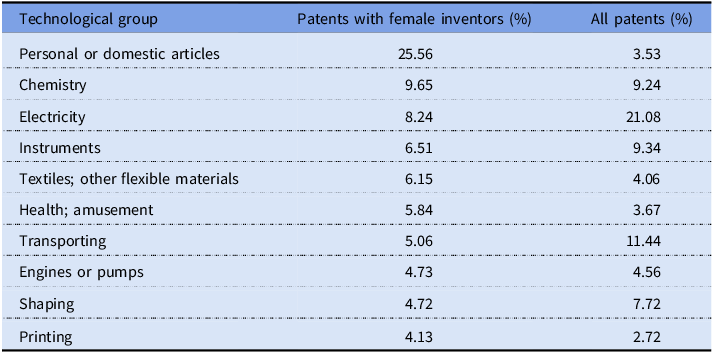
Table 5 illustrates the technological specialization of female inventors in Nazi Germany by comparing the proportion of patents with female inventors in a technological group (according to our WIR definition) with the proportion of all patents in this patent group. For the sake of clarity, we only report the Top 10 technological groups, based on the sample of patents with female inventors. The comparison makes it clear that female inventors in Nazi Germany focused primarily on consumer-related technological groups, which increasingly lost importance due to the National Socialist armament and autarky policy. This is most evident for the group “Personal or domestic articles,” which included more than 25 percent of patents with female inventors, although this technological group accounted for less than 4 percent of all patents. Patents with female inventors were also overrepresented in the groups “Health; Amusement,” and “Printing,” but strongly underrepresented in “Electricity,” and technology groups related to the machine-building industry, such as “Transporting” and “Shaping.” In “Chemistry,” which is one of the industries where formal education was particularly important, the shares are of similar size.
Technological specialization of women in Nazi Germany, 1938–42

Table 5. Long description
A table comparing the proportion of patents with female inventors in various technological groups to the proportion of all patents in those groups in Nazi Germany from 1938 to 1942. The table has 10 rows and 3 columns. Column headers are Technological group, Patents with female inventors (%), and All patents (%). Row 1: Personal or domestic articles, 25.56, 3.53. Row 2: Chemistry, 9.65, 9.24. Row 3: Electricity, 8.24, 21.08. Row 4: Instruments, 6.51, 9.34. Row 5: Textiles; other flexible materials, 6.15, 4.06. Row 6: Health; amusement, 5.84, 3.67. Row 7: Transporting, 5.06, 11.44. Row 8: Engines or pumps, 4.73, 4.56. Row 9: Shaping, 4.72, 7.72. Row 10: Printing, 4.13, 2.72.
Notes: We include all domestic patents granted in 1938, 1941, and 1942 to compute the yearly share of patents related to each technology group using IPC. The % shares shown in the table are the average shares. Patents with female inventors are defined based on our WIR definition. We only report the 10 classes with the highest shares, based on the patents with female inventors. See the text for additional information in the data.
Female inventors in the GDR
In the GDR, patenting increased significantly over time. In the 1950s, a total of about 26,500 patents were granted in the GDR. This number rose to over 119,000 patents in the 1980s. Our data show that throughout the 1950s, only 177 patents (0.5 percent) had at least one female inventor. The WIR is even lower than the already low rate in the early years of World War II. One possible explanation could be the discriminatory policies against women in Nazi Germany. Because women had been pushed out of universities and research-related professions during the “Third Reich,” there was now a shortage of young female inventors with the appropriate human capital and professional experience. It is also likely that many women with above-average human capital fled to the West in the late 1940s (Schmidt Reference Schmidt1997). Over time, however, the WIR increased massively, reaching an average of 14.9 percent (with 17,316 patents) in the 1980s. With a WIR of 19.2 percent, the highest rate is found in 1989. As in the period before 1945, the distribution of patents by female inventors was very skewed in the GDR. However, the share of female inventors who were involved in only one patent decreased from about 63 percent in the 1950s to about 30 percent in the 1980s. The share of serial inventors increased accordingly over time.
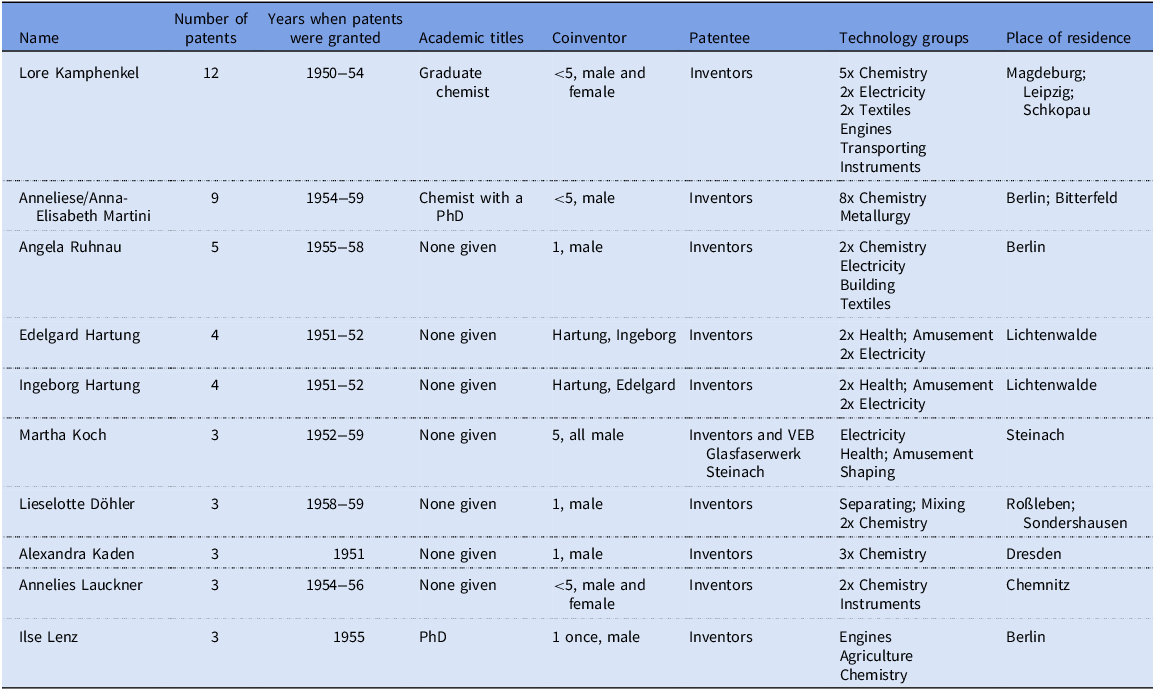
Table 6 lists the names and backgrounds of the great female inventors in the 1950s, measured by the number of patents granted. At the top is Lore Kamphenkel, who patented 12 inventions in only four years. For all 12 patents, she is listed as an inventor and patentee, but never as the only one for either. In most cases, Dr. Kurt Thinius was her coinventor, but for some inventions there are up to four male coinventors listed. In 1964, Kamphenkel was awarded the honorary title “Held der Arbeit” (Hero of Labor),Footnote 34 which was a state award given to merited workers of the GDR, often those who held a strong tie to the socialist regime. According to the patent, she was a chemist with a university degree, and the list of Hero of Labor honorees shows her as the head of the new department for plastics development (Leiterin Kunststoffneuentwicklung) in the state-owned chemical company Volkseigener Betrieb (VEB) Chemische Werke Buna.Footnote 35 The honorary award reflects that the GDR government considered her work to be important.
Great female inventors of the GDR in the 1950s

Table 6. Long description
The table contains information about female inventors from the 1950s, detailing their number of patents, years when patents were granted, academic titles, coinventors, patentees, technology groups, and places of residence. The table has 10 rows and 8 columns. Column headers are Name, Number of patents, Years when patents were granted, Academic titles, Coinventor, Patentee, Technology groups, and Place of residence. Row 1: Lore Kamphenkel, 12, 1950-54, Graduate chemist, <5, male and female, Inventors, 5x Chemistry, 2x Electricity, 2x Textiles, Engines, Transporting Instruments, Magdeburg; Leipzig; Schkopau. Row 2: Anneliese/Anna-Elisabeth Martini, 9, 1954-59, Chemist with a PhD, <5, male, Inventors, 8x Chemistry, Metallurgy, Berlin; Bitterfeld. Row 3: Angela Ruhnau, 5, 1955-58, None given, 1, male, Inventors, 2x Chemistry, Electricity, Building, Textiles, Berlin. Row 4: Edelgard Hartung, 4, 1951-52, None given, Hartung, Ingeborg, Inventors, 2x Health, Amusement, 2x Electricity, Lichtenwalde. Row 5: Ingeborg Hartung, 4, 1951-52, None given, Hartung, Edelgard, Inventors, 2x Health, Amusement, 2x Electricity, Lichtenwalde. Row 6: Martha Koch, 3, 1952-59, None given, 5, all male, Inventors and VEB Glasfaserwerk Steinach, Electricity, Health, Amusement, Shaping, Steinach. Row 7: Lieselotte Döhler, 3, 1958-59, None given, 1, male, Inventors, Separating, Mixing, 2x Chemistry, Roßleben; Sondershausen. Row 8: Alexandra Kaden, 3, 1951, None given, 1, male, Inventors, 3x Chemistry, Dresden. Row 9: Annelies Lauckner, 3, 1954-56, None given, <5, male and female, Inventors, 2x Chemistry, Instruments, Chemnitz. Row 10: Ilse Lenz, 3, 1955, PhD, 1 once, male, Inventors, Engines, Agriculture, Chemistry, Berlin.
Notes: Dataset of all patents of the GDR. See the text for additional information on the data.
Anneliese (or Anna-Elisabeth) Martini is ranked second in Table 6.Footnote 36 We also find her in the pre-1945 patent lists with patents on improvements to a process for the visualization of nucleosides, patented in 1941 and 1942. In 1952, she was awarded the honorary title “Verdienter Erfinder” (Honored Inventor), which was given annually to people whose inventions were of economic importance to the GDR. The prize money was calculated based on the economic benefit of each invention and usually varied between 2,000 and 10,000 East German marks. Anna Martini received 8,000 East German marks.Footnote 37 In this year, she was the only recipient of such a high prize money.
With five patents, Angela Ruhnau is third on this list. But in the 1950s she did not only patent in the GDR, but also received two patents in West Germany, two in the United States, and one each in the United Kingdom and France (according to DEPATISnet). The patents do not indicate a professional or academic title, and all inventions are coinventions with Hans-Dieter Selle. She received no further patents after 1960.
Edelgard and Ingeborg Hartung, sisters or otherwise related, patented four inventions together. Together with Ilse Lenz, who had two patents of her own without any coinventors, they are the only women among the great female inventors of the 1950s who never patented together with another man.
In the 1950s, the top female inventors accounted for about 25.4 percent of all patents invented with women, counting the Hartung sisters once, as they only patented together. Of all patents granted in the 1950s, the great female inventors accounted for only 0.17 percent.
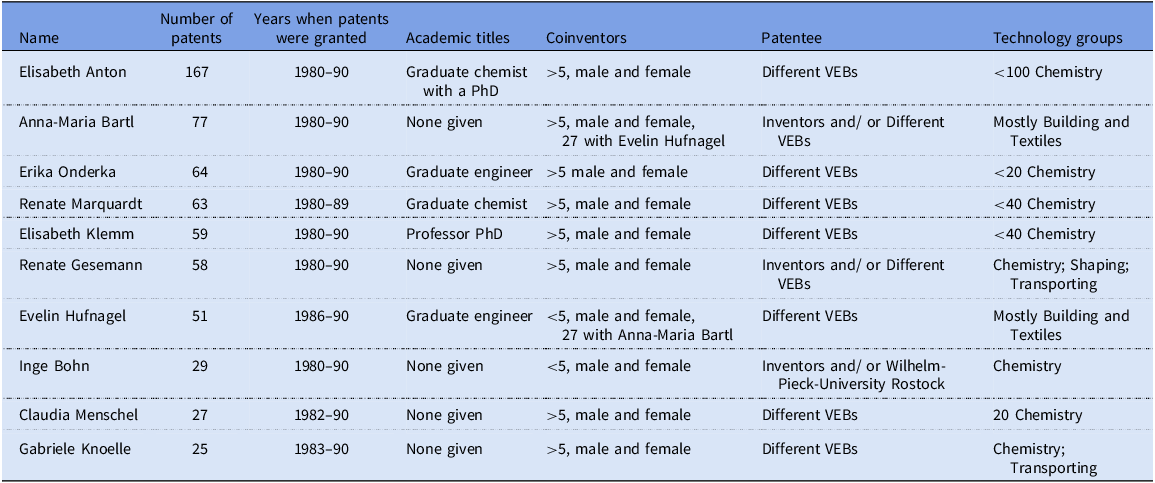
Table 7 shows the corresponding information for the great female inventors in the 1980s. With more than 160 patents in this decade, Elisabeth Anton was the most successful female inventor. Only one patent mentions her academic title as a graduate chemist with a PhD (Dr. Dipl. Chem.), and most of her inventions have several coinventors. She also received several patents outside the GDR, all in European countries, and more patents in the GDR before 1980. Most of our female serial inventors share the fate of being “invisible” in that their work has hardly been documented in publications or other accessible sources. Third is Erika Onderka with 64 patents. In 1977 and 1985, she was awarded the national prize for science and technology of the GDR (“third class” in 1977, “second class” in 1985) and with the “Verdienter Erfinder” award in 1983.Footnote 38 All prizes list her place of work as VEB Leuna-Werke „Walter Ulbricht“, although the patent records also show other VEBs as copatentees for her inventions.
Great female inventors of the GDR in the 1980s

Table 7. Long description
The table lists female inventors from the 1980s, detailing their patents, academic titles, coinventors, patentees, and technology groups. It has 10 rows and 7 columns. Column headers are Name, Number of patents, Years when patents were granted, Academic titles, Coinventors, Patentee, and Technology groups. Row 1: Elisabeth Anton, 167, 1980-90, Graduate chemist with a PhD, >5, male and female, Different VEBs, <100 Chemistry. Row 2: Anna-Maria Bartl, 77, 1980-90, None given, >5, male and female, 27 with Evelin Hufnagel, Inventors and/or Different VEBs, Mostly Building and Textiles. Row 3: Erika Onderka, 64, 1980-90, Graduate engineer, >5 male and female, Different VEBs, <20 Chemistry. Row 4: Renate Marquardt, 63, 1980-89, Graduate chemist, >5, male and female, Different VEBs, <40 Chemistry. Row 5: Elisabeth Klemm, 59, 1980-90, Professor PhD, >5, male and female, Different VEBs, <40 Chemistry. Row 6: Renate Gesemann, 58, 1980-90, None given, >5, male and female, Inventors and/or Different VEBs, Chemistry; Shaping; Transporting. Row 7: Evelin Hufnagel, 51, 1986-90, Graduate engineer, <5, male and female, 27 with Anna-Maria Bartl, Different VEBs, Mostly Building and Textiles. Row 8: Inge Bohn, 29, 1980-90, None given, <5, male and female, Inventors and/or Wilhelm-Pieck-University Rostock, Chemistry. Row 9: Claudia Menschel, 27, 1982-90, None given, >5, male and female, Different VEBs, 20 Chemistry. Row 10: Gabriele Knoelle, 25, 1983-90, None given, >5, male and female, Different VEBs, Chemistry; Transporting.
Notes: Dataset of all patents of the GDR. See the text for additional information on the data. For the great female inventors of the 1980s, none of these women listed a place of residence at the patent office, therefore this variable is not included in this table, in contrast to the 1950s.
Among the great female inventors of the 1980s are two women who have repeatedly patented together, sometimes with other coinventors. Anna-Maria Bartl and Evelin Hufnagel invented together 27 times between 1986 and 1990. The patent documents show that Hufnagel had an engineering degree (Dipl.-Ing.). Overall, in the 1980s, the great female inventors accounted for about 3.4 percent of all patents granted to women inventors. Compared with the great female inventors in the 1950s, we find that inventors in the 1980s were less likely to be also patentees and more likely to be coinventors.
In contrast to the number of women among coinventors, the share of women among patentees was extremely low, especially in the later years of the GDR. This can be explained by the fact that, in the GDR, an invention made by an employee of a state-owned enterprise (VEB) was patented by the state-owned firm in question. This drastically reduces the number of both women and men as patentees, but because female inventors in the GDR were more likely to be employees of state-owned companies than male inventors, this had a greater impact on the proportion of female patentees. According to our data, almost 93 percent of all patents with female inventors in the 1980s were granted to a state-owned enterprise.
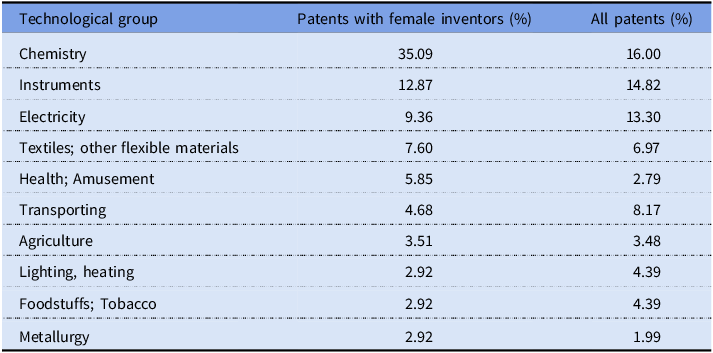
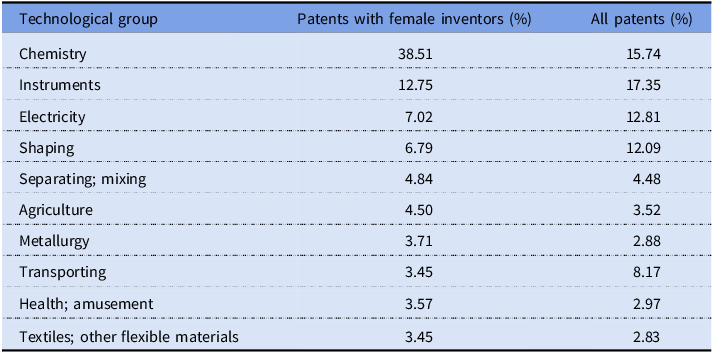
Finally, we examine in which technological groups the female inventors in the GDR specialized. In comparison with Table 5, Tables 8 and 9 illustrate the major differences in the technological specialization of female inventors in Nazi Germany and the GDR. Unlike the generation before them, the female inventors of the 1950s no longer concentrated on personal or domestic articles but had a comparative advantage over men in patents in the chemical industry – and this remained the case in the 1980s. Men continued to dominate in “Electricity” and “Transportation,” whereas the group “Health; Amusement” remained the domain of women.
Women’s technological specialization in the GDR in the 1950s

Table 8. Long description
The table compares the percentage of patents with female inventors to all patents across various technological groups. It has 11 rows and 3 columns. The columns are labeled ‘Technological group’, ‘Patents with female inventors (%)’, and ‘All patents (%)’. The rows list different technological groups and their corresponding percentages. Row 1: Chemistry, 35.09, 16.00. Row 2: Instruments, 12.87, 14.82. Row 3: Electricity, 9.36, 13.30. Row 4: Textiles; other flexible materials, 7.60, 6.97. Row 5: Health; Amusement, 5.85, 2.79. Row 6: Transporting, 4.68, 8.17. Row 7: Agriculture, 3.51, 3.48. Row 8: Lighting, heating, 2.92, 4.39. Row 9: Foodstuffs; Tobacco, 2.92, 4.39. Row 10: Metallurgy, 2.92, 1.99.
Notes: We include all domestic patents granted in the 1950s to compute the share of patents related to each technology group using IPC. Patents with female inventors are defined based on our WIR definition. We only report the 10 classes with the highest shares, based on the patents with female inventors. See the text for additional information in the data.
Women’s technological specialization in the GDR in the 1980s

Table 9. Long description
A table comparing percentages of patents with female inventors and all patents across various technological groups. The table has 11 rows and 3 columns. Column headers are Technological group, Patents with female inventors (%), and All patents (%). Row labels include Chemistry, Instruments, Electricity, Shaping, Separating; mixing, Agriculture, Metallurgy, Transporting, Health; amusement, and Textiles; other flexible materials. Row 1: Chemistry, 38.51, 15.74. Row 2: Instruments, 12.75, 17.35. Row 3: Electricity, 7.02, 12.81. Row 4: Shaping, 6.79, 12.09. Row 5: Separating; mixing, 4.84, 4.48. Row 6: Agriculture, 4.50, 3.52. Row 7: Metallurgy, 3.71, 2.88. Row 8: Transporting, 3.45, 8.17. Row 9: Health; amusement, 3.57, 2.97. Row 10: Textiles; other flexible materials, 3.45, 2.83.
Notes: We include all domestic patents granted in the 1980s to compute the share of patents related to each technology group using IPC. Patents with female inventors are defined based on our WIR definition. We only report the 10 classes with the highest shares, based on the patents with female inventors. See the text for additional information in the data.
Persistence of female inventorship?
Until now, we have presented female patent activities in the “Third Reich” and in the GDR separately from each other. In this section, we focus on the continuities and breaks between these two periods. World War II and the division of Germany, leading to the formation of the GDR in the Eastern part, marked one of the most significant structural breaks in German economic history. Concerning the role of women inventors, this raises the question whether there is still evidence for persistence over time.
First, we can ask whether women who patented inventions before 1945 also filed patents afterward and if so, where. For the pre-1945 period, we observe 626 female inventors in Germany. Of these, 461 (73.64 percent) lived in places that later became part of West Germany, 133 (21.25 percent) were from places in East Germany that later became part of the GDR, and 32 (5.11 percent) of them came from the Eastern German territories that later became part of Poland and the Soviet Union. The relatively small number of female inventors means we can check individually how many of them filed patents after 1945 in either West Germany or the GDR using the DEPATISnet online search tool from the German patent office. In fact, their numbers appear to be small, as only 27 of all 626 female inventors filed patents after 1945, thereof 26 in West Germany and only one female inventor in East Germany. Concerning the prewar places of residence of these 26 female inventors who obtained patents in West Germany after 1945, 19 (76 percent) of them were originally from West Germany, 5 (20 percent) from the later GDR, and 2 (8 percent) from Eastern German territories. Overall, this distribution reflects roughly the regional distribution of the prewar period. However, the fact that we find only one woman who patented in the GDR after World War II, compared with five women who migrated to and patented in West Germany, sheds light on the brain drain that reduced the GDR’s innovative potential, as also documented by Bergeaud et al. (Reference Bergeaud, Deter, Greve and Wyrwich2025).
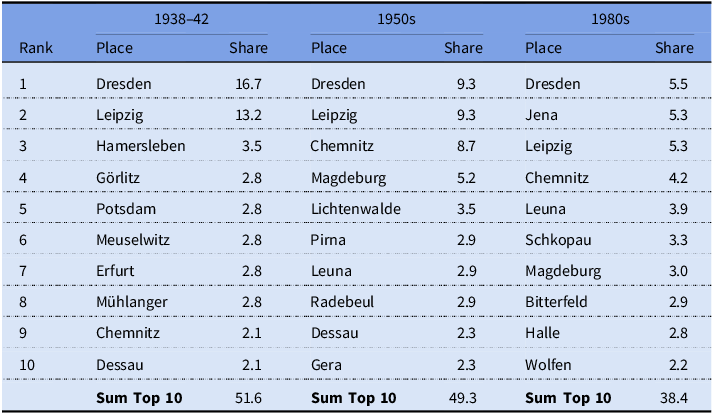
Second, we should consider whether there is evidence of persistence in the spatial distribution of women inventors in East Germany. There could have been places in East Germany that attracted relatively more women inventors, perhaps due to a more women-friendly culture. Table 10 shows the proportion of patents filed by female inventors, categorized by their place of residence, for the top 10 places in East Germany during the pre-1945 period, the 1950s, and the 1980s, excluding Berlin. Dresden and Leipzig, the two most populous East German cities after Berlin, ranked first and second in the 1950s, but their share decreased over time and Jena surpassed Leipzig in the 1980s. From 1938 to 1942, inventive activity of women was heavily concentrated. The top 10 cities accounted for around 52 percent of all patents from women inventors. In the 1950s, this share is slightly lower with 49.3 percent, but it decreased to only 38.4 percent in the 1980s. This reflects the increased inventive activity by women that we have documented in the previous section. Not only did inventive activity by women became more diverse in terms of technologies, but the geographical spread also increased.
Distribution of female inventors by places in East Germany

Table 10. Long description
The table presents the proportion of patents filed by female inventors in the top 10 places in East Germany, excluding Berlin, for the periods 1938-42, the 1950s, and the 1980s. The table has 12 rows and 7 columns. The columns are labeled as Rank, Place, Share for 1938-42, Place, Share for 1950s, Place, and Share for 1980s. The rows list the rank, place, and share for each period. For 1938-42, Dresden had the highest share at 16.7 percent, followed by Leipzig at 13.2 percent. In the 1950s, Dresden and Leipzig both had a share of 9.3 percent, with Jena surpassing Leipzig in the 1980s with a share of 5.3 percent. The sum of the top 10 places’ shares decreased from 51.6 percent in 1938-42 to 49.3 percent in the 1950s, and further to 38.4 percent in the 1980s.
Notes: This table shows the distribution of domestic female-inventor patents by place of residence in East Germany. All percentages refer to the total number of female-inventor patents from East German locations during the relevant period (Berlin excluded). The top ten places with the highest shares in each period are shown. The data for the period 1938–42 are based on the sample years 1938, 1941, and 1942. See the text for more information about the data.
Conclusion
In recent decades, historical studies have shown for several industrialized countries that the WIR has been very low since the emergence of modern patent systems and has remained low until today. The question arises as to which factors can explain the persistence of the gender gap regarding patenting and innovation. Our study suggests that the higher education of future female inventors will play a major role. If women are denied access to higher education, especially in STEM subjects, or if they are not interested in such studies, they lack the human capital that is necessary for successful inventive activity in knowledge-intensive industries. This misallocation of talent, however, is not mentioned by Naudé and Nagler (Reference Naudé and Nagler2021), who summarized the various reasons for the alleged decline of German innovation in recent decades. A promising approach to reviving innovation could be to counteract this misallocation.
In the “Third Reich,” the WIR was as low as in the nineteenth century. The Nazi government did little to change this. On the contrary, in the early phase of the Nazi regime, women were pushed out of universities and knowledge-intensive industries. This discrimination probably had medium-term consequences. At the beginning of the 1950s, there were fewer women in Germany who had the educational and professional background to invent than if they had received the same political treatment as men in the 1930s. It is therefore not surprising that there were also only a few female inventors in the newly founded GDR in the 1950s. What is surprising, however, is that the WIR rose sharply in the following decades and was significantly higher in the 1980s than in reunified Germany today, which has a WIR of only around 10 percent. We assume that the political support for women in the GDR, regarding the compatibility of family and career as well as university access, explains this special development.
However, we should be wary of a hasty positive assessment of GDR policy. We do not know, for example, which of the inventions patented in the socialist system of the GDR would also have been economically successful in a capitalist economic system. To assess whether the great female inventors of East Germany would have been able to excel under capitalism, it may be useful to examine their careers after German reunification. If they continued their successful careers as inventors after 1989, it is reasonable to conclude that they benefited from the women’s policies of the GDR in their role as inventors. Hipp and Hünermund (Reference Hipp and Hünermund2025) have already shown that 27 percent of East German inventors who continued their work after reunification did so in West Germany. About 10 percent of these East–West migrants were women.
Our overview makes it clear that our two new databases will give us the opportunity to develop new hypotheses on the relationship between gender, human capital, and innovation and to test them by adding further data. Both historical examples illustrate the potential influence of authoritarian regimes, which can use their unchecked power to the disadvantage or advantage of certain population groups, depending on their political will.
Acknowledgments
This research was supported by the Deutsche Forschungsgemeinschaft (DFG). We thank the editors of this special issue Michael Andrews, Bernardita Escobar, and Matti La Mela for their initiative and very helpful comments. We thank all participants of the Siena FRESH workshop, the EBHS-ABH Conference in York, and the WIMFEH Workshop in Berlin for helpful comments. We also thank Niklas Andree, Johannes Asam, Alida Basse, Frederik Beeg, Moritz Bode, Sebastian Bode, Lukas Brüwer, Fred End, Henri Felshart, Max Grillenberger, Erik Heyden, Johannes Keller, Anna Krächter, Tim Kühleis, Iona Andreea Paul, Julius Schöffel, Marlene Schößler, Tinh Tran, Elisa Unger, Sebastian Wiederkehr, Niklas Wischinsky, and Sergey Zuev for their excellent research assistance.

 Open access

