Honoring fallen peacekeepers, United Nations (UN) Under-Secretary-General Hervé Ladsous noted how peacekeepers ‘work in some of the most dangerous places on earth in order to help bring stability to some of the world’s most marginalized and vulnerable peoples’, and that they ‘are on the frontline every day’.Footnote 1 In 2013, the United Nations Organization Stabilization Mission in the Democratic Republic of the Congo (MONUSCO) backed a government offensive in the eastern parts of the Democratic Republic of Congo (DRC) that routed the rebel group M23 and ended its eighteen-month insurgency. In sharp contrast to MONUSCO’s active role in ending the insurgency, United Nations Organization Mission in the Democratic Republic of the Congo (MONUC, the prior UN mission in the DRC) was regularly criticized for failing to bring peace and for its limited success in protecting civilians against attacks, looting and mass rape by rebels, militia and the DRC army.Footnote 2 Yet MONUC suffered 161 fatalities, showing the real risks of peacekeeping. The contrasting levels of involvement in active conflict illustrate that peacekeepers are sometimes (but not always) deployed to areas where violent armed confrontations occur. Here we examine whether peacekeepers go to locations within countries where the civil war ragesFootnote 3 or whether they remain in areas away from the fighting. We identify the pull and push factors that drive the subnational deployment of UN peacekeeping forces across different missions and over time.
Our approach underlines that the deployment of UN peacekeepers is a two-step process. In the first stage the UN Security Council authorizes a peacekeeping operation (PKO) based on global and country-specific considerations. However, once in a country, a second stage of deployment decisions takes place when the UN special representative to the country decides to deploy peacekeepers based on the conditions on the ground and local factors. The quantitative literature provides strong evidence that UN peacekeeping concentrates on ‘hard cases’.Footnote 4 Peacekeepers are predominantly deployed to countries where the task of building a stable peace is rendered particularly difficult because democracy and stable institutions are in short supply and the legacy of war includes a large number of civilian causalities. Recent evaluations of the effectiveness of peacekeeping recognize that this makes it more challenging for the UN to generate successful outcomes.Footnote 5
Yet case studies on the effectiveness of peacekeepingFootnote 6 cast doubt on the presence of UN PKO forces in parts of the country affected by active hostilities. Restrictions on the use of force commonly imposed on UN peacekeepers and confusing rules of engagement, illustrated by missions like MONUC,Footnote 7 have led observers to question whether UN missions are truly deployed to address conflict ‘hot-spots’.
In effect, existing research nearly exclusivelyFootnote 8 considers the first stage of deployment and so focuses primarily on the aggregate characteristics of conflicts, such as conflict history, national capabilities and the characteristics of the missions.Footnote 9 There has been limited attention to the second stage in the deployment process, namely the local implementation of UN policies and practices as well as the exact deployment of UN forces within a country.Footnote 10 Our contribution is to focus on this second stage. To analyze the effect of peacekeeping on local conflict resolution requires first knowing whether UN forces are deployed subnationally to conflict areas, or whether they remain away from the most conflict-prone areas.Footnote 11
Although admittedly somewhat of a simplification, it is helpful to delineate two competing, ideal-type ‘logics’ of the deployment of peacekeepers: an instrumental logic and a logic of convenience. Here the term ‘logic’ refers to an internally consistent set of beliefs and rules that structure cognition and guide decision making and behavior. In that sense, it is best understood as a heuristic.Footnote 12 We do not claim that the UN, contributing countries or the peacekeepers consciously subscribe to a particular logic, but we regard them as ideal-type categorizations that allow us to contrast and test opposing implications.
The instrumental logic stipulates that peacekeepers are deployed in order to contribute effectively to the resolution of conflict; in other words, they are deployed to conflict areas. In contrast, according to the logic of convenience, feasibility determines deployment decisions: peacekeepers are deployed to areas where it is unlikely that they will have to engage in actual fighting, and where the infrastructure allows for an easy deployment, reinforcement and extraction of forces. The convenience logic assumes that the UN – and the individual countries that are contributing peacekeeping forces – is more risk averse than under the instrumental logic. The logic of convenience also emphasizes the bureaucratic nature of decision making in the UN. Both logics draw attention to the costs of deploying peacekeepers, since the deployment to conflict zones requires more resources to maintain lines of communication and safeguard peacekeepers.
Using subnationally disaggregated data on UN deployment in eight African countries, we empirically evaluate the relevance of both logics of peacekeeping deployment. We observe that peacekeepers are more likely to be deployed to areas that experienced civil war, but with a considerable time lag and biased toward urban areas. Taken together, the results suggest that peacekeeping largely follows an instrumental logic, but that deployment decisions are also made pragmatically, reflecting a sensitivity to (political) costs and demonstrating risk aversion; in other words, in part following a logic of convenience.
The next section briefly discusses what is known about where the UN chooses to intervene and the characteristics of these conflicts. A discussion of the contrasting logics of UN peacekeeping deployment follows. Here, we expand on why it is important to look at disaggregated information when studying peacekeeping operations. The empirical analysis first compares subnational deployment in eight UN peacekeeping missions, and next considers in more detail the deployment of UN peacekeepers in Sierra Leone. The conclusions discuss the implications of the results on subnational deployment for the study of the effectiveness of UN peacekeeping.
WHERE DO UN PEACEKEEPERS GO?
A popular view in the media and among many academicsFootnote 13 is that UN peacekeeping missions are largely deployed to conflicts in which the national interests of key Security Council members are at stake. JacobsenFootnote 14 argues that media attention, or the so-called CNN effect, influences when and where the UN chooses to intervene. In one of the first systematic studies of possible bias in UN peacekeeping, Gilligan and StedmanFootnote 15 report conflict severity, measured in terms of causalities, as the key factor in determining whether the UN intervenes. They find that humanitarian and security concerns mainly motivate UN operations, but that there is also a regional bias in favor of Europe and the Western hemisphere. FortnaFootnote 16 and de Jonge OudraatFootnote 17 similarly argue that the UN tends to intervene in more severe conflicts. Beardsley and SchmidtFootnote 18 examine 210 international crises from 1945 to 2002, providing a comprehensive analysis of the politics of UN involvement. They find that, although the overlap or conflict of national interests of the five permanent members of the Security Council indeed influence and constrain the UN’s ability to act in international crises, the severity of conflicts is a more important predictor of UN intervention. In particular, civilian casualties seem to guide the UN in line with its stated principle of the responsibility to protect.Footnote 19 In short, a consensus has emerged that the UN intervenes mainly in so-called hard cases.
Since the consensus that the UN selects hard cases is based on aggregate data – that is, country- and conflict-level data – it remains possible that deployment at the local level does not follow a similar pattern. CostalliFootnote 20 studies subnational variation in the presence of UN peacekeepers in Bosnia and highlights that the UN tends to be active where there was high level of violence against civilians. However, other studies of individual missions show that there is notable variation in the subnational pattern of UN deployment. Even if the UN intervenes in conflicts that are more violent or difficult to resolve, peacekeeping forces are often seen as locating themselves predominantly in relatively stable areas with a reliable infrastructure – that is, around their headquarters or major cities, rather than being deployed to remote areas with poor infrastructure (where actual fighting often takes place).
Several studies comment on how the pattern of local deployment affects the quality of peacekeeping in specific missions. AutesserreFootnote 21 and PoulignyFootnote 22 use ethnographic methods and argue that the failure of conflict resolution and peacekeeping strategies is rooted at the local level. These studies suggest that without a credible and capable local presence, peacekeepers remain largely irrelevant to the process of enforcing and maintaining peace. A reputation of peacekeepers as being soft targets or conflict avoiding casts doubts on their ability to engage with possible spoilers of peace, either militias or rebel groups. The loss of reputation for UN troops can encourage such groups to either directly challenge the peacekeeping forces – for instance, Serb forces took 400 peacekeepers as human shields and used them as hostages in 1995 in Bosnia – or to commit atrocities in areas under the UN supervision, as in the case of Kiwanja in Congo.Footnote 23 Such actions erode local support for UN involvement, as well as the organization’s overall credibility to operate as a competent peacekeeping and peacebuilding force.
So far, nearly all comparative and quantitative studies have focused on aggregate country or conflict characteristics to explain UN intervention, such as (under)development, severity of the conflict, number of causalities and conflict duration. Arguably, such analyses leave out possibly relevant variation over time and space across and within missions.Footnote 24 Over the course of a conflict, the fortunes of the varying warring parties, such as government and rebel forces, are likely to change, alliances are forged or broken, and battlefronts shift.Footnote 25 In such circumstances, it becomes important to know whether peacekeeping missions respond to emerging battlefronts and other territorial and political changes on the ground. The M23 rebellion and the subsequent deployment of an intervention brigade within MONUSCO – which was even authorized to act independently of the Congolese army if required – illustrate the fluidity of civil wars in the African context and how the roles of UN peacekeeping missions can change over time.
If the causes of civil war are local, the PKO mission, conflict or country is an unsuitable unit of analysis for the study of peacekeeping and peacebuilding. KalyvasFootnote 26 argues that since local grievances motivate violent collective action, any empirical implication should be tested at the local level as well. Accordingly, the disaggregation approach in the study of civil war uses data that are actor, time and space specific. Mirroring the theoretical shift from structure to actor, empirical analyses increasingly rely on data collected at a highly detailed level. Just as the conditions for conflict are often local, the conditions for peace are also likely to be local. The disaggregation approach is thus relevant for the study of both peacekeeping and conflict.
As far as we know, our study is the first to compare different UN missions in order to explore the factors that affect the subnational deployment of peacekeepers, allowing for spatial and temporal variation. If peacekeepers are not deployed and physically present in areas that experience civil war, then their ability to address conflict in its localized context will be compromised. To structure our analysis, we put forward that the deployment of UN PKOs is best understood as driven by two possible responses to local subnational conditions.
EXPLAINING THE DEPLOYMENT OF PEACEKEEPERS
Instrumental Logic of Peacekeeping
Recent research on civil wars highlights the importance of variation in states’ ability to project force across locations and to respond to local political and economic grievances.Footnote 27 Civil wars often erupt in the periphery of a country. Geographical distance presents opportunities for minorities to mobilize and organize insurgencies, particularly in territorial disputes with separatist goals.Footnote 28 The periphery is particularly vulnerable to conflict when localized factors such as borders with neighboring countries, the presence of natural resources, and population density interact with specific political and social factors, such as powerful ethnic minorities that are excluded from the political process.Footnote 29 Geography affects the onset as well as the duration of civil wars. Buhaug, Gates and LujalaFootnote 30 show that remote areas along the border, and regions where valuable resources are located, have a higher probability of experiencing prolonged civil wars. Raleigh and Hegre,Footnote 31 however, find that the location of the conflict in the periphery of a country only moderately prolongs conflict. Further, any effect is conditional on urban areas being located in the periphery, as for instance in the Eastern provinces of the DRC.Footnote 32
The instrumental logic of peacekeeping emphasizes that peacekeepers have to compensate for the government’s limited capacity to project force in outlying areas. The loss-of-strength gradient can model the decreasing ability of a central government to impose its authority on outlying regions. Accordingly, peacekeeping can be seen as a form of external intervention intended to offset the loss of strength.Footnote 33 Typically, civil wars concern relatively weak governments that are unable to provide public goods, such as safety, law and order, and a working infrastructure. Multidimensional peacekeeping missions are asked to provide basic state functions for the local populations.Footnote 34 Effective conflict resolution thus requires peacekeepers to operate in areas where the central government is unable (or possibly unwilling) to address local grievances, and to tackle the conflict locally. In practice this means that they have to operate in areas where central governments have limited reach.Footnote 35 The loss-of-strength gradient thus supports the deployment of peacekeepers in peripheral or border areas. Furthermore, geographical variation in social and economic conditions can lead to local grievances and thus affect the location of the peacekeepers. The instrumental logic of peacekeeping stipulates a deployment to conflict areas and where the population is ‘at risk’.
The instrumental logic implies that peacekeepers are willing to take greater risks and that the deployment is more costly in terms of logistics and even loss of lives. In 2013 UN peacekeeping troops suffered 104 fatalities, showing that peacekeeping is not without risks.Footnote 36 At the same time, the deployment is tailored to be effective: peacekeepers go where the job needs to be done. Consequently, the instrumental logic requires that peacekeepers are present in conflict areas where the central government is weaker than the rebels, and that peacekeepers become responsible for providing public goods and governance – first of all security and humanitarian aid – to the local population. Hence if the instrumental logic of peacekeeping holds, our testable hypotheses are as follows:
Hypothesis 1: Peacekeepers are more likely to be deployed subnationally to areas affected by civil war.
Hypothesis 2: Peacekeepers are more likely to be deployed to border areas rather than near the center of a country.
Logic of Convenience and Peacekeeping
The logic of deployment can also be articulated based on feasibility or convenience rather than efficacy: peacekeepers go where the conditions for deployment are most easily met. As a bureaucratic organization, the UN has an interest in protecting its reputation and budget, while safeguarding the vested interests of the member states.Footnote 37 The bureaucratization of peacekeeping has affected decision making at the UN and led to the development of criteria to decide the approval or extension of missions by the Security Council.Footnote 38 At the second (country-level) stage, standard procedures also inform decisions about local deployment. Internally defined routines and a reliance on standard operating procedures have historically led the UN to adopt self-defeating policies,Footnote 39 and bureaucratic decision making and the use of standard criteria also affect the deployment of peacekeepers. Howard,Footnote 40 AutesserreFootnote 41 and PoulignyFootnote 42 highlight some of the pathologies in the organization and deployment of peacekeeping missions. The application of universalism while ignoring particularities inevitably leads to a deployment of peacekeepers that does not correspond to local circumstances.
Concerns about feasibility and convenience can constrain the instrumental logic of deployment, depending on the overall level of commitment to the mission by key UN actors, such as Security Council members and contributing countries. The practice of UN PKO deployment is that the Security Council issues a resolution based on the report on the situation by the Secretary-General. Once the Security Council has authorized and outlined the mandate and size of the mission, the General Assembly approves the budget, and the Secretary-General appoints the head of mission (special representative-SRSG), force commander, highest civilian staff and police commissioner. The special representative and force commander decide the operational deployment of the forces based on the political and security situation.Footnote 43 The SRSG and force commander of the mission make the executive decision to deploy troops further into the country based on security assessments and the success of the operation. Yet the Department of Peacekeeping Operations (DPKO), the Department of Financial Service (DFS), and the Department of Safety and Security (DSS) must facilitate and support the movement and establishment of forward deployments. The role of DPKO, DFS and DSS in decisions on deployment within a country introduces bureaucratic constraints, the implementation of internally determined criteria and concerns about success in unpredictable environments. The logic of convenience suggests that the UN and peacekeepers are also risk and cost averse. They prefer to be deployed in areas that are readily accessible with a good (or at least usable) infrastructure and lines of communication. Accessibility matters possibly even more for the protection of peacekeepers who are on the ground, since it also affects the ability to extract troops.
The ‘self-imposed’ constraints on where troops can be stationed do not exclusively or even necessarily reflect an overly risk averse culture at the UN or a disregard for local conditions. Missions need to be sourced with personnel from multiple countries, and peacekeepers tend to take direct orders from their home capitals, which leads to different interpretations of the mandate and of the acceptability of the use of force,Footnote 44 especially when the mission shifts from traditional peacekeeping to peace enforcement. In these situations, the national interests of the contributing countries may well trump concerns about the operational ability of the UN forces.Footnote 45
Countries willing to contribute to UN peacekeeping missions often insist that the deployment of their troops conforms to national rules of engagement and has a realistic exit strategy. Accordingly, at the subnational level, logistic constraints influence the selection of deployment areas: long distances from the capital, rough terrain and lack of infrastructure, such as low road density, discourage the deployment of UN peacekeepers. As officials from the United Nations Mission in Liberia (UNMIL) pointed out, in the most remote parts of Liberia, such as Gbarpolu, the UN forces had limited access to three districts for long periods of time. In 2011 it was still common for UN forces to use helicopters to briefly visit remote areas and interact with the local elites rather than rely on regular patrols and establish contacts with a wider network of local actors. UN forces were more visible in areas of Liberia that had relatively easy access to Monrovia, such as Bong or Upper Nimba, or along major roads.Footnote 46 If the logic of convenience influences UN PKO deployment, then a third hypothesis can be formulated:
Hypothesis 3: Peacekeepers are more likely to be deployed to areas that are more easily accessible.
The instrumental logic of deployment and the logic of convenience are not necessarily mutually exclusive. In line with official UN rules, conditions on the ground should primarily drive the deployment of a new peacekeeping force, as the instrumental logic of deployment suggests. In effect, SRSGs enjoy a certain degree of autonomy in formulating their decisions on the ground. This is the case partly because of their personal credentials and prestige, but also because of the physical distance from the UN headquarters and bureaucracy. To some extent, their role in crystallizing decisions on the deployment of forces constitutes a bottom-up process in shaping UN PKO decisions in future deployments that is more in line with the instrumental logic of deployment.Footnote 47
The operational structure of the peacekeeping force can also lead to a blending of the instrumental and convenience logics. When peacekeeping is organized from the capital, the loss-of-strength gradient and other topographical features affect peacekeepers in similar ways as the central government. Boulding’s seminal studyFootnote 48 outlines how the power of actors decays the further away they move from their center, where, crucially, the loss of power is not measured in absolute terms but relative to the capabilities of the opponent. In other words, the decay of power indicates the ability of centrally based actors to fight specific opponents.Footnote 49 Other factors, such as the topography of the terrain and social and cultural cleavages in a population, also affect the decay of power.Footnote 50 Similarly, the geographical and economic characteristics of different regions within the borders of a state, such as mountainous terrain and limited infrastructure, affect the reach of peacekeepers. Accordingly, we not only test which logic best predicts the actual deployment of peacekeepers; we also use multivariate analysis to consider their significance ceteris paribus.
RESEARCH DESIGN
To evaluate the three hypotheses, we use spatially disaggregated geographic information system data on the subnational location of civil war and the deployment of peacekeeping forces. The Conflict Site Dataset (CSD) is the source for the subnational civil war location. CSD is an extension of the Uppsala Conflict Data Program/Peace Research Institute Oslo (UCDP/PRIO) Armed Conflicts Dataset and provides coordinates for the conflict zones in given countries.Footnote 51 The data are particularly useful because they measure the local onset and incidence of conflict rather than specific conflict events. Since the conflict data (the key independent variable) are given in grid-year format, our analysis also uses grid years as the unit of analysis.
The location of the deployment of peacekeeping forces is based on UN information and deployment maps. The deployment maps are regularly included in the reports of the Secretary-General and provide information on the location of bases, the nature of the contingent deployed and the nationality of the peacekeepers deployed at the bases. After compiling all maps included in the reports, we triangulated the information from the maps with monthly UN data on how many peacekeepers from specific nations were deployed to a particular mission. Accordingly, we estimated how many peacekeepers were deployed to a particular location in a certain period. The resulting estimates were spatially projected, while keeping the variation over time, and merged into the PRIO grids. The dependent variable, PKO Deployment, is a dummy variable taking a value of 1 if peacekeepers are deployed in a grid in a particular year, and 0 if no UN deployment took place in a grid at any point in a particular year.Footnote 52
Our sample encompasses major UN missions in Sub-Saharan Africa from 1989 until 2006: the United Nations Observer Mission in Angola (MONUA), the United Nations Observer Mission in Liberia (UNOMIL), UNMIL, United Nations Operation in Burundi (ONUB), the United Nations Observer Mission in Sierra Leone (UNOMSIL), the United Nations Mission in Sierra Leone (UNAMSIL), MONUC, the United Nations Mission in the Sudan (UNMIS), United Nations Operation in Côte d’Ivoire (UNOCI) and the United Nations Mission in the Central African Republic (MINURCA). In several cases, like Angola, Liberia and Sierra Leone, there is more than one peacekeeping mission with notable temporal and spatial variation. For instance, the analysis for Liberia includes both UNOMIL (1993–97) and UNMIL (2003–06). The PKO missions in the sample vary in the size of their deployments and durations.
The geographic unit of analysis is a grid cell of 0.5×0.5 decimal degrees, which at the equator covers an area of roughly 50×50 km.Footnote 53 We use yearly observations, since grid-year is becoming the standard analytical unit enabling us to compare not just within but also across countries. Even more important is that some of the main variables of interest have only minimal variation over time; for example, the conflict data are yearly observations (as discussed above). Using a small temporal unit would artificially inflate our sample.Footnote 54 Finally, we want to explain deployments as a function of conflict rather than singular conflict events, since we consider it unlikely that the UN bases its decisions on single events.
To test the hypotheses on the spatial location of peacekeeping forces, we analyze the probability that peacekeepers are deployed in a particular area (or grid) as a function of the level of conflict (lagged) in that area. Hence, we created a panel of grid-years for the eight African countries included in our analysis. To evaluate the instrumental logic, the models include temporal lags of Conflict (one and two years), in order to avoid simultaneity and mitigate problems of endogeneity. The models also include the distance of a particular grid from the border and the capital. Conflict lags are dummy variables with a value of 1 if conflict took place in that grid that year, and 0 otherwise.Footnote 55 We use conflict lags as direct proxies for our Hypothesis 1 and note that the location of conflict indeed changes over time. As a further control, the models include Onset Area to identify grid cells that hosted the initial battle location for each intrastate conflict.Footnote 56 Border and Capital Distances are the proxies for Hypothesis 2, where Border Distance is the geographical distance of the center of each grid cell (centroid) from international borders in kilometers and Capital Distance the distance in kilometers from the capital.Footnote 57
To evaluate the logic of convenience, and in particular Hypothesis 3, we use average traveling time to proxy the feasibility and costs of deploying in a certain area. Average Traveling Time gives the estimated cell-average travel time (in minutes) by land transportation from the grid cell to the nearest major city (or urban area) with more than 50,000 inhabitants.Footnote 58 The values are extracted from a global high-resolution raster map of accessibility. Using data from the United Nations Environment Program (UNEP) and the Food and Agricultural Organization (FAO), Average Mountains (logged) measures the percentage landmass of the grid that is covered by mountains and measures the roughness of the terrain, as a further proxy for accessibility.
Some further control variables, all defined at grid-year resolution, are included because they are likely to affect subnational deployment, such as Average Grid Precipitation, Population and Average Infant Mortality Rate. Footnote 59 Average Grid Precipitation may also affect accessibility, but is primarily related to agriculture and economic growth in Africa.Footnote 60 The analysis considers the time that a grid has been without PKO deployment in order to take into account the temporal dependency of the deployment probability. We also use its squared and cubed values.Footnote 61 Since the size of the country – and therefore the number of grids – varies considerably, the models also control for the total number of grids per country.Footnote 62
EMPIRICAL ANALYSIS
Inferential Evidence
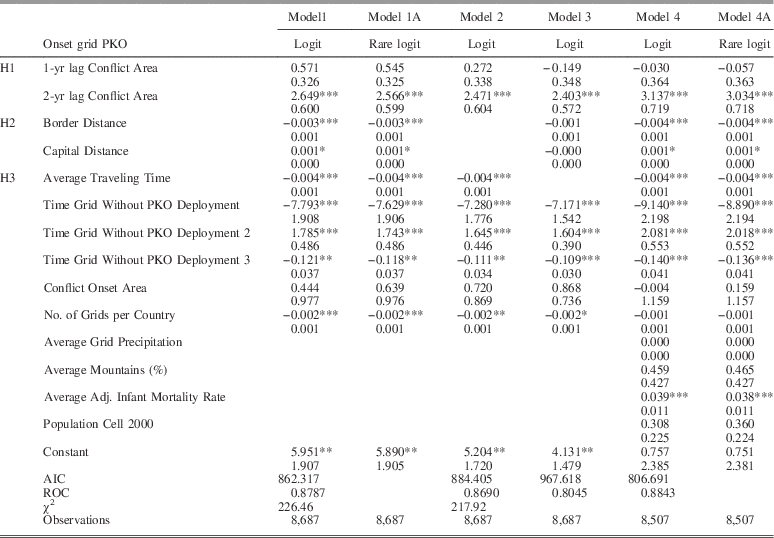
Table 1 compares the two deployment logics using multivariate logit models with clustered errors by country. Table 1 also includes rare-events logit modelsFootnote 63 since PKO deployment can be observed in only 5 per cent of the grids. Models 1 and 1A (rare logit estimator) illustrate our three hypotheses controlling only for temporal effects (how long a grid has been without local PKO deployment), whether the grid was in the original onset of the conflict and the number of grids in a country. Models 2 and 3 explore the robustness of the results for Hypothesis 2 under alternative specifications. The full models, Model 4 (logit estimator) and Model 4A (rare event estimator), evaluate the three hypotheses simultaneously while controlling for additional grid characteristics.
Subnational Deployment of UN Peacekeepers in Africa, 1989–2006

Note: robust standard errors. ***p<0.01, **p<0.05, *p<0.1.
In support of the first hypothesis, we find that the UN is more likely to deploy peacekeepers to areas with civil war. The models in Table 1 show that there is a higher probability for peacekeepers to be deployed in conflict areas, but we also observe a significant time lag in deployment. The one-year time lag of conflict is insignificant in our models, whereas the two-year conflict lag is consistently significant and correctly signed in all models. We further notice that Conflict Onset – that is, whether the civil war originated in a particular grid – is not statistically significant to explain the subnational deployment of peacekeepers.
The support for Hypothesis 2 is mixed. In support of the hypothesis, the UN is indeed more likely to deploy peacekeepers to locations that are closer to the border (Border Distance). The negative coefficient for border distance shows that deployment is less likely to take place in grids that are located further from the border. It may also be more likely that peacekeepers are deployed further from the capital. Yet the effect of Capital Distance is only marginally significant, and further tests reveal that the effect of neither Capital nor Border Distance is robust. In Model 3, excluding travel time, distance from the capital and from international borders loses its significance. Almost invariably, the capital is one of the urban areas used to determine traveling time, which may explain the findings for distance from the capital in Models 1, 2 and 4. Further, in the robustness section we highlight that the case of Angola might drive the effect of Capital Distance on the probability of the deployment. We considered whether conflict location, rather than distance to the borders, drives these empirical findings. Note, however, that the models explicitly control for conflict location, making this explanation less plausible.
To summarize, an instrumental logic thus appears to guide UN missions, but mainly in that the UN deploys to areas with a history of conflict. Further, the strategic importance of border areas – and possibly a strategy of the UN to balance the loss-of-strength gradient of the central government – may also matter.
To evaluate the importance of the logic of convenience as outlined in Hypothesis 3, Model 2 focuses on average traveling time from the nearest urban area while excluding distance from the border and the capital as further controls. Model 3 estimates the impact of the distance from the capital and the border while excluding average traveling time. Finally, Model 4 includes a number of additional controls to measure the accessibility of a particular grid cell, namely precipitation, mountainous terrain, infant mortality and population density. Among these additional control variables, only the level of infant immortality in a grid reaches statistical significance at standard levels. An increase of one standard deviation of infant mortality in a grid leads to a positive 86 per cent change in the odds of local deployment. This suggests that peacekeepers deploy, on average, in economically underdeveloped areas.
We find clear support for the idea that accessibility matters (Hypothesis 3). In all models (Table 1) the average traveling time from the nearest urban area significantly decreases the probability of the onset of UN PKO deployment; an increase of one unit (that is, just one minute) decreases the odds with 0.4 per cent, and a one-standard-deviation increase (approximately six hours) decreases the deployment odds with 80 per cent. The effect of traveling time is clearly robust across model specification. Supporting the third hypothesis, the longer it takes to reach a location from any urban area,Footnote 64 the lower the probability of PKO deployment. The finding for average traveling time suggests that, at least to some extent, the logic of convenience may also motivate deployment.
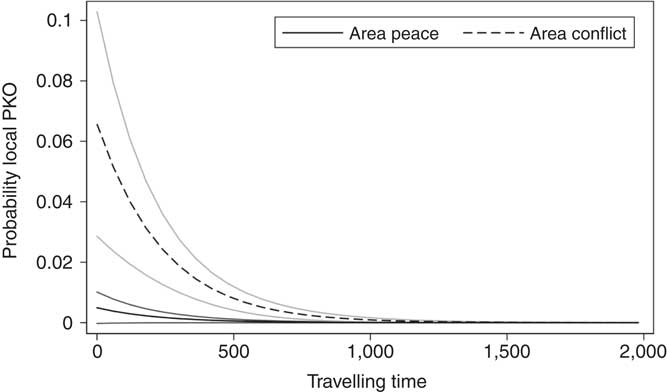
To further illustrate the relevance of traveling time on the probability of UN deployment, Figure 1 compares the marginal effect of traveling time on PKO deployment in conflict areas to the effect on PKO deployment in areas without conflict based on the estimates of Model 4 (Table 1). The black dashed line depicts the marginal effect of the probability of UN deployment in conflict areas, whereas the black line represents the probability of deployment in areas without conflict. The likelihood of deployment in conflict areas declines as the traveling time increases, approaching zero when the traveling time exceeds sixteen hours. In areas that have not experienced conflict, the probability of deployment only moderately declines as the cost of traveling time increases, as shown by the slope of the solid line that is much flatter than the line of the probability of deployment in conflict areas. Deployment to conflict areas becomes statistically indistinguishable from deployment to non-conflict areas if they are more than approximately ten hours from an urban area. As a further control for accessibility, mountainous terrain is included in Model 4, but the variable turns out to be insignificant.
Probability of deployment in conflict areas vs. areas with no conflict Note: the gray dashed lines give the 95 per cent confidence intervals.

The controls for time are all significant, which suggests that time dependencies matter: the longer peacekeepers have not been deployed to a grid, the lower the odds are that peacekeepers will deploy in that grid. However, the temporal effects are clearly non-linear since both the quadratic and cubic terms of the temporal dependency are statistically significant. As Model 4 (Table 1) shows, the inclusion of the control variables does not alter the main findings.
To summarize, the results from the models and simulations suggest that the deployment of peacekeepers follows the instrumental logic in the sense that the history of conflict matters, albeit with a temporal delay of between one and two years. However, the logic of convenience also matters for deployment; even though UN peacekeepers tend to be deployed in areas that have experienced conflict, the probability of deployment decreases substantially the further from urban areas – including the capital and other major cities – the conflict takes place. Research on civil wars has found that armed confrontations often take place in areas where the government suffers from a loss-of-strength gradient – in other words, in the periphery of a country. The significant findings for traveling time indicate that peacekeepers are not always deployed to compensate for the relative weakness of the central government.
Robustness of the Main Findings
The results are robust even when we control for further country, mission and grid characteristics. We control for the total number of UN peacekeepers deployed in a mission and for the number of countries contributing to the PKO.Footnote 65 It is plausible that both variables are correlated with the mandate of a mission and the depth of involvement of the international community,Footnote 66 and could thus affect the probability of deployment to particular localities as well. Yet our results remain substantially the same. Controlling for the presence of a mission supported by regional organizations does not change the results either. Our results also hold when controlling for the existence of a ceasefire agreement.Footnote 67
As a second robustness test, we used a case-control logit design to compare cells with deployment to a random sample of cells without deployment.Footnote 68 Using a case-control design also ‘helps to address the problem of spatial correlation across nearby cells, since a smaller random comparison sample is unlikely to include many nearby cells with less additional information’.Footnote 69 Randomly resampling the observations, by either excluding 10 per cent or 30 per cent of the zeros, did not change the results.
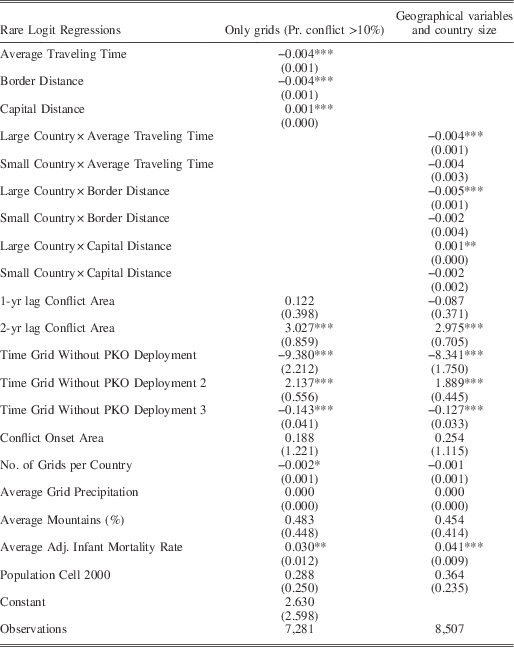
As a third robustness check, observations were resampled in order to exclude ‘irrelevant grids’, namely grids with a very low probability of conflict. Model 1 in Table 2 shows that only including grids with a probability of conflict greater than 10 per cent does not affect the main findings.Footnote 70 Even including only extreme cases – with a probability of conflict larger than 50 per cent – does not lead to any significant changes in the effects of the main explanatory variables.Footnote 71
Subnational Deployment of UN Peacekeepers, Robustness Checks

Note: robust standard errors in parentheses. ***p<0.01, **p<0.05, *p<0.1.
Even though all models control for country size (number of grids), it is still possible that the effects of geographical factors are conditional on country size. To put it differently, traveling time and distance could affect deployment differently in larger countries, such as Angola or the DRC, compared to smaller countries such as Burundi or Sierra Leone. When we include dummy variables for the large countries (DRC, Angola and Sudan), the results hold. Furthermore, we ran models in which the geographical variables (that is, Average Traveling Time, Border Distance, Capital Distance) interact with a dummy for small versus large countries. Table 2 (Model 2) provides some evidence that the effect of geography on deployment is conditional on country size: distance matters for large countries, such as Angola and DRC, but not necessarily for small ones, for instance Burundi and Sierra Leone. Finally, we followed a jackknife procedure, and the results are largely robust to the exclusion of each of the eight cases. It is noteworthy that Angola might drive the effect of the variable Capital Distance on the probability of the deployment.Footnote 72
Our results are based on information about the location of conflict areas extracted from the PRIO conflict site data.Footnote 73 However, as a further test of the robustness of our findings, we use the UCDP-GED dataFootnote 74 as an alternative. This dataset provides longitude, latitude and date of conflict events, which we use to compute for every grid whether there were any conflict events in a particular year. The two-year lag of the alternative operationalization gives results that are similar to the ones presented here.Footnote 75
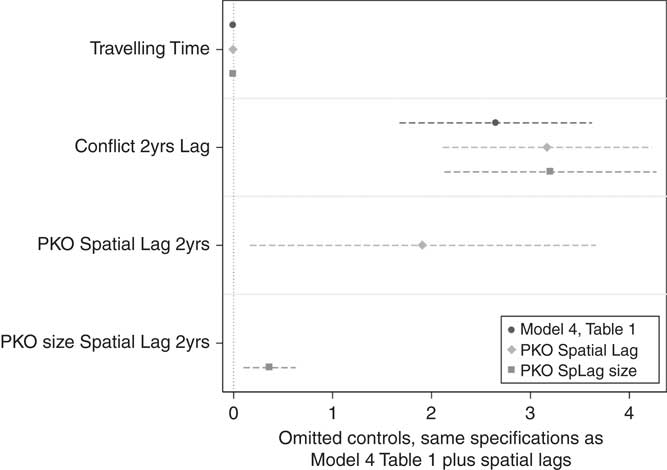
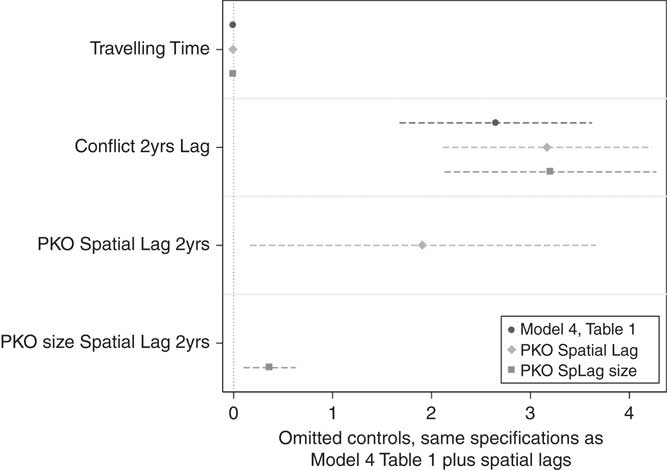
Finally, for the large countries we have run models with spatial lags of the PKO deployment in order to take into account possible correlations across space. In this case, we find more substantial results with possible spatial diffusion patterns.Footnote 76 We have computed the inverted distance interdependence matrix based on the presence of peacekeepers, as well as on the presence of peacekeepers weighted by the size of the deployment. Figure 2 reports graphically the coefficients of the two main variables in these three models when controlling for these spatial lags.Footnote 77 Figure 2 shows the empirical support for Hypotheses 1 (conflict) and 3 (traveling distance). The effects stay substantially the same as in Model 4.Footnote 78 Moreover, we find that the probability of deployment in a grid is positively affected by the presence nearby of peacekeepers in previous years.Footnote 79
Probability of deployment controlling for spatial effects Note: the gray dashed lines give the 95 per cent confidence intervals.
In order to check for multicollinearity we have run the diagnostic test of variance inflation factor. The explanatory variables are all above the tolerance threshold, and multicollinearity of the explanatory variables should not affect our results.
The Experience of UNOMSIL and UNAMSIL in Sierra Leone
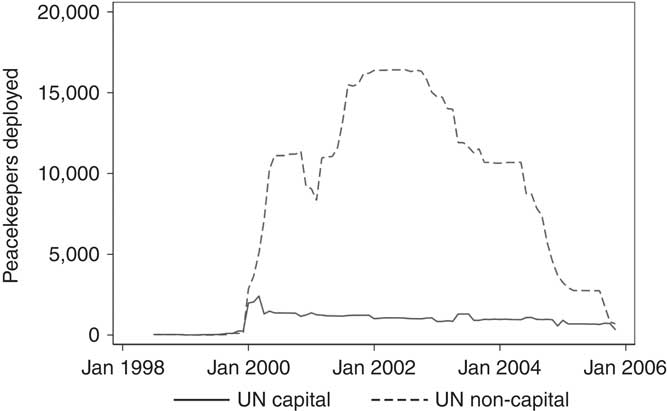
To further illustrate the main findings, we consider in greater detail the location and size of the peacekeeping forces in Sierra Leone. Figure 3 contrasts the size of UN deployment outside the capitalFootnote 80 with the size of UN deployment in the capital for the UNOMSIL and UNAMSIL peacekeeping missions. The solid line indicates the size of deployment in the capital, whereas the dotted line represents the size of the UN mission to the rest of the country. The missions to Sierra Leone are interesting because they exhibited both logics at different points. The logic of convenience is evident in the first period until September 2000 when the mission was understaffed, underfunded and in organizational disarray. From September 2000 a series of events led to a dramatic restructuring of the mission.
Comparison of deployment of peacekeepers to the capital, Freetown and outside the capital (UNOMSIL and UNAMSIL, Sierra Leone)

Following the adoption of Security Council Resolution 1270, UNAMSIL was established to replace the previous observer mission UNOMSIL in 1999. Unlike its predecessor, UNAMSIL included armed troops to be deployed throughout the country.Footnote 81 Initial planning was based on sharing peacekeeping tasks with troops from the Economic Community of West-African States Monitoring Group (ECOMOG) already present in the country. The Revolutionary United Front (RUF) was perceived as largely pacified and no longer posing a serious threat.Footnote 82 Initially, the Security Council approved a force of 6,000 troops with the expectation that ECOMOG forces would remain in the Northern and Eastern provinces controlled by the RUF at that time. When the departure of the Nigerian forces from ECOMOG left the UN with no significant presence in the rebel areas, the Security Council approved an increase in the UN force to 11,000 military personnel. The build-up was slow, however, and could not support entering deeply into rebel-controlled areas.Footnote 83 Contributing countries, such as Zambia, became increasingly dissatisfied with how their national forces were deployed as more of their troops were engaged in direct fights and the RUF succeeded in taking peacekeepers as hostages. Moreover, any troops deployed to crisis areas lacked sufficient logistic support and were left without basic knowledge of the terrain (such as proper maps). Although the (slow) deployment into conflict zones may suggest an instrumental logic, the peacekeepers lacked the support needed to be effective. In line with the logic of convenience, countries contributing to the mission interpreted the rules of engagement differently and were reluctant to forcefully confront the RUF.Footnote 84 They also retained direct control over the deployment of their contingencies, further diminishing the ability of the UN forces to attain a robust presence in rebel-held areas.
The fate of UNAMSIL was turned around when the USA, led by Holbrooke as the permanent representative to the UN, and Great Britain provided the necessary financial support and political backing for a dramatic increase in the number of troops and logistic support. The mission reached 17,500 military personnel at its peak. It was one of the most expensive and largest missions at the time. Moreover, Security Council Resolution 1346 provided the mandate for UN troops to use force against the threat of RUF. The additional resources, the restructuring of the leadership of the mission and efforts to homogenize the rules of engagement across all contingencies contributed to a stronger and better-equipped force that was able to enter all RUF-controlled areas.Footnote 85 In the spring and summer of 2001 UNAMSIL deployed forces in the Northern and Eastern provinces and established headquarters in key conflict areas such as Yengema, a diamond mining town in the Kono district. Figure 3 shows that the build-up of UNAMSIL forces was nearly exclusively outside the capital, Freetown.
FINAL REMARKS
Where do peacekeepers go? We know that overall, UN peacekeeping operations tend to choose hard cases to intervene, namely countries that have experienced long and violent civil wars. However, a full answer to the question requires looking beyond the country level and using disaggregated information on UN peacekeeping subnational deployment. Do peacekeepers actually go where conflict is observed, or do they tend to concentrate in the capital or areas that are away from the conflict?
On the basis of geo-referenced deployment and conflict data, we show that UN peacekeepers go where the conflict is located, but with a substantial temporal delay. A possible interpretation of the temporal delays is that UN peacekeeping forces, even though they are inspired by an instrumental logic, are trapped in logistic or bargaining dynamics. Regardless, peacekeepers do not appear to be proactively able to deploy quickly in areas where conflict diffuses. Further, even though the peacekeepers go to areas that have experienced conflict, they still shy away from conflict areas located far from urban areas. This suggests potential selection bias in where UN forces are deployed within a country, even if the country as whole can be classified as a ‘hard case’.
Overall, we interpret our findings to indicate that an instrumental logic best describes the deployment of UN peacekeepers, but that (at least in large countries) it is mitigated by ‘convenience’. Three underlying mechanisms may explain this empirical pattern. The first possibility is that logistic constraints cause the time delay of deployment to conflict areas. These constraints are interacting with the operational capacity and rules of engagement of the contributing forces. Alternatively, as AutesserreFootnote 86 argues, the pattern of deployment could reflect the relative insensitivity of the UN to local grievances and feuds that often fuel conflict. A final possibility is that developments on the ground affect attitudes toward risk. Prospect theory suggests that actors become more risk acceptant if they fear losses relative to the status quo, while they are more risk averse with respect to gains from the status quo.Footnote 87 If so, the instrumental logic should be more relevant if the situation on the ground is deteriorating, while the logic of convenience should apply more to improving (or static) situations. Current data do not allow us to explore these lines of thought more fully, and thus we leave these questions for future research.
Another further line of inquiry is the effect of our findings on the evaluation of the impact of peacekeeping. Even though there is evidence that UN deployments tend to follow the conflict, the finding that peacekeeping deployments seem at least partially motivated by a logic of convenience strongly suggests that the evaluation of UN effectiveness needs to take into account possible subnational selection bias.