Implications
Because of the typical production system in double-muscled Belgian Blue cattle, productivity was defined as dam weight gain per CI plus calf birth weight. Most cows were not yet mature, so that the production system can be considered as an extended form of beef production with early calving heifers. Daily cow–calf pair BW yield (BWY) depended on parity and was lower in older cows than in first- and second-calf cows. Dam BWY contributed considerably to the cow–calf pair BWY. A shorter CI is advised because of better nutrient utilisation, and a beneficial impact on selection, culling, profitability and greenhouse gas emission.
Introduction
The productivity of the beef cow is important to increase economic profitability. Productivity is often defined as the result of number and weight of weaned calves, taking reproductive performance and milk yield of the dam, and mortality and growth rate of the calf into account. Maintaining a short calving interval (CI) is an important target to obtain a maximum calf crop in beef cows, together with low calf mortality. It is an objective to get a calf from each cow every year. A longer CI means extra costs for feeding, housing, labour, machinery and it does not coincide with extra financial return. Kunkle et al. (Reference Kunkle, Sand and Rae1994) reported a reduction of the yearly income per cow from 356 to 142 US dollar when CI increased from 364 to 414 days.
Beef cow management in double-muscled Belgian Blue (DMBB) cattle is different in comparison with other beef breeds. The breeding season is limited in most beef cow operations (Deutscher et al., Reference Deutscher, Stotts and Nielsen1991; Blanc and Agabriel, Reference Blanc and Agabriel2008), whereas year-round calving is mostly applied in DMBB cows. Elective caesarean is routinely applied in DMBB cattle, because of the high cull value of cow and calf. Most DMBB dams do not suckle their calves because of variable and sometimes insufficient milk production. Therefore, the classical definition of productivity cannot be used in DMBB cows. BW yield (BWY) is used instead of productivity, and is defined as calf birth weight plus dam weight gain per CI.
CI tends to be longer in DMBB cows than in other breeds. Hanzen et al. (Reference Hanzen, Laurent and Ward1994) reported an average CI of 435 days in suckled DMBB cows compared with 364 days for Blue–Grey cows (Osoro and Wright, Reference Osoro and Wright1992), 370 days for Angus cows (Frazier et al., Reference Frazier, Sprott, Sanders, Dahm, Crouch and Turner1999), 377 days for Simmental cows, 387 days for Salers cows, 381 days for Limousin cows and 393 days for Hereford cows (Pilarczyk and Wójcik, Reference Pilarczyk and Wójcik2008). It averaged 364 days for Charolais and Limousin multiparous cows, and 385 and 389 days, respectively, for Charolais and Limousin primiparous cows (Agabriel et al., Reference Agabriel, Grenet and Petit1992). A mean CI varying between 391 and 402 days has been reported for Aberdeen Angus, Limousin, Simmental and South Devon cows (Roughsedge et al., Reference Roughsedge, Amer, Thompson and Simm2005). However, direct comparisons between DMBB cattle and other breeds are scarce, so that the comparison of CI from different studies is an indication of differences rather than an absolute reference. CI depends on several factors (Blanc and Agabriel, Reference Blanc and Agabriel2008) because reproductive performance is the result of a complex system. The longer CI in double-muscled cattle may be because of reduced fertility (lower conception rate, lower pregnancy rate and lower calving rate) in comparison with normal-muscled cattle (Ménissier, Reference Ménissier1982). However, the negative effect of a prolonged CI on cow–calf pair BWY of DMBB cattle, owing to a lower calf crop, may be counterbalanced by a heavier BW at birth (BWb) of DMBB calves, compared with other beef breeds. Birth weight of DMBB animals is close to 50 kg for females and somewhat higher for male calves (Fiems et al., Reference Fiems, van Caelenbergh, De Campeneere and De Brabander2005a), so that it is higher than in most other breeds (Andersen and Plum, Reference Andersen and Plum1965; Přibyl et al., Reference Přibyl, Misztal, Přibylová and Šeba2003; Phocas and Laloë, Reference Phocas and Laloë2004). However, direct comparisons of BWb among beef breeds are scarce here again, with exception of a 12-breed comparison conducted over 12 years (Přibyl et al., Reference Přibyl, Misztal, Přibylová and Šeba2003). Furthermore, first calving at an age of 24 months and a prepartum BW of 600 kg are recommended for dam development, calf BWb and economical reasons (Fiems and De Brabander, Reference Fiems and De Brabander2009). Primiparous DMBB cows did not yet achieve their adult BW at first calving. This means that these young cows produce extra BW beside their offspring. Consequently, BWY of the cow–calf pair depends on calf BWb and dam BW gain during the subsequent CIs. Therefore, it is sometimes argued that CI is not of main importance in DMBB cows.
DMBB animals are extremely lean, resulting in a low body condition score (BCS; Fiems et al., Reference Fiems, van Caelenberg, De Campeneere and De Brabander2006). Osoro and Wright (Reference Osoro and Wright1992) reported a shorter CI for cows having a higher BCS at calving. However, the effect of BCS on the reproductive performance of DMBB cows is not clear. Previous results showed that open DMBB cows at 9 months postpartum had a higher BCS at the last calving than cows that became pregnant within 9 months postpartum (Fiems et al., Reference Fiems, van Caelenberg, De Campeneere and De Brabander2006).
The objective of this study was to investigate the factors affecting CI, and to study the effect of CI and parity on BWY of DMBB cow–calf pairs.
Material and methods
Animals and animal management
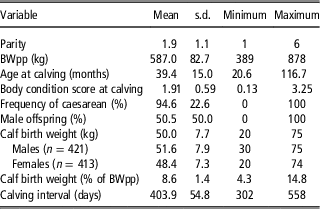
Data were collected from the DMBB beef cow herd of the institute (ILVO – Animal Sciences Unit, Melle, Belgium), involving 834 CIs originating from 386 females. Parturition characteristics and length of the CI are shown in Table 1. CI is defined as the number of days between two subsequent parturitions. Gestations giving multiple births (0.6% of total number of gestations) were excluded. Spontaneous abortion interrupted gestation in 2.7% of the cases. Pregnancies after an abortion or ending with an abortion were also excluded. As a general management strategy, cows were excluded for further breeding and culled when they were not pregnant within 9 months after calving. All heifers were used for the replacement of cows.
Characteristics of parturitions and calving intervals of the double-muscled Belgian Blue cows (834 cow records)

BWpp=postpartum dam BW.
Normally, cows were fed according to the energy and protein requirements applied for dairy cattle (Centraal Veevoederbureau (CVB), 1998) during the winter period, but some cows were offered a restricted energy allowance (Fiems et al., Reference Fiems, De Campeneere, van Caelenbergh and De Brabander2009). During the indoor period, diets consisted of maize silage, or maize and grass silage, supplemented with an appropriate concentrate to meet energy and protein requirements, except in case of a restricted energy allowance. Cows were confined in tie stalls as well as in loose houses during the winter period. Grazing occurred from late April to early November. Rotational grazing on monoculture of perennial ryegrass was practiced. Cows moved to a new parcel on the basis of a target post-grazing sward stubble height of 6 to 8 cm. The use of fertiliser was in accordance with a decree of the Flemish government: maximum 370 and 350 kg/ha of total N, and 95 and 90 kg/ha of total P2O5, when grass was only mowed, or mowed in combination with grazing, respectively. Excess of grass in spring and early summer was mowed for hay making or ensiling.
The breeding season was not limited, so that cows could calve throughout the year. Breeding of heifers started from a minimum age of 13 months and a minimum BW of 360 kg onwards. Breeding of cows started from 1 month after calving, when the wound due to caesarean section (CS) was healed.
Factors affecting CI
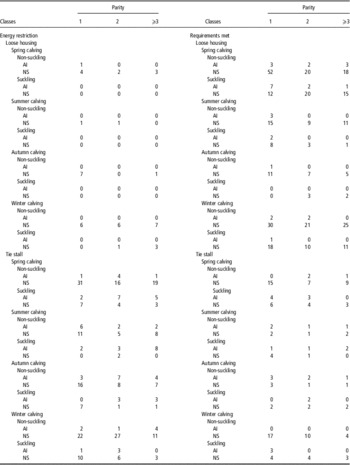
The effects of parity, BCS, calf BWb expressed as a percentage of dam postpartum BW (BWpp), mode of delivery, month and season of calving, breeding system and suckling on CI were investigated. BCS was estimated as described by Agabriel et al. (Reference Agabriel, Giraud, Petit, Barboiron, Coulaud and Decuq1986). Cows were divided into groups according to their BCS: <1.5, 1.5 to 2, 2 to 2.5, 2.5 to 3 and >3. To study the effect of BWb/BWpp (%) on CI, cow–calf pairs were divided into groups: <6, 6 to 7.9, 8 to 9.9, 10 to 11.9 and ⩾12. Calf delivery by CS was compared with vaginal birth. The effect of the meteorological season at calving on CI was investigated besides month of calving. Artificial insemination (AI) as a mating system was compared with natural service (NS). Cows were randomly selected for NS or AI. In the case of NS, the maximum number of non-pregnant cows per mating bull was always smaller than 25. Bulls stayed together with the cows on pasture, and in loose houses during the winter. Tied cows were mated when oestrus was detected. Cows were visually observed for oestrus in the morning and in the afternoon. Mating continued until 9 months after calving. Finally, the effect on CI of dams suckling their calves for 16 weeks postpartum was compared with dams that were dried off after colostrum collection and whose calves were reared. Calves were reared on milk replacer, fed twice daily at 10% of their initial live weights, until weaning when daily concentrate intake exceeded 0.5 kg. Concentrate intake was restricted at 3 kg/day, whereas grass hay was fed ad libitum beside milk replacer and concentrate. The number of cows involved within different classes is presented in Table 2.
Number of double-muscled Belgian Blue cows within different classes

AI=artificial insemination; NS=natural service.
Effect of CI and parity on BWY of DMBB cow–calf pairs
Because of the unique cow management in DMBB cattle, as mentioned before, and because milk production is variable and often insufficient so that most calves are not suckled by their dams, BWY was defined as calf BWb plus dam BW gain per CI in absolute terms (kg), as well as on a daily basis (kg/day). The contribution of the dam BW change to BWY of the cow–calf pair was also calculated and expressed per kg of calf BWb. CI was divided into classes: <12, 12 to 13, 13 to 14, 14 to 15, 15 to 16 and >16 months.
Statistical analysis
A factorial analysis investigating the effect of parity, calving season, BCS, CS, calf management, mating system, BWb/BWpp, confinement and energy intake level during the indoor period on CI was not possible because of unbalanced data (see Table 2). Only the effect of calving season, calf management and mating system on CI was analysed using a factorial design, with other factors used as covariates. Factors not involved in this factorial analysis were separately analysed as single factors using ANOVA, with the remaining factors used as covariates. Beside the aforementioned factors, calf sex was also used as covariate for the factorial analysis of parity and CI on BWY.
The Statistica software (StatSoft, 2009) procedure for general linear models was used for the analysis of the effects on CI, and for the effect of parity and CI on BWY. Results were presented as least squares means. Treatment means were tested for significance by the least significant difference method. Treatment effects were presented as significant when P<0.05 and trends were identified at 0.05<P<0.10. Pearson correlation coefficients were calculated between subsequent CIs.
Results
Factors affecting CI
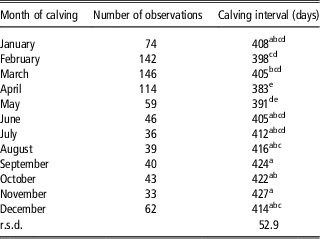
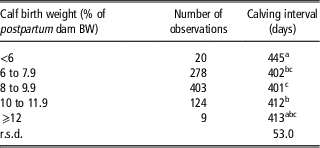
CI averaged 404±1.9 (s.e.) days and was not significantly affected (P>0.10) by confinement, feeding according to energy requirement or restricted feeding, BCS or breeding system (NS v. AI). Cows undergoing CS tended to have a longer CI compared with those calving per vaginum (405 v. 391 days; P=0.093), but there was no interaction with parity (P>0.10). CI of primiparous cows (400 days) was shorter than CI of cows with three or more parturitions (410 days; P=0.028), whereas CI of second-calf cows (405 days) was not different from the other groups. Multiparous cows in general (407 days; P=0.057) tended to have a longer CI than primiparous cows. CI was affected by calf management (P<0.001) and averaged 419 days for suckling cows v. 398 days for non-suckling cows. Month of calving (Table 3) and calving season affected CI. Mean CI of spring calvings amounted to 395 days and was lower in comparison with other seasons (P<0.05). CI of autumn and winter calvings averaged 423 and 403 days, respectively, and were different (P<0.05). Mean CI of summer calvings (411 days) was intermediate, and was not different from CI of autumn or winter calvings. There was an interaction between calf management and calving season (P=0.012). CI in non-suckling cows was longer for summer (413 days) and autumn (419 days) calvings than for spring (385 days) and winter calvings (395 days), whereas CI in suckling cows was longer in autumn (438 days) than in spring (414 days) and summer calvings (406 days), with an intermediate CI for winter calvings (423 days). An interaction between mating system and calving season occurred (P=0.004). Autumn calvings resulted in a longer CI (432 days) than other seasons in case of NS, whereas CI was shortest for spring and winter calvings (393 and 402 days, respectively), and CI of summer (410 days) was intermediate between spring and winter calvings. In case of AI, spring and autumn calvings resulted in the shortest CI (399 days each), whereas CI was longest for winter (431 days; P<0.05); CI for summer calvings (414 days) was intermediate between spring and autumn calvings, on the one hand, and winter calvings on the other. BWb/BWpp exerted a significant effect on CI (Table 4). Dams giving birth to lighter calves were characterised by a longer subsequent CI (P=0.003). The length of subsequent CIs was weakly correlated (P>0.05) as shown in the correlation matrix (Table 5).
Effect of month of calving on subsequent calving interval of double-muscled Belgian Blue cows

BWb=BW at birth; BWpp=postpartum dam BW.
Statistical model: Y ijklmnop =μ+Calving month i +Parity j +Caesarean section k +Energy intake level l +Confinement m +Calf management n +Breeding system o +BWb/BWppp+ε ijklmnop .
a,b,c,d,e P<0.05 between months.
Effect of calf birth weight on subsequent calving interval of double-muscled Belgian Blue cows

BWp=BW at birth; BWpp=postpartum dam BW.
Statistical model: Y ijklmnop =μ+BWb/BWpp i +Parity j +Calving month k +Caesarean section l +Energy intake level m +Confinement n +Calf management o +Breeding system p +ε ijklmnop .
a,b,c P<0.05 between calf birth weight groups.
Pearson correlations between subsequent calving intervals of double-muscled Belgian Blue cows

CI=calving interval.
1 CI after the first parturition.
2 CI after the second parturition.
3 CI after the third parturition.
4 CI after the fourth parturition.
5 CI after the fifth parturition.
6 Number of observations.
Subsequent calving intervals are not significantly correlated at P=0.05.
Effect of CI and parity on BWY of DMBB cow–calf pairs
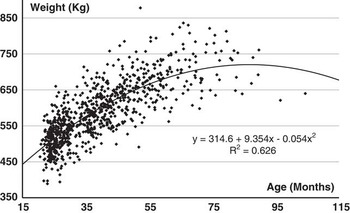
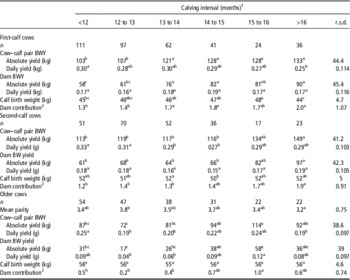
Effects of CI on cow–calf pair BWY are presented per parity (Table 6) because of the interactions between parity and CI. Absolute BWY of cow–calf pairs was affected by parity (P<0.001) and CI (P<0.001), with a significant interaction (P=0.029). Daily BWY of cow–calf pairs was also affected by parity (P<0.001) and CI (P=0.013), with a tendency for an interaction (P=0.094). There was an increase in absolute BWY with increasing length of CI in first- and second-calf cows, whereas daily BWY tended to decrease with increasing length of CI, but these effects were less clear in older cows. Absolute BWY of cows was affected by parity (P<0.001) and CI (P<0.001), with a tendency for an interaction (P=0.053). Absolute cow BWY increased with increasing length of CI in first- and second-calf cows, but the effect was largely variable in older cows. Absolute cow BWY was highest for a CI of 15 to 16 months and lowest for a CI of 12 to 13 months. Other CIs resulted in intermediate values that were not different from the extreme values. Daily BWY of cows was only affected by parity (P<0.001). Daily cow BWY was lowest for dams with the highest parity. This phenomenon corresponds with Figure 1, presenting the evolution of postpartum BW, and showing that the growth curve flattens with increasing age and parity. Absolute and daily BWYs of cow–calf pairs and of cows were higher for first- and second-calf cows than in older cows. Calf birth weight was only affected by parity (P<0.001). Dam contribution to BWY tended to be affected by parity (P=0.095) and CI (P=0.085), without interaction (P>0.10). Dam contribution to BWY tended to be higher for increasing CI and it decreased when parity increased.
Evolution of postpartum BW of Belgian Blue double-muscled cows with increasing age.

Effect of length of calving interval within parity on cow–calf pair BWY in double-muscled Belgian Blue cattle

BWY=BW yield; BWb=BW at birth; BWpp=postpartum dam BW.
a,b,c P<0.05 between calving interval.
1 Statistical model: Y ijklmnopq =μ+CI i +Parity j +CI i ×Parity j +Calving month k +Caesarean section l +Calf sex m +Energy intake level n +Confinement o +Calf management p +Breeding system q +BWb/BWpp r +ε ijklmnopqr .
2 Dam contribution: dam BW change/calf birth weight
Discussion
Factors affecting CI
The mean CI of 404 days observed for DMBB cows in this study was considerably longer than reported for most other beef breeds (Osoro and Wright, Reference Osoro and Wright1992; Frazier et al., Reference Frazier, Sprott, Sanders, Dahm, Crouch and Turner1999; Pilarczyk and Wójcik, Reference Pilarczyk and Wójcik2008). Reasons for the reduced reproductive performance are related to the double-muscling phenomenon (Fiems, Reference Fiems2012). A fetomaternal disproportion is typical for these animals, resulting in an increased frequency of dystocia (Eriksson et al., Reference Eriksson, Näsholm, Johansson and Philipsson2004). BWb/BWpp ratio amounted to 9.0% and 8.3% for primiparous and multiparous cows, respectively, compared with 7.5% and 6.3% for Holstein cattle (Johanson and Berger, Reference Johanson and Berger2003). Calving difficulty may exert a negative effect on reproductive performance (Cammack et al., Reference Cammack, Thomas and Enns2009). CS is not always inevitable in case of a difficult calving in most cattle breeds. Calves are frequently born with some assistance by the producer without resorting to CS. Dystocia and CS occur more often in young cows (Fiems et al., Reference Fiems, De Campeneere, van Caelenbergh and Boucqué2001). In the current study, 94.6% of the parturitions were by CS, which is considerably higher than in most other beef breeds. Consequently, direct and residual effects of a (difficult) vaginal birth were absent. The present study only indicated a tendency for an increased CI (14 days; P=0.093) because of CS. Charolais cows delivering by CS had a 4-week longer CI than cows calving per vaginum (Agabriel et al., Reference Agabriel, Grenet and Petit1992). Gutiérrez et al. (Reference Gutiérrez, Goyache, Fernández, Alvarez and Royo2007) reported a significantly longer CI of 394 days for Asturiana de los Valles beef cows calving with CS compared with 336 to 347 days for cows calving without CS. The longer CI in multiparous cows, compared with primiparous cows, may be because of the repetitive use of CS. However, no parity×CS interaction was observed with regard to CI.
The tendency for a shorter CI in DMBB primiparous cows compared with multiparous cows was not in accordance with the findings of Agabriel et al. (Reference Agabriel, Grenet and Petit1992), where CI of Limousin and Charolais primiparous cows averaged 389 and 385 days, respectively, compared with 364 days for multiparous cows in both breeds. On the other hand, Drennan and Berry (Reference Drennan and Berry2006) did not find an effect of cow parity on CI. Nevertheless, an effect of parity on CI, as reported by Agabriel et al. (Reference Agabriel, Grenet and Petit1992), can be expected. Guedon et al. (Reference Guedon, Saumande and Desbals1999) reported a longer interval between calving and first ovulation for primiparous than for multiparous cows. Moreover, primiparous cows are not yet mature. Therefore, extra nutrients must be provided for further development beside the nutrients required for maintenance and foetal development or milk production in case of gestation or suckling (Short and Adams, Reference Short and Adams1988). Mature BW (ca. 715 kg) and age (ca. 7 years) were mostly not attained in the current study, even by multiparous cows (Table 1; Figure 1).
BCS at calving did not affect CI in the present study, which is in contradiction to previous findings in other beef breeds. Osoro and Wright (Reference Osoro and Wright1992) reported an 11-day shorter CI (P<0.001) for each extra unit of BCS at calving between 1.25 and 3.75 on a six-point scale. Kunkle et al. (Reference Kunkle, Sand and Rae1994) reported no effect on CI (364 days) when BCS at calving was reduced from 6 to 5 on a nine-point scale, whereas further reduction to 4 and 3 increased CI to 381 and 414 days, respectively. CI varied cubically with BCS at calving and quadratically with BCS at breeding (P<0.001 and 0.002, respectively) in a study by Renquist et al. (Reference Renquist, Oltjen, Sainz and Calvert2006). Rae et al. (Reference Rae, Kunkle, Chenoweth, Sand and Tran1993) found that beef cows with a BCS at pregnancy diagnosis, performed at 60 to 100 days postpartum, of 5 or more had a pregnancy rate of 89%, whereas cows with a BCS of <4 had a lower pregnancy rate (59%; P<0.05). The lack of an effect of BCS on CI in DMBB cows is in accordance with previous results (Fiems et al., Reference Fiems, van Caelenberg, De Campeneere and De Brabander2006). Furthermore, the study of Rae et al. (Reference Rae, Kunkle, Chenoweth, Sand and Tran1993) emphasises that BCS at breeding may also be related to reproductive performance.
The lack of an effect of BCS on CI is in agreement with the lack of an effect of feeding according to energy requirements or a restriction below the requirements. This may be because of the fact that energy restriction was only applied during the winter period, and the fact that the mean CI was longer than 365 days, so that energy restriction did not always coincide with the postpartum interval. Confinement also did not exert an effect on CI, probably because the influence of housing was also limited to the winter period. This agrees with findings of Ducrot et al. (Reference Ducrot, Grohn, Humblot, Bugnard, Sulpice and Gilbert1994), where the impact of housing on postpartum anoestrus of Charolais cows was not significant.
CI was clearly affected by BWb/BWpp. Increased BWb generally increases the frequency of dystocia (Eriksson et al., Reference Eriksson, Näsholm, Johansson and Philipsson2004), and dystocia may exert a negative effect on reproductive performance (Cammack et al., Reference Cammack, Thomas and Enns2009). However, we expected no impact of BWb or BWB/BWpp on CI in DMBB cows because of the extended application of CS. Low as well as high ratios resulted in a longer CI in the current study. The reason for increased CI due to a low BWb/BWpp ratio is not clear. However, lighter calves resulted in a higher incidence of retained placenta in dairy cows (Joosten et al., Reference Joosten, van Eldik, Elving and van Der Mey1987). The tendency for increased CI due to a higher BWb/BWpp ratio may be provoked by increased competition for space within the abdomen between the pregnant uterus and the digestive organs (Forbes, Reference Forbes1987). This competition may be more pronounced in double-muscled than in normal-muscled cows, because of their reduced organ size and feed intake capacity on the one hand, and a higher calf BWb on the other (Fiems, Reference Fiems2012). The importance of BWb/BWpp ratio should not be exaggerated because only a low number of observations were in the classes with a low (n=20) or a high ratio (n=9), resulting in an increased CI.
Although cattle are not seasonal breeders, there is an indication that calving date may affect reproduction. Blanc and Agabriel (Reference Blanc and Agabriel2008) reported shortest and longest CIs for parturitions in May to June and October to November, respectively. Cows that calved between October and March had significantly longer intervals from parturition to first oestrus than cows that calved between April and September in experiments of Hansen and Hauser (Reference Hansen and Hauser1983). The effect of calving season reported by Blanc and Agabriel (Reference Blanc and Agabriel2008) and Hansen and Hauser (Reference Hansen and Hauser1983) is in accordance with the longer CI during autumn found in the current study for the pooled data, and for NS. The effect of calving season may also be linked with nutrition. Reproduction is dependent upon nutrition. There is most often an abundant supply of forage with a high nutritive value in spring.
An effect of bull fertility cannot be excluded. Body condition of some bulls involved was low in autumn, depending on duration and intensity of bull restlessness and nervousness around cow oestrus, combined with a longer interval from calving to conception. Reduced BCS of service bulls may result in reduced fertility. Barth and Waldner (Reference Barth and Waldner2002) reported that significantly fewer bulls with a BCS of 2 on a five-point scale had satisfactory semen quality than bulls with average BCS.
The prolonged CI for suckled DMBB cows is in accordance with the well-known phenomenon of increased postpartum anoestrus interval for suckling compared with non-suckling cows (Williams, Reference Williams1990). No effect of NS or AI was observed in the current study, although Smith et al. (Reference Smith, Ely, Gilson and Graves2004) reported a shorter CI for NS in comparison with AI in dairy cows. The accuracy of oestrus detection is far more important in case of AI compared with when a bull remains with the cow herd.
Significant interactions observed in this study confirm the results of Rae et al. (Reference Rae, Kunkle, Chenoweth, Sand and Tran1993) and Blanc and Agabriel (Reference Blanc and Agabriel2008). This means that reproduction is a complex process, and that good management is required for calving to occur on a regular basis. Because the correlation between subsequent CIs is low (Table 5), the length of the CI may be difficult to predict. Werth et al. (Reference Werth, Azzam and Kinder1996) reported that the repeatability of CI was low. These results are a confirmation of the findings of Roughsedge et al. (Reference Roughsedge, Amer, Thompson and Simm2005) and Cammack et al. (Reference Cammack, Thomas and Enns2009), showing that fertility traits are in general of low heritability.
Effect of CI and parity on BWY of DMBB cow–calf pairs
The BWY of cow–calf pairs was largely affected by the BWY of the cows. Mean dam BWY exceeded calf BWb. Absolute and daily cow–calf pair BWY and dam BWY (Table 6) were highest for first- and second-calf cows in the current study. This can be explained by the fact that mature BW and age were not attained by most cows in this study (Figure 1). DMBB cows are often culled before they achieve their mature BW, partly owing to lack of pregnancy, but also because of the development of perimetrial adhesions as a consequence of CS (Vandeplassche and Bouters, Reference Vandeplassche and Bouters1982). Furthermore, carcass quality decreases with increasing dam age (Fiems et al., Reference Fiems, De Campeneere, van Caelenbergh, De Boever and Vanacker2003). Nearly all DMBB heifers are used for the replacement of culled cows. This production system can be considered as an extended form of beef production with early calving heifers (Roux et al., Reference Roux, Teissier, Bonnemaire and Dumont1987), with two to three calvings per cow on average to generate a sufficient number of replacement heifers to maintain the size of the cow herd. The lower BWY in older cows was only partly compensated by a heavier calf BWb. A positive effect of parity on calf BWb is usually reported (Andersen and Plum, Reference Andersen and Plum1965). Although absolute cow–calf pair BWY and dam BWY increased with CI, daily dam BWY was not affected by CI in first- and second-calf cows. Daily cow–calf pair BWY was not different for CIs varying from <12 to 16 months in primiparous cows, mainly owing to the considerable dam BWY. Consequently, the objective of having a calf every year may be less important in young cows, although this should be verified if the extra production costs owing to a longer CI are compensated by the greater BWY, and if there is an effect on lifetime productivity.
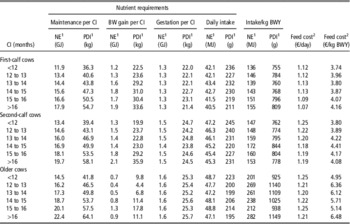
A retrospective calculation of energy and protein required by dams is shown in Table 7, based on the results of Table 6. Energy and protein evaluation systems involved were described by van Es (Reference van Es1978) and Tamminga et al. (Reference Tamminga, van Straalen, Subnel, Meijer, Steg, Wever and Blok1994), respectively. Previous (unpublished) studies indicated similar maintenance requirements for DMBB animals as mentioned by the National Research Council (NRC, 1996). Requirements for gestation were based on requirements reported by CVB (1998), and increased according to the predicted calf BWb (NRC, 1996). Tissue composition of dam BWY was based on body composition of DMBB cows (Fiems et al., Reference Fiems, van Caelenbergh, Vanacker, De Campeneere and Seynaeve2005b). Prices for energy (20.27€/GJ net energy) and protein (1.17€/kg protein digested in the small intestine) were assumed based on the information of Wageningen UR (http://www.wageningenur.nl/nl/Expertises-Dienstverlening/Onderzoeksinstituten/livestock-research/Faciliteiten-producten/Voederwaardeprijzen-Rundvee.htm). Daily feed cost was slightly reduced with increasing CI, but feed cost per kg of cow–calf pair BWY was increased with increasing CI. This is the consequence of lower efficiency of nutrient utilisation with increasing CI. Consequently, attempts to reduce CI should be advised. Cow contribution to cow–calf pair BWY is smaller for a shorter CI (Table 6). Because the selling price per kg of the newborn calf is normally higher than the price per kg of dam BWY in DMBB cattle, a shorter CI will result in greater yearly income. Furthermore, a larger calf crop can enable more intense selection and increase cow culling, resulting in increased income.
Effect of length of calving interval and parity on cow nutrient requirements and feed costs

CI=calving interval
1 NE=net energy (calculated according to van Es, Reference van Es1978); PDI=protein digested in the small intestine (calculated according to Tamminga et al., Reference Tamminga, van Straalen, Subnel, Meijer, Steg, Wever and Blok1994).
2 Feed costs are based on unit prices calculated for energy (20.27€/GJ NE) and protein (1.17€/kg DVE) by Wageningen UR: http://www.wageningenur.nl/nl/Expertises-Dienstverlening/Onderzoeksinstituten/livestock-research/Faciliteiten-producten/Voederwaardeprijzen-Rundvee.htm (April 2014).
Daily dam BWY of DMBB primiparous cows was slightly larger than the BW gain of Charolais cows from 32 to 44 months of age (129 g/day; Nadarajah et al., Reference Nadarajah, Marlowe and Notter1984). BW gains of Charolais cows from 44 to 56 months (41 g/day) and from 56 to 84 months of age (21 g/day; Nadarajah et al., Reference Nadarajah, Marlowe and Notter1984) were considerably lower than in the current study. Nevertheless, a higher daily dam BWY in young DMBB cows may be compensated by a longer CI to yield a somewhat higher calf BWb in comparison with other beef breeds.
The bio-economic performance of the cow–calf pair is of great importance in beef production. Besides profitability, there is an increasing need to investigate the contribution of the cow–calf pair in beef production to greenhouse gas emissions. Ruminants, especially beef cows, are often considered to be major contributors to global warming. The reduction of CI, without compromising daily cow–calf pair BWY, can have a positive effect on greenhouse gas emissions (Perdok et al., Reference Perdok, Hulshof, Veneman, Newbold and van Zijderveld2011). This is confirmed by the retrospective calculation shown in Table 7, where a shorter CI resulted in better efficiency of nutrient utilisation. This coincided with a smaller cow contribution to cow–calf pair BWY.
Conclusion
Although the production system in DMBB cattle is different from other beef breeds, CI is also dependent on a myriad of factors and interactions, like in other beef breeds, making it part of a complex system. The main factors affecting CI are parity, suckling, calving season and the ratio of calf birth weight to dam BW. CI tended to be longer in multiparous than in primiparous cows. Autumn calvings resulted in a longer CI, but there were interactions between calving season and suckling, and between calving season and mating system. Daily cow–calf pair BWY was not different for CIs from <12 to 16 months in primiparous cows, but it was more variable in older cows. Daily dam BWY in first- and second-calf cows was not affected by the length of CI. However, a shorter CI is advised because of more efficient nutrient utilisation.
Acknowledgement
The authors greatly acknowledge Piet Van Laere, Martin De Brabander, Paul Van De Casteele and Rudi Danneels for their skilled technical assistance.