Introduction
Patients needing radiotherapy treatment to their head and neck are immobilised in a specially made mask to fix the head and neck in a desired position. A mask should stabilise the patient for the stability, accuracy, and reproducibility of each day of treatment, aiming to target the tumour and avoid permanent harm to surrounding organs.1–Reference Dobbs, Barratt, Morris and Roques3 However, the tightness of the mask causes pressure to the superficial contour of the patients’ head and neck. This has the potential to restrict vision, impair swallowing, and impair respiration affecting the patients’ physical comfort. It could be suggested that an improvement in patient comfort is overlooked owing to the net effect of accuracy.Reference Leitzen, Wilhelm-Buchstab and Garbe4–Reference Mullaney, O’Shea and Dunne6
Unfortunately, patient comfort in radiotherapy is not well described.Reference Cheng and Wang7–Reference Kolcaba and Steiner9 Patient comfort is an elementary human need but PineauReference Pineau10 suggests that, in a modern society where physiological needs of food, water and shelter have been met, the context of comfort is more complex and concerns the style of the environment (psycho-social) in which a person has to adapt. In clinical nursing, Kolcaba et al. have advanced a theory of comfort to improve nursing care. Comfort was described in three constructs, relief, ease and transcendence (where patients are able to rise above their challenges) and identified four contexts of comfort including physical, psycho-spiritual, environmental and socio-cultural.Reference Kolcaba, Tilton and Drouin8, Reference Kolcaba and Steiner9 Intentional assessment of comfort is viewed as a key part of addressing patient needs in nursing practice. These interpretations of comfort may be transferable to radiotherapy to provide a patient centred approach to a traditionally technical environment.
At present in radiotherapy, comfort is assessed and evaluated usually in the context of physical comfort, using various methods including visual analogue scales (VAS) or quality of life questionnaires. In practice, comfort may be assessed on a daily basis by radiographers asking if the patient is comfortable before the delivery of a radiotherapy treatment session. This is completed without empirical evidence or guidance.Reference Bartlett, Colgan and Carr11 Patient comfort has been evaluated in radiotherapy clinical trials that tested novel techniques. Predominantly, the comfort assessments used in these trials were patient reported questionnaires administered after the session of the radiotherapy treatment.Reference Nutting, Khoo and Walker12, Reference Cox and Davison13 Cox and DavisonReference Cox and Davison13 proposed that comfort could be a determiner of treatment position (prone or supine) in patients diagnosed with prostate cancer. They reported that patient comfort in both positions was rated highly and therefore had no bearing on selection of position. The authors used VAS to measure comfort and anxiety and only considered the mono-context of physical comfort. The VAS is a generic assessment and widely used in many disciplines, but it may be too basic to capture the complexities of comfort in radiotherapy. Therefore, this study aims to explore patient’s comfort from the experiences of patients wearing a mask during head and neck radiotherapy to inform a study developing and testing a valid comfort measure in radiotherapy practice.
Methods
A focus group interview was the selected method to explore patients’ experiences of comfort in radiotherapy to encourage participation. The group participants shared a common experience which gives ‘permission’ to talk about issues not usually addressed.Reference Maclsaac and Doucette14–Reference Flinton and Owens19
Setting
The Beacon centre is a rural cancer centre with radiotherapy services based in the south west of England. The radiotherapy service has a population catchment area of 500,000 and treats 17,000 patients per year. The centre consists of one planning computed tomography (CT) scanner and three radiotherapy linear accelerators utilising conventional, intensity modulated, arc therapy and breath-hold techniques. The strategic aim of the Beacon centre is to improve patient experiences such as comfort in radiotherapy in order to deliver high quality and as safe radiotherapy.
Sample
Convenience sampling was used and five patients were invited to participate in the focus group.Reference Creswell18 Only patients who had received radiotherapy for head and neck cancer, and deemed to be free of emotional distress by the cancer nurse specialist (CNS), were invited to participate. The reason for this was two-fold, first the patients will be able to have in-depth discussion about their experiences and the CNS selection was made to avoid distressing vulnerable patients. Inclusion criteria were: all participants must have been diagnosed with head and neck cancer and treated with radical radiotherapy. Participants must have completed treatment within 6 months of the focus group being undertaken. The time period of 6 months was considered to allow participants time to recover after the radiotherapy treatment. The time limit to 6 months was also considered a sufficient period to recall memories. Excluded were patients that were deemed to be suffering from emotional distress.
Data collection
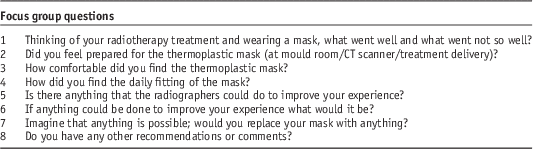
Questions for the semi-structured focus group interview were designed to facilitate discussion in relation to the patient’s experience of comfort during radiotherapy while wearing a thermoplastic mask (Table 1). Participants were asked questions followed up with probes to elicit a more complete and in depth response.Reference Rubin and Rubin20
Focus group questions

Note: Abbreviation: CT, computed tomography.
The focus group was planned to convene for around 1 hour. A digital recorder was used to record the conversation and to transcribe the discussion.Reference Kidd and Parshall21 An independent note taker was invited to make sure no information was lost and allowed for checking any information that may have been interpreted differently or was difficult to hear from the recording. All patient related data were anonymised. The transcript was sent to the participants to confirm that they agree with what has been expressed during the focus group interview.Reference Williams, Wilford and Cutler22 The focus group was held on the 20 November 2014.
Data analysis
Thematic analysis was deployed to identify themes and subthemes.Reference Braun and Clarke15, 23 The analysis of the transcript was organised by hand using Microsoft Excel spreadsheets. The first analysis step involved familiarisation of the narratives and two researchers independently read the transcripts. The next step, two researchers (one being the principal researcher) independently coded the text by allocating the text fragments to formulated codes. In the following step, two researchers discussed the results of the individual codes and tried to reach consensus on the codes and related text fragments. After this, the codes were reviewed and themes were formulated. The final step was the determination of meaningful text fragments and themes.Reference Onwuegbuzie, Dickinson, Leech and Zoran24 Confidentiality was protected by changing names to an alias.
Findings
Five patients were invited for the focus group. Three patients consented and participated; one female (F1) and two males (M1 and M2) age between 51 and 68 years. Two patients accepted the invitation but did not attend.
Three major themes emerged from the analysis: Physical Comfort, Mental Perception and Passivity. The physical comfort theme relates mainly to the physical contact of the plastic mask to the patient including the feelings of pressure and looseness. The mental perception relates to the patients perception of comfort level. Passivity relates to the passiveness of the patient to do as the doctor or radiographer has instructed because ‘they know best’.
Physical comfort
Considering the physical comfort is anecdotally proposed to be an important factor when wearing mask, the focus group produced some variable responses. F1 stated to be physically uncomfortable: ‘They did say we could take a shim out I think it’s called. They eventually did do that and it was more comfortable. But look at this photo this is how it left me (a photo was presented of the patients head). On my eyes there was a lot of pressure. I got some really strange looks walking through the hospital or even out into reception’. The same participant described certain comfort levels related to dignity and how the radiographers ameliorated the discomfort. The patient addressed the individual dignity of the physical impression the mask made on the skin (lots of blotched red imprints covering the face), and the strange looks people would give not knowing what had happened to the patient. This encouraged M1 to elaborate more about the experience of physical comfort when wearing the mask, specifically during concurrent chemo-radiotherapy days: ‘In fact mine was tight, but it wasn’t anything like that. I felt I could move and could certainly see although I always had my eyes shut’. M1 continued ‘I was having chemotherapy and I was feeling quite sick and ill and having the mask on for 15minutes made me quite anxious’. Adding to this, M1 divulged that some days the treatment set up time was extended ‘There were some days that the mask seemed a lot tighter and took longer to fit. But then somewhere the mind starts to relax and you get through it. I wouldn’t say it was terrifying but it was unpleasant’. Only one of the other two participants had concurrent chemo-radiotherapy but did not share the same experience.
The environmental comfort is briefly described in terms of sensory awareness, of keeping the eyes closed and concerns that patients do not know what is going on. Moreover, the application of lead plugs inserted in the nose to protect the nasal septum has been described in terms of comfort level, but it could also be viewed as a sensory awareness restriction, and in reducing dignity. M1 sums up this experience with: ‘Comfort is the main thing, the rest of your body needs support and to try and make it more comfortable would be great’. This participant suggested that increasing comfort over the whole body, not just the treatment region, would have improved the experience. Radiographers could ask patients if they are comfortable across the whole body, and then add an extra pad under the knees or back to improve the comfort experienced by the patient. However it is interesting to note that M2 did not find the mask uncomfortable, but did not say it was comfortable stating ‘The mask did not bother me one bit’ and went on with ‘it went okay but it croppered (made to feel ill) me I was in ere for a month afterward’. F1 was encouraged to confirm feelings of comfort by saying ‘It was never comfortable. Always wishing for the moment they would take it off. As soon as I heard the gate go, I got about thirty seconds’.
The participants were then asked by the moderator to imagine that anything is possible; would you replace your mask with anything? All participants engaged in this discussion. F1 suggested ‘A softer mask, a softer material. There must be something out of a space program that’s rigid but softer. A softer feel than hard plastic’ which then led to M2 asking ‘Would it be possible to make, you know, the foam that they mould so it would come further around so nothing over your face. No mask with something joining here’, pointing towards the back of his head. Then M2 said ‘I did find the block that my head was on uncomfortable’. The interesting suggestions provided by the participants might lead towards possible future developments in radiotherapy.
Mental perception
Although physical comfort was shown to be an important factor to all participants, there were marked differences in their experiences and thoughts. In similarity with Arino et al.Reference Arino, Stadelmaier, Dupin, Kantor and Henriques de Figueiredo26 the comfort of participants was overlooked at the greater good of curing their cancer. F1 stated: ‘What went well is they seem to have solved my problems. They cured me of cancer’. This participant was very happy to have had the cancer treated and cured, and maybe overlooked comfort because as far as the patient was concerned they had received optimal treatment.
F1 mentioned: ‘At the time I was the only one I knew having my type of treatment. I am female, and we like to talk, it would have been nice to speak to someone going through the same thing’, describing the socio-cultural comfort defined by Kolcaba.Reference Kolcaba, Tilton and Drouin8 This patient suggested being better able to cope with discomfort if receiving support from peers with the same type of treatment. M1 continued saying: ‘Suppose the worst thing I had of claustrophobia was when it was made, I found that really bad’. M1 elaborated on this issue and described the thermoplastic mask as the worst experience ‘I imagine it’s a bit like having your head in a polythene bag and your breathing and it just sucks in and you feel as though I’m not gona breath here, and they say its gona take 10–15 minutes and it was probably after 2–3 minutes and I was thinking Im not gona make this I don’t think, for me, it wasn’t any physical pain it was a mental thing’. The perception of M1 of wearing the mask was as a ’mental thing’ which might relate to the psycho-spiritual contexts of comfort.Reference Kolcaba, Tilton and Drouin8 The patient’s mental state determines whether the physical comfort level is acceptable. There is a consistent theme arising from both participants in the socio-cultural and psycho-spiritual context, where the mental perception seems to be the dominant factor in overall comfort.
F1 suggested that the comfort level is proportional to how the mind perceives the unpleasantness: ‘My initial way of dealing with the mask was to count what I perceived to be the beams, so that I knew when I got past the halfway mark, I was on my way home. I kept my eyes shut and listened to the noises. That’s one thing with your eyes shut you cannot see what’s going on. Oh and the plugs up my nose got quite sore. Warming them up under a warm tap really helps. Someone came up with that idea and it really helped’. Likewise, M1 described a mental perception strategy to manage the comfort level via counting the length of time it would take to deliver treatment.
Passivity
Passivity can be a natural discourse of visiting a health care environment and having complete faith in the healthcare practitioner. Through having faith the patient then gains passivity through trusting the actions of the health care practitioner to be true even at the expense of patient comfort. In demonstrating passivity M1 said ‘I understood it (mask) had to be tight, because it was here that I was being treated’. After stating that the eyes could not be opened the F1 said ‘No I couldn’t but I was reassured it (radiotherapy beam) was going in the right place’. F1 then went on saying ‘I don’t think I could have been prepared for it because, how can you, unless you speak to someone else. I mean I was here and all set up for treatment and it all happened, I was just on the train as such and just took along for the ride’. F1 is alluding to passivity, and points once again towards the benefit of socio-cultural comfort of having a peer talk to her about how they felt when experiencing the same. Then further demonstrating passivity F1 stated: ‘I’ve always be the type of person that if a doctor tells me to do something I do it. I won’t fight against it. I won’t disagree, I won’t say no’. M1 and M2 agreed with what F1 was saying, but made no specific comments.
M1 became passive in a form of delirium from having concurrent chemotherapy and said: ‘Some days I didn’t know where I was, a few times I had a drip as well. So it was quite difficult’. It would seem that M1 demonstrated passiveness due to the performance status, rather than through a general mind-set that the healthcare practitioners know best. But did go on saying: ‘Were you down to the shoulders’, meaning the mask was made to cover the shoulders, ‘Mine came down to there’, pointed to the shoulder, ‘It was quite rigid at times. I suppose in some cases I would like to ask them what are you doing, what is that measurement. And you can’t. Then when treatment is finished you get up and go home’. Thus, M1 actually demonstrated passivity through a situation in which he did not feel empowered to ask questions. Questions which could have been answered and made him feel more at ease possibly.
An alternate perspective of passivity is given by F1, who said ‘I am not claustrophobic I am fine, but I can imagine some little old folk would have struggled with six weeks of radiotherapy. And with mine the pressure was so tight I could not see afterwards. I was restricted on driving so I was reliant on lifts’. F1 created a passive self through imagining if the participant was an elderly frail patient, suggesting being better suited for such treatment. Due to the physical pressure of the mask on the eyes, the participant was not able to drive leading to further passivity.
Discussion
There are different views of comfort among the patients; two participants (F1, M1) described the mask as uncomfortable from a viewpoint of psycho-spiritual and socio-cultural themes of physical comfort and mental perception in keeping with the Cheng and Wang study emphasising the importance of social support.Reference Cheng and Wang7 However, M2 said the mask ‘did not bother me one bit’. This could be a generalisable picture of a wider population where some patients find a mask more traumatic than others. Asking patients about a very specific comfort level, such as the pressure across the right eye needs to be completed at the time of radiotherapy treatment rather than several months after. Alternatively, there could be a problem with the meaning of comfort;Reference van der Steen, Sampson and Van den Block27 without the sensitivity of a standard assessment tool to detect and discriminate comfort it can be confused with pain to some people which could explain the findings in the Cox and Davison study.Reference Cox and Davison13 They concluded that comfort does not need to be considered when a patient is positioned supine or prone.Reference Cox and Davison13 However, this is contrary to a study byReference Bayley, Catton and Haycocks28 suggesting that the supine position was significantly more comfortable. A possible reason for this is the lack of specificity as neither study used standardised and validated radiotherapy comfort assessment methods. This could explain the findings in the current focus group as there may be other phenomena at work.
F1 elaborated more about passivity than M1 and M2. F1 was female and M1 and M2 were male. It could be suggested that the responses of the male participants were due to a deeper characteristic such as hegemonic masculinity.Reference Appleton, Wyatt and Perkins29 Neither M1 nor M2 agreed or disagreed with F1 when she suggested she would do as the health professional had instructed, because the health professional knows best in keeping with the passivity theme. Passivity is described by Arino and et al.Reference Arino, Stadelmaier, Dupin, Kantor and Henriques de Figueiredo26 as an acceptance of the mask providing a protective effect. This could suggest that comfort level maybe viewed as an acceptability level that patients will tolerate. Nonetheless, passivity needs considering in clinical practice for optimised patient care and treatment. The non-response from the male participants could be due to hegemonic masculinity.Reference Appleton, Wyatt and Perkins29 It is worth noting that M1 wished to ask questions while in the mask, but did not feel he could. This could point towards a level of passivity in agreement with F1. However, the topic of hegemonic masculinity is out of the scope of the current study but is worth acknowledgement.
The three themes of comfort arose when analysing the transcripts based on the experiences of patients in the focus group. It could be suggested that the themes are inseparable to the overarching context of comfort. Nonetheless, the findings provide an insight into the patient’s experience of comfort in radiotherapy that has not been addressed before.
Limitations
The limitation of this consultation study is the sample size of three patients which is not the recommended sample size. This does mean that the sample is potentially open to bias and unlikely to be representative.Reference Williams, Wilford and Cutler22 This was a smaller group size than recommended for a focus group study because two patients did not arrive for the focus group. The possible bias due to sample size has to be acknowledged.
Conclusion
The identified themes related to comfort provide a deeper understanding of how patients experience the radiotherapy of the head and neck region while wearing a mask for immobilisation. Physical comfort, mental perception and passivity need to be considered in developing a comfort measure for daily radiotherapy practice. The findings of this study calls for further investigation of how the themes of patient comfort can be specifically measured in radiotherapy to improve the patient experience and accuracy of radiotherapy treatments.
Acknowledgements
The authors acknowledge the input of the three participating patients. Their experiences have been invaluable for designing future clinical trials on comfort during Radiotherapy.