1. Introduction
Smalley first introduced the term spatial texture in the context of spatiomorphology, as ‘concerned with how the spatial perspective is revealed through time’ (1997: 124), describing certain aspects of spatial structure and the manner in which space is generated by spectromorphological motion and anatomy. In view of the more recently introduced vocabulary of space-form (Smalley Reference Smalley2007) we can situate the original notion of spatial texture within the category of perspectival space,Footnote 1 expanding its potential as a spatiotemporal fabric of structures in acousmatic music. We can also allow this to enhance our understanding of texture as a spectromorphological principle in general, with emphasis on its role in the production and presence not only of perspectival, but also spectral Footnote 2 and source-bonded Footnote 3 space. Thus, the present article introduces research which investigates texture within space-form, following the conjecture that space is carried and generated by spectromorphology, rather than being a pre-existing container which is to be filled. From such an angle, spatial texture can be thought of as ‘the texture of space’,Footnote 4 or ‘texture as spatiality’.Footnote 5 The intention with the concepts presented here is to draw attention to textural processes in space, and to provide a vocabulary for describing these. While the theory attempts to be useful as a sensible, intuitive and applicable approach to existing phenomena in acousmatic repertoire, it does also reflect an aesthetic attitude with indications towards potential innovations in form. Thus, on one level, it can enhance the listening appreciation of what is already there while, on another, it can also be applied in compositional thought and practice, guiding the poiesis of a work.
In the article ‘Space-form and the Acousmatic Image’, Smalley argues that ‘acousmatic music can be a quasi-visual, as much as an aural, experience’ and that ‘visual and sounding space are not easily disengaged from each other’ (2007: 40). Indeed, many of the concepts of space-form, particularly those related to perspectival space, emphasise an image-view of the music unfolding in front of, or around, the listener's vantage point. This quasi-visual listening is also a guiding principle in the description of spatial texture phenomena here, not merely by analogy with pictorial visual perspective, but also in an environmental sense, following the conviction that vivid sound experiences also engage other sense modalities.
An interesting aspect of spatial texture is the interdependency among wholes and parts, which may enhance our appreciation of scale in space-form and therefore could hold potential for principles of form in acousmatic music. The present article discusses texture mainly from a low-level point of view, which is pertinent to its associated characteristic as ‘self-propagating’ (Smalley Reference Smalley1986: 82). Despite this, however, many of the defining and most striking spatial and material characteristics of texture are perceived instinctively, without knowledge of internal structure influencing our ideas of what it is made of. I want to suggest that textural immersion can happen along a continuum, especially when music presents an ambiguous ecology of spatial percepts, ranging from the anatomy to the surface. In such cases we can hear how the music brings itself into existence, as its origins and destination are simultaneously present.
2. Space and spatial texture
Texture, as a principle of form in electroacoustic music, is in many ways inherently spatial: it often evokes space through source-bonding; it articulates peripheries of stereo space, background and foreground, or fills spaces with sound-matter. While gesture often instigates new spaces, texture allows them to establish, grow and refine. But texture can also have a subversive effect on direction in music, absorbing time in immersive environments and drawing the listener to examination of low-level detail, or higher-level landscape. When textures mutate, spatial forms can integrate and disintegrate within their fabric. These processes occur on several levels, and can be appreciated with an understanding of the internal interactions among spatial manifestations in texture.
Smalley describes contiguous and non-contiguous space as two different manifestations of spatial texture:
Space is contiguous when revealed, for example, in continuous motion through space (such as in a left-right gestural sweep), or when a spectromorphology occupies a spread setting (without spatial gaps). Non-contiguous space is revealed when spectromorphologies are presented in different locations such that two successive events are not considered near neighbours: there is no sense that a spectromorphology occupies or moves through adjoining sectors of space. (1997: 124)
Here, ‘locations’ appear to refer primarily to positioning within the stereo image, but how ‘the spatial perspective is revealed through time’ is also likely to concern the perceived depth of the frontal image and spectral occupancy, since these are related. This suggests that spatial texture is to be interpreted as perspectival; that it is a question of the spreading of sound in prospective space. Footnote 6 Smalley points out that contiguity can be relative to structural scale, so that a texture consisting of non-contiguously scattered morphologies on a lower time-scale can be perceived as contiguous over a longer duration, if local events are sufficiently dense and consistent over time. Thus, textures of agglomerated elemental sounds do often cover their spaces without gaps, although the low-level morphologies are separated enough for us to be aware of them.
In non-contiguous texture, the distribution of elements is an important factor, and here three styles are defined: the presentation of spatially isolated morphologies, the interaction of panoramic exchange patterns, and scattering across spatial regions. Contiguous textures either articulate space through spread settings, covering an area, or trajectories, which cross space according to paths, velocities or residues (Smalley Reference Smalley1997: 124). In non-contiguous situations the spatial gaps in between the sounds are also part of the spatial texture. These are often both spatial and temporal, and can allow space within texture to embrace other spectromorphologies, or to subtly articulate panoramic width.
It is not only perspectival space that is relevant here, however; spatial texture in action often appears to be stretching, zoning or interleaving spectral space, expanding perspectival regions in prospective space (which includes panoramic, distal and proximate space), lateral space and circumspace.Footnote 7
The vertical dimension, which enables elevation and grounding of spatial texture, is a function of spectral space. Indeed, many perspectival phenomena are difficult to isolate from spectral space, where relative densities and distributions have implications for the biases of textural orientation and layering. Further, internal textural morphology often evokes source-bonded associations, whereby real-world imagery may enter the experience.
In extrapolation of Smalley's definition of spatial texture, I find spatial gesture-texture useful as a term describing situations where gestures carry or instigate spatial texture (such as the ‘left–right gestural sweep’ mentioned above). Thus we can speak of spatially textured gestures, and the spatiality created by the motion of such events.
Finally, spatial texture will here be defined as a condition where sound matter covers an area in space, and coheres as texture, or where successive events have different or altering perspectival and/or spectral properties, so that a region of spatiality is created over time. Thus, multiple similar, simultaneous streams of textured activity, in different locations or spectral strata, could combine to create a spatial texture. This article discusses instances of spatial texture where a degree of granularity is involved. Such textures articulate space in different ways from the smooth and continuous, and have provided a starting point for the research.
3. Scale
The question of scale and context has bearings on the perceived internal detail of spatial texture. From a macroscopic view, texture can be coagulated to the point where smaller elements are not perceivable or, conversely, so smooth that its internal anatomy is irrelevant. In other situations, elements seem larger and more detailed and the texture more immersive, so that we are experiencing it as if from the inside rather than from a distance. When this happens, there can be a sense of magnification, as if we are situated in a micro-space, and our surroundings become more complex and accentuated. Spatial scale thus tends to be context-dependent.
The intention here is not to imply the existence of a unidirectional causal path from the bottom up, but rather to map out elemental space as a facet of texture, in mutual interdependency with macroscopic percepts. This involves the introduction of a new category of spectromorphological phenomena – textons – which exist only by virtue of texture, and, conversely, the aggregates of which can be the spatial substance of texture, when there is enough internal resolution.
4. TextonsFootnote 8
Albert Bregman's discussion of textured sounds in Auditory Scene Analysis (1990: 116–22) includes an interesting parallel to Béla Julesz’ research on textures in visual perception. Julesz showed that preattentive neurological processingFootnote 9 can immediately distinguish texture gradients based on conspicuous features among individual elements, which he termed textons (Julesz and Schumer Reference Julesz and Schumer1981; Julesz and Bergen Reference Julesz and Bergen1983; Kandel and Wurtz Reference Kandel and Wurtz2000: 502–4). He concluded that the preattentive system ‘knows where texton gradients occur, but is unaware of what these textons are’ (1986: 245), so that the visual system is able instantaneously to scan an area and separate regions of textural difference based on local ‘gross properties such as width, length, and orientation’ (Julesz Reference Julesz1986: 246). Dynamic visual textures also include motion and flicker as texton properties. It is the density and orientation of texton features that causes preattentive texture segmentation, and we therefore do not easily segregate regions of texture containing different elements with varied constellations of the same numbers of lines and terminators. Further, it is only through attentive visionFootnote 10 that we are able to define, for example, shapes of blobs and differences in the composition of line segments.
Long before presenting the texton theory, Julesz had also made some experiments concerning discrimination between auditory textures, using statistics of randomly generated melodic patterns. Although it has not since been proven that auditory textons exist (Julesz Reference Julesz1995), Bregman sees a hypothetical connection between Julesz’ textons and the idea of acoustic grains, as would be applicable to distributions and densities of granular textures in the time domain. He speculates that our perceptual system might organise certain auditory information based on groupings of grain features over time, but asserts that more research is needed to verify such a hypothesis.
Where spatial texture is concerned, however, we need to be able to describe elements in both spatial and temporal terms. Here, the textons would be a phenomenon of spatiotemporal granularity with locations, spectral distributions and aggregations in time. Principles of auditory stream segregation and integration certainly have bearings on this, although it should be noted that the meaning of ‘spatial’ in auditory science is not translatable to space-form (particularly since the spectral domain is not considered spatial). Further, the role of textons in spatial texture is different, since we will also be interested in properties that do acquire attentive listening, and a relative distinction of textures which depends on aesthetic, musical contexts. As Handel (Reference Handel2006: 23) explains, the spatial resolution (referring to sound source localisation, not space-form) of audition is significantly lower than that of vision, due to the size of wavelengths, impairing our ability to determine shapes and sizes of objects. The spatial fragility of sound is well known to acousmatic composers, yet clear and refined articulation is common. The temporal definition of elemental sounds clearly helps the articulation of detail, which indicates a concurrence among temporal and spatial scales.
The scientific origins of Julesz’ research in visual texture segregation, treating problems of psychological or neural processes of perception, and others’ applications of textons in computational analysis and synthesis of texture (Forsyth and Ponce Reference Forsyth and Ponce2003; Wang and Zhu Reference Wang and Zhu2004; Zhu, Guo, Wang and Xu Reference Zhu, Guo, Wang and Xu2005), are here of less interest than phenomena consciously perceived in, and relevant to, an aesthetic context. In visual texture, there is an intuitive dimension to textonal granularity, which is easily appreciated by an observer: this, along with their aesthetic potential for spatial patterning if manipulated in the continuum of time, is what informs my application within sonic spatial texture. Therefore, insofar as it is possible, I avoid discussing neurological or psychological processes that we are unaware of while perceiving music. Further, while there are analogies between auditory and visual processing in the role of preattentive interpretation of information in perceptual organisation (Bregman Reference Bregman1990; Handel Reference Handel2006; Sussman, Horvath, Winkler and Orr Reference Sussman, Horvath, Winkler and Orr2007), this is not the emphasised aspect of the acousmatic conception of textons. Although the question of how our perceptual mechanisms discriminate textures is relevant, this research seeks to describe phenomena of spatial texture emergence as they can possibly be perceived, rather than account scientifically for the conditions that enable them.
In the present context, acousmatic spatial texture can be thought of as a field of spatial granularity, where textons are like small islands in space and time, clearly distinguished or diffusely radiating as perceived elemental morphologies. Distributed in aggregates, they are perceived as fleeting micro-shapes with locality in perspectival space and vertical elevation in spectral space. As textons propagate in time, they animate the acousmatic image and feed music with new space. Their complexities of patterning and interaction articulate the spatiality of texture, somewhat like sunrays reflecting in rippled water, or the motions and body orientations among a flock of birds creating a spatial body in the sky. Together, the singularities and the aggregate can hold source-bonded information about the internal matter, external surface and acoustic surroundings of texture, but they also shape texture's abstract presence in spectral and perspectival space.
4.1. Texton shapes and properties
The appearance of textons in space is ephemeral and dependent on the texture which they constitute. Here, transformative processes and internal complexity often bring out dynamic qualities or differences among textons. The spatial fluctuations of texture are influenced by the definition of textons in time and spectrum, their temporal elongation, and their locality in perspectival space and elevation in spectral space. The intrinsic features of textons are globally referred to as their shapes, the uniqueness or variety of which can be the identity of a texture. Temporal definition is determined by the continuum between sharpness and graduation, referring to the dynamic onset and termination, which can have bearings on the perceived proximity and distance of textons. The most microscopic texton would have an attack portion alone, of infinite sharpness, whereas larger textons could have any combination of sharpness and graduation in onset or termination. If textons have brief elongation in time, they can have spectral orientations, which can manifest as small glissandi,Footnote 11 or more complex variations. Together with the temporal properties, the spectral definition of textons further serves to articulate a texture's transparency and presence in perspectival and spectral space; in aggregation, diffusely resonating or noisy spectra can impart different spatial qualities than more concentrated tones.
Although we can define textons as the lowest-level perceived elements in a texture, in some cases spatial and temporal granularity is not symmetrical; for example, in very brief trains of iterated impulses, appearing in a low-density texture, the iterations can appear as mere texton-elongations, as opposed to individual space-producing textons. This distinction is obviously dependent on temporal density, but also on the textural context and listening focus. Further textons often emerge in pitch- or dynamic-modulations of continuous morphologies, when the alternations draw more attention than the continuity; a continuum of texton graduation and sharpness can emerge in these situations, as textons gradually bubble up from, or are wrinkled out of a smooth substance.
The spatial distribution of textons is considered in terms of locality, which refers to their position in perspectival space – a condensation of several properties, including dynamics and spectra – and elevation in spectral space. Elevation is to be understood as the spectral ‘position’ of textons, assuming that similar textons could emerge in disparate places of an area in spectral space. There are, of course, limits to the possibilities of textonal similarity in different regions of spectral space; not least since the spectrum of audible frequencies itself has inherent timbral qualities. Sounds in the high frequency range tend to seem thinner or smaller than those in the lower range,Footnote 12 and this can translate into differences in perceived textonal shape as well, leading to the separation of textures. Elevation is therefore not necessarily distinctly separated from shape. The coherence of spatial texture is dependent on the perceived range of possible states within an area of space and this can be a combination of elevations, localities and shapes; often we do not necessarily know, or need to know, which is what. Textures often contain scattered transpositions of small sounds, and although they sound different depending on elevation, they still cohere, as we are able to identify the common origin of the sounds. Similar coherence applies when textons are gradually elevated over a period of textural evolution: although the beginning and end is different, the continuum connects the two. Thus various contexts usually influences texton properties. Sound example 1, with comments in section 8.1, illustrates aspects of texton properties.
4.2. Propagation
It is implicit in the textural condition that textons appear in quantities and spread in time and space. I think of this as a process of propagation, where textons clone and mutate in time, alluding to the notion of texture as a self-causal phenomenon, sustained by itself and fed by its own seeds. Textons can thus generate the material character, spatiality and motion of texture. A spatial texture may consist of one or many streams, in which textons propagate; we can imagine, for example, several propagation streams of similar textons and spectral elevations, but separated in panoramic space, creating a non-contiguous spatial texture. The spatial texture, in this case, is a group of similar texton propagations.
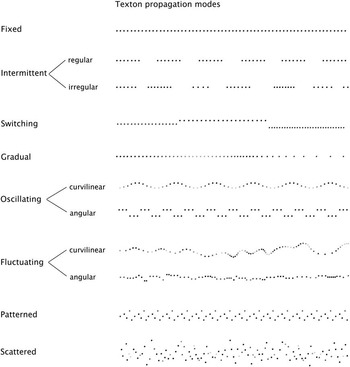
As propagation occurs, textons may change in shape, locality or elevation, as they appear in time. These modulations can happen in several different ways, and are here considered in terms of propagation modes. The modes defined are illustrated in figure 1, representing the modulation of two spatial properties in time. Together, the varying properties result in a propagation animated in spectral and perspectival space.
Texton propagation modes. The horizontal dimension represents time and propagation density, while the vertical and the texton grey-scale can be applied to any properties of elevation, locality or shape.

Propagations in which textons hardly change are considered fixed. Intermittent propagations appear in the form of interrupted trains of textons, which may have regular or irregular intervals, and can appear in more or less coherent streams with iterations recurring in a particular region, or appearing in different places each time. Propagations can also be switching abruptly between states, or changing smoothly or slowly over time in gradual fashion. The oscillating mode is regular, or varying steadily over time, while the fluctuating propagation implies irregular, unstable variation. These two modes may occur in interpolation over multiple textons, as in the illustration, but could also be manifested on a lower level; in some circumstances, each texton can present a small turn of fluctutation or oscillation. Angularity and curvature are two important criteria which influence the manner in which propagation varies: for example, an oscillation can switch between states in angular fashion, or have more curvilinear interpolations. Patterned propagation implies some degree of repetition, or at least fractured repetition, in the occurrence of textons with different properties, and can be in diffuse relation with scattering depending on predictability. Scattered propagation implies some degree of randomness so that each texton seems to be slightly different in terms of locality, elevation or shape, but without obvious patterning. This is a generalised category, which can be further nuanced by considering audible characteristics relating to statistical distributions and the unpredictability, or overall range, of possible states within the scattering. The latter has strong bearings on how we perceptually structure and distinguish texture among other elements in music.
There is no implication that all textural propagation falls unambiguously into either of these categories; on the contrary, they often happen together and the modes can be decomposed further and applied separately on individual properties of texton propagation, if that makes sense in the given context. Thus, propagation may, for example, oscillate in dynamic intensity, while simultaneously having fixed spectral elevation. And, importantly, the propagation modes can also independently affect the temporal density and periodicity of textons.
When the propagation modes occur in spatial gesture-textures the gestural duration will have bearings on the possible propagation complexity. Such situations generally fall into the category of gestured propagation; in acousmatic music, gradual (e.g. trajectories in spectral elevation or panoramic location) or scattered (e.g. gradually dissipating temporal density) gestured propagation modes are common, where the change of textonal properties over time creates gestured contours. Note, however, that this is not referring to the onset or termination of the gesture, but, rather, the textured continuant phase.
Propagation density is a combination of the rate at which textons appear and their temporal size, affecting the contiguity of a texture. Here, contiguity can be understood in terms of both perspectival space and time. Temporal contiguity happens when textons overlap and is therefore related to density. Another defining textural factor is the degree of periodicity of texton propagations, affecting the pitch-noise continuum in high densities, and rhythmic metre at lower rates. Sound examples 2–6, with comments in section 8.2, illustrate texton propagations.
5. Relative distributions in spatial texture
The spatial distribution of textons can be dependent on temporal segmentation, but textons can also be simultaneously distributed, while yet spatially separated. Textons can be distinguished through decorrelated temporal features, or relative spectral distributions which do not cause fusion.Footnote 13
Distributions describe the relative whereabouts and biases of propagation streams, indicating the regions articulated by spatial texture. Both spectral and perspectival space are considered, where the latter can be broken down into its subcategories, so we can describe panoramic, lateral, circumspatial (in multi-channel works) and distal-proximate distributions. Since perspectival space is relative to the listener's vantage point, the perceived centre in a concert scenario will be different depending on where one is seated in the auditorium. It is therefore unavoidable that distributions have a degree of fragility. Nevertheless, we can accept that they do exist although they may differ with respect to vantage point.
Where peripheries of spaces are concerned, we can in some cases distinguish between the absolute and the relative, but while the absolute peripheries of, for example, spectral space, would be the highest and lowest audible frequencies, these are not necessarily relevant, since the context of a piece, section or texture creates its own peripheries, relative to itself. Following this, the idea of centres or biases also has to be a context-dependent judgement. In a stereo piece we do have an idea of the absolute panoramic left–right peripheries, if we listen in a two-loudspeaker setup, but even then the image sometimes extends beyond expected limits. In diffusion, panoramic peripheries are more mobile and often extend to lateral space. The proximate–distal peripheries are particularly relative, and can depend either on the relative proximity or distance of textons within in a texture, or the relation between a texture and its surroundings. Similar considerations apply to circumspace; it has no prescribed size since its peripheries can appear to be either closer than, or further beyond, the loudspeaker arrangement.
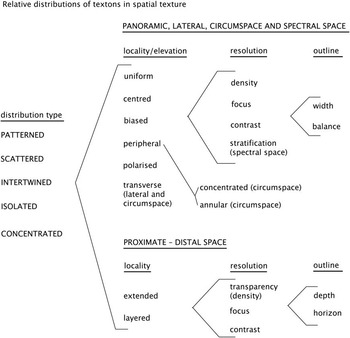
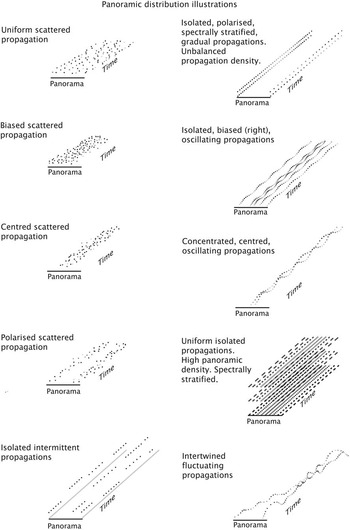
The diagram in figure 2 explains the relative distribution of textons in space, and figure 3 illustrates some possible panoramic textures. Scattered and patterned distributions coincide with the scattered and patterned propagation modes, except that here we pay closer attention to the whereabouts of activity in the propagation stream. Intertwined propagations cross one another due to, for example, fluctuations or oscillations in spectral or panoramic space, and, in isolated distribution, texton propagation streams are separated in space. Concentrated distribution implies that propagations occupy a minimum of a given spatial dimension, so if several are involved they are packed together. The spatial tendencies of textons in spectral-, panoramic-, lateral-, and circumspace are indicated in the locality/elevation column, where a uniform spread covers an area evenly (e.g. the whole of panoramic space); centred draws textons to the middle; biased implies accumulation away from the centre; peripheral attracts textons towards a spatial extremity; and finally, in a polarised spread, textons aggregate in the opposite peripheries.
Relative distributions of textons in spatial texture.

Panoramic distribution illustrations.

Panoramic polarisation of texton propagations is common, and the degree of difference in texton shapes, elevation, propagation density and periodicity can affect the perceived separation, width and balance of the stereo space. In cases of patterned distribution, polarisation may cause left–right exchange patterns (Smalley Reference Smalley1997: 124).
Peripheral localities in circumspace can be more or less concentrated along a particular boundary region, or, if annular, surround the entire periphery of the listening space so that a full circle is articulated. The outline of this can be balanced or unbalanced depending on whether there are weightings somewhere along the edge. Polarisation in circumspace can happen in any diametrical opposites (e.g. left front and right rear), and transverse distributions occur when textural activity stretches in bridges across lateral- or circumspace.
Uniform locality in circumspace covers the entire field, and while centred distributions in panoramic space suggest focus on the straight-ahead front, centring in circumspace has an effect on proximate space and can bring texture closer to egocentric space.Footnote 14 In circumspace, bias manifests as an accumulation in one zone (not peripheral, however).
Resolution describes the relative visibility of individual propagations in spatial texture, where the density of textons in, for example, panoramic space, ultimately can reach a contiguous state, but density can also describe a texture's spectral mass within its peripheries.Footnote 15 Focus implies that a certain part of the texture is the centre of articulated activity, blurring out the rest; contrast, on the other hand, refers to the degree of simultaneous, individual distinction among all streams, and the resulting lucidity. In spectral space, stratification of multiple isolated propagations can occur, in which case they are clearly separated spectrally. Obviously, these aspects of texture are highly influenced by the temporal and spectral definition of texton shapes. Outline describes the peripheral aspects of texture, in terms of its width in each spatial dimension, and the overall balance between the peripheries.
Proximate and distal space are treated apart from the rest, since together they form a more vague and context-dependent territory. Extended locality of proximate–distal distributions would create a texture which stretches from the listener's space towards a perceived horizon in a field between the near and far; this is dependent on relations with other musical activity, and the perceived peripheries of the texture. Distal peripheries and proximity can also be articulated by layered distribution, where textures become like screens, acquiring foreground and background roles depending on factors such as transparency and texton shapes. I should note that many textures have an intrinsic tendency to orient themselves towards proximate space due to the small size and definition of textons. In great densities, textures can appear to recede, as if we have zoomed out to a larger scale, but they can also approach the listener, if they block out other activity. The resolution of texture in proximate/distal space is determined by three factors: transparency, which is a byproduct of spectral and perspectival density, allows the letting through, or blocking, of other activity; focus emphasises individual layers at the expense of other activity; and contrast increases the clarity of both near and far, possibly bringing everything closer as a result. Finally, depth is an outline of the extension of the textural space, and the horizon appears at the distal periphery, if such is perceived.
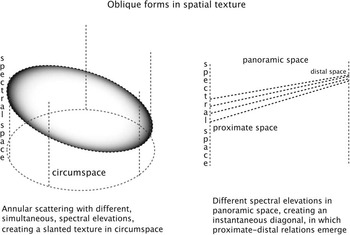
Oblique forms, some possibilities of which are illustrated in figure 4, occur when a texture has simultaneous, interdependent weighting in several dimensions of space. If, for example, distributions in spectral space are biased in panoramic or circumspace, textures can wrap simultaneously from high to low across perspectival dimensions. Thus the spectral spatiality of the same texture can differ in regions of perspectival space. An example could be a panoramic scattering of gradual propagation streams, which all have different spectral elevation, so that a panoramic-spectral slant is created; sometimes this also creates a difference in proximity in panoramic space. While it is obvious that the perspectival and spectral spatiality of texture are always interdependent, the oblique condition refers to the specific phenomenon where texture gives the impression of simultaneous difference in several spatial aspects. While the oblique spatiality needs time and change to be perceived fully, the spread of the texture as such is not dependent on motion trajectory as it lives in many areas at once. Smalley describes circumspectral space as a situation where one spectromorphology is able to surround the listening space by virtue of its internal spectral substance being simultaneously spread in circumspace (2007: 51). Similar phenomena can happen to texture in circumspace, where a coherent field spreads out and fluctuates in several regions simultaneously.
Oblique forms in spatial texture.

I should acknowledge that the concepts presented here, in regards to propagations and distributions, pay little or no attention to temporal evolution; they outline the spatial conditions of texture as if time's function is merely the elongation of space. This is of course paradoxical, since one of the key elements of texton propagation is the generation or creation of space in time. Nevertheless, these structures are important, and when operating in the continuum of time they can have vast potential for mutation and transformation in musical evolution.Footnote 16 The distribution types can of course be dynamic, and we can use Smalley's textural motion and growth processes to describe the way spatial texture evolves (1997: 116). Thus, for example, peripheries can dilate and contract; isolated propagations can diverge or converge; patterned distributions can grow in the centre, in processes of endogeny, or expand by adding to the exterior, towards peripheries, in processes of exogeny; agglomeration and dissipation can occur in processes related to increase and decrease of density. Sound examples 7–9, with comments in section 8.3, illustrate aspects of distributions.
6. Emergent textural states
Textural states are situations where the continuity of energy in space is such that that a distinct wholeness emerges, which overrides or obscures the textonal anatomy, usually related to propagation density or motion. The states are all source-bonded to some degree, although this can vary between a conceptual, imaginative or more concretely aural reference. The idea of spatial and morphological texton properties often loses significance as the macroscopic mass or unity influences our idea of the elements. Although, here, the states are elucidated from a textonal point of view, they generally exist on a more universal level and can in some cases be reached through musical processes that have no presence of textons. I underline that the states are open to interpretation, and represent impressions which can coincide with a multitude of different spectromorphological conditions. In the following outline I indicate some common or comprehensible conditions where states appear, but it is not an attempt at formalisation, as any work might find its own ways into these phenomena. The states are the projective, entitative, coagulated, fluid, vaporous and gaseous.
6.1. Projective state
Propagations which are fixed, or modulate in a highly stable manner, often seem to extend space through mere longevity. To describe this phenomenon I use the word projection, as an interpretation of Edgard Varèse's words:
sound projection – that feeling that sound is leaving us with no hope of being reflected back, a feeling akin to that aroused by beams of light sent forth by a powerful searchlight. (Varèse Reference Varèse1936: 197)
In projective states the temporal dimension is absorbed in the extension of space, as if textons are frozen in a perpetuated instance. There are several textonal conditions which may lead to the projective state, but a key factor is the sense of infinity, which is manifested in spectral fixity, or uni-directionality. A typical projective state is the stabilised, hypnotic drone, where textons are fused in a continuum and sometimes only appear in vestiges, or are implied as surface roughness or fluctuations. Another example is the propagation of temporally contiguous or semi-contiguous iterated textons, where resonant features focus the projection. If projective states have spectral directionality, it is in the form of prolonged, predictable glissandi, and, if there is perspectival motion, textons travel in trains so that stable vectors emerge. A boundless prospective space often emerges in projective states, as if sound extends into a void in front of the listener. Projections can to glow steadily in distal space, or forcefully penetrate the sonic fabric, like high-energy rays or projectiles. Sound examples 10 and 11, with comments in section 8.4, illustrate projective states.
6.2. Entitative state
In some situations, textons of a propagation stream can synthesise into a motion trajectory, suggesting the presence of a self-propelled entity. While projective states are formed by blind arrows pointing into space, entitative states give the impression of living forms mapping out texture as they travel across spatial territories. Entitative streams of textons can erratically jitter around, in fluctuating propagation modes, or swarm in more directed, symmetrical trajectories through spectral and perspectival space. Thus they often evoke reference to water- or air-borne animals in flock-motion. The motion may occur in temporally dense propagation streams, or as apparent motion trajectories among non-contiguous textons, which cohere over time so that an impression of living behaviour and integrity emerges. A common and fully source-bonded entitative spatial texture is that of the buzzing fly, chaotically powering itself through perspectival space. In very dense entitative states, where several propagation streams are at work, we may not perceive the individual entities as much as we get a sense that the texture motion is caused by internal activity of living morphologies. Sound example 12, with comments in section 8.4, illustrates an entitative state.
6.3. Fluid state
If textons are elongated with spectral concentration, and propagate in a spectrally scattered mode, the densification will often lead towards a state of semi-continuous fluidity. The spectral variation of textons prevents coagulation, and a lighter, more mobile texture is perceived. Fluid state often implies an immersive wash of texture, and texton shapes are often induced from the macroscopic impression of source-bonded phenomena such as liquid droplets. It is also possible for fluidity to emerge in thicker, noise-textures, where the macroscopic spectral and perspectival properties imply fluid motion. Fluid states can of course also appear in continuant, non-textonal textures; e.g., where sinuous motion among resonances in a spectral fabric creates a sense of liquidity. Textonal fluid states are often associated with turbulent flow, and boiling or pouring liquids. Sound example 13, with comments in section 8.4, illustrates a fluid state.
6.4. Coagulated state
In a coagulated state, texture is near solidification and textons clot in a thick magma or thin crust. The propagation mode of coagulations is often fixed, or gradual, so that a sense of stability is imparted. In the case of high-density patterned propagations we can get a sense that texture solidifies in brittle crystals. Densification is a condition of coagulation, but granularity often remains, suggesting a rough surface, or lumps in a slow-moving mass. Coagulation can reach non-textonal continua if the context of a given passage makes us aware of the densification process. Sound example 14, with comments in section 8.4, illustrates a coagulated state.
6.5. Vaporous and gaseous states
The vaporous and gaseous are closely related and are both highly remote from textonal activity. There can, however, be a context of agglomeration of textons associated with the texture, or conversely textons might emerge in a condensation process towards fluidity, or as a dilution of a gaseous substance. Vaporous states can manifest as smooth, noise-textures, and are often in transitory relation with fluid or coagulated states. Gaseous states are less spectrally dense, and diffusely resonant or transparent, so that an almost invisible texture is created. Aside from the source-bonded spaces associated with vaporous and gaseous textures, spectral and perspectival space are also articulated, where strata in the higher spectral regions might strengthen the impression of air-borne substances or cloud-formations. Sound examples 11 and 15, with comments in section 8.4, illustrate vaporous and gaseous states.
7. Conclusions
A general note on propagations, distributions and textural states is that those outlined here are idealised conditions rather than formalisations. In musical reality, spatial texture is dynamic, and ambiguities are an important part. The concepts are not categorical and many might appear simultaneously; the negotiation through the world of spatial textures is dependent on the listener's judgement. Textons are of course more applicable in some contexts than others, and textured gestures are sometimes so strongly tied to their source-causes that ideas of propagation and shapes are inapplicable. Further, the manner in which propagation and distribution behave in the acousmatic image is of course also dependent on aesthetics and the approach taken to material in the composition of a work. The attitude to spatial texture taken here lends itself well to music in which low-level organisation is significant, but this is not exclusive, and I want to emphasise that the intention with this research endeavour is to illuminate the possible connections among several structural levels. The textural states are a reflection of this concern: they are conditions where the macroscopic percept can supervene upon the microscopic in a perceptual feedback loop. This suggests that the phenomenon of textons is not only relevant to a bottom-up attitude to listening or composition. So, while from one point of view we might think of textons as living cells, producing spatial texture, they can also be the surface structures that occur due to macroscopic, textural processes.
The next stage of this research is a closer look at the dynamic process-forms and patterns that appear in textures. Circumspace is of particular interest since it has great potential for multiple parallel or interactive spatial processes to occur, as well as the zoning of textures. Another interest is the larger-scale mutative processes that can occur when textonal processes react together. This can be related to the ambiguities of perceptual segmentation of spatial textures, where a great potential for different space-forms might be interpolated in an aesthetic where music lingers on the boundary of textural integration and disintegration. This, I hope, will reveal some novel perspectives on the role of time in space-form. I do not think that environmental, spatial or textural music has to be such at the expense of temporal evolution or direction; on the contrary, I think that the arrow of time can be asserted by the contingencies of a complex musical space. The notion of textons in music has an inherent emphasis on the interdependency of time and space, and follows the belief that the full extension of space in musical form is highly dependent on the relations that are established between the small and the large.
8. Sound examples
8.1. Texton properties
1. Wind Chimes by Denis Smalley (excerpt: 1′57″–2′55″) – 0′57″
The excerpt illustrates ambiguities in textural organisation and segmentation due to texton shapes and elevations. Layers in proximate space and strata in spectral space appear and disappear throughout. Texton shapes change from generally sharp onset definition to gradual at around 0′37″. Pitch patterns emerge in otherwise spectrally and panoramically scattered propagations.
8.2. Texton propagation
2. 24 Variations by Horacio Vaggione (excerpt: 0′51″–1′15″) – 0′23″
Several patterned propagations are layered in proximate space. In the foreground, in higher spectral space, elongated textons propagate in pitched, rhythmic and panoramic patterning, and after the gesture at 0′12″ a texture of rhythmically patterned textons with sharper onset is added. Generally there is a high textural contrast due to clearly articulated texton shapes.
3. 24 Variations by Horacio Vaggione (excerpt: 1′44″–2′08″) – 0′24″
Sharp, short textons populate proximate space here, propagating in spectrally switching and sometimes intermittent mode. At 0′18″, the propagation fragments into spectral patterning. The excerpt also has multiple textures of figured patterns layered in prospective space and stratified in spectral space.
4. Wind Chimes by Denis Smalley (excerpt: 1′07″–1′24″) – 0′17″
A gesture instigates spectrally and panoramically scattered texton propagations.
5. Elemental Chemistry by Erik Nyström (excerpt: 4′27″–5′16″) – 0′49″
The reducing density of a proximate layer of textonal particles, in gradual propagation mode, allows a rich texture of intermittent propagations to appear. The high, twittering propagations are isolated and stratified in spectral space, whereas more scattered relationships emerge in the mid-range.
6. Elemental Chemistry by Erik Nyström (excerpt: 10′05″–10′41″) – 0′36″
Gradual propagations of initially elongated textons increase in density and decrease in size. Around 0′25″ they begin to oscillate in dynamics and spectra.
8.3. Distributions
7. Gwerz by Elsa Justel (excerpt: 0′00″–0′56″) – 0′56″
A spatial gesture-texture transforms into gradual propagations creating panoramic and distal peripheries. At 0′07″ a panoramically centred, concentrated propagation emerges, soon layered by another centred, fluctuating propagation. At 0′20″–0′24″, a series of three gestures outlines panoramic peripheries, into which the fluctuating propagation is polarised. Strata of denser, polarised propagations begin to appear at 0′39″. Here, figures of various texton shapes and propagations also appear in the centre.
8. Pentes by Denis Smalley (excerpt: 2′00″–2′57″) – 0′57″
Several isolated propagations are panoramically biased and layered in proximate and distal space. The rhythmic interactions among the several propagations create a kaleidoscopic texture with emergent coordination of motion.
9. Far-from-equilibrium by Erik Nyström (excerpt: 0′00″–0′46″) – 0′46″
In the high spectral region, oblique spectral distributions and alternating densities create panoramic balancing among gradual propagations.
8.4. Textural states
10. Pentes by Denis Smalley by (excerpt: 6′20″–8′22″) – 2′02″
A high-energy projective texture glides through spectral space and recedes in the distance, settling into a steady, subtly glowing state, where harmonic projections emerge.
11. Far-from-equilibrium by Erik Nyström (excerpt: 8′20″–10′04″) – 1′44″
Textons in high spectral space gradually begin to project, at first spectrally fixed, and then descending into the bass region, where another projective state emerges at 0′45″. The high-frequency resonant textures begin to reach vaporous or gaseous states around 1′12″, while projective resonances simultaneously grow stronger in the mid-range.
12. Danses Acousmatiques: Swarm by Andrew Lewis (excerpt: 0′35″–1′20″) – 0′45″
Several buzzing propagations in spectral and perspectival motion create an entitative textural state. At 0′18″ the texture settles into a denser, more distant entitative texture.
13. 24 Variations by Horacio Vaggione (excerpt: 8′17″–8′35″) – 0′18″
A few seconds into the excerpt, a texture emerges, where the density, spectral distribution and variety of texton properties create a fluid state. The cymbal resonances stabilise in a projective state.
14. Far-from-equilibrium by Erik Nyström (excerpt: 1′09″–1′37″) – 0′27″
A texture in near coagulation emerges in the bass range, slowly flowing in a thick mass.
15. Valley Flow by Denis Smalley (excerpt: 0′44″–1′39″) – 0′55″
A diffusely resonating, gaseous texture in high spectral space expands across perspectival space in oblique formations, where distance and varying panoramic-spectral elevations are simultaneously present. At 0′36″ another gaseous texture in the bass region creates a sense of spectral scale. The overall textural motion and complexity increase throughout the excerpt.