Implications
In addition to colostrum quality, the main issue in dairy calf colostrum management is the amount of colostrum fed within a few hours of birth. Allowing the calf to nurse colostrum from the dam for the first hours of life could be effective in improving the transfer of passive immunity while avoiding the need for additional work by the farmer at the same time. This study investigated a colostrum provision strategy for nursing calves that would be both highly practical to dairy practitioners and more in tune with public opinion on calf welfare.
Introduction
The practice of separating newborn calves from dams right after birth is commonly adopted in intensive dairy farms for several reasons, such as facilitating first care to the calf, minimizing calf–dam separation distress and reducing biosecurity risks (McGuirk and Collins, Reference McGuirk and Collins2004; Maunsell and Donovan, Reference Maunsell and Donovan2008; Stěhulová et al., Reference Stěhulová, Lidfors and Špinka2008). In this context, good colostrum management practices specify providing calves with at least 4.0 l of good quality colostrum (i.e., with immunoglobulin (Ig) G concentration ≥50.0 g/l) within 6 h of birth in order to achieve the minimum level of passive immunity needed for protection against infectious diseases (Weaver et al., Reference Weaver, Tyler, VanMetre, Hostetler and Barrington2000; Godden, Reference Godden2008). Inadequate colostrum consumption leads to failed transfer of passive immunity (FTPI), a condition defined as occurring when calf serum IgG concentration is less than 10.0 g/l at 48 h of life and one that compromises calf health and survival (Tyler et al., Reference Tyler, Hancock, Thorne, Gay and Gay1999; Furman-Fratczak et al., Reference Furman-Fratczak, Rzasa and Stefaniak2011). Despite the well-known importance of good colostrum management practices for calf health, the estimated occurrence of FTPI in dairy calves is still high, and ranges from 35% to 40% (Weaver et al., Reference Weaver, Tyler, VanMetre, Hostetler and Barrington2000; Vogels et al., Reference Vogels, Chuck and Morton2013; Lora et al., Reference Lora, Barberio, Contiero, Paparella, Bonfanti, Brscic, Stefani and Gottardo2018a). In this regard, a previous study by Lora et al. (Reference Lora, Barberio, Contiero, Paparella, Bonfanti, Brscic, Stefani and Gottardo2018a) showed that Italian dairy calves were being provided good quality colostrum on time but in insufficient quantity (≤2.0 l). Moreover, farmers usually failed to give more than one colostrum feeding to the calves within the first 6 h of life. Therefore, allowing the calf to nurse colostrum from its dam could be hypothesised to improve passive immunity transfer by increasing both the amount of colostrum intake in the first hours of life and the intestinal absorption of Ig (Lidfors, Reference Lidfors1996; Kälber and Barth, Reference Kälber and Barth2014). Such practice would also comply with the rising public demand for better newborn calf welfare without creating significantly more work for farmers. However, a certain percentage of suckling calves might not consume enough colostrum within a few hours of birth and be more at risk of FTPI (Edwards and Broom Reference Edwards and Broom1979; Besser et al., Reference Besser, Gay and Pritchett1991; Filteau et al., Reference Filteau, Bouchard, Fecteau, Dutil and DuTremblay2003). Therefore, the aim of this study was to investigate whether the advantages of colostrum provision through dam nursing can be exploited at dairy farms while avoiding its disadvantages by managing newborn calves with their dams for the first day after birth with specific farmer assistance. The effect of such practice on passive immunity transfer was tested against dam nursing with no farmer assistance and traditional colostrum feeding by nipple-bottle, and the potential effects of separation distress and health on both calves and dams were also taken into consideration.
Material and methods
Farm description and study design
This study was carried out from October 2014 to April 2015 in two dairy farms with 77 and 105 cows located in the Northeast Italy (Veneto Region). The farms were selected on the basis of the farmers’ willingness to take part in the study and the farms’ similar characteristics. The breed reared on both farms was Italian Holstein; the housing system was loose with cubicles; the feeding technique was total mixed ration, and the cows were milked twice a day in the milking parlour with the same milking routine (pre-dipping, teat cleaning and stripping). Calving and calves management were also similar. Two or three days before the expected calving, cows were moved into a 14 m2 straw-bedded calving pen placed next to the milking parlour. Fresh straw was added daily, and cows were visually checked for parturition at least three times a day. Newborn calf navel disinfection was done right after birth by dipping into a 7% tincture of iodine, and on both farms the calf was left in the calving pen with the dam for the first day of life. All newborn calves were checked for bovine viral diarrhoea virus (BVDV) using a blood sample collected by the farm veterinarian in the first week of life, and both males and females were kept on the farm until at least 3 months of age.
Three colostrum provision methods (CPMs) were defined in this study: ‘hand-fed method’ (HFM), ‘nursing method’ (NM) and ‘mixed method’ (MM). The calves’ assignment to each CPM was subordinated to the field study limitations of guaranteeing that the calving pen housed only one cow at a time and ensuring a clean and quiet environment for parturition. Thus, during this study, newborn calves of each farm were alternately separated from dams right after birth or left in the calving pen with their mothers for the first 12 h of life. In the first case (calf–dam separation right after birth), calves were assigned to the HFM and were fed their dams’ colostrum by nipple-bottle according to farmer’s own routine. In the second case (calf left with the dam in the calving pen), calves were alternately assigned to the NM or the MM. In both NM and MM calves nursed colostrum freely from their dams, but in NM there was no farmer intervention, whereas in MM the farmer offered them a supplementary colostrum meal (3 l of its dam colostrum) by nipple-bottle within 6 h of birth. The colostrum for calves of HFM and MM was milked within 2 h of the calf’s birth or from the discovery of it in the milking parlour when the routine milking time fell within this time period and manually when not, in both cases after pre-dipping, teat cleaning and stripping. The nipple-bottles used in this study were cleaned thoroughly after every use. Regardless of the CPM, the cows were milked twice daily in the milking parlour starting from the day of parturition. Calves were included in the study regardless of sex or genotype (Holstein purebred or Holstein-beef crossbred). After separation from dams, calves were housed in straw-bedded single crates until 8 weeks of age and then transferred to straw-bedded group pens housing five pen mates. Six litres of whole milk per day divided into two equal meals (morning and evening) were fed individually until weaning (9 to 11 weeks of age), whereas water and solid feeds (grass hay and commercial calf starter) were available starting from 7 days of age.
Sampling and data collection
Before starting the study, farmers were briefly trained in data recording and colostrum sample collection for Ig concentration assessment. During the study, farmers were given a report form in which they recorded for each calf included in the study: sex, breed, date and time of birth, whether calving was assisted or not, dam parity, the CPM assigned (HFM, NM, or MM) and the time and amount of the colostrum meals provided by nipple-bottle within 12 h of birth (HFM and MM).
Moreover, farmers were asked to collect a sample of the colostrum consumed at the first meal by each calf included in the study in a 100 ml tube and to store it at –20°C. For the NM, they were trained to hand-milk the sample within 2 h of the calf’s birth or from the discovery of it and to collect one squirt per teat of each dam after accurate pre-dipping and teat cleaning, discarding the first three squirts per teat. The farm veterinarian gathered the frozen colostrum samples for delivery to the laboratory once a week.
The same blood sample already collected by the farm veterinarian for BVDV testing was also used to assess serum Ig concentration. The sample was taken from the jugular vein of each calf in the study between 1 and 5 days of age using a 10 ml Vacutainer® tube without anticoagulant (Becton Dickinson, Franklin Lakes, NJ, USA).
Although the main purpose of this study was to evaluate the transfer of passive immunity, additional recordings of behaviour after separation and health of both calves and dams were carried out by the farmers and the farm veterinarian, respectively. The farmers were video-trained to recognise some easy and unequivocal behavioural indicators of separation distress in calves and dams in the 24 h following calf–dam separation, to be recorded as binary variables (Yes/No) in a dedicated form. Two particular indicators for calves (vocalisations and refusal of the nipple-bottle) and two for dams (vocalisations and behaviour at milking) were considered according to the following criteria: calf and cow vocalisations were considered present when high frequency calls were produced with the mouth fully opened for at least part of the call (Padilla de la Torre et al., Reference Padilla de la Torre, Briefer, Reader and McElligott2015), possibly corroborated by a body language indicating that the dam was looking for the calf or vice versa (e.g., looking in the direction of the calf/dam barn, walking around, pulling the head out of the fences); refusal of the nipple-bottle was considered present when the calf failed to take at least the first meal administered after separation by nipple-bottle; undesirable behaviour at milking was considered present when the cow kicked more than once, detached the milking unit, or had no milk ejection during the routine milking (Rousing et al., Reference Rousing, Bonde, Badsberg and Sørensen2004). At the end of the training, the farmers had to pass a test in which they had to correctly recognise the presence or absence of the behaviours considered in 10 different videos for each behaviour. This was considered as a test of agreement between observers.
The veterinarian who routinely visited both farms twice a week was asked to record in specific forms all episodes of disease and mortality in the calves until 3 months of age and all cases of clinical mastitis (requiring medical treatment) and postpartum disorders (i.e., puerperal collapse and placenta retention) in the cows until 7 days after calving.
Laboratory analyses
Blood and colostrum samples were kept respectively refrigerated (4°C) and frozen (–20°C) during transport before reaching the laboratory within 2 h of blood collection. At the laboratory, blood samples were centrifuged at 3076 × g for 10 min at 20°C and the serum aliquots needed for the study were transferred into 2 ml tubes after being separated from the fraction required for routine BVDV testing. Serum and colostrum samples were stored at –20°C until the day of analysis. The procedures for sample processing and analysis described by Lora et al. (Reference Lora, Barberio, Contiero, Paparella, Bonfanti, Brscic, Stefani and Gottardo2018a) were followed to assess serum and colostrum Ig concentrations using an electrophoretic method. This method has a good accuracy for IgG assessment (89% to 97%) compared to the gold standard radial immunodiffusion (RID) (Pfeiffer et al., Reference Pfeiffer, McGuire, Bendel and Weikel1977; Rumbaugh et al., Reference Rumbaugh, Ardans, Ginno and Trommershausen-Smith1978; Massimini et al., Reference Massimini, Peli, Boari and Britti2006).
Data and statistical analyses
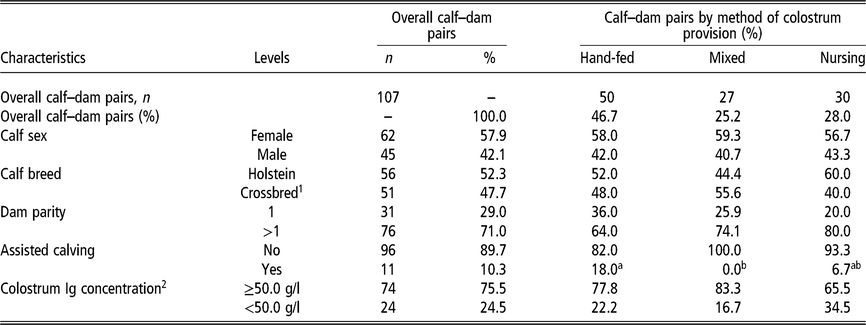
The number of calf–dam pairs included in this study in the two farms was 41 (HFM: n = 19; NM: n = 12; MM: n = 10) and 67 (HFM: n = 32; NM: n = 18; MM: n = 17), respectively. Only one calf–dam pair was discarded from the final dataset due to the haemolysis of the calf blood sample. The characteristics of the remaining overall 107 calf–dam pairs (HFM: n = 50; NM: n = 30; MM: n = 27) are reported in Table 1. Colostrum samples were missing for five calves in the HFM, three in the MM and one in the NM group.
Characteristics of the calf–dam pairs assigned to each method of colostrum provision

1 Holstein-beef crossbred.
2 Ig = immunoglobulin; colostrum analyses were available for 98 calves: 45 in the hand-fed method (45.9%), 24 in the mixed method (24.5%) and 29 in the nursing method (29.6%).
a,b Values within a row with different superscripts differ significantly at P<0.05.
Chi-square test and multiple comparisons were used to exclude baseline differences in calf sex and breed, dam parity, occurrence of assisted calvings and colostrum quality among the three CPMs. Colostrum quality was considered good when Ig concentration was equal to or higher than 50.0 g/l and poor when it was lower than 50.0 g/l. Chi-square test was used to preliminarily investigate the effect of dam parity (primiparous vs multiparous) on colostrum quality.
Differences in calf serum Ig concentration (considered as continuous variable) among CPMs were then tested by a general linear mixed model (PROC MIXED, SAS Institute Inc., Cary, NC) including the farm as random effect and using the Bonferroni adjustment option for post hoc multiple comparisons.
After that, three levels of passive immunity transfers in calves were defined based on serum Ig concentration: FTPI (<10.0 g/l), adequate transfer of passive immunity (from 10.0 to 15.9 g/l) and optimal transfer of passive immunity (OTPI) (≥16.0 g/l). As in previous studies (Furman-Fratczak et al., Reference Furman-Fratczak, Rzasa and Stefaniak2011; Lora et al., Reference Lora, Barberio, Contiero, Paparella, Bonfanti, Brscic, Stefani and Gottardo2018a), the thresholds used for colostrum quality and levels of passive immunity transfer definitions were chosen on the basis of the cut-offs most commonly reported in literature for IgG concentration (Godden, Reference Godden2008; Furman-Fratczak et al., Reference Furman-Fratczak, Rzasa and Stefaniak2011), given that the latter accounts for roughly 90% of the total Ig concentration (Godden, Reference Godden2008).
The effect of the CPM on the three levels of passive immunity transfer, behavioural indicators of separation distress and calf and dam health was assessed by Chi-square test and multiple comparisons.
The same test was used to assess the effect of some specific factors (time of the first colostrum meal, amount of colostrum fed within 6 h of life, colostrum quality, calf sex and breed, dam parity and occurrence of assisted calvings) on FTPI occurrence within each CPM, and relative risk with 95% confidence interval was calculated for those with P<0.05. Moreover, within each level of the considered factors, multiple comparisons were made on FTPI occurrence among CPMs.
The threshold for significance was set at P<0.05 for all the statistical analyses performed.
Results
As shown in Table 1, calf–dam pair characteristics (calf sex and breed, dam parity and colostrum quality) were equally distributed among the three CPMs (P>0.05). Only the occurrence of assisted calvings differed, with the greatest percentage observed in the HFM and no cases in the MM (P<0.05). Overall, Ig concentration in colostrum ranged from 24.4 to 146.3 g/l, with a mean value and a standard deviation (SD) of 68.0 ± 23.6 g/l. The overall percentage of poor-quality colostrum samples was 24.5%, and it was higher for primiparous (41.4%) than for multiparous (17.4%) cows (P<0.05).
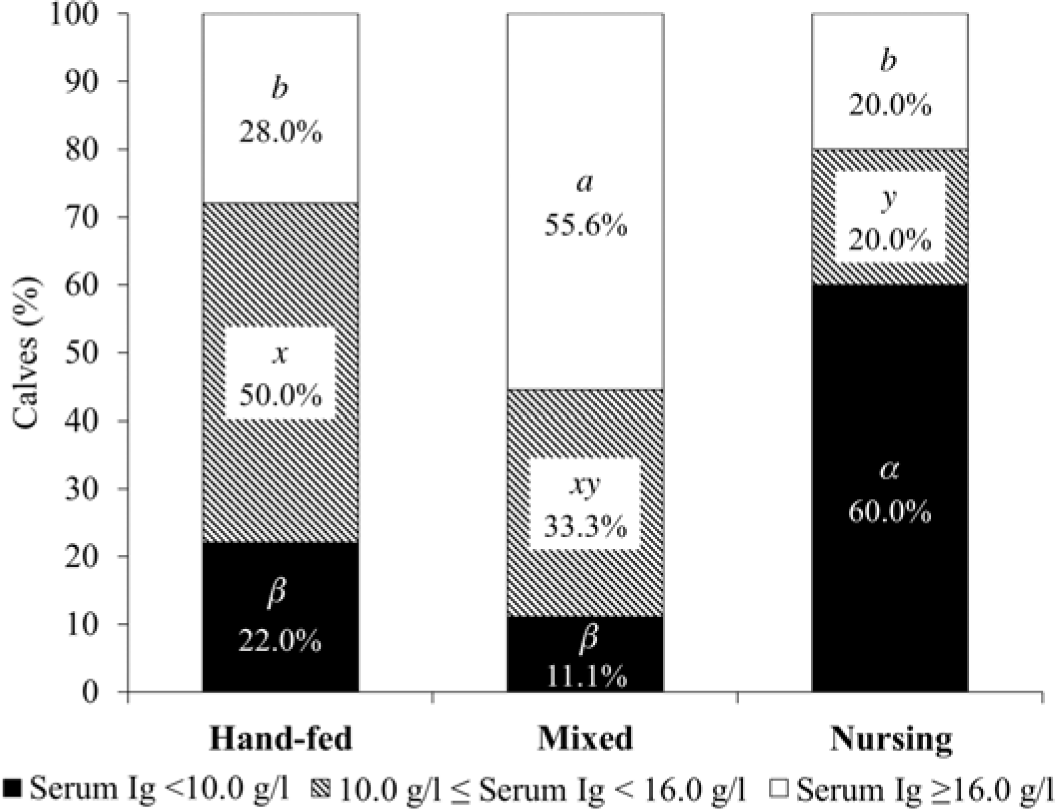
Passive immunity transfer in calves differed considerably among CPMs (P<0.001), with greater mean (± SD) serum Ig concentration in the HFM (13.9 ± 6.0 g/l, ranging from 3.8 to 30.9 g/l) and the MM (17.1 ± 7.5 g/l, ranging from 4.6 to 42.2 g/l) compared with the NM (10.0 ± 6.2 g/l, ranging from 1.6 to 25.2 g/l). The greatest FTPI occurrence was found in the NM (60%) compared with both the MM (11%) and the HFM (22%) (P<0.05), whereas the greatest fraction of calves with OTPI was observed in the MM (56%) (Figure 1). Calves in the HFM consumed 1.9 ± 0.8 l (mean ± SD) of colostrum within 6 h of life in a single meal fed at 2.2 ± 0.1 h (mean ± SD) of birth. Colostrum supplementation consumed by MM calves was of 2.0 ± 0.8 l (mean ± SD) in a single administration at 1.4 ± 0.1 h (mean ± SD) of birth. The factors that affected FTPI occurrence in calves within each CPM are reported in Table 2. Particularly, HFM calves that consumed less than 2.0 l of colostrum within 6 h of life were more at risk of having FTPI than those that ate at least 2.0 l (P = 0.044). In both the HFM and MM groups, the risk of FTPI occurrence was higher for calves that received poor-quality colostrum than for those fed good quality (P<0.001 and P = 0.013, respectively). Regardless of CPM, calves born from primiparous cows were more at risk of having FTPI than those born from multiparous cows (P<0.001, P = 0.015 and P = 0.025 for HFM, MM and NM, respectively). Moreover, FTPI occurrence was the highest in the NM (P<0.05) among calves fed good-quality colostrum, females, Holstein purebreds and Holstein-beef crossbreds, calves born from both primiparous and multiparous cows and calves born without assistance. Among males, FTPI occurrence was the highest in both the NM and the HFM (P<0.05).
Distribution of calves with failure of transfer of passive immunity (serum immunoglobulin (Ig) concentration <10.0 g/l), with adequate transfer of passive immunity (serum Ig concentration ranging from 10.0 g/l to 15.9 g/l), and with optimal transfer of passive immunity (serum Ig concentration ≥16.0 g/l) according to the method of colostrum provision. Different letters for the same level of transfer of passive immunity identify differences (P<0.05) among methods of colostrum provision.

Chi-square test and multiple comparisons of factors affecting failure of transfer of passive immunity (FTPI -calf serum immunoglobulin (Ig) concentration <10 g/l) in calves within method of colostrum provision: relative risk (RR) and 95% confidence interval (CI) are reported for factors with P < 0.05. Differences in FTPI occurrence among methods of colostrum provision for each level of the factors considered are also reported

1 Colostrum analyses were missing for five calves in the hand-fed method (overall calves with FTPI = 24.4%), for three calves in the mixed method (overall calves with FTPI = 12.5%), and for one calf in the nursing method (overall calves with FTPI = 58.6%).
2 The test was not applicable.
3 One entry was moved in the ‘case and not-exposed’ category to perform the test.
4 Holstein-beef crossbred.
a,b Values within a row with different superscripts differ significantly at P<0.05.
* P<0.05, *** P<0.001.
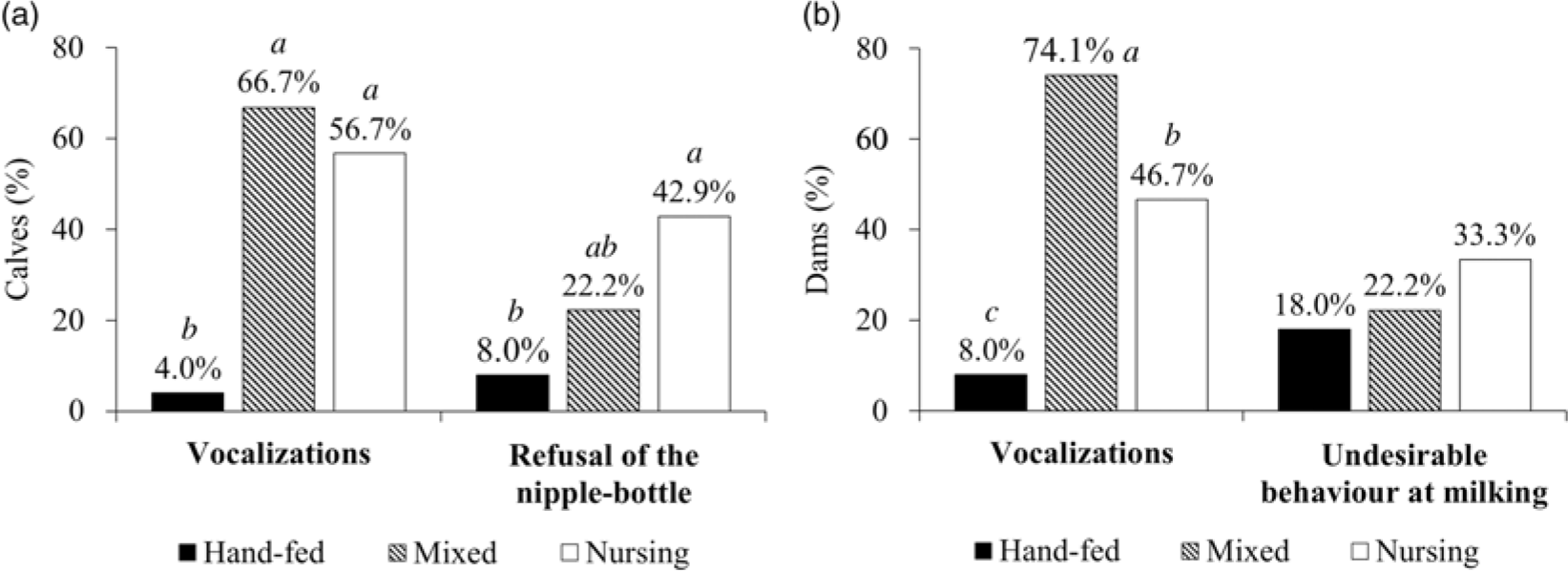
The lowest percentages of vocalisation events were observed for both calves and dams in the HFM (4% and 8%, respectively), compared with the MM (67% and 74%) and the NM (57% and 47%) (P<0.001; Figure 2a and b). Refusal of the first meal provided by nipple-bottle after calf–dam separation occurred mainly in NM calves (43%), whereas the lowest frequency was observed in HFM calves (8%, P = 0.001; Figure 2a). Dam behaviour at milking was unaffected by CPM (P = 0.288; Figure 2b).
Effect of the method of colostrum provision on calf (a) and dam (b) behaviour after separation. Different letters for the same behavioural indicator identify differences (P<0.05) among methods of colostrum provision.

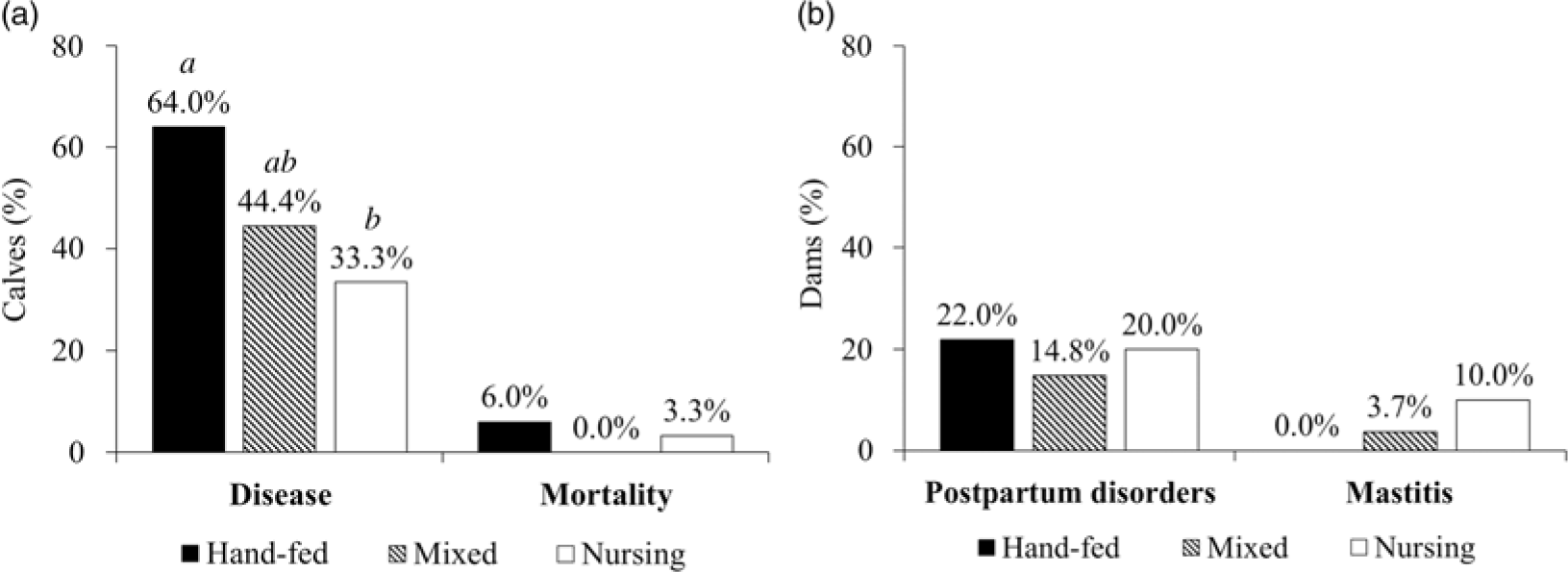
During the 3-month observation period, overall 50.5% of the calves showed clinical symptoms: 94.4% of enteric and 5.6% of respiratory disease. All cases of diseases except one were recorded within 30 days of age, with the peak of occurrence observed within 8 days of age (46.3%). Four calves (3.7%) died of enteric disease within 15 days of age. The occurrence of calf disease was affected by CPM (P<0.05; Figure 3a) with the highest percentage of ill calves observed in the HFM (64%) and the lowest in the NM (33%) group.
Overall, postpartum disorders within 7 days after parturition occurred in 19.6% of dams (19.0% puerperal collapse and 81.0% placenta retention), whereas 3.7% were treated for mastitis. The CPM influenced neither the occurrence of postpartum disorders (P = 0.749) nor of mastitis (P = 0.074; Figure 3b).
Effect of the method of colostrum provision on calf health within 3 months of life (a) and on dam health within 7 days after parturition (b). Different letters for the same health parameter identify differences (P<0.05) among methods of colostrum provision.

Discussion
Except for the number of assisted calvings, the lack of differences among the characteristics of the calf–dam pairs assigned to each CPM indicated that the results of this study were unaffected by the variability of the sample features.
Analysing each CPM tested in this study, the HFM proved to be effective in avoiding FTPI in calves, even if the percentage of calves with OTPI was lower than that in the MM. The effect of dam parity on the transfer of passive immunity in hand-fed calves was probably linked to its effect on colostrum quality, because in accordance with literature (Weaver et al., Reference Weaver, Tyler, VanMetre, Hostetler and Barrington2000; Morin et al., Reference Morin, Constable, Maunsell and McCoy2001; Gulliksen et al., Reference Gulliksen, Lie, Sølverød and Østerås2008), we found the colostrum quality of primiparous cows to be lower than that of multiparous cows. The fairly high FTPI occurrence observed among male and crossbred HFM calves may be attributed to the relatively higher requirements of Ig typical of these calves due to their larger size compared with females and Holstein purebreds (Quigley and Drewry, Reference Quigley and Drewry1998; Vogels et al., Reference Vogels, Chuck and Morton2013), requirements that were probably not satisfied by the limited amount of colostrum provided by nipple-bottle. Although the greatest occurrence of assisted calvings was found in the HFM, this factor did not affect FTPI occurrence in this group. Dystocia has been generally associated with an increased risk of FTPI due to the poor calf vitality and to the postnatal acidosis that frequently occurs in such cases (Godden, Reference Godden2008; Murray and Leslie, Reference Murray and Leslie2013). In this study, it was likely that the immediate calf assistance given by the farmers after birth (typical of the HFM) and the controlled colostrum provision might have mitigated potential poor calf vitality.
The NM gave the worst results in terms of passive immunity transfer, with the highest FTPI occurrence (regardless of colostrum quality, calf sex and breed, dam parity and occurrence of assisted calving) and the lowest percentage of calves reaching OTPI. Similar findings with suckling calves were reported by Besser et al. (Reference Besser, Gay and Pritchett1991), Rajala and Castrén (Reference Rajala and Castrén1995) and Filteau et al. (Reference Filteau, Bouchard, Fecteau, Dutil and DuTremblay2003), likely due to the inability of some calves to spontaneously consume enough colostrum within 6 h of life. Under natural conditions, calf vitality is crucial in teat finding, and it affects both the time of the first suckling after birth and the amount of colostrum ingested (Lidfors, Reference Lidfors1996; Furman-Fratczak et al., Reference Furman-Fratczak, Rzasa and Stefaniak2011). In particular, Rajala and Castrén (Reference Rajala and Castrén1995) found that a 30-min delay in first suckling led to a 2.0 g/l decrease in calf serum Ig concentration. Furthermore, the relatively scarce mothering instinct and poor udder conformation for nursing purposes of high-producing cows could pose additional obstacles that hinder calves from successfully reaching teats (Brignole and Stott, Reference Brignole and Stott1980; Kälber and Barth, Reference Kälber and Barth2014). Because both mothering instinct and udder conformation vary with dam parity (Lidfors, Reference Lidfors1996; Flower and Weary, Reference Flower and Weary2001; Kälber and Barth, Reference Kälber and Barth2014), the higher risk of FTPI occurrence found in NM calves born from primiparous cows than those born from multiparous cows was probably due more to the younger cows’ lower mothering instinct and inexperience that prevented the calves from suckling successfully rather than their udder conformation, which is instead more favourable for nursing purposes in younger cows. Finally, because colostrum quality was not associated with FTPI occurrence in the NM (contrary to that in the other CPMs), it was likely that the amount of colostrum consumed by the calf within 6 h of birth was the main factor affecting FTPI occurrence in this CPM, even if it was not measurable in this study.
Accordingly, a strategy to overcome the limits of the NM could lie in the assistance the farmer gives to the suckling calves in the same way as in the MM. The provision of a supplementary colostrum meal to the suckling calves within a few hours of birth, in fact, proved to be an effective practice in maximizing the transfer of passive immunity, given that the MM was not only the CPM with the lowest FTPI occurrence (even disregarding the different factors considered in this study) but was also the one with the greatest fraction of calves reaching OTPI (more than 50%). Similar findings were reported by Petrie (Reference Petrie1984) on calves given early assistance in suckling colostrum to satiation. It might be speculated that having more energy to spend for the purpose, calves that suckled from the nipple-bottle were more motivated to search for the udder. Therefore, the MM has the combined advantages of both the HFM and the NM: not only were the calves aided by the farmer immediately after birth and ensured the first colostrum meal, they could also suckle more often during the day (even nine times per day) (Lidfors, Reference Lidfors1996; Jensen, Reference Jensen2011), thus increasing both colostrum intake and intestinal Ig absorption efficiency (Quigley et al., Reference Quigley, Martin, Bemis, Potgieter, Reinemeyer, Rohrbach, Dowlen and Lamar1995; Kälber and Barth, Reference Kälber and Barth2014). The quality of colostrum consumed by the calves and the parity of the dams were the factors that most affected FTPI occurrence in the MM. Consistent with findings by Petrie (Reference Petrie1984), it could be supposed that nearly all the MM calves consumed enough colostrum within 6 h of birth thanks to farmer assistance, thus making the quality of colostrum ingested the determining factor in FTPI occurrence. In this case, dam parity probably had the dual effect of influencing both colostrum quality and mothering behaviour, as discussed above.
Separation distress was high in both the MM and the NM, whereas the lowest negative effects on the behaviour of both calves and dams were observed in the HFM. These results were consistent with previous studies that reported that the longer the calf stayed with the dam, the greater the separation distress (Lidfors, Reference Lidfors1996; Weary and Chua, Reference Weary and Chua2000; Stěhulová et al., Reference Stěhulová, Lidfors and Špinka2008). Therefore, the HFM calf–dam pairs’ lower signs of separation distress were likely due to the lower strength of the cow–calf bond. Furthermore, nearly half the NM calves refused at least the first meal provided by nipple-bottle after separation from the dam. This kind of behaviour could be an issue in terms of both animal welfare and dairy practice. However, the incidence of calf refusal of nipple-bottle in MM was intermediate between the NM and the HFM, thus suggesting that previous experience with the nipple-bottle (due to the provision of a supplementary colostrum meal) could potentially help to reduce the occurrence of such undesirable behaviours in calves.
On the other hand, none of the three CPMs affected dam behaviour at milking, suggesting that routine dam milking starting from the day of parturition might be an effective practice in avoiding undesirable behaviour at milking following calf–dam separation.
As expected from literature (Wells et al., Reference Wells, Garber and Hill1996; Svensson et al., Reference Svensson, Lundborg, Emanuelson and Olsson2003; Windeyer et al., Reference Windeyer, Leslie, Godden, Hodgins, Lissemore and LeBlanc2014), the occurrence of disease in the calves of this study was concentrated in the first month of life. However, the overall percentage of calves that fell ill (50.5%) was greater than the 23% prevalence reported by Svensson et al. (Reference Svensson, Lundborg, Emanuelson and Olsson2003) and Windeyer et al. (Reference Windeyer, Leslie, Godden, Hodgins, Lissemore and LeBlanc2014). On the other hand, only few calves died, and unlike disease occurrence, calf mortality was not associated with the CPM. The percentage of calves that fell ill, mainly from enteric disease, was particularly high in the HFM. Such a high occurrence of disease cases was somehow unexpected considering the overall good level of passive immunity reached by the HFM calves and the recognised role of FTPI as a predisposing factor for calf disease (Maunsell and Donovan, Reference Maunsell and Donovan2008; Furman-Fratczak et al., Reference Furman-Fratczak, Rzasa and Stefaniak2011; Lora et al., Reference Lora, Gottardo, Contiero, Dall’Ava, Bonfanti, Stefani and Barberio2018b). Moreover, calf disease prevention is actually one of the main reasons why calves are separated from dams soon after birth because the practice of leaving them in the calving pen was commonly associated with an increased risk of diarrhoea (McGuirk and Collins, Reference McGuirk and Collins2004; Maunsell and Donovan, Reference Maunsell and Donovan2008). In this study, it might therefore be supposed that other factors besides the level of passive immunity acted as predisposing for enteric infections in calves, such as the cleanliness of crates and the hygiene of the milk provision equipment (Svensson et al., Reference Svensson, Lundborg, Emanuelson and Olsson2003; Maunsell and Donovan, Reference Maunsell and Donovan2008), which were not fully investigated.
Even if no cows were treated for mastitis in the HFM, the lack of differences among CPMs in dam health suggested that the presence of the calf and the suckling typical of both the MM and the NM had neither negative (e.g., mastitis due to the frequent opening of the teat channels) nor positive effects (e.g., lower percentage of placenta retention due to the frequent stimulation of oxytocin release), as would be expected from the literature reviews (Krohn, Reference Krohn2001; Kälber and Barth, Reference Kälber and Barth2014).
Conclusions
This study showed that offering a supplementary colostrum meal within 6 h of birth to the calves allowed to nurse colostrum from their dams for the first 12 h of life (MM) was an effective practice in maximizing the passive immunity transfer. On the other hand, there was evidence that calf–dam separation distress could be high, and therefore, it would be necessary to identify the best practices to mitigate this distress.
The HFM was effective in avoiding FTPI in calves and showed minimal calf–dam separation distress, but the percentage of calves with OTP was lower than that in the MM, and the percentage of calf diseases was unexpectedly high, probably reflecting the importance of proper hygienic management of the calf rearing environment to prevent neonatal diseases.
Finally, allowing the calf to nurse colostrum from its dam without any farmer intervention (NM) gave the worst results both in terms of passive immunity transfer and of calf–dam separation distress.
Acknowledgements
This study was supported by grants obtained from the Italian Ministry of Health for the research project (RC IZSVE 10/2011). This paper is from a thesis of the first author presented in fulfillment of the requirements for the PhD degree at the University of Padova.
I. Lora, 0000-0001-8725-8597
Declaration of interest
None.
Ethics statement
No ethics requirements were needed for this study because no cow or calf manipulations beyond routine farm practices were done and the sera used for the study were obtained by blood samples collected for routine clinical activities by the farm veterinarian (BVDV control plan).
Software and data repository resources
None of the data were deposited in an official repository.