Forney Library: A bit of history
The Forney Art Library belongs to the City of Paris Specialized Libraries Network, a group of ten heritage libraries among the 70 City of Paris Libraries, the largest municipal network in the country. Three of these specialized libraries are of particular interest: the Bibliothèque Historique de la Ville de Paris, housed in the beautiful 18th-century Lamoignon building in the historic quarter of the Marais; the Bibliothèque de l'Hotel de Ville, with its magnificent 19th-century reading room, housed in the Paris town hall; and finally the new Françoise Sagan Library, housed in the old Saint Lazare hospital (formerly a prison for women). These libraries all offer specialized heritage collections—manuscripts and printed books from the 15th century onwards, with subjects ranging from literature to the history of Paris, from law collections to children's books.
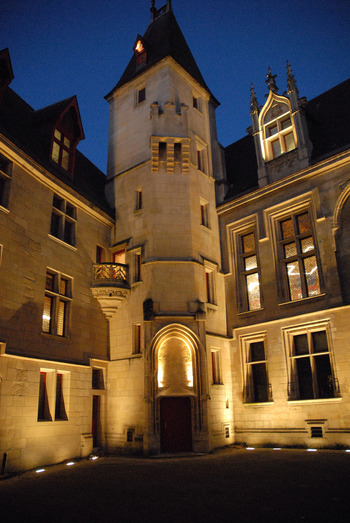
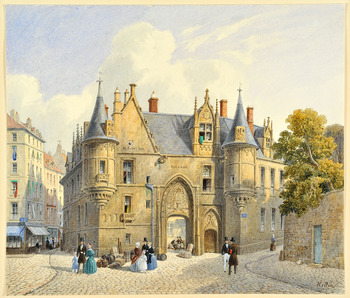
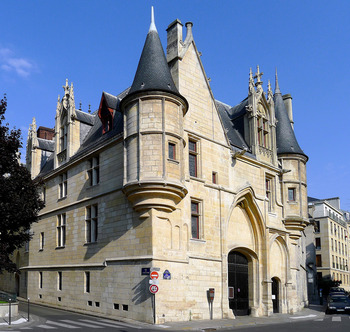
Since 1961, the Forney Library has been housed in the city residence of the archbishops of Sens, an historic Paris building—spectacular and much represented by artists since the 19th century. Built from 1475 to 1519 and commissioned by the powerful Tristan of Salazar, the Hôtel de Sens is one of the few surviving medieval civilian residences in Paris, recalling both a medieval fortress and an elegant Gothic domestic palace, reflecting the splendour of the rich and powerful ministers of the King of France.
From the 18th century onwards, the building endured many vicissitudes and was greatly damaged. In 1911 it was bought by the City of Paris and throughout the whole of the 20th century was renovated in a ‘Viollet le Duc’ spirit, preserving its authentic parts as well as reinventing those parts that had irrecoverably disappeared, mainly in the decoration of the interiors.
A great period of renovation took place between 1929 and 1961, interrupted only by the Second World War. More recently, in 2000, a renovation project cleaned and restored the external walls and towers looking toward the street as well as the walls of the rear public garden.
Initially, the Forney Library was erected on a site altogether different from its current home. Thanks to a donation given to the City of Paris by Aimé-Samuel Forney, a businessman who wanted to bring art craftsmanship back in favour at the end of the 19th century, the library was inaugurated in February 1886. The library sat at number 12, Titon Street, in the 11th arrondissement of Paris, in the middle of the popular Faubourg St Antoine, a cabinet makers and woodcarvers neighbourhood. Its aim was to help and educate local craftsmen, lending them drawing models for their work. At first the library was exclusively dedicated to applied arts and crafts, and was used only by cabinet makers, ceramists, or painters. However, its readership was later enlarged to students in art history and architecture, fashion professionals, graphic artists and designers, particularly after 1961 when it moved to the Hôtel de Sens, in the heart of the Marais, rue du Figuier, near the River Seine.
New courtyard lighting, Bibliothèque Forney/Ville de Paris. Copyright Yves Lesven/Bibliothèque Forney/Ville de Paris.

As one of the Specialized Libraries of the City of Paris, the Forney Library offers free and open access to everyone, and it is a landmark library in France for applied and decorative arts and crafts, fine arts, graphic arts and design. It is both an historic and lending library, free for all, with a long tradition of temporary exhibitions reflecting the collections' specialties. The building is famous for its beautiful walls and windows, looking out on both the French garden side and the internal courtyard with its dungeon; above all, the architecture of the main entrance wall, with its towers and its Renaissance porch, are both striking and picturesque. The Hôtel de Sens was classified as an historic monument at the end of the 19th century and is protected as such. Tourists know the Hôtel de Sens as a monument of the French capital, but they frequently ignore the library which is housed within.
After having renovated the exterior of the building, the library started its program of interior restructuring and refurbishment in January 2016 with the aim of attracting a new diversity of users: readers and casual visitors. The overall goal is to allow everyone (not just library readers), to discover the building and its history, as well as the richness of its art collections. Inside the building, the main reading room offers vintage 1960s decoration and furnishings, blended with a reconstructed French Renaissance style, a mix much appreciated by library users.
Hôtel de Sens, 19th-century print. Copyright Bibliothèque Forney/Ville de Paris.

The Hôtel de Sens, today. Copyright Bibliothèque Forney/Ville de Paris.

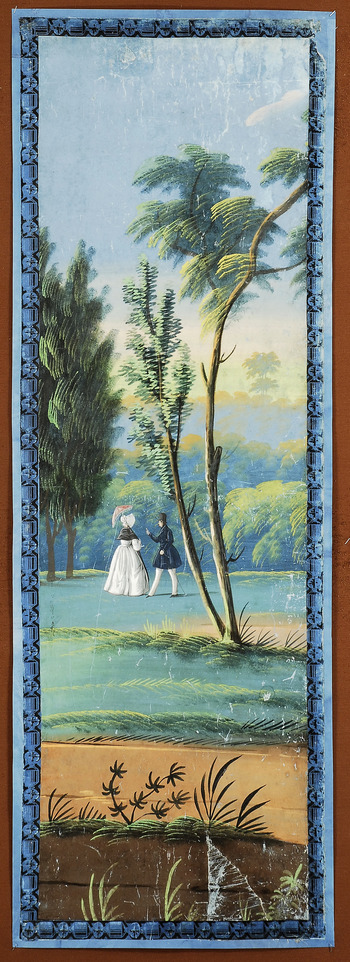
Panoramic wallpaper, 19th century. Copyright Bibliothèque Forney/Ville de Paris.

The collections include books and periodicals dating from the 17th century to the present day, but also printed advertisements, ephemera, and textile samples. The library continues to lend contemporary publications to its readers, as it has since its foundation.
Among the important but perhaps not sufficiently well-known collections, the Forney Library holds a great number of commercial catalogues published by the great department stores and manufacturers of the 19th century. This huge collection of commercial catalogues is an invaluable resource for today's researchers. The library has about a half million postcards, a collection which has been progressively digitized and which joins posters, wallpapers, and many ephemeral items in a digital collection. Additionally, great numbers of the periodicals and printed books are being digitized as well.
The renovation of the ground floor: “Heritage for all”
The most current renovation spanned from February 2015 to February 2017, including planning and construction. The library reopened in March of 2017, after 15 months of closure. The project aim was to rationalize the 15th-century building's spaces and its use, but also to attract tourists and general visitors to the library, encouraged to discover spectacular historic spaces and heritage collections they might not suspect the existence of. Indeed, until 2015, curious visitors could enter the courtyard, but were frustrated by not being allowed to enter the building without a reader's pass. The ground floor around the courtyard is now completely devoted to the valorization of the heritage collections and the history of the building: temporary and permanent exhibitions, conferences, and workshops, all of which attract many different users. Before the renovation, library readers did not have access to the ground floor spaces and general visitors did not have access to the library. The renovation makes it easy for patrons of all types (library and general) to access the entire library, collections and architectural spaces. In addition to the library and art collections, the grand staircases, the Chimney Room, the Great Reading Room, as well as tactile exhibits (curiosity cabinets with touchable paper samples for example) are now accessible to everyone.
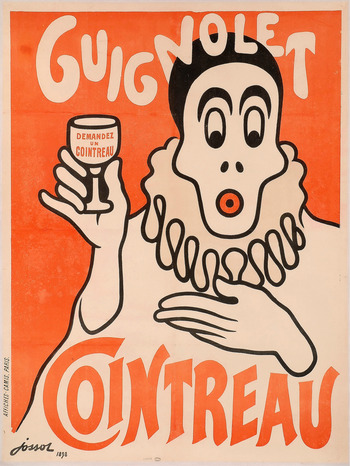
Commercial poster for Cointreau Liquor, Henri Gustave Jossot, 1898. Copyright Bibliothèque Forney/Ville de Paris.

Moreover, within the architectural constraints of the historical building, accessibility for the handicapped is much improved: there is a new wheelchair access (a reversible architectural intervention) to the exhibition rooms leading to a special area welcoming the handicapped.
The old entrance to the library is now the entrance to the new visitors' trail, giving access to exhibition rooms, conference and workshop rooms, a kind of permanent exhibition path (free for all to use), with text about the history of the building, samples of Forney ‘treasure’ collections, temporary exhibitions. This new path already exists in several great libraries such as the British Library and the Richelieu ‘quadrilatère’ for the Institut National d'Histoire de l'Art and the Bibliothèque Nationale de France, but it is worth stressing that this movement towards access to heritage libraries is now compulsory for French institutions, and will make the collections more widely known and seen, physically and virtually.
Thanks to the generosity of the Forney's Société des Amis de la Bibliothèque, the library has installed a multimedia device that shows samples from the digitized collections. Efforts such as these smooth the way to the discovery of the collections by a more diverse public. It is an obligation of the Forney Library to let its readers and visitors visually access (freely and easily) all that the collections have to offer.
Readers' spaces
In addition to providing more access to the library collections, the renovation intended to give more visibility to the building itself. Before the renovation, library offices were on multiple floors, mixed with public spaces. Now the library is entirely on the first floor. The renovation makes the arrangement of space much more rational and comprehensible: the first floor is entirely devoted to readers, with the lending collections clearly separated from the reference collections, and the “silent” reference and heritage consultation area of the main reading room, situated more appropriately at the end of the readers' circulation.
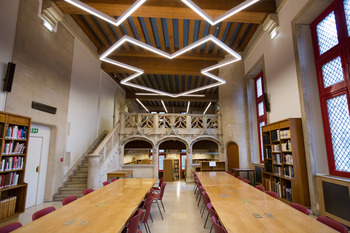
The bold design of the new lighting for the main reading room is striking, replacing dated lights from the 1970s, and echoing the historic design of the windows and the decorative mezzanine balcony. The reading room's oak tables were adapted to accommodate plugs for readers' laptops. Electricity upgrades were the costliest part of the project, seconded by the moving of materials, furniture, collections, and disposables, for nearly everything had to pass through old and narrow windows, greatly increasing the costs. Most of the historic modern furniture in the reading room was preserved (the 1960s Piretti chairs were revamped, for instance).
The second floor is now devoted to new staff offices (which badly needed renovation), resulting in more space and better working conditions for library staff. Comfortable and well lit, if not very much larger, the new offices exhibit the use of the ‘rouge Marais' colour on the windows and throughout the building. This colour is being used by architects everywhere in the Marais area who are restoring listed buildings and continuing an historical precedent for this region of Paris. A high degree of craftsmanship and expertise with respect to the historic spaces was ensured by using local craftsman for the renovation supervised by municipal and listed buildings architects.
The third floor houses storage for image collections; staff offices and a reading room for visual images and rare and fragile materials will undergo more major renovations in a later phase of the project. At this point, the project has updated fire and safety requirements on this floor. However, this comprised a huge operation of sorting and moving documents and materials to off-site stacks. Alongside the renovation of the historic building, the library has expanded off-site storage stacks (there are already three external sites, holding 80% of the collections, and retrievable by the public with only a day's delay). Moving collections to off-site stacks is a necessary part of the project, and goes hand-in-hand with the illumination of this historic building in central Paris.
New lighting in the main reading room. Copyright Yves Lesven/Bibliothèque Forney/Ville de Paris.

In conclusion, the renovation of the Hôtel de Sens enhances the visibility and usage of both the library and the museum collections. The library is more comfortable and user-friendly, while preserving most of its vintage modern furniture dating from the 1960s. General visitors are now encouraged to discover heritage collections, visit the library, attend lectures, workshops and other cultural events such as concerts and theatre in the courtyard. It is hoped that these efforts will enlarge the influence, enhance the reputation, and increase the use of the Forney Library.
A version of this article was presented as a paper at the IFLA Art Libraries Section Satellite Conference in Chicago, 9–11, August 2016.