1. Introduction
The tectonic evolution of the SW Yangtze Block and its relationship with the supercontinent cycle are still a matter of considerable controversy despite having been the subject of previous studies (Li et al. Reference Li, Li, Zhou and Peter2002; Greentree et al. Reference Greentree, Li, Li and Wu2006; Zhou et al. Reference Zhou, Ma, Yan, Xia, Zhao and Sun2006, Reference Zhou, Zhao, Chen, Li, Wang, Yan and Qiu2014; Geng et al. Reference Geng, Yang, Du, Wang, Ren and Zhou2007, Reference Geng, Kuang, Liu and Du2017; CH Zhang et al. Reference Zhang, Gao, Wu, Shi, Yan and Li2007; Li et al. Reference Li, Zhang, Yao and Xiang2013; Wang & Zhou, Reference Wang and Zhou2014; Zhao et al. Reference Zhao, Asimow, Zhou, Zhang, Yan and Zheng2017; Cawood et al. Reference Cawood, Zhao, Yao, Wang, Xu and Wang2018; H Zhang et al. Reference Zhang, Gao, Zhang, Ding, Li and Liu2018). To date, significant progress has been made that allows the geological events of the SW Yangtse Block to be divided into three distinct phases: (1) A ∼1800 to ∼1600 Ma continental rift stage. After the Columbia supercontinent was pieced together around 1800 Ma, a near-east–west continental rift was formed, evidenced by the lower portions of the Dahongshan Group (Laochanghe Fm, Manganghe Fm and Hongshan Fm), Hekou Group, Dongchuan Group (Yinmin Fm) and the Tongan Formation (First Section) (Greentree & Li, Reference Greentree and Li2008; Zhao et al. Reference Zhao, Zhou, Li, Sun, Gao, Sun and Yang2010; Zhao & Zhou, Reference Zhao and Zhou2011; Yang et al. Reference Yang, Liu, Du, Liu and Wang2012; Yin et al. Reference Yin, Sun, Ren and Wang2012; Chen et al. Reference Chen, Zhou and Zhao2013; Li et al. Reference Li, Zhang, Yao and Xiang2013; DB Wang et al. Reference Wang, Yin, Sun, Wang, Wang, Liao, Tang and Ren2013; Ren et al. Reference Ren, Pang, Sun and Yin2014; Wang & Zhou, Reference Wang and Zhou2014; Pang et al. Reference Pang, Ren, Sun and Yin2015; SW Wang et al. Reference Wang, Jiang, Yang, Sun, Liao, Zhou, Guo, Wang and Yang2016; Geng et al. Reference Geng, Kuang, Liu and Du2017); (2) A ∼1600 to ≤1500 Ma passive margin stage. During this stage, the continental rift was further extended, and the southwestern part of the Yangtze Block developed into a passive continental margin, mainly consisting of upper portions of the Dahongshan Group (Feiweihe Fm and Potou Fm), Dongchuan Group (Luoxue Fm, Heishan Fm and Lvzhijiang Fm) and the Tongan Formation (Second, Third and Fourth Sections) (Yin et al. Reference Yin, Sun, Ren and Wang2012; Li et al. Reference Li, Zhang, Yao and Xiang2013; Wang & Zhou, Reference Wang and Zhou2014; Pang et al. Reference Pang, Ren, Sun and Yin2015; Geng et al. Reference Geng, Kuang, Liu and Du2017); (3) A ∼1050 to ∼1000 Ma active margin stage. At this time the southwestern margin of the Yangtze Block transformed into an active continental margin, of which the representative stratigraphic units are mainly the Kunyang and Huili groups that formed alongside magmatic arc volcanism (ZX Li et al. Reference Li, Li, Zhou and Peter2002; Geng et al. Reference Geng, Yang, Du, Wang, Ren and Zhou2007; Zhang et al. Reference Zhang, Gao, Wu, Shi, Yan and Li2007; Yin et al. Reference Yin, Sun and Zhang2011, Reference Yin, Sun, Ren and Wang2012; HK Li et al. Reference Li, Zhang, Yao and Xiang2013; Zhu et al. Reference Zhu, Zhong and Li2016).
Although significant progress has obtained in the study of this area, the tectonic setting of the SW Yangtze Block remains controversial. The Kunyang Group is generally regarded as the product of later tectonic events that occurred during the amalgamation of Rodinia (Zhang et al. Reference Zhang, Gao, Wu, Shi, Yan and Li2007; Li et al. Reference Li, Zhang, Yao and Xiang2013). Greentree et al. (Reference Greentree, Li, Li and Wu2006) maintained that the Sibao Orogeny was formed before 1142 Ma, and that the Kunyang Group formed in the foreland basin of the orogenic belt (Greentree et al. Reference Greentree, Li, Li and Wu2006; Li et al. Reference Li, Zhang, Yao and Xiang2013). However, Zhang et al. (Reference Zhang, Gao, Wu, Shi, Yan and Li2007) observed that the Kunyang Group exhibits characteristics of an active continental margin setting, and so is expected to have formed alongside active subduction of oceanic lithosphere not earlier than basin closure at c. 1032 Ma. Although the convergence of the SW Yangtze Block is controversial, and the onset and transition mechanism of subduction even less clear, the basaltic volcanic rocks of the Luonie Valley, Dechang County, SW Sichuan, China, are potentially of great significance due to their association with an extensional tectonic margin during the formation of Rodinia (Greentree et al. Reference Greentree, Li, Li and Wu2006; Zhang et al. Reference Zhang, Gao, Wu, Shi, Yan and Li2007; Li et al. Reference Li, Zhang, Yao and Xiang2013; Hu et al. Reference Hu, Zhai, Wang, Tang and Ren2017; Cawood et al. Reference Cawood, Zhao, Yao, Wang, Xu and Wang2018, Reference Cawood, Wang, Zhao, Xu, Mulder, Pisarevsky, Zhang, Gan, He, Liu, Qi, Wang, Yao, Zhao, Zhou and Zi2020). This paper reports new zircon U–Pb ages, whole-rock geochemical and Lu–Hf isotopic data for the newly recognized late Mesoproterozoic rocks including basaltic volcanic rocks, granites, metamorphic ignimbrite and arkose in the SW Yangtze Block. The new dataset allows us to explore the petrogenesis and tectonic setting and shed light on the tectonic evolution of the late Mesoproterozoic in the SW Yangtze Block. This work will also have important implications for the role of Yangtze Block in the reconstruction of Rodinia.
2. Geological setting and rock series
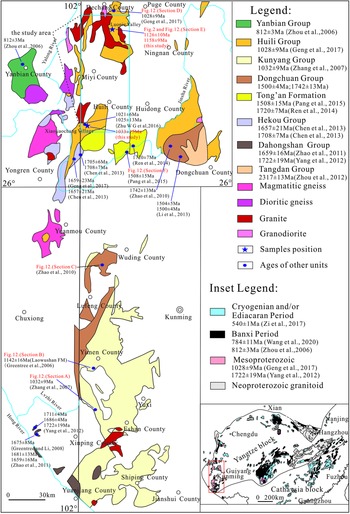
The ancient Kangtien shield is located in SW China and comprises a thick succession of stratigraphic units of Proterozoic age that outcrop discontinuously in a N–S direction and are distributed throughout the Kangding–Dukou–Yuanmou–Yimen area of Yunnan Province. The stratigraphic units of the Kangtien shield in central Yunnan and neighbouring southern Sichuan provinces include the Dahongshan Group, Hekou Group, Dongchuan Group, Tongan Formation, Kunyang Group, Huili Group and Laowushan Formation (Yin et al. Reference Yin, Sun and Zhang2011). The study area is located in the north of the ancient Kangtien shield where the Huili Group comprises the Tianbaoshan, Fengshanying and Limahe Formations (Fig. 1). The main studied section is located in Luonie Valley, Dechang County, SW Sichuan, where the traditional Tianbaoshan Formation outcrops.
Regional geological map of the SW Yangtze Block showing the distribution of Precambrian strata, plutons and position of the study area.

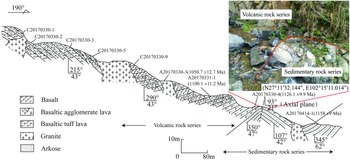
The typical rock types of the Tianbaoshan Formation comprise grey-green sericitic phyllite, metamorphic rhyolitic porphyry, rhyolitic lava and tuff, intercalated with metamorphic sandstone and schist. However, a rock assemblage consisting mainly of volcanic breccia-agglomerate and basic volcanic lava in Dechang County (Wu, Reference Wu1986) was attributed to the Tianbaoshan Formation on a 1:200 000 geological map (1996), despite the apparent difference in lithology from the traditional Tianbaoshan Formation. Two rock systems are developed along the Luonie Valley, where the lower part is a sedimentary rock series and the upper part, a volcanic rock series (Fig. 2), accompanied by intrusive granite (Fig. 3g). The granite intrudes into two rock systems along the weak zone. In addition, the appearance of the two rock systems is parallel, and its contact surface has no obvious signs of disconformity such as a weathered crust (Fig. 2).
Geological profile of the Luonie Valley, with locations of samples for zircon U–Pb dating and whole-rock geochemical analyses (A20170330-4, A20170331-1, A20170330-3, A20170414-1, C20170330-1, C20170330-2, C20170330-3, C20170330-5 and C20170330-9).

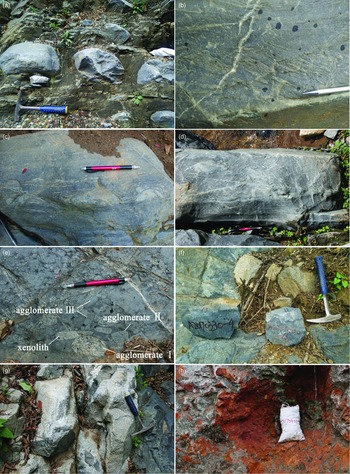
Field photographs of the arkose and volcanic rocks in Luonie Valley and the ignimbrite in Xiaojiaochang Village: (a) mud flame structure of the arkose; (b) soft shear slip deformation of the arkose; (c) sliding fold of the arkose; (d) liquefied vein of the arkose; (e) agglomerate I, agglomerate II, agglomerate III and xenolith of basaltic agglomerate lava; (f) basaltic tuff lava; (g) granite intruded into the basaltic rocks; (h) ignimbrite of the Limahe Formation.

The sedimentary rock series comprises medium-thick layered arkose, mainly composed of feldspar and quartz and a small amount of detrital mica, exhibiting parallel to occasionally oblique bedding as well as abundant evidence of soft-sediment deformation in four distinct forms: (1) Mud flame structures (Fig. 3a) corresponding to where the upward movement of argillaceous material has deformed overlying sandstone layers, retaining a smooth and regular cross-section indicative of material flow rather than tectonic deformation. (2) Soft shear slip deformation (Fig. 3b) referring to where sandstone layers comprise imbricated blocks, while the argillaceous rock remains homogeneous. The different deformational characteristics between these two contrasting lithologies imply that the argillaceous material was not consolidated during deformation. (3) In sliding folds (Fig. 3c), in which the sandstone is folded, while the underlying argillaceous rock has not been affected by the deformation. (4) Liquefied veins (Fig. 3d) that cut through overlying strata in wedges and spines, whilst the whole rock exhibits strong disturbance.
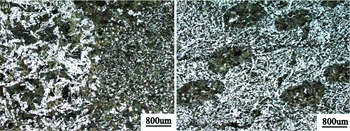
According to the characteristics of the texture and structure, the volcanic rock series can be divided into basaltic agglomerate lava, basaltic tuff lava and basalt. The basaltic agglomerate lava comprises black and grey thickly layered and blocky lava, including a large number of volcanic agglomerates with occasional xenoliths (Fig. 3e). The aggregates are oval, long and irregularly shaped, and some of them have ‘S’-type deformation. The diameter of the aggregates is between 1 mm and 50 cm, but mainly within the 1–5 cm range. On the basis of the crystallization degree and mineral composition, the aggregates can be divided into agglomerates I, II and III (Fig. 3e). The micrographs show that the pyroxene content of the agglomerates is higher than that of the surrounding lava, and the feldspar content is less (Fig. 4a, b); basaltic tuff lava consists of dark-grey thickly layered blocks with cryptocrystalline structure (Fig. 3f); and basalt consists of black and grey thickly layered blocks with cryptocrystalline texture, occasionally developing stomata and almond structure.
Micrographs (plane-polarized light) of the volcanic rocks in Luonie Valley: (a) the contact boundary of agglomerate I; (b) the spherical distribution of agglomerate III.

The studied units also include the Limahe Formation of the Huili Group in Xiaojiaochang Village, Huili County (Fig. 1) where the lithology is metamorphic ignimbrite (Fig. 3h). The rock has cryptocrystalline texture and is strongly weathered.
3. Sample selection and methodology
In this study, five samples for dating (A20170330-4, A20170331-1, A20170330-3, A20170401-1, A20170414-1) and five samples for geochemistry (C20170330-1, C20170330-2, C20170330-3, C20170330-5 and C20170330-9) were collected from the Luonie Valley. Samples A20170414-1 and A20170330-3 were collected from the lower sedimentary rock series and the granite, respectively, while the others were taken from the volcanic rock series. In addition, sample A20170401-1 was taken from the top of the Limahe Formation in Xiaojiaochang Village, Huili County (N26°28′35.46″, E102°5′33.15″ (Fig. 1).
Zircon dating of samples A20170330-4, A20170331-1, A20170330-3 and A20170401-1 was carried out using the SHRIMP II instrument at the Beijing SHRIMP Center, Chinese Academy of Geological Sciences (CAGS). The analytical process is described in detail in Lance et al (Reference Lance, Sandra, Charlotte, John, Donald, Russell and Chris2003 a, b). At the time of the analysis, the mass resolution of the instrument was c. 5000 (1 wt % peak height), and the O2− strength of the primary ion current was between 4 and 6 nA. The diameter of the primary ion current was 25–30 μm, and each data point was made up of five scans. Standard zircon TEM and M257 were used for fractionation correction and U content calibration. The processing of the original data and the drawing of the zircon 206Pb/238U concordia plot were conducted using the Squid and Isoplot programs written by Ludwig (Reference Ludwig2002). The correction for common Pb was deduced from the measured Pb, and the model of Stacey & Kramers (Reference Stacey and Kramers1975), which estimates the isotopic composition of common Pb. In Table 1, 1σ of the age error is an absolute error, and 1σ of the isotope ratio error is a relative error. The weighted average zircon 206Pb/238U age has a 95 wt % confidence coefficient.
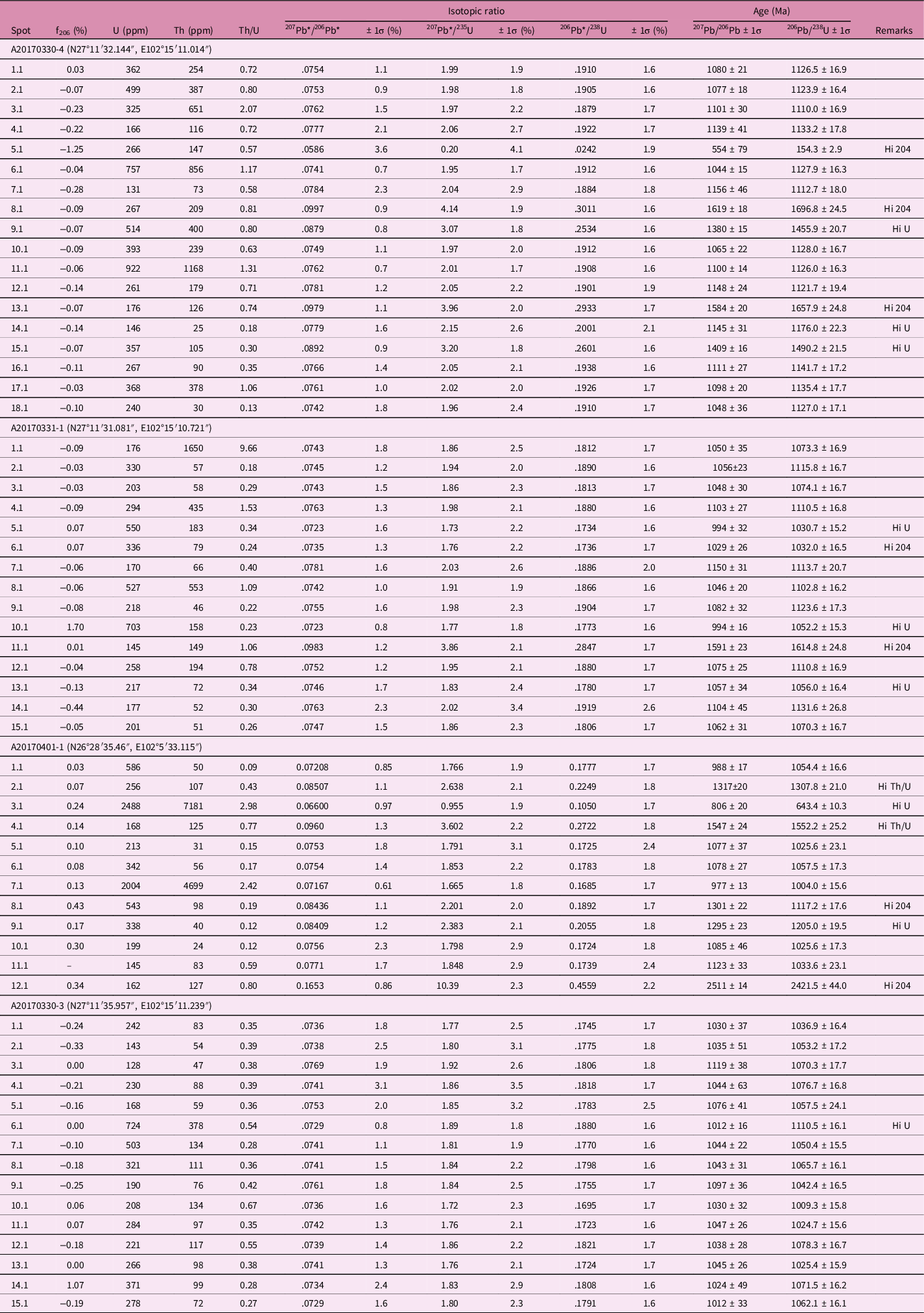
Zircon U–Pb data of samples A20170330-4, A20170331-1, A20170401-1 and A20170330-3

Zircon dating of sample A20170414-1 was carried out using laser ablation – inductively coupled plasma – mass spectrometry (LA-ICP-MS) at the Wuhan Sample Solution Analytical Technology Co. In the analysis, the excimer laser GeoLasHd was used for denudation sampling, and the Agilent 7900 four-stage rod plasma mass spectrometer was used to test the ion signal strength. The relevant parameters are laser energy 80 mJ, frequency 5 Hz and laser beam spot diameter 32 m. The specific analytical conditions and procedures are detailed in the literature (Liu et al. Reference Liu, Hu, Gao, Günther, Xu, Gao and Chen2008, Reference Liu, Gao, Hu, Gao, Zong and Wang2010).
Zircon Lu–Hf isotope compositions of the dated zircon grains were analysed using a Geolas 193 nm excimer ArF laser-ablation system, attached to a Nu Plasma multi-collector MC-ICP-MS, at Northwest University, Xi’an, China. A stationary spot was used with a beam diameter of 44 μm, a 5 Hz repetition rate and laser power of 6 J cm−2. Fractionation correction of the Lu–Hf isotope ratios was calculated using index law, and 176Lu/175Lu = 0.02656 and 176Yb/173Yb = 0.78696 were used to deduce the influence of 176Lu and 176Yb on 176Hf. The ratio of Hf isotopes to Lu isotopes was corrected using 179Hf/177Hf = 0.7325, while the Yb isotope ratios were corrected using 173Yb/171Yb = 1.12346. International standard zircons 91500 and Mudtank were used as reference standards.
The geochemical analyses were carried out at the Laboratory of Regional Geology and Mineral Survey Research Institute, Hebei Province. Samples were crushed and powered to at least 200 mesh in an agate mill. Major elements were determined by ICP-HEX-MS, the accuracy of which was ±1 wt %. Trace and rare earth elements were determined using plasma mass spectrometry (Element 2) and X-ray fluorescence spectrometry with analytical uncertainties between 1 wt % and 5 wt %.
4. Results
4.1. Geochronological results
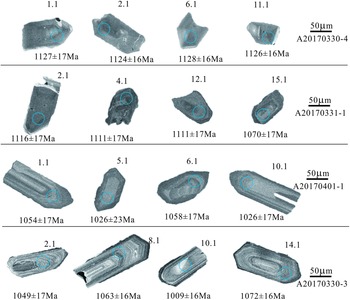
Under the microscope, the zircons occur as stubby crystals with an aspect ratio of c. 1:1.5 (Fig. 5). For the selection of zircon grains and dating microzones, the authors selected zircon grains that were not too bright nor too dark by combining transmission light, reflected light and cathodoluminescence (CL) images, and avoided inclusions and cracks in the zircon crystals. The selected microzones for dating were located in obviously magmatic oscillatory zones.
CL images of analysed zircons from samples A20170330-4, A20170331-1, A20170401-1 and A20170330-3.

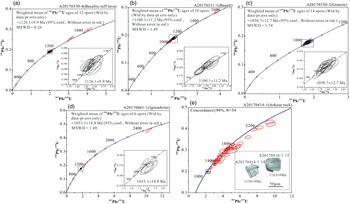
Sample A20170330-4 is a basaltic tuff lava. A total of 18 data points were analysed in this sample (Table 1), 6 of which were removed due to their higher 204Pb and higher U. The projection ellipse of the remaining 12 points lies on or close to the concordia line in the U–Pb concordia plot. The weighted average 206Pb/238U age is 1126.1 ± 9.9 Ma (MSWD 0.26) (Fig. 6a).
Zircon U–Pb concordia plots from samples A20170330-4 (basaltic tuff lava), A20170331-1 (basalt), A20170330-3 (granite), A20170414-1 (ignimbrite) and A20170414-1 (arkose).

Sample A20170331-1 is basalt. In total, 15 data points were analysed in the sample (Table 1). Five points were eliminated due to their higher U and higher 204Pb, which are 1031 Ma, 1032 Ma, 1052 Ma, 1056 Ma and 1615 Ma. The weighted averaged 206Pb/238U age is 1100.1 ± 11.2 Ma (MSWD 1.49) (Fig. 6b).
Sample A20170330-3 is granite, and a total of 15 data points were analysed in this sample (Table 1), 1 of which was eliminated due to its higher U. The weighted averaged 206Pb/238U age is 1050.7 ± 12.7 Ma (MSWD 1.74) (Fig. 6c).
Sample A20170401-1 is an ignimbrite. A total of 12 data points were analysed in this sample (Table 1). Six of these were eliminated because of higher U, higher Th/U and higher 204Pb. The weighted average 206Pb/238U age is 1033.1 ± 14.8 Ma (MSWD 1.48) (Fig. 6d).
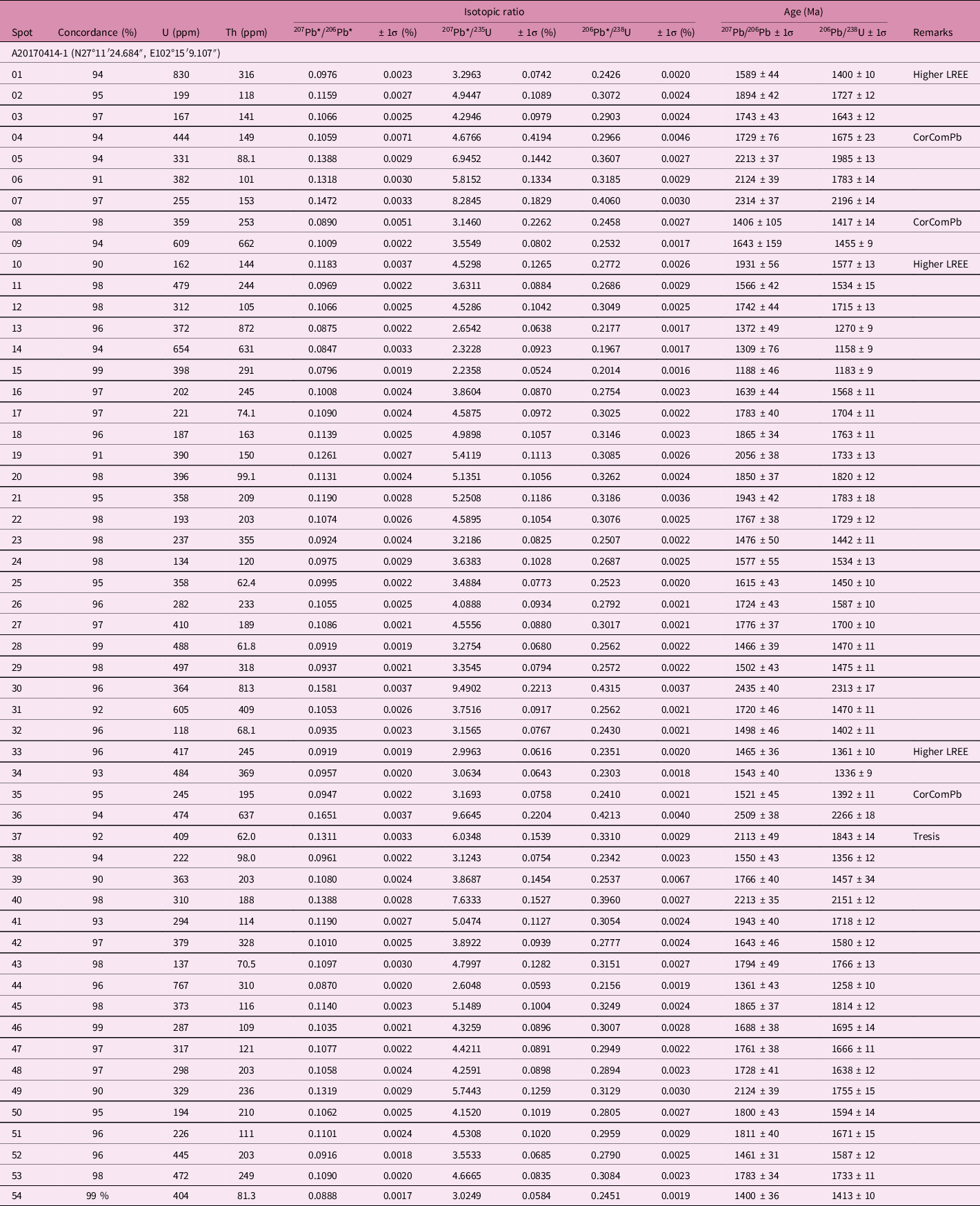
Sample A20170414-1 is an arkose. A total of 54 data points were obtained for this sample (Table 2). The confidence of all data is greater than 90 wt %. Two minimum ages were obtained for this sample, which are 1158 ± 9 Ma and 1183 ± 9 Ma (Fig. 6e).
Zircon U–Pb data of sample A20170414-1

4.2. Zircon Lu–Hf isotopes
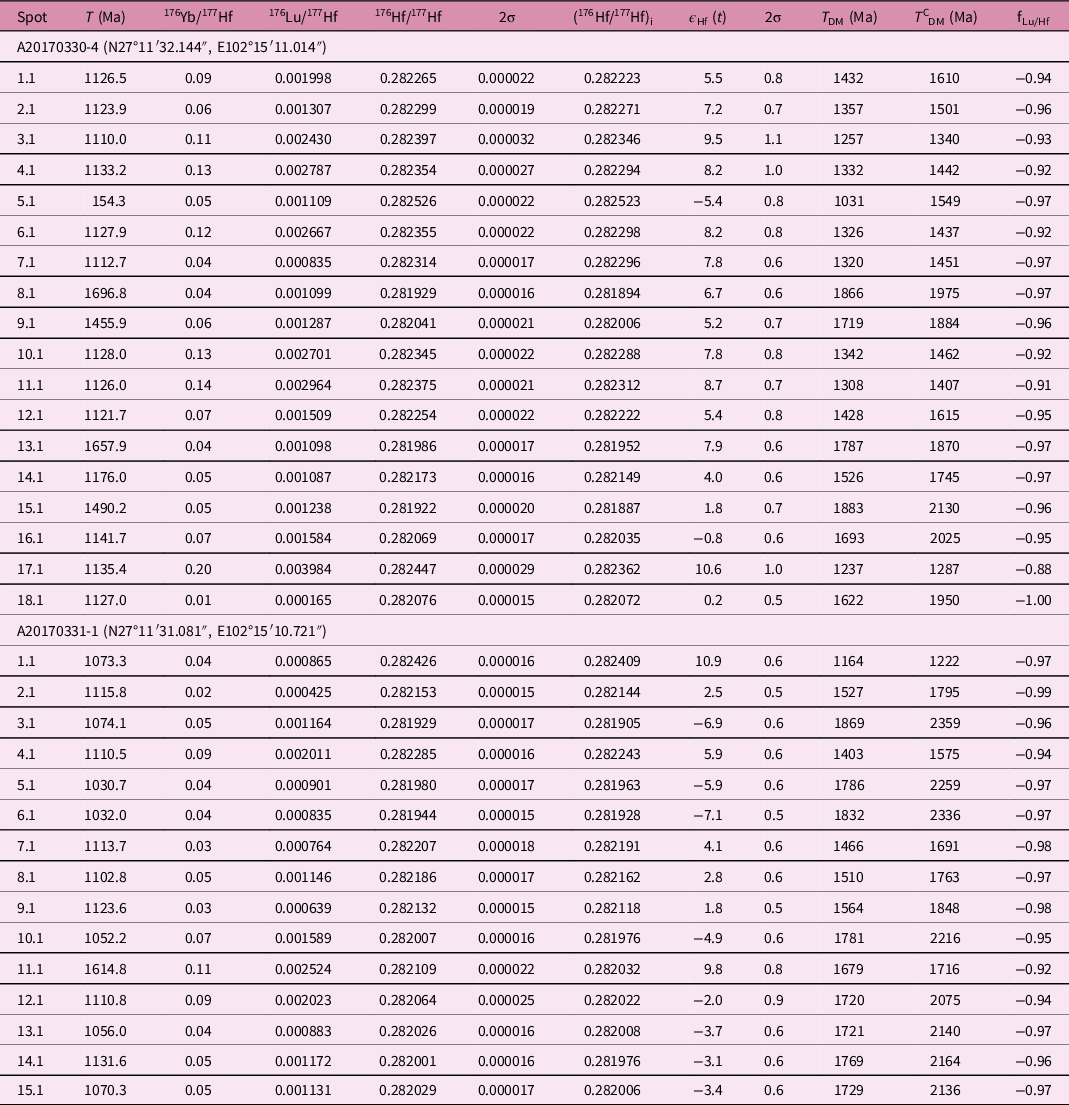
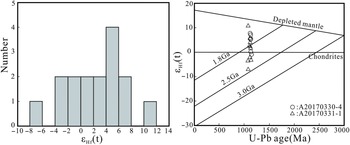
The Lu–Hf isotope compositions of the zircons were analysed in the same microzone position as that used for zircon U–Pb dating. Prior to the Lu–Hf analysis, zircon U–Pb age data for samples such as A20170330-4 and A20170331-1 that displayed higher U and higher error correlation coefficients were deleted. In addition, the data with 176Lu/177Hf ratios greater than 0.002 were also eliminated because only when the 176Lu/177Hf ratio is less than 0.002 can the 176Lu/177Hf ratio represent the Hf isotope composition of the source region (Wu et al. Reference Wu, Li, Zheng and Gao2007). The remaining 16 data points were used for data analysis (Table 3). Because samples A20170330-4 and A20170331-1 are both basaltic volcanic rocks from the same layer, they are considered and displayed together. ϵ Hf(t) values of all the data points lie in the range −6.9 to +10.9, with an average value of 2.4, and so the dataset sits mainly above the Hf isotope evolution line of chondrites (Fig. 7). The single-stage Hf model age of the 16 data points ranges between 1320 Ma and 1869 Ma, with a weighted mean of 1536 Ma. The two-stage Hf model age ranges between 1222 Ma and 2359 Ma, with a weighted mean of 1799 Ma.
Zircon Lu–Hf isotopes data of samples A20170330-4 and A20170331-1

ϵ Hf(t) histogram and age– ϵ Hf(t) plot of the basaltic volcanic rocks from samples A20170330-4 and A20170331-1.

4.3. Geochemical results
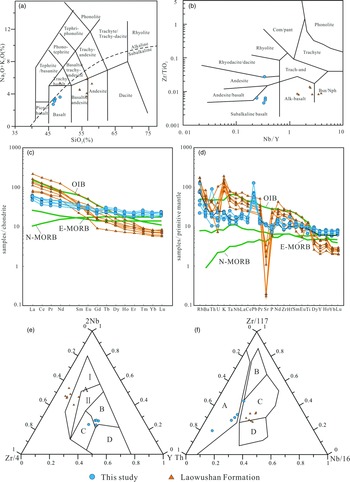
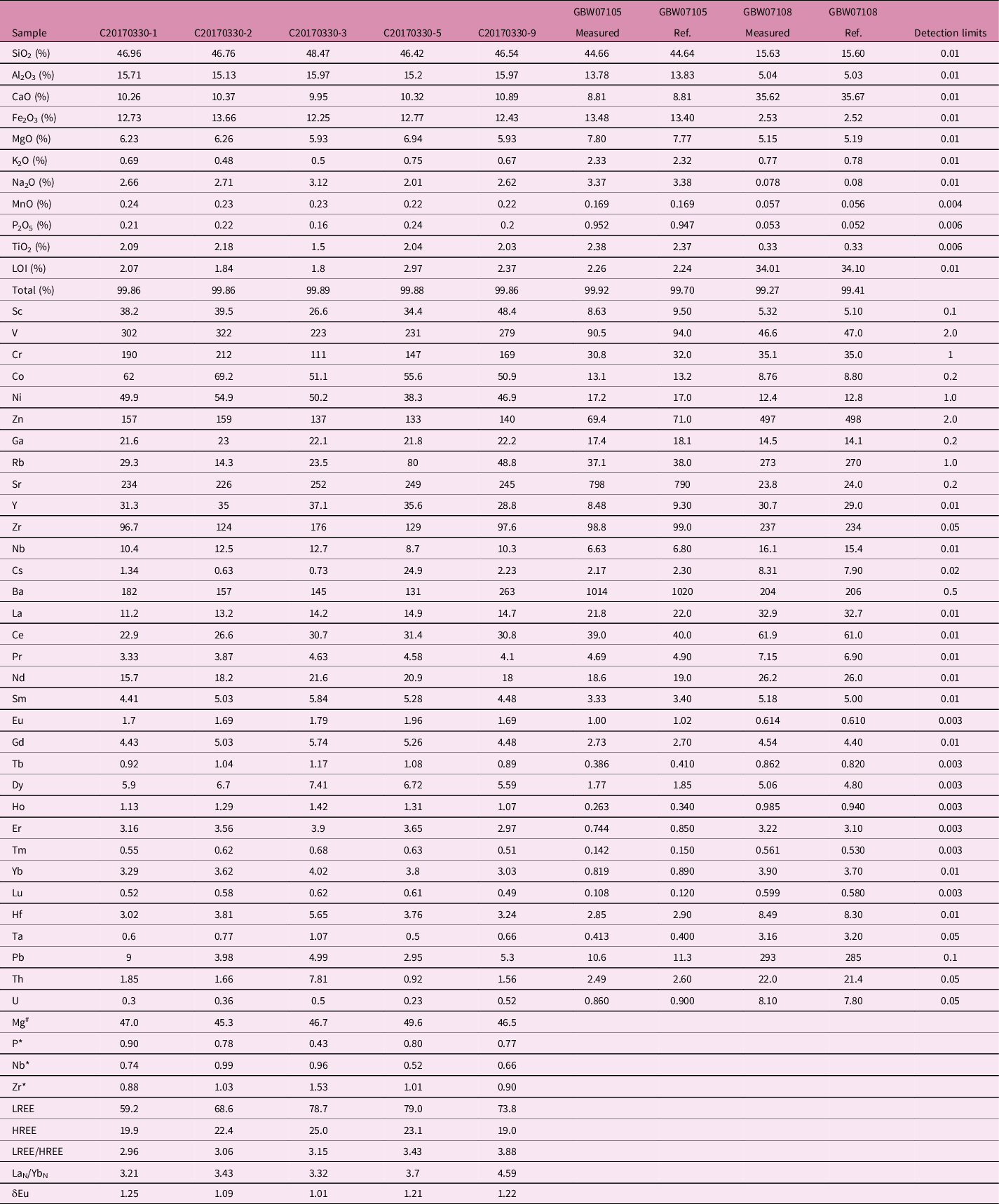
The SiO2 contents of the volcanic rock samples are in the range 46.42–48.47 wt %, with an average value of 47.03 wt %, satisfying basis rock composition. The range of K2O content is 0.5–0.75 wt %, which is lower than the average value of mid-oceanic ridge basalt and alkaline basalt (2.75 wt % and 3.20 wt %, respectively). The Na2O content is 2.01–3.12 wt %. The total-alkali silica (TAS) diagram of the volcanic rock shows that the samples are of basaltic composition (Fig. 8a). The Zr/TiO2–Nb/Y diagram of the volcanic rock further confirms that the samples are subalkaline basalt (Fig. 8b).
Geochemical diagrams of the volcanic rocks in Luonie Valley and Laowushan Formation. (a) TAS classification diagram. (b) Zr/TiO2–Nb/Y classification diagram. (c) Distribution pattern diagrams of REE. (d) Distribution pattern diagrams of trace elements (ehondrite and primitive mantle from McDonough & Sun (Reference McDonough and Sun1995); the values of OIB, E-MORB and N-MORB from Sun & McDonough (Reference Sun and McDonough1989)) (OIB: oceanic island basalt; E-MORB: exceptional mid-ocean ridge basalt; N-MORB: normal mid-ocean ridge basalt). (e) The triangular discrimination diagrams Zr/4–Y–2Nb (Wood, Reference Wood1979; Meschede, Reference Meschede1986) (AI: alkaline basalt of intraplate; AII: alkaline basalt and tholeiite of intraplate; B: E-type MORB; C: tholeiite of intraplate and volcanic arc basalt; D: N-type MORB and volcanic arc basalt). (f) The triangular discrimination diagrams Th–Nb/16–Zr/117 (Wood, Reference Wood1979; Meschede, Reference Meschede1986) (A: basalt of the destructive plate margin; B: N-type MORB; C: E-type MORB; D: basalt of intraplate).

The light rare-earth elements (LREE) of the basaltic volcanic rocks are slightly enriched relative to the heavy rare-earth elements (HREE), with LREE/HREE = 2.98–3.88 and (La/Yb)N = 3.21–4.59, and the content of rare-earth elements (REE) is (79.15 × 10⁻⁶)–(103.67 × 10⁻⁶) (Table 4; Fig. 8c). The δEu values of the samples are in the range 1.01–1.25, with an average value of 1.16 and weak positive anomaly. Other large ionic lithophile elements (Rb, Ba, Th, U, K) are also enriched relative to the primitive mantle (Sun & McDonough, Reference Sun and McDonough1989) (Fig. 8d). Furthermore, Pb shows a positive anomaly, while P shows a slight negative anomaly (Fig. 8d).
Major and trace elements for the rocks from Luonie Valley: C20170330-1, C20170330-2, C20170330-3, C20170330-5 (basaltic agglomerate lava; the samples have no agglomerate), C20170330-9 (basalt)

Notes: LOI = loss on ignition; Nb* = 2*Nb N/(La+K)N; P* = 2*P N/(Hf + Nd)N; Zr*=2 *Zr N/(P + Sm)N. Normalization uses chondrite values from Sun & McDonough (Reference Sun and McDonough1989).
5. Discussion
5.1. Volcanic lithofacies
Volcanic lithofacies can be divided into continental and marine facies (Xu & Qiu, Reference Xu and Qiu2010). The volcanic rocks of continental facies are usually reddish or purplish brown in colour. The weathered crust is more developed, and the contact relationship with the underlying strata is generally unconformable. Pyroclastic materials also account for a large proportion of the volcanic rock composition of continental facies, and the sorting of fragments is poor (Li et al. Reference Li, Li, Wang, Wang, Shang, Zhang and Zhao2011; Shan et al. Reference Shan, Li, Chen, Ran, Chen and Liu2013). The composition of continental lava ranges from mafic to felsic, often developing columnar joints (Farmer, Reference Farmer and Rudnick2003). In contrast, the volcanic rocks of marine facies generally exhibit the opposite features (Jiang and Wang, Reference Jiang and Wang2005; Xu and Qiu, Reference Xu and Qiu2010). The basaltic volcanic rocks of Luonie Valley are dark-grey to grey-black, and their lithology is relatively homogeneous. Furthermore, there is an apparently transitional and thus conformable contact relationship with the underlying arkose, and no weathered crustal material has been formed. In summary, the basaltic volcanic rocks show the characteristics of marine volcanic rocks. However, they also have some important characteristics of continental volcanic rocks, such as a relatively high proportion of pyroclasts, poor sorting of aggregates and no pillow structure. Therefore, the basaltic volcanic rocks most likely formed in a littoral–neritic environment quite different from N-type mid-ocean ridge basalt (MORB).
5.2. Age of the Luonie Formation
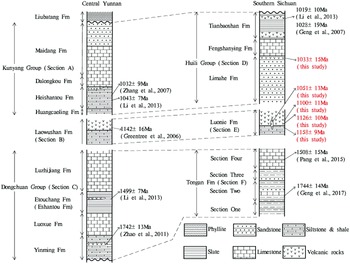
In this study, zircons from the ignimbrite at the top of the Limahe Formation were dated at 1033.1± 14.8 Ma. Although this age and other published ages do not represent the bottom of the Huili Group (Geng et al. Reference Geng, Yang, Du, Wang, Ren and Zhou2007; Zhang et al. Reference Zhang, Gao, Wu, Shi, Yan and Li2007; Li et al. Reference Li, Zhang, Yao and Xiang2013), the bottom age is not expected to be significantly different. The new dated ages of 1126.1± 9.9 Ma and 1100.1 ± 11.2 Ma for the basaltic volcanic rocks of the Luonie Valley in this study are much older than published ages of the Huili Group, indicating that there was an important volcanic event before the deposition of the Huili Group in the Dechang area of SW Sichuan. Although some younger points were removed before obtaining the 1100.1 ± 11.2 Ma, this was due to their anomalously higher U and higher 204Pb. All other determined ages are greater than 1070 Ma.
Before discussing the significance of these basalt ages, the presence of comagmatic zircons in presumably silica-unsaturated basalt may be questioned. The melt system and the fluid system can be seen as two independent geological systems according to transmagmatic fluid metallogenesis theory (Luo et al. Reference Luo, Mo, Lu, Chen, Ke, Hou and Jiang2007). Magma can also be viewed as a mixture of melt, fluid and even solid (Petcovic and Dufek, Reference Petcovic and Dufek2005; Bachmann and Bergantz, Reference Bachmann and Bergantz2008; Burgisser et al. 2008; Miller and Wark, Reference Miller and Wark2008). Because zirconium tends to concentrate in the fluid phase during partial melting and crystallization, the concentration of Zr in fluids can increase by —two to three orders of magnitude, especially if the fluid system contains NaHCO3 (Pouchon et al. Reference Pouchon, Curti and Degueldre2001; Marsh, Reference Marsh2002). The crystallization of biotite in basalt can consume magma volatiles, reducing the solubility of Zr and leading to zircon crystallization (Luo et al. Reference Luo, Mo, Wan, Li and Wei2006). As a consequence, zircons are commonly found not only in basic rocks, but also in ultrabasic rocks (Yu et al. Reference Yu, Tung and Lee2001).
Our argument, however, does not rest solely on the determined U–Pb ages of the extrusive basalts. Granite intrusion into these basaltic rocks at 1050.7 ± 12.7 Ma provides key supporting evidence that the basaltic rocks do not belong to the Tianbaoshan Formation, and the age is c. 50 Ma younger than the 1100.1 ± 11.2 Ma for the basalt age. In addition, the age of 1126.1± 9.9 Ma can represent the base of the basaltic volcanic rocks. The maximum sedimentary age of the arkose is c. 1158 Ma, not much different from 1126.1± 9.9 Ma, implying the likely continuity between the underlying sedimentary rock series and the overlying volcanic rock series. The observation that detrital zircon age peaks are different for the Huili Group than the Kunyang Group further supports this.
Comparably, tuff from the Laowushan Formation underlying the Kunyang Group in the Yimen area of central Yunnan yielded an age of 1142 ± 16 Ma, which is the only previous evidence for a stratigraphic unit of c. 1150 Ma in the coeval Kangtien succession (Greentree et al. Reference Greentree, Li, Li and Wu2006) (Fig. 9). However, the Laowushan Formation and the basaltic volcanic rocks described here are exposed in different areas, and so may be the products of contemporaneous but different settings. With the new ages of 1158 Ma and 1126.1± 9.9 Ma, the sedimentary rock series and volcanic rock series in the Luonie Valley can be correlated with the Laowushan Formation in central Yunnan. Therefore, we propose that these two units should be separated from the overlying Huili Group, and collectively be renamed the Luonie Formation.
Comparison and correlation used for the different stratigraphic systems from late Paleoproterozoic to Mesoproterozoic in Central Yunnan and Southern Sichuan.

On a global scale, the 1150 Ma magmatic event in the SW Yangtze Block was not isolated and occasional, but probably a global volcanic-magmatic event related to the convergence of Rodinia (Buchan et al. Reference Buchan, Ernst, Hamilton, Mertanen, Pesonen and Elming2001; Upton et al. Reference Upton, Emeleus, Heaman, Goodenough and Finch2003; Buchan & Ernst, Reference Buchan and Ernst2004; Hanson et al. Reference Hanson, Harmer, Blenkinsop, Bullen, Dalziel, Gose, Hall, Kampunzu, Key, Mukwakwami, Munyanyiwa, Pancake, Seidel and Ward2006; Ernst, Reference Ernst2007). Buchan & Ernst (Reference Buchan and Ernst2004) obtained an age of 1140.6 ± 2 Ma from the basic dike swarm in the Superior Province, Canada. Ernst (Reference Ernst2007) obtained 1177 ± 5 Ma age from the basic dike in Greenville, Eastern Canada. It has also been reported that 1163 ± 2 Ma is produced in the giant dike in the Greenland Shield (Buchan et al. Reference Buchan, Ernst, Hamilton, Mertanen, Pesonen and Elming2001; Upton et al. Reference Upton, Emeleus, Heaman, Goodenough and Finch2003), whereas age ranges of 1112–1106 Ma are recorded for the Kalahari craton of Africa and the Grunehogna region of Antarctica (Hanson et al. Reference Hanson, Harmer, Blenkinsop, Bullen, Dalziel, Gose, Hall, Kampunzu, Key, Mukwakwami, Munyanyiwa, Pancake, Seidel and Ward2006). Based on the above-mentioned ages, the authors believe that the magmatic events of 1150 Ma in the SW Yangtze Block are comparable to those on the global scale.
5.3. The magma source and tectonic environmental analysis
The MgO content of the volcanic rock samples is 5.93–6.94 wt %, which is lower than that of primitive basaltic magma (>9 wt %). The Mg# value (45.34–49.61 wt %, with an average of 47.02 wt %) is significantly lower than that of the primary magma (68–75 wt %). The content of Cr ((111 × 10−6)–(212 × 10−6)) and Ni ((38.3 × 10⁻⁶)–(54.9 × 10⁻⁶)) is relatively low (Table 4). These characteristics indicate that the basaltic volcanic rocks of the Luonie Valley have undergone crystallization differentiation of olivine and pyroxene (Wilson, Reference Wilson1989). The total REE of the basaltic volcanic rocks compared with E-type MORB is slightly higher, indicating that the basaltic volcanic rocks have undergone crystallization differentiation. The P anomaly indicates that phosphate minerals and ferrotitanium oxidation have undergone slight crystallization differentiation (Fig. 8d). The slightly positive Eu anomaly suggests that the crystallization differentiation of the magma was low and has relatively reducing properties (Ding et al. Reference Ding, Yao, Liu, Zhou and Yang2003). The reducing condition is generally believed to be provided by seawater, which is not contradictory to the littoral–neritic environment obtained from the lithofacies analysis.
Zircon Lu–Hf isotope data show that the 11 ϵ Hf(t) values of the basaltic volcanic rocks are positive and 5 ϵ Hf(t) values are negative (Table 3), with an average value of 2.4, indicating that the basaltic volcanic rocks originate primarily from the depleted mantle and may also be slightly stained by crustal material. The single-stage Hf model ages and the two-stage Hf model ages are different from the formation age, which may also be caused by a small amount of miscible crustal material (Wu et al. Reference Wu, Li, Zheng and Gao2007). Some similar conclusions can be drawn from the characteristics of trace elements. The negative P* anomalies (mean 0.74 < 1) of the samples suggest that the source region of the volcanic rocks is mainly composed of mantle-sourced magma. The negative Nb* anomalies (mean 0.78 < 1) and positive Zr* anomalies (mean 1.07 > 1) of the samples show the loss of Nb and the unfractionation of Zr, which indicate that the basaltic volcanic rocks were mixed with granitic rock or crustal material (Wen and Duo, Reference Wen and Duo2009; Fan et al. Reference Fan, Wang, Shi, Yang, Holzheid and Zoheir2020). The positive Pb anomalies further illustrate this point (Rampone et al. Reference Rampone, Romairone and Hofmann2004).
High-field-strength elements (HFSE), HREE and transition elements (Cr, Ni, V) are not easy to migrate during metamorphism and transformation, and are relatively stable (Xu and Qiu, Reference Xu and Qiu2010). Therefore, it is very effective to use them to identify the tectonic environment. According to the trace element analysis, the REE distribution pattern shows a slight enrichment of LREE, while the HREE are relatively depleted (Fig. 8c). The distribution pattern is therefore similar to E-type MORB. Likewise, the trace element spider diagram shows enrichment in large ionic lithophile elements, with the exception of Y, Ho, Yb and Lu (Fig. 8d). In summary, the trace element distribution is also similar to E-type MORB with the exception of Pb and P anomalies. In order to further determine the tectonic setting of the basaltic volcanic rocks, we applied the triangular discrimination diagrams Zr/4–Y–2Nb and Th–Nb/16–Zr/117 (Wood, Reference Wood1979; Meschede, Reference Meschede1986). The data points mainly fall in the area of E-type MORB in the Zr/4–Y–2Nb discrimination diagram (Fig. 8e), which is consistent with the conclusion of REE and trace elements analysis. Further, the Th–Nb/16–Zr/117 discrimination diagram distinguishes destructive plate-margin basalt from the E-type MORB, and the data points mainly fall in the former region (Fig. 8f). Therefore, the basaltic volcanic rocks of the Luonie Formation should have formed in a destructive plate-margin tectonic setting.
In contrast, the Laowushan Formation shows different geochemical characteristics (Fig. 8). This formation is mainly classified as basaltic andesite in the TAS diagram (Fig. 8a). Greentree et al. (Reference Greentree, Li, Li and Wu2006) believe that the volcanic rocks of the Laowushan Formation have undergone some alteration and are classified as alkali-basalt using the Zr/TiO2–Nb/Y diagram. According to the trace element analysis, the REE distribution pattern shows enrichment of LREE, while the HREE are relatively deficient (Fig. 8c). The distribution pattern is similar to oceanic island basalt. Except for K and Sr anomalies, the same conclusion about the characteristics of oceanic island basalt can be obtained from the trace element spider diagram (Fig. 8d). This is different from the trace element characteristics of the E-type MORB basaltic volcanic rocks in Luonie Valley. However, the triangular discrimination diagrams Zr/4–Y–2Nb and Th–Nb/16–Zr/117 show that the Laowushan Formation has minor characteristics of intraplate basalt (Fig. 8e, f). This conclusion is consistent with final opinion of Greentree et al. (Reference Greentree, Li, Li and Wu2006) that the Laowushan Formation was formed in an intracratonic rift basin. In conclusion, although both the basaltic volcanic rocks of Luonie Valley and the Laowushan Formation were produced in the southwest of the Yangtze Block at 1150 Ma, their tectonic settings may be different.
Based on the analysis of volcanic lithofacies, geochemical data, geochronological data and comparison with the Laowushan Formation, we propose that the basaltic volcanic rocks of Luonie Valley were formed in an extensional environment by upwelling of deep mantle material. It is possible that magma differentiation occurs to a certain extent during upwelling, accompanied by crustal assimilation. The extensional environment is different from the normal mid-ocean ridge, which should be a reductive littoral–neritic condition. Combined with the previous results of tectonic evolution in the SW Yangtze Block, we conclude that the basaltic volcanic rocks were formed in the extensional basin of the passive continental margin, belonging to the transition stage from the passive to the active continental margin.
5.4. Evolution process
Between 1300 and 1000 Ma, the fragments of the Rodinia supercontinent gradually converged (Mosher, Reference Mosher1998). During this period, the continental margins of most blocks were probably active. However, exactly when this tectonic setting changed is not clear. In addition, the lithology and geochemical characteristics of the Kunyang and Huili groups indicate that they most likely formed in an active continental margin, but consensus regarding the convergence time of the SW Yangtze Block has not been reached (Li et al. Reference Li, Li, Zhou and Peter2002; Geng et al. Reference Geng, Yang, Du, Wang, Ren and Zhou2007; Zhang et al. Reference Zhang, Gao, Wu, Shi, Yan and Li2007; Yin et al. Reference Yin, Sun and Zhang2011, Reference Yin, Sun, Ren and Wang2012; Li et al. Reference Li, Zhang, Yao and Xiang2013; Zhu et al. Reference Zhu, Zhong and Li2016). The 1126.1 ± 9.9 Ma age for the basaltic volcanic rocks and the 1142 ± 16 Ma age for the Laowushan Formation can provide evidence for the above controversy. Greentree et al. (Reference Greentree, Li, Li and Wu2006) believed that the Laowushan Formation was formed in the foreland basin of the orogenic belt. Hanson et al. (Reference Hanson, Crowley, Bowring, Ramezani, Gose, Dalziel, Pancake, Seidel, Blenkinsop and Mukwakwami2004) also believed that the Umkondo (1112–1103 Ma) and Keweenawan (1117–1087 Ma) magma was an overflowing basalt event on both sides of the Grenville orogenic belt, with a background of intracontinental rifting (Ernst et al. Reference Ernst, Wingate and Buchan2008). The cracking process should quickly be transformed by the concurrent Grenville orogenic convergence (Manson & Halls, Reference Manson and Halls1997). However, this study has discovered that the basaltic volcanic rocks not only have a cracking background, but also were probably formed in a littoral–neritic environment. This evidence indicates that around 1150 Ma the southwestern margin of the Yangtze Block probably had a slightly different tectonic setting and evolutionary process than other regions of the world. Chen et al. (Reference Chen, Sun, Zhou and Wang2018) thought that the 1050 Ma A-type felsic rocks in the southwest of the Yangtze Block were formed in the extensional basin of the passive continental margin. This view can also support the results of this study. The 1126 Ma basaltic volcanic rocks and the 1050 Ma A-type granites may have the consistency of tectonic setting and the continuity of evolutionary process. The tectonic setting ranges from the 1126 Ma basaltic volcanic rocks to the 1050 Ma A-type granites.
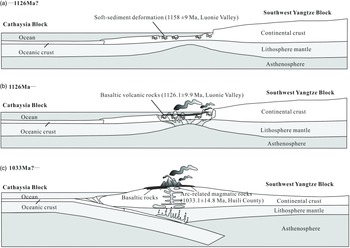
According to the above analysis, it is reasonable to think that the basaltic volcanic rocks are important evidence for the transition from passive to active continental margin before the convergence of Rodinia. At least 1126 Ma or more ahead, the southwest margin of the Yangtze Block was still in the passive continental margin (Fig. 10a). Starting from 1126 Ma, the tectonic setting completely changed; the passive continental margin began to rift apart, causing eruption of the basaltic volcanic rocks of E-type MORB into the littoral–neritic environment (Fig. 10b). A rift stage then developed into an active continental margin, after which island arc-type volcanic rocks of the Tianbaoshan Formation (Huili Group) were formed. The transition may have occurred earlier than 1033 Ma (Fig. 10c). The basaltic volcanic rocks of the Luonie Formation erupted before the convergence of Rodinia, which should represent the onset and transition mechanism of the convergence of the SW Yangtze Block.
Development of the tectonic setting during the late Mesoproterozoic in Dechang area, SW Yangtze Block: (a) the passive continental margin; (b) the rift caused by the eruption of basaltic volcanic rocks. (c) the active margin of the Huili Group.

6. Conclusions
-
1. The basaltic volcanic rocks erupted around 1126.1 ± 9.9 Ma whereas the underlying sedimentary arkose unit was formed not earlier than c. 1158 ± 9 Ma. Here we rename these two units together as the Luonie Formation.
-
2. Lithofacies analysis shows that the basaltic volcanic rocks extruded onto a littoral–neritic environment.
-
3. Lu–Hf isotope data indicate that the magmatic source of the basaltic volcanic rocks was the depleted mantle, following the upwelling of mantle material under an extensional regime. Trace element characteristics further confirm that the basaltic volcanic rocks formed in a destructive plate-margin tectonic setting with E-type MORB properties.
-
4. The basaltic volcanic rocks should represent a rift stage of passive continental margin that preceded the convergence of the SW Yangtze Block to form part of Rodinia. The rift stage then developed into an active continental margin.
Acknowledgements
Biao Song of Beijing SHRIMP Center, Zhian Bao of the Continental Dynamics Laboratory, Northwest University, and other workers are greatly appreciated for their assistance with the analyses. This research was supported by the National Natural Science Foundation of China (Grants Nos. 41902242), Geological Tectonic Division and Comprehensive Integration of Regional Survey of China (Grants Nos. DD20190370) and the Geological Survey Projects Foundation of the Institute of Hydrogeology and Environmental Geology (Grants Nos. DD20190303).
Declaration of interest statement
The authors declare that they have no known competing financial interests or personal relationships that could have appeared to influence the work reported in this paper.