When it comes to the ‘hyper-quantification of global governance’, scholars in Science and Technology Studies argue that certain global public policy agendas have become sufficiently robust in terms of the materialities, interlinkages, actors, processes, and expertise that compose them as to configure epistemic infrastructures.Footnote 1 In this case, the authority of experts is centred on their use and access to quantified data, which provides a sense of urgency and the perception of objectivity, making their knowledge claims authoritative and legitimate. In turn, the authority accorded to such expertise relies on the materialities, processes, and general functioning of the infrastructure and its capacity to continuously exert its role producing quantified knowledge.Footnote 2 Arguably ‘a paradigm shift in global public policy’,Footnote 3 the United Nations (UN) 2030 Agenda (A2030) is one such epistemic infrastructure, aimed at fulfilling 17 Sustainable Development Goals (SDGs) and formed by a multitude of specialized and dedicated bodies, meetings, instruments, and processes oriented towards implementation and monitoring. Within this infrastructure, technology and ‘expert’ techniques are considered essential for the production of data on the implementation and monitoring of the SDGs. When it comes to marginalized communities, however, local tools and processes used for datafication may vary considerably, indicating important epistemological differences in how knowledge gets validated, with considerable political impacts regarding visibility, accountability, and inclusion.
Since being approved in 2015, the structure has become exponentially large, encompassing an increasing number of actors who are external to the UN but who nonetheless are integral to the functioning of the A2030 epistemic infrastructure. For instance, considering that the agenda needs to be implemented at the local and national levels, challenges of scaling up and down public policy design and monitoring mechanisms are frequent and complex.Footnote 4 The UN coined the term ‘localization’ to describe the ‘process of taking into account subnational contexts in the achievement’ of the SDGs, a term that invites discussions on participation and the inclusion of marginalized communities.Footnote 5 This movement can be read as a key example of steps taken by international organizations (IOs) to respond to criticisms posed against their ‘managerial’ logic and related epistemic exclusionary practices.Footnote 6 This article looks at the case of the A2030 as an epistemic infrastructure to analyse the ways in which IOs have attempted to pluralize their expertise by absorbing other forms of (local) knowledge into their knowledge toolkit.
As will be seen, there is simply not enough data on the most vulnerable communities and groups when it comes to the implementation and monitoring of the SDGs. Alternative data sources (also called ‘non-traditional’ or ‘innovative’), such as geospatial data and citizen-generated data (CGD),Footnote 7 have been promoted as important solutions – oftentimes, as in the case of CGD, as an answer to all the reasons why data gaps exist, as by definition CGD tends to address that which was invisible by difficulty or design.Footnote 8 Crucially, however, in this highly datafied field, disputes around improved participation involve both claims that more people be accounted for and that more ways of accounting be authorized.Footnote 9 In this sense, the movement to fill in the data gaps can be more principle-based or technocratic: A principle-based approach improves participation both in terms of accountability and inclusive counting of diverse groups and peoples, and is oriented towards emancipatory ends, as will be discussed. A technocratic approach only includes more people and not necessarily in a participatory way that is attentive to context. While the latter, thus, may lead to increased visibility of some groups, the first tends to also raise important questions about authoritative ways of seeing.Footnote 10
By contrasting such approaches, the goal is to analyse the validation processes – that is, the authority and legitimacy of these different datafying practices, and to explore the possibility of pluralization of expertise in IOs such as the UN. ‘Localization’ is the term used by the UN; however, as will be shown, some local groups choose instead the term ‘territorialization’, understood here as ‘subaltern strategies of localization’,Footnote 11 as they presuppose different epistemic standards. These territory-based knowledge practicesFootnote 12 are consistent with substantiated knowledge that is intrinsically connected with care, community, and the fulfilment of rights as criteria for methodological adequacy.Footnote 13 As these standards defy technocratic validation processes embodied by the UN’s A2030 infrastructure, the only way they can become part of the A2030 epistemic infrastructure is by its technocrats sanitizing, unpacking, and using only parts of them to help further legitimize templates and other tools valued by technocratic knowledge. Care in this analytical frame can be seen as a practice of fighting against political and economic injustices as much as against epistemic injustices,Footnote 14 resisting practices of technocratic disassembling that leave alternative repertoires of knowledge outside.Footnote 15
This article can be read against a broader debate: Development has increasingly become a technocratic field, like many others, having even been called ‘an anti-politics machine’ many years ago.Footnote 16 It is now a heavily quantified and datafied field.Footnote 17 This has raised many questions about the scope and quality of social participation, a concern which is not new to the discussions on technology in generalFootnote 18 but has particular contours when the matters at hand are social issues that affect everyday life, such as those covered by the SDGs – gender violence, sanitation, and so on. Will an increasingly datafied field be more transparent and, thus, more inclusive, by highlighting gaps in public policy, for instance? Or will the technocratic nature of the datafication necessary to navigate this field contribute to further excluding certain groups, who will not be able to frame their questions in the ‘right’ way or get their messages through? At the core of such questions is the possibility of truly pluralizing expertise within those centres of power that concentrate the legitimacy and authority for knowledge production in the field.
The article will look at how alternative data sources are frequently mobilized as part of data disaggregation efforts, itself part of a larger attempt to make the A2030 monitoring mechanisms sufficiently effective as to leave no one behind (LNOB – the A2030’s motto). As part of disaggregation efforts, there have been significant incentives by UN expert bodies to develop or acknowledge new methodologies and standards that provide granular information on gender, race, class, disability, and other issues. Nevertheless, as will be argued, these initiatives often seek to merely fill in the gaps in official data without really absorbing the more emancipatory principles and practices of local, territory-based methodologies. The article illustrates this point by analysing the emphasis placed on technocratic knowledge in the form of templates, checklists, and so on by two UN expert bodies: the Inter-agency and Expert Group on SDG Indicators (IEAG-SDGs) and the High-level Group for Partnership, Coordination and Capacity-Building for Statistics for the 2030 Agenda for Sustainable Development (HLG-PCCB). This emphasis effectively deconflictualizes and, thus, depoliticizes the processes through which localization initiatives of the SDGs are discussed and promoted within the A2030 epistemic infrastructure.Footnote 19
By looking into localization projects in the state of Rio de Janeiro, Brazil, the research shows, in turn, that their main contributions revolve around what community leadership names the ‘activation’ of their territorial networks as they deliver both SDG data and much-needed basic services that are not provisioned by the State. Indeed, those two tend to be delivered together through practices of care and community. This is where actual epistemological challenges to technocratic expertiseFootnote 20 seem to occur, disputing the authorized technocratic forms of knowledge-making by making data not only for monitoring or for action Footnote 21 but also for caring Footnote 22 and for living or making live (as opposed to letting dieFootnote 23). In this sense, the datafying practices that lead to visibility are indissociably related to care and community and, also, intimately linked to citizenship-based demands for service provision – evidence of both emancipatory and epistemological potential.Footnote 24
‘Playing the game’ of datafication reinforces the technocratic nature of the rules, which may generally downplay the more pluralizing potential of these territory-based knowledge practices (besides taking responsibility out of the hands of State authorities). The risk is not ignored by the local groups. This realization, however, is obfuscated by the reality of life-threatening or undignified situations.
Desk reviews of reports and key informant interviews with the leaderships of six territories were conducted to analyse the localization projects, understand their context, priorities, methodologies for data production, challenges, strategies for knowledge-making and visualization, and the common grammar employed. The theoretical and methodological framework deployed mobilizes elements of Maria Puig de la Bellacasa’s work on ‘care’Footnote 25 and a proposition around ‘data-caring’ as an ethico-political intervention,Footnote 26 both generally guided by theoretical contributions from sociologies of quantificationFootnote 27; critical debates on knowledge validation and datafication practicesFootnote 28; critical and feminist data studiesFootnote 29; and critical development studies.Footnote 30 Sociolog(ies) of quantification help understand how technocratic knowledge becomes dominant epistemic practices. Critical and feminist data studies and critical development studies lead to questioning the absence of those whose data are supposed to be made known in the construction of this knowledge, in addition to offering a framework to study knowledge practices that rely on alternative repertoires.Footnote 31
The article concludes that although the promotion of bottom-up methodologies and participatory mechanisms within the A2030 epistemic infrastructure seems a positive sign that development expertise is being pluralized or even decolonized to an extent, this inclusiveness shows signs to involve in fact ‘legible acts of display’.Footnote 32 This means local datafication practices that accompany implementation of the SDGs become ‘an integral part of the technocratic repertoire of knowledge production and expertise’ of IOs such as the UNFootnote 33 and are effectively emptied out of their more emancipatory potential.
Monitoring the implementation of the SDGs: ‘expert’ and local datafication within the A2030
The system responsible for monitoring the implementation of the SDGs within the UN has evolved as frequent evaluations of the A2030 progress indicated the need to increase data production,Footnote 34 refine or elaborate new methodologies, indicators, and standards, and to include a diversity of voices and representations.
The UN counts with a UN Statistics Commission (UNStats), which oversees the UN Statistics Division (UNSD), a Functional Commission of the UN Economic and Social Council.Footnote 35 UNStats is responsible for the IAEG-SDGsFootnote 36 and the HLG-PCCB,Footnote 37 previously cited. Since its approval in 2015, the status of implementation of the A2030 is reported every year during the High-Level Political Forum on Sustainable Development (HLPF) at the UN headquarters. Each year, some of the 17 goals are prioritized, and a few countries come forward to present Voluntary National Reports (VNRs)Footnote 38 on implementation of these SDGs (and any additional others).Footnote 39 It is important to say that when the Agenda was approved, it was not without the knowledge that there was much work to be done to achieve the many ambitious established goals and to monitor action in such diverse themes. The IEAG-SDGs then elaborated a three-tier system to classify SDG indicators according to conceptual clarity, availability of methodology and standards, and existence of data.Footnote 40 Today, the framework does not contain any remaining Tier III indicators, which means all indicators are conceptually clear and count with established methodologies and standards. That said, for 60 indicators in Tier II, the ‘system’ judges that not enough data are regularly produced.Footnote 41
The SDGs are meant to be achieved at global, national, and subnational levels. Implementation of goals on diverse themes, such as gender, peace, and water, offers a multi-dimensional challenge, and data production on their implementation also requires a somewhat polycentric governance.Footnote 42 Therefore, the UN’s notion of localization refers both to ‘how the SDGs can provide a framework for local development policy and to how local and regional governments can support the achievement of the SDGs through action from the bottom up’.Footnote 43 The notion seeks to encapsulate at least in part the need for mutual learning between IOs and local communities.
Moreover, ‘many of the investments to achieve the SDGs will take place at the subnational level and be led by local authorities’.Footnote 44 The UN expert bodies rely on national statistics offices (NSOs) to provide official and administrative data, but as seen, these are often insufficient, especially when it comes to the realities of those in vulnerable situations.Footnote 45 This has led to national and subnational adaptation of targets and development of indicators and methodologies that are more context-appropriate, which in turn often brings to the fore issues of international data standards, epistemic authority, and legitimacy.
The case of Brazil exemplifies the complexity of the landscape of data produced on the SDGs. Brazil was active in the Open Working Group that led to the proposal of the SDGs and was soon, in 2017, the first country to establish a National Commission on the SDGs, with a diverse composition. The Institute of Applied Economic Research (Ipea) and the Brazilian Institute of Geography and Statistics (IBGE) were tasked, respectively, with adapting targets and developing methodologies and indicators. As a result, ‘39 targets maintained the original wording, two were considered not applicable to Brazil, 128 adapted to the Brazilian reality, and eight new targets were proposed’, increasing the UN’s original 169 targets to 175.Footnote 46 This collaborative process is part of an SDGs datascape, marked by a ‘fluidity of perspectives’ in which ‘-scape means there are not only diverse actors involved in data production and analysis but also that the way knowledge is constructed and mobilized for action varies enormously’.Footnote 47
In recent years, Brazil faced the challenge of changing governments and, with that, switching political directions often abruptly, including (and especially) on global agendas that can be considered progressive, such as the A2030. From the impeachment in 2016 of former President Dilma Rousseff from the Workers Party (she signed the Agenda in 2015), to the provisional government of her former Vice-President, Michel Temer, and the subsequent government of conservative Jair Bolsonaro, which ended in 2022, civil society in Brazil provided a well-recognized resistance front, keeping the SDGs afloat and fighting for their implementation in marginalized communities and municipalities.Footnote 48 For most members of the civil society, it was not about the UN A2030 per se; it was just that the SDGs mirrored the basic rights established in the Brazilian Federal Constitution.Footnote 49 The Civil Society Working Group for the 2030 Agenda (GTSCA2030) is a case in point: The civil society network has been responsible for publishing the Spotlight Reports on the SDGs annually since 2017, providing an important historical series, reaching out to and reflecting work conducted in the territories.Footnote 50
In Brazil, the term ‘territorialization’ has been used by many in civil society as a synonym of localization of the SDGs.Footnote 51 That use is guided both by the influence of decolonial literature and by the strength of civil society engagement with SDGs implementation in Brazil.Footnote 52 The concept of ‘territory’ has important roots in the work of national and other Latin American authors in Critical Geography and related fields. It is mobilized, for instance, as part of what is called ‘territorial development’, an approach within Development Studies.Footnote 53 As Haesbaert argues, the concept of territory in the Latin American decolonial tradition, even in contrast with other critical views – for instance, Foucaultian – has a distinction in that it emphasizes economic-disciplinary relations of power in the space, but it also focuses on a ‘symbolic and modern-colonial power’, looking at the ‘territorial dynamics of subaltern resistance’.Footnote 54 As such, the territory can be understood in ‘a continuum between hegemonic domination and appropriation and subaltern resistance, between a more functional and/or repressive power and more symbolic and/or autonomist power’.Footnote 55 Moreover, ‘territory’ seems to offer the possibility of an alternative ‘articulatory discourse’Footnote 56 that is place-based, departing from experience and embodied knowledge, therefore, valuing knowledge practices that are accountable to the realities of communities.
The territory is the appropriated space that is relationally, historically, and socially constructed – regardless of its juridical status.Footnote 57 In that way, claims advanced in the context of localization projects in Rio de Janeiro are exemplary of the understanding that the local is more than a geographical space; it is the territory:
Many residents are invisible in the process of forming their own territory. Since the territory is the space for constructing identities, it makes no sense not to allow men, women, young people, children and the elderly to be the main subjects of the development of their localities.Footnote 58
Civil society in Brazil departs from the ‘territory’ and the critical grammar that surrounds the notion of territorialization to build alternative practices of datafication and elaborate their own territorialized lists of priority targets within the general context of the SDGs.Footnote 59
A territorialized concept of development presupposes both a multi-dimensional and multi-scalar concept of territory, as well as the principle that all development is territorial or all development is always territorialized.Footnote 60 In addition, we can say a territorial concept of development is coherent with a local perspective on data, after all, as suggested by some researchers in critical data studies, ‘wherever data are used, local communities of producers, users, and even nonusers are affected’.Footnote 61 Therefore, all data are local.Footnote 62 This is a truth well known by community groups, NGOs, social movements, and other ‘collectives’ (how some of them self-identify) working to territorialize the SDGs in Brazil, especially against the background of what many denounced as a ‘data blackout’, when even the national census was delayed.Footnote 63 That is why a major NGO in the city of Rio de Janeiro, Casa Fluminense, initiated a cycle of courses to form leaderships on public policy design and monitoring and then launched a call, backed by external funding (Fundo Casa Fluminense or simply ‘Fundo Casa’), to support the development of local A2030s in the most vulnerable municipalities and communities of the state of Rio de Janeiro.Footnote 64
The assumptions behind these initiatives, as analysed ahead, were precisely that local data production and territorial development walk hand in hand. Moreover, local leaderships are the true experts on both fronts, for their situated lived experiences of the local problems, their interest and investment in addressing them, their connections to diverse actors who are important for the development of the territory, and their willingness to care even when unjustly not compensated for their work.
This article argues that data produced through their leadership and the advocacy that accompanies them reflect crucial epistemological challenges to ‘technocratic’ IO expertise.Footnote 65 Nevertheless, when any part of the lessons produced through these practices reverberates within the UN expert bodies, this tends to translate into ‘carefully orchestrated performances and [become] an integral part of the global technocratic repertoire’.Footnote 66 That is, it tends to perhaps authorize knowledge otherwise,Footnote 67 if that much, but it does not seem to authorize other knowledges.
Methodology
In order to explore that argument and following feminist and critical data studies that emphasize the importance of place, context and experience,Footnote 68 the research compares the ways these alternative data practices, in the form of localization/territorialization initiatives, are promoted within and by the referred UN expert bodies – IEAG-SDGs, HLG-PCCB, and more broadly, the UNSD and UNStats – with the ways another if not ‘alternative’, complementary data practice has been promoted within and by the same bodies: data disaggregation. Data disaggregation would be a step towards producing better databases, but the reality is that disaggregation is still so incipient as to have become a complementary approach. Data disaggregation promotion touches upon possibilities such as CGD, an important example of bottom-up methodology, but does so within the containing limits of ‘technocratic expertise’. That is, it is as if knowledge is based on a ‘view from nowhere’.Footnote 69
For that comparison, the research focuses on IEAG-SDG’s Working Group on data disaggregation, of which Brazil is a member. Data disaggregation is a key part of the Work Program of IEAGFootnote 70 and is understood to be one of the main challenges within A2030, in technical and political terms. There is, crucially, according to the UN body, a ‘[c]onflict between data availability, commonly used or required categories and harmonized, internationally comparable standards’.Footnote 71 According to estimates, data collection for the implementation of the SDGs would need to be disaggregated in 84 dimensions for ‘minimum’ disaggregation, which would cover dimensions stated in the targets and the corresponding indicators. Therefore, the challenges range from technical difficulties to the fact that certain types of disaggregation are prohibited in some countries, and that some political decisions are required as well.Footnote 72
The research proceeds to compare these practices with localization projects in the state of Rio de Janeiro, Brazil. I conducted interviews with at least one leadership member from six local agendas, according to the following criteria: they have attended courses and events in Casa Fluminense about A2030, and they are currently working on data collection and dissemination regarding the SDGs in the context of the localization projects led by their collectives. The interviews were semi-structured, conducted over two months in 2025; they did not cover any sensitive issues that would place these individuals under any risk within or outside their communities, but anonymity was preferred. Each collective leading such efforts is identifiable as the main author in the published local agendas. The goal was to build a profile of some of the leaders taking up these initiatives and to understand their role and the role of their collectives within their respective communities. Two of these collectives are led by men; four are led by women, but five of them have a majority of women in their composition, which oscillates. Only two are led by people over 30 years old. I am not personally engaged with any of the local initiatives and came into contact with the collectives either via the snowball sampling method or through details publicly provided online. The fact that I had previously conducted a research project along similar lines offered relevant context for the first contact. The current research is still in progress.
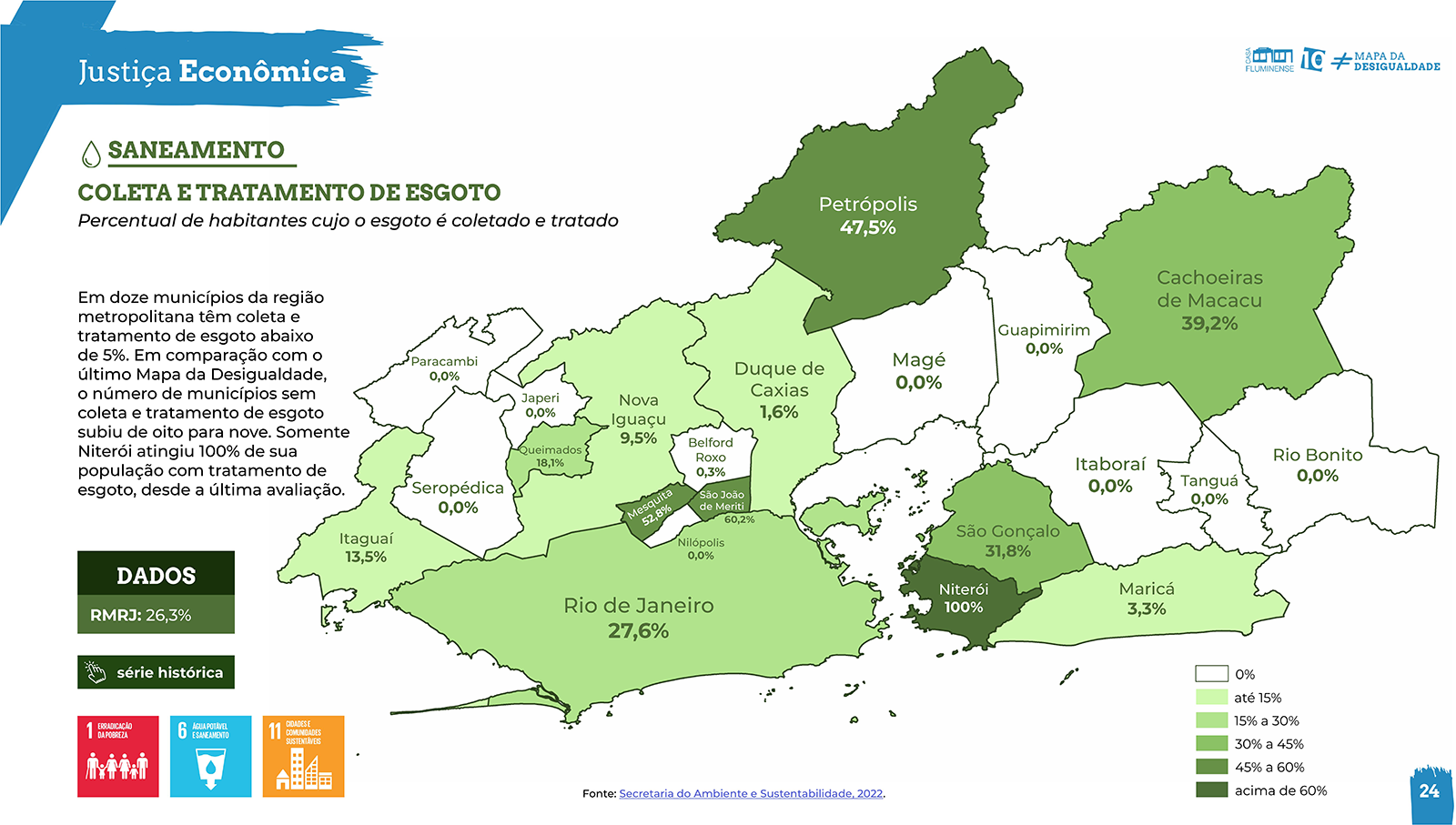
The territories covered were Belford Roxo, Japeri, Magé, Realengo, Rio das Pedras, and São Gonçalo, of which four are municipalities, one is a neighbourhood, and the other a favela in the city of Rio de Janeiro (see Figure 1).Footnote 73 This diversity was important so that different territorial approaches to development might arise.
Map that composes the Inequality Map of 2023, produced by Casa Fluminense. It depicts the reality of sanitation in the Metropolitan Area of Rio de Janeiro.

The research was guided by the following main questions, based on critical debates on epistemology, knowledge practices, and datafication: How do communities know things in common?Footnote 74 How is this knowledge ‘validated’ and by whom?Footnote 75 In this case, specifically, do the UN expert bodies we are looking at access, learn from, or with these knowledge practices? Do they authorize them or are further authorized by them – to what extent or how? Based on previous research, one assumption was that care was at the basis of the construction of these local agendas, precisely as a work of construction, that is, as a practice of community-building,Footnote 76 making knowledge inclusive.Footnote 77 This contrasts with the UN’s ‘expert’ approach to data disaggregation, as we begin to see next.
Data disaggregation and inclusion: technocracy and a ‘view from nowhere’
The IEAG-SDGs has been commissioned by the UN to develop the necessary statistical standards, tools, and capacity on disaggregated data to monitor implementation of the SDGs and make sure ‘no one is left behind’ – the A2030’s motto. Without disaggregated data, many are and will remain invisible to policymakers.
Hundreds of millions of people across the world are uncounted: the poorest 20% of the global population account for 55% of unregistered births. Marginalized people are being left behind because data used for decision making doesn’t include them. Some data collection methods are biased and may entirely miss marginalized groups, for instance homeless people are unlikely to be reached through household surveys. In other cases, data is not disaggregated to identify sub-groups’ needs and national averages mask the challenges facing specific population groups.Footnote 78
The Global SDG indicator framework includes an overarching principle of data disaggregation, evidenced in the final list of proposed SDG indicators: ‘Sustainable Development Goal indicators should be disaggregated, where relevant, by income, sex, age, race, ethnicity, migratory status, disability and geographic location, or other characteristics, in accordance with the Fundamental Principles of Official Statistics’.Footnote 79 Thus, the IEAG-SDGs created a dedicated work stream and, in 2018, the group prepared a background document that would cover both a ‘comprehensive compilation of all currently available data disaggregates for all indicators and future plans that custodian agencies have for additional data disaggregation’ and ‘the identification of the policy priorities of different vulnerable population groups to advice on future focus of data disaggregation’.Footnote 80 Through 2018 and 2019, the group then proceeded to consult with UN custodian agencies and other major groups and international agencies. Through these consultations, the IAEG-SDGs outlined that the term dimensions would refer to the characteristics by which data are disaggregated (such as age, sex, disability, etc.), and categories would refer to the different characteristics under a certain disaggregation dimension (such as male/female under the sex dimension, etc.). The main goal was to develop a minimum disaggregation set.
The table developed as part of that outline document – presented as work in progress – shows a notably low number of existing global standards for most of the dimensions, although (or rather, ‘and’) the preamble acknowledges the document ‘only contains the European perspective, however it is open for further input’.Footnote 81 This reflects the general diagnosis that, while the A2030 requires disaggregated data, ‘few national Sustainable Development reports submitted to the High Level Political Forum have disaggregated data by any dimension’. Moreover, ‘[m]any organizations and governments lack the knowledge and capacity on how to generate and use inclusive and disaggregated data, and best practices are often siloed within sectors’.Footnote 82
For example, under the dimension ‘race’ on the IEAG-SDG document’s table, no categories were listed as used in the Global Indicator Framework, as of 2018. ‘Data is not disaggregated by race’, it says simply. There are no global standards, ‘possibly due to varying national circumstances’, and under ‘Existing regional standards’, the EU-Standard offers only ‘SDG data is not disaggregated by race’.Footnote 83
Against that background, in 2020, the IEAG-SDGs ran a questionnaire with UN agencies and expert groups, international expert groups, and committees, focusing on specific population groups, disaggregation dimensions, and data collection methods, the goal being to later provide countries with a resource platform on data disaggregation for SDGs.Footnote 84 Of the agencies and groups consulted, the cohort of UN bodies selected for the purpose of this research features only twice: Social and Gender Statistics Section, UNSD: Secretariat of the IAEG-Gender Statistics, and Expert Group on Time-Use Statistics; and Secretariat of the Expert Group on Migration Statistics. Under neither of them do the tools recommended divert from the ‘technocratic expertise’ expected from such sources. For instance, as guidance material, the recommended Guide to Producing Statistics on Time Use: Measuring Paid and Unpaid Work is a 400-page-long document outlining the state of the art when it comes to statistical procedures and standards. The technical nature of the arrangement of its chapters and sections – on design specifications, sample designs, and so on – places it comfortably within the category of ‘highly specialized knowledge’.Footnote 85
Here, it is important to point out that the same guidance material produced by the IEAG-SDGs’ work stream on data disaggregation has a shorter section dedicated to presenting ‘tools and guidance for using different data sources in collecting disaggregated data’.Footnote 86 Four such sources are listed: sample surveys, CGD, administrative data and populations, and housing censuses. Therefore, a bottom-up, essentially participatory methodology, CGD, is among those featured as a relevant source for disaggregated data.
The UN groups engaging with CGD that responded to the IEAG-SDGs questionnaire were only UN-Habitat, Food and Agriculture Organization (FAO), Office of the United Nations High Commissioner for Human Rights (OHCHR), and the Stakeholder Group of Persons with Disabilities (SGPwD). The UN website reports that UN-Habitat collects data using mobile-based apps ‘on the communities and with the communities’; FAO is ‘disseminating crowdsourced consumer prices of 14 main food products in all countries and the average price change for each product’; OHCHR incentivizes ‘the use of official survey questionnaires in data collection carried out by relevant civil society organizations (CSOs) or integration of data produced by community-based mechanisms in official statistics’; and SGPwD collaborates with International Civil Society Centre in the LNOB Partnership Project ‘that gathers community-driven data from marginalized groups to fill data gaps in SDG monitoring’.Footnote 87 While the UN-Habitat case offers no further details, FAO’s is very specific and limited, OHCHR provides more of a recommendation than a set of practices, and it is only SGPwD that thoroughly describes how it engages with CGD. Nevertheless, for each of them, information provided is divided between ‘Data collection methods’ and ‘Quality assessment procedures/methods’, and under the latter, SGPwD states ‘[t]his research [the LNOB Partnership Project] was conducted inclusively with target groups involved in the production of data and were involved in dialogues and workshops’.Footnote 88
Although further research would be needed for a more detailed analysis, we can say the phrasing signals a contrast between a technocratic understanding of inclusion (pertaining to a politics of standardized inclusiveness) that still conceives of the community as ‘targets’ and that of the territorialization approaches described in the next section, which lead to the elaboration of the local A2030s in the state of Rio de Janeiro. In the first case, inclusion seems to be translated into practices such as ‘involving’ the community in dialogues and workshops, while in the second case, inclusion is an ontological reality, and there is only knowledge to the extent that there is community.Footnote 89
As will be argued, territorialization initiatives, in general, rely much on affective engagement, first-hand embodied lived experience, care, unpaid feminine labour, and a plurality of knowledges.Footnote 90 And while their political potential is immense, their technical contributions are either not considered good enough or are not even known as to be absorbed by NSOs and reported back to UN bodies (or mentioned directly by them through varied initiatives), or they feature as well-rehearsed checklists and established performances that help legitimize what are meant to be participatory and inclusive processes, devoid of their politically charged components.
Local A2030s and the ‘activation’ of networks of care
The A2030 emphasizes the importance of ensuring ‘responsive, inclusive, participatory and representative decision-making at all levels’ (Target 16.7). Overall, it has presented itself, since its inception, as a much more inclusive global agenda, as compared to the Millennium Development Goals, for instance. Some see a ‘re-politicization of quantification – the discourses of democratization, participation, and bottom-up country buy-in’ indicating a major change in that sense.Footnote 91 Nonetheless, there have always been conflicting pressures whereby there is an increasing multiplicity of datafying experts, while at the same time, there is a push to standardize and harmonize expert datafication.Footnote 92 The territorialization of the A2030 illustrates these conflicts well, bringing to the fore what we can call a new politics of standardized inclusivity, with the dilemmas and potentialities that accompany a pluralization of expertise.Footnote 93
In the state of Rio de Janeiro, the localization – hereafter, territorialization – of the SDGs has been greatly advanced through the work of the NGO Casa Fluminense, which supported the development of several local A2030s in diverse marginalized areas of the state. I analysed these agendas and interviewed some of the leaders of six of these initiatives. As mentioned, Casa Fluminense organized a series of cycles to inform community leaders about the design and implementation of public policies. Certain leaders were directly invited to take part in the courses because of their well-known work to advance rights and the delivery of basic services within their communities. All the collectives led by those who were interviewed engaged with these courses, so that either the individuals I spoke to took the courses themselves or some of their colleagues did and passed the knowledge along. Indeed, the goal of the public policy courses was that attendees would act as multipliers and form new cohorts of leaders.Footnote 94 The fact that they had the courses and Casa Fluminense itself in common meant they got to know each other, and this was crucial for the sharing of practices and experiences that would lead to the local agendas. When Casa Fluminense launched a call for proposals to fund local A2030s, submissions were led by those same individuals and collectives.
The six local agendas – Belford Roxo, Japeri, Magé, Realengo, Rio das Pedras, and São Gonçalo – will be presented according to the following structure: leadership and collective identification; territory-based methodologies and knowledge practices; follow-up issues; and community perspective.Footnote 95
Leadership and collective identification
E.S.,Footnote 96 from Rio das Pedras, the only favela among the territories covered, says she was already employing her degree in Biology elsewhere, and this was an opportunity to apply knowledge in her own territory. R.,Footnote 97 from the municipality of São Gonçalo, states the same about himself and the other young people who participate in his collective, who he says ‘used to study outside the territory but never look within, and now have the possibility to do so collectively’. Most of them study Social Sciences and are passionate about popular education. Similarly, in the case of E.S., she started dedicating a great amount of her time to activities of environmental education at Rio das Pedras, alongside her formal work elsewhere, and she combined this with her role leading the elaboration of the local A2030. In fact, each leadership and their respective collectives imprinted their profile on the local Agenda, which then tends to feature not only local priorities according to each context and its vulnerabilities, but also the individual trajectories of territorial engagement and dedicated expertise of the leaderships involved, in turn adapted and applied in unique ways. P.,Footnote 98 from Japeri, for instance, led an initiative concerned with mobility and that became the focus of their local agenda. Being a farmer and part of a collective of farmers, in her experience, the lack of circulation of people and goods within Japeri and between Japeri and other localities kept the municipality from developing any further. D.,Footnote 99 in turn, is from Belford Roxo, the municipality that ranks the worst in social and economic indicators, for which reason I want to detail her profile a little further.
The challenges are immense and distributed everywhere in Belford Roxo; thus, D.’s trajectory is perhaps more multifaceted. She says she started mobilizing during the pandemic when she realized thousands of people around her were starving, and the politicians who had the means to distribute ‘cestas básicas’ (‘food baskets’, with basic items) would do so in exchange for votes. She says it was a neighbour, a woman, who finally made her leave home during lockdown, when she called to ask what the document was that she needed to prove that her work was ‘essential to live’, so she could go out to work. The woman was a cleaner and had to feed her five children, living, after all, in a municipality where many inhabitants spend 33% of their income on transportation alone in order to find work elsewhere.Footnote 100 D. said that explaining to this woman that her work was not essential when her children would starve was a turning point for her activism. The keyword throughout Belford Roxo’s agenda is ‘justice’ in its different dimensions – economic, social, racial, gender, and climate, borrowing from Casa Fluminense’s ‘Agenda Rio 2030’, which is revised every two years and forms the basis for most local agendas.Footnote 101
In Magé, Ra., A.C., and A.V.Footnote 102 spoke to me as a team, having always worked together. They founded a collective concerned with the loss of green areas in the municipality, even though neither of them had technical expertise in environmental engineering or other similar domains. They started organizing fairs and helping local producers sell their goods and slowly became a reference for environmental activism in the area. Their local agenda has a stronger focus on sanitation.
Notably, most of these leaderships and groups are women, hence the importance of mobilizing feminist data studies as well as other critical contributions, to counter invisibilization and to emphasize and analyse practices of care. In two of these territories, I spoke with men, but even then, they themselves acknowledged that much of their work in building the local agenda was made possible by the leadership of many women occupying other places in their networks. In the other territories, my interlocutors were all women who worked, in turn, with a majority of women. Of the 61 people working at D.’s NGO in Belford Roxo, by far the biggest group among those contacted, only 7 are men.Footnote 103 It is important to point out that all the other collectives are actually rather small, often counting with three or four people only (a number that is multiplied each time the network is ‘activated’, as will be seen).
Moreover, they all perform unpaid work of care when it comes to most of what they do for their territory, including building the local A2030s,Footnote 104 since the funding from Casa Fluminense cannot possibly remunerate all these individuals. Everyone I spoke to has another job, and in fact, only for that reason was able to perform voluntary work. E.S. says: ‘Women are the ones most engaged. But we don’t get any income, only more work’.
Territory-based methodologies and knowledge practices
When it comes to the methodology employed in the construction of the local agendas, Casa Fluminense provided important foundations with the courses it offered to the local leadership and also by publishing the ‘Agenda Rio 2030’, which established SDG axes based on the idea of justice: racial, gender, climate, and economic. It has also published the Inequality Map since 2017, which has since 2023 turned into an interactive platform. It shows georeferenced data on the inequalities that permeate the Metropolitan Area of Rio de Janeiro, composed of the capital city and other 21 surrounding municipalities (Figure 1).Footnote 105 The maps are the result of consultation of public databases, in addition to partnerships with organizations that produce CGD. The maps cover several important indicators, so they are not dedicated to monitoring implementation of the SDGs per se. Nevertheless, they offer a rich overview of the socioeconomic realities of the region.
All local agendas began with these two forms of support provided by Casa Fluminense and adapted to the realities of their own territories and networks. In Rio das Pedras, whose agenda was published in 2024,Footnote 106 the local collective organized workshops in different areas to discuss priorities, using pre-existing local documents. The workshops were established as a circle of conversation, with the exception of one, which had to be turned into a tour of the nearby (polluted) lagoon, because there was ongoing conflict in the area. ‘The general goal was to walk through the territory, listen to the people inhabiting it and build a collective understanding’, E. S. says, ‘We thought about how they would feel, to be listened to where they live’. She explains that the workshops were not completely unscripted but departed from the problems ‘they all knew’ existed in the territory. Another activity was organized in a community school, where a ‘map of dreams’ was drawn to brainstorm on what changes were needed. E.S. says they always started every activity by explaining what the UN and the SDGs were, ‘since, even for those who know them, the global agenda and the local agenda may look very different’. A survey was also conducted with the help of academics. The agenda itself was then written collectively by 10 people.
R. reports a similar methodology for ‘Agenda São Gonçalo’, published in 2021.Footnote 107 Inspired by ‘Agenda Rio 2030’, they created the Dialogues 2030, travelling the territory and promoting encounters between groups that performed complementary work, he explains, but had not been in touch until then. In fact, part of the goal was precisely to uncover the potential in the territory, communicating possibilities and unmaking the stereotype of a ‘dormitory city’. R. says: ‘We discovered São Gonçalo had a rural area, for instance. We didn’t know that, and it was actually beautiful’. A second edition was published in 2022. In that version, the collective decided the agenda would prioritize three themes: food security and sovereignty, female entrepreneurship, and popular education. If in 2021, security concerns were at the forefront, this changed in the second edition, as they listened to the people. R. explains: ‘Active listening and popular participation were our main methods’.
Japeri published its agenda in 2021 as well.Footnote 108 Local priorities were established through courses organized by the same leadership that attended the courses in Casa Fluminense and wanted to pass knowledge forward and involve other groups. The collective held in-person and virtual meetings on average every two weeks, ‘and we had to be realistic’, P. says, ‘we couldn’t try to have too many goals, because what would be the point of having a goal of which none of us there could actually speak comfortably?’ They created Google Docs and worked collectively on the drafts. She explains further: ‘If we could not develop an adequate proposal, then we would discard, because it needed to be concrete, feasible’.
Most of these processes had an average duration of a couple of months. Elaborating those agendas had to involve a speedy construction, as the deadlines were short, as was the time of those volunteering for this work.
In Magé, whose agenda was also released in 2021,Footnote 109 the collective first circulated a survey based on the Inequality Map of Casa Fluminense: ‘Our goals were really to listen and get people’s own sense of the problems they face in the territory, in their own words. We never conduct any activity with our collective without actively listening to people’, Ra. explains. ‘Our assumption is that the local 2030 agenda serves as an interlocutor with all who are looking at the community’, A.V. adds. And A.C. remarks: ‘It was crucial that the agenda was accessible, that people could have ownership to address their problems, question their reality’. They explain they managed to get enough people to answer the survey due to their collective’s existing network: ‘Everyone here is someone’s son. We know everyone’.
D., in turn, tells of how, in Belford Roxo, the local agenda was built in the context of ‘data blackout’, that existent public official data were overestimated and the problems were much worse. ‘Our goal was mainly to provide visibility, because we here, we don’t exist. So we need to be together, we need to aquilombar’ (from ‘quilombo’, the term for a settlement historically founded by former enslaved people), D. defends. She goes further to say the only numbers that do exist about sanitation, for instance, an area in which Belford Roxo features as the fifth worst-ranked municipality in the country, are federal-level data. ‘We wanted to show it’s possible to do things differently. After all, we can’t just feel the pain, we have to do something about it. And we can act through our territorial identity’. ‘Doing things differently’, the collective built their local agenda through weekly meetings, which at the beginning counted with up to 40 leadership figures, and where transversal themes were discussed. A survey was not possible, however, due to time constraints, but she explains the main objective was to help local leadership appropriate data such as that featured in the Inequality Map, to help do the work they were already leading.
Realengo just recently finalized the second edition of its local agenda (not available online). The first was published in 2022.Footnote 110 L.Footnote 111 explains that the collective involved in constructing the agendas already had much experience advocating for the preservation of a major park, Realengo Park, as the one green area in the neighbourhood, essential for its environment. Their team is formed by professionals from different areas as well, so their position seems to be perhaps slightly more advantageous in general than that of other collectives. Nonetheless, their advocacy is strongly committed to the territory, and their work is voluntary, as with the others. Their focus has been on the right to the city. The first edition focused on approving the establishment of the park by law. Since this was achieved, even if with limitations, the second edition showcases this success but also amplifies the scope of the targets. First, the collective organized a series of discussions, guided always by one academic and one person from a social movement about one specific topic. In that, they also decided to follow ‘Agenda Rio 2030’ and focus on a few priorities. For the second edition, there were fewer resources and only a survey was conducted, ‘but we don’t do anything without listening to people, so we wanted to do the survey’, and they got 240 respondents. They also take pride in having offered the first agenda with mappings in 2022.
Follow-up issues
The collectives faced some common challenges when developing their respective local agendas, as shared in the conversations held. One involved dissemination, since resources, including printing, were limited, but mostly they needed to move forward to other commitments once the agenda was done. For most of them, it was clear from the start that the local agendas were never meant to do work like the UN does: ‘We never felt a pressure to follow up, monitor implementation and so on. We wouldn’t even be able to do that. It was always about people owning these problems, their realities’, Ra. says. ‘We know we have generated impact because some of the secretariats in the municipalities tell us, but they don’t say that to society in general. So no, people wouldn’t know and we can’t show we have had impact’. Many of them also shared the frustration with the feeling that by ‘playing the game’, in a way, they contribute to somewhat relieving the State of its responsibilities and reinforcing a logic of knowledge production that might not benefit them in the end. For most, it is about using the agendas as an opportunity to generate visibility not only to the problems their communities face but to their communities altogether, as D. affirms. R. says taking their agenda to a public audience at the end of Dialogues 2030 was an achievement in that sense.
Therefore, be it because it would not have been feasible in any case, be it because it would not be desirable, the local agendas were not designed to be monitoring mechanisms. They are less a source of alternative SDGs data, as per global standards, than a manifestation of unfulfilled rights and public services, with related targets and preferred pathways. As will be further elaborated ahead, however, it is precisely that fact that configures a source of data itself and that could feed alternative practices of knowledge authorization into the A2030 epistemic infrastructure. The reason is that this fact indicates the validation processes in place and that territory-based approaches to data in this context are geared towards care, community, and access to rights.
Community perspectives
An expression that was recurrent in these conversations and appeared in a few of the documents, including in Casa Fluminense’s ‘Manual for Local Agendas’, is ‘to activate a network’.Footnote 112
What would be the “activation” of a network? Remember that we talked about developing active listening with a plurality of people, with different experiences, perspectives, knowledge and affective and historical relationships with the space discussed in the Local Agenda? Once in contact with this plurality of people, groups, movements and collectives, one can imagine the construction of a knowledge exchange network, a network capable of building the agenda and making it more than just a piece of paper, but rather a tool for social transformation and planning public policies.Footnote 113
Probably coming out of the courses attended by most of the leadership, the expression entered the common vocabulary of these groups, hence, of the local A2030s. What goes into ‘activation’ are the notions of an affective relationship or identification with the territory, and the way first-hand lived experiences and historical relationships with the territory produce and authorize certain kinds of knowledge. Moreover, active listening, an essential part of activation, presupposes getting in touch with a plurality of perspectives while at the same time relating to the people on a territorial basis, according to the definition of territory discussed so far. This is crucial for the kind of mobilization required of these leaders and groups.
R., from São Gonçalo, says that ‘strengthening networks is what we can do, at the end of the day’: ‘What we do, our collective, is that we pull people together; we don’t do anything alone’. Similarly, Ra., from Magé, points out: ‘We are always building bridges, all the time’. Additionally, D., from Belford Roxo, states: ‘We have to work together, because we have to do a lot with very little; we have to be inventive, creative, resilient’. And L., from Realengo, says: ‘We had all this experience in place already, of occupying, of organizing petitions’.
***
The Inequality Map became the basis for all local agendas, not only due to the lack of data on marginalized populations in general, but because it addressed the very inequalities experienced by these populations. The local agendas became acknowledged as worth the unpaid time dedicated to their construction, even if commitments to traditional follow-ups were never present because they were built as other forms of knowledge, ones that serve to confer visibility to invisible groups and to offer a common language to engage potential interlocutors looking at these overlooked territories.
In order to reach places where public services are not delivered and the State is generally not present – and in order to produce knowledge about realities when there are no available data – whatever is achieved is done by leveraging the care work and community-building practices that already exist on the ground, as will be further developed ahead. Furthermore, knowledge produced alongside these practices is made authoritative within the living contexts of these territories precisely because it manages to care and include. Care here is understood, thus, as a ‘concrete work of maintenance with ethical and affective implications’.Footnote 114
Analysis: on IOs and the possibility of a pluralization of knowledges
There is indeed a stark contrast between what is considered inclusive knowledge practices within the context of the Agenda’s territorialization and in the A2030 epistemic infrastructure. The Inequality Map, the basis of all local agendas, was constructed in part with CGD: All methodologies developed to build the local agendas initiated with collective and active listening and taking into account the authority of those who hold an affective identification with the territory. Certain UN expert groups have moved to expand the scope of practices that may authorize knowledge production about the SDGs, indeed increasing the number of data sources considered legitimate, for instance. It seems the use made of them, though, is still guided by the same technocratic expertise generally pervasive in IOs. If the inclusion of extra sources is meant to signify inclusion of a diversity of voices by way of ‘involvement’ of ‘targets’ in workshops and consultations, there is little room for authorizing other knowledges, much less true epistemological change.
Of course, CGD is but one example of a participatory methodology and, as we have seen, it is not the only alternative data source incentivized by UN bodies for monitoring SDG implementation. As a proxy, however, it serves well to depict how IOs deal with claims that are supposed to complement claims of objectivity, impartiality, and neutrality attributed to their technocratic expertise. In this case, a claim to make knowledge more inclusive. It also serves to provide an analytical entry point for the territory-based knowledge practices taking place in the localization of the A2030.
In the broader field of Citizen Science (CS) – which refers to the active contribution of the general public in scientific research through their intellectual effort, knowledge, tools, or resources, citizens contribute to the ‘co-creation of a new scientific culture’.Footnote 115 In this context, CGD is one method of CS, since it can be defined as datafication conducted collectively, serving both activist and objective purposes, openly available to the public, and with users understanding the data’s purpose.Footnote 116 CS and CGD are usually praised for balancing the downsides of official data collection, as ‘official data are often epistemically ill-suited to capture contextual information and local knowledge’.Footnote 117 CGD initiatives are seen to generate more specific and accurate information, calling attention to the issues usually overlooked or even unnoticed by marginalized populations.Footnote 118
In UN mainstream documents, CGD is usually mentioned as a methodology capable of ‘filling the gaps’ of official data within the infrastructure of the A2030, thus, a means of populating ‘official knowledge assemblages’.Footnote 119 On the ground, in turn, CGD appears as one kind of participatory methodology that can support the implementation of the SDGs by localizing global goals. While CGD is theoretically valued for its capacity to produce data about groups that have been so far invisible, it is also often seen by IO experts as ‘not good enough’ or ‘scientific enough’ and requiring too much input in the form of capacity-building for their results to be scalable.
The technical aspects of the methodology are pointed out in expert reports as grave obstacles to its widespread use. Some cite ‘issues such as an inherent lack of trust in CGD, as well as (in some cases) inconsistent adherence to best practices for data management’.Footnote 120 Thus, CGD, we could argue, would be only as good as (1) its participatory methods and the data collected served to complement official data, not to counter them; and (2) when it follows international (expert) standardized procedures for collections and analysis. The need for accuracy is hardly debatable, but to the extent official data often also present failures, gaps, and inadequate reporting, it appears CGD’s said weaknesses are not a necessary or particular truth.
Nevertheless, it seems bottom-up approaches in general are usually unpacked within the A2030 epistemic infrastructure, the more emancipatory or politically charged elements are discarded, and the bits of them that can be administered in a technocratic manner are absorbed and ‘manualized’; that is, they become established steps of manuals and other guidance material in the overall technical repertoire. This usually takes the following form: by making territory-based approaches at the most complementary to official, technocratic expertise, and depriving them of their more radical content, which resides precisely in the irrevocable association with care and its components of relationality, community-building, and solidarity. Care, in this context, translates into making sure knowledge practices are also themselves conducive to a more cohesive and just environment: ‘Quality participation, we argue, involves primarily maintaining context, which is a work of care’.Footnote 121
Concluding thoughts
Making marginalized groups visible is indisputably important, but exactly because this truth is easy to acknowledge, it has also become easy to transform visibility into the very definition of inclusion. Territory-based approaches as forms of participatory methodologies, however, have the potential to enlarge scientific sensitivity beyond the realms of results to the social processes that help build more just relations along with them, making embodied experiences of community matter. What is lacking is the ability to move further from the ‘filling the gaps’ rationality.
In this context, there is potential in investigating what possibilities there are for such ‘civic epistemologies’,Footnote 122 specifically in the form of participatory territory-based knowledge practices, to retain more of their emancipatory tones. Civic epistemologies, as ‘culturally-specific knowledge-ways’, require being framed along with all their epistemic heterodox views as legitimate among ‘the institutionalized practices by which members of a given society test and deploy knowledge claims used as a basis for making collective choices’.Footnote 123 Of relevance to take us further here, Jasanoff’s understanding of the public is of an epistemically active nature, referring to knowing things in public and forming collective sense of public things.Footnote 124 Thus, I want to suggest by means of conclusion that if each epistemological tradition impacts democratic governance in a specific way, as Jasanoff argues, it is crucial that we preserve a place of relevance for participatory territory-based initiatives such as those described here.
Both in theoretical and methodological terms, it seems there are important contributions to be made, whereas neither IOs nor academia have so far been able or willing to engage with the more emancipatory elements of participatory territory-based knowledge practices. UN expert bodies, for instance, only engage with ‘local experts’ in the projects analysed to the extent that the knowledge produced in the localization of the SDGs serves to further authorize their own expertise, becoming established steps in processes that come to be displayed as forms of participation. Academia, in turn, tends to engage with such cases with discomfort, facing difficulties in placing research on these emancipatory potentials within the proper constraints of scientific enquiry. In good case scenarios, scholars more familiarized with the Global South academic literature might identify legitimacy in what they see as participatory action research,Footnote 125 but more often than not, this kind of research can be considered too policy-oriented or normative. Therefore, framing this discussion in terms of a pluralization of expertiseFootnote 126 and locating it in the broader interdisciplinary debates about technocracyFootnote 127 offer the possibility to envisage a rupture of these analytical bubbles and to acknowledge and further understand the important contributions of territory-based knowledge production.
Finally, I also argue that care plays a central role in the territorialized knowledge practices analysed, effectively making not only knowledge claims possible and authoritative but bringing the community together. Beyond the production of data for action and data for monitoring,Footnote 128 we need to consider the true epistemological changes that can be brought to the fore if data for caring and data for living are afforded the same authoritative status. Elsewhere, I developed a framework for an ethico-political intervention based on the notion of data-caring that takes shape around three main propositions: caring about data; caring with data; and datafying with care. Combined, they caution us to be aware of data settings; to take responsibility for data narratives and their meaning-making; and to notice that data can be used to build relations.Footnote 129 This research is another step into the development of that ethico-political intervention.
The notions of caring with data and datafying with care refer us back to the important contributions of feminist philosophers of science around the practice of thinking with: Just as thinking-with defies the academic logic of the ‘disposal of the gap’,Footnote 130 the overall notion of data-caring challenges the technocratic approaches to data that make datafication a matter of merely filling the gaps in data. Similarly, just as data-caring claims the role data might play for caring and making live, thinking-with ‘belongs to, and creates, community’.Footnote 131
I believe this is a path towards making knowledge truly more inclusive, opening space for real epistemological change to take place beyond the performances of technocracy. Moreover, this research shows that care plays a vital role in conferring authority to the kind of knowledge that makes life possible for marginalized populations, offering insights about alternative repertoires for knowledge validation.
Video Abstract
To view the online video abstract, please visit: https://doi.org/10.1017/S0260210526101910.
Acknowledgments
I would like to thank, first and foremost, for the time and knowledge shared by individuals who developed the six local Agendas analysed. I would also like to thank for the research assistance provided by Larissa Firmino, the careful reading done by Maíra Siman, Chris Leite, and Julien Jeandeboz, and the important feedback provided by peer reviewers and the editor.
Funding statement
Funding for this ongoing research has been provided by FAPERJ, under grant number E-26/200.168/2023 (282109). FAPERJ had no role in the design, execution, analysis, and interpretation of data, or writing of the study.