This study focuses on cultural models of Brazilian women regarding their relationship to their families as evaluated by the Family Allocentrism Idiocentrism Scale (FAS), originally developed by Lay et al. (Reference Lay, Fairlie, Jackson, Ricci, Eisenberg, Sato and Melamud1998). We will discuss the theoretical foundation surrounding the Allocentrism construct, and propose that it may not be considered a one-dimensional construct, as it has been generally considered. Based on that argument we will analyze the scale’s structure, and the patterns of response in a sample of Brazilian women. We assume that this discussion and our results are important, not only because of their theoretical value, but for the understanding of the scale and also the study of family dynamics in different cultural contexts.
A particularly important contribution to the study of cultural models has been the Individualism – Collectivism (I-C) distinction. These concepts were employed for the first time in the XIX century, in England (Triandis, Reference Triandis, Smelser and Baltes2004, Reference Triandis, Wyer, Chiu and Hong2009), although its basis can be located in ancient Greece and Europe at medieval times (Kagitçibasi, Reference Kagitçibasi2007). In Psychology, Individualism and Collectivism understood as dimensions of cultural patterns, were introduced initially by Hofstede (Reference Hofstede1980), and by Triandis and collaborators (Hui & Triandis, Reference Hui and Triandis1986; Triandis, Bontempo, Villareal, Asai, & Lucca, Reference Triandis, Bontempo, Villareal, Asai and Lucca1988). Hofstede (Reference Hofstede1980, Reference Hofstede2001) conducted a well-known cross-cultural study with a large sample of IBM workers in 64 countries, aiming to identify the basic dimensions of cultural variations. Individualism – Collectivism (I-C) has been the most discussed and investigated among them. Individualism is characterized as involving emphasis in personal goals, autonomy, self-actualization, and focus on personal necessities, in contrast to the necessities of family and other in-groups (friends, work colleagues, organizations). In addition, social ties would be weak and it is expected that individuals take care primarily of themselves and of their closest family circle. The connection with extended family members has been pointed out as a characteristic of collectivism. According to the collectivistic trajectory, people would be integrated since birth in strong and tight in-groups that continue to protect them, in exchange to loyalty without questioning. Attending to social norms and expectations and the interests of the in-groups are part of this model.
Triandis (Reference Triandis, Lonner, Dinnel, Hayes and Sattler2002) considers cultural syndromes as what is shared (attitudes, beliefs, norms and values) in each group of a particular geographic region, in a particular historical moment, which speak the same language or dialect. The author describes syndromes of cultural complexity, rigidity (‘tightness’), activity-passivity, emotional expression or suppression, and individualism-collectivism. He applied the individualism - collectivism dimensions to characterize differences among societies, especially Western and Eastern (Triandis, Reference Triandis1995). Triandis’ characterization of individualism is markedly in accordance to Hofstede (Reference Hofstede1980) formulations and was initially considered as a set of one-dimensional, bipolar attributes that lead to a number of consequences. This dimension’s attributes include emphasis on personal goals, autonomy, as well as in certain emotional distance to the groups the individuals belong. Triandis (Reference Triandis, Wyer, Chiu and Hong2009) gives as an example of extreme individualism people living in Hollywood, USA. At the opposite pole, collectivist societies emphasize attributes that promote family integrity, the definition of individual identity by their group membership, the behavior guided by obedience to rules, hierarchical and non-confrontational setting, and strong we - them distinction. In contrast to the extreme individualism in Hollywood, we could cite the Parakanã, an ethnical group in Brazil.
The literature on I-C at societies’ level is extensive and will not be discussed in detail in this work (see reviews by Ferreira, Assmar, & Souto, Reference Ferreira, Assmar and Souto2002; Kagitçibasi, Reference Kagitçibasi2007). Nevertheless, some of the key issues relevant for the present discussion are highlighted. One of these issues is related to the non-homogeneity of cultures and societies and how they may present individualist and collectivist tendencies, depending on the context and the situation (Oyserman & Lee, Reference Oyserman and Lee2008).
The second aspect to highlight regards the application of the I-C dimension at the level of individual members in society. Seeking to characterize I-C in its manifestation in individuals, Triandis (Reference Triandis1989) described the contrasts between idiocentrism and allocentrism. In the first case, the self would be constructed independently of group membership, and would give emphasis on the unique and distinctive contributions of individuals. In contrast, in allocentrism, the self would be highly concerned to belonging to the group.
The third aspect under discussion is the question of horizontality (H) and verticality (V) of the I-C dimension. Triandis (Reference Triandis1995) has revised his original conception of one-dimensionality of the I-C concept. Based on problems with consistency identified in scales devised to measure I-C, this author noted that the discrimination between different groups would be more efficient if considerations regarding types of relationship among individuals were included. Vertical relationships would be hierarchical, and individuals would hold a place of differentiation from other members in their group. Horizontal relationships would assume that all group members are in the same level, and consequently there would be no hierarchy.
When intersecting the two dimensions, I-C and V-H, we can obtain four possibilities. In vertical individualism, autonomy, differentiation of individuals in social hierarchies, self-realization, and competition are emphasized. Triandis (Reference Triandis1995) suggests that this pattern is characteristic of countries such as the United States and France. In horizontal individualism, this movement of differentiation by hierarchy is the focus. Individuals perceive themselves as autonomous, but not more capable or better than others. Each is one among others, not defined by group membership, but as an independent member of these groups. This pattern would probably be found in societies such as Australia and Sweden.
In terms of collectivism, the same differentiation becomes possible, thus complicating the original classification. In vertical collectivism, individuals define themselves by their membership to a group, but members’ positions within it are differentiated and hierarchical. Although the group is central to individuals’ self-definition, they are not equal to each other in the group. Triandis suggests that this profile can be seen in countries like India (which even has a caste system), for example. In horizontal collectivism, individuals see themselves as members of their groups and with equal status in comparison to other members. The author’s example for this category is the organization in the original Kibbutz of Israel.
Kagitçibasi (Reference Kagitçibasi2007) makes a similar distinction between normative and relational I-C. The first refers to a values orientation, whereas the second refers to a self-orientation. She argues that the values orientation appeared earlier in cross-cultural psychology and is still dominant. It is related to social norms, values and rules. The self orientation, more recent than values orientation, and less prevalent, is associated with separation and with connection with others. She says: “Normative collectivism puts the emphasis on the group or collectivity that serves as the person’s in-group and whose need have priority” (Kagitçibasi, Reference Kagitçibasi2007, p. 104). On the other hand, normative individualism is related to individual needs and rights. This differentiation is important because it refines the explanation of changes in the individual level. She points out that social-economic development brings changes in social norms and customs. Thus, normative collectivism, as demonstrated, for example, in hierarchical family roles, and power distance, may change in the direction of individualism. However, this does not mean that the close emotional bonds with the family are diminished, as presented in the relational collectivism.
Idiocentrism, allocentrism, collectivism and the family
As previously discussed, Triandis (Reference Triandis1989) has referred to idiocentric and allocentric tendencies in his consideration of the I-C dimensions at the individual level. One other question arises at this point, besides the aspects of verticality and horizontality. It is the specificity of the groups to which individuals belong. In the characterization of horizontality – verticality, all the different groups the individuals belong are treated indiscriminately, including kinship groups. This brings some difficulties pointed out by Oyserman, Coon, and Kemmelmeier (Reference Oyserman, Coon and Kemmelmeier2002). According to them, it seems relevant to specify the nature of groups (e.g., family, friends, and/or coworkers) in discussions concerning cultural patterns.
Lay et al. (Reference Lay, Fairlie, Jackson, Ricci, Eisenberg, Sato and Melamud1998) had attempted to make this differentiation. In their studies on allocentrism, they focused on families as groups, although they have also investigated friendship groups. The family is one of the main groups individuals belong in different cultures, and it is fundamental to the construction of self throughout ontogeny. For Georgas (Reference Georgas, Georgas, Berry, van de Vijver, Kagitcibasi and Poortinga2006), the family is a critical and specific group in its role in psychological differentiation. Moreover, the family is the mediator between the individual and society, and a privileged setting in the social construction of reality.
Family allocentrism is different from collectivism in general, since it focuses on the relationships with family. This specification is a step forward in addressing this concept, but it still suffers from limitations primarily because allocentrism is still considered a one-dimensional category, not including verticality and horizontality, or normative versus relational aspects.
The Family Allocentrism-Idiocentrism Scale (FAS)
The Family Allocentrism-Idiocentrism Scale was developed by Lay and colleagues (1998), aiming to be a measure of contextualized Allocentrism - Idiocentrism, focusing on this dimension in relation to the family, considered by them as a group of privileged membership. For these authors, this dimension is seen as a trait or disposition, and the construction of the scale was based on their efforts to understand this construct, which central feature is the connection to groups, more specific than a general desire to interact with others. In order to develop the scale, the authors created initially items related to the connection with family, friends and schoolmates. In a first study with a sample of Eastern and Western Canadians, 20 items were kept from a list of 87. These items were all related to family allocentrism.
Subsequent studies reported in the same publication (Lay et al., Reference Lay, Fairlie, Jackson, Ricci, Eisenberg, Sato and Melamud1998) were conducted for the scale’s validation. The second one, involving a sample of students with eastern and western backgrounds, indicated that those from the first group presented higher scores in allocentrism than students from western origins. The reported Cronbach’s alpha was .84 for both groups. Allocentrism scores were significantly correlated to a style of identity oriented to norms. A third study related allocentrism to ethnic identity in a sample of western students. The results of this study were in the expected direction: individuals with higher scores on allocentrism also presented a greater sense of connection to their ethnic origins. A fourth study showed that allocentrism acted as a mediator, which protects individuals from everyday stress and depression probably, according to the authors, through the development of perceived social support. One final study related allocentrism to acculturation. Its results indicated that more allocentric subjects were more sensitive to the stress of acculturation and adaptation to a new culture, depending on their image of the ability to function in this new culture. Gender differences were not observed in the five studies.
Since its construction and the studies reported, the scale has been used in cross-cultural research. For example, Keller et al. (Reference Keller, Lamm, Abels, Relindis, Borke, Henning and Chaudhary2006) investigated the practices of care, socialization goals and allocentrism in mothers from nine countries, representing three prototypical cultural groups: German, American and Greek middle-class (independent model), Indian and rural areas of Cameroon (interdependent model) and Indian, Mexican, and Costa Rican middle-class urban (autonomous-relational model), this last mode based also on the contribution of Kagitçibasi (Reference Kagitçibasi2007). Results corroborated the hypotheses regarding the practices, goals and allocentrism scores. Mothers from groups of the hypothesized independent model had the lowest means on allocentrism, the groups representing the interdependent model presented the highest means, and mothers from groups in the autonomous-relational model presented intermediate means. Keller et al. (Reference Keller, Abels, Borke, Lamm, Su and Wang2007) compared Chinese and American mothers in regards to allocentrism, as well as regarding the interactions with their children. They observed that Chinese mothers are more allocentric and direct their care towards interdependency, in contrast to Americans, who are less allocentric, and value more autonomy for their children in their practices.
Sato (Reference Sato2007) examined the relationships among family allocentrism-idiocentrism, horizontal and vertical individualism-collectivism, and independent-interdependent self-construals. A total of 292 adults from 52 different countries completed the Family Allocentrism-Idiocentrism Scale (Lay et al., Reference Lay, Fairlie, Jackson, Ricci, Eisenberg, Sato and Melamud1998), the Horizontal and Vertical Individualism-Collectivism Scale (Singelis, Triandis, Bhawuk, & Gelfand, Reference Singelis, Triandis, Bhawuk and Gelfand1995), and the Self Construal Scale (Singelis, Reference Singelis1994) in a laboratory in a large city in Canada. Results indicated that family allocentrism was positively correlated to horizontal and vertical collectivism, as well as to interdependence in self construal. In contrast, family allocentrism was negatively correlated to horizontal and vertical individualism, as well as to independence in self construal. Sato stressed that these findings provide not only additional convergent validity for the Family Allocentrism-Idiocentrism Scale, but also new ideas on cross-cultural differences in self construal, family structure, and interpersonal relationships.
In a recent study, Kirschner (Reference Kirschner2009) tested the concurrent validity of The Family Allocentrism-Idiocentrism Scale (FAS) in a sample of 58 college students. FAS scores were correlated to Vertical and Horizontal Individualism and Collectivism Scale. The hypotheses were that the FAS would positively correlate to the subscales of vertical and horizontal collectivism, and negatively correlate to the subscales of individualism. Results supported only the first hypothesis. According to Kirschner (Reference Kirschner2009) this indicates that a highly individualistic person may also present high scores in both family idiocentrism and allocentrism. The scores in FAS were also correlated to a self-construal scale. It was hypothesized that there would be a positive correlation to the scale of interdependence, but this was not confirmed. One interpretation for this result was that the scale of Self-construal does not refer to a specific group of belonging, and it is possible that the family is differently perceived from other social groups. The author confirms the idea that the connection to family is from a specific nature, and must be measured independently.
Brazilian studies of mothers’ cultural models
Literature on parental beliefs and ethno-theories of Brazilian mothers has recently increased. One study with 200 mothers from Rio de Janeiro (Seidl-de-Moura et al., Reference Seidl-de-Moura, Targino, Nahum, Da Cruz, Amaral and De Marca2009) used the Socialization Goals Interview (SGI, Harwood, Reference Harwood1992), and an adapted version of an inventory of beliefs about care practices. Its results indicated that mothers of Rio de Janeiro share a model of autonomy for their children, but they also believe in the importance of their relationship to others. The model of relational autonomy seems to be present in this specific sample.
A national network of researchers (Seidl-de-Moura et al., Reference Seidl-de-Moura, Lordelo, Vieira, Piccinnini, Siqueira, Magalhães and Rimoli2008) conducted a study on parental beliefs and values on a sample of 350 mothers living in seven state capitals from all five geographic regions in Brazil. Results obtained corroborated trends observed in mothers living in Rio de Janeiro, and additionally found intra-cultural variations in socialization goals. The three tendencies were observed across the country: autonomy/independence; interdependence; and relational autonomy. A significant effect of the size of the city where mothers lived was observed; mothers in larger cities had higher scores on autonomy goals than mothers in small/inner cities.
Vieira and colleagues (2010) have continued this line of investigation of cultural models of Brazilian mothers, using scales developed by Keller (see Keller, Reference Keller2007) to study the extent of autonomy and interdependence in socialization goals and care practices of mothers from State capitals and small cities, in six Brazilian States. Results indicated that mothers from both contexts (capitals and small cities) valued equally autonomy, but interdependence was most valued by mothers living in small cities. However, even in capitals, both autonomy and interdependence were valued by mothers. Based on this larger study and on previous research, we can see indications of the value of autonomy and interdependency for Brazilian mothers, the latter especially in small cities.
These Brazilian studies regarding the dimensions of autonomy and interdependence have focused on maternal beliefs regarding their children. Studies on the connection between mothers and their families of origin may be important to expand the characterization of socialization trajectories in the country’s social-cultural contexts. Furthermore, the analysis of a scale on family allocentrism and idiocentrism can contribute to understanding the dimensions of individualism and collectivism at the psychological level.
A systematic review of the literature was conducted focusing on studies employing the Family Allocentrism-Idiocentrism Scale, and reports on its factorial structure were not found. The scale has been used to contrast cultural groups, and its concurrent validity was investigated by the original authors, as well as in further studies. It has been considered as a one-dimensional category (high or low allocentrism), but there is no evidence supporting that proposal. The present study aims to validate a Brazilian version of The Family Allocentrism-Idiocentrism Scale from Lay et al. (Reference Lay, Fairlie, Jackson, Ricci, Eisenberg, Sato and Melamud1998) for the use in Brazil, as well as to characterize aspects of family relatedness in a sample of mothers living in small cities and state capitals of the country. We included participants from six states, from major cities, capitals, and the interior, i.e., cities with less than 24,000 inhabitants. Based on the literature review on I-C, we hypothesize that family allocentrism, as a specific psychological manifestation of collectivism, may involve at least two factors or aspects of Allocentrism: one normative or vertical, and another relational or horizontal. We also hypothesize that differences regarding the connection to their families will be found among participants of capitals and small cities in the interior. Larger cities present conditions typical of complex societies, which create situations for the increased independence and autonomy of individuals. These conditions include increasing membership to diverse groups and potential competition among them, with the decrease of individuals’ loyalty to these groups, less family social support, and more isolation, among others (Triandis, Reference Triandis1989, Simmel, Reference Simmel and Velho1973). Thus, participants living in state capitals are predicted to have lower scores in allocentrism than the ones from small cities. Taking into account the rapid rate of the country’s urbanization (today more than 80% of the country’s population lives in urban settings) in the last decades and the high indexes of migration from rural areas to cities and metropolitan regions, we decided to include the places where mothers were raised as a factor in our analyses. The hypotheses are that different aspects of Familial Allocentrism will behave differently depending on the places mothers live, contrasted to the places in which they were raised.
We believe this study can bring a dual contribution. In the first place to the literature on Familial Allocentrism, testing the hypothesis that it may be a bi-dimensional dimension and providing information for further research with the scale in different contexts. In the second place, we bring an adapted version of the scale to be used in Brazil and contribute to the Brazilian literature on mother’s beliefs.
Method
Participants
Participants were 606 women, from six Brazilian states, older than 20 years (Mean age 29.5, SD = 6.5), who had at least a child younger than six years old. The sample was divided into two groups per state: mothers from capitals and mothers from small cities - 160 miles away from the capital, and with less than 24,000 inhabitants. In relation to educational level, 23% of the participants had less than eight years of schooling, 8% had eight years of schooling, 35.5% had more than eight years of schooling (although they had no college education), and 33.5% had completed university studies or were graduate students.
Instrument
The Family Allocentrism-Idiocentrism Scale. The instrument consists of 21 assertions about family cohesion, including six inverted items, presented in a five-point Likert scale (not at all = 1 to completely = 5). Originally, Lay and cols (1998) reported Cronbach’s alphas of .89, and alphas ranged between .74 and .83 in the study of Keller et al. (Reference Keller, Lamm, Abels, Relindis, Borke, Henning and Chaudhary2006).
Although not relevant to the current study, participants also completed measures of Practices and Beliefs of care (Keller, Reference Keller2007), Social support (Griep, Chor, Faerstein, Werneck, & Lopes, Reference Griep, Chor, Faerstein, Werneck and Lopes2003) and Adult Attachment (Collins & Read, Reference Collins and Read1990).
Procedures
Adaptation of the scale: The original scale of Lay et al. (Reference Lay, Fairlie, Jackson, Ricci, Eisenberg, Sato and Melamud1998) was translated, submitted to back-translation, and adapted in its wording to contemplate Portuguese language regional differences. Pilot studies were conducted in all regions of the country to test its adequacy, and only after the necessary adjustments the scale was used in the actual data collection.
Data collection: After approval by Brazilian ethical committees, mothers were invited through public and private daycare centers, health clinics, and indications from other participants. They signed an informed consent form if they agreed to participate in the study. Interviews were conducted by previously trained students at the participant residence. Data was coded in a general spread-sheet submitted to various verifications.
Data analyses: Data analyses involved two stages. Initially, principal components analysis (PCA) was used to evaluate the scale covariance structure, and estimate the number of components to retain (Raykov & Marcoulides, Reference Raykov and Marcoulides2008; Tabachnick & Fidell, Reference Tabachnick and Fidell2007). It is highly advisable that a PCA be performed as an exploratory first step in multivariate analysis, for it will help to uncover the “true” dimensionality of the data set (Raykov & Marcoulides, Reference Raykov and Marcoulides2008). This analysis was followed by principal axis factoring (PAF) and varimax rotation. Item analyses were performed following the polytomous Rasch model (PRM) proposed by Andrich (Reference Andrich1978), using Winsteps. The second part of the analyses used Analyses of Variance and Univariate GLM (General Linear Model), with p < .05 to test the scale validity in discriminating among groups of mothers.
Results
Principal components analysis (PCA) yielded initially six components with eigenvalues above one. However, a more detailed consideration of a number of data peculiarities advised that only the three first components should be retained. PCA results were used as a basic orientation for a principal axis factor analysis (PAF). The results of both PCA and PAF, rendered components and factors with quite similar structures, e.g., three components or three factors to be considered, respectively, with amounts of explained variance relatively low.
The first component presents an eigenvalue of 4.07, explaining 19.4% of the variance. The second and third components, with eigenvalues of 1.96 and 1.44, explain, respectively, 9.3% and 6.3% of the variance. The screen plot with decreasing eigenvalues levels out at the fourth component. The third component is, in decreasing order of magnitude, barely above these last two, indicating the unmistaken presence of two components.
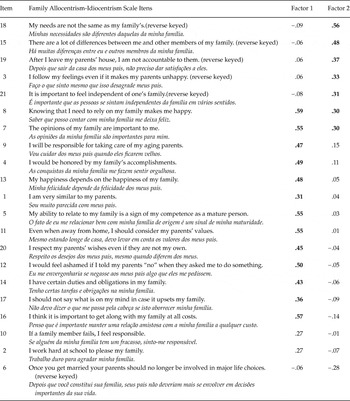
The PAF two factors model was the best solution for the theoretical interpretation of the FAS structure as bi-dimensional. Table 1 presents factor loadings above .30, resulting from a Varimax rotation. Items 8 and 7 cross-loaded on both factors, and were included in the factor in which they had the highest loading. Items 10, 2 and 6, although presenting lower than .30 loadings, were not excluded because we wanted to preserve all the original scale’s items. Items 10 and 2 were placed under Factor 1, and item 6, under Factor 2.
Factor loadings of exploratory factor analysis with Varimax rotation

These considerations point out to a highly faceted scale, presenting a great challenge to interpret its factorial constitution. Facing this challenge demanded a theoretical effort supported by further analyses item-wise, following the polytomous Rasch model (Andrich, Reference Andrich1978, Reference Andrich1988, Reference Andrich2010), using Winsteps (Linacre, 2010).
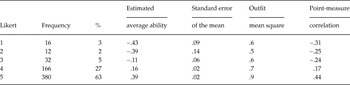
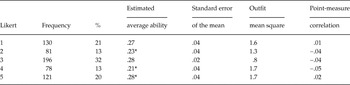
In Table 2, the best fitting item to the Rasch model is presented in Part (a), and the worst fitting item in Part (b). The comparison of the frequency distributions demonstrates that the wording of item 6 confused mothers in answering it, spreading the sample in contradictory patterns of responses over the five categories. In contrast, item 8 presents mother’s responses increasing steadily from lower to higher categories with more mothers in the upper steps than mothers in the lower ones.
a) Best fitting item to the Rasch model
English original, item 8:
Knowing that I need to rely on my family makes me happy.
Portuguese:
Saber que posso contar com minha família me deixa feliz.
Literal back-translation:
Knowing that I can count on my family makes me happy.

b) Worst fitting item to the Rasch model
English original, item 6:
Once you get married your parents should no longer be involved in major life choices (reverse keyed).
Portuguese:
Depois que você constitui sua família, seus pais não deveriam mais se envolver em decisões importantes da sua vida.
Literal back-translation:
After you start a family, your parents should no more involve themselves in important decisions of your life.

Note:
*Average ability does not ascend with category score
Table 2 also presents the Likert value, the frequencies for each category, its estimated average ability, and standard error referring to the Allocentrism measure (Linacre, 2010). Fit, in this context, is conceived as “the degree of match between the pattern of observed responses and the modeled expectations” (Bond & Fox, Reference Bond and Fox2007, p. 310). One can see that the outfit mean square values for the best fitting item are all below 1.0, indicating overfit to the Rasch model, i.e., the data are more predictable than the model expects; whereas there are four outfit mean square values in the worst fitting item above 1.0, indicating underfit to the Rasch model, i.e., the data are less predictable than the model expects.
The reversed seesaw effect
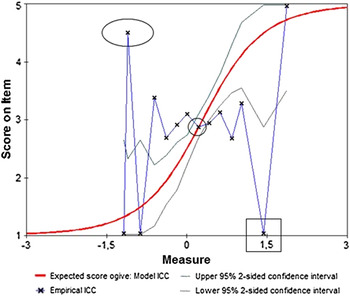
The ‘*’ next to estimated average ability coefficients in Table 2 indicates that the average measure for a higher score value is lower than for a lower score value, i.e., the expected proviso that “higher score value implies higher Allocentrism, and vice-versa” is contradicted. Figure 1 illustrates that effect with item 6. One can also see, from Table 2, Part (b), that 196 mothers endorsed the 3 Likert category. This category, in the graph in Figure 3, it is the only one point with no deviation from the theoretical Rasch modeling item characteristic curve (ICC).
Worst fitting item to the Rasch model. Once you get married your parents should no longer be involved in major life choices (reverse keyed) [Item 6]. Measure on the latent variable along the x-axis. The more to the right, the higher the Allocentrism overall score. Along the y-axis are the Likert response categories 1 to 5.

We propose to call this result the “reversed seesaw effect”. It is our understanding that the reversed seesaw effect is the main responsible for the low Alfa reliability of the overall Allocentrism scale in Brazilian data (α = .72), and the low eigenvalues in the first three or four components (PCA) or factors (EFA). After a close re-examination of item 6, it becomes clear that the supposed meanings mothers worked out from some of the Portuguese item adaptations are quite different from the meanings supposedly obtained by the English-speaking mothers.
Nevertheless, through closer item by item examination of other sources of error variance, as indicated by the outfit mean squares compared to the point-measure correlation, one can conclude that in no item category the outfit index was above 1.7, and in no item it was below .60, except for the .50 observed, in category 2, item 8. According to the literature, values higher than 2.0 means that off-variable noise is greater than useful information, and that this degrades measurement. With values > 1.5 it is noticeable off-variable noise, which neither constructs nor degrades measurement. Values between .5 and 1.5 indicate the productive region of measurement. Finally, outfit values < .5 indicates an overly predictable category that misleads us into thinking we are measuring better than we really are (Bond & Fox, Reference Bond and Fox2007; Linacre, 2010).
In reversing the scoring order of negatively worded items to set all responses in the same direction, it is usually observed “that reversed ‘negative’ items indicate something different than their unreversed ‘positive’ counterparts” (Wright & Stone, Reference Wright and Stone2004, p. 25). That certainly appears to be the case with the FAS adaptation to our culture. The authors suggest that we should list persons according to their degree of misfit, and they conclude that “statistics must be transcended by a clear understanding of the construct implied” and wisely advise, finally, that we must “reach for an understanding of what went wrong for the persons who misfit” (Wright & Stone Reference Wright and Stone2004, p. 32–33). If we do have the methodological means to do it, we will have the answer to the albeit embarrassing key question in the ethical realm, posited by Hutz, a question which every researcher in psychology should ask yourself: “What happens if I am wrong and somebody believes me?” (2009, p. 3). In order to identify the error, and to know why persons were mislead to misfitting an inadequate piece of a measuring instrument, and to know who these persons are, is an ethical imperative, if one is to take seriously the caveats also presented by Hutz (Reference Hutz2009) on the ethics of psychological assessment.
Family Allocentrism in the studied sample of Brazilian mothers
The second part of the analyses was aimed at testing the scale validity in discriminating groups of mothers from larger cities (State capitals), as opposed to mothers who live in small cities, using the scores in the allocentrism scale. Since there has been great migration from rural to urban areas in Brazil in the last decades, we decided to consider also the information about where the mothers were raised: in urban or rural settings. For the analyses that follow we calculated factor scores on the two factors, and transformed them into standardized scores (M = 50, SD = 10). The total score is the sum of scores on each item. We had three scores: Factor 1 (α = .78), Factor 2 (α = .53), and total score (α = .72).
Initially, we tested the correlation between the two factors, which was not significant (r = .05). Thus, it was decided to perform univariate GLM analyses for each set of tests. The first one used the place where the mother lives now as a factor. For factor 1, (Normative family allocentrism), the result was not significant, F(1, 604) = 3.44, p > .05. There are no differences between the scores of mothers living in small inner cities (M = 50.67, SD = 8.22) and those living in large cities (M = 49.31, SD = 9.82). However, when we considered the place where the mother was raised (in urban or in rural areas) as factor, a significant result is found, F(1, 604) = 8.1, p < .05, η p 2 = .013. Mothers raised in rural areas (M = 51.33, SD = 8.50) have higher scores on average in this aspect of allocentrism than mothers who grew up in urban areas (M = 49.18, SD = 9.30).
The results for factor 2 (Relational family allocentrism) are the opposite. There was a significant effect of the place where mothers lives, F(1, 604) = 4.47, p < .05, η p 2 = .007, in scores on this factor. Participants from rural areas presented higher means on this factor (M = 50.66, SD = 7.52) than participants living in state capitals (M = 49.32, SD = 8.12). The analysis performed on the second factor and the place where mothers were raised presented a non-significant result, F(1, 604) = .13, p > .05, η p 2 = .001. Mothers raised in rural areas scores (M = 50.14, SD = 7.72) presented the same results in this factor than mothers raised in urban areas (M = 49.90, SD = 7.93). Thus, what is observed is a contrast between the two factors. For the normative aspect of allocentrism, (Factor 1) what seems to matter is the most extensive influence of the place where mothers had been raised. The place where they currently live does not lead to differences in this factor. In contrast, for the relational aspect of family allocentrism, (Factor 2) it is the influence of the current context that matters, not where mothers had been raised.
If we use the scale’s total score, as it is usual in the literature, the result is significant both for where mothers live as for where they had been raised. In the first case, F(1, 604) = 12.54, p < .05, η p 2 = .02. Women in the capitals are less allocentric (M = 70.02, SD = 10.87) than those in small cities (M = 72.86, SD = 8.78). The same happens with the place mothers were raised, F(1, 604) = 13.68, p < .05, η p 2 = .022. Mothers raised in rural areas, had higher scores in Familial Allocentrism (M = 73.34, SD = 9.24) than mothers who grew up in urban areas (M = 70.30, SD = 9.24). The analyses with the total scores may not be strictly correct, since we are proposing two factors. However, we wanted to test the general tendency observed in this sample to compare to previous studies. Results with the total scores confirm the expectation of higher Allocentrism in groups from rural areas or less populated urban contexts.
Results in this study demonstrated that, despite the outfitting of item 6, the scale was able to capture the differences between the two groups of mothers, and bring new evidence to be considered in relation to previous studies. The total score behaved in the direction predicted by the theory and the literature. However, when considering the factors identified, results have demonstrated some allocentric characteristics which deserve to be further explored in future studies.
Discussion
Based on aforementioned theoretical discussions (Triandis, Reference Triandis1995; Kagitçibasi, Reference Kagitçibasi2007), we have argued that the FAS may be a bi-dimensional scale, including two components, which we think can be interpreted in the direction proposed by Kagitçibasi (Reference Kagitçibasi2007), as normative and relational components. The results about the scale structure, despite the limitations and difficulties previously discussed, plus the GLM analyses, support in some ways our expectation. Our hypothesis that family allocentrism, as measured in this scale, has two dimensions.
The first factor, that we called Normative familial allocentrism seems to be the “core” of family allocentrism, not affected by the changing process experimented by women living in urban contexts. It would be sensitive to the place where mothers had been raised, in urban or in rural areas. The influence of this kind of context may be more pervasive than the one from the context where the person lives as an adult. It is in these raising contexts that socialization trajectories are constructed since birth, and follow different paths according to prevalent cultural models. Thus, the place where one is raised would create a kind of “social marker”, which would remain strong, even though people, after a certain age, move to places with different social standards and values. According to this, to grow up in rural places with its social-demographic and social-cultural characteristics could lead people to construct belief systems that value specific aspects related to Allocentrism. Belief systems, in an implicit level, seem to be normative regarding to some family interaction aspects, and can be seen in some of the items with high loadings in factor 1. Some examples of items in this factor are: “I work hard at school to please my family”; “The opinions of my family are important to me”; “Even when away from home, I should consider my parents’ values”; “I should not say what is on my mind in case it upsets my family”; and “I respect my parents’ wishes even if they are not my own”. At the same time there is a subcomponent of duty and obligation, in items such as: I have certain duties and obligations in my family; and I will be responsible for taking care of my aging parents.
Rural groups are characterized by strong social ties and great capacity of protecting their members. The focus is on family needs, where members take care of each other, and this is a crucial aspect for the development of family relationships, with few or no rules being questioned (Kagitçibasi, Reference Kagitçibasi2007). Mothers raised in rural contexts present higher scores in this aspect of Allocentrism. The items they consider important are related to their families, specifically their parents. They worry about keeping a good relationship to them, and express happiness because they know the family would provide support when needed. Family’s opinion is positively valued. We can infer that the place where one is raised really matters. The social-cultural context seems to be more important to construct our beliefs about families in a specific moment in life span - that is, in the childhood. Once constructed, these beliefs seem to be, to some extension, stable or not changeable in a significant way. Like a sensible period, they will continue to influence our behaviors in adulthood. That is why the place where women live today does not lead to differences in factor 1, but the place where they had been raised seems to have left a mark in their constructed representation of their families. We can see the endurance of childhood cultural models to some degree underlying these women’s current lives.
All this discussion seems not to apply to Factor 2, Relational family allocentrism. Observing separately the effect of the second factor, the items that have been more valued are clearly focusing on the establishment of a distinction between “me and others” (in this case, the family), in terms of values, needs, and points of view. The results indicate that mothers living in small cities have higher means in this factor than those living in state capitals. We can suppose that mothers living in small cities in the sample studied would tend to construct different conceptions or views about the family role. As indicated previously, all the items in this factor are reverse-keyed and their score was affected by the kind of context where mothers live. Thus, at least in this group of Brazilian women, the action to negate the assertions presented on these items is indicative of some type of relation to the family, associated to the characteristics of the everyday life of these mothers. If mothers lived in small cities, they were more likely to answer in the direction of allocentrism on these items. These items are: “I follow my feelings even if it makes my parents unhappy”; “There are a lot of differences between me and other members of my family”; “My needs are not the same as my family’s”; “After I leave my parents’ house, I am not accountable to them”; and “It is important to feel independent of one’s family”. Besides being reverse-keyed, most of these items indicate that what is valued is the aspect of being related to the family, not having different needs, not following one’s feelings if it is going to hurt the family, not feeling independent from them. Mothers in small cities establish less distinction between “me and the others” (family members), in terms of values, needs, points of view. The items of the second factor could be understood as a type or a subgroup of allocentrism, in which a person identifies himself/herself as an autonomous member and, at the same time, he/she considers him/her affectively bonded to his/her family. Thus, it could be a form of relational allocentrism.
Summarizing, the two factors could be ways to manifest or to express Allocentrism. The first is more related to an inner dimension, close to moral values, and belief systems; whereas the second factor is more related to less ingrained beliefs and values. We could further speculate that Factor 1, Normative family allocentrism is somehow related to Vertical Allocentrism – perception of self as interdependent to others and subordinate to them; and Factor 2, Relational family allocentrism to horizontal Allocentrism (Alavi & McCormick, Reference Alavi and McCormick2004) - people have the same needs and perceive themselves as very similar to other family members.
This study is an exploration of the dimensions of Allocentrism as measured by the Family Allocentrism-Idiocentrism Scale (FAS) in a group of Brazilian women. It has several limitations. First, we have a sample of women only, although this may not be a major flaw, once no gender differences were identified in the original studies from Lay et al. (Reference Lay, Fairlie, Jackson, Ricci, Eisenberg, Sato and Melamud1998). Second, the scale adaptation may have led to cultural differences difficult to detect, even with all the technical procedures followed. The results of the PCA, PAF, and Rasch analyses indicate some measurement difficulties that should be taken into account. Based on these limitations, our conclusions are tentative. We recognize these limitations and the need for caution, but we do believe the study brings contributions to the study of cultural dimensions of the self, to the literature on Familial Allocentrism and the Brazilian studies on mothers’ beliefs. We think that it can also help us to understand the complexity of the relatedness dimension. Further investigations need to be done to confirm the tendencies to bi-dimensionality observed in this present work, with different groups, from other cultures, including people living or raised in rural and urban contexts. Another set of studies could be based on the concept of acculturation, where one can expect to find more changes in one of the components than in the other. Gender differences need also to be tested. In Brazil, the availability of this version of the Family Allocentrism-Idiocentrism Scale, will allow new studies on parents cultural models and their possible effect on socialization practices.